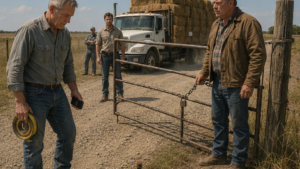
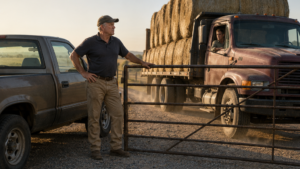
The Three Inch Lawn Ticket And The Alaskan Fish Fertilizer
CHAPTER 2: THE SCENT OF GLYPHOSATE
Hal stepped into his tiled kitchen through the side patio door, wiping his heavy work boots thoroughly on the coarse coir mat before stepping onto the cool saltillo tile. The air conditioning was humming quietly in the ceiling ducts, circulating the clean, refreshing aroma of steeped peppermint tea and sun-dried cotton. Seated at the heavy mesquite dining table was his daughter, Dr. Sarah Finch. At forty-two, Sarah possessed her father’s thoughtful grey eyes, his lean, determined jawline, and an encyclopedic command of Western environmental jurisprudence. For ten years, she had served as a senior regulatory litigator for the Arizona Department of Water Resources before opening a private practice focused on defending small agricultural landholders and suburban residents against predatory municipal water authorities and developer cartels.
Her portable field laboratory was already deployed across the table: a high-resolution digital stereo microscope, a portable gas-chromatography mass-spectrometry field unit, and stacks of indexed Maricopa County aquifer extraction registries bound in black vinyl covers.
“I saw the white golf cart tearing down the asphalt through the kitchen blinds,” Sarah said, looking up over the rims of her reading glasses with a sharp, knowing smile. “Did Brenda Sterling finally decide to test your automated irrigation system?”
“She tried to sit on the number-three brass rotary head to block the vent,” Hal said, scrubbing his forearms with pumice soap at the stainless steel sink. “She got forty gallons of pure Pacific cod and herring hydrolysate delivered straight through the nylon mesh of her folding chair at eighty pounds per square inch. She’ll be scrubbing fermented marine oil out of her pores until next Thanksgiving.”
“Serves her right,” Sarah said, though her smile faded as she noticed the small sealed polyethylene specimen pouch Hal placed onto the granite counter beside her laptop. Inside the pouch were three damp cylindrical core plugs of turf root, fibrous thatch, and dark sandy loam extracted with a soil auger. “What did you find on the property line, Dad?”
Hal dried his hands on a clean flour-sack towel and sat down across from her. “Take a close look at the root sheaths along the southern boundary. Brenda wasn’t just standing out there shouting about an extra quarter-inch of leaf blade. She was kneeling right along the expansion joint where my Bermuda meets the association’s common turf verge. She was pretending to measure the leaf canopy with an acrylic ruler, but her eyes were glued to the root crown. Look at the discoloration along the base.”
Sarah slipped on a pair of powder-free nitrile examination gloves. Using a pair of stainless steel dissection tweezers, she carefully extracted one of the root plugs and positioned it beneath the objective lens of the digital microscope, switching on the calibrated ultraviolet light ring. The high-magnification image populated her laptop screen in vivid, high-contrast color.
“This isn’t heat dormancy or localized dry spot, Dad,” Sarah said, her voice dropping into a razor-sharp, analytical register. “Look at the vascular bundles in the xylem and phloem tissue. The cellular membranes haven’t just collapsed from lack of water; they’ve been completely dissolved by an aggressive chemical surfactant. And see that white, needle-like crystalline residue clinging to the organic matter around the rhizome node?”
Hal leaned forward, studying the screen with a practiced eye. “Ammonium salt of glyphosate. Commercial agricultural grade, mixed at twenty times the legal residential dilution rate.”
“Precisely,” Sarah confirmed, tapping her keyboard to run a spectral absorbance match against the EPA pesticide database. “Ninety-nine point two percent match for Ranger Pro with a petroleum-based penetrating surfactant. This wasn’t drift from a weed-eater or an accidental overspray from a broadcast nozzle. Look at the soil penetration pattern—it’s a concentrated, vertical column less than an inch wide. Someone used a fine-gauge veterinary syringe or a pressurized soil-injection probe to deliver pure herbicide straight into the root crowns under the grass.”
“They wanted to ensure the damage was permanent,” Hal said grimly. “Glyphosate translocates throughout the underground rhizome network. Within five days, that entire six-foot section of turf will collapse into an ugly, bleached-yellow dead zone.”
“Why go to all that trouble for six feet of grass?”
“Because Section 7, Subsection D of the Willowbrook Green CC&Rs contains an automatic architectural condemnation clause,” Hal explained, pulling a worn, tabbed copy of the association’s founding covenants from the desk shelf. “If any residential turf area exhibits more than five contiguous square inches of necrotic or dying foliage for more than fourteen consecutive days, the landscape committee has the unappealable legal right to declare the entire lawn an environmental nuisance. The homeowner is given seventy-two hours to completely eradicate the lawn and replace it with approved desert xeriscaping. And if the homeowner refuses?”
“The association hires an approved contractor to perform the conversion by force and places a binding property lien on the deed,” Sarah said, her eyes flashing with anger. She spun her laptop around, pulling up the Arizona Corporation Commission’s real-time commercial database. “And let me guess who the sole approved xeriscaping contractor is on the committee’s registry.”
“Sterling Desert Landscaping LLC,” Hal stated without hesitation.
“Registered sixteen months ago to an executive suite in Paradise Valley,” Sarah read from the corporate charter. “The managing members are listed as Craig Sterling and Brenda Sterling. And look at the billing records filed with the county recorder’s office. Over the last two years, twenty-eight homes in this subdivision have had their lawns condemned under Section 7. Every single one of them was forced to pay Sterling Desert Landscaping an average of thirty-eight thousand dollars to scrape away their turf and replace it with cheap crushed river gravel and artificial plastic turf.”
“That’s over one million dollars in private contract revenue,” Hal calculated softly. “Extorted directly from elderly residents living on fixed retirement pensions.”
“And when they couldn’t afford the thirty-eight thousand dollars?” Sarah asked.
“Brenda foreclosed on them,” Hal said, his voice hard as tempered flint. “Arthur and Mary Graham lived down on the corner of Palo Verde Way for twenty-six years. Arthur was an eighty-two-year-old retired postal clerk with Parkinson’s. Brenda hit them with four thousand dollars in lawn fines, slapped an HOA lien on their house, and had the sheriff execute a foreclosure sale on the courthouse steps last December. They were forced to move into an assisted living facility in Mesa. Their house was purchased for pennies on the dollar by an offshore shell company called Palo Verde Holdings.”
Sarah checked the corporate filing for Palo Verde Holdings. “Managing member: Brenda Sterling. She didn’t just steal their savings, Dad. She stole their home.”
A loud, authoritative rap echoed through the front hallway, rattling the frosted glass sidelight beside the front door.
Hal rose from the table, walked down the corridor, and pulled the heavy oak door open. Standing on the covered porch was Officer Ryan Cooper, a uniformed code compliance investigator for the City of Scottsdale and a certified municipal water auditor. Cooper wore a tactical duty belt equipped with a water pressure logger, a digital soil penetrometer, and a body-worn camera. He looked visibly uncomfortable, holding a clipboard in one hand while dabbing sweat from his forehead with a handkerchief.
“Afternoon, Mr. Finch,” Cooper said, touching the brim of his straw duty hat. “I received an urgent emergency dispatch from Mrs. Brenda Sterling approximately twenty minutes ago. She logged a priority-one complaint alleging biological contamination, chemical assault, and hazardous waste discharge originating from this property.”
Hal looked at the officer with a calm, amused glint in his grey eyes. “Did Mrs. Sterling happen to specify the exact nature of the hazardous biological substance, Officer Cooper?”
Cooper’s mouth twitched, struggling to suppress a broad grin. “She claimed you discharged raw toxic industrial sewage across her person, Mr. Finch. However, when I stopped by her residence on Palo Verde Ridge to take her initial deposition, her entire three-car garage smelled like a commercial fish-processing pier in Dutch Harbor. She was standing in her driveway wrapped in plastic garbage bags, and she had approximately eight stray neighborhood cats attempting to claw their way through her patio screens to get to her golf cart.”
Cooper stepped closer, lowering his voice. “I smelled the residue on her floorboards, Mr. Finch. That wasn’t sewage. That was cold-pressed fish hydrolysate, wasn’t it?”
“Cold-processed Alaskan cod and herring emulsion,” Hal confirmed with a nod. “One hundred percent organic, OMRI-listed, and fully permitted under Arizona Department of Agriculture standards for residential soil bio-remediation. But while you’re standing on my porch, Officer Cooper, you need to look at what was actually poisoned on this property.”
Hal gestured for the officer to step inside the kitchen, where Sarah had the gas-chromatography mass-spectrometer glowing on the table.