He Reported the Old Farm Utility Pole—Then the County Marked His New Concrete Yard for Removal
Chapter 1: The Complaint Arrived Before the Hay Truck Did
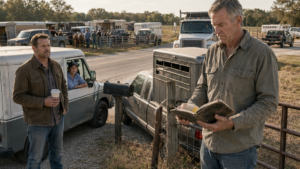
The county notice was already stapled to the old utility pole when Dennis Walker came down the lane at six-thirty Monday morning.
He saw the white sheet before he saw the county seal.
It fluttered against the gray wood in the wake of his pickup, bright and wrong against a pole that had stood beside that gravel entrance longer than several of the nearby machine sheds. Someone had driven two fresh staples through the top corners. Below them, the paper carried enough bold print to be read from the road.
Dennis stopped with the truck half across the entrance.
Behind him, somewhere beyond the curve, an air horn sounded once.
The hay delivery.
“Of course,” Dennis muttered.
He stepped out, leaving the engine running, and walked to the pole. At sixty-seven, he no longer moved quickly just because somebody else wanted him to. His boots ground pale limestone into the damp edge of the lane.
The notice identified the structure as the subject of a county utility and access inspection scheduled for Thursday morning.
Dennis read it twice.
The second time he noticed the reference number.
He put one thumb against the bottom of the sheet.
The number bothered him more than the words above it.
A semi horn sounded again.
Dennis folded the notice upward without tearing it loose and looked down the road. The hay truck was waiting beyond the narrow turn, loaded high enough that the top bales seemed to scrape the pale morning sky.
A dark pickup eased out of the neighboring drive before Dennis could signal the truck forward.
Alexander Green stopped beside the utility pole.
His window came down.
“You got it, then.”
Dennis looked at him.
Alexander was younger by more than twenty years, clean-shaven, broad-shouldered, and dressed like a man whose workday could include both a field and a lender’s office. His farm sat across what had once been a single family tract. In the two years since buying it, he had replaced fencing, resurfaced the equipment yard, erected a climate-controlled produce building, and poured a wide concrete loading apron behind it.
Dennis nodded toward the notice.
“I can read.”
Alexander’s jaw tightened slightly. “I tried talking to you about that pole.”
“You told me you didn’t like it.”
“I told you it was in a bad location.”
The hay truck idled behind them.
Dennis glanced at it.
Alexander continued. “Combines swing through here. Delivery rigs cut that corner. The wires sag. The base looks thirty years past due.”
“Pole’s older than that.”
“That doesn’t help your case.”
Dennis almost smiled.
Instead he stepped aside and waved the hay driver through. The semi crept past the pole with several feet to spare, tires crunching along the inside edge of the lane.
Alexander watched it.
“That right there,” he said. “Every driver has to favor your side because of it.”
“Every driver who knows the lane gets through.”
“And one who doesn’t?”
Dennis looked at the faded metal identification plate nailed chest-high into the pole. Most of the stamped characters were dull beneath years of rain and dust.
“There are roads all over the county narrower than this.”
“That’s not an answer.”
“No.”
Alexander got out of his truck.
He had been building toward this conversation for months, Dennis thought. Each exchange had grown a little more official. First the pole was ugly. Then inconvenient. Then outdated. Then hazardous.
Now there was county paper hanging from it.
“I filed the complaint Friday,” Alexander said. “They called this morning. Inspection is Thursday. If it’s what I think it is, they’ll mark it for removal.”
Dennis let the silence sit.
Alexander frowned.
“You’re not surprised?”
“About the complaint? No.”
“About removal.”
Dennis looked again at the reference number.
The county had changed filing systems twice since he had left field engineering. He did not know what all the current designations meant anymore. But some numbers stayed familiar.
This one did.
Or almost did.
That was what made him cautious.
Alexander crossed his arms. “I’m not trying to start some feud, Dennis.”
“You filed against my service pole.”
“I filed about a safety problem.”
“It powers the pump shed.”
“You’ve got newer service on the barn.”
“That’s not all it does.”
Alexander waited.
Dennis could have explained more.
The old pole had never been simply a pole to him. It was a surface marker for work mostly hidden from sight: conduit, buried water service, an old agricultural corridor surveyed when the surrounding ground still belonged to fewer owners.
But explaining that to Alexander felt, in that moment, like accepting a demand to prove that Dennis understood his own land.
So he said only, “Thursday will sort it out.”
Alexander’s eyebrows rose. “It will.”
He started back toward his pickup, then turned.
“And if they decide it’s unsafe, I’m asking them to deal with the access issue too. Not just the pole.”
Dennis’s attention sharpened.
“What access issue?”
“The clearance along the lane. I included it in the complaint.”
For the first time that morning, irritation gave way to something colder.
“Along which side?”
Alexander pointed past the pole toward the low strip of grass that ran between the gravel and the boundary.
“That whole utility mess. Pole, wires, whatever old service is buried there. If it’s obsolete, I want the corridor cleaned up.”
Dennis looked beyond him.
The grass strip continued toward the neighboring equipment yard.
It disappeared, from this angle, behind Alexander’s new produce building.
Dennis said, “You asked them to inspect the corridor?”
“I asked them to confirm what’s legal.”
A small beat passed.
Alexander seemed to mistake Dennis’s silence for hesitation.
“The county can settle it,” he said. “No argument between us.”
Then he climbed into his pickup and drove back across the lane.
Dennis remained beside the pole.
The hay driver leaned out his window from inside Dennis’s yard.
“Want those bales at the north shed?”
Dennis lifted a hand. “Same place as last time.”
He waited until the truck moved on before touching the notice again.
The reference number was printed beneath the complaint summary.
E-17-4B.
Dennis stared at it.
He could see, not the paper, but an old field map spread across the hood of a county truck. He remembered orange stakes. A transit tripod. A younger version of himself standing ankle-deep in ditch grass while another technician called measurements.
E-17.
Agricultural service corridor.
The final characters might have changed. The alignment had not.
He walked to the base of the pole and kicked gently through the grass.
A faint stripe of old survey paint appeared on a stone near the shoulder, almost entirely bleached away.
Dennis straightened.
Across the boundary, Alexander’s concrete apron caught the morning light.
He could not see enough from here to judge its exact edge.
And he did not trust memory where concrete was concerned.
By seven-fifteen the hay was unloaded. Dennis parked beside the equipment shed, finished two phone calls, and tried to return to ordinary work.
He lasted twenty minutes.
Then he crossed the shed to a dented metal cabinet bolted into the back wall.
The bottom drawer was locked.
He searched a ring of keys, found the small brass one, and opened it.
Inside were folders from years when county records still came folded into brown survey envelopes.
Dennis pulled out one marked with a faded black number.
E-17.
He stood very still.
Then he carried the folder toward the light.
Chapter 2: The Old Pole Was Not the Whole Story
Anna Walker had the old map flattened across Dennis’s kitchen table before lunch.
She pressed one finger against a typed line near the lower margin.
“E-17,” she said. “Same number.”
Dennis stood by the sink with a mug of coffee he had forgotten to drink.
“I saw it.”
“You said the notice was E-17-4B.”
“It is.”
Anna looked from the county notice to the yellowed sheet. “Then why did you act like you weren’t sure?”
“Because I’m not sure what the four-B means.”
“You’re sure what E-17 means.”
Dennis took the chair across from her.
Anna handled old records the way he handled machinery: with a respect for failure points. She had spent the last six years doing the farm books, insurance renewals, crop contracts, and every piece of paperwork Dennis had once considered something to be completed at the end of a long day.
Now she had his survey folder, a current parcel aerial pulled up on her laptop, and two sharpened pencils aligned beside it.
The old map showed a narrow hatched strip beginning near the county road, following Dennis’s entrance, then bending northeast across what was now the Green property.
A note identified it as an agricultural utility and service access easement.
Anna traced it.
“This is the pole?”
Dennis nodded.
“And this?”
“Pump shed.”
She moved farther along the corridor. “What’s the dashed line?”
“Buried water.”
“I thought that well line only served us.”
“It did once.”
“Once?”
“Before the original place was divided.”
Anna looked up.
Dennis leaned over the map.
“The north tract used the same line for field irrigation. Later they separated the meters, but the main run stayed. Electric feed followed part of the same corridor.”
“So Alexander’s farm is still tied into it?”
“Not necessarily the way it was. Depends what got replaced.”
“That sounds different from what you told him.”
Dennis sat back. “I told him the pole wasn’t abandoned.”
“You told him that?”
“Close enough.”
Anna gave him a look.
Dennis knew that look. It had first appeared when she was twelve and discovered that “I’ll fix it this weekend” could mean any weekend before winter.
“What did you actually say?”
“He came over last fall complaining about the wires and asked why I didn’t take the pole down. I told him there was more under that lane than he could see.”
Anna waited.
“That was it?”
“He wasn’t asking. He was telling.”
“That was still it?”
Dennis looked toward the window.
Outside, the old pole stood beyond the machine shed roofline, the county notice a white square against it.
Anna turned the map ninety degrees and compared it with the aerial image.
Her finger stopped.
“Dad.”
“What?”
“Come here.”
“I’m sitting three feet away.”
“Then lean over.”
He did.
She enlarged the image of Alexander’s farm. The recent satellite view showed the produce building, the widened equipment drive, and the pale rectangular expanse of the new concrete apron.
Anna laid the old map beside the screen.
The easement line entered Alexander’s parcel at an angle.
Her finger followed it.
Dennis already knew what she was seeing.
“No,” she said.
“Could be scale distortion.”
“It crosses the apron.”
“Looks like.”
“It doesn’t just touch it. It goes under it.”
Dennis rubbed his thumb along the rim of his mug.
Anna looked at him sharply. “Did you know?”
“No.”
Her shoulders relaxed a fraction.
“I wondered.”
“I suspected where the old alignment ran. That’s not the same.”
“But you worked on this.”
“Thirty-five years ago.”
“You surveyed it.”
“I helped survey it.”
“And you can remember the reference number from a notice nailed to a pole.”
Dennis pushed the mug away.
“That doesn’t mean I can place a buried line within a foot from my kitchen.”
Anna studied him.
It irritated him that she was right to.
By Tuesday afternoon they had a current county parcel printout and a scanned easement description from the recorder’s office. The document confirmed the corridor had never been vacated.
The language was dry and exact: rights of entry, maintenance, repair, replacement, unobstructed access.
No decorative phrasing. No ambiguity useful to either neighbor.
Anna read the final section twice.
“Unobstructed,” she said.
“I heard you.”
“If that slab crosses it—”
“If.”
She looked at him.
Dennis folded the copy.
He had spent most of his working life distrusting people who treated maps as though the paper knew more than the ground. Maps were only useful when someone understood both.
But this one kept leading back to the same place.
On Wednesday morning, Anna followed him down the lane carrying the printouts inside a clear plastic sleeve.
The pole cast a long shadow over the gravel.
Dennis stopped at its base and paced the distance to the ditch line.
“Twenty feet from center,” he said.
“You remember that?”
“Standard width here was forty. Sometimes fifty.”
Anna checked the legal description.
“Forty.”
Dennis paced again.
They moved along the grassy strip toward the property line.
Here and there, half-buried stones showed faint traces of old orange or yellow marking paint. Most would have meant nothing to anyone passing.
To Dennis they formed a sentence with missing words.
Anna crouched beside one.
“This is old.”
“Could be from any locate.”
“Does it line up?”
Dennis looked toward Alexander’s yard.
The concrete apron began beyond a newer fence opening, broad enough for two trucks to pass. Its edge was clean, pale, and square.
The invisible corridor aimed straight toward it.
Anna stood.
“We should tell him.”
Dennis continued looking at the slab.
“He’ll get the same information Thursday.”
“That’s not what I said.”
“He filed the inspection. Let them inspect.”
“If they find a live line under that concrete, this stops being about your pole.”
Dennis turned back toward the lane.
“Maybe that’s what it takes.”
Anna did not follow.
He walked several paces before realizing she was still standing beside the faded mark.
“What?”
Her face had changed.
Not anger exactly.
Recognition.
“You knew they were pouring there.”
Dennis said nothing.
Anna glanced at the new slab, then at him.
“You knew.”
“I saw the forms.”
“When?”
“Spring.”
“Before the pour?”
Dennis picked up a loose stone from the lane and tossed it toward the ditch.
“The crew was setting them.”
“And you didn’t say anything?”
“I did.”
“What did you say?”
Dennis remembered the afternoon too clearly now: concrete forms running in clean straight lines, the contractor checking grade, Alexander walking the site with a tablet in one hand.
Dennis had stopped his pickup.
He had told Alexander, “You might want to check what runs under that side.”
Alexander had barely looked up.
“We had it surveyed.”
Dennis had answered, “Then I guess you know.”
That had been all.
Anna watched him.
“What exactly did you tell him, Dad?”
Dennis looked again toward the concrete.
“I told him there was old service through there.”
“Did you tell him there was a recorded easement?”
“No.”
“Did you show him this map?”
“No.”
“Did you tell the contractor?”
“No.”
Anna’s hand tightened around the plastic sleeve.
Dennis felt the old instinct rise—the one that said a man who had already been dismissed did not owe repeated warnings to somebody determined not to listen.
He nearly said it.
Instead he looked down at the faded stripe beside his boot.
“I saw them setting the forms,” he said.
Anna’s voice was quieter.
“And you let them keep setting them.”
Chapter 3: The Crew Came to Remove One Problem
The excavator arrived at eight-oh-three Thursday morning.
It came behind a white county utility truck, both vehicles slowing at the shared entrance where Dennis’s old pole stood with the inspection notice still stapled to it.
Dennis watched from beside his pickup.
Across the lane, Alexander was already outside.
He wore work boots and a clean blue jacket, arms folded against his chest as the county truck stopped. Two neighboring farmers had paused near the road farther back, not close enough to join the conversation but close enough to see what happened.
Dennis wished they had kept driving.
The inspector stepped down with a clipboard.
An excavation crew chief followed from the second truck.
“You Dennis Walker?”
“That’s me.”
The inspector looked at the pole. “We’re here on a utility safety and access complaint.”
“I know.”
Alexander crossed the lane.
“I’m the complainant.”
The inspector nodded once. “We’ll speak with both property owners before anything happens.”
That seemed to disappoint Alexander slightly.
Dennis opened the passenger door of his pickup.
The survey folder lay on the seat.
He left it there.
For now.
The inspector walked around the pole, checking the base, the overhead conductors, the angle to the gravel lane, and the small metal identification plate.
“Do you know who owns this structure?” he asked.
“County service originally,” Dennis said. “Maintenance shifted depending on what equipment was attached.”
“That’s not especially clear.”
“No.”
Alexander said, “That’s part of the problem.”
The inspector ignored the comment and wrote something down.
He checked the pump-shed feed. Then he measured clearance from the pole to the traveled part of the lane.
The crew chief stood beside the excavator, waiting.
For several minutes nothing happened.
Dennis could hear a diesel engine idling, a bird calling from the fence line, gravel clicking beneath the inspector’s boots.
Then the inspector said, “The complaint says this structure may be obsolete and that the associated service corridor interferes with modern agricultural access.”
Alexander nodded. “Exactly.”
Dennis looked at him.
Modern agricultural access.
The phrase sounded like it had been composed for a form.
The inspector continued. “If the pole is inactive and privately maintained without authorization, removal may be appropriate. If it is part of an active recorded facility, that’s different.”
Alexander glanced at Dennis as though waiting for him to object.
Dennis reached into his pickup.
He brought out the folder.
The inspector looked at its worn edges.
“What’s that?”
“Old E-17 survey.”
The inspector’s expression changed just enough for Alexander to notice.
“You have a recorded document?”
“Copy of the field survey. Anna pulled the recorder’s version Tuesday.”
He handed over the newer certified copy first.
The inspector read the first page.
Then the second.
The crew chief stepped closer.
Alexander unfolded his arms.
“What is it?”
The inspector did not answer immediately.
He walked to the pole, checked the identification plate again, then compared a number on the map.
“Where did you get this?”
“County records.”
“I mean the original.”
“I worked field engineering back then.”
Alexander stared at him.
Dennis felt no satisfaction in saying it.
Not yet.
“You were with the county?” Alexander asked.
“For a while.”
“You never said that.”
“You never asked.”
Anna’s criticism echoed in Dennis’s head as soon as the words left his mouth.
The inspector crouched near the pole and scraped grass away from a small concrete marker almost hidden at the edge of the lane.
A rusted survey nail sat in its center.
He checked the map again.
Then he turned to the excavation crew chief.
“Hold the machine.”
The crew chief lifted a hand toward the operator.
The excavator’s engine dropped to idle.
Alexander stepped forward.
“Hold it for what?”
“We’re not removing anything until we verify this corridor.”
“You came because of the pole.”
“We came because of your complaint about the pole and associated access.”
“And?”
“And this appears to be an active recorded easement.”
The sentence landed without drama.
That made it heavier.
Alexander looked from the inspector to Dennis.
“Active?”
“According to the record, yes.”
“The pole too?”
“We’re still verifying the service. But it feeds that pump shed, correct?”
Dennis nodded.
The inspector checked the line again.
A utility locator arrived twenty minutes later in a smaller service truck.
By then the neighboring farmers had gone, but an agricultural delivery driver had stopped briefly at the entrance before being waved around the county vehicles. Alexander paced between his gate and the edge of the gravel.
Dennis stayed near his pickup.
He did not want the scene to become what Alexander feared it was becoming: a public contest with a loser.
The locator clipped equipment to the visible service and began tracing.
Short bursts of electronic tone sounded along the grass.
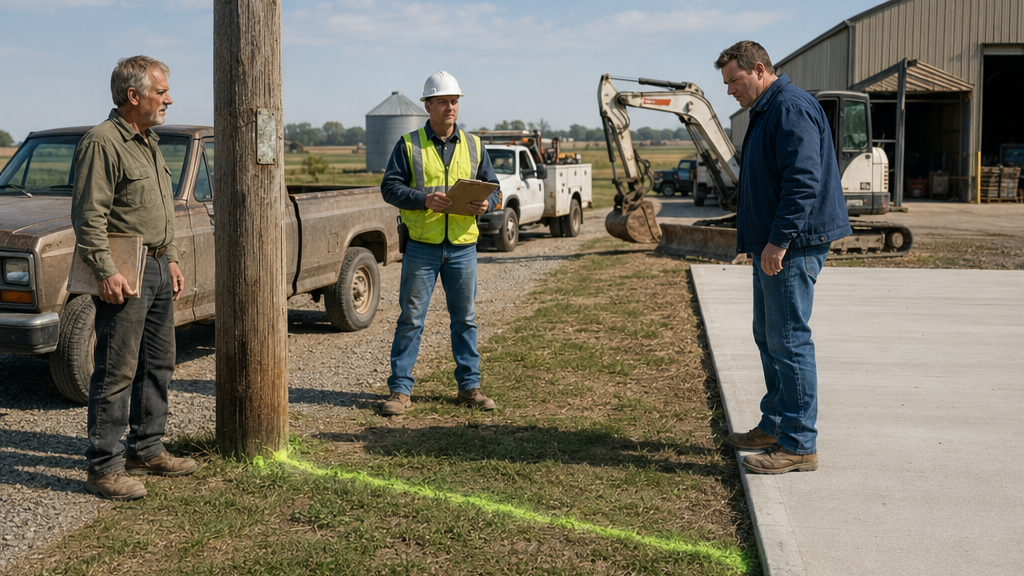
He sprayed a fluorescent mark near the pole.
Then another farther down.
The old faded line gained a bright new companion.
Alexander watched.
“Where’s that going?”
The locator continued along the corridor.
The inspector carried Dennis’s survey copy beside him.
The marks crossed the grass strip, angled past the fence opening, and entered the Green property.
Alexander’s pacing stopped.
“That can’t be right.”
The locator sprayed another mark.
Dennis knew the feeling.
A line on paper could be argued with.
Paint on the ground was harder.
Alexander approached the inspector. “My survey didn’t show an active utility through there.”
“Do you have the survey?”
“In the office.”
“Get it.”
Alexander hesitated, then walked quickly toward his building.
The locator continued.
Dennis followed at a distance.
At one point the signal weakened. The locator backed up, recalibrated, and tried again.
The tone returned.
“Still got it,” he said.
The inspector looked at Dennis.
“You said buried water too?”
“Original layout had it.”
“Active?”
“Don’t know.”
“Then we’ll confirm separately.”
That answer relieved Dennis more than it embarrassed him.
He did not want to become the authority here.
He had spent enough years around buried utilities to know memory could be dangerous when people mistook it for measurement.
Alexander returned carrying a rolled plan set.
He handed it to the inspector.
“This is what my contractor worked from.”
The inspector opened it on the hood of the county truck.
Dennis stayed back.
After a minute, the inspector pointed to a note.
“This shows an easement reference.”
Alexander leaned closer. “It says existing corridor—verify in field.”
“Yes.”
“We did.”
“With whom?”
“The contractor.”
The inspector looked toward the bright marks.
The locator had moved another twenty yards.
Alexander followed his gaze.
So did Dennis.
The fluorescent line was approaching the new concrete apron.
Alexander walked toward it.
“No,” he said.
The locator sprayed a mark at the gravel edge.
Then another on the compacted stone beside the slab.
The signal tone continued steadily.
He stepped onto the concrete.
Alexander moved closer.
“What are you doing?”
“Tracing the line.”
“There’s nothing under that slab.”
The locator looked at his receiver.
Then at the inspector.
“I’ve got signal.”
Alexander shook his head. “That corridor was supposed to be abandoned.”
The inspector said, “According to what?”
Alexander did not answer.
The locator walked farther onto the concrete.
The tone strengthened.
He bent, shook the paint can, and sprayed a bright fluorescent stripe across the pale new surface.
The line ran straight toward the center of Alexander’s loading apron.
Dennis looked back over his shoulder.
From where he stood, he could see the old wooden pole at the farm entrance, the fresh markings in the grass, and the painted line continuing across the neighboring concrete as though all three had always belonged to the same picture.
Alexander stared down at the paint.
“What exactly is under my yard?”
No one answered him yet.
Chapter 4: The Yellow Line Crossed the New Concrete
The utility locator’s fluorescent stripe stopped at the edge of Alexander Green’s concrete apron for less than a second.
Then the receiver chirped again.
He stepped onto the slab.
Alexander followed him.
“That’s eight inches thick,” he said. “You’re telling me you can read through that?”
“I’m telling you I still have the signal.”
The locator moved slowly, holding the receiver close to the pale concrete. The electronic tone rose, steadied, then dipped. He backed up two feet and tried again.
The tone returned.
He shook the paint can.
Alexander lifted one hand. “Before you mark anything else, I want to know what you think you’re finding.”
The county inspector stood several yards behind them with the easement map opened against his clipboard.
“A buried service inside the recorded corridor.”
“What service?”
“That’s what we’re confirming.”
Dennis stayed near the gravel edge.
From there he could see everything he had tried not to imagine since Anna had placed the old map beside the aerial photograph.
The weathered pole stood behind him.
The new yellow line ran from its base through the grass, crossed the property boundary, and reached Alexander’s slab without wavering.
Years apart in age, purpose, and appearance, the pole and concrete were tied together by one bright mark.
The locator sprayed across the slab.
Alexander stared at it.
“You’re putting paint on finished concrete.”
“It washes off.”
“That’s not the point.”
“No,” the inspector said. “It isn’t.”
Alexander turned.
The inspector had moved closer.
“Your construction plan referenced an existing easement.”
Alexander’s expression hardened. “It referenced an old corridor that everybody involved understood to be inactive.”
“Who is everybody?”
“My contractor. The survey company. Me.”
“Did the county issue an abandonment?”
“I don’t know what form they would’ve used.”
“That isn’t an answer.”
Dennis recognized the phrase.
Alexander did too.
His eyes flicked toward Dennis, and for the first time that morning the certainty in them looked less like anger than calculation.
The excavation crew chief walked over from the machine.
“You want us potholing?”
The inspector looked at the slab.
“Not through that yet.”
Alexander gave a short breath of relief.
“Start outside the concrete. Confirm depth and material.”
The relief vanished.
The excavator remained parked. Instead, two workers brought hand tools and a vacuum excavation hose from the service truck. They opened a small test area in the soil just beyond the apron.
Dennis watched dark earth emerge beneath dry gravel.
The process was careful, slow, and unimpressive to anyone expecting a dramatic machine to start breaking concrete.
But Dennis knew what every inch meant.
A buried line did not care whether the surface above it had cost ten dollars or ten thousand.
Alexander paced.
“This whole thing started over a pole in the entrance.”
The inspector did not look up. “This started because you requested review of the pole and associated access corridor.”
“I requested removal of an unsafe obstruction.”
“And the corridor is part of the complaint.”
“I didn’t ask you to inspect my yard.”
“You asked us to determine whether the recorded facility was valid.”
Dennis lowered his eyes.
There it was.
The reversal Alexander had invited without understanding it.
For a brief, ugly moment, Dennis enjoyed it.
He remembered Alexander standing by the old pole on Monday, saying Thursday would settle things. He remembered the way he had said obsolete. The way he had looked at the lane as though decades of work could be improved merely by replacing everything that appeared old.
Dennis felt satisfaction rise warm and quick.
Then he saw Alexander glance toward the produce building.
Not at Dennis.
Not at the inspector.
At the building.
Its roll-up doors were open. Stacked crates stood inside. A refrigerated unit hummed along the rear wall. Everything Alexander had spent two years assembling seemed to gather behind that glance.
The worker near the test hole called out.
“Got something.”
The inspector crouched.
Dennis moved closer despite himself.
A section of pipe had appeared roughly four feet down, running along the corridor indicated on the old survey.
The inspector brushed loose dirt away.
“Water main.”
Dennis recognized the material.
“Same line?”
“Looks original.”
The inspector pointed toward the service connection running north.
“Still active.”
Alexander stopped pacing.
“That feeds my north irrigation manifold.”
No one answered immediately.
He stepped nearer.
“I thought that came from the newer branch.”
The inspector looked at him. “It may branch from this.”
Alexander stared into the hole.
The inspector checked the map again, then looked toward the concrete.
“If the line follows the recorded alignment, it continues under your apron.”
“How sure?”
“Enough that I’m not calling the corridor abandoned.”
Alexander looked toward the slab.
The bright stripe now seemed harsher against it.
“What does that mean?”
“It means access has to be maintained.”
“I can access around it.”
“Not if the utility runs underneath eight inches of reinforced concrete.”
Alexander’s jaw shifted.
“It has sleeves.”
The inspector turned.
“Where?”
“Under the slab. For utilities.”
“Do your plans show this line sleeved?”
Alexander did not answer.
The inspector flipped through the plan set.
Dennis watched his finger move from note to note.
The silence lasted too long.
Finally the inspector asked, “Where’s the county approval for crossing the easement?”
Alexander looked at the plans.
“My contractor handled permits.”
“Building permit?”
“Yes.”
“I’m asking about utility access.”
“He handled it.”
The inspector pulled out his phone and called the county office.
The conversation was brief.
He gave the parcel number, construction date, and easement reference.
Then he waited.
Alexander stood perfectly still.
Dennis could hear the refrigeration unit humming inside the produce building and the faint pulse of the locator’s receiver farther along the slab.
The inspector ended the call.
“They have the building permit.”
Alexander nodded immediately. “Right.”
“They have the electrical inspection for the building. Stormwater review. Drive approach.”
“Yes.”
“They do not have an approved utility-easement crossing for this apron.”
Alexander’s face changed.
Not dramatically.
His mouth simply stopped moving.
The inspector continued.
“There’s no recorded relocation either.”
“My contractor said everything was cleared.”
“He may have meant construction permits.”
“So what happens now?”
“First we verify the corridor.”
“And then?”
“If the active utility is inaccessible under your slab, access gets restored.”
Alexander looked at the wide concrete apron.
“How?”
The excavation crew chief answered this time.
“Usually by cutting concrete.”
“How much?”
“Depends on what access they require.”
Alexander looked at Dennis.
The glance carried accusation before either man spoke.
“You knew this ran here.”
Dennis felt the satisfaction drain away.
“I knew the old alignment.”
“You worked on it.”
“Years ago.”
“You knew enough to bring a map out this morning.”
Dennis did not reply.
Alexander took a step toward him.
“And you watched us pour this.”
The inspector looked between them.
Dennis felt Anna’s voice return to him: And you let them keep setting them.
“I saw the forms,” Dennis said.
Alexander’s eyes narrowed.
“You saw the forms.”
“I told you there was old service through this side.”
“You said, ‘You might want to check what runs under there.’”
The exactness of the quote surprised Dennis.
Alexander remembered it too.
“That was your warning?”
“You told me it had been surveyed.”
“Because I believed it had.”
“And I believed you knew what you were doing.”
Alexander laughed once, without humor.
“That’s convenient.”
The county inspector stepped between the direction of their voices, if not physically between the men.
“This is not the time to settle who warned whom. We’re establishing the utility location.”
The locator called from the far side of the slab.
“Signal continues.”
He painted another stripe.
Straight across the concrete.
Alexander turned away.
By late morning, the county had enough field verification to suspend any discussion of removing Dennis’s pole.
The old structure remained where it had always been.
The problem had moved.
A temporary notice was placed at the edge of Alexander’s apron: no excavation or additional construction within the marked corridor until review was complete.
Dennis should have felt finished.
Instead he felt as if the morning had only opened something.
Alexander stood by the produce building calling his contractor.
His voice carried across the yard in clipped pieces.
“Need you here.”
“No, today.”
“Because they’re saying the easement is active.”
A pause.
Then Alexander turned partly away.
“You told me that line was dead.”
Dennis looked toward the old pole.
It no longer appeared threatened.
That should have been enough.
It wasn’t.
Twenty-five minutes later a pickup came quickly down the county road and turned into Alexander’s entrance.
The concrete contractor got out before the engine fully stopped.
He spoke first with Alexander, then with the inspector.
Their conversation grew tense but remained low.
Finally the contractor returned to his truck.
“I’ve got something.”
He unlocked the cab, reached behind the seat, and pulled out his phone.
After scrolling for a moment, he held it toward the inspector.
“This was the morning we set the forms.”
Alexander leaned in.
Dennis stayed where he was.
The inspector enlarged the photograph.
Then he looked at Alexander.
The contractor said, “Those marks were already there.”
On the screen, beside the wooden forms that would soon hold Alexander’s concrete, a faded line of utility paint crossed the dirt.
Chapter 5: The Photograph Changed Who Was Responsible
The photograph showed more than Dennis wanted it to.
Orange utility paint ran beside the concrete forms in a broken but visible line. A wooden stake stood several feet beyond it. The date stamp placed the image three days before the pour.
Alexander stared at the screen.
The contractor kept his arm extended.
“I asked about those.”
“You asked if they were current.”
“I asked if we needed another locate.”
“And I told you the property had been surveyed.”
The contractor lowered the phone.
“You told me the old corridor had been abandoned.”
Alexander’s eyes moved toward him.
“I said I was told it was abandoned.”
“By who?”
Alexander did not answer.
The county inspector took the phone long enough to note the date and ask for a copy.
Dennis stood beside his pickup, feeling the scene shift again.
For an hour, Alexander had looked like a man caught by someone else’s mistake.
Now that explanation was thinning.
The contractor rubbed one hand over his jaw.
“We didn’t pour over a marked live utility because we felt like it. I stopped the layout when I saw that paint.”
“You stopped for half a day.”
“Because you told us to proceed.”
Alexander looked toward the county inspector.
“This contractor had the same plans I did.”
“And the plans said verify the corridor in the field,” the inspector said.
“We did.”
“No. You made an assumption about whether it was active.”
Alexander’s voice sharpened. “Based on information I was given.”
“Then bring us that information.”
A county records clerk later found nothing.
By Thursday afternoon Dennis sat in the county office with Anna on one side of him and the easement packet between them.
Alexander was in another room speaking with the inspector.
Dennis could see the hallway through the open door. People moved past carrying folders, coffee cups, rolled plans. Nobody seemed especially interested in the conflict that had consumed both farms for four days.
Anna turned the contractor’s photograph toward herself.
“He really did ignore it.”
Dennis looked at the image.
“Looks that way.”
“He knew there was something there.”
“Knew there was paint.”
“He told the contractor to pour.”
“Yes.”
Anna waited.
Dennis knew what was coming.
She tapped the photograph.
“Where were you when this was taken?”
“I don’t know.”
“You said you saw the forms.”
“That doesn’t mean I was standing there when the picture was taken.”
“Dad.”
He stared down the hallway.
Anna lowered her voice.
“I’m not trying to blame you for his concrete.”
“Good.”
“But I need to know what happened.”
“You know what happened.”
“No. I know what you told me Wednesday.”
Dennis folded his hands.
Across from them, a copier fed out three pages with a mechanical whine.
Anna said, “You told him there was old service.”
“Yes.”
“Those exact words?”
“Close enough.”
She closed her eyes briefly.
“That phrase again.”
Dennis said nothing.
“Tell me exactly.”
He felt irritation rise, but it had nowhere useful to go.
“The crew was laying forms. I stopped at the gate.”
“And?”
“I asked Alexander if he’d checked what ran underneath that side.”
“What did he say?”
“He said they had it surveyed.”
“And you?”
“I said there used to be service through there.”
“Used to be?”
Dennis looked at her.
Anna caught it.
“You said used to be.”
“I might have.”
“That matters.”
“I didn’t know what was still active.”
“You knew the easement existed.”
“I remembered it existed.”
“You knew enough to think he should check.”
“Yes.”
“Did you say the words recorded easement?”
“No.”
“Did you tell him you had an old survey?”
“No.”
“Did you call the county?”
“No.”
Anna leaned back.
For a moment neither spoke.
Dennis looked at the photograph again.
The forms were straight and new, the future slab still nothing but compacted gravel and exposed soil.
There had been time then.
Time for Alexander to stop.
Time for Dennis to walk home, open the locked cabinet, and bring back the survey.
He had not done it.
At the time, Alexander’s response had angered him.
We had it surveyed.
The tone had meant more than the words. It had said the matter was handled by professionals. It had said Dennis’s memory was unnecessary.
So Dennis had let him have exactly that confidence.
Then I guess you know.
That had been Dennis’s final answer.
He had driven away.
Anna watched him.
“You were angry.”
“He was dismissive.”
“That’s not what I asked.”
Dennis pushed the photograph back toward her.
“Yes.”
Anna nodded.
There was no triumph in her expression.
“That doesn’t make his decision your fault.”
“No.”
“But it means this could have been prevented.”
Dennis stared at the closed conference-room door where Alexander sat with the inspector.
“Maybe.”
Anna’s voice softened.
“You always say people should know their land.”
“They should.”
“Knowing includes telling somebody when they’re about to put concrete over a water main.”
Dennis looked at her.
“That’s a neat rule from a kitchen table.”
“And what was your rule?”
He had no answer he liked.
The door opened.
Alexander came out first.
He looked tired.
Not defeated. Not humbled in any satisfying public way.
Just tired.
The inspector followed with several pages.
“We’ve confirmed there is no county abandonment order for E-17,” he said. “There’s also no approved relocation.”
Alexander rubbed the back of his neck.
“So you’re cutting the slab.”
“A portion will have to come out unless engineering accepts another access configuration.”
“How much?”
“Current easement gives us the right to clear the full width if necessary.”
Alexander’s face tightened.
Anna asked, “Is it necessary?”
The inspector looked at her.
“That depends on maintenance access. We need enough width to expose the line, repair it, replace it, and bring equipment in without asking permission every time.”
Dennis glanced at Alexander.
The loading apron stretched nearly the entire width behind the building. Full easement clearance would cut a broad scar through it.
Alexander said quietly, “If you take forty feet, I lose most of the loading area.”
The inspector nodded. “I understand.”
“No, I don’t think you do.”
The room went still.
Alexander stopped himself.
He exhaled.
Then he said, “Sorry.”
The inspector waited.
Alexander continued more carefully. “That slab is tied to drainage grade, dock height, truck turning radius. It isn’t just concrete.”
Dennis understood that better than he wanted to.
Land improvements always looked simple to someone who had not paid for everything connected to them.
The inspector placed one document on the table.
“There may be another option.”
Dennis looked down.
It was a sketch.
The marked utility corridor crossed the slab at an angle. Beside it, someone had drawn a narrower access strip.
“If both landowners consent,” the inspector said, “and if our engineering review confirms adequate access, we can establish a permanent maintenance path narrower than the full easement width through this section.”
Alexander leaned over the page.
“How narrow?”
“Not decided.”
“And the rest?”
“Existing easement remains. This would define the practical access area around the buried infrastructure where the slab conflicts.”
Anna asked, “Would it be recorded?”
“Yes.”
Alexander looked at Dennis.
Dennis wished he had not.
The inspector continued. “Because Mr. Walker’s parcel shares the corridor and service infrastructure, we need agreement on how access will function.”
Alexander kept looking at him.
Two days earlier, Dennis might have enjoyed this moment.
Alexander had complained.
Alexander had ignored markings.
Alexander had told his contractor to pour.
The county could clear every foot it was legally allowed to clear, and Dennis could stand aside and say the rules were the rules.
But the photograph sat between them.
Dennis could see the forms.
He could see his own pickup in the far corner of the image.
Only the front bumper, barely visible.
Enough to prove he had been there.
The inspector gathered the papers.
“We’ll meet on site tomorrow afternoon. I’ll bring a preliminary minimum-access recommendation.”
Alexander asked, “And if we don’t agree?”
“Then the county uses the recorded easement.”
No one needed him to explain what that meant.
Full access.
More concrete.
More cost.
The inspector left the room.
Alexander remained standing.
He looked at Dennis for a long moment.
“You could’ve shown me the map.”
Dennis felt Anna beside him.
He could have defended himself.
He could have pointed to the paint in the photograph, the plans, the contractor’s warning, the words verify in field.
Every one of those things was true.
Instead he said, “Yes.”
Alexander seemed almost more unsettled by that than he would have been by an argument.
Dennis looked down at the narrower line on the county sketch.
Tomorrow, someone would ask him how much of Alexander’s concrete he was willing to let them save.
Chapter 6: Being Right Was No Longer Enough
The county inspector handed Dennis a tape measure and asked, “Where do you want the access corridor reopened?”
Dennis did not take it.
They stood Friday afternoon between the old utility pole and Alexander’s concrete apron.
The fluorescent markings were brighter now. Additional paint traced the water main, the electrical service, and the boundaries of the recorded easement. Small flags trembled in the grass.
Alexander stood on the other side of the line.
For once, his arms were not crossed.
Dennis looked at the tape measure.
“You’re asking me?”
“I’m asking what access you need from your side. Engineering says we can work with a narrower permanent strip if the approach stays clear and we maintain excavation room.”
The inspector extended the tape again.
Dennis took it.
The legal answer was easy.
Forty feet.
The old easement gave the county enough room to clear a broad path and never have this argument again.
The practical answer was harder.
Dennis hooked the tape at the base of the pole.
He walked toward Alexander’s slab.
The metal ribbon clicked out behind him.
Ten feet.
Fifteen.
Twenty.
The old pole had become the starting point for every measurement, but it no longer felt like evidence in Dennis’s favor.
It was simply a fixed point.
Something useful because everybody agreed where it stood.
Alexander watched him reach the concrete.
“If they take the full corridor,” he said, “I’ll have to redo the drainage pitch.”
Dennis kept measuring.
Alexander continued.
“And part of the dock approach.”
Dennis stopped at twenty-four feet.
The inspector said, “We’re not at full width yet.”
“I know.”
Dennis moved back two feet.
Alexander looked from him to the inspector.
“I need the loading apron.”
The inspector said, “Then you should have verified the easement.”
Alexander’s jaw tightened.
“I understand that.”
It was the first time Dennis had heard him say it without adding something afterward.
The excavation crew chief stood nearby with a spray can, waiting to mark whatever line was decided.
Dennis looked toward the produce building.
A truck could still swing in if they cut a narrower band at the correct angle. It would make the turn less generous, but workable.
“You finance that building?” Dennis asked.
Alexander looked surprised.
“Yes.”
“How much tied up in the yard?”
“That your business now?”
Dennis handed the tape back to the inspector.
“No.”
Alexander looked away.
A few seconds passed.
Then he said, “Enough.”
Dennis waited.
Alexander rubbed his thumb along the seam of his work glove.
“I refinanced the original purchase last year. Added the cooler, the grading, the slab. The lender wanted the whole operation cleaned up.”
“Cleaned up?”
“Not your farm.”
“I didn’t say mine.”
Alexander exhaled.
“They wanted predictable access. Clear boundaries. No questionable structures near commercial traffic.”
His eyes went toward the old pole.
Dennis understood.
“That’s why you reported it.”
“It was part of it.”
“You thought the lender would see it.”
“I thought an inspector would.”
“And decide your place wasn’t managed right.”
Alexander gave him a tired look.
“You know what it’s like going into a bank with land but not enough history behind you?”
Dennis almost answered sharply.
Alexander went on before he could.
“You have forty years of production records. Everybody here knows your name. If you run an old truck or keep an old pole standing, people assume there’s a reason.”
Dennis said nothing.
“If I do it,” Alexander continued, “they assume I’m overextended or careless.”
“That why everything has to look new?”
“No. Everything has to look intentional.”
The sentence sat between them.
Dennis looked again at the concrete.
For two years he had seen Alexander’s improvements as vanity: fresh fence, straight gravel, clean siding, white-painted doors, every machine parked as though someone might photograph the place.
Maybe some of it was vanity.
But not all.
The inspector cleared his throat.
“We need a decision.”
Dennis pointed toward the grass.
“Where’s minimum machine clearance?”
The inspector showed him the engineering recommendation.
A narrower strip could work if the cut widened near one access point and remained free of permanent structures.
Dennis studied it.
Alexander said, “If you want the full forty, say it.”
Dennis looked up.
Alexander’s face was controlled, but the strain underneath was plain.
“You’re entitled to.”
Dennis disliked the word.
Entitled.
It made cooperation sound like mercy.
He handed the drawing back.
“I’m not the county.”
“No. But they’re asking you.”
Dennis looked toward Anna, who stood beside his pickup with a folder under one arm.
She had said almost nothing since arriving.
That was deliberate.
This choice was his.
The inspector asked, “Mr. Walker?”
Dennis walked to the edge of the slab.
The contractor’s photograph returned to him again: forms, faded paint, his own bumper in the corner.
He could not ask Alexander to own every inch of a mistake while pretending his silence had been neutral.
Dennis turned.
“I should’ve shown you the survey.”
Alexander blinked.
The excavation crew chief looked down at his spray can.
Dennis continued before pride could stop him.
“I told you there was old service. I knew that wasn’t the same as explaining it.”
Alexander’s expression hardened reflexively.
“You also told me to check.”
“I did.”
“And I didn’t.”
“No.”
Neither man moved.
Dennis said, “Both things can be true.”
Alexander looked at the concrete.
After a moment, he nodded once.
The inspector unfolded the engineering sketch again.
Dennis pointed to the proposed strip.
“If we widen here, can you get repair equipment through without clearing the whole forty?”
“Yes.”
“And if the line needs replacing?”
“We’d need temporary additional working room, but not permanent demolition across the full easement.”
Dennis walked the path with the tape.
He measured from the pole, crossed the grass, then stepped onto the slab.
At the proposed angle, the cut would remove a band wide enough for excavation but preserve most of Alexander’s truck apron.
Dennis stopped.
“Move it eighteen inches east.”
The inspector examined the line.
“Why?”
“Truck swing.”
Alexander looked at him.
Dennis pointed toward the dock.
“You’re coming in loaded, you’ll want the west side. Cut farther east and you keep the better turn.”
Alexander stared at the slab as if seeing it differently.
The inspector measured again.
“That still gives us clearance.”
Dennis nodded.
“Then that’s enough.”
The crew chief raised the spray can.
Alexander said, “Dennis.”
He paused.
“I’m not asking you to do me a favor.”
“Good.”
“I mean it.”
Dennis looked at him.
“So do I.”
Alexander’s mouth tightened, then relaxed.
“You were right about the pole.”
Dennis glanced back toward it.
“No. The records were right.”
“That sounds like something you’d say after winning.”
Dennis shook his head.
“If I was interested in winning, we’d be measuring forty feet.”
The inspector looked away, hiding what might have been a smile.
Dennis walked along the proposed cut one final time.
At the far edge, he stopped and pressed the toe of his boot against the concrete.
“This corner stays clear afterward.”
Alexander nodded.
“No pallets?”
“No.”
“No permanent bins.”
“Understood.”
“And when Anna sends you the updated map, keep it.”
Alexander gave a small, tired laugh.
“I’ll frame it.”
“Don’t. Use it.”
The crew chief shook the spray can.
The rattle sounded sharp in the quiet yard.
Dennis pointed.
“Start there.”
A fresh line appeared across the concrete.
Not forty feet wide.
Not nothing.
A strip wide enough to expose what had been buried and leave room for anyone who needed to come back.
The crew chief followed Dennis’s measurements, painting the new cut across Alexander’s apron.
When he finished, the inspector checked the width once more.
“That’ll work.”
Dennis stepped back beside the old utility pole.
For the first time all week, nobody was arguing about whether it belonged there.
Across the yard, Alexander studied the narrower fluorescent line that would decide how much concrete came out.
He did not thank Dennis.
Dennis was glad he didn’t.
The crew chief capped the paint can.
“Monday morning,” he said. “We’ll cut exactly what’s marked.”
Dennis looked from the line to Alexander.
What happened after the concrete came up would be harder to measure.
Chapter 7: The Pole Stayed, but the Boundary Changed
The hay truck cleared the old utility pole by three feet while a worker knelt across the lane finishing the last strip of repaired concrete.
Dennis Walker stood beside the pump shed and watched the trailer pass.
For weeks, the entrance had been crowded with county trucks, saws, barriers, utility flags, and people measuring ground that had been crossed every day without much thought. Now most of it looked ordinary again.
Most of it.
A narrow band cut diagonally through Alexander Green’s loading apron. The replacement concrete was slightly darker than the older slab, making the repaired access path visible even though the excavation trench beneath it had been filled and compacted.
Along its edges stood low permanent utility markers.
No faded paint this time.
Nothing that could disappear beneath weeds and memory.
The old wooden pole remained at the entrance.
Its county notice was gone.
Dennis had removed the staples himself.
The worker finishing the concrete stood and brushed dust from his knees.
“That should be it.”
Dennis nodded.
Alexander came out of the produce building carrying two coffees.
He handed one to the worker, then kept the other.
He did not offer it to Dennis.
Dennis appreciated that.
They were not suddenly friends because a disagreement had ended.
Some things repaired slower than concrete.
The worker gathered his tools.
Alexander looked toward the lane as the hay truck disappeared behind Dennis’s machine shed.
“Turn looked all right.”
Dennis followed his gaze.
“Driver knew what he was doing.”
“He didn’t touch the new strip.”
“No reason to.”
Alexander nodded.
For a few seconds they stood on opposite sides of the marked corridor.
The arrangement had become familiar.
Then Alexander said, “County packet came.”
Dennis looked at him.
“This morning?”
“About an hour ago.”
Alexander walked back to his pickup and opened the passenger door.
When he returned, he carried a large envelope.
Not a complaint.
Not an inspection notice.
A clean set of recorded maps.
He handed one copy to Dennis.
The front page carried the E-17 reference, updated parcel boundaries, utility locations confirmed during excavation, and the narrower permanent maintenance access area across Alexander’s loading apron.
Dennis unfolded it against the hood of his pickup.
The old corridor was still there.
But now the map showed what decades of repairs and property divisions had changed.
The water main remained active.
Electrical service branched near the old pole.
The access path crossed both farms clearly.
Anna had already warned him the county’s final drawing would look different from the old field survey.
Dennis had expected that.
What he had not expected was how little the differences bothered him.
For years, the map in his locked cabinet had felt like proof that he remembered the ground correctly.
This one was better.
It showed what the ground was now.
Alexander leaned against the truck.
“They gave me three copies.”
“Trying to tell you something.”
“I figured.”
Dennis folded the map carefully.
Alexander looked at the old pole.
“You ever think about replacing it anyway?”
Dennis looked up.
Alexander raised one hand.
“Not removing it. Replacing it.”
Dennis studied the wood.
The pole was sound according to the county inspection, but sound did not mean permanent. Nothing exposed to wind, moisture, machinery, and time was permanent.
“Eventually.”
Alexander nodded.
“I talked to the utility inspector. He said when that happens, they can set the replacement about two feet farther off the traveled lane without moving the corridor.”
“You talked to him?”
“I’m learning.”
Dennis almost smiled.
Alexander looked down at the newer concrete strip.
“The lender got the final inspection report too.”
Dennis said nothing.
“They weren’t happy.”
“I imagine not.”
“But they didn’t call the note.”
Dennis glanced at him.
Alexander shrugged.
“They wanted proof the problem was corrected and access was recorded. That’s what we gave them.”
“We?”
“County, contractor, me.”
He hesitated.
“And your consent on the narrower access.”
Dennis closed the map.
Alexander said, “That saved more than concrete.”
Dennis did not ask how much.
Alexander did not offer a number.
The silence between them was different now.
Not comfortable.
Usable.
Anna’s pickup appeared at the county road and turned into Dennis’s lane.
She parked near the pump shed and climbed out carrying a plastic document case.
“You got yours?”
Dennis lifted the map.
Alexander said, “He was about to put it back in that cabinet where nobody can find it.”
Dennis looked at him.
Alexander’s expression was completely serious for half a second.
Then it broke.
Anna laughed.
Dennis did not.
At least not enough for either of them to claim it.
“I brought the laminated copies,” Anna said.
She opened the case.
Inside were duplicate maps sealed against moisture, each showing the utility corridor, emergency contact information, and the county reference number.
“One for our office,” she said. “One for Alexander. One for the pump shed.”
Dennis frowned.
“The pump shed?”
“Yes.”
“Why?”
“So if somebody is standing out here ten years from now wondering what runs under the lane, they don’t need a key to your metal cabinet.”
Alexander looked at Dennis.
Dennis stared at Anna.
She waited.
The answer would once have come easily.
Records belonged protected.
Originals stayed dry.
People who needed them could ask.
But he looked toward the concrete apron.
He remembered forms.
Orange paint.
His pickup stopping at the gate.
You might want to check what runs under there.
Then I guess you know.
He had spent years believing silence kept arguments from growing.
Sometimes it only allowed mistakes to grow instead.
“Fine,” he said.
Anna handed him the laminated map.
“You mount it.”
“Why me?”
“Because you’re the one who knows where everything is.”
Dennis took the map.
The three of them walked toward the pump shed.
The building was small, metal-sided, and older than Alexander’s ownership of the neighboring farm. Inside, the pump controls shared wall space with electrical disconnects, pressure gauges, and a shelf full of fittings.
Dennis chose a clear place beside the door.
Alexander held the map while Dennis drilled two pilot holes.
It was a small thing.
Neither man mentioned how strange it felt.
When Dennis finished, he screwed the clear cover into place and stepped back.
The map hung at eye level.
E-17.
The line crossed both parcels without favoring either one.
Anna looked at it.
“Now nobody gets to say they didn’t know.”
Dennis glanced at Alexander.
Alexander gave a slow nod.
“No.”
Outside, the late afternoon traffic had thinned. Dust settled over the lane where the hay truck had passed earlier.
Dennis walked back toward the old pole.
The permanent utility markers made the corridor easy to follow now. They ran through the grass and across Alexander’s apron, no longer hidden beneath assumptions.
Alexander stopped beside him.
“I was wrong about the pole.”
Dennis looked at the weathered wood.
“You were wrong about what it meant.”
Alexander considered that.
“Difference?”
“Usually.”
Another silence.
Then Alexander said, “You were wrong too.”
Dennis turned.
Alexander did not sound triumphant.
“You could’ve told me more.”
Dennis looked toward the pump shed where the new map hung openly on the wall.
“Yes.”
That was all.
No argument followed.
The admission did not take anything from him.
If anything, Dennis felt lighter without the need to protect his side of the story from every uncomfortable fact.
Alexander started back toward his farm.
At the concrete strip, he stopped.
“I’m keeping that lane clear.”
“You’d better.”
“And if I build anything else—”
“Check the map.”
Alexander nodded.
“Before the concrete.”
Dennis finally smiled.
“Before the concrete.”
Alexander continued across the yard.
Dennis remained beside the utility pole.
Months earlier, Alexander had looked at it and seen neglect.
Dennis had looked at the same pole and seen history.
Both views had been too small.
The pole was neither an embarrassment nor a monument.
It was infrastructure.
Something built to carry what people needed across property lines they would later draw.
Something useful only because somebody maintained it, marked it, and made sure the next person understood where it stood.
Dennis reached up and touched the faded metal identification plate.
Then he looked past it toward the pump shed.
Through the open doorway, he could see the new map mounted plainly on the wall.
No locked drawer.
No private knowledge.
No guessing.
A truck turned onto the county road in the distance.
Dennis stepped away from the pole and opened the gate before the driver reached it.
The story has ended.