My Neighbor Moved His Farm Fence Nine Feet—He Forgot I Surveyed This County for Twenty-Two Years
Chapter 1: The First Post Was Nine Feet Wrong
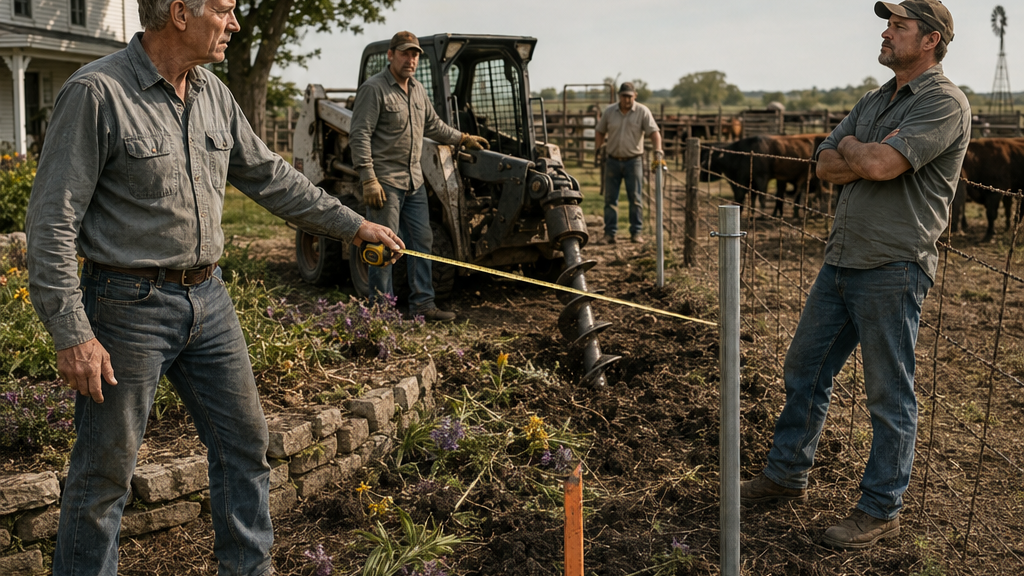
The auger went through Amy’s flower bed before Raymond Hall understood what the machine was doing.
He heard the hydraulic whine from behind the equipment shed, came around the corner with a grease rag still in one hand, and saw a spiral of dark soil climbing from a hole between the purple coneflowers and the old stone edging.
“Stop.”
The contractor did not hear him over the skid-steer.
Raymond walked faster.
“Stop the auger.”
One of the laborers finally raised a hand. The machine idled down. Loose dirt slid from the bit and fell across a clump of flattened leaves.
Raymond stared at the hole.
The bed had narrowed over the years. Amy had once kept it full from the porch steps nearly to the pasture gate, but after she died, Raymond had done only enough to keep the strongest plants alive. Still, he knew every stone along that edge.
There had never been a fence post there.
The contractor stepped down from the machine. “Morning, Mr. Hall.”
“What are you setting?”
“Livestock fence. Green property.”
Raymond looked past him.
A line of fresh steel posts stretched north toward Benjamin Green’s cattle pens. Two were already set. A third hole had been drilled. The intended line crossed the strip between Raymond’s garden and the neighboring pasture at an angle that was wrong enough to make his stomach tighten.
“How did you establish this line?”
The contractor pointed toward a sagging strand of old woven wire half buried in honeysuckle.
“Mr. Green said that’s been the boundary forever.”
Raymond folded the grease rag and put it in his back pocket.
“Did he give you a survey?”
“He gave us the line.”
“That wasn’t my question.”
The contractor’s face changed slightly. Not anger. Caution.
Raymond walked to the corner of the garden and pushed aside weeds near an old cedar post. Orange plastic showed beneath dried grass.
He crouched and cleared it with his fingers.
The survey stake was sun-faded, scratched, but still firm.
He had driven it years earlier as a reference point while checking the corner for maintenance work. He remembered the day because Amy had complained that the orange cap ruined the view from the kitchen.
Then she had tied a piece of green ribbon around it.
The ribbon was long gone.
Raymond returned to the shed, retrieved a one-hundred-foot tape, his field notebook and his phone.
The contractor watched him without speaking.
Raymond hooked the tape at the stake and walked it toward the nearest new steel post.
Eight feet.
Nine.
He stopped.
The post center sat just short of nine feet inside the line indicated by the stake.
He checked the tape for twist, reset it and measured again.
Eight feet, eleven inches.
One laborer gave a low whistle.
Raymond took a photograph showing the stake, tape and post in the same frame. Then another. He photographed the auger hole in Amy’s bed and switched on the timestamp setting before taking close views of the disturbed soil.
The contractor rubbed his jaw. “You survey?”
“Did.”
“For who?”
“County work. Private boundary work. Road jobs. Twenty-two years licensed before I retired.”
The younger laborer glanced toward the machine as if it had suddenly become dangerous.
Raymond wrote the date, time and measurements in his old notebook.
The contractor said, “So this is definitely wrong?”
Raymond looked at him.
“I said your post is almost nine feet from my reference stake. I did not say my stake settles a legal dispute.”
The contractor seemed surprised by that answer.
Raymond pointed to the machine.
“But now that I’ve formally told you there is a boundary dispute, I’m asking you not to disturb another foot of ground until it’s checked.”
The contractor looked toward Benjamin’s barn.
“That’s between you and him.”
“It is. And now you know it exists.”
For several seconds no one moved.
Then the contractor told the laborer to shut the skid-steer off completely.
The silence afterward felt enormous.
Raymond looked again at the hole in the garden. One of the coneflowers had been torn almost completely from the ground. Its roots lay exposed in the brown spoil pile.
He bent and lifted it carefully.
Amy had planted those flowers during the last summer she still had enough strength to work outside for hours. Raymond remembered measuring a road right-of-way fifteen miles away while she had hauled compost in a red wheelbarrow by herself.
At the time he had thought there would always be another Saturday.
A pickup rolled across Benjamin’s pasture lane.
Benjamin Green got out before the dust settled.
He was broad through the shoulders, wearing work jeans and a faded cap. He looked first at the idle machinery, then at Raymond holding the uprooted plant.
“What happened?”
Raymond pointed toward the first post.
“Your fence line is inside my property.”
Benjamin’s eyes went to the orange stake.
“That thing again?”
“Almost nine feet.”
“From that stake.”
“Correct.”
Benjamin crossed his arms. “That stake isn’t the fence.”
“No.”
“The fence is the fence.”
Raymond felt a familiar heat rise behind his ribs. For most of his working life, people had paid him precisely because fences were not necessarily boundaries.
He kept his voice level.
“If you have a recorded survey showing that old fence controls, bring it over.”
Benjamin glanced toward his cattle pens.
“I already paid these men.”
“That doesn’t establish title.”
“And you measuring your own property doesn’t either.”
That landed harder because Raymond knew it was technically true.
He shut the notebook.
“Then we agree on one thing. We need the line verified.”
Benjamin stared at him for a moment, then turned to the contractor.
“You have enough room to keep moving north?”
The contractor hesitated. “He’s disputing it.”
“I heard him.”
Raymond stepped forward. “Benjamin.”
Benjamin looked back.
“I am formally asking you not to continue.”
Benjamin’s jaw tightened. “And I’m telling you that old fence was there when my father leased this place. It was there when I bought it. It was there before you bought yours.”
“That doesn’t make it the deed line.”
“Maybe not to a surveyor.”
“To the law, too.”
Benjamin looked toward the ruined flower bed, then away.
For a moment Raymond thought he might stop.
Instead Benjamin said, “Set the posts. Don’t cross any farther into his garden than you have to.”
The contractor did not move immediately.
Then he climbed back onto the machine.
Raymond stepped away from the line and raised his phone.
The hydraulic whine started again.
He filmed as the auger turned.
Benjamin stood beside the old woven-wire fence, one boot resting against a rotted post.
“That line,” he said over the machine, “has been there longer than either one of us has owned these farms.”
Raymond watched the earth rise around the spinning bit.
For the first time that morning, the question was no longer whether the new fence looked wrong.
It was whether the old one had ever been right.
Chapter 2: A Surveyor Cannot Certify Himself
The county clerk had written three words across the top of Raymond’s complaint before he even reached the records counter Monday morning:
DISPUTED OWNER CLAIM.
Raymond read them twice.
He had submitted the form electronically Saturday afternoon with photographs, measurements, deed references and a short statement identifying the apparent encroachment. He had expected a routine file number.
Instead, the zoning/property officer called him before eight.
“You’re going to need an independent survey,” the officer had said.
“I supplied measurements.”
“I saw them.”
“And photographs of the monument reference.”
“I saw those too.”
Raymond had paused.
The officer knew his name. Most people who had worked around county roads or property records for any length of time did.
Then the officer said carefully, “Raymond, you’re the owner.”
“I’m also a licensed surveyor.”
“Retired surveyor.”
“Which doesn’t erase what I know.”
“No. But you can’t be the neutral professional establishing your own contested boundary.”
Raymond disliked how reasonable that sounded.
By nine-thirty he was standing beneath fluorescent lights at the land-records counter with a legal pad tucked beneath one arm.
The clerk brought out copies of his deed, Benjamin’s deed, the subdivision-era road survey and a recorded plat from a later conveyance.
Raymond spread them across a table.
At first glance, the documents supported him.
His deed called to an iron monument near the county road, then followed a bearing north along the Green tract. The newer plat showed essentially the same alignment Raymond remembered. If that line were projected into the field, Benjamin’s steel posts sat well inside Raymond’s parcel.
He felt the old confidence return.
Then he compared the distance from the road reference.
It did not fit.
Only by a few feet at first. But in surveying, a few feet could unravel an entire assumption.
Raymond pulled the oldest deed closer.
The description referenced a stone corner “east of the traveled way.”
The modern plat referenced an iron monument measured from the current road centerline.
The county road had not always been the same width.
He knew that.
Still, he had expected the records to stack neatly in his favor.
The clerk returned with a file folder.
“There’s an older road project in the archive. Late eighties.”
“Can I get the plans?”
“I can request them. Might take a day.”
Raymond nodded.
He photographed nothing inside the records room. Instead he ordered certified copies, paid the fee and carried the packet home in a flat document envelope.
At his farmhouse office, the old drafting table still sat beneath the east window. Amy had wanted him to get rid of it after he retired.
“You’ll spend your retirement surveying the kitchen if I let you,” she had said.
He had kept it anyway.
Raymond laid out Saturday’s photographs beside the records.
The orange stake appeared clearly in one image, its faded cap behind the tape. In another, the steel fence post stood eight feet, eleven inches away.
The evidence looked strong.
Yet the officer’s words kept returning.
You’re the owner.
Near noon, Raymond’s phone rang.
His attorney had received a letter from Benjamin’s counsel.
Raymond listened while the attorney summarized it.
“They’re not conceding the boundary. They’re also raising your professional involvement.”
“My professional involvement is why I know where the problem is.”
“It is also why they’re saying your measurements are self-serving.”
“That’s nonsense.”
“It’s predictable nonsense.”
Raymond stood at the kitchen window.
Outside, Benjamin’s new posts formed a hard line beyond the garden. The contractor had stopped setting them Sunday, perhaps because Benjamin’s lawyer had told him to. No wire had been stretched yet.
His attorney continued.
“They’re asserting the historic agricultural fence as evidence of long-standing possession and practical recognition.”
“It wandered.”
“I know.”
“It was built around trees and wet spots. Half the posts aren’t even on a straight bearing.”
“I know that too.”
Raymond rubbed his forehead.
“What do you recommend?”
“Independent survey. Someone who has no reason to favor either of you.”
Raymond looked at the orange stake through the glass.
He did not like needing another surveyor to tell him what he believed he already knew.
That reaction bothered him almost as much as Benjamin’s fence.
By late afternoon, the county clerk called.
The archived road file had been found.
Raymond drove back before closing.
The old plans showed a widening project that had shifted the traveled surface and expanded the right-of-way along the front of both farms. That explained part of the discrepancy between the old deed language and the newer plat.
But not all of it.
He traced the old boundary notation with one finger.
A field sketch was tucked behind the construction plan.
It showed the Hall-Green corner, the old fence, a measured offset and a temporary reference point.
Something about the handwriting made Raymond lean closer.
Numbers slanted upward.
Sevens were crossed in the middle.
The notation beside the reference stake used a compact capital R followed by an H.
Raymond stopped breathing for a second.
He knew those initials.
They were his.
The clerk glanced over from the counter. “Everything okay?”
Raymond did not answer immediately.
The date in the lower corner was thirty-one years old.
He had been young enough then to take weekend jobs for farmers who needed a quick line checked before setting gates or cleaning ditches. Not every visit became a recorded boundary survey. Sometimes an owner wanted only enough information to understand where a corner probably lay.
Raymond stared at his own handwriting.
The orange reference stake shown on that old sketch sat near the same location as the surviving stake beside Amy’s garden.
But the sheet was not a signed plat.
It was not sealed.
And beside the old fence, Raymond had written two words he had completely forgotten:
“occupation line.”
Not “boundary.”
Not “property.”
Occupation line.
His own thirty-one-year-old field notes proved that he had once recognized a difference between the fence and the deed geometry.
They also proved he had been involved with this corner long before Benjamin ever bought the neighboring farm.
Raymond folded his arms on the table.
Saturday morning he had believed the orange stake was the simplest part of the dispute.
Now his own initials had made it the most complicated.
Chapter 3: The Old Fence Told Two Stories
Raymond remembered driving the orange stake.
That was the problem.
By Wednesday morning, he could remember the sound of the hammer striking its cap, the old pickup he had owned, even the smell of mud from the roadside ditch.
What he could not find was a recorded survey explaining exactly why he had put it there.
He searched every file box in the farmhouse office.
Invoices. Field books. Copies of plats. Old road projects. Jobs he had not thought about in twenty years.
Nothing matched the date on the county sketch closely enough to settle the question.
At ten, the independent surveyor arrived with a total station, a locator and a cautious expression.
Raymond knew the younger professional by reputation. Thorough. Conservative. Not easily hurried.
Good qualities in another surveyor.
Infuriating qualities when Raymond wanted an answer.
Benjamin stood near the old woven-wire fence with his adult son. He had brought copies of his closing papers and several photographs taken before he bought the farm.
In every picture, the old fence was visible.
“This is what I relied on,” Benjamin said.
Raymond studied one photograph.
The fence curved around an ash tree, dipped toward a wet depression, then straightened again beyond a gate.
“That shows a fence,” Raymond said.
“It shows the line everybody treated like the line.”
“Those aren’t the same thing.”
Benjamin gave him a tired look. “They were until Saturday.”
The surveyor raised a hand before Raymond could answer.
“I’m not deciding anything from conversation. I’m collecting evidence.”
That irritated Raymond too, though he knew it should not have.
They began at the road.
The surveyor located modern right-of-way markers, measured the existing iron monument and compared the geometry with the archived widening plans Raymond had obtained.
Raymond stayed several yards back.
For ten minutes.
Then he stepped closer.
“If you hold the old centerline station and apply the widening offset—”
The surveyor looked up from the data collector.
“Raymond.”
“I’m just saying—”
“I know what you’re saying.”
Benjamin’s mouth tightened as if suppressing satisfaction.
The surveyor continued, “You hired me because you can’t be neutral in your own dispute. Let me be neutral.”
Raymond walked away.
He hated that the correction was deserved.
Near noon, they moved north along the old fence.
The difference between occupation and geometry became increasingly obvious. Some sections of wire sat nearly on the apparent deed bearing. Elsewhere the fence wandered several feet around rocks, trees and drainage.
Benjamin pointed toward the longest straight section.
“My cattle have been against that fence for years.”
Raymond said, “Use isn’t title by itself.”
“I didn’t say it was.”
“You keep acting like it is.”
“I’m acting like I paid for a farm that was shown to me with that fence around it.”
For the first time, Benjamin sounded less defiant than exhausted.
Raymond looked toward the cattle pens.
Temporary panels had been stacked near the chute. A trailer sat backed against a narrow lane. He had noticed the equipment before but not considered why Benjamin was changing the fence now.
The surveyor called them over.
He had found remnants of an older cedar post at the base of the woven wire.
“This may help establish the age of occupation,” he said, “but not necessarily the deed line.”
Benjamin pointed at Raymond. “He put that orange stake there thirty years ago.”
Raymond’s eyes narrowed.
“How do you know that?”
“Your sketch.”
“My sketch says occupation line beside the fence.”
“It also shows the stake.”
“As a reference.”
“Reference to what?”
That question stopped Raymond.
He remembered the old job in pieces.
The previous owner of Benjamin’s tract had wanted to replace a washed-out gate. Raymond had checked the deed geometry against visible features, but the man had not commissioned a full boundary survey. Raymond had set a temporary reference so construction could stay clear of the likely property line.
He had been careful not to call it a monument.
At least he believed he had.
But memory after thirty-one years was not evidence.
They returned to the road plans.
Raymond spread copies across the hood of his pickup.
The original deed called to a stone corner east of the traveled way. The widening project had moved the road and buried portions of the old shoulder beneath fill.
Suddenly the mismatch made more sense.
“If the original stone survived,” Raymond said, “it could be under the widened shoulder.”
The independent surveyor nodded. “Possible.”
Benjamin looked toward the pavement. “You’re going to dig up the county road?”
“No,” the surveyor said. “We search from the right-of-way.”
For the next two hours, the locator gave them nothing decisive.
Raymond grew restless.
He knew the temptation well: when one piece of evidence refused to appear, surveyors began leaning harder on the pieces they already had.
That was how mistakes became confident.
At the garden, the orange stake stood only a few yards from Benjamin’s fresh steel posts.
Raymond touched its faded cap.
For days he had treated it as proof.
Now it felt more like a question someone younger had left for him.
The surveyor crouched beside it.
“No original markings.”
“It wasn’t intended as a property corner,” Raymond said.
Benjamin gave a short laugh. “That’s interesting.”
Raymond turned.
“What is?”
“Saturday you stretched a tape from it like it was Scripture.”
The remark stung because it was fair enough to sting.
“I told the contractor it didn’t settle the legal boundary.”
“After you told everybody my post was nine feet wrong.”
“It probably is.”
“Probably.”
Raymond felt the old reflex rise—the urge to bury Benjamin under terminology, deed priority and professional history.
Instead he looked at the damaged flower bed.
One section had been churned into bare soil. Amy’s stone edging disappeared beneath the spoil pile.
He said, “That’s why we hired him.”
Benjamin followed his gaze but said nothing.
The independent surveyor stood.
“I need more evidence before I call this corner.”
“What kind?” Benjamin asked.
“Original monuments if they exist. Road records. Adjoining tract calls. Possibly older conveyances.”
Raymond said, “The widening plan references a stone.”
“Yes.”
“And the stone should fall beyond the present shoulder.”
“Approximately.”
Raymond could already see the search pattern in his mind.
The surveyor must have noticed.
“Don’t.”
Raymond frowned. “Don’t what?”
“Go looking tonight and then tell me what you found.”
“I know how to run a locator.”
“That’s exactly why I don’t want you doing it.”
Benjamin’s son looked away, hiding a smile.
Raymond exhaled slowly.
The surveyor packed the data collector into its case.
“I’ll come back tomorrow with the older road sheets and a deeper locator. Until then, I’m not adopting your orange stake, and I’m not adopting Benjamin’s fence.”
Benjamin folded his arms. “So nobody knows.”
The surveyor looked from one man to the other.
“No. We know both of you have been treating visible evidence as if it proves more than it does.”
Raymond watched him close the equipment case.
Then the surveyor added, “And if that original road monument is still there, it may tell a different story than either one.”
He pointed beyond the widened shoulder, toward a strip of packed earth and grass that had not been disturbed in decades.
“That’s where I’m looking next.”
Chapter 4: The Reason Benjamin Needed Those Nine Feet
Raymond saw the temporary cattle panels before he saw Benjamin.
They had been jammed into the narrow loading lane in a crooked double row, leaving barely enough room for a full-grown cow to turn without striking steel. One panel bowed inward where something heavy had hit it. Another was tied to a gatepost with two lengths of baling twine and a piece of chain.
Raymond stopped at the edge of his property.
The arrangement made no sense as a permanent system.
It made perfect sense as an emergency one.
Benjamin came out of the barn carrying a bucket and set it down when he noticed Raymond.
“You lost?”
“The surveyor wants access along the northern section tomorrow.”
“He told me.”
Raymond nodded toward the panels. “Those new?”
Benjamin’s face closed.
“Temporary.”
“That lane wasn’t that tight last year.”
“No.”
Raymond looked toward the steel posts standing nine feet inside the disputed strip.
For the first time, he saw the proposed fence not as a straight act of encroachment but as part of a larger shape. If Benjamin gained those nine feet, the lane beside his working pens became considerably wider. A stock trailer could approach more directly. Cattle would have room to funnel toward the chute without bunching at the turn.
“You were widening the handling lane.”
Benjamin picked up the bucket again.
“I was fixing a problem.”
“On my ground.”
“That’s still what we’re arguing about.”
Raymond almost answered automatically.
Instead he watched a young steer shove its nose through a panel gap. Benjamin’s adult son moved along the opposite side and pushed it back with a sorting paddle.
The panel shuddered.
Benjamin said, “You want to know why I didn’t wait?”
Raymond said nothing.
“A calf got out three weeks ago.”
Benjamin set the bucket down again.
“Slipped past my boy when we were loading. Hit that turn, bounced off the gate and went straight through where the old wire was weak.”
Raymond glanced toward the county road.
Benjamin followed his eyes.
“Made it across the ditch. Got onto the pavement.”
“Hit?”
“No. Almost.”
Benjamin’s voice became quieter.
“A feed truck came around the bend. Driver got stopped, but not by much. Calf tore itself up on the ditch fence when we got it back. Vet tech had to stitch the shoulder.”
Raymond pictured the bend beyond the maple trees. Trucks came through there too fast even when they were not hauling anything.
“You could’ve replaced your handling panels.”
“I did.”
Benjamin kicked one of the temporary feet.
“These were all I could get before the sale.”
“What sale?”
“Two loads due out this week.”
There it was.
Not an excuse. A deadline.
Raymond looked again at the new fence posts. Benjamin had not been widening some ornamental pasture edge. He had been trying to redesign a dangerous choke point before moving cattle.
“You could have called me.”
Benjamin laughed without humor.
“And said what? Raymond, I want nine feet you’re going to tell me is yours?”
“You didn’t know I’d say that until I showed you the stake.”
Benjamin’s gaze shifted toward the disputed strip.
Raymond saw the answer before Benjamin gave it.
“You did know.”
Benjamin rubbed the back of his neck.
“I knew there was a marker.”
“That isn’t what I asked.”
“I knew there was something there.”
“And you knew it didn’t agree with the old fence.”
“I knew it might not.”
Raymond felt the sympathy that had begun forming inside him harden at the edges.
“When?”
Benjamin did not answer.
“When did you know?”
“The contractor found it before they started.”
Raymond stared at him.
Benjamin continued before he could speak.
“I told them the old fence was the occupied line. That’s what I bought. That’s what I’ve maintained. That’s what the prior owner showed me.”
“You could’ve stopped and checked.”
“I had cattle scheduled.”
“You could’ve called a surveyor.”
“You know what it costs to get somebody out here on short notice?”
“I know exactly what it costs.”
“And you know how long it takes.”
Raymond stepped closer to the old fence.
“You made the uncertainty my problem.”
Benjamin’s jaw tightened.
“I made a decision on the evidence I had.”
“No. You had conflicting evidence. You chose the piece that gave you more room.”
Benjamin looked toward the pens, where his son had begun fastening another temporary panel.
“That room keeps cattle off the road.”
“That doesn’t make it yours.”
“I didn’t say it did.”
“You built as if it did.”
For several seconds they listened to the metallic banging from the pens.
Raymond understood more now than he had on Saturday.
That did not make him less angry.
It made the anger cleaner.
Benjamin had not secretly decided to steal land because he wanted a bigger farm. He had a genuine problem, a narrow cattle lane, an upcoming sale and a memory of an animal loose on the county road.
And when faced with uncertainty, he had solved that problem by pushing the risk onto Raymond.
Benjamin picked up the bucket.
“If your line wins, I move it.”
“You should’ve said that before the auger hit Amy’s garden.”
Benjamin’s eyes dropped.
“I didn’t know about the flowers.”
“You knew it was a garden.”
“I knew it was ground in the way.”
Raymond went still.
Benjamin seemed to hear his own words.
“That came out wrong.”
“No,” Raymond said. “It came out useful.”
He turned toward his property.
“Raymond.”
He stopped.
Benjamin spoke more carefully.
“I am sorry about the garden.”
Raymond looked over his shoulder.
He wanted to dismiss the apology. He wanted Benjamin to remain simple enough to resent without effort.
Instead he saw a tired cattleman standing beside equipment he could barely afford to replace, trying to protect a farm operation that depended on animals moving safely through twelve feet of space.
Raymond said, “Being sorry after you decided to take the chance isn’t the same as not taking it.”
“I know.”
That was all.
Raymond walked back along the disputed strip.
The orange stake stood ahead of him, almost absurdly bright beside the dirt and gray steel.
From Benjamin’s side, it blocked the most convenient place to widen the cattle lane.
From Raymond’s side, it marked the ground Amy had planted and the access route he had used for years.
One piece of plastic. Two completely different stories.
His phone rang before he reached the farmhouse.
The independent surveyor.
Raymond answered immediately.
“You find something?”
“Maybe.”
“Where?”
“Roadside. Outside the present traveled shoulder.”
Raymond stopped walking.
The surveyor continued.
“I went back through the older widening sheets. There’s a recovery note on the original monument that wasn’t copied onto the later plan.”
“What kind of monument?”
“Stone originally. Later referenced with an iron pin set beside it.”
Raymond’s pulse quickened.
“Did you locate it?”
“I got a strong signal under the fill.”
“How deep?”
“Deep enough that I stopped guessing and started digging.”
Raymond looked toward the road.
“When?”
“Tomorrow morning. County right-of-way crew knows we’re working outside the pavement.”
Benjamin had come halfway across the pasture and was watching him now.
Raymond asked the question both of them needed answered.
“If it’s the monument?”
“Then we finally have independent evidence tied directly to the oldest deed call.”
“And if it isn’t?”
“Then we keep looking.”
The surveyor paused.
“But Raymond?”
“Yes?”
“It’s in roughly the place your old road reconstruction suggested.”
Raymond ended the call.
Benjamin approached the fence.
“What?”
Raymond put the phone in his pocket.
“They found something buried beyond the widened shoulder.”
Benjamin’s face changed.
“The corner?”
“Maybe.”
For the first time since the dispute began, neither man argued about what the evidence meant.
They both looked toward the county road.
Somewhere beneath decades of fill, grass and roadside grading, the ground might still be holding the answer.
Chapter 5: The Buried Monument Changes Everything
The iron pin came out of the roadside fill under the surveyor’s hand like a rusted bone.
Raymond saw the top of it first.
A dull brown circle, barely wider than his thumb, buried beneath packed gravel and old soil beyond the present shoulder.
The surveyor brushed around it carefully with a small digging tool.
“Don’t touch it.”
Raymond had not moved.
“I wasn’t going to.”
The surveyor gave him a look.
Raymond stepped back anyway.
Benjamin stood ten feet away with his arms folded. His son waited near the pickup. No one spoke while the surveyor exposed enough of the pin to inspect it without disturbing its position.
Beside it, deeper and offset slightly, was the edge of a stone.
Raymond felt something loosen in his chest.
The old deed had called for stone.
The road project notes had described an iron reference set beside it.
The combination was stronger than anything they had found so far.
The surveyor photographed both, measured the exposed pin, then set up the total station farther from the shoulder.
For the next hour, Raymond did the hardest professional work he had done since retiring.
He stayed quiet.
Every time the surveyor entered a point or shifted the prism, Raymond’s mind calculated ahead.
Bearing.
Distance.
Residual.
He knew what should happen if the monument tied correctly to the adjoining deeds.
He also knew how easily a landowner could talk himself into seeing agreement where there was only hope.
Benjamin paced once along the old fence, then stopped.
Finally the surveyor called both men over.
“This appears consistent with the monument referenced in the widening records.”
“Appears?” Benjamin asked.
“I’m not signing anything based on one recovery. I need the whole network.”
Benjamin exhaled through his nose.
Raymond said, “Good.”
The surveyor glanced at him, perhaps surprised he had not demanded more.
They worked north.
Modern control points tied back to the recovered roadside monument. Adjoining calls began to close. The line projected toward Raymond’s garden, then continued past the old occupation fence with enough separation to make Benjamin’s expression increasingly difficult to read.
Near noon, the surveyor stopped beside Raymond’s orange stake.
He set the prism over a computed point several inches away.
Raymond noticed immediately.
“How much?”
The surveyor checked the collector.
“Seven and three-eighths.”
Benjamin looked at Raymond.
“Seven feet?”
“Inches,” the surveyor said.
Benjamin gave a short, sharp laugh.
“So his stake’s wrong.”
Raymond felt heat rise into his face.
Seven and three-eighths inches.
After all his insistence.
After stretching a tape from that orange cap in front of the contractor.
He stared at the computed point.
The surveyor said, “Raymond?”
“I heard you.”
“You set this as a reference, not a corner.”
“I know what I set.”
“Then you also know seven inches on a thirty-year-old reference stake doesn’t decide where that fence belongs.”
Benjamin’s satisfaction faded slightly.
The surveyor set a fresh temporary marker at the calculated boundary.
It stood closer to Benjamin’s new fence than Raymond’s orange stake did.
But not remotely close enough.
The surveyor stretched a tape from the computed line to the nearest steel post.
Eight feet, three inches.
Farther north, another post was more than eight and a half feet inside.
Near the garden, where the alignment shifted slightly, the original first post remained close to nine.
Benjamin stopped smiling.
The surveyor continued running points along the entire disputed section.
By early afternoon, the pattern was undeniable.
Raymond’s old orange reference stake had been imperfect.
His central conclusion had not been.
Most of Benjamin’s new fence stood several feet onto Raymond’s deeded land, with the worst portion approaching the nine-foot measurement Raymond had made Saturday.
Benjamin stared at the rows of fresh stakes now marking the reconstructed boundary.
“What about the old fence?”
The surveyor pointed toward it.
“Evidence of occupation.”
“That means something.”
“It does.”
“How much?”
“That depends on legal questions I don’t decide. What I can tell you is that it does not match the deed boundary we reconstructed from the controlling monument, adjoining records and road history.”
Benjamin looked toward Raymond.
Raymond resisted the urge to say anything.
He had imagined this moment repeatedly.
In several versions, he reminded Benjamin that he had warned him.
In one particularly satisfying version, he asked whether the fence was still older than both of them.
Instead he looked at his orange stake.
Seven and three-eighths inches.
Wrong enough to humble him.
Right enough to have warned everyone that something needed checking.
The surveyor drove a new capped marker into the proper line a short distance away. Its orange top was brighter than Raymond’s old one.
Two markers stood side by side.
One memory.
One verified position.
Raymond crouched and looked between them.
“I leaned on mine too hard,” he said.
Benjamin frowned.
“What?”
“Saturday. I knew it was a reference. I treated it like more because I was angry.”
Benjamin glanced at the destroyed garden.
“You were still right about my posts.”
“That’s not the same thing.”
“No.”
The word settled between them.
Later, Raymond’s attorney called.
The independent survey had not yet been finalized, but the preliminary findings were strong enough to change the posture of the dispute.
“Assuming the signed survey matches what you’ve described,” the attorney said, “we demand removal of the encroaching fence.”
“Obviously.”
“And restoration.”
Raymond looked toward the garden.
“Meaning?”
“Surface damage. Access. Landscaping. Potentially professional restoration of the perennial bed if you can document what was there.”
Raymond was silent.
The attorney continued.
“You have photographs?”
“Some.”
“Before the damage?”
“Yes.”
“Receipts?”
“Not for most of it.”
“Doesn’t necessarily matter. We can establish reasonable restoration cost.”
Raymond watched Benjamin walking toward his cattle pens.
The man moved slowly.
Relocating the fence meant more contractor expense. New post holes. New alignment. Possibly reworking the handling lane entirely.
Raymond reminded himself that Benjamin had chosen that risk.
His attorney said, “And if they fight us, we can pursue additional costs associated with the encroachment.”
“How much?”
“I don’t know yet.”
Raymond could hear papers moving at the other end.
“But you’re in a much stronger position than you were Monday.”
Raymond looked at the two orange markers.
He should have felt cleanly vindicated.
Instead he kept seeing the seven-inch difference.
For twenty-two years people had hired him to understand that precision mattered. Now another surveyor had shown him that precision mattered even when the larger conclusion favored him.
“Send me the options,” Raymond said.
“You mean settlement options?”
“All remedies. Everything I could reasonably claim.”
His attorney paused.
“All right.”
Raymond ended the call.
Benjamin was standing at the steel post nearest Amy’s garden, one hand resting on it.
He looked across the strip at Raymond but did not speak.
Raymond did not either.
That evening, an email arrived from his attorney with a list of potential claims.
Fence removal.
Survey expenses.
Legal expenses subject to agreement or court determination.
Restoration of disturbed soil.
Replacement plantings.
Professional landscape reconstruction.
Loss of use.
Raymond read the list twice.
Then he opened the folder of photographs from before Amy became ill.
The disputed nine feet were there in nearly every summer picture.
Purple coneflowers.
Daylilies.
A stone border.
Amy kneeling in the dirt with one glove off.
Raymond closed the photograph.
He had won the factual question.
Now he had to decide what winning was supposed to cost Benjamin.
Chapter 6: Winning the Line Does Not Restore the Garden
The plant should have been dead.
Raymond found it Saturday morning beneath a slab of dirt that the auger had thrown against the stone border.
Only two green leaves remained above the crown. Most of the stems had been crushed, and one root had been torn nearly clean through.
He recognized it anyway.
A pale daylily.
Amy had planted three of them in that corner.
Raymond set down his shovel and worked his fingers under the root ball.
He had spent the week talking about replacement value.
Now, kneeling in the mud, he understood how useless the phrase was.
You could price a plant.
You could price labor.
You could pay someone to rebuild a stone edge and bring in good soil.
You could not invoice a Saturday morning from twelve years earlier.
Amy had been wearing an old blue shirt that day, sleeves rolled past her elbows. She had already been tired more often by then, though neither of them understood why.
Raymond had come home late from a survey job and found her planting along the side yard.
“You could’ve waited,” he had told her.
“For what?”
“For me.”
She had laughed.
“I’d never get a garden planted if I waited for you to finish measuring the county.”
At the time, he had taken it as teasing.
Later, after the diagnosis, he understood how many things she had stopped waiting for.
Raymond loosened the damaged daylily and carried it to an intact section closer to the porch.
He dug a smaller hole there.
The motion brought back another conversation.
He had once complained about a neighboring fence that wandered six inches across a surveyed line near the back pasture. He had intended to speak to the owner.
Amy had listened, then said, “Do you need the six inches?”
“That’s not the point.”
“That means no.”
“The line is the line.”
She had smiled.
“You surveyors always think knowing exactly where something ends tells you what you ought to do about it.”
Raymond had argued with her for ten minutes.
He could not remember a single thing he had said.
He remembered her sentence.
He pressed soil around the daylily’s roots.
Behind him, the properly surveyed boundary was marked with fresh stakes. Benjamin’s new steel posts still stood inside it, but the contractor had not returned.
The fence was officially wrong.
That fact had brought Raymond less relief than he expected.
His phone buzzed on the porch rail.
The attorney.
Raymond wiped his hands before answering.
“They made an offer,” the attorney said.
“How much?”
“Benjamin will pay the survey cost and relocate the fence.”
“And the garden?”
“Nothing.”
Raymond looked at the broken bed.
“Nothing?”
“The position is that the landscaping was incidental to work performed under a good-faith boundary belief.”
“He was warned before they kept drilling.”
“I made that point.”
“And?”
“They’re distinguishing the initial work from what happened afterward.”
Raymond laughed once.
“That’s convenient.”
“It is also an opening offer.”
Raymond walked to the kitchen with the phone against his ear.
On the table were the photographs he had pulled from storage.
Amy beside the flowers.
Amy carrying a watering can.
Amy sitting on the stone edge with dirt on both knees.
His attorney said, “We can reject it and pursue restoration.”
“How far?”
“As far as you want, within reason.”
Raymond stared at the pictures.
Within reason.
That was the phrase everyone used when there was no survey instrument for the thing being measured.
“What would professional reconstruction cost?”
“I have a preliminary estimate. Several thousand, depending on materials and mature plant replacement.”
Raymond imagined contractors arriving with landscape plans and pallets of nursery stock, rebuilding the bed until it looked approximately as it had.
Approximately.
Not Amy’s.
Just expensive.
“Raymond?”
“I’m here.”
“You don’t have to decide today.”
“Yes, I do.”
His attorney went quiet.
Raymond sat down.
For years after Amy died, he had treated certain parts of the farm as if changing them would amount to erasing her.
The red wheelbarrow stayed beneath the shed even after one handle cracked.
Her garden tools hung where she left them.
He replanted empty spaces with the same varieties whether they grew well there or not.
He had told himself he was preserving things.
Now he wondered how much of it was simply refusing to admit that time had moved without permission.
He picked up the photograph of Amy sitting on the garden edge.
On the back, in her handwriting, were four words.
Raymond had forgotten them.
For the dogs someday.
He turned the picture over again.
The photograph showed the narrow strip beside the house before they had ever adopted a dog. Amy had apparently imagined fencing it eventually.
He sat completely still.
She had talked about rescue dogs near the end. Not seriously enough for them to act on it then. Raymond had said they already had enough work.
After she died, the idea disappeared with a hundred other small plans.
The phone was still in his hand.
His attorney said, “Everything okay?”
“Yes.”
Raymond looked through the window at the disputed strip.
“No. But I know what I don’t want.”
“What’s that?”
“I don’t want somebody rebuilding the garden to make it look like nothing happened.”
“All right.”
“And I don’t want Benjamin buying his way out of moving the fence.”
“He can’t. The fence has to move.”
“Good.”
Raymond stood.
“Tell his attorney I’m rejecting the offer.”
“I expected that.”
“But don’t send a counter yet.”
“What are you thinking?”
Raymond looked toward Benjamin’s cattle pens beyond the fresh boundary stakes.
The temporary panels were still there.
The narrow turn was still dangerous.
The survey had proved the nine feet belonged to Raymond. It had not made Benjamin’s livestock problem disappear.
“I need one thing from the surveyor first.”
“What?”
“A sketch showing how much working room Benjamin actually has if every improvement stays entirely on his deeded side.”
His attorney paused.
“You’re helping him redesign his cattle lane?”
“I didn’t say that.”
“It sounds like it.”
Raymond almost smiled.
“I’m deciding what the line is for.”
He ended the call and carried the rescued daylily outside.
By afternoon, it stood upright in fresh soil near the porch.
The broken stems were still obvious.
Raymond left them.
On Monday, the independent surveyor emailed a simple dimensioned sketch. It showed Benjamin could create a workable, narrower funnel by shifting two temporary panels, moving one gate and relocating the disputed fence fully onto his own land.
It would not be as convenient as taking Raymond’s nine feet.
But it would work.
Raymond printed the sketch.
Then he opened the attorney’s draft demand, crossed out the request for full professional garden reconstruction, and wrote a different set of terms in the margin.
Benjamin would pay for the fence removal.
Benjamin would fund the corrected permanent line.
Benjamin would reimburse the independent survey.
Benjamin would sign a recorded acknowledgment so neither farm would inherit the same argument later.
And Raymond would reduce the landscaping demand if Benjamin used the savings to make the cattle lane safe without crossing the boundary again.
When Raymond finished, he read the page once.
It was not forgiveness.
It was not friendship.
It did not return Amy’s flowers.
But it required Benjamin to fix what he had done while leaving him a way to solve the problem that had started it.
Raymond called his attorney.
“I have the counteroffer.”
There was a pause.
“Go ahead.”
Raymond looked at the replanted daylily through the open kitchen door.
“No,” he said. “This one I want to explain in person.”
Chapter 7: Raymond Chose a Boundary Benjamin Could Live With
Benjamin arrived expecting a bill.
Raymond could tell by the way he carried himself across the shared boundary—shoulders squared, jaw set, one folded sheet of paper already in his hand as if he had decided in advance which number he would refuse.
The two attorneys stood near the cattle lane. The independent surveyor had joined them only to answer questions about dimensions and the permanent markers.
Raymond held his own copy of the settlement proposal.
Benjamin looked at him. “How much?”
Raymond handed him the paper.
“Read it.”
Benjamin unfolded the pages.
His eyes moved quickly through the first section.
Removal of all encroaching fence posts and associated materials.
Reinstallation entirely within the Green property.
Reimbursement of the independent survey.
A recorded boundary acknowledgment tied to the new survey.
Benjamin’s expression barely changed.
Then he reached the landscaping section.
He looked up.
“This is less than your lawyer asked for.”
“Yes.”
“Why?”
“Keep reading.”
Benjamin did.
Attached behind the settlement terms was the dimensioned sketch Raymond had requested from the surveyor. It showed Benjamin’s cattle lane, the corrected boundary and a revised arrangement of panels and gate positions.
Benjamin studied it for longer than he had studied the legal language.
“You had him draw this?”
“I asked what could fit without crossing my line.”
Benjamin pointed at the sketch.
“That turn is tighter.”
“Yes.”
“Trailer won’t come in straight.”
“No.”
“I’d have to move the gate.”
“Yes.”
“And shift those panels.”
Raymond nodded.
Benjamin looked toward the actual pens as if mentally laying the paper over the ground.
His attorney stepped closer.
“The proposed agreement reduces the landscaping demand provided the boundary correction and safety modifications are completed within the stated period.”
Benjamin looked back at Raymond.
“So I spend the money on my lane instead of your flowers.”
“Some of it.”
“You expect me to thank you?”
“No.”
Benjamin folded the paper once.
“This still costs me plenty.”
“You ordered a fence built across disputed ground after you knew a marker contradicted the old line.”
“I know what I did.”
“Then we don’t need to argue about the cost of undoing it.”
Benjamin’s face hardened.
“What I don’t understand is why you care how my cattle lane works.”
Raymond glanced at the temporary panels.
“Because if a calf ends up on that road next month, proving I owned nine feet won’t make that feel any better.”
Benjamin said nothing.
Raymond continued.
“And because I don’t want you telling yourself ten years from now that I used a boundary dispute to make your farm unsafe.”
Benjamin’s attorney murmured something to him.
Benjamin shook his head.
“No. I heard him.”
He walked several steps toward the newly marked line.
Permanent orange-capped markers had replaced the temporary stakes at key points. The one near the garden stood only inches from Raymond’s old reference stake.
Benjamin stopped beside it.
“You get everything you want,” he said.
Raymond looked at the two orange caps.
“No.”
Benjamin turned.
“My old stake was wrong.”
“By inches.”
“Wrong is wrong.”
Benjamin almost smiled.
“That sounds like something I should’ve said to you.”
“Probably.”
The tension loosened for half a second, then returned.
Benjamin tapped the settlement paper against his leg.
“I can’t agree to this today.”
His attorney looked at him sharply.
Raymond felt disappointment rise, but he kept his voice flat.
“Then don’t.”
Benjamin frowned.
“You’re not going to threaten court?”
“My attorney already explained what happens if we can’t settle.”
“And you’re fine with that?”
“No.”
Raymond folded his own copy.
“But the ground isn’t changing while we negotiate.”
Benjamin looked again at the sketch.
“My sale barely covered the feed note.”
Raymond said nothing.
“The fence contractor wants half up front to come back.”
Still Raymond waited.
Benjamin’s anger seemed to drain into something heavier.
“I thought that old fence gave me enough cover to move fast.”
“It didn’t.”
“I know that now.”
“You knew enough then to stop.”
Benjamin nodded once.
That mattered more to Raymond than he expected.
No excuse followed it.
No argument about fathers, old fences or practical possession.
Just acknowledgment.
Benjamin’s attorney asked for ten minutes.
They walked toward the barn.
Raymond remained beside the surveyor.
“You think he signs?” the surveyor asked.
“Not my call.”
The surveyor glanced sideways at him.
“That’s a new phrase for you.”
Raymond gave him a dry look.
Ten minutes became twenty.
When Benjamin returned, his adult son came with him.
Benjamin held the settlement open to the signature page.
“One change.”
Raymond waited.
“The deadline on the cattle-lane work. Thirty days instead of twenty-one.”
His attorney said, “That is workable.”
Raymond nodded.
“Fine.”
Benjamin signed first.
Raymond watched the pen move across the page.
The recorded boundary acknowledgment came next. It stated plainly that both owners accepted the surveyed line and that the relocated fence would not be treated as evidence of some different ownership boundary in the future.
Raymond signed beneath Benjamin.
No one shook hands.
The attorneys gathered the documents.
Two mornings later, the fence contractor returned.
This time, the machine stood on Benjamin’s side of the orange markers.
Benjamin was there before Raymond.
The first wrongly placed steel post resisted removal. The contractor rocked it with the loader, but the packed soil held.
Finally Benjamin wrapped a chain around the post himself.
He signaled the operator.
The post came loose with a wet sucking sound.
Mud clung to its buried end.
Benjamin unhooked the chain and dragged the post away from Amy’s garden.
Raymond stood beside the new orange-capped marker.
Benjamin stopped.
For a moment the two men looked at the empty hole where the post had stood.
“That one cost me twice,” Benjamin said.
Raymond glanced at him.
“Once going in?”
“Once going in. Once coming out.”
Raymond looked at the marker.
“Some lessons are priced that way.”
Benjamin gave him a tired look.
“You always talk like a survey note?”
“Only when I’m trying not to say something worse.”
That earned the smallest smile Raymond had seen from him since the dispute began.
Over the next several days, the new fence moved onto Benjamin’s side. Two panels shifted. The gate was rehung. The cattle lane became narrower than Benjamin wanted but wider and safer than before.
The garden remained scarred.
Raymond wanted it that way for the moment.
By Friday afternoon, the last misplaced post was gone.
Benjamin stood at the corrected fence and looked through it toward Raymond.
“That all of it?”
“All of what?”
“My side of the agreement.”
Raymond checked the final alignment.
“Yes.”
Benjamin nodded toward the bare nine-foot strip.
“What are you doing with that?”
Raymond said, “Using it.”
“For what?”
He did not answer.
The next morning, a gravel truck backed slowly along Raymond’s side of the farmhouse.
Its warning alarm echoed between the barn and the pasture.
Benjamin came out of his equipment shed and stopped when he saw where the driver was aiming.
The truck bed began to rise over the strip Benjamin had tried to fence.
Gray gravel poured onto the recovered ground.
Chapter 8: The Nine Feet Became Living Ground Again
Raymond opened the new gate where Benjamin’s fence had once blocked him and immediately wondered whether he had made a mistake.
The recovered strip looked nothing like Amy’s garden anymore.
A narrow gravel path ran along most of its length. New black-mesh farm fencing enclosed the outer edge, set safely inside the surveyed boundary. At the porch end, Raymond had preserved the section of surviving perennials around the replanted daylily.
The result was useful.
Clean.
Practical.
And for one uneasy second, Raymond hated it.
He stood with one hand on the latch.
Behind him, two rescue dogs pulled impatiently against their leads.
He had brought them home three days earlier from a county shelter—one aging mixed-breed shepherd and one smaller hound with a white chest and ears too large for its head.
They knew nothing about deeds.
Nothing about monuments.
Nothing about old fences, attorneys or seven-and-three-eighths-inch errors.
They knew there was a gate.
And Raymond had not opened it quickly enough.
The hound whined.
“All right.”
He released the latch.
The dogs shot forward.
The shepherd ran first, surprisingly fast for its age, gravel scattering beneath its paws. The hound followed, overshot the turn near the garden, corrected, then sprinted back in the other direction.
Raymond laughed before he realized he was doing it.
They raced the full strip again.
Nine feet wide where the encroachment had been worst.
Long enough for them to build speed.
Wide enough to pass each other.
The hound stopped beside Amy’s surviving flowers and shoved its nose into the leaves.
“Not there.”
Raymond walked over.
The dog backed away, then sat as though deeply offended.
Raymond crouched beside the daylily.
New growth had begun at its center.
Not much.
Enough.
He had kept the old stone edging around that small section. Beyond it, the dog run began.
For weeks he had worried that putting gravel over part of the former bed meant surrendering something.
Now he looked at the dogs circling each other and understood the difference between changing a place and erasing it.
Amy’s garden had never been static when she was alive.
She moved plants constantly.
Thinned them.
Replaced them.
Complained about things that grew badly and planted other things in their place.
Raymond had been the one trying to turn it into a photograph.
The shepherd trotted back and leaned against his leg.
Raymond scratched behind its ears.
“You’d have liked her.”
The dog sneezed.
Raymond smiled.
A truck door closed beyond the boundary.
Benjamin had stopped beside the corrected cattle fence.
He looked at the dogs, then at the gravel strip.
“So that’s what the truck was for.”
Raymond stood.
“Most of it.”
Benjamin approached the fence but did not cross.
The new orange-capped boundary marker stood between them, fully visible now. Raymond had deliberately left it unobstructed.
Benjamin nodded toward the hound.
“Those yours?”
“They appear to think so.”
“Shelter?”
“Yes.”
Benjamin watched the dogs run again.
For the first time, Raymond wondered what Benjamin saw when he looked at the recovered strip.
Maybe the money he had spent twice.
Maybe the land he had assumed he could use.
Maybe simply two dogs moving through space that no longer belonged to his problem.
Benjamin pointed toward the flowers.
“You saved some.”
“One daylily. A few coneflowers. Some roots may come back.”
“That the one the auger hit?”
Raymond nodded.
Benjamin rested one hand against the corrected fence.
“I meant what I said about being sorry for that.”
“I know.”
There was no need to make him say it again.
Benjamin looked at the survey marker.
“I still think anyone buying my place twenty years from now would’ve assumed that old fence was the line.”
“They probably would have.”
“That bother you?”
“It’s why we recorded the acknowledgment.”
Benjamin nodded.
Then he said, “Your old stake is still there.”
Raymond glanced toward the faded orange cap beside the newer marker.
“Yes.”
“You keeping it?”
“For now.”
“Even though it was off?”
“Especially because it was off.”
Benjamin looked puzzled.
Raymond did not explain.
For most of his career, markers had represented certainty to him. Points fixed in ground. Measurements tied to other measurements.
The old orange stake meant something different now.
It had been useful.
It had been close.
It had also been insufficient.
Raymond had needed another person to measure what he thought he already knew.
There were worse things for a man to remember.
Benjamin turned toward his cattle pens.
The redesigned handling lane was visible behind him. A steer moved through the narrower approach without crowding the panel. Benjamin’s son swung the new gate smoothly behind it.
“It works,” Raymond said.
Benjamin followed his gaze.
“Barely.”
“Barely counts.”
Benjamin snorted.
“You’d never put that on a plat.”
“No.”
He started walking away, then stopped.
“Raymond.”
“Yes?”
“I should’ve stopped the contractor.”
Raymond looked at him.
There was nothing new in the admission except that Benjamin had chosen to say it when no lawyer was present.
“Yes,” Raymond said.
Benjamin nodded and went back toward the barn.
That was as close to reconciliation as either man needed.
By late afternoon, the dogs had worn themselves out.
Raymond carried water into the run and set the bowl near the porch end. The hound drank noisily. The shepherd circled twice before lying down beside the flower bed.
Raymond sat on the old stone edge.
The gravel felt warm beneath his boots.
Across the boundary, cattle moved quietly through Benjamin’s corrected lane.
The new fence followed the proper line without drama.
There was no sign explaining who had won.
No warning pointed toward Benjamin’s house.
No reason for one.
Raymond had considered putting up a private-property sign during the angriest week of the dispute. He had even priced one.
He never ordered it.
The orange marker said enough.
The hound came over and dropped beside the shepherd.
Both dogs stretched in the narrow strip Amy had once imagined using for exactly this purpose.
Raymond thought of the words on the back of the old photograph.
For the dogs someday.
Someday had taken longer than either of them could have expected.
It had arrived through a ruined flower bed, a misplaced fence and an argument that forced Raymond to measure more than land.
He rested one hand against the warm stone.
The garden was smaller now.
The boundary was clearer.
Neither fact repaired the years behind him.
But the ground beside the farmhouse was alive again.
As the light lowered across the pasture, the two dogs slept beside Amy’s surviving flowers.
A few yards beyond them, the faded old orange stake remained in the grass.
Beside it stood the newer marker, bright, precise and permanent.
Raymond left both where they were.
The story has ended.