They Replaced the Farmer Who Kept Their Fields Dry—Then the Autumn Rains Exposed What Was Buried Beneath the Easement
Chapter 1: The Ditch Barbara Said Anyone Could Maintain
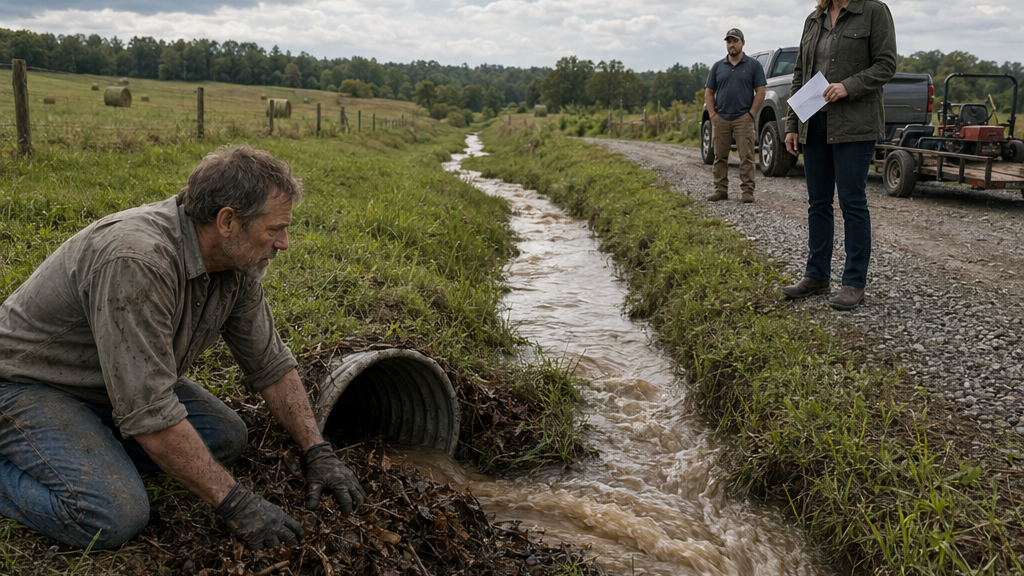
Richard Campbell had both arms buried past the elbows in the culvert when Barbara Wright stopped her SUV on the gravel lane and stepped out holding a white envelope.
He heard the door shut but did not turn.
A mat of wet leaves had packed itself against the steel grate beneath the road. The September rain two nights earlier had pushed mud, grass, twigs, and sycamore leaves into a dense brown plug. Water stood almost level with the ditch bank on the upstream side.
“Richard?”
“Minute.”
He hooked his fingers underneath the packed debris and pulled.
Nothing moved.
Barbara remained by the roadside in clean boots that had never been near the ditch before. Behind her SUV sat a pickup Richard did not recognize, towing a small commercial mower and two string trimmers.
That told him most of what was in the envelope.
He planted one knee in the wet grass and pulled again.
The plug gave way all at once.
Brown water punched through the culvert with a hollow roar. Richard rocked backward onto one hand as leaves and muddy water shot beneath the lane. The shallow swale downstream filled quickly, then narrowed into a fast-moving ribbon headed toward the lower hay ground.
Barbara took two steps away from the edge.
“I didn’t realize it held that much.”
Richard watched the water settle into the channel.
“It usually doesn’t.”
He stood, wiped his hands on his work pants, and looked at the pickup behind her.
The man inside gave him a small nod through the windshield.
Barbara held out the envelope.
“The association voted Tuesday night.”
Richard did not take it immediately.
“For what?”
“To change the maintenance contract.”
He looked at the mower trailer again.
“You mean end mine.”
Barbara’s mouth tightened, not quite an apology.
“The current arrangement is hard to account for. We’ve been paying a flat seasonal amount without itemized labor, and the insurance review raised questions about contractors working across multiple parcels.”
“For eleven years nobody asked for itemized labor.”
“I know.”
Richard took the envelope.
Barbara continued, “We’re trying to make things more professional.”
The word landed harder than he expected.
He opened the envelope. The letter was brief. Maintenance services would conclude at the end of the week. A new grounds contractor would begin Monday.
Grounds contractor.
Richard folded the letter once.
Barbara gestured toward the swale. “They’ll mow the lane shoulders, trim around the culverts, keep the ditch presentable, clear brush—basically what you’ve been doing.”
Richard looked down at the water still racing between the grass banks.
“Basically.”
She heard something in his voice.
“I’m not saying you haven’t done good work.”
“No?”
“No. But the property has changed. We have more visitors now, more horses coming in and out, events on weekends. The roadside needs to look maintained.”
Richard glanced toward Barbara’s lower parcel. She had spent most of the past two years converting an old livestock barn into an equine and event property. Fresh board fencing traced the road. Gravel parking had replaced a patch of pasture. On Saturdays, trailers and cars lined the approach.
“That ditch isn’t there to look maintained,” he said.
Barbara crossed her arms.
“I understand it handles runoff.”
Richard looked at her.
“Did you read the old drainage map?”
“The contractor has the site plan.”
“That’s not what I asked.”
A small silence opened between them.
Barbara’s patience cooled.
“I reviewed the documents the association keeps.”
“The current ones.”
“Richard, I’m not trying to argue with you.”
“Neither am I.”
He bent, picked up the wet mass of leaves he had removed, and carried it above the bank where it could not wash back into the grate.
Barbara followed his movement with her eyes.
“What exactly are you saying?”
Richard almost told her.
He almost pointed across the lower field and explained where the perforated line ran beneath the grass, where the stone junction sat below grade, where water from three parcels converged before crossing toward the creek. He could have told her why the lowest inspection point had to stay clear in autumn and why mowing the swale short did nothing if the underground line could not breathe.
Instead he heard the phrase again.
Basically what you’ve been doing.
He handed the letter back.
“I’m saying you ought to find that map.”
Barbara did not take the paper.
“You keep it.”
Richard placed it on the hood of her SUV.
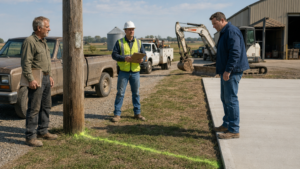
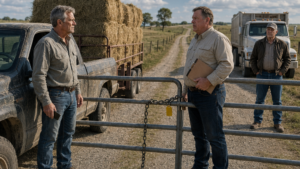
The contractor finally climbed from his truck. He was younger than Richard by twenty years and wore a company polo with reflective sunglasses perched on his cap.
Barbara introduced him only by role.
“He’ll walk the property with me Monday.”
Richard nodded.
The contractor looked toward the ditch.
“Pretty straightforward.”
Richard looked at him for a moment, then down at the muddy water.
“Most days.”
Barbara exhaled.
“You’ll finish through Friday?”
Richard bent to retrieve his rake.
“I said I would.”
He spent the next two hours doing exactly what he had always done. He cleared the second culvert. He checked the low section behind Kevin Harris’s fence. He walked the grassed swale to the place where it flattened near Barbara’s property and pressed one boot into the soil, feeling for softness.
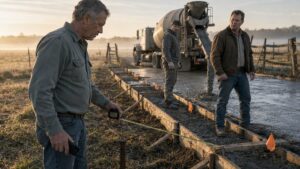
Before leaving, he put two weathered wooden stakes upright beside the roadside grass.
Anyone else might have taken them for old survey markers.
Richard knew better.
One marked an inspection point above the buried line. The other marked the approximate edge of the stone overflow bed beneath the sod.
For years, nobody had asked why they were there.
By Friday evening, his mower, rake, shovel, and clearing hooks were back at his own farm.
One thing remained.
The small pump shed near the lower lane held an oil-stained shelf where Richard had kept his maintenance notebook for more than a decade. The cover had once been black. Sun, mud, and years of dirty hands had faded it almost gray.
He opened it.
Dates filled the pages in his handwriting.
Culvert cleared.
Standing water after storm.
North outlet slow.
Stone bed opened.
Leaves removed before freeze.
Some entries went back to his father.
Richard stood alone in the shed, the notebook resting in both hands.
Barbara had paid for maintenance.
She had not paid for memory.
For a few seconds he considered leaving it.
Then he slid the notebook under his arm, switched off the light, and carried eleven years of knowledge home with him.
Chapter 2: The New Crew Mowed Over Every Warning
On Monday morning, the new contractor pulled Richard’s two wooden stakes out of the ground and tossed them into the bed of his truck.
Richard saw it from his tractor.
He was baling the last cutting on the field above the lane when the contractor stopped beside the swale, walked the shoulder with a string trimmer, then yanked both stakes free as casually as if they were broken fence pickets.
Richard eased off the throttle.
The baler rattled behind him.
He could have crossed the field in less than a minute.
Instead he watched.
The contractor mowed the grass down tight along both banks. He trimmed around the culvert mouths until the ditch looked unusually clean. Then he blew the cuttings and scattered leaves downslope.
Toward the overflow section.
Richard gripped the steering wheel.
“Not my job,” he said aloud.
The tractor engine swallowed the words.
By noon the whole roadside looked sharper than it had in years. Barbara drove past twice, slow enough to inspect it.
Richard hated that part most.
It looked good.
The ditch had smooth edges. No tall weeds hid the culvert. The lane shoulders were even. To somebody driving through with no reason to know better, the new crew had improved everything.
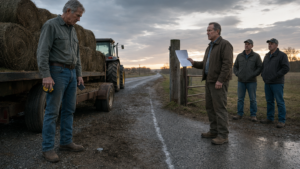
At three that afternoon Kevin Harris pulled into Richard’s farmyard.
Kevin climbed from his pickup carrying two paper cups from the gas station ten miles away.
“Peace offering.”
Richard stayed beside the tractor tire he was checking.
“For what?”
Kevin handed him a coffee.
Richard took it.
Kevin looked toward the lane.
“I voted for them.”
Richard unscrewed the cup lid.
“I figured.”
“You did?”
“You won’t look me in the eye.”
Kevin gave a short laugh without humor.
“It wasn’t personal.”
“That helps.”
Kevin leaned against the pickup.
“The association budget jumped almost twenty percent. Barbara’s insurance went up. Gravel cost more. Everybody’s complaining. The contractor bid less than half what we were paying you.”
Richard took a drink.
“He bid for mowing.”
“He bid for maintenance.”
“No.”
Kevin’s expression changed.
Richard set the cup on the tractor fender.
“You know those stakes they pulled this morning?”
“Old property markers?”
“No.”
Richard wiped his fingers on a rag.
“The north one marked a buried inspection point. The other marked the edge of the stone overflow bed.”
Kevin looked toward the road.
“There’s pipe under there?”
Richard stared at him.
“You’ve lived beside it fourteen years.”
“I know there’s drainage.”
“That’s not the same thing.”
Kevin glanced away.
Richard regretted the sharpness immediately, but not enough to take it back.
The buried system had been installed in sections over decades. Some of it was perforated agricultural pipe. Some was crushed-stone trench. Some was older clay tile that Richard’s father had tied into rather than replace.
Water from the upper pasture, Kevin’s field edge, and part of Barbara’s ground all found its way toward the same low corridor.
The swale was simply the part everyone could see.
Kevin rubbed his jaw.
“So tell Barbara.”
Richard picked up his coffee again.
“She fired me.”
“That doesn’t mean you can’t tell her.”
“I told her to find the old map.”
“Richard.”
“What?”
“You know how she is. She probably thinks you meant a property survey.”
Richard said nothing.
Kevin studied him.
“You could make one phone call.”
“And say what? Hire me back because your new man doesn’t know where to blow leaves?”
Kevin’s face tightened.
“That’s not what I said.”
“No. But it’s what she’ll hear.”
For a moment neither man spoke.
The distant mower started again.
Kevin finally said, “You’re enjoying this a little.”
Richard looked at him.
That landed because it was partly true.
Not the danger. Not the possibility of water backing up.
But the sight of somebody confidently erasing the little things he had spent years protecting had given him a bitter satisfaction.
Let them see.
The thought had been there all morning.
Richard hated hearing it in Kevin’s voice.
“I’m not going to sabotage anything.”
“I didn’t say you would.”
“I’m also not going to chase after people who decided they knew better.”
Kevin nodded slowly.
“That sounds more like you.”
He climbed into his pickup but paused with the door open.
“For what it’s worth, I thought you’d always keep doing it.”
Richard’s eyes narrowed.
Kevin realized what he had said.
“That came out wrong.”
“No,” Richard said. “It came out right.”
Kevin drove away.
Late that afternoon Richard walked the boundary where the swale disappeared into thicker grass. The contractor’s blower had driven a fan of leaves toward the lower depression. Most were dry now, but autumn had only started.
He crouched and pressed his hand against the ground.
The buried line was still moving water.
Nothing had failed.
Nothing needed him today.
He stood.
That was the argument he used to walk away.
At home, he carried the old notebook to the kitchen table and opened it for the first time since removing it from the pump shed.
Most pages were familiar.
His own handwriting filled the later years. His father’s blockier script occupied the earlier ones.
Richard thumbed backward.
A folded sheet slipped loose from the binding and landed on the floor.
He bent to pick it up.
It was yellowed notebook paper, creased into quarters.
At first he thought it was one of his father’s feed calculations.
Then he unfolded it.
A hand-drawn line crossed three roughly sketched parcels. Small circles marked culverts. A shaded rectangle sat beneath the lower lane.
Along one edge his father had written:
OLD TILE—DO NOT BLOCK.
Richard stared at the drawing.
The line did not follow the swale the way Richard remembered.
It cut farther east.
Straight beneath land Barbara’s new contractor had never touched.
Chapter 3: His Father’s Map Did Not Match Their Plat
The county map put the easement twenty-three feet west of where Richard’s father had drawn it.
Richard measured twice with his finger against the scale printed at the bottom of the plat.
It still came out wrong.
He sat at a public table inside the county records office with three documents spread in front of him: the current parcel plat, a drainage easement recorded decades earlier, and the folded sketch from his father’s notebook.
The clerk had already brought him everything indexed under the parcel numbers.
Richard pointed to the line on the current plat.
“This is the drainage easement?”
“That’s what’s recorded.”
“And this is the latest?”
“Yes.”
He looked at his father’s sketch again.
The two routes did not match.
The clerk called someone from another office.
Ten minutes later Jennifer Brown arrived carrying a tablet and a rolled set of older engineering copies.
She introduced herself as a county drainage technician, then studied Richard’s papers without rushing.
“This sketch yours?”
“My father’s.”
“Surveyed?”
“No.”
“Then we start with the recorded documents.”
Richard nodded.
That was reasonable.
He disliked it anyway.
Jennifer flattened the older drainage plan beside the plat.
The first thing Richard noticed was the buried line.
Not the grass swale.
The line beneath it.
It crossed his lower corner, ran under the shared lane, clipped the edge of Kevin’s parcel, then continued into what was now Barbara’s property before joining an older overflow structure.
Richard leaned closer.
“That’s it.”
Jennifer looked at him.
“You’ve seen it opened?”
“Parts of it.”
“When?”
“Over the years.”
“You maintained it?”
“For eleven years. My father before that.”
Jennifer traced the recorded easement with a pen cap.
The easement was wider than the visible ditch and narrower than Richard had assumed in other places. More importantly, it followed the buried infrastructure rather than the current mowed line.
Richard felt a slow satisfaction rise.
“So Barbara can’t have a contractor treat that whole strip like ordinary yard.”
Jennifer did not answer immediately.
“She can maintain property she owns.”
“Not inside the easement however she wants.”
“Correct.”
Richard leaned back.
There it was.
Not everything he had hoped, but enough.
Jennifer continued.
“However, you don’t control it exclusively either.”
The satisfaction vanished.
“I didn’t say I did.”
“You were about to.”
Richard looked at her.
Jennifer’s expression remained neutral.
“This grants access for inspection, maintenance, repair, and drainage function to the benefited parcels.”
“Benefited parcels?”
“Plural.”
Richard glanced down.
“I thought the Campbell parcel held the maintenance right.”
“It holds an access right. So do the others named here.”
She turned the document.
Richard read the legal description again. He had seen versions of it before, but never with a reason to question what his father had told him.
For years, he had understood the arrangement in simple terms: their family maintained the lower drainage line because it crossed their land first, and in exchange they had the right to access the rest.
Jennifer tapped a paragraph.
“This is not ownership of the infrastructure.”
Richard said nothing.
“It’s a shared drainage easement.”
“Then why has nobody else maintained it?”
“That’s not something this document can tell me.”
She pulled another record from the stack.
“This amendment mentions allocation of maintenance costs.”
Richard looked up.
“What allocation?”
Jennifer read silently for several seconds.
“This one is messy.”
“How messy?”
“It references an agreement that may have been separate from the easement filing.”
Richard felt irritation return.
“Meaning?”
“Meaning property law likes paperwork, and neighbors like handshakes.”
Despite himself, Richard almost smiled.
Jennifer rolled back one plan and opened another.
The buried line was clearer on this copy. A stone overflow junction sat near the low boundary between Barbara’s land and the shared lane.
Richard knew exactly where it was.
Or had known, before the stakes were removed.
Jennifer pointed to the line.
“If your contractor—”
“Not mine anymore.”
She looked at him.
“The current contractor. If they’re doing surface maintenance only, that’s one thing. If they excavate, alter grade, block access, or interfere with drainage function inside this corridor, that could become a problem.”
Richard nodded.
“So Barbara was wrong.”
“About having unrestricted control? Yes.”
The answer pleased him.
Jennifer kept reading.
“But if you think this means you can prohibit necessary maintenance because you no longer have the contract, that would also be wrong.”
Richard’s jaw tightened.
“I’m not prohibiting anything.”
“Good.”
“I stopped doing work I’m not being paid to do.”
“That is different.”
He waited.
Jennifer added, “Usually.”
Richard heard the qualification.
“What does that mean?”
“It means private obligations can depend on agreements that aren’t obvious from this plat. We need the older maintenance document.”
The clerk searched again.
Nothing appeared under the drainage easement number.
Jennifer asked for the predecessor parcel index.
That produced a thin scanned file from decades earlier.
The document was badly faded.
Richard recognized his father’s surname immediately.
CAMPBELL.
He leaned toward the screen.
A paragraph described routine clearing, inspection, repair costs, and proportional contribution among benefited parcels.
Richard read it once.
Then again.
His first reaction was disbelief.
“This says they were supposed to share it.”
Jennifer nodded.
“That’s how I read it.”
“Then why did my father pay for everything?”
“I don’t know that he did.”
Richard almost laughed.
“I do.”
He thought of invoices stuffed into old feed ledgers. Stone. Pipe. Fuel. Excavator hours. Years when his father had worked the swale himself rather than hire anybody.
Jennifer scrolled lower.
“Here.”
One sentence had been typed beneath the allocation paragraph.
Richard leaned closer.
Pending recovery of the adjacent owner’s financial position, routine maintenance costs will be temporarily assumed by Campbell.
He stopped breathing for a second.
“Temporarily?”
Jennifer read the sentence again.
“That’s what it says.”
“For how long?”
“No duration here.”
“Who was the adjacent owner?”
“We’d have to trace the parcel history.”
Richard already knew which parcel it had become.
Barbara’s.
The thought came fast and satisfying.
Then another followed.
His father had never told him the arrangement was temporary.
Or Richard had never asked.
He left the county office with copies tucked beneath his arm.
At home he spread everything across the kitchen table.
The old notebook lay beside the recorded agreement.
For years Richard had believed the maintenance was theirs because that was simply how the land worked.
His father did it.
Then Richard did it.
Nobody questioned the bill because Richard never separated one parcel’s share from another.
Nobody questioned the responsibility because the ditch stayed clear.
He opened the notebook to the earliest pages.
There were numbers in the margins.
Costs.
Initials.
Short notes.
He turned pages faster.
Then he found three consecutive entries in his father’s handwriting.
Wright share—covered.
Wright share—covered.
Wright share—covered.
Richard sat very still.
For the first time since Barbara had handed him the termination letter, he was no longer certain that the biggest misunderstanding belonged to her.
Chapter 4: The Favor His Father Never Put Into Words
The fourth ledger Richard opened had three lines that made his stomach tighten.
Wright share—covered.
Wright share—covered.
Wright share—covered.
The entries were written in his father’s heavy block lettering, each beside a different year. Below them were smaller figures for gravel, fuel, rented excavator time, and replacement tile.
Richard sat behind the scarred desk in the barn office with the old maintenance notebook open to his left and the county copies spread to his right.
He had expected to find proof that somebody else had failed to pay.
Instead he had found proof that his father had chosen not to collect.
The barn door rattled once in the wind. Richard barely heard it.
He turned another page.
A fourth year showed a different note.
Wright paid partial.
Then, two pages later:
No charge. Leave it be.
Richard stared at those four words.
His father had been dead six years. Richard could still hear the way he used to say things like that—as if refusing money was no more complicated than deciding which pasture to cut first.
Leave it be.
Richard had obeyed without knowing he was obeying.
By late afternoon he drove to Kevin Harris’s place with the ledger on the passenger seat.
Kevin was standing at his kitchen counter when Richard laid it down between them.
“You remember this?”
Kevin bent over the page.
His expression changed before he answered.
“Some of it.”
“What does that mean?”
Kevin pulled out a chair.
“It means your father told me not to talk about it.”
Richard remained standing.
“That’s convenient.”
“Sit down.”
“I’m fine.”
Kevin looked at the page again.
“This was before Barbara owned the place. Her family still had it then.”
“I know whose parcel it was.”
“They were in trouble.”
Richard said nothing.
Kevin rubbed his thumb along the edge of the ledger.
“There’d been two bad years. Feed prices were up. One of the barns needed a roof. Then the bank started leaning on them.”
“How bad?”
“Bad enough people around here thought they might lose the ground.”
Richard looked toward the window.
Kevin continued.
“The drainage line needed work about the same time. Your dad knew if he pushed for their share right then, they probably couldn’t pay it.”
“So he paid.”
“He covered it.”
“For years.”
“Yes.”
“And nobody thought maybe that was worth mentioning after?”
Kevin met his eyes.
“I asked him once.”
“What did he say?”
Kevin gave a faint, almost embarrassed smile.
“He told me a ditch didn’t care whose name was on the tax bill.”
Richard looked down.
That sounded exactly like his father.
Kevin added, “He said if the lower ground flooded, everybody would pay eventually.”
“That doesn’t explain why it became my job.”
“No.”
“Doesn’t explain why everybody kept letting me send one flat maintenance bill while every other parcel acted like I was hired help.”
Kevin’s face hardened slightly.
“You sent the bill that way.”
Richard looked up.
“What?”
“You never broke it out.”
“My father never did.”
“Your father had a reason.”
“And I didn’t?”
Kevin waited.
Richard knew the answer before he said it.
“I thought the arrangement was mine.”
“Exactly.”
The words stung because they were not cruel.
Kevin leaned back.
“You knew more about that drainage than any of us. Everybody knew it. If something backed up, we called you. If the ditch got soft, you fixed it. If the culvert slowed, you cleaned it.”
“That’s called maintenance.”
“That’s also called letting one person carry the whole thing because he never makes anybody else learn it.”
Richard’s jaw tightened.
“You voted to replace me.”
“I did.”
“Then don’t talk like you were worried I carried too much.”
Kevin looked away.
“That’s fair.”
The room went quiet.
A refrigerator motor clicked on.
Kevin finally said, “I voted for the cheaper contractor because I figured the hard part was already done.”
Richard frowned.
“The hard part?”
“The system was there. It worked. I thought upkeep was upkeep.”
Richard almost laughed, but the sound never came.
That was the whole problem, reduced to one sentence.
They had mistaken the absence of trouble for the absence of work.
Kevin tapped the ledger.
“And I figured if anything unusual happened, you’d tell somebody.”
Richard looked at him.
There it was again.
The expectation.
Not that Richard had been hired.
Not that Richard had been assigned responsibility.
That Richard would simply know—and therefore act.
“You all fired me and still expected me to stand watch.”
Kevin shook his head.
“I’m saying we got used to you doing it.”
“So did I.”
That answer surprised both of them.
Richard pulled out the chair and sat.
For the first time since Barbara had handed him the envelope, his anger felt less clean.
He had complained for years that nobody understood what he did.
But he had never taught them.
He had kept the old inspection points in his notebook instead of putting them on an association map. He had known which low spot mattered and which wet patch could be ignored. He had watched Barbara discuss “ditch maintenance” and decided her ignorance was proof she did not deserve an explanation.
Part of him had wanted them to discover his value by losing it.
He looked at his father’s handwriting.
That was not the promise he had made.
Keep the lower ground dry.
Richard had always heard obligation in those words.
Now he wondered whether his father had meant something simpler.
Keep the water moving. Keep people from hurting each other over it. Do what needs doing.
Not: make sure nobody can do it without you.
Kevin stood and poured coffee into two chipped mugs.
“Barbara know about any of this?”
“No.”
“You going to tell her?”
Richard looked at the ledger.
“I don’t know.”
Kevin set a mug in front of him.
“She should’ve listened.”
“Yes.”
“You also should’ve said more than ‘find the old map.’”
Richard gave him a flat look.
Kevin shrugged.
“I’m not saying I would’ve enjoyed saying it.”
Richard took the coffee.
That evening, back at his farm, he copied the county documents and placed Barbara’s set in a plain envelope.
He addressed it.
Then left it on the desk.
He did not drive it over.
At nine fifteen his phone buzzed with a weather alert.
A broad band of rain was expected to move through late the following week.
Richard opened the forecast.
Two inches possible.
Then he scrolled lower.
A second system was forming behind it.
Several days of heavy autumn rain were possible if the fronts stalled.
Richard looked through the barn office window toward the dark line of the lower fields.
The envelope for Barbara sat beside his father’s ledger.
For the first time, doing nothing no longer felt like the same thing as staying out of the way.
Chapter 5: The First Rain Found the Missing Maintenance
Richard knew something was wrong when he saw water running across the gravel lane.
It had never crossed there before.
Not in spring thaw. Not during the hurricane remnants eight years earlier. Not even the year the creek rose into the willow bottoms.
Yet that October morning, a thin brown stream moved from the ditch on the uphill side, slid over the tire tracks, and disappeared into the grass beyond.
Richard stopped his pickup in the road.
Rain struck the windshield in hard, steady drops.
He looked downhill.
The swale was full.
Not flooded yet. Full.
Water should have been dropping through the lower overflow section and feeding the buried line.
Instead it was stacking up.
He reached for the door handle.
Then stopped.
Not my job.
The phrase sounded worse now than it had in September.
He took his hand away from the handle and called Barbara.
She answered after four rings.
“What is it?”
“Go look at the lower ditch.”
A pause.
“I’m looking at rain everywhere, Richard.”
“The water’s crossing the lane.”
Her tone changed.
“Is that bad?”
“It’s never done it before.”
Another pause.
Then, “Can you come clear it?”
Richard looked through the glass at water sliding over the gravel.
“Call your contractor.”
“I did. He says the culvert is open.”
“The roadside culvert probably is.”
“Then what’s the problem?”
“That’s what needs inspection.”
Barbara exhaled sharply.
“You know what the problem is.”
“I know where I’d start.”
“Then come start there.”
Richard’s fingers tightened around the phone.
For eleven years, that was exactly how it had worked.
A call.
A problem.
Richard handled it.
No written scope. No separate authorization. No question about whose parcel benefited most.
He said, “I’m not going back to the old arrangement because it’s raining.”
“This is not about an arrangement. Water is coming toward my lower barn.”
“I know.”
“So help me.”
Richard closed his eyes for a second.
“I’ll tell you what to do. Call the county drainage office. Tell them there’s backup inside a recorded easement. Give them the parcel numbers I sent.”
“You never sent me anything.”
Richard looked toward his barn in the distance.
The envelope was still on his desk.
His silence had just become physical.
“I’ll bring the copies.”
Barbara said nothing.
Richard continued, “But you need the county involved before anybody digs.”
“My contractor has an excavator.”
“Tell him not to put a bucket in the ground until someone confirms the easement line.”
“Richard—”
“I mean it.”
He ended the call.
Twenty minutes later he was standing with Barbara beside the lower swale.
The difference from September was immediate.
The manicured banks were almost invisible beneath moving water. Leaves had gathered in thick rafts where the swale flattened near the buried junction.
Barbara wore an old raincoat and rubber boots now. No paperwork. No clean roadside posture.
Her contractor stood beside a compact excavator parked above the ditch.
“We can open this up,” he said.
Richard looked at the machine.
“Where?”
The contractor pointed toward the obvious low spot.
Richard shook his head.
“That’s not the junction.”
“You sure?”
“Yes.”
Barbara folded her arms.
“Then where is it?”
Richard looked across the grass.
The stakes were gone.
He could have walked directly to the inspection point once.
Now the field presented nothing but wet grass and pooled water.
“Approximately twenty feet east.”
The contractor stared at him.
“Approximately?”
“The marker got pulled.”
The man glanced toward his truck.
Recognition crossed his face.
“Those old stakes?”
Richard said nothing.
Barbara looked from him to the contractor.
“You removed them?”
“They looked abandoned.”
Barbara’s mouth tightened.
Richard felt a brief flash of vindication.
Then he saw water push over the lowest section of bank and spread toward Kevin’s field entrance.
The satisfaction disappeared.
A truck horn sounded from uphill.
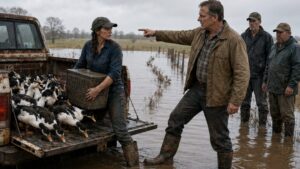
Kevin’s cattle trailer had stopped before the flooded crossing.
He climbed from the cab and walked forward through the rain.
“I’m not taking that through.”
Richard nodded.
“You shouldn’t.”
“I’ve got six head in there.”
Barbara turned toward Richard.
“This is getting ridiculous.”
“No,” Richard said. “This is getting connected.”
Kevin stared at him.
Richard pointed toward the water.
“Your access. Her barn. My lower pasture. Same system.”
Barbara’s expression shifted.
Not surrender.
Understanding, perhaps, but only the beginning of it.
Her contractor came closer.
“If you can show me where the line is, I can expose it by hand first.”
Richard shook his head.
“Not without authorization.”
“You just told me where it is.”
“I told you where I remember it being.”
Barbara raised her voice over the rain.
“So what are we supposed to do?”
Richard handed her the plastic sleeve containing his county copies.
“Call Jennifer Brown. The number’s on top.”
Barbara looked down.
“You could’ve given me this last week.”
“Yes.”
The answer came out harder than he intended.
She looked up.
For once, Richard did not defend himself.
“I should have.”
Barbara blinked.
The admission seemed to unsettle her more than an argument would have.
Richard continued, “And you should’ve had somebody review it before changing maintenance.”
She looked toward the water.
“Yes.”
It was not an apology.
It was enough for the moment.
The contractor called his office and then his insurance carrier. Ten minutes later he returned with the answer Richard expected.
He would not excavate inside a disputed recorded easement without written authorization or county direction.
Barbara’s face went pale.
“So we wait?”
“For inspection,” Richard said.
“And if it keeps rising?”
“We move what we can.”
Richard helped Kevin back the cattle trailer to higher ground. They shifted portable fencing away from the low pasture. Barbara’s workers moved equipment from the lower barn.
Nobody asked Richard to resume his old contract again that afternoon.
By dusk the rain weakened.
The swale remained high but stopped rising.
Barbara’s barn stayed dry.
Kevin’s lane remained partially blocked.
Richard stood at the fence watching brown water tremble against the grass.
The first storm had shown them the weakness.
It had not broken anything yet.
At home, Richard checked the forecast.
The next alert came less than an hour later.
The second system had accelerated.
Rain would begin again overnight.
This one carried a flood advisory.
The county inspection was scheduled for the following afternoon.
Richard looked at the time.
Then at the drainage notebook.
For the first time in years, the system might have to survive a heavy storm without anybody on the ground who knew exactly where to touch it.
Chapter 6: Four Parcels Learned What the Water Connected
Barbara called at 5:42 in the morning.
Richard answered on the second ring.
For several seconds he heard only rain.
Then she said, “We may have made a mistake.”
Richard sat up.
“How high?”
“It’s at the barn.”
He was already pulling on his jeans.
“Inside?”
“Not yet.”
“Lane?”
“Gone on the low side.”
Richard stood.
“I’m coming.”
He hung up before she could answer.
By the time he reached the shared road, headlights reflected off water where gravel should have been.
The swale had overtopped completely.
Brown runoff moved across Barbara’s lower field in a wide sheet. At the barn, water pressed against the foundation blocks and curled around the corner toward the doors.
Kevin stood beside his pickup in a rain jacket.
“Your pasture’s taking it too.”
Richard looked west.
Water had entered the lowest part of his hay ground.
The sight cut through the last of his private satisfaction.
This was no longer Barbara’s lesson.
The water had made that argument meaningless.
Jennifer Brown arrived shortly after seven in a county truck, accompanied by an excavator operator who remained on the road until she established where work could safely occur.
Barbara met Jennifer with a folder of association papers.
“We need authority to clear the line.”
Jennifer looked at the flooded corridor.
“First we need to know why it isn’t carrying.”
“The contractor couldn’t maintain it because Richard said the easement prevented access.”
Richard turned.
“That’s not what I said.”
Barbara looked at him.
“You said they couldn’t dig.”
“I said they shouldn’t excavate without knowing the recorded line.”
Jennifer lifted one hand.
“Both of you, stop.”
The rain hammered the hood of her truck.
She spread a laminated county copy across it and weighted the corners.
“Mrs. Wright, you do not have unilateral authority to alter the drainage corridor just because portions lie on your parcel.”
Barbara opened her mouth.
Jennifer turned to Richard.
“And Mr. Campbell, your access right does not mean you can treat the system as entirely outside your responsibility if your parcel is also a benefited parcel under this agreement.”
Richard stiffened.
“I stopped working after I was terminated.”
“That is not the same thing as causing the blockage.”
“I know.”
“But the documents describe shared maintenance obligations. Shared means neither side gets the simple answer.”
Barbara stared at the map.
“So who’s responsible?”
Jennifer looked at the water.
“Right now? Everyone who benefits from keeping that water moving.”
Richard felt the sentence land.
His father could have said it.
Jennifer walked the easement corridor with Richard while the others followed several yards behind.
The visible culvert was clear.
The surface swale was carrying water.
That left the buried junction.
Jennifer probed the saturated ground with a metal rod.
“Where’s the inspection point?”
Richard looked toward the old fence line.
The stakes were gone.
The contours had changed after mowing.
For a moment the field felt unfamiliar.
Then he noticed a shallow dip beside a clump of fescue.
Not the grass itself.
The way water moved around it.
He walked twelve paces east.
“No. Too far.”
He backed up three.
His father had taught him to find buried tile without measuring tape: watch where frost melted first, where grass greened earliest, where water hesitated before sinking.
Richard knelt in the rain.
He pressed both palms against the ground.
Nothing.
He shifted two feet downhill and tried again.
The soil felt firmer.
“There.”
Jennifer marked the spot.
The excavator operator approached but Richard stopped him.
“Hand tools first.”
Barbara looked impatient.
“We’re losing time.”
“If that cap is shallow and he breaks it, we lose more.”
She hesitated, then nodded.
Richard took a shovel from the truck.
After six inches he hit compacted gravel.
At ten inches the shovel scraped plastic.
He cleared mud by hand.
A round inspection cap emerged.
The contractor stared.
“I mowed right over that.”
“You couldn’t see it,” Richard said.
He almost added because you pulled the marker.
He did not.
Jennifer opened the cap carefully.
Water stood high inside.
“Junction’s intact,” she said.
“That’s good?”
“Better than a collapsed line.”
Richard lowered a probing rod.
It stopped sooner than it should.
“Debris.”
The operator and contractor set up a pump while Richard explained the configuration from memory. The buried junction fed the downstream overflow, but surface leaves and sediment could enter through the intake bed when the upper swale was neglected.
The system had not failed because one man stopped mowing.
It had failed because maintenance had been reduced to mowing at all.
Hours passed.
They cleared the blocked intake, removed compacted leaf debris, opened the stone bed, and restored enough flow to lower the water.
By early afternoon the line began taking water steadily.
The change was almost quiet.
The swale dropped an inch.
Then another.
Water stopped pressing against Barbara’s barn.
Kevin’s lane reappeared beneath the muddy current.
Barbara stood beside Richard watching it happen.
“I thought the new company was maintaining it.”
“They maintained what they could see.”
“I should have had it inspected.”
“Yes.”
She looked at him.
“You could have explained more.”
Richard watched water disappear into the stone.
“Yes.”
The word cost him less this time.
Jennifer approached with a temporary access form.
“If you continue emergency clearing today, I want everyone acknowledging this is temporary work under shared drainage necessity. It does not decide the long-term cost allocation.”
Barbara signed first.
Kevin signed next.
Richard read every line.
Then he signed.
Barbara looked surprised.
“You’re helping?”
“I’ve been helping all morning.”
“I mean after today.”
“No.”
Her expression closed.
Richard handed the clipboard back to Jennifer.
“I’ll help stabilize it. I’ll help map it. I’ll tell you everything I know.”
He looked toward the field where the old inspection stakes had stood.
“But I’m not going back to being the only person who knows where everything is.”
Barbara was quiet.
Richard continued.
“And I’m not taking another flat check that lets everybody pretend this belongs to me until something goes wrong.”
Kevin looked down.
Jennifer said nothing.
The rain softened by late afternoon.
With the main intake cleared, the water retreated from the barn foundation. The lane remained muddy but passable to four-wheel-drive vehicles.
Richard walked back to the inspection point one last time.
The plastic cap was visible now inside a ring of disturbed soil.
He remembered exactly where his father’s old stake had stood.
He drove a temporary marker into the ground beside it.
Barbara came up behind him.
“What happens now?”
Richard leaned on the post driver.
“Now you get the whole line surveyed.”
“And then?”
“Every benefited parcel gets listed.”
Kevin had joined them.
“Cost shares too?”
Richard nodded.
“Inspection schedule. Access. Who can authorize digging. Who gets called when something’s blocked.”
Barbara looked at him.
“You’ve thought about this.”
“For about eleven years.”
A trace of embarrassment crossed her face.
Richard straightened.
“The bigger problem isn’t this cap.”
He tapped the temporary marker.
“It’s that all of us let the system live in my head instead of on paper.”
Barbara looked toward the water draining steadily through the swale.
“So we write it down.”
Richard thought of his father’s ledger. The word temporarily. The favor that had lasted long enough to become an obligation nobody remembered choosing.
“Yes,” he said.
“This time, we write it down.”
Then he looked at Barbara and Kevin in turn.
“And nobody fixes this with another handshake.”
Chapter 7: This Time the Ditch Belonged to Everyone
Barbara placed Richard’s weathered notebook on the folding table as though it were evidence.
The meeting was being held in the equipment shed because nobody’s kitchen was large enough for everyone who now had an opinion about drainage.
Fresh gravel still clung to the tires of the parked trucks outside. Beyond the open shed doors, the repaired swale curved along the shared lane, newly graded and marked with bright permanent inspection posts. The old flooded ruts had been filled. The lower barn was dry.
On the table sat the proposed maintenance agreement.
Beside it sat Richard’s notebook.
Barbara rested one hand on the cover.
“I think this should be part of the record.”
Richard looked at her.
Three weeks earlier, she had treated what he knew as an outdated way of doing a simple job.
Now she wanted copies.
Kevin sat across from him with two neighboring landowners. Jennifer Brown had reviewed the technical portions but was not attending; the county had made clear that the private owners needed to decide how they would meet their shared obligations.
Barbara slid the agreement toward Richard.
“We added the inspection schedule you suggested. Spring, early fall, and after any major runoff event.”
Richard read without answering.
“Access rights are spelled out,” Barbara continued. “Nobody excavates inside the corridor without notice except during an emergency. Any contractor gets the drainage plan first.”
Kevin leaned forward.
“And every inspection point is marked permanently.”
Richard glanced through the shed doors.
One of the new posts stood almost exactly where his father’s weathered stake had once been.
Almost.
That mattered more than he expected.
He turned another page.
The agreement divided routine costs among the benefited parcels.
Richard stopped.
“This is wrong.”
Barbara stiffened.
“What?”
He pointed to the percentages.
“My parcel isn’t listed for the lower junction.”
Kevin frowned.
Barbara said, “We assumed that since the line starts on your property and you’ve already carried so much—”
“No.”
The room went still.
Richard tapped the page.
“My ground benefits from that junction.”
Barbara studied him.
“You want to pay more?”
“I want it accurate.”
Kevin gave a quiet breath that might have been a laugh.
Richard looked at him.
“What?”
“Nothing.”
“Say it.”
Kevin smiled faintly.
“I just didn’t expect that to be your first objection.”
Richard leaned back.
“It’s the reason we’re here.”
Nobody answered.
He looked around the table.
“For years, everybody treated that system like it belonged to me when there was work to do and belonged to everybody when there was water to get rid of. I’m not signing another version of that.”
Barbara slowly pulled the agreement back.
“We’ll change it.”
Richard nodded.
One of the neighboring landowners asked, “How do we figure the percentages?”
“By benefited acreage and function,” Richard said. “Not by who complains loudest and not by who happens to own the most pipe.”
Kevin added, “Jennifer said the county can help verify the drainage areas.”
Richard looked at him.
“That’ll work.”
Barbara made a note.
There was no argument.
That felt stranger than conflict.
Richard reached for the notebook.
The cover was soft at the corners from years of handling. Inside were dates, measurements, repair notes, sketches, arrows, reminders, and the shorthand he had never needed to explain to anyone.
He opened to a page marked fourteen years earlier.
A crude drawing showed the lower junction.
Beside it, his father had written:
WATCH AFTER LEAF DROP.
Richard ran a thumb beneath the words.
Barbara said quietly, “I owe you an apology.”
He looked up.
She did not sound rehearsed.
“I thought we were paying too much for something that had become routine,” she said. “And I thought routine meant simple.”
Richard said nothing.
Barbara continued.
“The property expenses had gotten away from me. Insurance, fencing, the barn improvements. Every month there was another bill. Your maintenance invoice was one of the few things I thought I could make predictable.”
“You could’ve asked.”
“I should have.”
“You also could’ve read the easement.”
“Yes.”
There was no excuse attached to the word.
Richard closed the notebook halfway.
Barbara looked around the table.
“We replaced expertise we didn’t understand.”
Kevin lowered his eyes.
Barbara continued, “And some of us—including me—benefited from an arrangement we never bothered to learn because Richard kept it working.”
Richard felt the old instinct rise.
The one that wanted to hear more.
Wanted the room to understand precisely how many wet mornings he had spent clearing culverts. How many times he had checked the line before storms. How many years he had carried something that technically belonged to all of them.
Then he looked at the notebook.
That desire felt less satisfying than it once had.
Kevin spoke.
“I need to say something too.”
Richard waited.
“I voted to replace you because I assumed if the new crew missed anything important, you’d catch it.”
One of the neighbors shifted uncomfortably.
Kevin went on.
“That wasn’t fair. We treated your knowledge like another piece of infrastructure. Something that would just be there.”
Richard looked toward the open doors.
Water moved in a narrow silver line through the swale.
Nothing dramatic.
That was the point.
Barbara pulled another sheet from her folder.
“There’s one more thing.”
Richard looked back.
“A maintenance contract.”
He frowned.
“For who?”
“You.”
He did not touch it.
Barbara explained, “Annual inspection, routine clearing, emergency response. Separate compensation for repairs. Everything itemized.”
Richard read the first page.
The money was fair.
Better than fair.
Six weeks earlier he would have wanted this exact offer.
Recognition in writing.
Defined scope.
Respectable pay.
Proof that they finally understood.
He set it down.
“No.”
Barbara stared at him.
“No?”
“I’ll help train whoever you hire. I’ll walk the line with them. I’ll give the association copies of the maps and the notebook.”
Kevin said, “Why wouldn’t you take it?”
Richard looked at him.
“Because then we rebuild the same problem with better paperwork.”
Nobody spoke.
Richard turned the notebook so the others could see.
“This can’t live with one person anymore.”
He tapped the pages.
“My father knew things nobody else knew. Then I did. That felt useful.”
His voice slowed.
“More than useful, probably.”
Barbara watched him.
Richard did not look away.
“I complained that everybody depended on me. Truth is, part of me liked being the one person who could fix it.”
The admission sat awkwardly in the shed.
He let it.
“My father told me to keep the lower ground dry. I spent years acting like that meant I had to carry the whole thing.”
Kevin asked, “What do you think he meant?”
Richard glanced outside.
“I think he meant keep the water moving.”
A small smile crossed Kevin’s face.
“That sounds like him.”
Richard nodded.
“And water doesn’t care who gets credit.”
Barbara took the maintenance contract and folded it back into her folder.
“All right.”
There was disappointment in her voice, but not resentment.
“What do you want instead?”
Richard slid the notebook toward the middle of the table.
“Copies for every parcel owner. A county map attached to the agreement. Inspection points numbered. Maintenance logs kept in the association records.”
Kevin said, “And somebody besides you learns the system.”
“Several people.”
Barbara wrote it down.
They spent another hour correcting the agreement.
Richard’s parcel received its proper share.
Barbara’s did too.
Kevin objected once to the emergency-access language, then withdrew the objection when Richard reminded him what had happened to his cattle trailer.
Nobody won every point.
That helped.
When the final draft was ready, Barbara read the last page and pushed it toward Richard.
He signed.
Kevin signed after him.
Then Barbara.
The others followed.
The notebook remained in the center of the table.
Not surrendered.
Shared.
Two days later Richard met the new maintenance crew beside the swale.
He showed them each inspection post.
He explained where the buried line turned, where leaves accumulated first, and why the grass could look perfect while water underneath was already slowing.
The crew leader took notes.
Richard made him repeat the location of the lower junction.
He got it right.
“Good,” Richard said.
Then he walked away before anyone could ask him to stay and supervise.
Later that afternoon, a light autumn shower moved across the farms.
Richard stopped his pickup beside the shared lane.
Water slipped through the grassed swale, clear enough that he could see flattened blades beneath the shallow current. It reached the culvert, disappeared underneath the road, and continued toward the lower ground without spreading across the gravel.
Beside the ditch stood one of the new inspection posts.
Square.
Pressure-treated.
Numbered.
Permanent.
It occupied nearly the same patch of ground where his father’s crooked wooden stake had stood for decades.
Richard rested one arm on the open truck window.
For years, that old stake had meant something only because he knew what it meant.
Now the new one belonged to everyone who depended on the water passing beneath it.
Richard watched the swale carry the rain away.
Then he put the truck in gear and drove home before anyone needed to call him.
The story has ended.