He Warned His Neighbor Not to Pour Concrete Across the Farm Line—Then the Survey Changed Everything
Chapter 1: The Concrete Was Already Moving
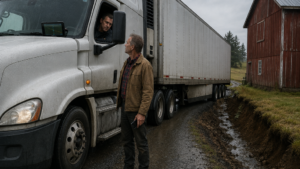
The concrete was already coming down the chute when Samuel Walker reached the lower field.
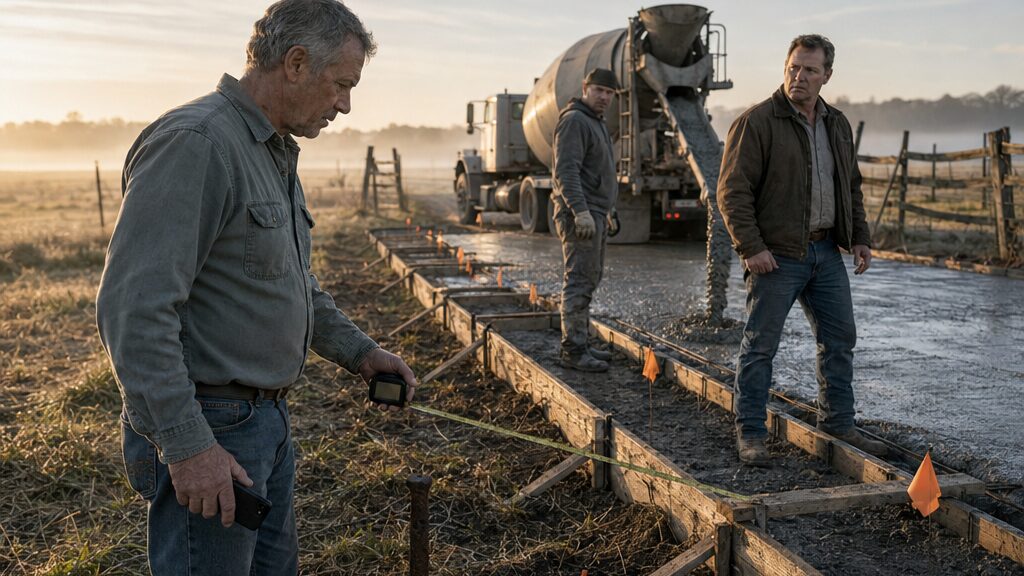
Gray slurry rolled into the wooden forms in a steady, heavy stream, swallowing gravel and reinforcing mesh beneath it. The mixer truck idled beside Justin Clark’s new machinery shed site, its drum turning with a low mechanical growl. Two laborers worked rakes through the wet concrete while another guided the chute.
Samuel stopped at the edge of the farm lane.
“Hold it.”
The concrete foreman looked up.
Samuel pointed toward the south side of the forms. “That corner is across my line.”
The foreman glanced toward Justin instead of answering.
Justin stood beside a stack of steel posts, boots muddy, jacket unzipped despite the cool morning. “It isn’t.”
Samuel had expected an argument eventually. He had not expected concrete to be moving before sunrise on Monday.
He walked back to his pickup and took a twenty-five-foot steel measuring tape from the door pocket.
“Samuel,” Justin said, “we already laid this out.”
“You laid it out from the fence.”
“That’s where the line is.”
Samuel said nothing.
That silence had served him well with cattle, machinery dealers, and men who liked hearing themselves talk. With Justin, it usually made things worse.
He crossed the grass toward an old iron pin near the ditch. Only three inches of rusted metal showed above the soil. Samuel had known it since childhood. His father had shown it to him when Samuel was fourteen, back when the lower field was still planted in corn.
Samuel hooked the tape against it.
Justin followed him. “That pin could mark anything.”
“It marks something.”
“That isn’t an answer.”
Samuel drew the tape tight.
The steel ribbon cut diagonally across the grass toward the corner of the new forms.
Seven feet before the tape reached the wooden edge, Samuel saw orange plastic crushed into the dirt.
He crouched.
An orange survey flag lay bent under the form board, its wire stem flattened by a tire. Only the torn triangular top remained visible.
The foreman shut down the chute.
For the first time that morning, the concrete stopped moving.
Justin’s expression hardened. “Why’d you stop?”
The foreman pointed at Samuel. “He says there’s a boundary dispute.”
“I say there isn’t.”
Samuel pulled his phone from his pocket and photographed the tape, the iron pin, the orange flag, and the fresh concrete.
Justin laughed once, without humor.
“You planning to build a court case out of pictures?”
“I’m planning to know where my ground ends.”
“The fence tells you.”
Samuel looked toward the old woven-wire fence running between the farms. It had been repaired so many times that no two stretches matched. Cedar posts gave way to steel T-posts, then back to cedar. Near the shed site, the fence curved gradually into Samuel’s field before bending toward the road.
His father had always said it wandered.
Samuel had never questioned by how much.
The mixer drum continued turning.
The foreman wiped his hands on his jeans. “I need somebody to make a call. This load won’t wait forever.”
Justin stepped closer to Samuel. “The contractor is here. The reinforcement is tied. I’ve got another truck coming. If we stop now, I lose the slab.”
“That’s your problem.”
The words came faster and harder than Samuel intended.
Justin’s jaw tightened. “No. Your problem is you decided this morning you don’t like where my shed sits.”
Samuel reeled in the tape halfway, then stopped.
He could have explained.
The lower strip was not empty grass to him. A drainage route crossed it somewhere beneath the soil. The hay wagons needed room to swing there when the lower field was cut. His father had spent years keeping that access open.
Instead Samuel said, “You were told the boundary was uncertain.”
“I was told you complained about it.”
“That isn’t the same thing.”
“You object to everything I do along this fence.”
Samuel felt the old anger rise.
Three years earlier Justin had moved a feed wagon through the lower gate without asking. The year after that, he had stacked round bales near the corner until Samuel could barely turn a tractor. Both times Justin had apologized after the fact.
Samuel had accepted both apologies.
He had not forgotten either one.
The foreman looked between them. “I’m not pouring through a disputed boundary unless one of you takes responsibility.”
“I will,” Justin said.
Samuel stared at him.
Justin pointed toward the forms. “Finish the slab.”
The foreman hesitated.
“You heard me.”
“Justin,” Samuel said quietly.
Justin faced him.
“If that concrete crosses my property, it comes back out.”
For a moment neither man moved.
Then Justin nodded toward the mixer.
The chute lowered.
Wet concrete began flowing again.
Samuel stepped clear.
He did not touch the truck. He did not stand in front of it. He did not raise his voice when Justin told the workers to continue.
He photographed everything.
The buried flag.
The form boards.
The distance from the pin.
The truck number.
The time on his phone.
The concrete creeping steadily toward the disputed corner.
By seven-thirty the south side of the slab was filled.
Samuel returned to his pickup and placed the steel tape on the hood. It lay there like a narrow silver accusation.
Justin came over after the crew began leveling the surface.
“You could’ve avoided all this.”
Samuel looked at him. “By doing what?”
“By accepting where the boundary has always been.”
“You mean the fence.”
“I mean the line everybody has treated as the line.”
Samuel closed the tape with a sharp metallic snap.
Justin pointed toward the fence. “My dad farmed to that fence. Your dad farmed to that fence. Before either of us owned these places, both families treated it as the boundary.”
Samuel looked again at the crooked wire.
Justin lowered his voice.
“That fence has been there forty years, Samuel.”
For the first time that morning, Samuel wondered whether the thing he remembered
Message delivery timed out. Please try again.
Retry
He Warned His Neighbor Not to Pour Concrete Across the Farm Line—Then the Survey Changed Everything
Chapter 1: The Concrete Was Already Moving
By the time Samuel Walker reached the lower field, concrete was already sliding down the mixer chute.
The truck sat crooked on Justin Clark’s side of the old fence, its rear wheels sunk into gravel, engine thudding while a gray ribbon of wet concrete folded into wooden forms. Two workers dragged the mix toward the corners with rakes. Another stood ankle-deep in mud, guiding the chute.
Samuel stopped at the edge of the hayfield.
The forms were farther west than they had been Friday.
Too far.
He crossed the grass without hurrying.
“Hold the pour.”
The concrete crew foreman looked up. “You talking to me?”
“I’m talking about that form.”
The foreman glanced toward the house beyond the machinery yard.
Samuel pulled a steel measuring tape from his jacket pocket.
Justin came around the half-built shed frame before Samuel had extended ten feet. He wore work pants and an open flannel shirt, coffee in one hand.
“What now?”
Samuel hooked the tape against an old iron pin near the ditch.
“This corner’s across the line.”
Justin gave a short laugh. “No, it isn’t.”
Samuel pulled the tape tight.
He had measured the same ground twice over the weekend, first from the iron pin and then from the corner of the old pump shed. He had not trusted himself the first time. The second measurement had been worse.
The concrete form sat several feet inside what he understood to be Walker ground.
Justin stepped over a stack of rebar.
“That pin hasn’t meant anything since before either of us were running these places.”
“It marks something.”
“The fence marks the boundary.”
Samuel looked toward the fence.
The old woven wire sagged between cedar posts, running almost straight for fifty yards before bending toward Justin’s machinery yard.
Almost straight.
That bend was exactly the problem.
Samuel kept pulling the tape.
A worker lifted his rake out of the wet concrete and watched.
“Justin,” the foreman said, “you want us stopped?”
“No.”
Samuel’s jaw tightened.
“I’m telling you the boundary’s disputed.”
“And I’m telling you the fence has been there forty years.”
“The fence isn’t a survey.”
“It’s been good enough for everybody until you saw me building something.”
The accusation landed harder than Samuel wanted it to.
He crouched beside the form.
An orange survey flag was trapped beneath a board, its wire stem bent flat in the mud. Only the triangular tip showed.
Samuel wiped dirt away with two fingers.
He remembered placing no flag there.
He looked at Justin.
“Who put this in?”
Justin shrugged. “Contractor marked utilities, probably.”
Samuel measured from the iron pin to the trapped flag, then from the flag to the form.
The numbers tightened something in his chest.
The form did not merely brush his expected line.
It crossed it.
The foreman climbed down from the truck platform. “How far are we talking?”
Samuel read the tape again.
“Enough that you shouldn’t cover it until somebody checks.”
Justin set his coffee on a stack of lumber.
“You’re not shutting down my pour because you suddenly decided an old pin outranks the fence.”
Samuel stood.
“I didn’t say I could shut you down.”
“Sounds like what you’re trying.”
Samuel looked at the concrete already filling the first section.
He could step onto the boards. He could pull the chute away. He could make enough trouble that no crew would risk continuing.
Instead, he took out his phone.
He photographed the iron pin.
The tape.
The orange flag under the form.
The wet concrete.
Justin stared at him. “You taking pictures now?”
“Yes.”
“For what?”
“So nobody has to remember this differently later.”
The foreman rubbed a hand over his chin.
“Justin, I need you to tell me straight. You want us pouring with him claiming the property line runs through the form?”
“Yes.”
Samuel turned to the foreman.
“You heard my objection.”
“I did.”
“I’m not blaming your crew. I’m asking you to note when I said it.”
The foreman nodded once.
Justin exhaled sharply. “Samuel, this is a machinery shed. Not a subdivision. You know exactly why I need it.”
Samuel did know that Justin had bought a larger baler and had two tractors sitting outside under tarps. He knew harvest would tighten every schedule in the county within weeks.
What he did not know was why Justin thought urgency altered ownership.
“You can build what you want,” Samuel said. “On your side.”
“I am on my side.”
The foreman looked between them.
Then Justin pointed at the chute.
“Keep it moving.”
The worker pulled the lever.
Concrete began flowing again.
For several seconds Samuel heard only the mixer engine, the scrape of steel rakes and the heavy slap of wet concrete hitting wet concrete.
He stood with the tape still stretched between his hands.
He had expected Justin to argue. He had not expected him to continue after being warned.
That changed the weight of the morning.
Samuel reeled the tape in slowly.
Justin picked up his coffee.
“You going to stand here all day?”
“No.”
“Good.”
Samuel walked along the fence toward the farm lane, counting posts without meaning to. At the bend, he stopped.
From here the problem looked different.
The fence leaned toward his field.
Not by inches.
By feet.
He stepped across the grass and measured from the farm lane to the nearest post. Then another. Then another.
The bend grew steadily.
Five feet.
Then nearly six.
For the first time that morning, his certainty weakened.
He looked back toward the slab.
Justin was watching him.
“You see it now?” Justin called.
Samuel said nothing.
Justin came closer but stayed on his side of the wire.
“My dad repaired that fence with your dad standing right there,” he said. “I was a kid. You were already working this place.”
Samuel remembered repairs.
He remembered cattle pushing wire down after storms.
He remembered his father saying fences wandered when men got tired.
But he did not remember anyone agreeing to move a boundary.
Justin rested one hand on a post.
“Forty years, Samuel.”
Behind him, the concrete kept moving.
“If that fence is wrong,” Justin said, “then it’s been wrong a long time.”
Samuel looked from the sagging wire to the iron pin behind him.
For the first time since he had walked into the field, the question was no longer how far Justin had crossed his property.
It was whether Samuel had been measuring from the right line at all.
Chapter 2: The Fence Did Not Match the Map
By noon, Samuel had found a place where the fence stood nearly six feet inside the parcel dimensions written on the county map.
He measured it twice.
The steel tape lay across the farmhouse kitchen table beside a photocopy he had pulled from an old farm file. Pencil marks from his father remained along one edge, numbers written in the tight block handwriting Samuel had seen on feed bills and machinery manuals his whole life.
Donna Walker leaned over the paper.
“You’re assuming this corner is still where that map says it is.”
“The road hasn’t moved.”
“That isn’t what I said.”
Samuel pressed one finger against the printed boundary.
“The parcel width is right here.”
“So is a disclaimer.”
He ignored that.
Donna folded her arms.
“You’ve been doing that since breakfast.”
“Doing what?”
“Reading the parts you like.”
Samuel looked up.
Donna had driven over after he called to ask whether she remembered the lower fence ever being moved. She owned part of the acreage with him, though Samuel handled nearly every daily decision.
He had expected a memory.
Instead, he had gotten questions.
“The concrete is already down,” he said.
“I know.”
“If it’s on us, every hour matters.”
“And if it isn’t?”
Samuel folded the map.
“Then I’ll know.”
At the county land office, the clerk printed a newer parcel sheet and pointed Samuel toward Rachel Baker.
Rachel worked at a counter behind a computer with rolled field maps stacked in vertical bins. She studied Samuel’s documents without reacting to his explanation.
He set his phone beside them and showed her the photographs.
The iron pin.
The tape.
The concrete form.
The orange flag.
Rachel enlarged the image of the pin.
“You know who set this?”
“No.”
“You know whether it’s referenced in the recorded survey?”
“My father treated it as the corner.”
“That wasn’t my question.”
Samuel leaned back.
“No.”
Rachel turned to the parcel map.
“And the fence?”
“Been there decades.”
“Straight?”
“No.”
“Rebuilt?”
“Parts of it.”
“Moved?”
“Not that I know of.”
Rachel looked at him over the top of the paper.
“That answer and ‘no’ are not the same answer.”
Samuel felt irritation rise.
He had come for confirmation, not a lesson in vocabulary.
“The neighbor poured concrete this morning.”
“I understand.”
“I measured it.”
“I understand that too.”
“And?”
“And I’m not certifying a legal boundary from your tape measure and a tax parcel graphic.”
Samuel stared at her.
“What can you certify?”
“After field verification, possibly quite a bit.”
“How soon?”
Rachel checked a calendar.
“Thursday morning.”
“Three days?”
“That’s soon.”
“He’s building now.”
Rachel slid the map back.
“You can tell him the boundary remains disputed. You can consult counsel if you want immediate legal options. But if you’re asking me whether the concrete is definitely on your parcel, I’m not going to tell you something I haven’t established.”
It was not the answer Samuel wanted.
That was partly why he trusted it.
He scheduled the field visit.
On the drive home he slowed beside the lower field.
The concrete had hardened enough for workers to walk across.
Stacks of lumber now sat on it.
Justin had not waited.
By late afternoon, upright posts appeared along the slab edge.
Samuel stopped his truck at the farm lane and got out.
Justin was carrying a beam with the foreman.
“You’re framing already?”
Justin lowered his end.
“The concrete’s there.”
“The county survey is Thursday.”
“Good.”
“You could wait.”
“I could also lose three days.”
Samuel looked at the new posts.
“You’re building on a disputed slab.”
Justin wiped sweat from his forehead with his sleeve.
“And you’re disputing land my family’s maintained longer than you’ve been running Walker Farm.”
“That doesn’t make it yours.”
“Maybe your map doesn’t make it yours either.”
Samuel nearly answered.
Instead he put one hand into his jacket pocket and felt the tape measure.
He left it there.
The gesture bothered him more than the argument.
Until that morning the tape had represented certainty. Now it felt like an accusation he was not sure he could prove.
At the farmhouse that evening, Donna brought an old box from the hall closet and set it on the table.
“Found these behind Mom’s tax records.”
Inside were photographs, machinery receipts and several faded snapshots of the lower pasture.
Samuel held one up.
The fence was visible behind his father and Justin’s father beside a stock trailer.
It sat farther west than Samuel expected.
He turned to Donna.
“When was this?”
“Probably late eighties.”
He studied the picture.
The image was too grainy to establish feet or inches, but it made one thing clear: the strip between the fence and the field had never been treated as carefully as Samuel remembered.
Donna pulled out another photograph.
Justin’s father was driving a tractor along the same narrow ground Samuel now considered part of his equipment access.
“You knew about this?”
“I knew they used it.”
“How often?”
“Sometimes.”
“That isn’t permission.”
“I didn’t say it was.”
“Dad would’ve said something.”
Donna gave him a long look.
“Dad let neighbors turn equipment wherever it fit.”
“Not if it cost him land.”
“You keep saying that like every fence post was a court order.”
Samuel set the picture down harder than necessary.
Donna’s voice softened.
“Sam, I’m not saying Justin gets to pour concrete wherever he wants.”
“Sounds close.”
“I’m saying you’re remembering Dad as stricter than he was.”
Samuel looked toward the dark kitchen window.
His father had made him promise, during the last year he was still able to climb into a tractor, not to let the usable acreage disappear a little at a time.
A ditch widened.
A neighbor moved a gate.
Brush swallowed a corner.
Nobody meant harm, his father had said. That was how land disappeared anyway.
Samuel had carried those words like instructions.
Donna touched the old photograph.
“Justin’s family used that strip before you took over.”
Samuel looked again at the tractor tracks frozen in the faded image.
The county survey would still determine where the recorded boundary lay.
But another question had entered the dispute now.
Even if the ground belonged to the Walkers on paper, what exactly had forty years of casual use taught Justin to believe?
Chapter 3: What Ran Beneath the Narrow Strip
The water should have disappeared in ten minutes.
After forty-five, a brown sheet still stood across the lowest section of Samuel’s hayfield.
He shut the test valve at the old pump shed and walked downslope, boots sinking into soft ground.
The field had always drained toward the boundary strip before turning beneath the lane through an old buried line. Samuel had not thought about that pipe in years because it had never given him reason to.
Now the water had nowhere to go.
Donna stood near the fence with her hands in her jacket pockets.
“That normal?”
“No.”
He followed the shallow flow until it reached the raised ground beside Justin’s new slab.
The water pooled there.
Samuel crouched.
“What are you looking for?” Donna asked.
“Outlet.”
He pushed grass aside.
Nothing.
He moved several feet north.
Still nothing.
Then he saw the dark edge of an old corrugated pipe beneath packed soil.
Its mouth disappeared directly under the gravel base beside the slab.
Samuel’s stomach tightened.
He dug around it with his hands.
The pipe entered the ground at an angle aimed beneath the newly poured corner.
Donna came closer.
“Is that the drain?”
“Yes.”
“Does Justin know?”
Samuel did not answer immediately.
He had argued about ownership.
He had measured posts.
He had photographed forms.
He had never told Justin this strip carried drainage from the lower field.
Partly because Samuel himself had forgotten how directly.
Partly because after Justin dismissed his first warning, explaining anything had felt too much like pleading.
Donna understood the silence.
“You didn’t tell him.”
“He shouldn’t need a list of reasons not to cross a boundary.”
“That’s not what I asked.”
Samuel stood.
“He was told the line was disputed.”
“And you decided that was enough.”
“It should have been.”
Donna looked toward the slab.
“That’s your problem, Sam.”
He turned sharply.
“My problem?”
“You get hurt, then you make people guess what matters.”
“This isn’t about feelings.”
“No. Now it’s about water standing in a hayfield.”
Samuel walked back to the truck.
He returned with the steel tape.
From the old pump shed he measured the equipment lane, then the turning space needed to bring the hay wagon around without dropping one set of wheels into the drainage depression.
With the new slab where it stood, the turn narrowed badly.
He stretched the tape again.
The numbers gave shape to something more serious than his father’s promise.
If the strip were permanently blocked, Samuel could still reach the field.
But not cleanly with his wider equipment.
And if the buried line remained pinched beneath fill or concrete, heavy rain could keep water against the lower acreage long enough to damage a cutting.
Donna watched him mark the turning arc with his heel.
“So that’s why it matters.”
Samuel reeled in the tape.
“That’s one reason.”
“One you might’ve mentioned Monday.”
He said nothing.
At midday he walked to Justin’s machinery yard.
Justin was helping position roof trusses near the partially framed shed.
Samuel waited until Justin climbed down from the ladder.
“We need to talk about the drain.”
Justin looked at him.
“What drain?”
Samuel pointed toward the lower field.
“There’s an old buried line running under that strip.”
Justin’s expression changed, but only briefly.
“You’ve never mentioned a drain.”
“I found the outlet this morning.”
“Convenient.”
Samuel stared at him.
Justin shook his head.
“First it was the iron pin. Then the county map. Now there’s a buried drain.”
“You think I dug a pipe into the ground overnight?”
“I think you keep finding a new reason after the last one doesn’t settle it.”
“The survey hasn’t happened yet.”
“Exactly.”
Samuel stepped closer, keeping his voice level.
“My lower field isn’t draining.”
“And you know my slab caused that?”
“I know the outlet goes under your base.”
“You know where it enters. You don’t know where it runs.”
That was true.
Samuel hated that it was true.
Justin saw the hesitation.
“There. That’s what I mean.”
“What?”
“You talk like every guess you make is already settled.”
Samuel felt the old instinct rise—to stop explaining, to let Thursday answer everything.
Instead he forced himself to continue.
“I also need the strip to turn equipment.”
Justin laughed once, without humor.
“Now it’s equipment.”
“Yes.”
“You’ve driven that field for years.”
“With the fence where it was.”
“The fence is still where it was.”
“The slab isn’t.”
Justin rubbed both hands over his face.
“I have lumber sitting out, a baler that doesn’t fit in the old shed and a lender expecting this building completed. You think I started pouring because I wanted a feud?”
“I think you kept pouring after I warned you.”
Justin’s jaw tightened.
“And I think you waited until concrete showed up to suddenly remember every problem that strip ever solved.”
That struck close enough that Samuel did not answer.
Justin pointed toward the half-framed shed.
“You want me to believe the whole farm depends on six feet you haven’t cared about in twenty years?”
Samuel looked past him to the concrete.
He could have said his father had cared.
He could have spoken about the promise.
Instead he said, “Thursday will tell us where the line is.”
Justin nodded.
“Then maybe Thursday’s when you should’ve started acting like you knew.”
Samuel walked away angry at Justin, and angrier at himself because there was truth buried inside the insult.
That afternoon he opened the old pump shed and traced the drainage route as far as he could. He found a second access point under a rusted metal cover and pushed a flexible rod through the pipe.
It stopped.
He withdrew it, changed the angle and tried again.
Same point.
Roughly beneath the slab edge.
Donna stood in the doorway.
“Blocked?”
“Maybe crushed. Maybe packed with dirt.”
“What happens if it rains hard?”
Samuel looked toward the lower field.
“We find out how much water it can hold.”
Near sunset a truck appeared on the county road, slowed at the Walker entrance and turned down the gravel lane.
Samuel stepped outside.
Rachel Baker was behind the wheel.
A second county worker rode beside her, and survey equipment filled the truck bed.
Samuel checked the time.
“You’re early.”
Rachel climbed out.
“Tomorrow’s schedule opened up. I figured neither of you would complain.”
Across the boundary, Justin noticed the truck.
He came out of the shed frame wiping his hands on a rag.
Rachel opened the tailgate and lifted out a tripod, a receiver and a bundle of marking stakes.
“Before anybody tells me where they think the line is,” she said, “I want both sides clear on something.”
Samuel and Justin stood ten yards apart.
Rachel planted the tripod in the gravel.
“Today we follow recorded evidence and monuments. Not fences. Not memories. Not who has used what.”
She glanced at the new concrete.
“And not who has already spent the most money.”
Justin folded his arms.
Samuel felt the steel tape against his pocket.
For three days it had been the closest thing he had to proof.
Now Rachel carried instruments that could make his measurements irrelevant.
She walked toward the buried iron pin, then stopped.
Instead of setting up over it, she looked past it toward a patch of compacted gravel beside the new slab.
“There should be another monument near here.”
Justin frowned. “There’s nothing there.”
Rachel handed the county worker a shovel.
“Let’s find out.”
The shovel cut into gravel less than two feet from the concrete.
On the fourth scrape, metal rang beneath it.
Chapter 4: The Survey Pin Under Fresh Concrete
The shovel struck metal again.
Rachel Baker raised one hand, and the county worker stopped digging.
Samuel stepped closer, but Rachel pointed him back.
“Give me room.”
The worker cleared gravel with the edge of the shovel until a rust-darkened iron monument appeared, no wider than Samuel’s thumb.
Justin came down from the slab.
“That’s the corner?”
“It’s a monument,” Rachel said. “I haven’t said what it proves yet.”
She brushed away dirt, set the receiver over it, then checked her field notes against the recorded survey. The process took long enough for the quiet to become uncomfortable.
Samuel could hear cattle shifting behind the upper fence.
Justin kept looking at the new post frame as if work might resume if he stared at it hard enough.
Rachel moved to the older iron pin Samuel had measured from on Monday.
She took another reading.
Then another farther north.
The county worker drove a temporary stake into the ground.
Rachel stretched a line between the verified points.
It did not follow the fence.
Samuel felt a small release in his chest.
Then he saw where the line went.
It crossed Justin’s concrete.
But not where Samuel had claimed.
The official line clipped through the western corner of the slab, placing a substantial section on Walker ground, though several feet less than Samuel’s first measurement had suggested.
Rachel checked the reading again.
Justin stared at the line.
“How much?”
Rachel gave the distance.
Samuel listened without reacting.
He had been right.
Mostly.
That word irritated him.
Justin looked toward Samuel.
“So he was wrong.”
Rachel turned.
“No. The slab encroaches.”
“But not by what he said.”
“No.”
Justin gave a humorless laugh. “That matters.”
“It does.”
Samuel finally spoke.
“So does the fact that it crosses.”
Rachel nodded.
“Also correct.”
She walked toward the old fence and placed another marker.
The fence wandered across the surveyed line in both directions. In one section it stood well inside Samuel’s parcel. Farther north, it drifted onto Justin’s.
Rachel pointed to the irregular path.
“This is why neither of you should have treated the fence as legal proof.”
Justin folded his arms.
“My family maintained that side for decades.”
“Usage is a separate question.”
Samuel heard the distinction clearly.
Boundary.
Usage.
Access.
Different things.
He had collapsed them into one.
Rachel moved the line again and aligned it across the slab.
Samuel took his steel tape from his pocket.
For a moment he hesitated.
Then he held one end while Rachel set the other against the verified point.
The tape ran over hardened concrete.
Not wet concrete now.
Not a warning.
A fact.
The measurement showed exactly what had happened.
Part of Justin’s slab sat on Samuel’s property.
Part of Samuel’s original claim had been too broad.
Rachel marked the correct line with paint and temporary stakes.
Justin stood beside her.
“What happens now?”
“That’s between the property owners unless you involve legal counsel or local enforcement. My job is the line.”
Samuel looked at the slab.
On Monday he had imagined the satisfaction of seeing the entire thing broken apart.
Now the image felt different.
The line divided not only the land but his certainty.
Rachel walked toward the drainage edge.
“Your old fence explains the confusion.”
Justin looked at Samuel. “Exactly.”
Rachel held up a hand.
“I said explains. Not excuses.”
Justin’s mouth closed.
“You poured after being told the boundary was disputed,” she continued. “That was a choice.”
Samuel expected to enjoy hearing it.
He did, briefly.
Then Rachel looked at him.
“And you treated your first measurement like a final survey. That was also a choice.”
Samuel looked down at the tape.
Donna would have enjoyed that sentence more than he did.
The county worker began setting more visible markers.
One of the orange flags landed just beyond the slab edge.
Samuel watched it flutter.
On Monday those flags had seemed like evidence in his favor.
Now they meant something simpler.
Pay attention.
Justin walked toward the building frame.
“What am I supposed to do with this?”
Samuel followed him.
“You move what’s across.”
“That corner is tied into the whole pad.”
“That’s not my doing.”
Justin turned.
“You think they can just chip off whatever you don’t like?”
“I think you poured it after I told you not to.”
“I told you why I thought the fence was the line.”
“And I told you it was disputed.”
Justin stepped closer.
For a moment Samuel thought the argument would return to where it had started.
Instead Justin looked toward the machinery yard.
When he spoke again, his voice was lower.
“You want to know why I kept going?”
Samuel said nothing.
Justin rubbed the back of his neck.
“The lender inspection is next week.”
Samuel waited.
“I’ve got equipment tied to the expansion. Shed, storage, everything. If the building isn’t far enough along, they can freeze the next draw.”
Samuel’s anger did not disappear.
But it shifted.
“You knew the survey wasn’t done.”
“Yes.”
“And poured anyway.”
Justin looked at the concrete.
“I thought the fence would hold.”
“You hoped it would.”
Justin did not correct him.
Rachel called from the line.
“I’ll have the field notes filed tomorrow.”
Samuel turned back toward her.
The answer he had wanted was finally under his boots.
The line was real.
The encroachment was real.
But Justin’s problem was real too.
For the first time, Samuel understood that being right about the ground did not automatically tell him what justice should cost.
Chapter 5: The Cost Behind Justin’s Refusal
Justin opened the machinery shed door on his old building and pointed inside.
Samuel had expected an argument.
Instead he saw a tractor wedged so tightly between a hay rake and a baler that neither could be moved without pulling something else outside first.
The roof leaked near the north wall.
A blue tarp hung beneath the rafters to catch water.
“You wanted to know why I couldn’t stop,” Justin said.
Samuel remained near the doorway.
“I know why you said you couldn’t stop.”
Justin looked at him.
“That’s not the same thing.”
“No.”
Outside, two more pieces of equipment sat under weathered covers.
Samuel recognized the larger baler Justin had mentioned.
“You bought all this before the shed was done?”
“Loan package covered equipment and expansion.”
“That seems backward.”
“It wasn’t supposed to be.”
Samuel heard defensiveness, but not the swagger Justin had carried on Monday.
Justin walked past the baler.
“My old storage lease ended. Owner sold the place. I had until harvest to move everything.”
Samuel touched the tape measure in his jacket pocket but did not take it out.
Justin noticed.
“You going to measure my building too?”
“No.”
“Could’ve fooled me.”
Samuel almost left.
Then Justin said, “I knew Rachel’s survey wasn’t finished.”
The admission stopped him.
Justin leaned against the tractor tire.
“I called the county Friday.”
Samuel turned.
“You called?”
“They told me they couldn’t confirm the line until the field work.”
“And you poured Monday.”
“Yes.”
There it was.
Not ignorance.
Not merely an old fence.
A gamble.
Samuel felt his sympathy narrow.
“You knew enough to know you might be wrong.”
Justin looked at the floor.
“I knew enough to know waiting could cost me.”
“So you made that my risk.”
Justin’s head came up.
“I thought the odds were on my side.”
“That isn’t an answer.”
“It’s the answer I’ve got.”
Samuel stared at him.
Justin’s financial pressure explained the decision.
It did not clean it.
“You should’ve stopped.”
“I know that now.”
“No. You knew it then.”
Justin did not argue.
That mattered more than Samuel expected.
They walked outside.
The half-built shed cast narrow shadows across the slab. The surveyed line remained visible in paint.
Justin pointed toward the frame.
“If you demand removal of the whole pad, the posts come out. Reinforcement has to be cut. Probably half the structure goes with it.”
“That corner is on my ground.”
“I’m not denying that.”
“Not anymore.”
Justin’s jaw tightened, then relaxed.
“No.”
Samuel stood looking at the concrete.
He had already called a contractor that morning.
The first estimate assumed complete removal of the slab section and surrounding structural work. It was expensive enough to hurt Justin badly.
At the time, Samuel had thought that was fair.
Justin had ignored the warning.
Justin should bear the consequence.
Simple.
Now the word “simple” bothered him.
Donna arrived later in the afternoon while Samuel was checking the drainage outlet again.
She found him sitting on the tailgate of his truck.
“So?”
“He admitted he knew the survey was unresolved.”
Donna raised her eyebrows.
“That doesn’t help him.”
“No.”
“You sound disappointed.”
Samuel looked toward the slab.
“I wanted him to be wrong for a stupid reason.”
“What’s the real reason?”
“Money. Timing. Pride.”
Donna sat beside him.
“That sounds more expensive than stupidity.”
Samuel almost smiled.
Almost.
“He still chose it.”
“Yes.”
“He could’ve waited.”
“Yes.”
“He made the problem.”
“Yes.”
Samuel turned to her.
“You planning to disagree with me at some point?”
“I’m waiting until you say something wrong.”
He looked back toward the boundary.
“If I force full removal, it could take out more concrete than what crossed us.”
Donna nodded.
“Would that help the drainage?”
“Maybe. Maybe not.”
“Would it help equipment access?”
“No more than cutting it back to the line.”
Samuel rubbed both palms together.
His father’s voice lived in his memory with irritating clarity.
Don’t lose usable land because nobody wanted to make trouble.
Samuel had always heard that as a command to hold hard.
But his father had never said to take more than what belonged to them.
Donna nudged his shoulder.
“What do you actually need?”
“The strip clear.”
“And?”
“The drain repaired.”
“And?”
“A permanent surveyed boundary.”
Donna waited.
Samuel understood what she was asking.
“Not the whole slab.”
The answer left a bad taste.
Not because it was wrong.
Because part of him had wanted the whole thing broken.
He had wanted Justin to watch the project disappear and remember Monday morning every time concrete dust blew across the yard.
That desire had nothing to do with drainage.
Nothing to do with acreage.
Nothing to do with stewardship.
It was punishment.
Samuel stood.
The contractor arrived Friday morning in a work truck with concrete saw equipment in the bed.
He examined the slab, the reinforcement plan and Rachel’s marked boundary.
“Could cut only the encroaching section,” he said.
Justin looked sharply at him.
Samuel asked, “Without taking the rest?”
“Probably. Need to expose steel, cut clean, reinforce the remaining edge. Depends what we find.”
Justin stepped closer.
“That saves the posts?”
“Most likely.”
Samuel looked at the painted line.
“How much clearance after removal?”
The contractor measured.
Enough for the equipment turn.
Enough to reach the drainage route.
Not generous.
But enough.
Justin said nothing.
Samuel took the steel tape from his pocket and checked the measurement himself.
This time he did not use it to challenge anybody.
He simply confirmed the numbers.
The contractor watched him.
“You want me to price the full tear-out or just the surveyed encroachment?”
Samuel looked at Justin.
Justin’s face gave away nothing.
Samuel thought of the concrete flowing Monday.
The warning ignored.
The old fence.
The wrong measurement.
The blocked drain.
The lender.
His father.
Then he folded the tape.
“Price the cut.”
Justin exhaled.
Samuel raised a hand.
“I didn’t say you were off the hook.”
“I know.”
“You pay for removal and repair.”
“I know.”
“And if that drain is damaged—”
“I pay for that too.”
Samuel studied him.
For once Justin did not sound cornered.
He sounded tired.
The contractor climbed into his truck.
“I can bring the saw Monday.”
Samuel nodded.
As the truck pulled away, he watched the painted line disappear beneath its shadow.
The concrete would still be cut.
The boundary would still be restored.
But the question had changed.
It was no longer how much damage Samuel could legally demand.
It was whether removing only what crossed the line would be enough to protect what actually mattered.
Chapter 6: Cutting Back Only What Crossed
The concrete saw rested directly over the surveyed line.
Its blade had not started yet.
Samuel stood beside the slab with Rachel’s field markers on one side and Justin’s framed shed on the other.
The contractor crouched to check the guide.
“You’re certain this is the cut?”
Samuel took out the steel tape.
He measured from the permanent reference point to the painted boundary, then checked the contractor’s mark.
The numbers matched.
“Yes.”
Justin stood ten feet away.
He had spent most of the morning silent.
When the contractor started the saw, the engine rose into a hard mechanical whine.
Water sprayed over the blade.
Concrete slurry ran gray along the surface.
The cut began.
Justin watched as if he were looking at a wound opening.
Samuel understood the feeling.
A week earlier, he would have welcomed it.
The blade followed the exact line Rachel had established.
Not Samuel’s first line.
Not the old fence.
Not Justin’s assumption.
The surveyed boundary.
Halfway across the corner, the contractor stopped.
“You still want just this section?”
Justin looked at Samuel.
There it was.
Expectation.
He thought Samuel might change his mind.
Samuel could see it plainly.
“You thought I was taking the whole slab,” Samuel said.
Justin did not answer.
“You did.”
“Yes.”
“Why?”
Justin gave a dry laugh.
“Because I probably would, if it were mine.”
That honesty settled something.
Samuel looked at the saw.
“Keep the cut where it is.”
The contractor nodded.
Justin stared at him.
Samuel said, “What crossed gets removed. What didn’t stays.”
No gratitude came.
Samuel preferred it that way.
The saw started again.
After the perimeter cuts were complete, the excavator operator lifted the first broken section.
Underneath, compacted gravel gave way to dark soil.
Then the contractor raised his hand.
“Hold.”
The excavator stopped.
He climbed into the exposed cut and knelt.
Samuel stepped closer.
A crushed section of corrugated drainage pipe was visible beneath the slab base.
The top had been flattened.
Mud packed the opening.
Samuel felt anger return instantly.
“There.”
Justin came beside him.
He looked at the pipe.
“You were right.”
Samuel did not enjoy hearing it.
The lower field had been holding water for days.
“How much is damaged?” Samuel asked.
The contractor exposed another foot.
“Hard to say until we open it.”
Justin said, “Fix it.”
Samuel looked at him.
Justin kept his eyes on the pipe.
“I said I’d pay for the drain.”
The contractor began clearing gravel.
Samuel walked to his truck and brought back the old tape.
He measured the distance from the pipe to the access lane.
Justin followed him.
“What are you checking?”
“Turn radius.”
Justin waited.
Samuel stretched the tape across the cleared strip.
“With the concrete cut back here, I can bring the hay wagon through.”
Justin nodded.
“You could’ve told me that Monday.”
Samuel looked at him.
“Yes.”
Justin seemed surprised.
Samuel reeled in a few feet.
“I should have.”
The saw noise had stopped. Without it, the field sounded unusually quiet.
Samuel continued.
“I thought the boundary ought to be enough.”
“It should’ve been.”
“That doesn’t mean I handled it well.”
Justin looked toward the lower field.
“So the drain and the turn are the real reasons?”
“They’re practical reasons.”
“What’s the other one?”
Samuel knew exactly what he meant.
He had not planned to say it.
“My father.”
Justin waited.
“He spent his last years worrying about losing usable ground a little at a time. Brush. Ditches. Gates. People cutting corners because nobody wanted to argue.”
Justin looked toward the old fence.
“He and my dad moved cattle through here together.”
“I know.”
“He didn’t act like every foot was sacred.”
“No.”
Samuel paused.
“That’s part of what I’ve been wrong about.”
Justin turned toward him.
Samuel folded the tape against his palm.
“He told me not to neglect the farm. Somewhere along the way I started hearing that as don’t yield anything, ever.”
Justin looked at the broken concrete.
“And I heard forty years of using a strip as proof it belonged to us.”
Samuel nodded.
“Neither one helped.”
The contractor called them over.
The damaged pipe section could be replaced without disturbing the rest of the slab. The remaining concrete edge would need reinforcement, but the shed frame could stay.
Justin would lose part of the intended floor area.
Not the whole building.
Samuel would regain the surveyed strip.
Not a foot more.
They spent the afternoon watching the encroaching concrete come out.
There was no celebration.
No audience.
Just machinery, wet dust and the scrape of broken pieces being loaded into a truck.
When the last chunk was lifted, the orange survey flag beyond it became visible again.
Samuel stood beside it.
The strip looked narrow.
Almost ridiculous compared with the week of conflict it had caused.
But then he pictured the hay wagon turning.
Water moving through the repaired drain.
Land remained useful through details that looked small until someone blocked them.
The contractor reset the pipe.
Samuel opened the test valve.
Water ran down from the pump shed.
For several seconds nothing happened.
Then muddy water pushed through the repaired outlet and spilled into the ditch.
Justin crouched beside it.
“That’s it?”
“That’s it.”
He watched the water run.
“All this over a pipe and a few feet.”
Samuel looked at him.
“No.”
Justin glanced up.
“All this because neither of us wanted to believe the other one before we had to.”
Justin sat back on his heels.
“That sounds worse.”
“It is.”
Near sunset, the contractor packed his tools.
The slab edge now followed the verified line.
Justin’s building looked narrower but intact.
Samuel walked the strip once more.
Justin joined him at the permanent marker.
“I don’t want to do this again.”
Samuel glanced at him.
“Good.”
“I mean the fence.”
Samuel looked toward the old wire wandering north.
Justin kicked lightly at the base of a leaning post.
“We ought to replace it. Put it where the line actually is.”
Samuel said nothing.
Justin continued.
“Permanent markers at the turns. Both of us there when they go in.”
The request was simple.
A week earlier Samuel might have treated it as surrender.
Now it sounded like something better.
A way not to depend on memory.
Justin looked at him.
“You willing to help me set it right?”
Samuel closed the measuring tape in his hand.
The metal case clicked shut.
“Yes.”
Chapter 7: The Line They Could Finally See
The rain started before dawn and did not let up.
By seven, water was running in silver sheets off the machinery shed roofs and cutting narrow channels through the gravel lane. Samuel Walker stood at the edge of the lower hayfield in a waxed jacket, watching the lowest swale fill.
Three weeks earlier, that sight would have tightened his stomach.
Now he waited.
Water gathered along the shallow depression and moved toward the repaired drainage line. For several seconds it pooled around flattened grass.
Then it dropped.
Not all at once. Slowly at first, then with enough pull to make loose stems turn in the current.
Samuel followed it toward the boundary.
The repaired outlet released a steady brown stream into the ditch.
He crouched and watched.
No backup.
No spreading sheet across the hay.
No water pressing against the equipment lane.
Behind him, tires crunched on gravel.
Justin Clark stopped his truck on his side of the new shed and stepped out without an umbrella.
The smaller building was finished now. Its west wall sat entirely inside the surveyed boundary, the concrete edge cut clean where the disputed section had been removed. The adjustment had cost Justin storage space and money, but the structure stood.
Justin came to the ditch and looked at the flowing pipe.
“Working?”
Samuel nodded.
“So far.”
Justin watched the outlet.
“Rain’s hard enough to prove it.”
“That’s what I figured.”
They stood without speaking while water moved between them.
The old fence was still there farther north, sagging across the landscape as if none of the last month had happened.
Temporary survey stakes stood beside it.
Samuel had noticed that the orange flags no longer irritated him.
They were not accusations now.
Just markers.
Justin shoved his hands into his jacket pockets.
“Equipment fit?”
Samuel looked toward the lane.
He had tested the turn the previous afternoon with the hay wagon.
“Barely.”
Justin glanced at him.
Samuel added, “But it fits.”
That earned the smallest trace of a smile.
“You make everything sound like a complaint.”
“I said it fits.”
“Exactly.”
Samuel straightened.
Three weeks had not turned them into friends.
They still spoke carefully.
Justin still became defensive when costs came up. Samuel still caught himself watching every tire that crossed near the boundary.
But something had changed after the concrete came out.
Neither man could pretend uncertainty anymore.
The line had been measured.
The drain had been repaired.
The cost had been assigned.
There was less room for argument, and less need for it.
Justin pointed toward the old fence.
“I got a price.”
“For what?”
“Replacing it.”
Samuel looked over.
“All of it?”
“From the road to the back pasture.”
“That’s more than the disputed section.”
“The whole thing wanders.”
Samuel could not argue with that.
Justin continued.
“Thought we could split it.”
Samuel’s first reaction came quickly.
“No.”
Justin’s face hardened.
Then Samuel said, “Not fifty-fifty.”
Justin frowned.
“The sections on your land that serve your cattle, you cover. The sections on ours, we cover. Shared stretches, we split.”
Justin considered that.
“Rachel’s markers stay?”
“Permanent monuments stay. Fence goes where the surveyed line says.”
“No shortcuts.”
“No shortcuts.”
Justin nodded.
It was the kind of agreement both men understood because it could be measured.
Later that morning, Donna arrived with coffee and found Samuel walking the boundary.
She looked at the drain first.
“Field’s clearing.”
“Yes.”
She handed him a cup.
“And the shed?”
“Finished.”
She studied the smaller footprint across the fence.
“Looks fine.”
“Justin would disagree.”
“Justin probably disagrees with gravity.”
Samuel smiled despite himself.
Donna noticed.
“That’s new.”
“What?”
“You didn’t look angry when you said his name.”
“I’m still capable.”
“I’m sure.”
They walked toward the old pump shed.
The hayfield smelled wet and clean, the flattened grass already lifting where the water had receded.
Donna looked toward the temporary markers.
“So this was all worth it?”
Samuel took a drink.
The question stayed with him.
Worth it could mean too many things.
The money Justin lost.
The days Samuel spent at the county office.
The damaged pipe.
The arguments.
The resentment he had carried home each evening.
Or it could mean the field draining correctly while rain still fell.
“It needed fixing,” he said.
“That wasn’t what I asked.”
Samuel glanced at her.
Donna waited.
He looked down the narrow strip.
“No,” he said finally. “Not all of it.”
Donna said nothing.
Samuel continued.
“I should’ve explained the drain Monday.”
“Yes.”
“I should’ve waited for the survey before acting like my measurement was final.”
“Yes.”
“You enjoying this?”
“A little.”
He shook his head.
Then she asked, “And Justin?”
“He should’ve stopped the pour.”
“Yes.”
“He knew better.”
“Yes.”
Samuel looked toward the shed.
“That part doesn’t change.”
“No.”
The answer relieved him.
Accepting his own mistakes did not require pretending Justin’s choice had been harmless.
That distinction had taken him longer than any survey.
By afternoon the rain weakened.
Samuel brought the steel measuring tape from the truck and met Justin beside the first permanent marker.
They had agreed to verify the line together before the fence contractor arrived.
Justin held one end.
Samuel walked the distance Rachel had recorded.
The tape stretched across wet grass between them.
For a moment the scene felt uncomfortably familiar.
Samuel remembered Monday morning.
Wet concrete.
Justin ordering the crew forward.
Samuel holding the same tape as if the numbers alone could force another man to listen.
Now neither of them argued.
Samuel called the measurement.
Justin checked the marker.
“Matches.”
They moved to the next point.
Again the numbers matched.
At the bend where the old fence wandered badly, Justin stopped.
“My dad set that post.”
Samuel looked at the leaning cedar.
“My dad probably helped.”
“Maybe that’s why it’s crooked.”
Samuel laughed once.
Justin did too.
It was brief and awkward.
Still, it was the first shared thing between them that had not involved blame.
Justin touched the old post.
“You want to keep it?”
Samuel considered the weathered cedar.
For years he had treated such objects as proof that memory could hold land in place.
The survey had taught him otherwise.
“No.”
Justin nodded.
“Me neither.”
They marked the correct position for the replacement fence.
The new line would place a narrow wedge of grass on Justin’s side that Samuel’s family had cut for years. Farther north, it returned a different strip to Samuel.
Neither outcome perfectly matched what either family had believed.
That seemed fitting.
At the final marker, Samuel measured once more.
Justin watched the tape.
“You going to check it twice?”
Samuel looked at the number.
“No.”
“You sure?”
“Yes.”
He pressed the release.
The steel ribbon snapped back into its case with a rapid metallic whisper.
For years Samuel had thought stewardship meant vigilance without softness.
Notice every inch.
Correct every mistake.
Never let anyone take what could not be returned.
Now the boundary stood more securely than it had in decades, not because he had refused every compromise, but because he had finally separated what needed protection from what merely fed his anger.
Justin pointed toward the ditch.
“Water’s still moving.”
Samuel looked.
The repaired outlet ran clear now.
Beyond it, the lower field had drained enough that the grass showed through in long green rows.
The machinery lane remained open.
Justin’s shed remained standing.
Nobody had gotten everything they wanted.
That, Samuel realized, was probably why the result felt real.
Justin started toward his truck, then turned.
“Fence crew comes Thursday.”
“I’ll be here.”
“I figured.”
Samuel watched him leave.
Then he walked back to the permanent marker at the field edge.
He rested the closed measuring tape in his palm.
His father’s promise returned to him, but not in the old hard form.
Do not let the farm disappear through neglect.
Samuel had kept the land.
He had also learned that a fight could become another form of neglect if a man spent more effort preserving resentment than preserving what the ground actually needed.
He put the tape in the toolbox behind the truck seat.
Then he shut the lid.
Across the field, rainwater continued moving through the restored drain, crossing the narrow strip without argument and disappearing beneath the lane exactly where it belonged.
The story has ended.