The Numbered Hooks
Part I — The Card on the Table
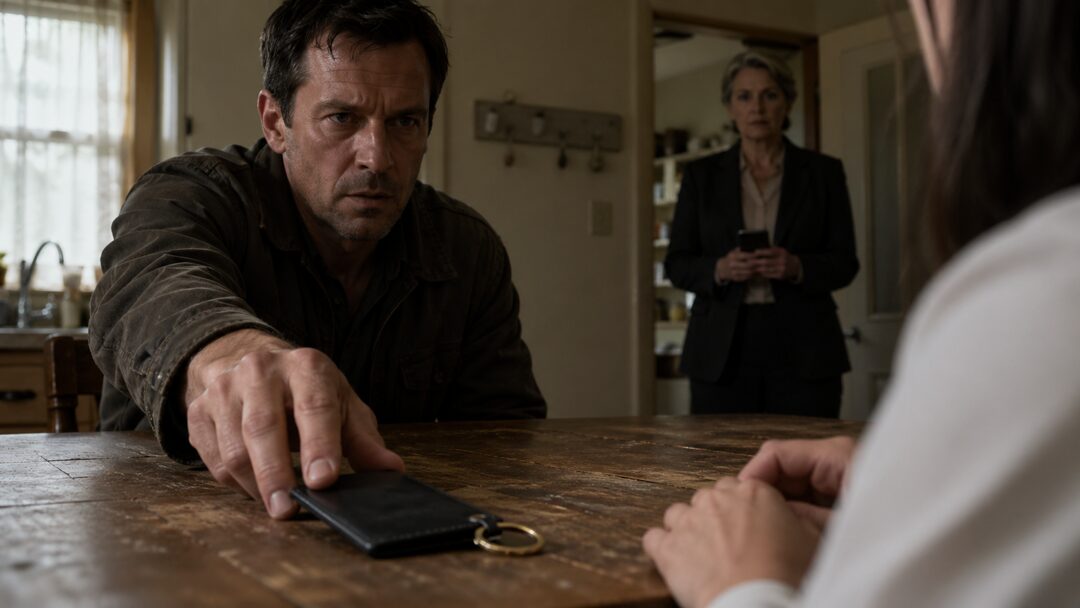
Michael slid the dark debit card across the kitchen table like it might burn his fingers.
Emily did not pick it up.
For three seconds, she only looked at the chip, the raised silver numbers, the familiar bank logo, and the name embossed beneath it.
Daniel Whitmore.
Her ex-fiancé’s name sat in her mother’s kitchen as if it had never left.
Michael leaned forward, his work jacket still smelling faintly of rain and motor oil. “Tell me you know why Mom has this.”
Emily’s white blouse pulled tight at her shoulders when she inhaled. She had worn it that morning to a job interview where a woman younger than her had smiled too carefully and said, We’ll be in touch. The blouse was still buttoned to the throat, as if dignity could be fastened shut.
“Where did you find it?” she asked.
“In Mom’s coat.” Michael’s voice was low. “The navy one she wears when she wants people to know she owns a good coat.”
Emily almost smiled. She didn’t.
The kitchen was too bright for this kind of thing. Late afternoon light came through the sheer curtains above the sink. Patricia had wiped the counters until they smelled of lemon. A pot of tea sat cooling near the stove. Nothing in the room looked guilty.
That made it worse.
Emily reached for the card, then stopped when she saw the sleeve beneath it.
Black leather. Thin. Expensive.
A small brass ring hung from one corner.
Her eyes moved, without meaning to, to the narrow wooden strip Patricia had mounted beside the pantry door two years ago.
Seven hooks.
Seven numbers painted above them in Patricia’s careful hand.
-
-
-
-
-
- 3.
-
-
-
-
Emily had always hated the way they were out of order. Patricia called it her “memory rail,” a system for keys after she began misplacing things. House key on one. Mailbox on two. Shed on five. Michael had laughed about it once and said Mom had invented a puzzle no burglar would bother solving.
Now one hook was empty.
Number seven.
Emily looked back at the brass ring attached to the card sleeve.
Michael saw her face change.
“What?” he asked.
Emily picked up the sleeve by the edge. The ring was warm from Michael’s hand, or maybe from her own sudden sickness.
“Mom said she lost the spare pantry key,” Emily said.
“She lied.”
The words came too fast. Michael looked almost relieved to have said them.
Emily turned the card over. The signature strip was blank. Daniel never signed cards. He used to say signatures were for people who expected to be questioned.
“Is it active?” she asked.
Michael pulled folded receipts from his jacket pocket and laid them beside the card.
ATM slips.
Three of them.
Same bank. Same branch near the freeway. Cash withdrawals. One marked with a small handwritten 7 in blue ink. One marked 4. One marked 2.
Emily stared until the numbers doubled.
“How long?” she asked.
“I don’t know. I only found those today.”
“Why were you in her coat?”
“She asked me to take it to the cleaners.” Michael’s mouth tightened. “There was also an invitation in the inside pocket.”
Before Emily could ask, footsteps moved in the hall.
Patricia appeared in the doorway with her phone in both hands.
She was sixty-three, but she dressed as if age were a social error she could correct with tailoring. Dark blazer. White blouse. Gray hair pinned low. Practical black shoes polished enough to see light in them.
She looked at Michael first.
Then at Emily.
Then at the card.
Her mouth parted, but no sound came.
That was how Emily knew.
Not because her mother looked guilty.
Because she looked caught.
Part II — The Memory Rail
Patricia recovered quickly. She had always believed composure was a form of class.
“Michael,” she said, “go wait in the living room.”
He stayed where he was.
Patricia’s eyes sharpened. “This is between your sister and me.”
Michael gave a humorless laugh. “Funny. I found the card.”
“And you’ve delivered it.” Patricia set her phone face down on the counter. Too deliberately. “Now let your sister speak for herself.”
Emily looked at the phone.
The screen lit once before going dark.
A message preview flashed too quickly to read.
But she saw the name.
Daniel.
Something inside her folded in half.
“Why do you have his card?” Emily asked.
Patricia’s shoulders settled, as if she had chosen the version of the truth she could survive.
“Daniel asked me to help with a private family matter.”
“Daniel is not family.”
Patricia’s gaze moved over Emily’s blouse, her tired makeup, the folder from the interview still tucked under the chair. “No. But he was nearly yours. And you should remember there are still people who want to help you.”
Emily smiled once, small and empty. “Is that what this is?”
“Don’t make your voice hard with me.”
“Then don’t make me ask twice.”
Michael stepped closer to the table. Patricia noticed and softened her expression in a way that was not softness at all.
“You always did need an audience for your pain,” she said to Emily.
The sentence landed quietly. That was Patricia’s talent. She could wound without raising the temperature of the room.
Emily’s hand closed around the card.
Michael said, “Mom.”
Patricia ignored him.
Emily stood and walked to the numbered hooks. The empty one seemed brighter than the others now, a small absence with teeth.
“When did you move the ring from seven?” she asked.
Patricia’s face changed by half an inch.
Enough.
Emily touched the painted numbers. The wood strip was old, but the numbers were newer. Patricia had repainted them last spring, around the time Daniel’s family foundation had started appearing in the local papers again.
She remembered Daniel’s voice on a public statement after the engagement ended.
Emily and I are taking time apart for her wellbeing.
Her wellbeing.
After that, people stopped asking why she had left. They started asking if she was okay in that slow, careful tone reserved for unstable women and grieving widows.
She had not left.
He had let her be removed.
Emily turned from the hooks. “These numbers aren’t for keys.”
Patricia’s fingers moved toward her phone, then stopped.
Michael took the receipts and spread them across the table. “The slips were in envelopes in the drawer.”
Patricia’s voice went cool. “You searched my kitchen?”
“It’s our kitchen when you use it to lie to us.”
Emily opened the drawer beside the sink before her mother could stop her.
It was the drawer Patricia used for the leftovers of a life: rubber bands, coupons, old Mass cards from funerals, birthday candles, batteries, stamps, photographs, medical bills folded into thirds.
Beneath a stack of envelopes, Emily found more ATM receipts.
Some had numbers written in the corner. Some had initials.
D.W.
Her hand shook once. She pressed it flat against the drawer until it stopped.
“How much?” she asked.
Patricia said nothing.
Emily looked at her. “How much of Daniel’s money have you been moving through this house?”
“It was his account.”
“That wasn’t my question.”
Patricia’s jaw tightened. “Enough to help.”
“Help who?”
“Everyone.”
There it was. The word Patricia used when she meant Emily should be grateful for damage done in her name.
Emily set the receipts beside the card. “What did he ask you to do?”
Patricia turned to Michael. “Leave.”
“No.”
“Michael.”
“I said no.”
Patricia’s face flushed. Not from shame. From disobedience.
Emily picked up the phone from the counter before Patricia could reach it.
Her mother lunged forward. “Emily.”
That was the first time fear entered her voice.
Emily looked at the locked screen. Three missed calls from Daniel. Two messages.
She did not open them.
She didn’t need to.
The kitchen had already started confessing.
Part III — What Protection Costs
Patricia sat down only after Emily did.
That was new. Patricia never sat second.
Michael stayed by the back door, arms crossed, trying to look angry enough to hide that he was hurt.
“Daniel needed cash discreetly,” Patricia said.
Emily almost laughed. “For groceries?”
“For his family’s foundation.” Patricia lifted her chin. “There’s a donor dinner tonight. They’re trying to rebuild support after all the gossip.”
“The gossip,” Emily repeated.
Patricia looked away.
That hurt more than any answer.
“You mean after he told everyone I fell apart,” Emily said. “After his mother called me ‘fragile’ to half the country club. After people looked at me like I might scream if they said the wrong thing.”
Patricia folded her hands. “You were not well.”
“I was humiliated.”
“You were both.”
Michael swore under his breath.
Patricia’s eyes snapped to him, then back to Emily. “Daniel wanted to make things right when the timing was better.”
Emily looked at the receipts.
Seven. Four. Two.
The numbers on the wall were no longer strange. They were obedient. They had done what Patricia made them do.
“Make what right?” Emily asked.
Patricia hesitated.
Emily leaned in. “What did he promise you?”
“He said there might be a position for you at the foundation once things settled.”
Silence.
The refrigerator hummed. A car passed outside. Somewhere in the walls, old pipes clicked.
“A job,” Emily said.
“A good one.”
“After he let people think I was unstable.”
“He said you needed time.”
“He said that because it made him look kind.”
Patricia’s eyes filled, but no tears fell. Patricia had always treated tears as something to be rationed.
“You think kindness pays rent?” she asked.
Emily went still.
There was the other room beneath this one. The one they never entered unless Patricia opened the door.
After Emily’s father died, there had been bills in stacks. Patricia had worn black dresses to church and smiled while women brought casseroles and pity. Emily had been twenty-one then. Michael sixteen. Their mother had sold jewelry, then the car, then pride in small pieces.
Daniel’s family had helped with the house.
Not openly. Never openly.
Patricia had called it a refinance. Later Emily learned it had been a rescue dressed as a transaction.
“You think I don’t remember what it is to be nobody?” Patricia asked. “To have people lower their voices when you walk into a room? To watch them decide how much pity you deserve?”
Emily said, “So you sold me back to him?”
Patricia flinched.
“I tried to keep a door open.”
“A door?” Emily lifted the card. “This is a leash.”
Patricia’s voice broke at the edge. “You are not built to survive being nobody.”
The words entered Emily slowly.
Not because they were cruel.
Because they were almost tender.
Patricia believed them. That was the terrible part. She had looked at her daughter and seen a woman too breakable for ordinary life. Too old to start over. Too stained by gossip to be hired, loved, or welcomed unless Daniel’s name washed her clean.
Emily wanted to hate her.
Instead she felt twelve years old for one weak second, standing in a thrift-store dress while Patricia fixed the hem and said, Hold still. People notice when things don’t fit.
Michael pushed away from the door. “You don’t get to decide that for her.”
Patricia turned on him. “You don’t know what it costs to keep a family from sinking.”
“I know what it costs Emily.”
Patricia looked back at her daughter. Her phone buzzed again on the counter.
Emily reached for it.
This time Patricia did not stop her.
The message preview was waiting.
Daniel: Please confirm she hasn’t seen the invitation. We need tonight clean.
Emily stared at the words until they stopped looking like language.
“What invitation?” she asked.
Michael closed his eyes.
Patricia said, “Emily—”
But Emily was already standing.
She took Patricia’s purse from the chair by the hallway and opened it with both hands.
Inside, beneath lipstick, tissues, and a small bottle of aspirin, was a cream-colored envelope.
Whitmore Family Foundation.
Private Donor Dinner.
Tonight, 7:30 p.m.
Patricia Lawrence — Table One.
Daniel Whitmore — Host.
Emily searched the envelope again.
Her name was not inside.
There was, however, a folded note in Daniel’s handwriting.
After dinner, I’ll speak with her. Foundation role. Housing if needed. She’ll accept if Patricia stays firm.
Emily read it twice.
Then she folded it carefully along the same crease.
That was the moment something in her stopped asking to be loved correctly.
Part IV — Someone Who Has Been Through a Difficult Season
The country club smelled of white wine, polished wood, and flowers too expensive to have fragrance.
Emily arrived at 8:06 with Daniel’s card in her coat pocket and the brass ring closed tight in her palm.
No one stopped her at the entrance. That was one of the last privileges of almost marrying into a rich family: people remembered your face long after they had forgotten your place.
A framed display stood near the doors to the dining room.
Daniel smiled out from a glossy photograph, one hand resting lightly at the back of a blonde woman in a navy dress.
Below the photograph, elegant lettering read:
Daniel Whitmore and Sarah Collins
Partners in the Foundation’s Next Chapter
Emily stood still long enough for a passing server to ask if she was all right.
She said yes because women like her were trained to say yes at the exact moment they were not.
The dining room was full of people who had once toasted her engagement. They wore pearls, cuff links, charitable expressions. They turned when she entered, and the room performed recognition in stages.
First surprise.
Then pity.
Then delight, because pity is always more enjoyable when the object of it arrives unexpectedly.
Patricia saw her from Table One.
Her face went white.
Daniel saw her next.
He did not freeze. Daniel never gave anyone that much satisfaction.
He excused himself from a conversation, crossed the room, and approached Emily with the smooth warmth that had once made her feel chosen.
“Emily,” he said.
Her name in his mouth still did damage.
He bent and kissed her cheek.
Not a lover’s kiss. Not even a friend’s.
A public claim of management.
“You should have called,” he murmured.
“You sent enough messages to my mother for both of us.”
Something flickered in his eyes, then disappeared.
He turned slightly, guiding her into view of the room without touching her. “Everyone, you remember Emily.”
Several people smiled too brightly.
Daniel continued, “She’s been through a difficult season, and we’re all very glad to see her doing well.”
There it was.
Not denial.
Reduction.
He had not erased her. He had made her smaller in front of people who knew how to understand the signal.
A difficult season.
Not betrayal. Not abandonment. Not public humiliation.
A season. Weather. Something that had happened to her privately, regrettably, almost medically.
Sarah approached with a glass of champagne in her hand. She was younger than Emily by maybe six years, graceful in the way women become when money has never required them to hurry.
“Emily,” Sarah said, careful and kind. “I’ve heard so much about you.”
Emily wondered which version.
The unstable one.
The fragile one.
The one who needed time.
Patricia rose from the table and came toward them, her smile fixed in place.
“Emily,” she said softly. “This isn’t the place.”
Emily looked at her mother’s hand. It hovered near her elbow but did not touch.
Patricia knew better than to leave fingerprints on a public scene.
Daniel said, “Why don’t we step into the hall?”
It sounded like concern. It was removal.
Still, Emily followed him.
That was the worst part. Some old part of her still obeyed the shape of his voice.
The hallway outside the dining room was dimmer, lined with framed photographs of men holding trophies and women standing beside them. Daniel stopped beneath a portrait of his grandfather.
“Em,” he said.
The old name.
Her body remembered before her pride could stop it.
He reached toward her wrist, not quite touching. “I know tonight is painful.”
“You planned it.”
“I planned a donor dinner.”
“With Sarah on a sign by the door.”
His face softened. “Sarah is part of the foundation.”
“She’s part of your cleanup.”
Daniel exhaled. “That’s unfair.”
Emily almost laughed. “To whom?”
He looked toward the dining room, then back at her. “I never stopped caring about you.”
The sentence should have been cheap.
It wasn’t.
That was Daniel’s talent. Even his worst lines arrived wearing the face of something true.
“I wanted to marry you,” he said. “You know that.”
“You wanted to marry someone who made you feel decent.”
His jaw tightened.
Good, she thought. Bleed a little.
“The scandal made things impossible,” he said. “My board was worried. My mother was worried. You weren’t answering calls.”
“After you let them call me unstable.”
“I protected you from worse.”
She stared at him.
He believed that too.
Everyone who hurt her had found a way to call it protection.
Daniel lowered his voice. “There’s a role at the foundation. Communications. Real salary. Benefits. And an apartment if you need space from Patricia for a while.”
Emily’s hand closed around the brass ring in her pocket until its edge pressed into her skin.
“A hidden apartment,” she said.
“A discreet one.”
“For my dignity?”
“For your peace.”
He stepped closer.
She could smell his cologne. Cedar, expensive soap, winter. Memory came cruelly fast: Daniel fastening a bracelet around her wrist at an engagement party, Daniel whispering that she looked like she belonged, Daniel’s hand at her back as rooms opened for them.
Rooms did not open for Emily anymore.
Daniel knew that.
He was offering her a side door.
Then Patricia appeared at the mouth of the hall.
She had heard enough to be afraid. Not enough to be ashamed.
“Take it,” she said.
Emily turned.
Patricia’s eyes were wet now. In public, even tears looked controlled on her.
“Please,” Patricia said. “Don’t make pride your only inheritance.”
Emily looked from her mother to Daniel.
There it was, finally, clean enough to hold.
A man offering her comfort without respect.
A mother asking her to call it survival.
Emily took the debit card from her coat pocket.
Daniel’s eyes dropped to it.
For the first time all evening, his face lost its polish.
Part V — The Audience for Her Pain
Emily walked back into the dining room before either of them could stop her.
The room noticed immediately.
Rooms like that always did. Wealth had excellent hearing when embarrassment entered.
Daniel followed with Patricia behind him.
“Emily,” he said quietly.
She did not turn.
At Table One, a man in a tuxedo paused with his fork in the air. Sarah stood near her chair, champagne untouched, watching Daniel’s face instead of Emily’s.
Good, Emily thought.
Someone should.
She reached the center of the donor table and placed the dark debit card on the white tablecloth.
It made almost no sound.
Still, half the room heard it.
Then she opened her palm and set the brass ring beside it.
Small.
Round.
Damning.
Daniel arrived at her side. “This is not necessary.”
Emily looked at him. “That’s what people say when the truth is about to cost them something.”
His smile returned, but it was thinner now. “Everyone, I apologize. Emily has misunderstood a private matter.”
Patricia whispered, “Stop.”
Emily did not look at her.
She looked at the donors, at the people who had lowered their voices around her in grocery aisles and church vestibules, at the women who had texted thinking of you and never asked what happened, at the men who had shaken Daniel’s hand for surviving a woman’s collapse.
Then she looked at Sarah.
“I’m sorry,” Emily said to her.
Sarah went still.
Daniel’s smile hardened. “Emily.”
She turned the card so his name faced upward.
“This card was kept in my mother’s kitchen,” Emily said. Her voice was clear, though her heart was beating so hard she felt it in her teeth. “The cash withdrawals were marked on a numbered strip by her pantry door. Seven hooks. Seven numbers. Daniel gave her the system.”
A murmur moved through the table.
Daniel gave a soft laugh. “That sounds far more dramatic than it is.”
“Then answer plainly,” Emily said. “Was the account for helping my mother, or for buying her silence?”
The room changed.
Not loudly.
Not honestly.
But the air altered. People sat straighter. Sarah’s eyes moved to Daniel. Patricia’s hand covered her mouth.
Daniel stepped closer, lowering his voice. “You’re embarrassing yourself.”
Emily looked at him and felt the old reflex rise: apologize, retreat, make it smaller, be easy to defend.
Instead she said, “No. I’m embarrassing you. You taught me the difference.”
Someone at the table inhaled.
Daniel’s face flushed.
Patricia said, “Emily, please.”
That one word nearly undid her.
Please.
Not because Patricia meant stop hurting yourself.
Because Patricia meant stop hurting us.
Emily picked up the brass ring. “You told me I always needed an audience for my pain.”
Patricia’s eyes filled.
“So I brought one.”
Daniel’s voice sharpened. “Enough.”
Emily turned on him, and for the first time she did not feel like the woman he had left.
She felt like the woman who had survived being curated into a warning.
“You did not simply leave me,” she said. “You kept me nearby. You let people believe I was unstable because it made you look merciful. You used my mother to move money, to manage me, to keep me quiet until you could stand here with Sarah and call it a new chapter.”
Sarah set down her glass.
Daniel looked at Patricia. “Say something.”
Patricia did.
But not what he wanted.
“He asked me to keep her calm until tonight was over.”
The room went silent.
Patricia looked shocked by her own voice.
Emily closed her fingers around the brass ring.
Daniel stared at Patricia as if she had broken an expensive object.
“That is not what I meant,” he said.
Patricia swallowed. “You said after tonight, she would be more reasonable.”
“Patricia.”
“You said the job would help her accept things.”
A chair scraped.
Sarah stepped back from the table.
Daniel’s control did not explode. It cracked with dignity, which somehow looked uglier.
“This is a family misunderstanding,” he said.
Emily shook her head. “No. A family misunderstanding is when someone forgets who bought the pie. This was a plan.”
Patricia sat down as if her knees had been cut.
Emily looked at her mother then.
Really looked.
Patricia was not a villain in that chair. She was worse than that. She was a woman who had loved her daughter so fearfully she had offered her up to the strongest man in the room and called it shelter.
Emily wanted that to make it hurt less.
It did not.
She slid the card toward Sarah.
“You should know what kind of man calls control care.”
Sarah did not touch it.
But she read his name.
That was enough.
Daniel said, very softly, “You’ll regret this.”
Emily looked at him one last time.
“I already did.”
Then she walked out before anyone could decide whether to applaud, pity her, or stop her.
Outside, the night air was cold enough to hurt.
Michael was waiting by the curb in his truck.
He did not ask how it went.
He looked at her face and unlocked the passenger door.
Part VI — The Marks on the Wall
Patricia removed the numbered strip the next morning.
Emily stood in the kitchen doorway with her coat still on.
Neither of them had slept.
The house looked smaller after the country club. Not poorer. Just exposed. The counters were clean, the curtains pale, the table scarred where Michael had slid the card.
Patricia used a screwdriver with both hands.
Her fingers shook only when the first screw came loose.
“Michael told me you were leaving,” she said.
“He’s driving me.”
“To where?”
“A motel near the highway.”
Patricia flinched at motel more than she had at leaving.
Of course she did.
A motel was visible failure. A daughter staying in a house full of lies was not.
The wooden strip came away from the wall with a soft crack. Paint lifted behind it in pale rectangles. Seven small holes remained where the hooks had been.
Patricia touched the marks.
“I thought I was saving you,” she said.
Emily looked at the empty place on the wall.
“I know.”
Patricia turned, and for a moment she looked older than any blazer could fix. “That’s all you have to say?”
“No.”
Emily stepped into the kitchen and placed an envelope on the table.
Inside was Daniel’s card, three ATM receipts, the folded donor invitation, and copies of the message previews she had photographed before Patricia deleted them.
The envelope was addressed to the Whitmore Family Foundation Board.
Patricia stared at it. “You’ll ruin him.”
Emily shook her head. “He’ll survive. Men like Daniel always survive. I’m just making sure he has to be seen while he does it.”
Patricia’s eyes reddened. “And me?”
Emily waited.
That was the question Patricia had been asking all along.
What about the house?
What about the debt?
What about the neighbors?
What about the woman who had lived so long on the edge of pity that she mistook status for oxygen?
Emily wanted to be cruel.
Instead she was honest.
“I understand why you were afraid,” she said. “I understand why Daniel’s world looked like safety.”
Patricia reached for that understanding like it was forgiveness.
Emily did not give it to her.
“But understanding doesn’t make this safe for me.”
Patricia’s hand fell.
For a while, they stood with the removed strip between them on the table.
Without the hooks, it looked childish. A piece of wood with crooked numbers. Harmless, almost.
That was the worst part about betrayal.
So much of it looked ordinary after it was over.
A horn sounded outside.
Michael.
Emily picked up her overnight bag. Patricia watched the movement as if every zipper pull were a verdict.
At the doorway, Patricia said, “Emily.”
Emily stopped.
Her mother’s voice shrank. “Did he ever love you?”
There were a dozen answers.
Yes, in the way men love what makes them feel generous.
No, not enough to choose her in daylight.
Yes, but love without dignity is only another room you can be locked inside.
Emily said none of them.
“I think he loved who I became when I needed him.”
Patricia closed her eyes.
Emily walked out.
Michael sat behind the wheel with the engine running. He had a bruise-colored shadow under one eye from lack of sleep and a convenience-store coffee in the cup holder.
“You okay?” he asked.
Emily looked back at the house.
Through the kitchen window, she could see Patricia standing by the wall, one hand hovering over the pale marks where the numbered hooks had been.
“No,” Emily said.
Michael nodded, as if that was the first honest answer anyone in their family had given in years.
He drove.
At the motel, the clerk barely looked up. The room smelled of detergent and old carpet. The bedspread was thin. The curtains did not close all the way.
It was not safety.
Not yet.
Emily sat on the edge of the bed and opened her fist.
She had forgotten she was still holding the brass ring.
It had left a red circle in her palm.
For a moment, she almost laughed. Not because anything was funny, but because the body remembered pressure even after the thing pressing was gone.
She set the ring on the nightstand.
No key hung from it now.
No card.
No number.
Just a small empty circle catching the weak motel light.
Emily lay back without taking off her coat.
Her phone buzzed once.
Daniel.
She did not read it.
Outside, trucks moved along the highway, carrying strangers through the dark toward places that had never heard her name.
For the first time in months, that felt less like disappearance than mercy.