She Released a Truckload of Ducks Into the Flooded Field, but the Water Was Hiding Someone Else’s Mistake
Chapter 1: The Ducks Chose the Flooded Field
The ducks surged against the slatted crates just as the water climbed over the tops of Ashley Martin’s boots.
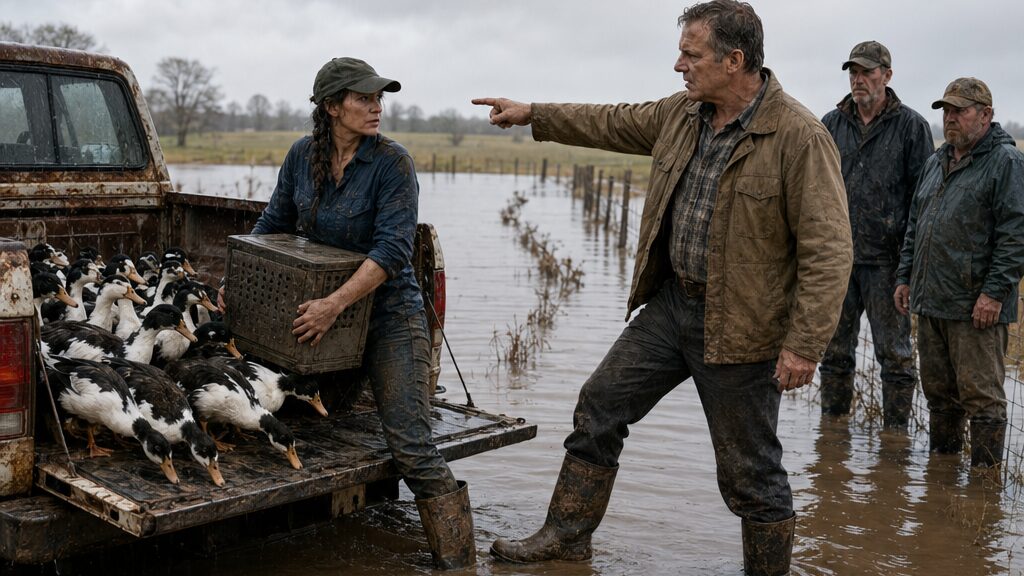
She shoved her shoulder into the final crate before it could slide across the pickup bed. Wings battered wood. Black-and-white bodies pressed against one another, red faces flashing between the gaps. Beneath the truck, brown water moved through the farmyard with enough force to carry straw, feed sacks, and a broken section of fence toward the road.
Behind Ashley, the duck shed groaned.
A support post had tilted during the night. The lower wire pens were already underwater. One more hard push from the current and the whole eastern wall would fold.
“Stay put,” Ashley told the birds, though none of them could hear her over the flapping.
She climbed down, splashed to the driver’s door, and looked once toward the farmhouse. Her mother stood behind the kitchen window with both hands braced on the sill.
Ashley raised one palm. It was not reassurance so much as an order: stay there.
The truck coughed twice before starting. She eased it through the yard, avoiding the deeper washout by the equipment shed. The pickup was old enough that every rut traveled through the steering wheel and into her shoulders. Water curled around the tires as she reached the county road.
The nearest dry barn belonged to a cattle farmer six miles north, but his flock restrictions made that impossible. The fairground pens were locked. The feed-store owner had offered two empty grain trailers, neither ventilated enough for seventy-three frightened Muscovy ducks.
That left the boundary field.
It rose only a few feet above Ashley’s pens, but it had once been wet pasture, long before her father fenced the lower acres. Even in flood years, the eastern strip held firm beneath the reeds.
She turned onto the narrow road between her land and Campbell property.
Steven Campbell’s truck was already parked across the entrance.
He stood in front of it wearing a brown work coat and a dark cap, one hand planted on his hip. Rain had darkened the shoulders of his coat. Behind him, the field spread beneath a sheet of shallow water, winter grass bending through the surface.
Ashley stopped ten yards away.
Steven walked to her window. “Turn around.”
“The pens are going.”
“That field is on my side of the marker.”
“The high strip isn’t.”
“You don’t know where the high strip ends under that water.”
“I know where it starts.”
He looked past her toward the pickup bed. The ducks had gone strangely quiet.
“You haul them out somewhere else,” he said.
“There is nowhere else.”
“That doesn’t make my ground yours.”
Ashley gripped the steering wheel. She had not slept. Her jeans were wet to the knee, and one sleeve smelled of diesel from the pump that had quit before dawn.
“I’m not grazing them,” she said. “I’m getting them out of a collapsing shed.”
“And when they foul the cattle water?”
“They won’t reach your cattle.”
“You can’t promise that.”
“No,” she said. “I can promise what happens if I take them back.”
The eastern wall of the duck shed sagged in her mind, mesh bowing beneath water, birds pinned against it.
Steven stepped away from the window and pulled out his phone.
“What are you doing?”
“Calling animal control.”
Ashley stared at him.
He held her gaze while the call connected. “I’ve got livestock being released across a disputed boundary during active flooding,” he said. “Yes. Birds. A truckload.”
A second vehicle slowed behind them. The neighboring cattle farmer leaned toward his windshield, watching. Another pickup stopped farther back.
Ashley felt the shape of the story forming around her before she had done anything: broke farmer dumps birds on neighbor’s land. Reckless woman makes her problem everyone else’s. She knew how quickly a simple picture could harden into truth in a county where people remembered unpaid bills longer than funerals.
Steven ended the call. “They’re sending someone.”
“How long?”
“Soon enough.”
The truck bed shifted. One crate struck the side panel.
Ashley opened her door.
Steven moved in front of it. “Don’t.”
“Get out of the way.”
“You release them, you take responsibility for every acre they touch.”
“I already take responsibility for them.”
“That is not the same thing.”
“No,” Ashley said. “It isn’t.”
She stepped around him and waded to the rear of the pickup.
The tailgate latch resisted. Rust had swollen around the hinge, and she had to strike it twice with the heel of her hand before it dropped. The metal landed with a dull clang above the water.
The ducks crowded forward but did not jump.
Steven came after her. “Ashley.”
She lifted the first crate door.
A drake thrust his head through, then withdrew. The field ahead was gray water, reeds, and low grass. The birds had spent their lives in shallow runs and mud channels, but the open flood had no banks they recognized.
“They think it’s deep,” Steven said.
“It isn’t.”
“You don’t know that.”
Ashley climbed onto the tailgate, lowered herself into the water, and reached back. Mud closed around her boots. She opened a second crate.
The cattle farmer had stepped out of his truck. “You sure about this?”
“No,” Ashley said.
Steven pointed toward the drowned fence posts. “There. That is the line. You cross them over, they’re on Campbell land.”
Ashley looked where he pointed. The old steel posts made a crooked path through the water. Half had fallen. The boundary they marked had always been clearer on paper than on the ground.
The first duck stepped onto the tailgate.
Then another.
Their claws clicked over rusted metal. A hen spread her wings, jumped into the water, and found the bottom almost immediately. The drake followed. Within seconds, six birds had descended and stood around Ashley’s knees.
Their panic eased.
The noise in the truck bed softened from frantic battering to low, nasal murmurs.
Ashley opened the remaining crates.
Steven’s voice hardened. “Reload them.”
She watched the birds turn east.
Not toward his cattle pond. Not toward the road. They moved in a close, deliberate group toward a thin line of reeds nearly hidden beneath the flood.
“They’re following the only route the water still remembers,” she said.
Steven gave a short, humorless breath. “Birds don’t read property records.”
“No. That may be the useful thing about them.”
More ducks poured down the tailgate. The flock widened across the flooded grass, then narrowed again as if guided between invisible banks.
The cattle farmer stared after them. “Why are they bunching like that?”
Ashley did not answer.
She had seen ducks follow worn paths, feed routes, fence shadows. She had never seen seventy-three birds choose a line so precisely across open water.
They reached the reeds and stopped.
Every bird faced the same patch of submerged ground.
A low vibration traveled through the soles of Ashley’s boots.
At first she thought it was the truck idling behind her. Then the engine coughed and went still, but the trembling continued beneath the field.
The ducks felt it too.
Their heads lifted together as something under the flooded pasture began to thrum.
Chapter 2: The Map Showed No Water There
The county map showed Ashley’s flooded pasture in a flat block of pale yellow marked DRY UPLAND.
She stood on the opposite side of Jacob White’s desk, water still trapped in the seams of her boots, and looked from the map to the mud streaked across her jeans.
“That’s wrong,” she said.
Jacob adjusted the paper so it lay square with the desk. “That’s what is recorded.”
“There’s standing water from my pens to the Campbell fence.”
“Standing water after a major storm does not establish a drainage feature.”
“The birds followed something.”
Jacob glanced at the printed photograph beside the map. The animal-control officer had taken it that morning: Ashley knee-deep beside the lowered tailgate while ducks streamed into the field. Steven stood in the background, one arm raised toward the boundary posts.
In the photograph, Ashley looked less like a farmer rescuing stock than a woman emptying a truck where she had been told not to.
Jacob tapped the picture. “This is the issue I can act on today.”
“The issue is under the field.”
“The issue documented today is livestock crossing a disputed property line.”
Ashley leaned closer to the map. Blue lines marked roadside ditches, a creek farther south, and the Campbell cattle pond. Nothing crossed the boundary field.
“There used to be a run through there.”
“Do you have an easement?”
“I have birds standing over it.”
“That is not documentation.”
He spoke without contempt, which somehow made the words heavier. Jacob was careful by profession. Even the pens in his shirt pocket were aligned by height.
He slid a form toward her.
TEMPORARY LIVESTOCK REMOVAL ORDER.
“You have until noon tomorrow,” he said. “After that, the county can authorize removal.”
“Removal to where?”
“That determination would be made by animal control.”
“They’ll split the flock.”
“Then relocate them before the deadline.”
“My shed is half underwater.”
“I understand.”
“No, you understand the box on that paper.”
Jacob’s jaw tightened. “And you understand that if I ignore procedure because you believe ducks located a buried ditch, anything that happens downstream lands on this office.”
Ashley looked again at the map. In its clean colors, her farm was dry, the boundary was straight, and no water had ever made a decision of its own.
“Who made this survey?”
“The current layer was adopted eleven years ago.”
“Based on what?”
He hesitated.
That pause was the first useful thing she had heard.
“Based on what?” she repeated.
Jacob turned to his computer and searched through a list of file numbers. “The digital map references a consolidated drainage survey.”
“Can I see it?”
“This is it.”
“The survey before it.”
He scrolled farther. His expression changed only slightly, but Ashley saw him read the same line twice.
“There was an earlier submission,” he said.
“Where is it?”
“Withdrawn before final filing.”
“By who?”
“The index doesn’t say.”
“What year?”
Jacob told her.
Ashley knew the year because it was the year her father had replaced the old duck runs with rectangular wire pens. The year Steven’s father had raised the Campbell pasture with truckloads of fill. The year Ashley had left for community college and returned six months later because her father’s back had failed.
Jacob printed a file request form.
“This may take several days.”
“I have until noon.”
“That is why I gave you until noon instead of ordering immediate removal.”
It was a concession, and both of them knew it. Ashley folded the temporary order and slipped it into her jacket.
Outside, the rain had stopped. Mud had dried in cracked scales along the pickup tailgate. Three white feathers clung to the hinge.
Her phone rang before she reached the driver’s door.
The farm-insurance adjuster did not ask about the shed first.
“I received notice of an unauthorized livestock relocation,” he said.
“It was an emergency.”
“Your policy covers emergency transport to approved facilities.”
“There were no approved facilities available.”
“Did the county direct you to use the Campbell field?”
“No.”
“Did the landholder consent?”
Ashley watched water drip from the truck’s undercarriage.
“No.”
A pause followed, filled with keyboard clicks.
“Then any losses connected to the relocation may fall under the exclusion.”
“What losses?”
“Contamination claims. Property damage. Animal loss beyond the insured premises.”
“The water caused this.”
“I’m not determining cause. I’m explaining coverage.”
By the time the call ended, Ashley’s twenty-four hours felt smaller.
She drove home past the boundary field. Most of the ducks rested along the reed line. A few dabbed at the water, calm enough to preen. Steven had parked a utility trailer near the road, perhaps preparing to move them himself when the deadline passed.
At the farmyard, Linda waited beneath the porch roof.
Ashley handed her the removal order.
Her mother read it without changing expression. “We’ll sell half.”
“Sell them where?”
“The feed-store owner knows people.”
“By noon tomorrow?”
“We don’t need a good price. We need them gone.”
Ashley pulled the folded county map from her jacket and spread it on the pickup’s muddy tailgate.
Linda looked down.
“This says there’s no channel,” Ashley said. “But Jacob found an older survey. It was withdrawn before filing.”
Her mother’s fingers stopped on the edge of the paper.
Ashley pointed to the date.
For one second, Linda looked not frightened but tired in a way that seemed older than the flood.
“Where did you get that?” she asked.
“The county.”
“Did you ask for the old survey?”
“Yes.”
Linda folded the map once, sharply, hiding the date.
“Stop asking.”
Ashley stared at her. “Why?”
“Because dry ground is what the county says it is.”
“There is water over three acres.”
“Then let it drain.”
“It isn’t draining.”
Linda pushed the map back toward her. “Move the birds. Take the loss.”
“You knew there was another survey.”
Her mother’s face closed.
“Ashley,” she said, “some maps cost more than land.”
Then she walked into the house and shut the door.
Chapter 3: Her Father’s Notebook Stayed Locked
The padlock hung open from the metal box before Ashley touched it.
She stood inside the equipment shed with the flashlight beam fixed on the bent brass shackle. The box sat beneath her father’s old workbench, exactly where it had remained since his funeral. Dust covered the lid except for a clean sweep around the lock.
Someone had opened it recently.
Ashley lowered herself to one knee.
The shed smelled of wet lumber, engine oil, and the sour river odor the flood had pushed across the yard. Rain ticked against the tin roof. Somewhere outside, a loose gate struck its post at uneven intervals.
She lifted the lid.
Her father’s field notebooks were stacked inside, their green covers warped from years of damp hands and jacket pockets. Beneath them lay folded receipts, seed invoices, and pencil sketches of fences that no longer stood.
Ashley took out the newest notebook.
The first pages held ordinary records: hatch counts, feed ratios, pump repairs, losses to foxes. Her father’s handwriting leaned hard to the right, letters gouged deep enough to show through the paper.
Then the entries changed.
January water at east posts: 14 inches.
Spring rise reached old willow line.
Campbell fill settling south edge.
She turned another page.
It had been torn out close to the binding.
So had the next three.
Ashley checked the remaining notebooks. More missing pages. Not random ones—the gaps appeared through the same two-year period as the withdrawn county survey.
A floorboard creaked behind her.
She turned quickly.
Linda stood in the doorway wearing her robe beneath an old barn coat.
“You broke the lock?” Ashley asked.
“No.”
“Who did?”
Her mother looked at the open box. “Your father kept spare keys everywhere.”
“He’s been dead four years.”
“That doesn’t mean everyone forgot where he put them.”
Ashley rose, notebook in hand. “Did you take pages?”
“No.”
“Did you know they were missing?”
Linda pulled the coat tighter. “You should put that away.”
“The county gives me until noon.”
“Then spend the night finding buyers.”
“The birds found the old run.”
“They found water.”
“They moved in a straight line over a place that isn’t on the map.”
“They’re ducks, Ashley.”
“Exactly.”
Linda’s mouth tightened.
Ashley carried the notebook outside before the argument could circle. She lowered the pickup tailgate and clamped a work light to the side rail. The rusted metal became a table beneath the yellow bulb.
She laid out the county map, the removal order, and her father’s notebooks.
Wet feathers had collected near the hinge. One black, two white. They lifted whenever wind entered the yard, then settled again against the paper.
Ashley worked through each entry by date.
Her father rarely drew complete maps. He made fragments—fence corners, post counts, arrows showing water direction. At first they seemed useless. Then she found a sketch made in late winter eleven years earlier.
Five short marks represented the boundary posts. A curved pencil line passed beneath them and continued toward Campbell pasture. Beside it, her father had written OLD RUN—STILL PULLS AFTER HARD RAIN.
Ashley placed the county map over the notebook page and aligned the road.
The curved line matched the path the ducks had chosen that morning.
Not approximately.
Exactly.
Her relief came so quickly it felt like laughter, but it died before reaching her throat. The sketch could stop the removal order. It could force Jacob to inspect the field.
It could also open whatever her mother wanted left shut.
Headlights swept across the shed wall.
Ashley closed the notebook.
Jacob’s county truck rolled into the yard and stopped beside the pickup. He climbed out carrying a narrow survey rod and a plastic file sleeve.
“I found a reference to the withdrawn submission,” he said. “Not the survey itself. It mentions seasonal conveyance through your east parcel.”
Ashley kept one palm on the closed notebook.
“That’s the old run,” she said.
“Maybe.”
“It is.”
“Do you have something showing it?”
The work light hummed between them. A white feather slid across the tailgate and stopped against Ashley’s wrist.
She could open the notebook. She could show him the sketch and give him reason to delay enforcement.
Instead she moved the county map over it.
“My father talked about it,” she said.
Jacob watched her hand.
“Talked about it when?”
“When I was younger.”
“That will not hold up against a filed parcel map.”
“You believed enough to come here.”
“I believed enough to check before the county moved seventy-three birds.”
“Then check the field.”
“I will at daylight. But if you have a record, now is the time.”
Ashley heard her father’s voice from the last winter of his life, thin but steady from the hospital bed: Don’t let them take this place apart after I’m gone. Every paper becomes a lever in somebody else’s hand.
She had promised because he was dying and because promises made beside machines felt permanent.
“No record,” she said.
Jacob looked toward the notebook edges protruding beneath the map.
He did not call her a liar.
“That choice may cost you the deadline,” he said.
After he left, Linda came to the porch but did not approach.
Ashley reopened the notebook. The sketch was still there, honest and incomplete.
At ten minutes past nine, another vehicle entered the yard.
Steven stepped out alone.
He carried no county notice, no phone, no tool. Only a mud-stained sheet of green paper folded once down the center.
Ashley recognized the torn edge before he reached the tailgate.
It matched the missing page in her father’s notebook.
Steven laid it beside the map.
Across the top, in her father’s handwriting, were the words CAMPBELL DITCH AGREEMENT.
Ashley looked up at him.
“Where did you get that?”
Steven kept two fingers on the page, as though the wind might take it.
“My father’s safe,” he said. “And before you decide it proves I buried your drainage, you should read the name at the bottom.”
He lifted his hand.
Beneath the faded measurements and a sketched culvert were two signatures.
One belonged to Steven’s father.
The other belonged to Ashley’s.
Chapter 4: The Water Followed the Buried Ditch
Before Ashley could answer, a duck vanished beneath the collapsed reeds.
Its wings struck the water once, hard enough to scatter the flock. Ashley dropped the torn notebook page onto the pickup tailgate and ran into the field.
The mud pulled at her boots. She reached the reed line just as the bird surfaced three yards away, shaking brown water from its head. It had not been dragged under. It had slipped through a narrow depression hidden by flattened grass.
Steven followed more slowly, holding the page above the water.
“You see that?” Ashley asked.
“I see a duck.”
“The bottom drops there.”
“The whole field is uneven.”
Another bird entered the same place. Its body dipped until only its back showed, then rose beside a pale gray edge beneath the reeds.
Concrete.
Ashley pushed both hands into the water. Her fingers found a straight surface slick with mud, then a corner. She cleared leaves from it until the shape widened beneath her palms.
Steven stopped beside her. “That could be an old trough.”
“Not running east to west.”
“It doesn’t prove what you think.”
Ashley stood, water pouring from her sleeves. “Then why did your father keep a drawing of it in his safe?”
His expression tightened. “Because your father signed the same agreement.”
The torn page lay between them in his hand. The sketched line crossed the boundary and ended at a small square marked PIPE. Beneath the two signatures was a notation faded nearly to nothing.
Ashley reached for it.
Steven pulled it back. “You don’t get to take this and make my family the whole story.”
“I didn’t say they were.”
“You were about to.”
She looked toward the pickup. The county map and her father’s notebook rested on the rusty tailgate under the work light, though dawn had begun to thin the darkness.
“I found his copy,” she said.
Steven’s eyes shifted to the truck. “You told Jacob you had nothing.”
“You heard that?”
“I saw his county truck leave.”
“That is not an answer.”
“No. It’s the same kind of answer you gave him.”
The truth of it landed cleanly. Ashley turned away and plunged her hands back into the reeds.
They worked without agreement.
She used a shovel from the truck to peel mud from the concrete edge while Steven drove a measuring stake beside it. The structure extended farther than either expected, nearly four feet across. Water pressed against one side but did not pass through.
Jacob arrived shortly after sunrise, carrying a survey rod and wearing rubber boots that looked too new for the field.
“You found something,” he said.
Ashley pointed with the shovel.
Jacob crouched at the exposed corner. He measured its elevation, then moved in a line toward the road, checking the ground every few yards. The ducks followed him at a distance, clustering whenever he crossed the buried depression.
“This is not a trough,” he said at last.
Steven folded his arms. “What is it?”
“A culvert headwall, probably.”
“Probably?”
“I need the other side.”
They searched downstream through thorn brush and drowned grass. Twenty yards beyond the boundary posts, Jacob’s rod struck something solid beneath a mound of fill.
Ashley dug first.
The shovel blade hit compacted clay, then gravel. Steven took over when her arms began to shake. Together they uncovered a second concrete edge, but the pipe opening had been buried under soil, broken stone, and a mat of roots.
Water on Ashley’s side had nowhere to go. It had spread backward through the old run until it reached her pens.
Jacob photographed the structure and checked the parcel map on his tablet.
His finger moved between two lines.
“This is where it gets complicated,” he said.
Steven gave a dry laugh. “It was complicated before you got here.”
“The downstream opening is on Campbell property. The upstream headwall is partly across the recorded Martin line.”
Ashley looked at him. “Partly?”
“According to the current parcel layer.”
“The same map that says this field is dry?”
“The parcel boundary and drainage layer were prepared separately.”
“So one can be right while the other is wrong?”
“One can be enforceable while the other is incomplete.”
Steven scraped mud from the shovel with his boot. “The pipe was installed by both owners.”
“That page does not say installed,” Ashley said.
“It says agreement.”
“For what?”
He unfolded the torn sheet again.
The lower half was stained and difficult to read. Jacob held it beneath the morning light.
“Fill placement,” he said. “Channel stabilization. Shared maintenance.”
“Shared,” Steven repeated.
Ashley stared at her father’s signature.
She had spent the night imagining coercion, a neighbor’s pressure, a deal made over his objections. The words on the page did not support that. They suggested participation.
Jacob moved back to the exposed headwall and rubbed mud from the concrete with his glove.
“There’s something here.”
Ashley knelt beside him.
Two sets of initials had been pressed into the wet concrete before it hardened. One had eroded into an unreadable groove. The other remained clear.
R.M.
Her father’s initials.
Beneath them was a date from eleven years earlier.
Steven did not speak. He did not need to.
Ashley touched the letters with two fingers. The grooves were shallow, ordinary, and unmistakable.
Her father had not merely known the culvert existed.
He had stood beside the wet concrete when it was built.
Chapter 5: Both Families Had Signed the Silence
Linda placed the canceled check on the kitchen table and kept her hand over the amount.
Ashley recognized Steven’s father’s signature before she saw anything else.
The check was made out to Robert Martin eleven years earlier. The memo line read EAST FIELD WORK. The amount beneath Linda’s fingers was enough to have covered the new duck pens, the pump, and several months of feed.
“You knew,” Ashley said.
Linda sat across from her without removing her coat. “I knew money came in.”
“You knew where it came from.”
“I knew what your father told me.”
“What did he tell you?”
“That the Campbells were improving the drainage and paying for the inconvenience.”
Ashley pushed the check back. “They buried it.”
“Not at first.”
The kitchen clock sounded too loud between them. Outside, the ducks called from the temporary field in low, irregular bursts.
Linda lifted her hand.
The amount was twelve thousand dollars.
“At the time, we owed the bank nine,” she said. “Your father’s back was gone. The hatch rate had fallen. You had left school to come home, and he believed he had ruined your life.”
“He took money to close a watercourse.”
“He took money because the farm was one missed payment from sale.”
“That doesn’t change what it did.”
“No.” Linda’s voice remained quiet. “It changes why he let himself believe it would be harmless.”
Ashley looked toward the window. Water still covered the lower yard, though the level had dropped since the culvert was exposed.
“Why were pages torn from the notebooks?”
“I don’t know.”
“Steven had one.”
“Then his father may have taken copies when they signed.”
“Or Dad gave it to him.”
Linda’s face tightened at the word Dad, as though Ashley had used it unfairly.
“He regretted it,” she said.
“Did he?”
“He checked that field every hard rain.”
“And never told me why.”
“He was ashamed.”
“That is not the same as fixing it.”
“No,” Linda said. “It isn’t.”
The drainage-board hearing began that afternoon in a county meeting room with beige walls and folding chairs. Mud dried on Ashley’s boots beneath the table. Steven sat two seats away, the torn page in a clear sleeve before him.
Jacob presented the inspection photographs without embellishment. He described the buried culvert, the incomplete drainage map, and the disputed parcel line. One board member focused on livestock contamination. The other kept asking who had authorized the fill.
Steven answered first.
“My father arranged the original work,” he said. “I was aware there was a culvert, but I understood it to be abandoned.”
Ashley watched him.
“Did you approve additional earthwork over that area?” the board member asked.
“Three years ago. Surface grading.”
“Did you inspect the culvert before grading?”
“No.”
“Why not?”
“Because it was not listed as an active drainage structure.”
The answer was technically useful and morally thin.
The county clerk entered the animal-control photograph as an exhibit. Ashley saw herself beside the rusted tailgate, ducks spilling around her while Steven pointed toward the boundary.
The image had lost the sound of the shed groaning behind it. It showed no collapsing pens, no failed pump, no choice narrowed by water. Only an act and an objection.
The board chair turned to Ashley. “Do you possess private records relating to the structure?”
Her father’s notebook rested inside her canvas bag.
“Yes,” she said.
Steven looked at her.
“Have those records been provided to county staff?”
“No.”
“Why not?”
Ashley could have said uncertainty. She could have said family privacy, incomplete documentation, or fear of misinterpretation.
“My father asked me not to let outsiders pull the farm apart with his papers.”
The room remained still.
The chair’s voice softened only slightly. “That request does not override an investigation.”
“I know.”
“Will you submit the records?”
Before Ashley answered, Steven leaned toward his microphone.
“My father ordered the work,” he said. “At least the first phase. I found correspondence this morning.”
The board members turned to him.
“I did not know water was backing into the Martin pens,” he continued. “But I knew reopening the old run would put part of my lower pasture under seasonal water again.”
Ashley heard what he had not said: he had known enough to prefer the blockage.
“Why did you oppose inspection?” Jacob asked.
Steven’s jaw shifted. “Because my lender classifies that acreage as usable grazing land. If it becomes wetland easement again, the valuation changes.”
It was not an excuse. It was a pressure with numbers behind it.
The board chair looked at Ashley’s bag. “Ms. Martin, your records may establish liability. They may also establish participation by your father. That could affect any compensation claim your farm makes.”
Ashley’s hand closed around the strap.
Linda sat in the back row. Their eyes met.
For years, Ashley had treated her father’s promise as a fence she had inherited. Now she saw it for what it was: a gate he had locked from the wrong side.
Linda gave one small nod.
Not permission. Release.
Ashley drew out the notebook and placed it on the table.
“My father signed the agreement,” she said. “He took payment. I believe he also recorded the water after the work, which means he knew the channel still carried runoff.”
Steven lowered his eyes.
The board chair opened the notebook but did not begin reading.
“We will need time.”
“The water doesn’t,” Ashley said.
“Ms. Martin—”
“The culvert is still blocked. More rain is coming tonight.”
Jacob checked the forecast on his phone. His expression confirmed it.
Ashley stood.
“Delay your ruling until morning,” she said. “Give me access to the control gate and the buried outlet. Let me open the route enough to show where the water goes.”
Steven looked at her sharply. “That could flood my lower pasture.”
“It probably will.”
“And if your father helped build it wrong?”
“Then my name belongs on that damage too.”
The room held no applause, only the soft scrape of the clerk’s pen.
The chair refused authorization but agreed to postpone the final ruling until nine the next morning.
It was less than Ashley had asked for and more than Steven wanted.
As they left the room, the first new rain struck the courthouse windows.
Chapter 6: Steven Closed the Gate Again
Water was already spreading across the floor of the empty duck shed when Ashley returned home.
It entered beneath the eastern wall in a thin brown sheet, curling around feed pans and abandoned nesting boxes. The birds were safe in the boundary field for the moment, but the shed’s lower beams had begun to twist.
Ashley waded inside and marked the waterline with a carpenter’s pencil.
It rose past the mark before she finished.
Her phone rang.
Jacob spoke over the sound of rain striking his truck. “The county attorney says no mechanical alteration before inspection.”
“The hearing was delayed because the water won’t wait.”
“I know.”
“Then open the gate.”
“I don’t have authority.”
“Who does?”
“The drainage board, during an emergency session.”
“When?”
“Earliest is seven in the morning.”
Ashley looked at the new pencil line disappearing beneath the water.
“That is eight hours.”
“I am trying to get someone on the phone.”
“Try from the pump road.”
“Ashley, do not cut anything. If the gate fails and causes downstream damage—”
She ended the call.
The control gate stood half a mile south of the buried culvert where the old run joined the larger drainage ditch. Her father had taken her there as a child to clear branches after storms. At some point after the agreement, the wheel had been replaced with a locked chain system controlled from Campbell property.
Ashley loaded a shovel, a pry bar, bolt cutters, and two lengths of rope onto the pickup tailgate.
Linda came from the porch carrying a raincoat.
“You are not going alone,” she said.
“You are staying here.”
“I stayed quiet. That does not mean I stay useless.”
Ashley looked at her mother’s thin wrists and the water moving around the porch steps.
“Watch the shed,” she said. “If the wall shifts, get to the house.”
Linda took hold of the tailgate before Ashley could raise it.
“Your father wrote something else,” she said.
“Where?”
“In the notebook. Near the back. I never read all of it, but I saw your name.”
Ashley glanced toward the canvas bag on the truck seat.
A set of headlights appeared on the road.
Steven’s truck stopped at the gate. He stepped out and walked through the rain.
“You asked the board for access,” he said. “They did not grant it.”
“The pens are flooding again.”
“So is my lower pasture.”
“Not yet.”
“It will if that channel opens.”
“That is what the land did before your father filled it.”
“And before my loan counted those acres.”
Ashley stared at him. “You closed the control gate.”
“I secured it.”
“When?”
“After the inspection.”
“You knew the culvert was backing water toward my farm.”
“I knew opening the system without control could send it through my cattle field.”
“Your cattle are on the north rise.”
“For now.”
His voice broke slightly on the last word, not with grief but exhaustion.
Steven wiped rain from his face. “I refinanced after two bad seasons. The pasture value is the difference between keeping the place and losing it. If that land is redesignated, the bank reviews everything.”
Ashley thought of the twelve-thousand-dollar check on her mother’s table. Different year, same kind of fear.
“So you locked the water against my farm.”
“I kept the gate where it was until the county decides.”
“You made a decision and called it waiting.”
“And you released livestock onto disputed ground and called it rescue.”
Both statements were true enough to hurt.
The rain thickened. Behind Ashley, something cracked inside the duck shed.
She turned.
The eastern wall bowed outward, then held.
Steven heard it too.
“They cannot go back in there,” she said.
“I know.”
“Then help me open the gate.”
He looked toward the dark line of the pump road.
“If I do that tonight, I admit the channel is active.”
“It is active whether you admit it or not.”
“That is easy to say when it is my collateral going under.”
Ashley stepped closer. “My father took your family’s money. I put that notebook in front of the board knowing it may cost us compensation. Do not stand here and tell me I have nothing at risk.”
Steven’s gaze dropped to the tools on the tailgate.
For a moment she thought he might move aside.
Instead he took a key from his pocket.
“The gate chain has a second lock now,” he said. “I added it this afternoon.”
Ashley felt anger rise, hot and clean.
“You knew the rain was coming.”
“Yes.”
“You knew what it would do here.”
“Yes.”
The admission altered him more than a denial would have. He no longer stood behind maps, procedure, or his father’s decisions.
This choice was his.
Ashley lifted the bolt cutters from the tailgate.
Steven’s hand closed around the key. “If you cut that chain, I call the sheriff.”
“If I leave it closed, the shed comes down.”
“The county said wait.”
“The county is dry.”
She carried the tools to the driver’s side.
Jacob called again. This time she answered.
“I reached the board chair,” he said. “They will not authorize action before daylight. I’m sorry.”
Ashley looked at Steven. Rain ran from the brim of his cap. He made no move to unlock the gate.
“Put that in writing,” she told Jacob.
“What?”
“That I reported rising water, requested emergency action, and was refused.”
“Ashley, do not—”
“Put it in writing.”
She ended the call and climbed into the pickup.
Linda released the tailgate and stepped back.
Steven stood in front of the truck for one long second. Then he moved aside.
Ashley shifted into gear.
The pickup entered the flooded road with the shovel, pry bar, rope, and bolt cutters rattling against the rusted tailgate. Water climbed over the tires as the headlights found the narrow pump road.
Ahead, beyond the reeds and darkness, the locked control gate held the storm against her land.
Chapter 7: She Put Her Own Name on the Damage
Ashley laid the notebook beside the bolt cutters on the open tailgate.
Rain struck the metal hard enough to blur the ink on the county form beneath them. The pickup’s headlights reached only as far as the floodgate, where a chain looped twice through the steel frame and disappeared beneath Steven’s new padlock.
Water pressed against the upstream side in a broad, dark sheet.
Ashley opened the notebook to the final pages.
Her father’s entries had grown less orderly near the end. Measurements gave way to unfinished sentences, dates without figures, and reminders written in the margins. She found her name halfway down a page warped by old moisture.
Ashley—
The rest continued beneath a feed calculation.
I told myself the fill would settle and the old run would carry enough. When it did not, I told myself reopening it would cost both farms more than either could bear. That was fear dressed as patience.
She read the line twice.
Below it, his handwriting weakened.
If the water comes back to the pens, do what I did not. Put our name beside the damage before somebody else carries it for us.
The note ended without a signature.
Ashley closed her eyes.
Her father had not left her innocence. He had left her a task.
She slipped the notebook into a plastic sleeve, placed it beside the tools, and filled out the county statement on the tailgate. Her hand shook only once, when she reached the line marked RESPONSIBLE PARTIES.
She wrote Robert Martin.
Then Ashley Martin, record holder and current operator.
Headlights appeared behind her.
Steven’s truck stopped on the pump road. He stepped into the rain without his coat, carrying the key to the outer lock.
Ashley did not reach for it.
“You came to stop me?” she asked.
Steven looked at the bolt cutters. “Would it matter?”
“No.”
He stood beside the tailgate and read the names on the form.
“You do not have to put yourself there.”
“The farm is mine now.”
“You did not build the culvert.”
“I hid the notebook yesterday.”
“That is not the same.”
“It kept the same thing alive.”
Steven looked toward the gate. Water foamed through narrow gaps between the boards.
“The lower pasture will flood,” he said.
“I know.”
“The bank inspector comes next week.”
“I know.”
“My father said the old channel was useless. He said your father agreed.”
“Maybe they both needed that to be true.”
A section of debris struck the gate with a deep metallic boom.
Ashley picked up the bolt cutters.
Steven unlocked the outer padlock.
The second chain remained.
“I do not have that key,” he said.
“You put it on.”
“I lost it in the field this afternoon.”
She studied his face, unsure whether to believe him. Then she saw the mud dried along one side of his trousers and the raw scrape across his knuckles.
He had already searched.
Ashley set the cutter jaws around the chain.
“Once this opens,” Steven said, “there is no putting the water back.”
“That was always the problem.”
She pulled.
The first attempt barely marked the link. She braced one handle against her hip and tried again. Metal creaked but held.
Steven stepped forward.
“Move.”
Together they leaned into the handles. The chain snapped with a sharp crack.
Water forced the gate inward before Ashley could clear the broken length. The wheel mechanism shuddered, jammed by branches and wire wound around its base.
Ashley grabbed the pry bar.
They worked in knee-deep water, dragging out sticks, fence mesh, and a length of rotted lumber. The current strengthened with every piece removed. Mud rolled away from the concrete in thick clouds.
Steven slipped once and caught himself against the frame.
“You all right?” Ashley asked.
“Yes.”
She did not ask again.
The gate lifted six inches.
Water tore through.
It rushed down the reopened ditch, flattening reeds and carrying years of silt toward the Campbell pasture. In the truck lights, the old channel appeared not as a neat line but as a wide, uneven hollow cut by memory and neglect.
Steven watched the first surge cross his boundary.
His face changed when it reached the lower field. Not surprise. Recognition.
“That corner will be under by morning,” he said.
Ashley leaned on the pry bar, breathing hard. “The duck shed might still be standing.”
He nodded once.
Then he climbed into the ditch and began pulling debris from the downstream side.
They worked until the gate stood halfway open and the water no longer pressed against it like a wall.
Jacob’s county truck arrived just before dawn.
He stopped at the sight of the cut chain, the open channel, and Steven knee-deep beside Ashley.
“I told you not to alter it,” he said.
“You told me authorization was refused,” Ashley answered.
Jacob looked downstream at the spreading water. “There will be an investigation.”
“I know.”
She took the signed statement from the tailgate and handed it to him with the notebook.
“This includes my father’s records and my own decision tonight.”
Jacob read the first lines. “You understand this may affect compensation and land-use review.”
“Yes.”
Steven stepped out of the ditch.
“Add my name,” he said.
Jacob looked at him.
Steven took the pen from Ashley and wrote beneath her signature.
Steven Campbell, landholder and drainage-board member.
He handed the form back without explanation.
By sunrise, water had dropped below the pencil mark inside the duck shed.
The eastern wall still leaned, but it remained standing.
Ashley returned to the boundary field as the flock stirred among the reeds. The ducks lifted their heads when the current reached the old run. One by one, they moved with it.
Behind her, Jacob sealed the notebook into an evidence bag.
Ahead, the water crossed both farms carrying mud, broken roots, and every name they had tried to keep out of it.
Chapter 8: The Tailgate Opened Toward Home
The first rain in six weeks passed without entering the duck shed.
Ashley stood in the doorway after dawn and watched clean runoff move through the restored channel instead of spreading across the floor. The eastern wall had been braced with new posts. The lower pens were smaller now, and two sections remained empty.
She had sold twenty-one breeding birds to pay for lumber, feed, and the insurance deductible the policy did not cover.
Their absence had changed the sound of the farm.
The remaining ducks still filled the morning with low calls and wingbeats, but there were pauses where the older flock had once answered.
The county’s final order arrived folded inside a plain envelope.
Responsibility for the blocked drainage was divided between the Martin and Campbell properties. The drainage district restored the seasonal easement, corrected the map, and required both landholders to maintain access to the culvert and gate.
Ashley received partial reimbursement for the shed repairs.
Not enough to replace what she had sold.
Enough to keep the farm.
The board suspended Steven from drainage decisions involving either property for one year. His lender reclassified the lower pasture as seasonal wet ground, reducing the value of the acreage.
Neither family escaped with the version of the truth they would have preferred.
That afternoon, a gravel truck came down the boundary road.
Steven drove behind it on a tractor.
He climbed down without greeting Ashley and pointed toward the washed-out crossing.
“County gravel is too coarse for the smaller ditch,” he said. “This is mixed.”
“You paying for it?”
“Half.”
“Which half?”
“The half that keeps your truck from sinking.”
Ashley looked at him.
He looked back for a moment, then walked to the tractor.
There had been no apology at the hearing. None at the gate. None now.
But he had brought gravel, a loader, and two lengths of drainage pipe. In that county, some men trusted machinery with words they could not carry themselves.
They worked until evening.
Steven rebuilt the crossing while Ashley cleared the banks. Linda brought coffee in a thermos and left it on the pickup tailgate without asking either of them to sit together.
Near sunset, Steven noticed the old steel boundary marker leaning beside the reopened run.
“That post is wrong,” he said.
“It is where your father put it.”
“That does not make it right.”
He wrapped a chain around the base and pulled it free with the tractor. Mud released it with a wet sucking sound.
Ashley expected him to move it toward the surveyed line.
Instead he laid it beside the channel.
“County will set a new marker next month,” he said.
The old post remained on the ground, stripped of its authority.
A week later, the repaired tailgate stuck when Ashley tried to lower it.
She struck the hinge with a rubber mallet, and it dropped smoothly onto its new cables. Steven had welded a clean plate over the rusted corner without mentioning it.
The remaining flock crowded inside the pickup bed.
This time there were no crates.
Ashley drove slowly from the farmyard to the restored wetland. The channel carried clear water between fresh stakes set by the county. Reeds had begun to stand upright again along the banks.
Linda waited near the gate.
Steven stood farther down the road beside his truck.
Ashley lowered the tailgate.
For a moment, the ducks remained still.
Then the oldest drake stepped forward. His claws clicked across the repaired metal. He paused at the edge, spread his wings, and dropped into the shallow water.
The flock followed.
Black-and-white bodies streamed down the tailgate, not fleeing a collapsing shed, not crossing a line in defiance, but returning to water that had room to move.
They divided at the channel, some turning toward the Martin side, others drifting across the seasonal easement into Campbell ground.
Steven watched them go.
“You planning to keep count every evening?” he asked.
“I always keep count.”
“What happens if they stay on my side?”
“They will come home when they are hungry.”
“And if they do not?”
Ashley looked at the open channel, the removed post, and the muddy strip where the old boundary had once pretended to be permanent.
“Then we find out what they know.”
Steven gave a small nod.
He walked to the old marker, lifted it from the grass, and set it flat beside the water where neither family could mistake it for a fence.
Ashley sat on the tailgate.
The farm was smaller than it had been before the storm. The flock was smaller. Her father’s name remained in the county record beside the damage, and so did hers.
Nothing had been restored to innocence.
But the water moved.
The ducks spread across the wet field, following the reopened run toward home.
The story has ended.