The Song He Remembered
Part I — The Table Behind the Museum
“I want you to understand what happens when people lie about the dead.”
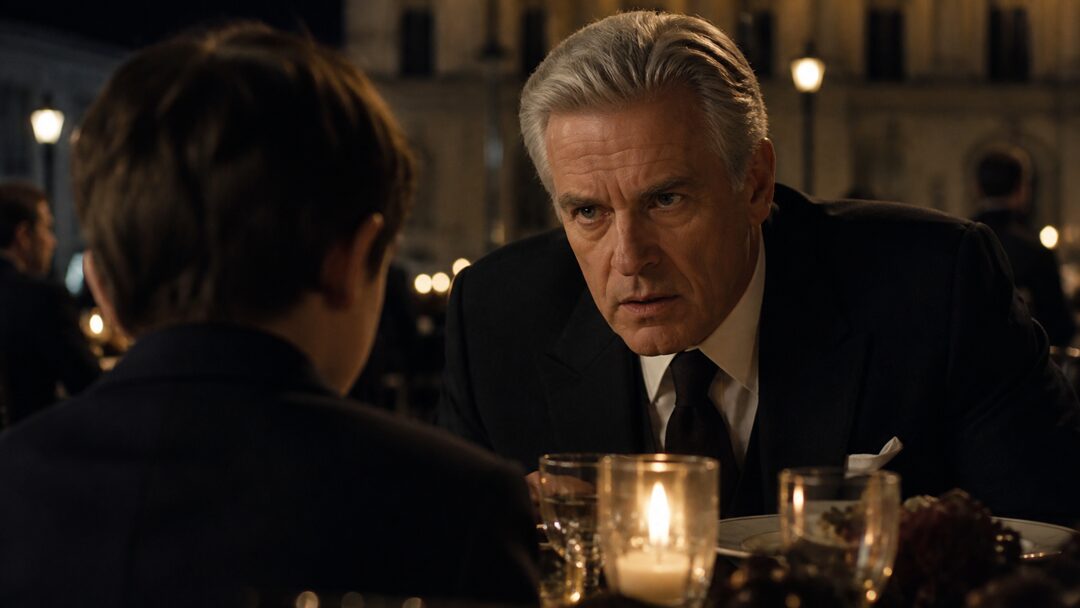
Robert Hayes said it softly, which made it worse.
Across from him, Ethan Miller sat with both feet hovering above the brick patio, too short for the chair, too small for the dinner jacket his mother had borrowed from a neighbor. The sleeves swallowed half his hands. His napkin was folded in his lap like he was afraid to touch it.
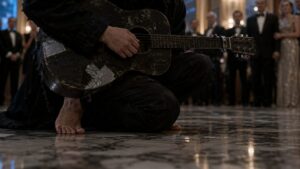
Between them sat two plates of untouched food, three candles, polished silverware, and a small wooden recorder in a worn brown case.
It looked absurd there.
A child’s instrument beside crystal glasses and white roses. A school thing. A cheap thing. Something that belonged in a backpack, not at a private table behind the National Veterans Memorial Museum while the last donors drifted toward the valet stand.
Robert watched the boy’s fingers move toward the case, then away again.
“Look at me,” Robert said.
Ethan did.
His eyes were gray-green, nervous, and too honest for Robert’s liking.
Robert had faced committees, commanders, grieving families, journalists who came smiling with knives hidden in their questions. He had sat through rooms where one wrong sentence could end careers. But this child’s face made him angrier than any of them.
Because the boy looked afraid.
And people who were truly cruel often knew how to look afraid.
“You told Mrs. Carter,” Robert said, “that you knew my son.”
Ethan swallowed.
“I didn’t say it like that.”
“You said you had something that belonged to Daniel Hayes.”
Ethan glanced toward the recorder case.
Robert’s hand tightened around his water glass. The candlelight caught the gold pin on his lapel, the one he wore every year at the fundraiser. Daniel’s unit insignia. A small bright thing he had learned to touch instead of speaking.
“My son has been gone for twenty years,” Robert said. “So I’m going to ask you once. Who put you up to this?”
“No one.”
“Your mother?”
Ethan shook his head quickly.
“Someone from the museum?”
“No, sir.”
“Then who?”
Ethan opened his mouth, closed it, and looked past Robert toward the dark glass doors. Inside, the museum lights glowed over framed photographs, medals, letters, uniforms behind glass. Lives made orderly after they had stopped being lives.
Robert leaned forward.
“This isn’t a game.”
The boy flinched.
From ten feet away, Linda Carter shifted beside the service door.
Robert felt it without looking. Her disapproval had weight. She had worked with him for twelve years and had perfected the art of silent warnings. Earlier that evening, she had taken him aside near the donor wall and said, “He’s nine, Robert.”
And Robert had answered, “Then someone should have taught him not to trespass on grief.”
Now she stood with one hand on her clipboard, watching.
Ethan finally spoke.
“Do you remember a song called ‘Going Home Through Rain’?”
Robert did not move.
The museum patio seemed to narrow around him.
The donors’ voices faded beyond the hedges. A fork clicked somewhere inside. A waiter laughed under his breath and was quickly shushed.
Robert looked at the boy’s face and found no triumph there. No rehearsed satisfaction. Just fear.
“What did you say?”
Ethan’s fingers curled against his sleeves.
“Going Home Through Rain,” he repeated. “That’s what he called it.”
Robert’s mouth went dry.
Daniel had made up that name when he was fourteen, sitting on the back steps during a summer storm, blowing three uneven notes into a recorder he’d won from a school music box. Later, overseas, he had carried a similar one as a joke. A ridiculous habit. A private habit.
No file held that title.
No speech mentioned it.
No article knew it.
Robert set the glass down carefully.
“Where did you hear that?”
Ethan stared at the candles.
“In my sleep.”
Robert almost laughed, but the sound never made it out.
Part II — The Wrong Question
Robert had spent his life knowing which question to ask.
A weak man asked what happened.
A trained man asked who benefited.
So he looked at Ethan and said, “Who told you that phrase?”
Ethan’s shoulders rose.
“No one.”
“You understand that is not an answer.”
“It’s the only one I have.”
Robert sat back, studying him. Small face. Pale knuckles. Shoes polished badly, one lace fraying at the end. The boy was not built for deception. That did not mean he was innocent. It only meant the adults behind him were careful.
“Your mother brought you here tonight?”
“She’s waiting in the lobby.”
“Does she know what you’re carrying?”
Ethan hesitated.
“She knows about the box.”
“What box?”
“The one from church.”
Linda took one step forward. “Robert.”
He did not turn.
“Let him answer.”
Ethan rubbed his thumb over the edge of the recorder case.
“There was a church sale. In March. They had old clothes and books and cups and stuff people donated. There was a box under one table with patches and buttons and postcards. I liked the recorder because it looked old. Mom said I could have it if I paid with my own money.”
“How much?”
“Two dollars.”
Robert’s jaw tightened.
Two dollars.
For a thing that had apparently carried twenty years across the country and landed in a child’s hands.
“And the photograph?”
Ethan looked up.
Robert saw then that he had said too much.
The boy had not mentioned a photograph at the table.
Ethan’s eyes widened slightly, not with guilt, but with recognition. As if a door had opened and both of them had heard it.
“You know about it,” Ethan said.
Robert’s voice sharpened.
“I know about people who bring props.”
“It isn’t a prop.”
“What is it, then?”
Ethan looked down.
“The man in it looked sad.”
Robert hated the softness in that sentence.
He hated that it landed.
“Lots of men look sad in old photographs.”
“This one looked like he was trying not to.”
The candles trembled in the breeze.
Robert looked away first.
Inside the museum, Daniel’s portrait hung in the east gallery. Captain Daniel Hayes, age twenty-eight. Sandy hair. Tired grin. Uniform dusty in the photo they had chosen because he looked alive enough to break a person and distant enough to survive being displayed.
Every year, Robert stood beneath that portrait and told donors what courage meant.
Every year, he left out the same thing.
He had been on the radio when Daniel died.
Not close enough to touch him. Close enough to command him.
“Where is the photograph?” Robert asked.
Ethan’s hand moved toward the inside pocket of his jacket, then stopped.
“I brought it.”
“Give it to me.”
The boy did not obey.
That, more than anything, struck Robert.
People obeyed him. Even now, out of uniform, with softer hands and a slower step, rooms adjusted when he entered. Men twice Ethan’s size still sat straighter at his voice.
But the boy only whispered, “Not yet.”
Linda came fully into the light.
“That’s enough.”
Robert turned on her.
“Mrs. Carter, please go inside.”
“No.”
The word was quiet, but it cut cleanly.
Ethan looked between them.
Robert’s face warmed with anger. “This is a private conversation.”
“With a frightened child,” Linda said. “At a table you arranged. After you asked me to locate his family.”
“I asked you to confirm a threat.”
“You asked me to bring him close enough for you to break his story.”
Robert stood.
The chair legs scraped the brick.
Ethan shrank back.
That movement stopped Robert more effectively than Linda’s words.
He looked at the boy’s hands, half-hidden in borrowed sleeves, and saw Daniel at nine for one terrible second. Daniel sitting at the kitchen table after breaking a neighbor’s window, chin lifted, eyes bright with fear, trying to be brave because he thought brave meant not asking to be loved afterward.
Robert lowered himself back into the chair.
“Play it,” he said.
Ethan blinked.
“The song,” Robert said. “If you know it, play it.”
Linda’s face changed. “Robert—”
“No.” His voice was lower now. “Let him.”
Ethan touched the recorder case like it might burn him.
“I’m not very good.”
“Neither was Daniel,” Robert said.
The boy looked up sharply.
Robert wished he could pull the sentence back.
But Ethan opened the case.
Part III — The Note That Shouldn’t Be There
The recorder was plain, darkened with age where fingers had held it often. Not Daniel’s original. Robert knew that immediately. Daniel’s had been cracked near the mouthpiece, repaired once with tape and later replaced by something he’d bought from a market overseas.
Still, Robert felt his pulse move into his throat.
Ethan lifted the instrument carefully.
For a moment, nothing happened.
The boy’s breath shook. The first note came thin and uncertain. Then the second. Then the third.
Robert closed his eyes before he meant to.
Rain.
That was the first thing memory gave him.
Not the country. Not the date. Not the briefing room.
Rain on porch steps in Virginia. Daniel at fourteen, knees muddy, playing the same five notes over and over until Robert, reading operational reports at the kitchen table, had finally said, “Daniel, for God’s sake, resolve the melody.”
Daniel had grinned through the screen door.
“It’s not supposed to resolve.”
“That’s not music.”
“It is if you’re still walking home.”
Robert had forgotten that.
No.
He had buried it under cleaner things.
Ethan kept playing. The melody wavered, righted itself, then came to the wrong note.
The wrong note.
Daniel’s wrong note.
Not wrong because he didn’t know better. Wrong because he liked it. Because he said the song needed a stone in its shoe.
Robert opened his eyes.
The patio had blurred.
Ethan lowered the recorder.
“I told you I’m not good.”
Robert did not answer.
He could command men under fire. He could testify before Congress with cameras fixed on his face. He could stand beside a folded flag and make his voice hold.
But he could not speak after hearing that wrong note from a child who should not exist inside that memory.
Linda stood very still.
Ethan’s voice was barely above the candle flame.
“He laughs after that part.”
Robert looked at him.
“What?”
“In the dream. When he plays the wrong part, he laughs. Like he knows somebody will be annoyed.”
Robert’s hand moved to his lapel pin.
Daniel had laughed that way. A quick sideways laugh, half apology, half defiance.
“Tell me the dream,” Robert said.
Ethan shook his head.
“Not all of it.”
“Why?”
“Because you get mad.”
Robert’s eyes hardened by habit.
Then softened by effort.
“I am already mad.”
“No,” Ethan said. “In the dream.”
Robert stopped breathing for a moment.
Ethan looked down at the recorder in his lap.
“There’s rain. A lot of it. And a room with broken walls. Like a school, maybe. There are drawings on the walls, but they’re dirty. He’s there with another boy. Not me. A different boy.”
Robert heard something in his own skull then.
Static.
Rain.
A radio channel layered with three voices.
Hold position.
Do not advance past the north road.
Wait for confirmation.
“Keep going,” Robert said.
Ethan’s mouth trembled.
“There are kids crying somewhere. He tells them to stay low. He has the recorder in his vest. He says it makes him look harmless.”
A sound left Robert, not quite a laugh.
Daniel had said exactly that in an email.
Don’t worry, Dad. No one fears a man carrying a school recorder.
Robert had not answered that line. He had corrected the report attached beneath it.
Ethan looked at him with sudden worry.
“Did I say something wrong?”
Robert shook his head once.
Linda pulled out the chair beside Ethan but did not sit. Her eyes were on Robert now, not the boy.
“Robert,” she said gently.
He ignored the gentleness.
“Who was the other boy?”
“I don’t know.”
“What did he look like?”
“Small. Dark hair. He had a cut on his eyebrow.” Ethan frowned. “He was holding the recorder first, I think. Or maybe Daniel was teaching him. I’m not sure.”
Robert pressed two fingers against the bridge of his nose.
Daniel’s final report had mentioned evacuees in a schoolhouse. Civilians trapped after the ceasefire broke apart. No photographs had come through official channels. No names. Just numbers, locations, damage assessments, language that made human beings easier to place in columns.
Linda finally sat.
Ethan turned the recorder slowly in both hands.
“I didn’t want to come,” he whispered.
Robert looked at him.
“Then why did you?”
“Because every time I tried to put it away, I heard the song.”
“That’s not an answer.”
“It is to me.”
The words were not clever. They were not dramatic.
That was why Robert believed them for one dangerous second.
Then he fought belief like an illness.
“Dreams are not evidence.”
Ethan nodded.
“I know.”
“Songs can be learned.”
“I know.”
“Photographs can be planted.”
The boy’s face changed.
Not anger.
Disappointment.
As if Robert had failed a test Ethan had not wanted to give.
“Yes,” Ethan said. “They can.”
And still, he reached into his jacket.
Part IV — What Robert Carried
Robert almost told him to stop.
Not because he did not want proof.
Because he did.
That was the terrible part.
For twenty years, proof had been the shape of his life. Reports, maps, radio transcripts, casualty records, commendation letters, sealed findings. He had collected certainty like sandbags and built a wall around the single thing he could not survive.
The fact that Daniel had called him.
The fact that Robert had answered as a commander first.
The mission had been called a stabilization effort in public language. In private, it was weather, confusion, bad maps, exhausted men, and instructions changing faster than anyone could carry them out. Daniel’s unit had been ordered to hold near the village school until the convoy cleared the southern route.
Then the line collapsed.
Then civilians moved where civilians were not supposed to be.
Then Daniel requested permission to shift position.
Robert had been in the operations room, listening through static, hearing his son’s voice buried under call signs.
Negative. Hold until confirmation.
Daniel came back: There are children in the schoolhouse.
Robert remembered looking at the map.
He remembered twelve other units waiting on decisions.
He remembered the colonel beside him saying, If Hayes moves, we expose the road.
He remembered his own voice.
Hold position.
A commander’s voice.
A father’s voice locked behind it, pounding.
Daniel had not argued. That had haunted Robert more than if he had.
Copy, Daniel had said.
Then, later, after the rain grew heavier and the channel broke apart, Daniel’s last clear transmission came through.
I heard you.
Nothing after that survived cleanly.
Reports said Captain Hayes led a small movement to evacuate trapped civilians during the collapse. Reports said his actions saved fourteen people. Reports said he showed exceptional courage.
Reports did not say whether he disobeyed.
Reports did not say whether he forgave.
Robert made sure no one asked the question in public.
Now Ethan pulled out a photograph.
It was small. Bent at one corner. Soft from years of being handled. The edges had browned.
He placed it on the table, but kept two fingers on it.
Robert stared at the back of the boy’s hand.
“Why now?” he asked.
Ethan looked confused.
“What?”
“You said you bought the box in March. That was seven months ago. Why bring this now?”
Ethan’s lips pressed together.
“I tried not to.”
Linda’s voice softened. “What do you mean?”
“I put it in my closet. Then in the garage. Then Mom told me if it scared me, we could throw it away.” He looked at Robert. “I almost did.”
Robert’s chest tightened.
“But?”
“But when I touched the trash can, I heard the song again. And then I felt…” Ethan searched for a word big enough and small enough. “Like someone was waiting.”
“For what?”
Ethan’s eyes filled, but he did not cry.
“An apology.”
Robert looked away.
The boy pushed the photograph closer.
Robert did not take it.
He could read command reports. He could read grief in a widow’s posture. He could read the lies men told themselves so they could sleep.
But he could not read that photograph while Ethan still touched it.
“Please,” Ethan said. “I don’t want to keep it anymore.”
The sentence broke something simple in the air.
Not proof.
Not mystery.
A child asking an old man to take back a weight.
Robert reached for the photograph.
His hand was steady until the moment he turned it over.
Part V — The Message on the Back
At first, Robert saw only Daniel.
Not Captain Hayes.
Not the portrait from the gallery.
Daniel.
Sandy hair damp with rain. Dust on his cheek. That tired, sideways grin he used when he wanted to make fear feel temporary. He sat on the floor of a damaged schoolroom with one knee raised, his uniform sleeves rolled up, the recorder tucked between two fingers.
Beside him sat a boy Robert had never seen.
Small. Dark hair. A mark near one eyebrow. He was holding the other end of the recorder like Daniel had just handed it to him or was just about to take it back.
Behind them, faded drawings clung to cracked walls.
A sun.
A house.
A stick figure with green arms.
Robert stared so long that the picture became less clear instead of more.
“This was not in the report,” he said.
Linda leaned slightly closer, then stopped herself.
Ethan watched Robert’s face.
Robert turned the photograph over.
The handwriting on the back hit him harder than the image.
Daniel’s handwriting had always leaned right when he was tired.
Tell Dad I heard him. I stayed anyway.
That was all.
No explanation.
No accusation.
No absolution.
Just a sentence with the force of a hand placed against a locked door.
Robert bowed his head.
For twenty years, he had believed the worst and the easiest thing.
That Daniel had died because his father’s order held him in place.
Then, on darker nights, he believed the other thing.
That Daniel had died because he broke that order, and Robert had raised a son who chose strangers over coming home.
Both versions had punished someone.
Himself.
Daniel.
Sometimes both.
Now the line on the photograph refused to let either version stay clean.
I heard him.
I stayed anyway.
Robert’s thumb moved over the words without touching them.
“General?” Linda said.
He did not correct her.
He could not yet become Robert.
Ethan whispered, “Is it real?”
Robert looked at the boy.
There was the question he had prepared to ask. The one that had armored him through the evening. Is it real? Is this a trick? Is this a lie?
Now it sounded different coming from Ethan.
Not a challenge.
A plea.
Robert set the photograph down with care.
“Yes,” he said.
Ethan let out a breath so shaky it almost made a sound.
Robert looked at the recorder in the boy’s lap.
“Play it again.”
Ethan blinked. “Now?”
“Yes.”
“I might mess up.”
Robert’s mouth pulled at one corner. It did not become a smile.
“That may be required.”
Linda looked down.
Ethan lifted the recorder.
The first note trembled worse than before. The second found itself. The third stepped carefully into the fourth, and then came the wrong note, small and stubborn, refusing to become beautiful in the proper way.
Robert kept his eyes on the photograph.
He did not make a speech.
He had given speeches for too long.
He had polished grief until it could sit on a stage and raise money. He had said sacrifice and honor and legacy until the words became useful furniture.
Now there was only a photo on a table and a child playing a song that had never learned how to end.
Robert spoke quietly.
“I gave the order.”
The music continued.
“You made the choice.”
Ethan’s fingers slipped, then recovered.
Robert’s voice broke on the last sentence, not loudly, not theatrically. Just enough that Linda turned her face away.
“I’m sorry I punished you in my heart for both.”
The recorder stopped.
No one moved.
The patio lights hummed softly overhead. Somewhere beyond the hedge, a car door closed. Life, with its terrible manners, continued.
Robert touched the edge of the photograph.
He expected something then.
Not a miracle. He was too old for that.
But perhaps a change in the air. A sign. A warmth. Some childish reward for finally saying aloud what had lived in him like a stone.
Nothing came.
Only the candle flame.
Only Ethan’s small hands around the recorder.
Only Linda quietly crying without wiping her face.
And somehow, the absence was not empty.
Part VI — What Remained
Ethan’s mother was waiting in the lobby under Daniel’s portrait.
She rose quickly when Robert entered with Ethan and Linda beside him. Her face carried the tight apology of a parent who had spent too many hours wondering whether her child had embarrassed someone powerful.
“I’m sorry,” she began. “If he upset you—”
“He didn’t,” Robert said.
The woman stopped.
Ethan stood beside her, holding the recorder case in both hands. He looked exhausted now. Not relieved exactly. Lighter, but confused by it.
Robert knelt.
It took effort. His knee objected. His back objected. Some old part of him objected most of all.
But he lowered himself until he was no longer looking down at Ethan.
The boy watched him carefully.
Robert held out the recorder.
Ethan frowned. “That’s yours.”
“No,” Robert said. “It was Daniel’s for a while. Then it was someone else’s. Then it found you.”
Ethan did not take it.
“What if the dreams come back?”
Robert considered lying.
He did not.
“Then you can tell your mother.”
Ethan looked at the recorder.
“And if the song comes back?”
Robert’s voice was quiet.
“Then play it badly.”
For the first time all evening, Ethan almost smiled.
He took the recorder.
Robert stood slowly, the photograph safe inside his jacket pocket. Ethan’s mother thanked him, though she did not seem sure what she was thanking him for. Linda walked them to the doors.
Before Ethan stepped outside, Robert called his name.
The boy turned.
Robert felt foolish before he said it. Worse, he felt sincere.
“If your mother allows it,” he said, “you may come to dinner again. Not for questions. Not for any of this.”
Ethan waited.
Robert’s voice lost its command.
“Just dinner.”
Ethan looked at his mother. She looked unsure, moved, protective.
Then Ethan nodded once.
“Okay.”
The glass doors opened. Cool night air moved through the lobby. The boy left carrying the recorder against his chest.
Robert remained beneath Daniel’s portrait.
For years, he had thought the portrait looked brave. Tonight, it looked young.
Linda came back and stood beside him.
“You did the right thing,” she said.
Robert looked at the framed face above them.
“I did one right thing.”
Linda accepted the correction.
After she left, Robert went alone into the east gallery.
The museum had gone quiet. The catered tables were being cleared in another room. The speeches were over. The donors had taken their programs, their tax receipts, their solemn handshakes.
Robert unlocked the small display beneath Daniel’s portrait.
Inside lay the medal, the folded citation, and a typed description of courage that had never been false.
Only incomplete.
He took the photograph from his jacket.
For a long moment, he held it under the gallery light.
Daniel and the boy in the schoolroom.
Daniel smiling like fear was something he could lend his shoulder to.
Daniel’s handwriting on the back, refusing to let love become command.
Robert placed the photograph beside the medal.
Not behind it.
Not under it.
Beside it.
Then he closed the glass.
The display looked less perfect now.
It looked more true.
Robert stood there until the motion lights dimmed around him, and in the soft gray of the gallery, he could almost hear the wrong note again.
Not resolved.
Still walking home.