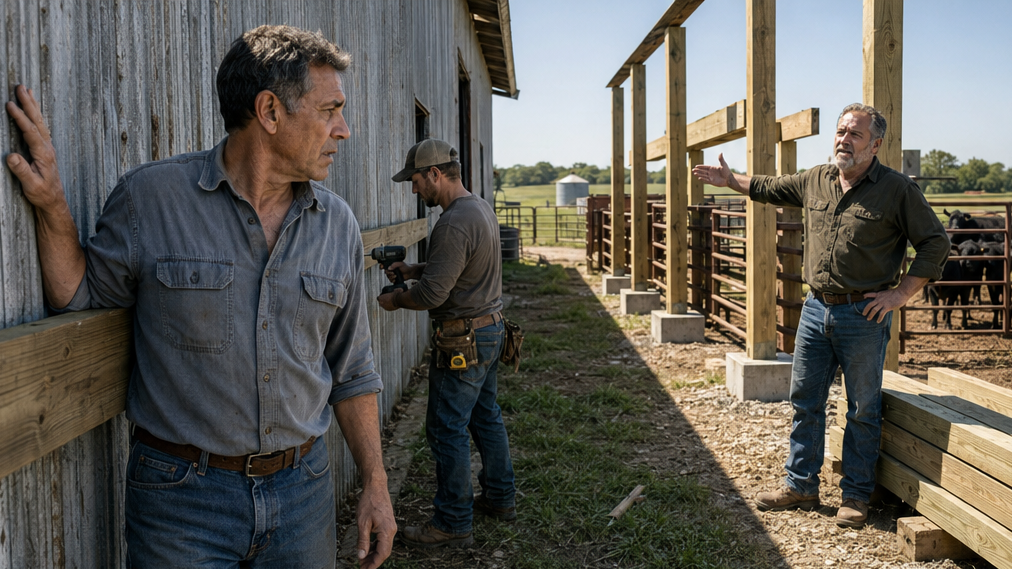
My Neighbor Bolted His New Farm Structure Into My Barn—Then the County Measured the Boundary
Chapter 1: The Morning the Barn Wall Started Shaking
The first jolt ran through the barn wall hard enough to make the wrench jump in Daniel Lopez’s hand.
He froze beneath the raised hood of the hay tractor.
A second vibration traveled through the corrugated steel behind him—short, mechanical, followed by the rapid hammering chatter of an impact driver.
Daniel lowered the wrench.
Nobody should have been drilling on that wall.
He crossed the equipment bay and pushed through the side door into the narrow strip between his barn and Charles Davis’s cattle lot.
For several seconds, Daniel simply stared.
Three fresh posts stood in new concrete along the edge of the gravel. Heavy horizontal timbers connected them. Joists extended outward over what had always been an awkward strip of grass and hard-packed soil between the two farms.
A carpenter stood on a temporary platform with an impact driver pressed against a thick ledger board.
The ledger was flush against Daniel’s barn.
A yellow measuring tape hung unused from the carpenter’s belt.
The driver rattled again.
Daniel saw the long structural screw disappear through the ledger and into the wall.
“Stop.”
The carpenter released the trigger.
Daniel walked closer, put his palm against the steel siding, and felt the fading vibration.
“That’s my barn.”
The carpenter looked toward Charles.
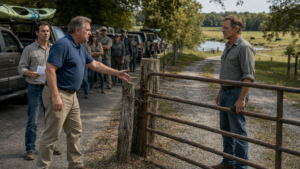
Charles stood ten yards away near a stack of treated lumber, work gloves tucked into his back pocket. He did not look surprised to see Daniel.
“It’s just a brace,” Charles said.
Daniel looked at the timber. “Then brace it to your building.”
“It’s temporary.”
“There shouldn’t be anything temporary screwed into my wall.”
Charles came closer, stepping carefully around a bucket of fasteners. “We’re putting in a loading platform. Feed storage on the back. It needs to be stiff until the posts cure.”
Daniel looked past him.
What Charles called a platform was already too large to be dismissed as a weekend repair. Concrete footings ran in a line toward the cattle pens. Upright posts suggested a roof would follow. Fresh lumber lay stacked beside sheets of metal roofing.
“You started all this this morning?”
“Yesterday afternoon.”
Daniel had spent most of Monday cutting hay on the south field. He had returned after dark and never walked behind the barn.
“You were going to tell me?”
Charles’s mouth tightened.
“I figured you’d see it.”
Daniel glanced again at the screw buried in the wall.
“That’s not the same thing.”
The carpenter shifted his weight. “You want me to pull that one?”
Daniel looked directly at Charles.
“I want everything off my barn.”
Charles exhaled through his nose. “You’re making this bigger than it is.”
“No. You made it bigger than it was when you attached it to my building.”
For a moment neither man moved.
They had argued before, but never like this.
For years, Charles had cut across the back corner of Daniel’s lane when a cattle trailer needed a wider swing. Daniel had borrowed Charles’s post driver twice. Charles had used Daniel’s gravel turnaround during muddy springs.
None of it had been written down.
None of it had seemed worth writing down.
Charles pointed toward the posts.
“This is on my side.”
Daniel followed the line with his eyes. “According to what?”
“The fence.”
“The fence isn’t the surveyed boundary.”
“It’s been treated like it for thirty years.”
“That doesn’t make my barn yours.”
Charles looked toward the carpenter.
“Take that screw out.”
The carpenter reversed the driver. The fastener came free with a metallic squeal.
Daniel watched the hole remain.
Charles said, “There. Happy?”
“No.”
“Daniel.”
“You’ve got a structure going up beside my barn, and I don’t know where the property line is because neither one of us has measured it in years.”
“I know where the line is.”
“Then show me the pin.”
Charles did not answer.
Daniel looked toward the corner where an old fence post leaned under decades of wire repairs.
The original iron boundary marker was somewhere near there. His father had shown it to him when Daniel was young enough that the barn roof had still been red.
Daniel could not remember the last time he had actually seen it.
Charles said, “You never complained when I brought trailers through here.”
“That was a trailer.”
“You never complained when we widened the turn.”
“You asked.”
“I thought we understood each other.”
The words landed harder than Daniel expected.
Because once, perhaps, they had.
There had been no forms when Charles needed to cross the lane during a flooded spring. No written permission when Daniel had needed Charles’s loader after a hydraulic line burst.
They had operated on the assumption that neighbors asked, neighbors helped, and nobody took more than was offered.
Daniel pointed to the half-finished framing.
“This isn’t borrowing a lane.”
Charles’s expression hardened.
“The cattle setup has to be ready before winter.”
“That still doesn’t make my wall part of it.”
Charles shook his head.
“You always do this.”
Daniel frowned. “Do what?”
“Say nothing for years, then decide there’s a line everybody else was supposed to know about.”
The carpenter suddenly became very interested in the screws at his feet.
Daniel felt heat climb his neck.
There were half a dozen answers he could have given. Most of them would have been satisfying for ten seconds and expensive for ten years.
Instead he said, “Keep your construction off my barn.”
Charles stared at him.
Daniel turned and went back inside.
The tractor sat where he had left it, hood raised, wrench on the floor.
He picked it up but did not resume the repair.
Through the wall came the muffled voices of the crew.
Then silence.
Daniel waited.
For several minutes, nothing happened.
He began to think Charles had finally understood.
Then the impact driver started again.
Not against the barn this time.
But close.
Daniel went to the window.
Charles stood beside the carpenter, pointing toward the remaining posts.
“Keep going,” he said.
Chapter 2: A Handshake Boundary Nobody Had Ever Measured
By Wednesday morning, six fresh concrete footings had appeared beside Daniel’s barn.
The concrete was still dark with moisture.
Daniel stood at the edge of the gravel with a mug cooling in his hand and counted them twice.
Charles’s crew had worked until nearly sunset Tuesday. They had honored Daniel’s demand not to put another fastener into his barn, but the structure itself had continued growing.
Posts now rose in a straight line that looked uncomfortably close to the wall.
Daniel went into the barn and found his thirty-foot measuring tape.
He hooked one end on the old fence corner and walked toward the building.
The tape rasped over gravel.
Twenty feet.
Twenty-five.
He stopped.
The problem was that he did not know exactly what he was measuring from.
The fence corner was visible.
The legal boundary marker was not.
Daniel crouched near the old post and scraped at the soil with a screwdriver. He found stones, a rusted washer, and the broken end of an old staple.
No iron pin.
He stood and looked at the tape lying between the fence and barn.
For the first time since seeing the screw enter his wall, certainty deserted him.
He knew the barn belonged to him.
He knew Charles had no right to attach anything to it.
But the exact land beneath the new posts was harder to claim from memory.
Daniel carried the tape back inside.
He did not walk over to Charles’s house.
Instead, he opened the metal filing cabinet in the farm office.
That was how Daniel handled conflict when he could: quietly, by finding something objective enough that nobody could argue with him.
He found the deed, tax maps, an old insurance survey, and a faded property sketch that showed dimensions but no convenient measurement from the barn.
Nothing gave him the answer he wanted.
By ten, Daniel was on the phone with the county permit office.
He explained the situation without using Charles’s name at first.
“A livestock loading platform and feed cover,” he said. “Timber construction. Footings. Close to an existing building.”
The permit clerk asked several questions.
Size.
Roofed or unroofed.
Permanent attachment.
Distance from the property line.
Daniel paused.
“That last part is what I’m trying to determine.”
The clerk explained that agricultural structures could be treated differently depending on use and location, but exemptions were not a blanket permission to ignore structural, drainage, setback, or property requirements.
“If it’s physically attached to someone else’s building,” the clerk added, “that’s a separate issue.”
Daniel looked at the small hole in his wall from across the office.
“So this isn’t just me being difficult.”
“I can’t make that determination over the phone.”
Daniel almost laughed.
“No. I suppose not.”
The clerk searched the parcel records.
There was no current permit application matching the project.
No recent site plan.
No new survey filed with the county.
Daniel thanked the clerk and hung up.
For several minutes he sat still.
He had wanted confirmation.
He had it.
But it did not feel like victory.
When he went outside again, Charles was tightening a temporary gate near the new posts.
Daniel walked toward him with the folded property sketch in one hand.
Charles saw it immediately.
“You called the county.”
“I asked what the requirements were.”
“That means yes.”
“You don’t have a permit.”
Charles dropped the wrench into a bucket.
“It’s a farm structure.”
“That doesn’t answer the question.”
“You think my dad pulled paperwork every time he put up a shed?”
“No.”
“Neither did yours.”
Daniel glanced at the barn.
“That was forty years ago.”
“And somehow the cows survived.”
Daniel unfolded the sketch.
“Do you know where the survey pin is?”
Charles looked down at it, then back at Daniel.
“I know where we’ve always treated the line.”
“That’s not what I asked.”
Charles pointed toward the lane.
“When your father needed that corner widened, he came over and said, ‘We’ll work it out.’ We moved wire. Nobody brought a surveyor.”
Daniel remembered.
Not the exact words, but the year.
A wet spring. A combine too wide for the old turn. His father and Charles’s father standing beside a fence with shovels.
Daniel had been there.
Later, when the fence was rebuilt, it had followed the easier path rather than the old straight line.
Daniel had never considered whether that had changed what either family believed.
Charles said, “You drove equipment through here for years.”
“With permission.”
“So did I.”
“With permission.”
Charles spread his hands. “That’s my point. We had an understanding.”
“No. We had favors.”
Charles’s face changed slightly.
Daniel knew he had found the real argument.
Not where the legal line stood.
What each man thought years of cooperation had meant.
Daniel looked at the new footings again.
“You still should have asked.”
Charles replied, “Maybe I thought I already had.”
That sentence stayed with Daniel long after he walked away.
He spent the afternoon clearing equipment from the barn wall in case the county needed access.
At dusk, he tried the measuring tape again, this time from another fence post.
The numbers changed.
Not dramatically.
Enough.
He reeled the tape back in.
His father had never liked paperwork. Neither had Daniel. There had always been something faintly insulting about asking a neighbor to sign a document proving he would behave like a neighbor.
Now Daniel wondered whether that pride had simply postponed the argument.
At eight the next morning, his phone rang.
The county inspector had reviewed the complaint and parcel information.
“I can come Thursday morning,” the inspector said.
Daniel looked through the kitchen window toward Charles’s unfinished structure.
“What time?”
“Eight-thirty.”
Daniel agreed.
After the call ended, he stood at the sink with the phone still in his hand.
Thursday morning, somebody was finally going to measure the line.
And Daniel could no longer be certain what that measurement would say.
Chapter 3: Six Problems Hidden Inside One New Structure
The county inspector did not begin with introductions.
He walked into the narrow strip beside Daniel’s barn, pulled a tape from his belt, hooked it against the metal siding, and stretched it toward the nearest post.
Charles arrived from the cattle lot just as the tape went taut.
“What are you measuring from?” Charles asked.
The inspector looked down at the mark.
“The existing structure first.”
“That’s not the property line.”
“No. It isn’t.”
Daniel stood several feet away with his hands in his jacket pockets.
He had promised himself he would not interfere.
Charles had promised nothing.
The inspector measured the barn, the posts, the width of the planned platform, and the distance to the drainage swale beyond the fence.
Then he photographed the hole where the ledger screw had entered Daniel’s wall.
Charles folded his arms.
“That screw was removed.”
“I can see that.”
“So it’s not attached.”
The inspector looked at him.
“Was it attached?”
“Temporarily.”
The inspector wrote something on the clipboard.
Charles glanced at Daniel as though Daniel had answered for him.
The carpenter arrived a few minutes later and stood near the lumber stack. Nobody told him to resume work.
The inspector moved to the concrete footings.
He scraped loose soil from one edge, asked how deep they were, then requested the construction sketch.
Charles handed him a single sheet.
The inspector studied it.
“This is from the lumber supplier.”
“It shows the framing.”
“It isn’t a site plan.”
“It’s a farm loading platform.”
“You’ve said that.”
The inspector’s voice was not hostile.
That seemed to irritate Charles more than hostility would have.
They worked down the line one measurement at a time.
Daniel watched the tape extend and retract.
Each click of the spring-loaded reel sounded sharper than it should have.
Eventually the inspector stopped near the third post.
He checked the number again.
Then he measured from a different reference point.
Charles stepped closer.
“What?”
The inspector pointed.
“If the boundary is where the parcel information indicates, this portion is inside the required separation.”
“By how much?”
“I’m not certifying the property line. You need a survey for that.”
“Then how can you say it’s wrong?”
“I can say the submitted placement doesn’t work with the available records.”
Charles made a short, humorless sound.
Daniel felt the first flicker of satisfaction.
It vanished almost immediately.
The inspector was not finished.
The roof runoff shown on Charles’s sketch would drain toward the narrow strip beside Daniel’s barn.
The footings required further verification.
The ledger attachment had not been approved.
The framing lacked several pieces of hardware required by the design Charles was using.
The proposed cattle movement created a pinch point beside the building that raised another compliance concern.
And there was still the unresolved setback.
By the time the inspector reached the far end, what Daniel had thought was one problem had become a list.
Charles stopped interrupting.
The inspector wrote each issue separately.
Daniel counted six entries before he looked away.
The carpenter finally spoke.
“If we move the outer posts, can we save the inside framing?”
The inspector shook his head slightly.
“You need an approved plan before I’m going to tell you what can stay.”
Charles said, “You’re shutting down the whole thing?”
“For now.”
“That platform needs to be operational before the cattle come off pasture.”
“That doesn’t change the site.”
“You understand what delay costs?”
The inspector clipped the papers together.
“I understand you built before review.”
Charles’s jaw tightened.
Daniel stared at the gravel.
That sentence should have felt satisfying.
Instead he pictured the unfinished roof, the concrete already poured, the lumber stacked in the weather.
The inspector handed Charles the written stop order.
“No further work until the placement and design issues are resolved.”
Charles took it but did not look at it.
The carpenter packed his drill into a case.
One of the farmhands began gathering loose joist hangers.
Within minutes, a place that had been full of hammering and saw noise became unnaturally still.
Daniel stepped closer to the inspector.
“What about my wall?”
“Document the damage. The attachment shouldn’t have been made without authorization.”
Daniel nodded.
There it was.
The sentence he had wanted.
He had been right.
But when he looked at Charles, he did not see the smug man who had told the crew to keep going Tuesday.
He saw a farmer standing inside several thousand dollars of lumber that could no longer move.
Charles caught him looking.
“Enjoy it?”
Daniel’s head came up.
“No.”
“You got what you wanted.”
“I wanted you off my barn.”
“You called the county.”
“After you kept building.”
Charles folded the stop order once.
Then again.
“You could’ve talked to me.”
Daniel stared at him.
“I did.”
“You came out already mad.”
“You had a screw in my wall.”
“And you were waiting for a reason.”
Daniel almost answered.
Instead he stopped himself.
Because part of that accusation reached somewhere uncomfortable.
There had been other things.
A gate left open two summers ago. Tire tracks across the lane after heavy rain. Charles using the turnaround without calling first.
Daniel had noticed all of them.
He had said almost nothing.
He had stored each irritation carefully and called that patience.
Now every one of them seemed to be standing between the two men.
The inspector left just before ten.
Charles walked toward his cattle lot without another word.
Daniel remained beside the barn.
He put his hand over the small hole in the siding.
The surface was cold.
Behind him, a pickup turned into the lane faster than usual.
Daniel stepped away from the wall.
Jennifer Clark climbed out.
He had not seen her in nearly a year.
She shut the door and looked first at the idle construction, then at the stop-order paper in Charles’s hand.
Finally she looked at Daniel.
“My dad says you shut the whole project down.”
Daniel said, “The county did.”
Jennifer walked closer.
“Do you even know what that project was for?”
Daniel glanced toward Charles.
“No.”
Jennifer’s expression hardened.
“Then maybe before you decide you won, you should find out.”
Chapter 4: Why Charles Could Not Afford Another Winter
Jennifer did not lower her voice.
“My dad thought you’d already agreed to it.”
Daniel looked at her across the narrow strip of gravel.
“To bolting lumber into my barn?”
“To using that side for the new setup.”
Charles stood twenty yards away near the idle framing, reading the stop order as if another look might change what it said.
Daniel glanced toward him.
“He never asked me.”
Jennifer folded her arms. “He says he did.”
That stopped Daniel.
“When?”
“Years ago.”
Daniel almost dismissed it. Then he saw the certainty on her face.
Not anger alone. Belief.
“He said when you widened the equipment turn, both families agreed that strip would stay shared for farm access.”
“Access,” Daniel said. “Not construction.”
“I know the difference.”
“Does he?”
Jennifer’s jaw tightened.
“He’s not trying to steal your land.”
“I didn’t say he was.”
“You called the county.”
“After he kept building.”
“And now everything stops.”
Daniel heard the strain beneath the accusation.
He looked beyond her at Charles’s cattle lot. Gates that had seemed ordinary two days earlier now formed a bottleneck. The unfinished platform sat where cattle would have been sorted and loaded. Feed pallets waited under tarps beside the posts.
“What exactly was the hurry?” Daniel asked.
Jennifer hesitated.
Then she looked toward her father before answering.
“I’m coming back.”
Daniel frowned.
“Back where?”
“To the farm. Full-time.”
He had known she worked away from the county, though he had never asked exactly where.
Jennifer continued.
“My dad’s been running fewer cattle every year because he can’t handle the winter work alone. I’ve been trying to get back for two years. We finally worked out a plan.”
She pointed toward the stalled framing.
“That was part of it.”
Daniel said nothing.
“The covered section keeps feed closer to the pens. The platform lets us load without swinging trailers across your lane. New sorting gates were supposed to go in next.”
Daniel looked at the structure again.
The thing he had seen as intrusion had another shape now.
It was still too close to his barn.
Still badly planned.
Still started without permission.
But it had not been built because Charles wanted another convenience.
It had been built because he believed his daughter coming home might keep the farm from shrinking into nothing.
Jennifer said, “If we miss this winter, we lose another season.”
“That doesn’t make the wall his.”
“I didn’t say it did.”
Her answer was immediate.
Daniel looked at her.
For the first time, Jennifer’s anger eased.
“He should’ve asked you,” she said. “I told him that.”
Daniel felt some of his defensiveness leave with hers.
“Then why didn’t he?”
“You know him.”
“That’s not an answer.”
“It’s the only one I’ve got.”
Charles had always preferred doing to discussing. Broken fence? Fix it. Muddy lane? Gravel it. Equipment stuck? Bring the loader.
Asking meant admitting dependence.
Paperwork meant admitting somebody else could say no.
Daniel understood that kind of pride because he carried his own version of it.
Jennifer walked back toward the cattle lot.
Before leaving, she said, “He thought you knew what we were trying to do.”
“I didn’t.”
“I know that now.”
Daniel watched her go.
That evening, he sat at his kitchen table with his measuring tape beside the county paperwork.
He should have been checking numbers.
Instead, he stared at the closed tape housing.
Something Jennifer had said kept bothering him.
Years ago.
Both families.
Shared access.
Daniel remembered the wet spring when his father had widened the turn beside the barn. Charles’s father had helped move wire. For several weeks, equipment from both farms had crossed wherever the ground was firm enough.
Later, the lane remained wider.
Nobody restored the original fence.
Daniel remembered Charles, younger then, standing beside the new gravel and saying, “Guess we’ll just keep this open between us.”
Daniel had answered without looking up from the tractor tire he was changing.
“Long as nobody gets stupid with it.”
At the time, it had been a joke.
Now he could hear how Charles might have remembered only the first half.
Daniel rubbed a hand across his face.
He had never intended to give permanent building rights.
But he had also never corrected the assumption.
Years of little irritations followed.
Charles taking a trailer through without calling.
Daniel moving a fence panel six feet and never explaining why.
Each man acting from a private version of an agreement neither had bothered to define.
Daniel picked up the measuring tape, then set it down again.
For once, another measurement would not answer the problem.
On Friday afternoon, Charles drove past Daniel’s barn without stopping.
A contractor arrived behind him.
They spent nearly two hours examining the structure.
Daniel stayed on his side.
He could hear fragments.
“Footings.”
“Move the roofline.”
“Drainage.”
“Start over.”
At one point Charles raised his voice.
“There has to be something we can keep.”
The contractor answered too quietly for Daniel to hear.
Charles walked away from him and stood beside the cattle fence.
Later, Daniel saw Jennifer carry a rolled plan into the house.
Saturday passed without construction.
So did most of Sunday.
Near dusk, Charles appeared at the fence between the farms.
Daniel was checking a water trough.
Charles did not come through the gate.
“You happy now?” he asked.
Daniel straightened.
“No.”
“County says I need revised plans. Engineer wants money. Surveyor wants money. Contractor wants money.”
“You built first.”
“I know what I did.”
It was the closest Charles had come to admitting anything.
Daniel waited.
Charles stared at the stalled structure.
“I still think you could’ve handled it different.”
Daniel almost said the same.
Instead he asked, “Can any of it stay?”
Charles looked at him.
For a moment, Daniel thought pride would keep him silent.
Then Charles said, “Contractor says maybe the concrete at the far end.”
“Maybe?”
“If the survey works.”
“And the rest?”
Charles looked away.
“Not enough to matter.”
The answer carried across the fence more quietly than any accusation they had exchanged.
Almost nothing could be economically salvaged.
And Daniel understood then that Charles might accept losing lumber before he accepted saying he had been wrong.
Chapter 5: Four Thousand Dollars Before the First Board Came Down
The survey flags appeared before sunrise.
Daniel saw the first one from his kitchen window: bright orange against the gray gravel beside the barn.
By the time he pulled on his boots, there were six.
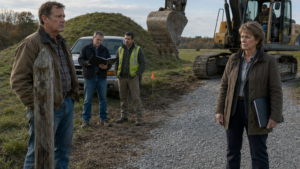
A surveyor stood near the fence corner with a receiver pole while an assistant worked farther down the property line.
Charles was already outside.
Neither man spoke.
The surveyor asked them to stay clear until the control points were established.
Daniel obeyed.
Charles followed two steps behind him.
For nearly an hour, the two farmers watched somebody else determine the truth beneath their feet.
The surveyor found the first old marker near the county road.
The second took longer.
Near Daniel’s barn, he used a metal detector, then knelt and scraped soil away with a narrow shovel.
The detector chirped.
He dug another inch.
A rust-dark circle appeared beneath the dirt.
Daniel leaned forward.
“There.”
The surveyor brushed soil from the top of an iron pin.
It was smaller than Daniel remembered.
For years, both men had argued around something buried six inches below ground.
The surveyor stretched a line between the verified points.
Daniel watched its path.
It did not follow the fence.
It did not follow Charles’s assumed line either.
It passed closer to Daniel’s barn than Daniel had expected, then angled slightly away near the cattle lot.
Charles spoke first.
“That can’t be right.”
The surveyor looked at him.
“It matches the recorded description.”
Daniel walked slowly beside the marked line.
His first instinct was relief.
The structure still crossed into the required separation area.
Several posts were unquestionably too close.
But then he reached the place where he had insisted the boundary must be farther toward Charles’s side.
He had been wrong too.
Not by feet.
By enough.
Charles noticed.
“You said the line was over there.”
Daniel looked at the orange flag.
“I was wrong.”
Charles seemed almost disappointed by the admission.
He had been prepared for another argument.
Daniel added, “So were you.”
The surveyor continued marking the line.
There was no victory in it.
Only coordinates.
By noon, the uncertainty that had survived for decades was gone.
The financial damage was just beginning.
Over the next week, trucks and paperwork replaced construction noise.
An engineer reviewed the framing.
The county required revised drawings.
The contractor charged for multiple site visits.
The survey bill arrived.
Daniel did not know every figure until Charles told him.
It happened beside the feed lot while both men waited for a delivery truck to clear the lane.
“Four thousand and change,” Charles said.
Daniel thought he had misheard.
“For what?”
“For learning I can’t use what I already paid to build.”
Charles counted on his fingers.
“Survey. Engineering. permit review. Contractor. County fees.”
Daniel looked toward the idle platform.
“Before demolition?”
Charles gave a dry laugh.
“Before one board comes down.”
The number should have felt like justice.
Instead Daniel imagined spending four thousand dollars on something that had produced nothing except a stop order and resentment.
Charles said, “You know what the best part is?”
Daniel did not answer.
“I still have to pay to take it apart.”
The feed truck rolled away.
Charles turned to follow it.
Daniel said, “The barn wall still has to be repaired.”
Charles stopped.
“I know.”
“The contractor looked at it?”
“He did.”
Daniel waited.
Charles faced him again.
“He says pulling that ledger clean may damage more siding. Maybe sheathing behind it.”
“You attached it.”
“I said I know.”
The impatience returned.
Daniel could feel his own answer forming.
He could demand a full professional repair, reimbursement for every hour lost, written guarantees, perhaps legal review.
Some of that would be reasonable.
Some would be punishment dressed as caution.
That afternoon, Daniel called his insurance agent but stopped short of opening a claim.
He wrote down the damage instead.
Hole in siding.
Fastener penetration.
Possible sheathing repair.
Interference with equipment access.
The list grew.
When he finished, it looked less like protection and more like a case file.
Daniel stared at the page.
This was what he did when conversation became uncomfortable.
He converted people into documentation.
Two days later, Charles arrived at the barn carrying a folder.
He set it on the hood of Daniel’s pickup.
“I’ve got a proposal.”
Daniel opened it.
The first page was a contractor estimate for repairing the barn wall.
Charles had agreed to pay the full amount.
Daniel looked up.
“That part’s fine.”
“There’s another page.”
Daniel turned it.
The second document described the revised structure. It included language allowing Charles to maintain the new loading area and related access near the boundary.
Daniel read the paragraph twice.
“This says I won’t object to future modifications within this access strip.”
“Reasonable modifications.”
“It doesn’t say that.”
“It’s standard language.”
“According to who?”
Charles’s face tightened.
“The contractor.”
“Your contractor.”
“It gives me enough certainty to spend money rebuilding.”
Daniel tapped the page.
“It gives you permission to decide what reasonable means.”
Charles spread his hands.
“You want your wall repaired. I’m offering to repair it.”
“In exchange for giving you future control over the same strip we’re fighting about.”
“I need to know you aren’t going to call the county every time I move a gate.”
Daniel closed the folder.
“This is exactly how we got here.”
“No. We got here because you decided a farm problem needed inspectors.”
“We got here because you built first.”
Charles leaned closer.
“And now I’m trying to fix it.”
“Then fix the wall.”
“And leave me exposed?”
“Exposed to what?”
“You.”
The word landed between them.
Daniel felt his temper rise.
Then he thought of the iron pin under the dirt.
Both men certain.
Both men wrong.
He handed the folder back.
“I’m not signing this.”
Charles took it.
“Then don’t expect me to pay until we settle the whole thing.”
Daniel stared at him.
The wall behind him carried the hole that had started everything.
Repair was finally within reach.
All Daniel had to do was give Charles a broader right than either man had ever clearly possessed.
Chapter 6: The Line Daniel Refused to Trade Away
Charles arrived Monday morning with the agreement already clipped open to the signature page.
He did not sit down.
Daniel’s farm office had two chairs across from the desk, but Charles stood beside one and slid the document forward.
“Sign it and I’ll have the repair crew here Wednesday.”
Daniel looked at the paper.
The wording had changed slightly.
Not enough.
The phrase “reasonable agricultural modifications” remained.
So did continuing use of the disputed access strip.
Daniel folded his hands.
“No.”
Charles stared at him.
“You didn’t even read it.”
“I read the part that matters.”
“I changed it.”
“You changed three words.”
“Because three words were the problem.”
“The problem is you want me to agree now to things you haven’t even decided to build.”
Charles pulled out the chair and sat.
“So what do you want?”
Daniel had prepared for that question.
A legal pad lay beneath his hand.
He turned it around.
Charles read the first line.
Then the second.
By the fifth, his eyebrows rose.
“Inspection of all repairs?”
“Yes.”
“Written notice before equipment crosses?”
“If it’s outside the existing lane.”
“Drainage approval?”
“If your roof drains toward my barn.”
Charles looked farther down.
“This sounds like something a lawyer wrote.”
“I wrote it.”
“That’s worse.”
Daniel felt himself stiffen.
Charles pushed the list back.
“You complain that I assumed too much, and your solution is to put rules on everything.”
Daniel looked down.
The page contained twelve conditions.
Some were necessary.
Some had been added at midnight after Daniel remembered an old gate left open.
One required seventy-two hours’ notice for temporary access.
Another prohibited storage within a distance wider than the county required.
Daniel knew exactly when he had written those.
Angry.
Alone.
Certain that if he could define every possible future conflict, he would never have to trust Charles again.
He picked up the pad.
Charles said, “Well?”
Daniel tore the page in half.
Charles blinked.
Daniel tore it again and dropped the pieces into the trash.
“That’s not what I need.”
For the first time that morning, Charles said nothing.
Daniel stood.
“Come outside.”
They walked to the barn.
The survey flags still marked the line.
Near the old fence corner, the iron pin had been left visible inside a short piece of protective pipe.
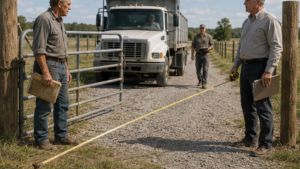
Daniel carried his measuring tape.
He hooked it beside the pin and walked toward the second marker.
The yellow blade stretched across the gravel.
Charles watched.
Daniel stopped at the surveyed line.
“This.”
Charles frowned. “This what?”
“This is the boundary.”
“I know.”
“No. I mean this is what I need us to stop arguing about.”
Daniel pointed toward his barn.
“Repair the wall correctly. Keep the new structure on your side with the required separation. Put drainage on your side. If you need to use my lane for something outside what we’ve already been doing, ask.”
Charles looked toward the cattle lot.
“That’s it?”
“No.”
Charles gave him a tired look.
Daniel continued.
“We write down the existing access. The turn by the road. The trailer swing. What we already do.”
Charles shook his head.
“You hate paperwork until it helps you.”
Daniel almost defended himself.
Then he said, “Yes.”
Charles looked back at him.
Daniel reeled in several feet of tape.
“That’s part of my problem.”
The admission sounded strange out loud.
“I let things bother me instead of saying something. Then I wait until I’m angry enough to make everything official.”
Charles’s expression shifted, but only slightly.
Daniel said, “That doesn’t excuse you putting a screw in my barn.”
“I know.”
It was clearer this time.
No argument attached.
Daniel looked toward the unfinished structure.
“Can the redesign work without this strip?”
Charles hesitated.
“The contractor says yes.”
“What changes?”
“Loading lane moves east.”
“That takes part of your feed staging.”
“Yes.”
“Roof?”
“Narrower.”
“Cattle flow?”
Charles kicked a small stone off the gravel.
“We’d have to move two gates and come around the back.”
“So it works.”
“It works worse.”
Daniel nodded.
“That’s different from not working.”
Charles’s jaw tightened.
“You know what that costs me every week?”
“I know what this cost me.”
“Your wall can be fixed.”
“So can your layout.”
They stood beside the yellow tape.
This time neither man raised his voice.
Jennifer arrived from the feed lot carrying a rolled drawing.
She slowed when she saw them together.
Charles held out a hand.
“Show him.”
She unrolled the contractor’s redesign on the hood of Daniel’s pickup.
The new structure had shifted deeper onto Charles’s property. The feed-storage portion was narrower. Trailer traffic entered from a different angle.
Daniel traced the route with one finger.
“This keeps trucks off my lane?”
“Most of the time,” Jennifer said.
“Most?”
“Large livestock trailers may need the road turn during spring mud.”
Daniel looked at Charles.
Charles said, “We ask.”
The simplicity of it irritated Daniel almost as much as it relieved him.
Years of trouble reduced to two words neither man had consistently used.
Daniel tapped the drawing.
“Put that access in writing. Limited to the turn. No storage. No permanent construction.”
Charles said, “And you don’t object to this plan if the county approves it.”
“If it stays on your side and meets the requirements, I don’t have anything to object to.”
“That’s not the same as agreeing.”
“It’s exactly the same if you quit looking for permission I’m not entitled to give.”
Jennifer looked from one man to the other.
Then she rolled the plan halfway closed.
“Sounds like you two are trying very hard not to call this an agreement.”
Neither answered.
Daniel crouched beside the tape.
He moved it until it lay exactly from one verified marker toward the next.
For the first time, the measuring tape did not feel like evidence.
It was simply a line.
Something that allowed both farms to exist without one having to disappear into the other.
Charles looked at the new plan.
“The feed area loses eight feet.”
Daniel said nothing.
“The whole reason I put it there was to keep the loading lane straight.”
“I understand.”
“That doesn’t make me like it.”
“I didn’t ask you to.”
Charles looked at him sharply.
Then, unexpectedly, he gave a tired half-smile.
“No. You finally didn’t.”
He took the revised drawing from Jennifer.
“I’ll look at the access wording tonight.”
Daniel nodded.
“And the wall?”
“If we settle this, Wednesday.”
“No conditions tying repair to future construction.”
Charles’s smile disappeared.
“You really don’t give anything away easy.”
Daniel looked at the hole in the siding.
“I gave too much away by never saying what I meant.”
Charles stood silent for a moment.
Then he folded the drawing under his arm.
“I’m not promising.”
“I know.”
Charles walked back toward his farm.
Jennifer stayed long enough to meet Daniel’s eyes.
“That was better.”
“Than what?”
“Than either of you has managed all month.”
She followed her father.
Daniel remained beside the barn.
The yellow tape still crossed the gravel between the iron markers.
He could have reeled it in.
Instead he left it stretched there while Charles carried the redesigned plan home.
By evening, Daniel still had no answer.
For the first time, though, the unanswered question was no longer where the boundary stood.
It was whether Charles could accept a future that required him to stay on his own side of it.
Chapter 7: What Stayed Standing After the Boundary Was Fixed
The first sound Daniel heard Wednesday morning was the same metallic scream that had started the whole dispute.
He stopped beside the barn door.
Across the narrow strip, the carpenter had his impact driver in reverse. The long structural fastener that had once disappeared into Daniel’s wall was slowly backing out through the timber ledger.
This time Charles stood beside him.
Nobody was arguing.
The screw came free, and the carpenter dropped it into a bucket.
For a second Daniel stared at it.
A month earlier, that piece of metal had seemed to contain the entire problem: Charles’s arrogance, Daniel’s anger, the uncertain line between their farms.
Now it looked surprisingly ordinary.
“Morning,” Charles said.
Daniel nodded. “Morning.”
The repair crew had arrived before seven. The agreement had been signed two days earlier after three drafts, none longer than two pages.
It described the existing trailer turn near the county road.
It allowed temporary access when conditions required it.
It prohibited permanent construction on Daniel’s side.
It required each man to ask before using anything beyond the agreed access.
Nothing in it tried to anticipate every possible disagreement.
Daniel had insisted on that.
So had Charles, eventually.
The damaged siding came off first.
Behind it, the carpenter found the fastener had penetrated the sheathing but missed the barn’s main framing.
Daniel released a breath he had not realized he was holding.
“Could’ve been worse,” the carpenter said.
Charles looked at Daniel.
“I’m paying either way.”
“I know.”
There was no argument in either answer.
By noon, the damaged section had been patched, sealed, and covered with matching metal siding. The replacement panel looked cleaner than the surrounding wall, but Daniel knew dust and weather would take care of that.
Across the boundary, dismantling moved faster.
The original platform framing came apart in sections.
Some lumber was saved.
Some was not.
Several concrete footings near the barn were removed entirely.
The redesign had shifted the structure deeper into Charles’s property, sacrificing part of the feed-staging area and forcing the cattle lane to bend around the back.
Daniel watched the new posts go in well away from his wall.
There was open air between the farms again.
Not much.
Enough.
Jennifer worked alongside the crew whenever she was not moving cattle or checking deliveries. She had marked the revised gate positions with orange flags, and by the second week the new livestock route was already taking shape.
One afternoon, she stopped beside Daniel’s lane.
“We tried the big trailer through the new turn.”
“How bad?”
She smiled faintly.
“My dad used several words I won’t repeat.”
“So it works.”
“It works.”
“That wasn’t my question.”
Jennifer laughed.
“No. He doesn’t like it.”
Daniel looked toward Charles, who was dragging a gate panel into position.
“Neither do I.”
Jennifer followed his gaze.
“But you can both live with it.”
“That seems to be the standard now.”
She nodded toward the repaired barn.
“He told the contractor not to argue about the repair bill.”
Daniel looked at her.
“He tell you that?”
“No. I was standing there.”
The distinction mattered.
Charles had not come over to announce that he was taking responsibility.
He had simply done it.
Daniel found that easier to trust.
Three weeks after the original stop order, the county inspector returned.
He parked beside the lane with the same clipboard and the same tape measure.
Charles came from the cattle lot.
Jennifer followed.
Daniel stayed near the barn.
The inspector examined the new footings first.
Then the framing.
Then the drainage route.
He walked beneath the partially roofed feed section and checked the hardware the carpenter had installed.
Finally he returned to the boundary.
Daniel noticed Charles’s shoulders stiffen when the tape came out.
The inspector hooked one end at the verified marker and pulled the yellow blade toward the nearest part of the new structure.
The four of them watched the numbers.
The inspector checked the distance once.
Then again from the second point.
Charles said, “Well?”
The inspector released the tape.
It snapped back into its housing.
“This placement works.”
Jennifer smiled before she could stop herself.
Charles merely nodded.
The inspector signed the approval sheet against his clipboard.
Daniel expected to feel something larger.
Vindication, perhaps.
Relief powerful enough to justify the past month.
Instead he felt the same thing he felt when a machine started properly after a difficult repair.
Good.
Necessary.
Finished.
The inspector handed the paperwork to Charles.
“Keep the drainage as shown. Any future modifications, come in before construction.”
Charles looked at Daniel.
“I’ve heard that somewhere.”
The inspector did not react.
Daniel almost smiled.
After the county truck left, Jennifer went back toward the cattle lot.
Charles remained.
For a while, both men looked at the space between the new structure and Daniel’s barn.
The difference was obvious now.
Before, timber had seemed to press against the building.
Now daylight ran cleanly between them.
Charles put his hands in his pockets.
“I should’ve asked.”
Daniel turned toward him.
Charles looked uncomfortable saying it.
That made Daniel believe him more.
“Yes,” Daniel said.
Charles nodded once.
“I thought because we’d always worked around each other, it wouldn’t matter.”
“It mattered.”
“I know.”
Daniel waited, wondering whether an apology would follow.
It did not.
Instead Charles said, “The new loading turn is terrible.”
Daniel looked toward it.
“You said it worked.”
“I said nothing of the kind.”
“Jennifer did.”
“She’s more optimistic.”
Daniel smiled despite himself.
Charles looked down at the gravel.
“Probably saves me from crossing your lane every other week, though.”
“That was the idea.”
Another silence settled between them.
It was not comfortable.
But it was no longer dangerous.
Charles said, “You know I wasn’t trying to take your property.”
“I know that now.”
“I was trying to get something done.”
“I know that too.”
Charles looked at him.
Daniel added, “That doesn’t mean you were right.”
“No.”
“And I should’ve been clearer years ago.”
Charles gave a small shrug.
“You could’ve mentioned some things sooner.”
“I could’ve.”
That was as close as either man came to dividing the blame.
It was enough.
Later that afternoon, Daniel moved equipment back against the repaired barn wall.
His old measuring tape lay on the workbench where he had left it after the negotiations.
For years, he had treated tools like that as things brought out only when somebody disputed him.
Proof.
Defense.
A way to avoid saying plainly what he wanted.
He picked it up.
Outside, Charles and Jennifer were testing the new cattle gates. A steer hesitated at the changed turn, then moved through.
Charles adjusted the hinge.
Jennifer pointed toward the feed area.
Their farm looked different.
So did Daniel’s.
Nothing had returned exactly to what it had been before.
The wall had been repaired, but Daniel could still find the replaced section if he looked.
The neighboring structure stood farther away.
The access agreement sat in a file drawer.
And the easy assumption that two families could keep sharing land indefinitely without defining anything was gone.
Daniel carried the measuring tape to the side door of the barn.
There was an empty nail beside the frame where an old extension cord had once hung.
He placed the tape there.
Not in the locked filing cabinet.
Not buried under tools.
In plain sight.
Across the boundary, Charles looked over.
Daniel raised one hand.
Charles did the same.
Then both men returned to work, each on his own side of a line they finally understood.
The story has ended.