The Desert Boy’s Pride: The Stallone Biker Who Toppled Barstow’s Water Syndicate
CHAPTER 1: THE PRIDE IN THE DUST
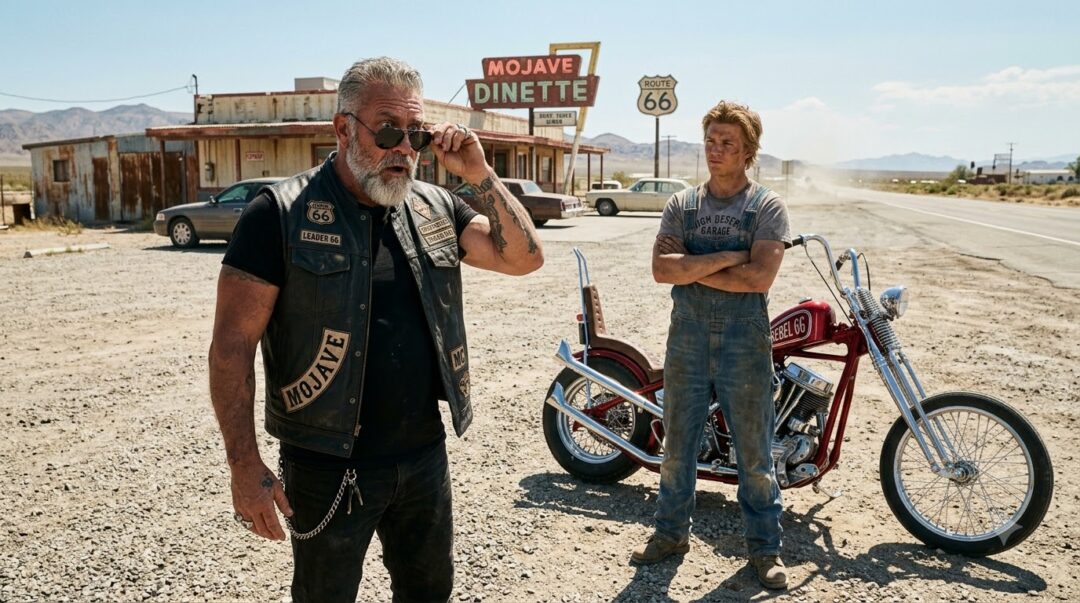
The heat shimmering off Route 66 thirty miles east of Barstow, California, turned the jagged peaks of the Calico Mountains into a wavering, liquid mirage of purple and bleached gold. At high noon in the Mojave Desert, the temperature hovered at one hundred and eight degrees. The only sanctuary for forty miles was the Oasis Diner—a weather-beaten cinder-block building with a peeling galvanized tin roof, flanked by two ancient gas pumps that hadn’t pumped leaded fuel since 1984.
Parked under the narrow strip of shade cast by the diner’s wooden porch awning was an absolute titan of a motorcycle: a 1972 Harley-Davidson Panhead, raked out with long chrome girder forks, dual upswept fishtail exhaust pipes, and a hand-hammered nickel-plated gas tank that reflected the blinding desert sun like a burning mirror.
Standing beside the machine, leaning against the wooden post with a heavy mug of black coffee in his hand, was Dutch “Grizzly” Vance.
At fifty-two, Dutch was a mountain of a man. His heavy, chiseled facial features, hooded eyelids, and downturned mouth gave him an uncanny, striking resemblance to a younger Sylvester Stallone, though thirty years of outlaw highway warfare had carved deeper scars across his weathered jawline. He wore dark aviator sunglasses, a sweat-stained gray henley, and a heavy black steerhide cut bearing the crossed-pistons insignia of the Mojave Iron Motorcycle Club.
Dutch had taken two sips of his coffee when he noticed the boy.
Standing ten feet away in the boiling white gravel was an eleven-year-old kid. He wore faded denim dungarees held up by a single canvas suspender, an oversized cotton t-shirt with holes in the hem, and cracked work boots that looked three sizes too large. His skin was burned brown by the desert wind, grease smudged across his cheekbones, his hair a wild mop of bleached straw. In his small, calloused hands, the boy carried an old gallon galvanized tin bucket filled with lukewarm water and a coarse burlap rag.
The boy had been wiping down the chrome spoke wheels of Dutch’s Panhead with quiet, methodical concentration, moving around the hot engine cases with the instinctual care of an apprentice who knew never to touch an exhaust pipe.
Dutch watched him through his dark aviator lenses. He set his coffee mug on the wooden railing, reached into the interior pocket of his leather cut, and pulled out a thick, crisp roll of hundred-dollar bills bound with a heavy green rubber band—the club’s road reserve.
Dutch peeled off ten one-hundred-dollar bills. A thousand dollars in cash. Enough money in this forgotten corner of San Bernardino County to buy three months of groceries, five drums of diesel, and a brand-new pair of leather boots.
He stepped off the wooden porch, his heavy engineer boots crunching on the gravel, and extended the fan of crisp hundred-dollar bills toward the boy’s chest.
“You’ve been scrubbing those spokes for twenty minutes in a hundred-degree sun, kid,” Dutch said, his voice a deep, gravelly baritone that sounded like two granite boulders grinding together in an arroyo. “Take the cash. Go inside, get yourself a cold soda, and buy a pair of boots that fit.”
The boy stopped scrubbing. He set the wet burlap rag over the rim of the galvanized bucket, stood upright, and looked at the green paper fanned before his face.
Dutch expected the boy’s eyes to widen with shock or greed. He expected the kid to snatch the bills and sprint for the diner door like every other desert stray he had encountered between Needles and Victorville.
Instead, the boy’s jaw set into an iron, uncompromising square. His dark brown eyes hardened with a sudden, astonishing ferocity that caught Dutch completely off guard.
The boy folded his thin, dust-caked arms across his chest. He took half a step backward on the gravel, his spine straight as a surveyor’s transit line, refusing to extend a hand toward the money.
“I don’t take charity from strangers on big bikes,” the boy said. His voice was high, cracked from the dry Mojave wind, but it carried an unshakeable, aristocratic dignity that seemed absurd for a child standing in the dirt.
Dutch’s eyebrows rose behind his aviator lenses. His massive arm remained extended in mid-air, the ten hundred-dollar bills fluttering slightly in the furnace-blast draft of a passing eighteen-wheeler.
“Charity?” Dutch rumbled, a faint, amused smirk playing at the corners of his mouth. “Kid, you just wiped three hundred miles of bugs and road oil off my front spokes. That’s labor. In my club, when a man works, he gets paid.”
“Wiping chrome takes three minutes,” the boy replied without flinching. “Three minutes of elbow grease is worth a quarter, maybe fifty cents if the water is cold. A thousand dollars is charity. Or a bribe.”
The boy looked Dutch dead in the face, his chin tilted upward with fierce, unyielding pride. “My dad said a man who takes money he didn’t bleed for is just a thief waiting for a darker room. If you want to pay me for the spokes, give me four bits. If you want to hand out hundred-dollar bills, go give them to the drifters at the truck stop in Barstow.”
Dutch stood completely motionless on the desert blacktop. The smirk vanished from his lips. The amusement in his chest transformed within two seconds into a profound, breathless awe that made his heart slam against his ribs.
Dutch slowly lowered his right hand, slipping the hundred-dollar bills back into his leather cut.
With his left hand, the massive outlaw reached up and slowly, deliberately, pulled his dark aviator sunglasses down the bridge of his nose.
His piercing, heavy-lidded brown eyes—sharp, assessing, and stripped of all pretense—locked directly onto the eleven-year-old boy’s face.
“Who taught you to talk like that, boy?” Dutch asked, his voice dropping into a low, terrifying whisper that silenced the desert wind. “What was your father’s name?”
The boy pointed a dirt-smudged index finger toward the left side of the Panhead’s engine—specifically toward the custom-cast aluminum rocker boxes and the delicate hand-stamped initials concealed beneath the front cylinder head.
“His name was Wyatt Miller,” the boy said, his chin quivering with an emotion he fought desperately to contain. “And he built that motorcycle for you twenty years ago before Raymond Coyle’s hitmen put him in the ground.”
CHAPTER 2: THE OASIS HOMESTEAD
The hot wind howling off the alkali flats seemed to stop in mid-air.
Dutch Vance stared down at the eleven-year-old boy, his aviator sunglasses hanging forgotten in his left hand, his face carved into an expression of raw, agonizing shock that no rival club’s shotgun had ever produced.
“Wyatt…” Dutch whispered, his voice catching in his throat.
Dutch dropped to one knee in the white gravel, bringing his towering, leather-clad frame level with the boy’s dusty shoulders. His calloused, grease-stained hands reached out with infinite gentleness, resting on the boy’s thin arms.
“You’re Wyatt’s son?” Dutch murmured, his eyes searching every line and angle of the child’s sun-browned face. “Toby? Your name is Toby, isn’t it? Your father sent me a photograph from Barstow ten years ago when you were born. He told me he had a boy with his mother’s eyes.”
Toby swallowed hard, his dark eyes glistening with sudden tears that he refused to let spill down his cheeks. He reached into the collar of his faded cotton shirt and pulled out a small, tarnished brass key hanging from a length of braided leather cord.
Stamped into the brass head of the key was a tiny, hand-carved serial number: WM-1972.
It was the master ignition key to the Panhead.
“Dad kept the spare key on his workbench,” Toby choked, his voice cracking with the heavy, unvoiced sorrow of an orphan who had guarded his father’s memory alone in the desert. “He told me that if the man with the heavy jaw and the crossed-pistons cut ever rode back into the valley, I was supposed to give him this key and tell him the well was running dry.”
Dutch closed his eyes for three long seconds, a shudder passing through his broad shoulders.
Twenty years ago, when Dutch was a reckless thirty-two-year-old combat veteran drifting across the Southwest, Wyatt Miller had taken him in, taught him how to balance high-displacement crankshafts, and hand-fabricated the frame of the Panhead from raw 4130 chromoly steel. Wyatt was the only honest man Dutch had ever known in the Mojave—a quiet master machinist who lived on an ancestral homestead five miles north of Barstow, where an artesian freshwater well had provided life to desert travelers for three generations.
“Where is your home, Toby?” Dutch asked, his eyes opening with a cold, lethal clarity that steeled his features into granite. “Take me to your father’s place.”
Toby swung his leg onto the custom rear fender pad of the Panhead, his small hands locking firmly around the leather belt of Dutch’s cut.
The dry desert heat was rising in shimmering waves from the cracked clay surface of the Calico trail, the dry scrub bushes rattling in the gale like handfuls of thrown dice. Dutch rode with his broad back rigid, his boots braced firmly on the highway pegs, his mind racing through two decades of buried memories. Wyatt Miller had been the elder brother Dutch never had; a man who could take a block of raw aircraft-grade aluminum and turn it into a work of rolling sculpture while quoting Marcus Aurelius and Thomas Jefferson. To think that this gentle genius had been executed in an engineered rollover for a desert water well was a crime that demanded total, merciless retribution. He could feel Toby’s small hands clinging to his leather belt, a reminder that the dead could only find justice through the living.
Dutch kicked the starter arm through. The 1972 Panhead erupted into life with a deep, subterranean roar that shook the porch posts of the Oasis Diner. Dutch banked the heavy machine off the asphalt onto an unpaved, rutted desert trail that wound through the Joshua tree forests toward the jagged red-clay canyons of the Calico foothills.
Five miles into the wasteland, nestled in a hidden natural amphitheater surrounded by four-hundred-foot volcanic sandstone bluffs, sat the Miller Oasis.
It was a five-acre sanctuary of green cottonwood trees and wild desert willow, fed by an ancient artesian wellhead that bubbled into a hand-laid stone reservoir. In the center of the grove stood Wyatt’s single-story adobe ranch house and his heavy corrugated-steel machine shop, surrounded by rusted tractor frames and vintage automotive parts.
But the peaceful grove was an armed camp.
Parked across the gravel driveway were two heavy commercial drilling rigs bearing the bright yellow logo of Coyle Desert Water & Infrastructure. Flanking the drilling rigs were three white pickup trucks with armed private security guards in khaki tactical shirts, carrying semi-automatic shotguns.
Near the stone wellhead, two commercial technicians were bolting a heavy steel cap over the artesian pipe, while a large diesel pump was actively pumping thousands of gallons of freshwater into a five-thousand-gallon transport tanker.
Standing beside the lead pickup truck was Raymond Coyle’s chief enforcer, a hulking, scarred man named Brody, holding an emergency county sheriff’s eviction notice in his hand.
Dutch killed his engine fifty yards away, letting the Panhead roll silently into the shadow of a massive cottonwood tree.
He dismounted slowly, lifting Toby down to the grass.
“Stay behind this timber stack, Toby,” Dutch whispered, his voice dropping into that quiet, terrifying battle rhythm. “Don’t come out until I call your name.”
“Dutch,” Toby whispered, tugging on his leather cut, his small face tight with fear. “They killed my dad three months ago because he wouldn’t sign that paper. Coyle has the whole county sheriff’s department in his pocket. They told me if I came back to the house, they’d shoot me as a trespasser.”
Dutch looked at the boy, then down at the worn leather cut across his own chest.
“Outlaws don’t recognize corrupt eviction notices, Toby,” Dutch said softly, reaching to his hip to unsnap the heavy iron chain lock from his sissy bar. “It’s time to evict the squatters.”
CHAPTER 3: THE WELLHEAD BRAWL
The afternoon heat inside the cottonwood grove was heavy and still, broken only by the rhythmic, mechanical thud of the diesel water pump siphoning the artesian well into Coyle’s five-thousand-gallon tanker.
Brody, the lead enforcer, stood by the hood of his white pickup, spitting tobacco juice onto the parched grass while checking his gold wristwatch. At six-foot-two, with thick forearms covered in barbed-wire tattoos and a tactical shotgun slung across his shoulder, Brody had spent ten years terrorizing small-scale desert homesteaders for Raymond Coyle.
“Hurry it up with that wellhead cap, boys!” Brody barked to the two technicians. “The county tax auction is at nine o’clock tomorrow morning in Barstow. Once the sheriff stamps the abandonment decree on this parcel, Coyle controls ninety percent of the water rights between here and the Nevada border.”
“The boy ran off toward Route 66, Brody,” one of the armed guards warned, leaning against the truck fender. “What if he flags down a state trooper?”
Brody laughed—a wet, arrogant chuckle. “The state troopers don’t have jurisdiction on county water disputes. And besides, an eleven-year-old orphan with no shoes isn’t going to convince anybody of anything. If the kid comes back, shoot him in the leg and toss him in the county juvenile home.”
From the shadow of the cottonwood grove, a voice answered.
“The kid isn’t coming back alone, Brody.”
The words weren’t loud, but they carried the immense, vibrating power of an oncoming freight train.
Brody spun around on his boot heels, grabbing the fore-end of his shotgun.
Walking out from between two ancient cottonwood trunks was Dutch Vance. The outlaw president walked with slow, measured steps across the dry grass, his heavy engineer boots crushing the gravel, his leather cut hanging open to reveal his massive, scarred torso. In his right hand, wrapped around his knuckles, was the four-foot heavy steel bike lock chain, its five-pound hardened iron padlock dangling two inches above the dirt.
Brody froze, his eyes widening in shock as he recognized the legendary face that had dominated California outlaw circles for two decades.
“Dutch Vance…” Brody stammered, his finger slipping onto the shotgun’s trigger guard. “What the hell are you doing in Calico? This is private commercial property under court jurisdiction!”
“This is Wyatt Miller’s land,” Dutch said, not breaking his stride as he closed the thirty-yard distance. “And you have five seconds to take your dirty hands off his well before I feed that shotgun down your throat.”
“Drop him!” Brody screamed to the two armed guards.
The guard on the right raised a twelve-gauge pump shotgun, but Dutch moved with the terrifying, explosive speed of a heavyweight champion.
Dutch swung his right arm in a violent, horizontal arc. The five-pound steel padlock whistled through the desert air, striking the guard’s weapon barrel with an ear-splitting clang that ripped the shotgun from the man’s hands and shattered the bones in his forearm.
Before the second guard could shoulder his weapon, Dutch closed the remaining ten feet in two massive strides, driving a straight right punch into the man’s solar plexus. The kinetic impact lifted the two-hundred-pound guard clean off the ground, throwing him six feet backward into the stone reservoir wall, where he collapsed into the mud, unconscious.
Brody panicked, leveling his shotgun point-blank at Dutch’s chest.
CLICK.
The weapon never fired.
Dutch’s left hand clamped around the shotgun’s receiver like an iron vise, his thumb jamming behind the slide to prevent the firing pin from striking the primer. With a savage, downward twist, Dutch tore the weapon from Brody’s grip, tossed it forty feet into the cottonwood branches, and grabbed Brody by the throat with both hands.
Dutch lifted the two-hundred-and-twenty-pound enforcer six inches off the ground, slamming his spine hard against the side of the yellow drilling rig.
“Who poisoned Wyatt Miller’s well?” Dutch growled, his face three inches from Brody’s purple, gasping face.
“Coyle!” Brody choked, his hands clawing uselessly at Dutch’s iron wrists, his eyes rolling back in terror. “Raymond Coyle! He put industrial mercury down the auxiliary bore three months ago to force Wyatt to sell! Wyatt refused, so Coyle’s men ran his truck off the embankment at Dead Man’s Curve!”
Toby stepped out from behind the timber stack, his small face pale with agonizing realization. “My dad… he didn’t crash because of the storm. They murdered him.”
“Where is the original deed to this land, Brody?” Dutch demanded, tightening his grip until Brody’s heels drummed against the sheet metal.
“Coyle has it in his penthouse vault in Barstow!” Brody wheezed, tears of pure terror streaming down his face. “He’s filing the final transfer at the county courthouse tomorrow morning! The judge is his brother-in-law! You can’t stop it!”
Dutch looked at Brody with cold contempt.
“Watch me,” Dutch said.
He shoved Brody backward onto the grass, kicked the diesel pump’s fuel line until the engine died with a coughing sputter, and turned to the two terrified technicians.
“Unbolt that steel cap from the wellhead,” Dutch commanded, his voice shaking the trees. “And get your yellow trucks off this land before I burn them into scrap.”
The technicians scrambled frantically with their wrenches, unbolting the steel cap within two minutes before throwing themselves into their trucks and tearing down the dirt road in a cloud of dust.
Dutch walked back to Toby, kneeling beside the weeping boy, wrapping his heavy leather arm around the child’s trembling shoulders.
“We have your father’s well back, Toby,” Dutch murmured softly. “Now we’re going to Barstow to take back his name.”
CHAPTER 4: THE SECRET OF THE FRAME
The desert twilight fell over the Miller Oasis like a curtain of deep purple velvet, cooling the scorched sand and turning the cottonwood grove into a sanctuary of long shadows and rustling leaves. Inside Wyatt Miller’s dimly lit adobe workshop, the air smelled of vintage cutting fluid, pine wood shavings, and the dry, sweet fragrance of ancient paper.
The ancient adobe bricks of the workshop walls were cool to the touch, holding the memory of a hundred desert winters and the quiet dignity of Wyatt Miller’s craftsmanship. Toby stood watching Dutch with his chin held high, his small fingers resting against the worn leather fringe of his suspenders. He had spent three months hiding in the dry arroyos, drinking muddy rainwater from cattle tanks and dodging Coyle’s searchlights, driven solely by the stubborn, unyielding pride his father had carved into his heart. Looking at Dutch Vance, the boy knew that his long, solitary watch in the wilderness was finally over.
Dutch Vance sat on a heavy wooden machinist’s stool beside the central work table, a pair of chrome mechanic’s magnifying goggles pushed up onto his gray-streaked forehead. Resting on the heavy maple bench before him was the Panhead’s hand-hammered nickel gas tank, which he had unbolted from the frame with Toby’s assistance.
Toby stood beside him, holding a small brass wire brush and a can of industrial solvent, watching Dutch’s massive, calloused fingers work with breathless fascination.
“Your father wasn’t just a mechanic, Toby,” Dutch said softly, his voice carrying the deep reverence of a master craftsman honoring a fallen brother. “Wyatt had an engineering degree from Caltech. He could have worked for Boeing or Lockheed in Los Angeles, but he chose to live out here in the quiet because he believed that true freedom only exists where a man can build his own machines and drink his own water.”
Dutch pointed the beam of an inspection flashlight down into the hollow triangular recess beneath the motorcycle’s central frame backbone—the structural steel tube that supported the entire chassis.
“When Wyatt built this frame in nineteen-seventy-two,” Dutch explained, “he used a specialized cold-forging die. He told me that if Raymond Coyle ever tried to challenge the 1888 federal water patent on this valley, the proof was etched somewhere nobody would ever think to look.”
Dutch dipped the wire brush into the solvent, scrubbing away forty years of baked-on road grime and chain lubricant from the inner face of the lower frame casting near the swingarm pivot.
As the black grease dissolved, a series of fine, razor-sharp mechanical engravings began to emerge beneath the bare steel:
US LAND PATENT NO. 44192 – ISSUED TO JOSIAH MILLER – 1888.
ALL SUBTERRANEAN AQUIFER RIGHTS IN PERPETUITY.
NOT TRANSFERABLE WITHOUT THE MASTER SEAL OF THE FOUNDER.
Beside the engraved patent numbers was a microscopic recessed cavity, two millimeters deep, shaped in the distinct silhouette of a four-pointed desert star.
Toby gasped, his hand flying to the brass ignition key hanging from his neck.
He pulled the small key from the leather cord. On the circular brass head of the key, raised in sharp relief, was an identical four-pointed desert star.
“The key…” Toby whispered, his eyes wide in the lantern light. “Dad told me to never take it off, no matter what.”
Dutch took the brass key, aligning the raised star with the recessed die on the motorcycle frame.
CLICK.
The brass key fit into the steel casting with a flawless, microscopic tolerance that could only have been milled by a genius. As Dutch turned the key ninety degrees clockwise, a hidden spring-loaded titanium cylinder slid out from inside the hollow structural backbone.
Inside the cylinder was a rolled document of indestructible archival drafting linen, containing the original, notarized survey maps of the entire Mojave aquifer basin, complete with the gold embossed seal of the General Land Office of the United States.
Dutch unrolled the linen on the workbench. His amber eyes traced the surveyor’s lines, reading the legal covenants that had protected the oasis for over a century.
“Wyatt was three steps ahead of Coyle the whole time,” Dutch said, a grim, triumphant smile breaking across his scarred face. “This linen proves that Raymond Coyle’s municipal water company has been illegally diverting two million gallons of water a month from Toby’s aquifer to feed private luxury golf resorts in Palm Springs. If this document is presented to the federal magistrate in Barstow tomorrow morning, Coyle doesn’t just lose the land—he goes to federal prison for grand theft of federal resources.”
CRACK.
A high-powered rifle bullet punched through the corrugated steel wall of the workshop, passing four inches above Dutch’s head and shattering an antique glass oil dispenser on the shelf behind him in an explosion of amber fluid.
“DOWN!” Dutch roared, tackling Toby off the stool and pulling the boy flat onto the concrete floor behind the heavy cast-iron base of an industrial lathe.
From the volcanic ridge three hundred yards north of the ranch house, two more high-caliber rounds tore through the workshop siding, punching fist-sized exit holes through the metal doors.
Through the bullet holes, Dutch saw the green laser emitter of a tactical sniper scope scanning the interior of the shop.
“Coyle didn’t wait for the morning auction,” Dutch growled, his hand drawing his Kimber .45 pistol from his holster, checking the chamber in the dark. “He sent his long-range shooters to burn this valley tonight.”
Outside, the roar of an approaching industrial diesel engine rattled the adobe foundation of the house.
Dutch peeked through a low ventilation grate near the floor.
Descending into the cottonwood grove was a fifty-ton Caterpillar D9 armored bulldozer, its heavy steel blade gleaming under floodlights, followed by four black pickup trucks filled with armed mercenaries.
Raymond Coyle was coming to level the Miller Oasis to the bedrock.
CHAPTER 5: THE MOJAVE NIGHT CONVOY
The massive armored blade of the fifty-ton Caterpillar bulldozer tore through the outer wooden fences of the Miller Oasis with a sickening crunch of splintering cedar, its twin diesel exhaust stacks belching black smoke into the star-lit desert night. The heavy steel tracks ground over the ancient stone retaining walls, crushing the flowerbeds and irrigation trenches Toby’s mother had planted twenty years ago.
Behind the bulldozer came four black pickup trucks, their roof-mounted halogen light bars flooding the adobe ranch house in a blinding white glare.
Standing in the open bed of the lead truck, holding a bullhorn and an electronic megaphone, was Raymond Coyle himself. At fifty-five, the water baron wore an expensive sheepskin coat over his silk Western shirt, his silver hair wild in the desert wind, his face contorted in a sneer of absolute, unyielding corporate arrogance.
“Burn it all!” Coyle’s voice boomed through the megaphone, echoing off the red sandstone cliffs. “Tear the house down and fill the well with five tons of quick-dry cement! When the county assessor arrives at dawn, there won’t be a single stone left to prove this land was ever an oasis!”
Two mercenaries in tactical gear jumped from the trucks, carrying five-gallon metal cans of aviation kerosene, advancing toward the front porch of the adobe house.
From the dark shadow of the machine shop, Dutch Vance didn’t flinch.
He stood beside Toby in the gloom, holding his heavy satellite radio to his ear, his voice calm, cold, and steady as an executioner’s blade.
“Iron actual to all desert chapters,” Dutch spoke into the microphone. “Target is engaged at the Miller homestead. The perimeter is breached. Green light for total deployment.”
From the black desert wilderness outside the canyon, a mile beyond the sandstone bluffs, the silence was shattered by a sound that made Coyle’s mercenaries freeze in their tracks.
It started as a low, tectonic hum that rattled the loose gravel in the dry creek bed—a sound like an approaching earthquake rolling across the Mojave.
Within five seconds, the hum exploded into a deafening, earth-shaking roar of forty heavy American V-twin engines firing with open straight-pipe exhausts.
Emerging from the darkness of Route 66, sweeping over the sandstone ridges in a double-echelon formation, came forty custom choppers and heavy cruisers of the Mojave Iron Motorcycle Club. Their high-beam halogen spotlights sliced through the desert dust like searchlights, illuminating the entire grove in an incandescent sea of warning light.
Leading the charge down the canyon road was Big Mike and Road Captain Hawk, their heavy machines sliding sideways across the gravel, cutting off the exit road and boxing Coyle’s four pickup trucks against the rock wall.
Forty hardened, leather-clad outlaws dismounted simultaneously, heavy iron tire irons, steel chain locks, and heavy wrenches glistening in their hands, forming an impenetrable human wall between the mercenaries and the adobe house.
“What is this?” Coyle shrieked through his megaphone, his voice cracking with sudden panic as he looked around at the army of outlaws surrounding his vehicles. “Sheriff! Where is the county support?”
“The county sheriff isn’t coming, Coyle,” Dutch Vance’s voice rumbled from the workshop threshold.
Dutch walked out into the blinding glare of the truck headlights, holding the Panhead’s master key in one hand and the ancient Land Office survey linen in the other. Flanking him on either side were Tank and Bruiser, their shotguns leveled calmly at the bulldozer’s cab.
The bulldozer operator looked at the forty bikers, killed his heavy diesel engine, threw the keys out the window into the dust, and raised both hands into the air.
Coyle scrambled backward in the bed of his pickup truck, his face pale as damp flour. “Vance! You have no legal standing here! That land patent is ancient history! My water leases are registered with the State of California!”
“Your water leases were signed by a bought commissioner using fraudulent surveyor maps,” Dutch said, his boots landing with measured, terrifying cadence on the gravel as he closed the distance to Coyle’s truck. “And this linen proves you’ve been stealing federal water for twenty years.”
Coyle saw his empire crumbling into the dust. With a sudden, desperate snarl, the water baron reached into his sheepskin coat, pulled a snub-nosed .357 Magnum revolver, and leveled the barrel directly at Toby, who had stepped out of the workshop door.
“If I’m going down, the Miller bloodline dies with me!” Coyle screamed, his finger tightening on the trigger.
Before Coyle could fire, Dutch closed the six-foot gap in a fraction of a second.
Dutch’s left hand shot forward, clamping around Coyle’s gun hand with bone-crushing force, twisting the cylinder upward just as the weapon discharged into the night sky with an ear-splitting bang.
With his right fist, Dutch delivered a devastating, textbook uppercut directly to Coyle’s jaw.
CRACK.
The water baron lifted clean out of the truck bed, flying backward across the tailgate before crashing heavily into the gravel, his expensive sheepskin coat torn, his gold watch shattered, unconscious in the dust.
The remaining mercenaries dropped their weapons onto the ground, raising their hands in total surrender as forty Mojave Iron riders moved in to zip-tie their wrists.
Dutch looked down at the ruined billionaire, spat onto the gravel, and turned to Big Mike.
“Tie Coyle to the back of the drilling rig,” Dutch ordered. “We’re escorting this whole circus into downtown Barstow for the morning court opening.”
CHAPTER 6: THE BARSTOW COURTHOUSE STANDOFF
The morning sun over Barstow broke across the Mojave Desert in a brilliant flash of golden light, illuminating the historic brick facade of the San Bernardino County Superior Court on Mountain View Street. It was eight-forty-five in the morning. On the broad concrete plaza in front of the courthouse steps, fifty local residents, dry-land farmers, and municipal clerks had gathered for the scheduled nine o’clock public auction of delinquent tax parcels.
Standing at the ceremonial wooden podium on the top landing was County Commissioner Harold Vance—Coyle’s bought political operative and second cousin. Beside him stood the county tax assessor, holding the official auction gavel and a stack of foreclosure deeds.
“Ladies and gentlemen,” Commissioner Vance announced, adjusting his microphone with an oily, satisfied smile. “We are ready to begin the tax default liquidation for Parcel 402, commonly known as the Miller Artesian Basin. As there are no surviving adult heirs to satisfy the delinquent property assessment, the minimum opening bid will be twenty-five thousand dollars, submitted by Coyle Infrastructure.”
The commissioner raised his gavel, preparing to strike the sounding block.
From the northern boulevard, three blocks away, a sound emerged that rattled the plate-glass windows of every bank and storefront in downtown Barstow.
It started as a low, rolling earthquake, building within seconds into the deafening, earth-shaking thunder of forty heavy American V-twin engines running in tight formation at forty miles an hour.
Turning onto Mountain View Street, accompanied by two South Dakota Highway Patrol interceptor cruisers with their emergency strobes flashing in a ceremonial escort, came the convoy of the Mojave Iron MC.
At the head of the formation rode Dutch Vance on his gleaming nickel-plated Panhead, wearing his aviator sunglasses and black leather cut. Sitting proudly behind him on the passenger saddle was eleven-year-old Toby Miller, wearing a clean denim jacket and Caleb Sterling’s original silver medal pinned to his lapel.
Behind the motorcycles came the yellow drilling rig and Coyle’s four pickup trucks, driven by club members, with Raymond Coyle and his twenty mercenaries handcuffed in the back of the open flatbeds.
The crowd on the courthouse plaza gasped in astonishment, cell phones flashing as the forty motorcycles pulled into an unbroken, double-flanked iron perimeter surrounding the entire municipal square.
The morning air over Barstow was hot and dry, carrying the scent of diesel exhaust from the rail yards and the dry dust of the Calico hills. The citizens who crowded the courthouse plaza were working people—railroad mechanics, truck drivers, small-scale alfalfa farmers, and diner waitresses who had watched their municipal water rates double every year while Raymond Coyle bought third-generation luxury ranches in Scottsdale. When they saw the forty leather-clad riders of the Mojave Iron surrounding the corrupt commissioner’s podium, a wave of fierce, electric hope surged through the crowd; for the first time in thirty years, someone had the courage to bring the syndicate to its knees in the broad light of day.
Dutch killed his engine, dismounted with effortless grace, and lifted Toby down onto the pavement.
Together, the towering outlaw president and the eleven-year-old orphan walked side by side up the broad concrete staircase, the forty leather-clad riders forming an honor guard two steps behind them.
Commissioner Harold Vance froze behind the podium, his hand clutching the gavel in mid-air, the color draining from his face as he recognized the battered, handcuffed figure of Raymond Coyle sitting in the lead truck bed below.
“What is the meaning of this armed demonstration?” the commissioner stammered into the microphone, his voice trembling with high-strung terror. “This is an official county legal proceeding! Bailiffs, clear these men from the steps!”
The two county bailiffs standing at the bronze double doors looked at the forty battle-hardened outlaws, looked down at their own modest holsters, and stepped aside, crossing their arms in silent refusal to intervene.
Dutch stopped two feet from the podium. He reached into his leather cut, pulled out the ancient archival drafting linen from 1888, and spread the document flat across the commissioner’s official auction ledger.
Beside the linen, Toby reached out his small hand and placed the brass master key into the center of the sounding block.
“The Miller parcel is not in default, Commissioner,” Dutch said, his voice dropping into that deep, terrifying mountain gravel that resonated through the public address speakers across the entire plaza. “And there is a surviving heir standing right beside me.”
Dutch tapped the Land Office seal on the linen.
“This is the original federal land patent signed by President Grover Cleveland,” Dutch continued, his amber eyes pinning the trembling commissioner like surgical needles. “It grants absolute subterranean aquifer rights in perpetuity to the heirs of Josiah Miller. And the forensic telemetry we extracted from Coyle’s drilling rigs proves that your office has facilitated the illegal diversion of eighty million gallons of federal water over the past ten years.”
From the courthouse lobby, the bronze doors swung wide open.
Stepping onto the portico was United States District Judge Margaret Caldwell, flanked by four armed Federal Marshals with gold star shields gleaming against their tactical windbreakers.
Judge Caldwell looked down at the drafting linen, then at the certified surveyor maps, her judicial expression cold and unyielding.
“Commissioner Harold Vance,” Judge Caldwell announced, her voice ringing across the silent plaza. “By emergency order of the United States District Court for the Central District of California, this auction is terminated with prejudice. And federal arrest warrants have been issued for you, Raymond Coyle, and twelve corporate officers for federal resource theft and conspiracy to commit murder.”
CHAPTER 7: THE WATERS OF JUSTICE
The morning sun over downtown Barstow bathed the brick facade of the courthouse in a brilliant, golden warmth that seemed to wash away twenty years of fear and corruption from the Mojave Desert. The crowd on the plaza erupted into an earth-shaking, joyous cheer as federal marshals ratcheted heavy steel handcuffs over Commissioner Harold Vance’s wrists, leading the disgraced politician down the granite steps beside the ruined Raymond Coyle.
Local ranchers, farmers, and store owners swarmed up the staircase, their hands reaching out to shake Toby’s small, trembling fingers, congratulating the young boy whose courage had saved the valley’s water supply.
United States District Judge Margaret Caldwell stood before Dutch Vance, her sharp judicial eyes taking in the scarred outlaw and the clean, gleaming lines of the 1972 Panhead parked at the curb.
“Mr. Vance,” Judge Caldwell said, her voice rich with profound, unyielding respect. “In thirty years on the federal bench, I have rarely seen an outlaw motorcycle club deliver such a flawless, ironclad case of civil and criminal vindication. The United States government is indebted to your vigilance.”
Judge Caldwell signed an emergency decree on the podium, presenting the stamped document to Toby Miller.
“Toby,” the judge said with a warm, motherly smile. “This court hereby restores the full, unencumbered deed to the Miller Oasis to you and your heirs forever. And under the Federal Aquifer Conservation Act, your family well is declared a permanent public water sanctuary. No corporate utility will ever touch your water again.”
Toby looked down at the official gold seal on the deed, his dark eyes brimming with tears of pure, overwhelming joy. He looked up at Dutch, throwing his small arms around the massive outlaw’s waist, burying his face in the steerhide of his cut.
“Thank you, Dutch,” the boy wept softly. “My dad… he can finally rest.”
Dutch knelt down on the concrete landing, his massive hands resting gently on Toby’s shoulders.
“Your father never left you, Toby,” Dutch murmured, his rough voice thick with an emotion he rarely showed the world. “He was with us on that road every mile of the way.”
Dutch reached into his leather cut, unclipped the heavy silver medallion of the Mojave Iron MC, and placed it around Toby’s neck.
“From this day forward, Toby,” Dutch announced, loud enough for every citizen and biker on the plaza to hear, “you are the official ward and protected brother of the Mojave Iron Motorcycle Club. Whenever you need help, whenever a predator comes into your valley, sixty brothers will ride through hell to stand at your side.”
The forty bikers on Mountain View Street hammered their heavy leather fists against their gas tanks in a rhythmic, deafening salute that shook the street signs, the crowd cheering and whistling in celebration.
Two hours later, the forty-motorcycle convoy escorted Toby back to the Miller Oasis.
The desert breeze through the cottonwood trees was cool and fragrant, rustling the green heart-shaped leaves like soft applause in the afternoon light. Standing beside the stone reservoir, Toby looked down at his father’s reflection in the clear, bubbling spring water, his face glowing with a quiet, triumphant peace that washed away three months of cold terror. The Miller Oasis was no longer a lonely, defenseless outpost in the wilderness; it was the sacred headquarters of an iron brotherhood that would defend every drop of water with their lives. Big Mike and Hawk had already unloaded three heavy toolboxes from the chase truck, beginning the complete restoration of Wyatt’s machine shop, while two older riders were rebuilding the front wooden porch with fresh cedar planks.
Dutch Vance walked over to the stone well, leaning his heavy forearms against the cool masonry, his dark aviator sunglasses pushed up onto his gray-streaked hair. He looked at Toby, seeing the unmistakable, resolute spark of Wyatt Miller burning bright in the young boy’s eyes. In forty years of riding the American badlands, Dutch had seen empires rise and fall, but standing in this desert grove, he knew that the only thing that truly endured was an honest man’s bloodline and the sacred promise of the road.
The heavy Caterpillar bulldozer, now operated by club mechanics, had already cleared the broken fences, while twenty riders were hard at work repairing the stone reservoir walls and reconnecting the clean, pure artesian spring.
Dutch stood beside his idling Panhead under the shade of the great cottonwood tree, watching Toby drink a cup of fresh, ice-cold water from his father’s stone well.
The boy walked over, carrying a cold ceramic mug, and handed it to Dutch.
“Four bits for the spokes, Dutch,” Toby smiled, holding up a single shiny fifty-cent coin he had earned fair and square. “And all the cold water you can drink for the rest of your life.”
Dutch took the fifty-cent piece, slipping it into his watch pocket as his most prized possession. He drank the cold, sweet water, savoring the taste of true desert freedom.
He swung his heavy leg over the saddle of the 1972 Panhead, pulled his dark aviator sunglasses down over his eyes, and looked at Toby with an unshakeable, fatherly pride.
“Keep the oil clean, kid,” Dutch smiled, cracking the throttle wide open.
The Panhead’s engine roared into life with an earth-shaking, glorious bark of American horsepower. Dutch Vance clicked the transmission into gear, raised his right hand toward the blue Mojave sky, and led his iron brothers back onto Route 66, riding into the golden desert horizon where justice had finally returned to the mother road.