The Room That Remembered
Part I — The Box on the Floor
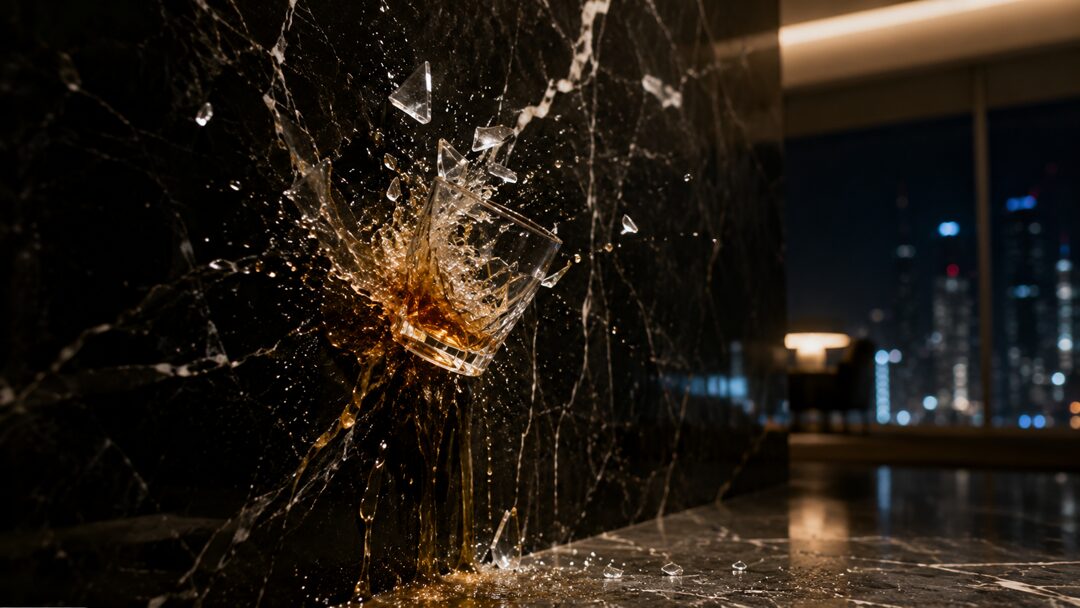
Sarah threw the whiskey glass so hard it struck the black marble wall before Michael could say her name.
Amber liquor burst across the stone. The glass broke in bright pieces near the bar, scattering under the city lights beyond the penthouse windows. For one second, the room held its breath: the silent skyline, the polished floor, the bottle on the counter, Michael standing in his half-open tuxedo shirt as if even fury should wait for permission here.
Then Sarah threw the black velvet box at his feet.
It snapped open on the marble.
A ring rolled against the edge.
Beside it landed an old photograph of a young woman in a white dress, smiling with one hand lifted toward a man whose face had been scratched out.
Michael looked at the photograph.
Not long.
Long enough.
Sarah saw the blood leave his face before he bent to hide it.
“Don’t touch it,” she said.
Michael froze with one hand halfway to the box. “Sarah.”
“No.”
Her blonde hair was still wet from the rain. Mascara had smudged beneath one eye. She had come straight from his private study, barefoot now because one heel had snapped in the lobby and she had not stopped to fix it.
She had stopped being elegant somewhere between the hidden wall panel and the elevator.
Michael stared at her like she had become a problem to solve.
“Where did you find that?” he asked.
Sarah laughed once. It sounded wrong in the room.
“That’s your question?”
His jaw tightened. “You’re upset.”
“I found a ring, an old photograph, and a letter addressed to your mother hidden behind a wall panel in the apartment where you asked me to live after we got married.”
“Sarah—”
“Don’t say my name like I’m the broken thing in the room.”
Michael looked down at the ring again.
The box was small and black, the kind used by old jewelers before velvet became cheap. The ring inside was vintage, delicate, with one small stone missing from the band. Not the kind Michael would have chosen. Not the kind his mother, Patricia, would have allowed.
Sarah had spent the first five minutes after finding it believing she had discovered another woman.
An old affair.
A secret engagement.
A dead romance he had never told her about.
Then she had seen the photograph.
The woman in white had Michael’s eyes.
Not similar.
His.
“Who is she?” Sarah asked.
Michael’s mouth opened.
No answer came.
That was when Sarah knew the photograph was worse than cheating.
Cheating made men defensive.
This made Michael afraid.
Part II — The Woman in White
Michael reached again for the box.
Sarah stepped on the lid.
Not hard enough to crush it.
Hard enough to tell him the rules had changed.
His eyes lifted to hers.
“Move your foot.”
“Say her name.”
“This is not how adults handle things.”
“Funny. Your family seems very good at handling things.”
The line landed. She watched it hit him.
For months, Sarah had been handled.
Handled at bridal fittings, where Patricia adjusted the neckline of her dress with two fingers and said, “You have a lovely figure, dear, but restraint photographs better.”
Handled at dinner, where Patricia introduced her as “Michael’s choice” instead of his fiancée.
Handled when her mother was seated three tables away from the Whitman family friends because, as Michael explained later, “Mom didn’t mean anything by it. She just thinks in old seating charts.”
Michael always apologized afterward.
Privately.
He was tender in elevators. Loyal in cars. Brave in rooms where no one could hear him.
Now he stood in front of broken glass, and Sarah understood how little that had cost him.
“She was troubled,” Michael said.
Sarah went still.
Not because the answer satisfied her.
Because it sounded rehearsed.
“She?”
Michael looked toward the windows, toward the city, toward anything but the photograph. “The family helped as much as we could.”
“The family?”
“She had problems.”
Sarah bent, picked up the photograph, and held it between them.
The woman in white looked young. Hopeful. Her arm was looped through someone’s. The man beside her had been scratched out so violently that the paper had thinned over his face.
“People don’t hide photographs of women they helped,” Sarah said.
Michael’s throat moved.
“She was my sister.”
The word made the penthouse colder.
Sarah lowered the photograph slightly.
“What?”
“My half-sister.”
Sarah waited for the rest.
Michael did not offer it.
The room had always made him look powerful. Dark glass. Steel lines. Black marble. The expensive hush of things too costly to touch carelessly. Tonight it made him look trapped inside his own reflection.
“What was her name?”
He shut his eyes.
“Emily.”
Sarah looked again at the photograph.
Emily in white. Emily smiling. Emily with a ring in a black box. Emily with a man scratched out of her life.
“And you hid her behind a wall?”
“I didn’t hide her.”
Sarah glanced at the loose panel at the far side of the study hallway, visible through the open door.
Michael followed her gaze.
His face tightened.
“That was my mother’s doing.”
“There it is.”
“What?”
“The first door out.”
“I’m telling you the truth.”
“No. You’re placing it in someone else’s hands.”
Michael took a step toward her. “You don’t understand what happened.”
“Then explain it.”
He looked at the box again.
For a moment, Sarah thought he might. The whole room seemed to lean toward the answer.
Instead he said, “Give me the letter.”
Sarah’s fingers closed around the damp paper folded inside her fist.
The one addressed to Patricia Whitman.
The one she had not yet finished reading because the first page had been enough to bring her through the penthouse like a storm.
“No,” she said.
Michael’s control slipped.
“Sarah, give it to me.”
The fear in his voice told her what the letter was worth.
She looked down at the ring.
Then at the photograph.
Then back at the man she had planned to marry.
“I thought she was your lover,” Sarah said quietly.
Michael flinched.
“Now I think she’s your warning.”
Part III — What Patricia Called Help
Emily Whitman had been born before Patricia.
That was the first thing Michael said once the silence forced him to speak.
Not before their father married Patricia. Before Patricia herself entered the family story and made sure every earlier chapter was rewritten in smaller type.
Emily’s mother had worked for the Whitmans in a way no one ever described clearly. Sometimes she was called an assistant. Sometimes a companion. Sometimes, when Patricia was being cruel with white gloves on, “a woman your father felt responsible for.”
Emily grew up near the family, but never fully in it.
There were photographs of Michael as a child in navy blazers, Christmas sweaters, summer whites on boats. There were none of Emily on mantels. She appeared in the corners of albums, half-cropped, carrying someone else’s flowers, smiling as if she had learned early to stand where the light did not favor her.
“She was older than me,” Michael said. “Eight years.”
“So you remember her.”
“Yes.”
“And you let me sit through six months of your mother acting like I was lucky to be chosen, without telling me your family had already practiced on another woman.”
“She wasn’t another woman.”
“No. She was your sister. That’s worse.”
He took the hit without defending himself.
That almost made Sarah angrier.
Michael told the story in pieces, because he could not stand to hold the whole thing at once.
Emily had fallen in love with Daniel, a teacher with no money, no family connections, no usefulness to the Whitman name. They got engaged quietly. Emily had worn a white dress to a small dinner because she thought the family might bless them if she made the moment soft enough.
Patricia made it formal.
That was her gift: turning cruelty into ceremony.
She invited Daniel to the penthouse dining room. She placed him across from Emily. She put the black velvet box beside Emily’s plate before dessert. Then she spoke of stability, suitability, family protection.
At the end of dinner, Patricia offered Daniel a check.
Not to help them begin.
To leave.
Emily had turned to Michael then. He was seventeen. Young enough to be scared. Old enough to know what he saw.
“She looked at me,” Michael said.
Sarah’s grip tightened around the letter.
“And?”
Michael’s voice dropped. “I said nothing.”
The penthouse seemed to sharpen around him.
Sarah imagined it too clearly: Emily in white, waiting for one person at the table to say she was not a problem. Michael looking down. Patricia smiling. Daniel humiliated into stillness. The ring returning to its box like a future being packed away.
“Patricia told everyone Emily was unstable,” Michael said. “She said Daniel had taken advantage of her. She said we needed to protect her from herself.”
“And you believed that?”
“No.”
That answer came too quickly.
Sarah hated him for it.
Michael looked at the broken glass. “I told myself if I pushed back, it would make things worse.”
“For Emily?”
He did not answer.
“For you,” Sarah said.
His silence told the truth more cleanly than confession could.
Sarah unfolded the letter.
The paper had been kept flat for years, then hidden, then found by a woman who was not supposed to ask questions. Emily’s handwriting was controlled, narrow, almost painfully neat.
Sarah read aloud.
“Patricia, I am not writing to ask for a place at your table. I know now that every chair in that room already had a price.”
Michael closed his eyes.
Sarah continued.
“I am writing because Michael should know the truth. I did not leave because I was unwell. I left because you told Daniel you would have him removed from his school and ruined in every room that mattered if I stayed.”
Michael’s head lifted.
“What?”
Sarah looked at him over the page.
“You didn’t know?”
“No.”
For one dangerous second, Sarah believed his shock completely.
Then she understood the trap inside it.
“Of course you didn’t,” she said.
Michael stared at her.
“You didn’t need to know how she did it. You only needed the life that came after.”
The words hurt him.
They were supposed to.
Part IV — The Pattern
Michael tried to hold her after that.
It was the worst thing he could have done.
Sarah stepped back so fast her heel caught on a shard of glass. He reached for her again, instinctively, gently, and she raised one hand.
“Don’t make tenderness another way to stop me talking.”
He froze.
The line stayed in the air between them.
Outside, rain moved down the penthouse windows, blurring the city into streaks of white and gold. Inside, every polished surface reflected some broken part of the room.
Michael’s voice softened. “I chose you, Sarah.”
She almost laughed.
That sentence had once been enough to warm her.
Now it sounded like a transaction.
“You chose me despite your mother?” she asked.
“Yes.”
“No. You chose me privately. In public, she trained me.”
“That’s not fair.”
Sarah turned on him.
“Do you remember the dress appointment?”
He looked away.
“She told me my shoulders looked too strong. You heard her.”
“She was being difficult.”
“She was teaching me how much of myself to remove.”
Michael said nothing.
“The dinner with my mother?”
He swallowed.
“The seating chart?”
“Sarah—”
“She called me generous of you, Michael. Like I was a charity you were bringing home.”
His face tightened. “I apologized for that.”
“In the car.”
“I was trying to protect you.”
“You were trying to keep both of us.”
That one landed deepest.
Because it was true in the precise way only an accusation from someone who loves you can be true.
Michael moved toward the bar, then stopped. There was no intact glass left near him. He looked lost without something to hold.
“What do you want me to do?” he asked.
Sarah stared at him.
There it was. The old male helplessness. The offer to follow instructions so he would not have to choose.
“I want you to know before I tell you.”
His phone lit up on the counter.
Patricia.
Sarah saw the name.
Michael reached for it too late.
The elevator chimed before either of them spoke.
Sarah looked at him.
“You called her?”
“I texted before—”
“Before what? Before I became too loud to manage alone?”
The elevator doors opened.
Patricia Whitman stepped into the penthouse in a cream coat, her silver-blonde hair arranged as if rain had no jurisdiction over her. Diamond earrings glinted under the recessed lights. She took in the broken glass, the liquor on the wall, the photograph in Sarah’s hand, the open black box on the floor.
Her expression barely changed.
That was the most frightening thing about her.
She understood immediately.
“Sarah,” Patricia said, with the cool regret of a woman noticing a stain on linen. “This is unfortunate.”
Sarah did not answer.
Patricia removed her gloves one finger at a time.
“You’re emotional. I understand. Engagements bring pressure.”
Michael said, “Mother.”
Patricia ignored him.
“Some women mistake pain for importance,” she said.
Sarah felt the sentence enter her like ice.
Not because it was new.
Because it was familiar.
Emily had been unstable. Sarah was emotional. Different words. Same room.
Sarah lifted the photograph.
“Was Emily emotional too?”
Patricia’s gaze flicked to Michael.
That tiny movement told Sarah everything.
Patricia was not afraid of Emily being remembered.
She was afraid of Michael hearing the wrong version in front of someone he loved.
Sarah opened the letter to the final page.
“I didn’t finish reading this until tonight,” she said.
Patricia’s face went still.
Sarah read, quieter now.
“One day Michael will love someone you did not make. If you cannot let him love her without controlling her, do not call it protection. Call it what it is.”
Michael turned toward Patricia slowly.
Patricia’s eyes hardened. “Emily always had a gift for drama.”
Sarah lowered the letter.
“She wrote about me before she knew me.”
“No,” Patricia said. “She wrote about weakness. It repeats.”
Michael’s voice changed. “Did you choose Sarah because you thought she’d be easier?”
Patricia looked at her son.
For the first time all night, she seemed disappointed in him.
“I chose to trust that you would understand your life.”
Sarah picked up the photograph from the floor. A shard of glass slid away from its edge.
Her hand trembled.
Her voice did not.
“Was Emily your sister only when no one important was watching?”
Michael looked at her.
Then at his mother.
Then at the box on the floor.
He had no answer that could save him.
Part V — In Front of Everyone
The engagement party began at eleven the next morning in the Whitman Foundation gallery.
Patricia did not cancel it.
Of course she didn’t.
People like Patricia did not cancel. They corrected lighting. They adjusted seating. They smiled hard enough to make reality behave.
Sarah arrived in a pale dress Patricia had approved weeks earlier. Around her neck lay the Whitman diamond necklace, placed there by Michael’s own hands that morning after he said, “We can get through today.”
She had looked at him in the mirror.
“Is that what you want? To get through it?”
He had not answered fast enough.
So she wore the necklace.
Not as surrender.
As evidence.
The gallery filled with investors, board members, family friends, and people who knew how to turn gossip into currency without ever raising their voices. Michael stood beside her, pale but composed. Patricia moved through the room with a glass of sparkling water and the calm of a woman who believed public spaces belonged to her.
When the speeches began, Patricia took the microphone.
Sarah watched Michael’s hand tighten at his side.
Patricia smiled at the crowd.
“Michael has always had a generous heart,” she said. “When he loves, he does so with great conviction, even when the rest of us need time to understand his choices.”
A few people laughed softly.
Not because it was funny.
Because they understood the insult and enjoyed being trusted with it.
Sarah felt the old heat rise in her face. The trained shame. The urge to smile so no one would say she lacked grace.
Then she remembered Emily’s photograph lying among broken glass.
Sarah stepped forward.
Michael whispered, “Sarah.”
She did not stop.
She placed the black velvet box on the white-clothed table beside Patricia.
The room quieted.
Patricia’s smile held, but her eyes sharpened.
“Not here,” she said softly.
Sarah opened the box.
The ring sat inside with its missing stone.
Then she laid the photograph beside it.
Emily in white. Daniel’s face scratched away. A woman’s future reduced to objects.
Patricia’s voice remained smooth. “This is inappropriate.”
Sarah looked at the guests.
“So was making a daughter disappear because she loved the wrong man.”
The silence was instant.
Real silence this time.
Not polite. Not confused.
Hungry.
Patricia’s lips parted.
Michael stared at Sarah, then at the room. This was the moment. She knew it. He knew it. Patricia knew it most of all.
A private man could still save himself.
A public one had to choose.
Sarah did not look at him when she spoke.
“Tell them who she is.”
Michael’s face changed.
For a second, he looked seventeen again. A boy at a dinner table, watching his sister be reduced while adults called it protection.
Then he stepped forward.
“Her name is Emily Whitman,” he said.
Someone near the back inhaled.
“She is my sister.”
Patricia turned white.
Michael kept going.
“My family erased her from public life because she became engaged to a man they considered beneath us. My mother called it protection. My father allowed it. I allowed it.”
The room was perfectly still.
Sarah watched him.
This was the truth.
It was also late.
Michael’s voice shook once.
“She was not unstable. She was cornered. And I was not innocent because I stayed quiet.”
Patricia stepped toward him. “Enough.”
Michael turned to her. “No.”
It was a small word.
It cost him more than any speech.
Patricia’s expression hardened into something almost bare.
“Emily would have destroyed this family.”
Sarah answered before Michael could.
“No. She would have made you tell the truth.”
The sentence struck the room with more force than the glass had.
Patricia looked at Sarah with pure, clean hatred.
Sarah reached behind her neck and unclasped the diamond necklace.
Michael watched her do it.
His face broke then.
Not publicly enough for anyone else to understand. Just enough for Sarah to see the man she loved realizing that confession was not the same as repair.
She set the necklace beside the ring box.
“I won’t marry into a family that calls silence loyalty,” she said.
Then she walked out before anyone could turn her dignity into drama.
Part VI — Clean Glass
Sarah found Emily in a coastal town three hours north, in a small gray house with wind-bent grass and a blue door.
Emily did not look like the photograph anymore.
Of course she didn’t.
Her hair was shorter. Her face had thinned. She wore jeans, a sweater, and the expression of someone who had survived by becoming difficult to surprise.
Sarah stood on the porch with the black box in her coat pocket.
“I’m Sarah,” she said.
“I know who you are.”
That was not an invitation.
Sarah almost turned back.
Then Emily opened the door wider.
Inside, the house smelled like coffee and salt air. There were books stacked on the floor, a chipped mug on the table, no photographs visible anywhere.
Sarah placed the black box between them.
Emily looked at it for a long time.
She did not touch it.
“Patricia kept it,” Sarah said.
“Patricia keeps everything she thinks proves her version.”
Sarah took the old photograph out next.
Emily’s mouth changed. Not quite pain. Not quite amusement.
“I loved that dress,” she said.
Sarah looked at the scratched-out face beside her. “Daniel?”
Emily nodded.
“Do you want to know where he is?”
“No.”
The answer came too fast, but Sarah respected it.
Emily picked up the ring at last. She held it on her palm as if examining an object from a life that belonged to someone with the same name.
“That girl wanted to be chosen,” Emily said. “I don’t know her anymore.”
Sarah felt the sentence settle inside her.
Not as despair.
As warning.
Michael came later that afternoon.
Sarah did not enter with him. She waited by the shore, coat pulled tight, watching gray waves break against dark rocks. Through the window, she saw Michael stand in Emily’s kitchen. She saw him speak. She saw Emily listen without softening.
When he came out, his eyes were red.
“She said being sorry isn’t the same as coming back when it mattered,” he said.
Sarah nodded.
He looked at her like he wanted to ask whether they still had a future.
For once, he did not ask.
Months passed.
Michael told the full story at the next Whitman board meeting. Patricia was removed from the foundation chair, though not from society. Women like her did not vanish. They became quieter in public and more careful with knives.
Michael sent Sarah one letter.
Not asking her to come back.
Not promising he had changed enough.
Only telling her what had been done and what still could not be undone.
Sarah read it twice, folded it, and placed it in a drawer.
She moved into a smaller apartment with old wood floors and windows that faced another building instead of the whole glittering city. At night, she could hear neighbors through the walls. Someone practicing piano. Someone laughing too loudly. Someone living without asking glass towers to make them look untouchable.
The black box sat on her shelf for a while.
Then one morning, Sarah took out the photograph.
Emily in white.
Still smiling.
Still visible.
Sarah bought a simple frame from a street market. Nothing expensive. Nothing chosen by Patricia. She cleaned the glass with the edge of her sleeve until no fingerprints remained.
Then she placed the photograph inside and set it by the window.
For a long time, she stood there looking at it.
The past had not become gentle.
It had only stopped hiding on the floor.