They Said the Mules Would Never Follow Her, Until the Dead Field Turned Dark Again
Chapter 1: The Mule Line Stopped at Emma’s Gate
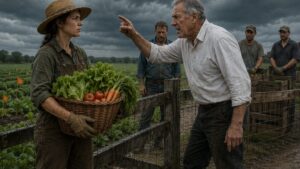
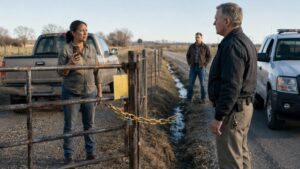
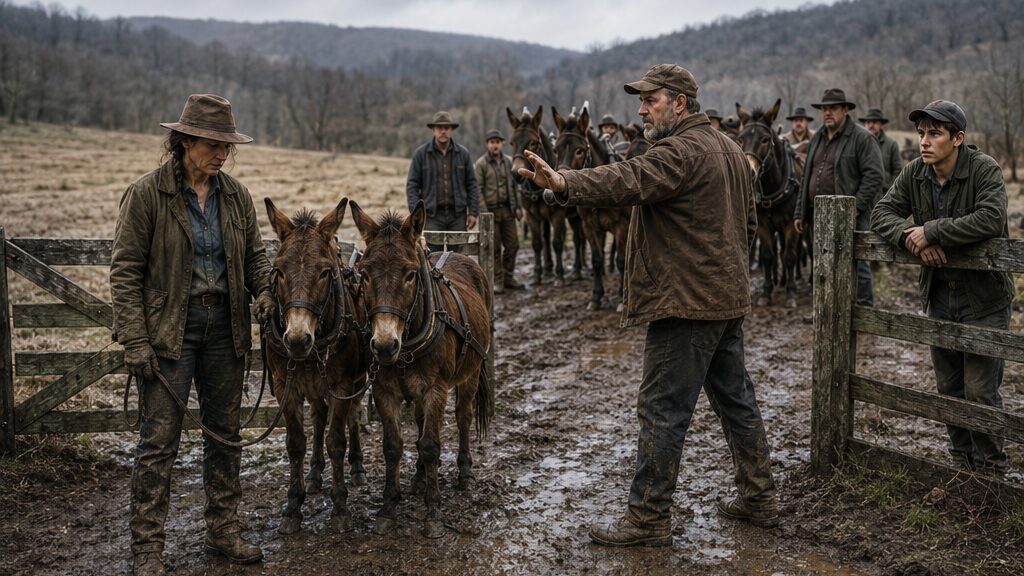
Samuel Harris swung the lower-field gate shut while twenty mules stood nose to tail behind Emma Taylor.
The iron latch struck the post with a hard, final sound. Harness chains settled along the muddy road. One animal stamped, then another, until the line seemed to carry its own low thunder between the fences.
Emma stood on the field side of the gate with mud to the ankles of her boots. Across from her, Samuel kept one gloved hand on the top rail. His beard was damp with mist, and his pale work shirt showed dark beneath the arms from bringing the team down from his barn.
“You brought them this far,” Emma said.
“I brought them to look.”
Two hired farmhands waited near the rear wagon. Three neighboring landowners had followed on foot, pretending they had come only to inspect the road. Joshua Green stood beside the smallest pair, his eyes moving between Samuel and Emma as if the argument might choose him before he chose a side.
Emma looked past them toward the mules. Their breath rose white in the cold. She knew most of them by gait and temperament. The broad gray near the center dragged his left hind toe when tired. The sorrel mare disliked loose chain behind her. The small dark pair beside Joshua had once taken a plow through sleet without pulling crooked.
Samuel tightened his grip on the gate.
“I won’t put them in that field.”
“You agreed to one day.”
“I agreed before the rain.”
“The rain stopped four days ago.”
“The top stopped shining four days ago.” He pointed through the rails. “That does not tell me what is underneath.”
Emma lowered her eyes to the ground beside the post. The roadside soil had dried to a pale crust. She pressed two fingers into it. The top half inch cracked, but beneath it the earth resisted like fired clay.
Behind Samuel, one of the landowners cleared his throat.
Emma wiped her fingers against her coat. “The planting window will not wait for your opinion.”
“No. It will wait for the ground.”
A farmhand looked away, but the quick pull at one corner of his mouth was enough. Emma felt the heat rise beneath her collar. She had been talked over in feed stores, equipment sheds, and kitchens since before she had been old enough to hitch a team. Most of it passed if she let it.
This would not pass. A field left unturned another week would become a season lost.
Samuel’s gaze moved toward the lower ground beyond her. The field sloped gently away from the road, its winter stubble flattened in uneven patches. It looked firm from the gate. That was what Emma had counted on.
“You still owe me for the fall hauling,” he said quietly.
The farmhands heard him anyway.
Emma kept her face still. “You have the figures.”
“I have figures. I do not have payment.”
“You’ll have it after planting.”
“If planting takes.”
The words landed more heavily because he did not raise his voice.
Joshua rubbed a thumb over the braided leather lead in his hand. The dark mule nearest him turned its head toward Emma. A white scar crossed the bridge of its nose, half hidden beneath the halter.
Emma stepped closer to the gate.
Samuel said, “Don’t.”
She ignored him and reached between the rails. The mule stretched forward until its breath warmed her bare knuckles. She rubbed the hollow above its nostril, then touched the old scar.
“Easy, Ruth,” she murmured.
The mule’s ears, which had been angled back toward the restless line, came forward. Its jaw softened. The second mule leaned until the chain between their halters slackened.
Joshua stared at them. “She remembered you.”
“Animals remember who did not rush them,” Emma said.
Samuel opened his mouth, then shut it again.
For one brief moment, the road went quiet except for harness leather creaking beneath the animals’ breathing. Emma felt the line’s attention shift. Not the men’s. The mules’.
Samuel broke the silence.
“It does not matter whether they follow you to the gate.”
“Then open it.”
“No.”
The single word traveled down the road.
Emma looked beyond him to the neighboring owners. “I need one pair for half a day. You can stand at the edge and pull them the minute you think they’re at risk.”
No one answered.
One man studied his boots. Another adjusted his coat though it did not need adjusting.
Samuel said, “They will not lend to you.”
Emma turned back to him. “You speak for everybody now?”
“I spoke to them because you wouldn’t hear it from me.”
A different kind of cold moved through her.
“How many?”
“All the team owners between here and the county road.”
Joshua lifted his head sharply.
Samuel went on. “Nobody wants a strained animal or a broken plow sunk in that lower field. You have one chance to stop before a bad season becomes a worse debt.”
The words sounded almost reasonable. That made them more dangerous.
Emma could feel the folded feed invoice in the inside pocket of her coat. She could feel, too, the unopened county envelope beneath the flour tin in her kitchen and the second notice tucked behind the old tack cabinet. She had told herself paper could wait until work caught up.
Work had not caught up.
A car horn sounded from the bend.
A faded sedan came slowly down the rutted lane, its tires slipping twice before it stopped behind the mule line. Debra Moore stepped out wearing town shoes unsuited to the mud and carrying a large brown envelope under her arm.
Emma did not move.
Debra picked her way along the fence. Her coat was buttoned to the throat, and her mouth already held the shape it took when she had rehearsed an argument during the drive.
Samuel released the gate and stepped aside.
“What is all this?” Debra asked.
“Work that has stopped,” Emma said.
Debra looked at the mules, the watching men, and the shut gate. “That makes two things.”
She drew a document from the envelope.
Even before Emma saw the lender’s mark in the corner, she knew what it was.
“No,” Emma said.
“You have not read it.”
“I know what you brought.”
“It is consent to list our interest in the lease. Not a sale. Not yet.”
Samuel looked toward the road as though family matters had no place in front of him, though he did not leave.
Debra held out the pages. “The lender called me because you would not call back.”
“I have work to do.”
“You have no team.”
Emma took one step toward her sister. Mud sucked at her boot and released with a wet sound.
Debra’s voice dropped. “Sign before the valuation falls again.”
The smallest mule shifted behind Joshua. Its lead slipped from his loosened hand and fell across the road.
No one reached for it.
Emma looked at Samuel, then at the paper in Debra’s hand. She saw the field behind her, pale and sealed beneath its flattened stubble. She saw her late husband standing at the same gate three winters earlier, telling her there was always another way through if a person knew the ground.
She no longer knew whether he had believed that or merely needed her to.
Emma bent, picked up the braided lead, and wrapped it once around her palm.
The dark mule stepped forward.
Chapter 2: She Took the Smallest Team First
The mule placed one hoof beyond the gate and paused while every person on the road waited for it to sink.
Emma felt the lead tighten across her palm. She did not pull. Ruth’s ears turned toward the field, then back toward the animals behind her. The second mule, a narrow-chested bay named Amos, stood half a step behind, trembling through the shoulder.
Samuel moved toward the latch.
“Bring them back.”
Emma kept her eyes on Ruth’s front feet. The hoof had broken the dry crust but stopped on firmer earth beneath it.
“One step is not a field,” Samuel said.
“No,” Emma replied. “It is one step.”
She loosened the lead and moved sideways rather than forward. Ruth followed the change in angle, placing her second hoof close to the first. Amos shifted after her. The chain between their collars remained slack.
Joshua came through the gate before Samuel could stop him.
“I can hold the trace,” he said.
“You can stay clear of their heels,” Emma answered.
Samuel caught his nephew by the sleeve. “You stay on the road.”
Joshua pulled free, more embarrassed than defiant. “I am on the road every day.”
The farmhands exchanged a look.
Emma walked the pair ten yards into the field without a plow. She watched the fetlocks, the depth of each print, the way mud lifted from the hooves. Ruth tested the ground before committing her weight. Amos tried to hurry and was checked by nothing more than Emma raising her hand.
She had helped train them six years earlier, when they were young enough to fight the collar and frightened of chain noise. Her husband had called Ruth stubborn. Emma had called her careful.
The difference had mattered.
At the edge of the first planting strip, Emma stopped and crouched. She pressed her fingers into a hoofprint. The earth beneath the crust was cold and dense but not loose enough to swallow weight.
Samuel watched from the gate.
“You are proving the top holds two animals without a load,” he said.
Emma stood. “Then we add a light load.”
The walking plow waited near the fence where she had left it the evening before. Its steel share was narrow, polished from use, and patched at one handle with a strip of rawhide. Emma led Ruth and Amos to it, checking each strap before Joshua helped attach the traces.
He worked too quickly.
“Again,” Emma said.
Joshua glanced at Samuel, who stood with his arms folded. “It’s set.”
“The left trace is twisted.”
The boy looked, saw it, and flushed. He unhooked the strap.
Emma ran both hands along the harness. She loosened Amos’s collar one notch and shortened Ruth’s outside trace. The difference was small enough that one farmhand muttered something she could not hear.
Samuel heard it.
“She is balancing their pull,” he said.
The farmhand stopped smiling.
Emma took the plow handles. Joshua moved to Ruth’s head.
“No,” she said. “Walk outside Amos. Ruth knows the line.”
She clicked her tongue once.
The pair leaned into the collars. Leather tightened. The plow share bit through the pale crust with a dry tearing sound, then entered darker soil.
For twenty feet, the furrow opened straight.
Men who had come to watch the team fail began walking along the fence to keep pace. Emma saw them only at the edge of her vision. Her attention stayed on the animals: the roll of Ruth’s shoulders, the quickening breath from Amos, the tension in the reins.
The ground grew heavier halfway down the strip. The plow handles pressed upward. Emma shifted her weight instead of forcing the share deeper.
Samuel called, “That is enough.”
Emma stopped the team.
The sudden quiet unsettled Amos. He tossed his head. Emma left the plow standing and walked forward, laying one hand against his neck until the muscle stopped jumping.
She waited.
Somebody on the road sighed impatiently.
Emma waited longer.
When Amos lowered his head, she checked both front legs and cleared a clot of mud from one hoof with the blunt edge of her knife.
Samuel’s voice had lost some of its certainty. “You cannot stop every twenty yards and finish before dark.”
“I can stop before an animal gets hurt.”
She returned to the plow.
The second stretch went easier. The dark earth rolled to either side of the share, moist and nearly black beneath the dead surface. Emma could hear the change in the crowd. No praise, but fewer boots shifting. Fewer throats clearing.
She reached the low center of the field and felt the plow jerk.
The right handle tore against her palm. Ruth lurched in the collar. Amos jumped sideways.
“Whoa.”
Emma dropped the reins and drove both heels into the soil, holding the plow upright. Joshua caught the loose trace before it wrapped an ankle.
The animals stopped.
Samuel was already through the gate.
“I told you.”
“It caught,” Emma said.
“It sank.”
“Those are not the same.”
She crouched beside the share. The steel had struck no stone. A glossy seam of black soil clung beneath it, much wetter than the turned earth behind them.
Samuel knelt opposite her and touched it with one finger.
His face changed.
It was brief. A tightening near the eyes, gone before the others arrived.
Emma saw it.
“What?” she asked.
“Nothing.”
“You know this ground.”
“I know wet dirt.”
She dug along the buried seam with her hand. Water did not rise, but the soil pressed cold and slick around her fingers.
Samuel stood. “Take them out.”
“Their footing is sound.”
“For now.”
Emma looked back at the clean furrow behind them. It ran from the gate in a nearly perfect line, dark against the pale field. It was exactly what she had needed everyone to see.
It was also not what she had expected to feel beneath it.
She adjusted the plow shallower and moved three feet uphill. “One pass back.”
Samuel stepped in front of Ruth. “No.”
Emma met his eyes. “You wanted proof.”
“I have it.”
“So do I.”
He looked down at the wet soil on her hand. “Not the kind you think.”
She led the team around him.
On the return pass, she kept the share high and followed the contour instead of forcing a straight route. Ruth settled first. Amos followed. The mules walked toward the road in a measured line, the plow turning one final ribbon of earth behind them.
By the time Emma reached the gate, nobody was laughing.
Debra still held the sale papers, but they had lowered to her side.
Joshua unhooked the traces. “They never slipped.”
Samuel checked the animals himself. He ran both hands down their legs, lifted each hoof, and examined the tendons above the fetlocks. When he finished, he gave a small nod he seemed to regret.
Emma removed the lead from her wrist.
“You were wrong about the team,” she said.
Samuel looked toward the dark furrow. “I was not wrong about the field.”
He led the mules back toward the road before she could answer.
The neighbors followed more slowly. One stopped beside the furrow and pressed his boot into it, as though he needed proof beneath his own weight. Debra remained at the gate.
“You got what you wanted,” she said.
Emma stared at the lower end of the strip. “Not yet.”
She walked back alone to where the plow had caught. The field looked different now, divided by the clean dark line she had made. From a distance it resembled success.
Emma knelt and pushed her bare hand flat against the exposed soil.
The surface gave beneath her palm.
For a moment nothing happened.
Then water gathered inside the shape of her handprint, clear at first, then brown around the edges, slowly filling the hollow she had left.
Chapter 3: The Soil Remembered What Emma Hid
Debra emptied the unopened county notices onto the kitchen table before Emma had washed the mud from her hands.
Three envelopes slid across the oilcloth. One struck the sugar bowl and stopped. Another fell open along a crease worn soft from being hidden behind the flour tin.
Emma closed the door behind her.
“You went through my cupboards.”
“I looked for the account ledger.”
“You knew where the ledger was.”
“I knew where it used to be.”
Debra pulled out the first notice. A red line crossed the top, visible even from across the room.
Emma removed her coat slowly. Mud had dried in the creases of her right palm, dark lines embedded in her skin. She rubbed her thumb against them and felt grit.
Debra spread the pages between them. “Drainage inspection deferred. Follow-up required. Corrective work recommended. You got the first one fourteen months ago.”
“The county recommends something every time it rains.”
“The second says surface runoff had begun crossing the lower boundary.”
“It has done that since we were girls.”
“The third says failure to correct may affect the valuation.”
Emma hung her coat on the peg.
Debra slapped the sale-consent form onto the table. “You let me walk into this morning thinking the problem was one stubborn man and a wet week.”
“Samuel is still part of the problem.”
“That is not an answer.”
Emma went to the sink and turned the pump handle. The first water came out rust-colored, then cleared. She scrubbed her hands with the small hard bar of soap until the skin reddened, but the dark lines remained beneath her nails.
Debra watched her.
“How much?” she asked.
Emma reached for a towel.
“How much do we owe?”
“The farm owes.”
“Our names are on the lease.”
“I handle the farm.”
“That is how you kept me from asking questions.”
Emma faced her sister. “You left.”
Debra’s mouth tightened. “I took a job.”
“You left.”
“I took a job because somebody had to pay for Mama’s medicine when you and your husband said the farm would carry us.”
The room seemed to contract around the words.
Emma folded the towel once and placed it beside the sink. “Do not bring Mama into this.”
“She has been in it the whole time.”
Debra’s voice had lowered. That was worse than shouting. She gathered the notices, aligning their edges with sharp taps.
“When she needed rides, I drove. When she needed groceries, I bought them. When she stopped knowing which day it was, you came when the planting allowed it. Then you told everybody you were keeping the family place alive.”
Emma felt the old defense rise: the animals had still needed feeding; the fences had not repaired themselves; their mother had never wanted both daughters trapped in one sickroom. Every part of it was true. None of it would survive being spoken aloud.
A car door slammed outside.
Both women turned.
The local lender climbed the porch steps, carrying a narrow leather folder. He knocked once and entered after Emma answered, wiping his shoes carefully on the mat.
“I will not stay,” he said. “I came because Mrs. Moore returned my call.”
Emma looked at Debra.
Debra did not apologize.
The lender placed a single page on the table. “The valuation has been moved to Monday morning.”
“That was supposed to be next month,” Emma said.
“The winter review changed the schedule. The lower acreage has been flagged.”
“By whom?”
“The county record and current condition.”
Samuel, Emma thought, though she had no proof.
The lender continued, “If the drainage issue is active, the lease interest will be assessed accordingly. If you intend to list, earlier is better than later.”
“We are not listing,” Emma said.
Debra rested two fingers on the unsigned consent form.
The lender glanced between them. “Then I suggest you agree before Monday on what you are doing.”
After he left, the kitchen held the smell of wet wool and cold air from the open door.
Debra sat down.
For the first time that day, she looked tired rather than angry.
“I do not want it bulldozed,” she said.
Emma remained standing.
Debra stared at the notices. “I do not want houses running up the hill. I do not want somebody cutting down the walnut trees because they shade a driveway. I hate that you make me say that as though it means I have agreed to lose everything else.”
Emma looked toward the window. Beyond the glass, the first dark furrow cut through the field.
“I can repair it,” she said.
“You do not know what is broken.”
Emma did know part of it.
The lower drain had slowed two summers earlier. After heavy rain, water remained in shallow pockets near the southern edge. She had cleared the visible ditch and told herself the rest was compacted soil. The following spring, the corn emerged unevenly. That fall, one wagon wheel sank to the axle.
Her husband had been gone six months by then.
She had not told Debra. She had not told the lender. She had folded the first notice and placed it beneath the flour tin because the feed bill had been due the same week.
“Where are the old field plans?” Debra asked.
Emma looked toward the equipment shed.
They searched until evening.
The shed smelled of leather, machine oil, and damp wood. Emma opened drawers that had not moved since her husband’s last winter. Receipts, seed tags, harness buckles, and folded instruction sheets collected in uneven stacks. Debra worked from the opposite wall, occasionally holding up a paper for Emma to reject.
At the back of the tack cabinet, behind a box of rusted nails, Emma found a rolled survey map tied with baling twine.
She carried it to the workbench.
The first drawing showed the original stone drain running from the lower field toward the creek. A second sheet had been folded inside it. This one was rougher, drawn in pencil, with a diversion trench marked across the slope.
Debra leaned closer. “That sends the upper runoff toward the lower field.”
“It was meant to keep water away from the barn.”
“Who drew it?”
Emma flattened the corner.
Two sets of initials appeared beside the changed route. One belonged to her husband.
The other set was S.H.
Debra looked at her.
“Samuel Harris,” she said.
Emma traced the pencil line from the upper pasture to the buried wet seam beneath her perfect furrow.
Outside, the dark field was disappearing into evening.
Samuel had not merely known the ground was wet.
He had helped decide where the water would go.
Chapter 4: Samuel’s Warning Was Not Entirely False
Samuel found the lead line hanging from the peg beside Ruth’s stall.
He stood with one hand on the barn door, looking at the dark braid of leather as if it had arrived there by itself. Mud had dried along the lower half. A fresh loop marked where Emma had wrapped it around her palm.
Joshua was in the next stall brushing Amos.
“You returned this?”
Joshua kept brushing.
Samuel lifted the line from the peg. “I asked you a question.”
“She gave it back.”
“That is not what I asked.”
The brush slowed over the mule’s shoulder. “You were busy checking their legs.”
Samuel looked at Amos. The animal stood evenly now, but Samuel could still see yesterday’s wet ground packed around the edges of the shoes. He had washed both animals himself after bringing them home. He had checked for heat twice before dark and again before dawn.
“They could have strained something,” he said.
“They did not.”
“That does not make the ground safe.”
Joshua set the brush on the stall rail. “It makes her right about one thing.”
Samuel coiled the lead tighter than necessary.
The boy had Emma’s straight furrow in his mind. Everyone did. By noon, half the county would hear how she had walked two small mules through land Samuel Harris had refused to touch.
What they would not hear was the sound the plow made when it struck the wet seam. They would not hear the suction beneath the crust or understand how quickly a sound pair could lose footing once tired.
“She knew when to stop,” Joshua said.
“She stopped after the plow caught.”
“She stopped before that. Twice.”
Samuel hung the lead back on the peg. “Finish the stalls.”
At the feed store, the clerk had already heard.
He leaned against the counter while Samuel signed for oats. “They say Emma turned the lower strip clean.”
“One strip.”
“Still turned.”
Samuel pressed the pen hard enough to leave a groove in the paper. “She caught water below the center.”
The clerk’s expression shifted from interest to concern. “Standing?”
“Enough.”
“That field had trouble years back, did it not?”
Samuel folded the receipt. “Most low ground has trouble.”
One of the neighboring landowners entered carrying a sack under his arm. He stopped when he saw Samuel.
“I heard the team came out sound,” he said.
“They did.”
“So maybe I was too quick telling her no.”
Samuel looked at him. “If you lend to her and a mule comes out lame, you pay the veterinarian. You lose the workdays. You explain to the lender why your spring schedule is behind.”
The man adjusted the sack against his hip.
Samuel continued, “The top carried yesterday because it was cold. Give it one warm afternoon and see what happens.”
The landowner looked toward the clerk, then down at the floor.
Samuel had made the same argument three times before Emma’s demonstration and twice after it. He knew how it sounded now: not like caution, but insistence.
Still, he did not take it back.
On the road home, he stopped where the county ditch crossed below Emma’s upper pasture. Water moved through the culvert in a thin brown stream. Beyond the fence, the land sloped toward the lower field.
He climbed down and crouched near the ditch.
The soil there crumbled from the bank in dark clods. Samuel picked up a piece and broke it between his fingers. The center was wet and sour-smelling. He slipped the fragments into his coat pocket without thinking.
Years earlier, Emma’s husband had stood in this same ditch complaining that runoff from the upper slope was cutting toward the barn. The original stone drain had been slow even then. Repairing it properly would have meant opening half the lower field, replacing collapsed stone, and paying for labor neither man had.
Samuel had drawn another route.
A shallow diversion trench, angled across the slope. Cheap. Fast. Enough to keep water from the barn.
He had said the lower field could carry the extra runoff because its soil was deep.
Emma’s husband had asked whether Samuel was sure.
Samuel had said yes.
At the time, he had believed it.
By late afternoon, a county truck waited outside his barn.
The soil-conservation officer stood beside it with a folder tucked under one arm. She was not in uniform, but her county badge hung from a plain cord at her belt.
“I am reviewing the Taylor lower acreage before Monday’s valuation,” she said.
Samuel remained on the ground beside Ruth’s hoof, packing ointment into a small crack.
“What do you need from me?”
“You worked that land before.”
“I worked most land around here at one point.”
“I need the drainage records.”
He set the hoof down.
The officer opened her folder. “The current county copy shows an older stone route. There is evidence of a later diversion.”
“Then ask Emma.”
“I did. She has a field sketch with your initials.”
Samuel looked toward the barn opening.
Joshua stood in the shadow, listening.
“It was not a county plan,” Samuel said. “Just a working note.”
“That is why I am asking for the original.”
“There may not be one.”
“There usually is when two men redirect water across leased acreage.”
Samuel rubbed his thumb against the soil in his coat pocket. The damp grit spread across the fabric.
The officer studied him. “Monday morning. Bring whatever exists.”
After she left, Samuel went to the loft.
The old records were in a wooden ammunition box beneath harness catalogs and tax receipts. He carried it to the workbench and sorted through years of folded paper until he found the sketch.
The pencil lines had faded, but his initials remained clear beside the diversion trench. Under them was a note in Emma’s husband’s handwriting: temporary until main drain repaired.
Temporary.
Samuel stared at the word.
He remembered the winter afterward, when feed prices rose and Emma’s husband postponed the repair. He remembered agreeing that one more season would not matter. Then another season passed. Then the man became ill, and Samuel stopped asking.
He set the sketch on the bench.
Joshua came down from the loft ladder.
“You told everybody not to lend to her.”
Samuel did not look up. “I told them the ground was unsafe.”
“You called three owners after she asked them.”
“They needed to know.”
“You needed them to say no.”
Samuel folded the paper once.
Joshua stepped closer. “Was that to protect the mules or protect you?”
Samuel’s hand stopped.
The boy’s face changed the moment the words were out, but he did not withdraw them.
Samuel said, “Ruth slipped in a flooded field when she was three. Tore the tendon near through. Took six months before she carried a collar again.”
Joshua glanced toward the stalls.
“I was there every morning,” Samuel continued. “Cold wrapping that leg. Walking her five minutes, then ten. If Emma had pushed yesterday, if she had tried to show off—”
“She did not.”
“No.” Samuel looked at the folded sketch. “She did not.”
That truth gave him less relief than it should have.
He carried the paper to the small iron stove near the tack room. The fire was low. He opened the door and held one corner of the sketch above the coals.
Joshua stared at him. “What are you doing?”
Samuel did not answer.
The paper darkened, curled, and caught.
For a few seconds the pencil trench remained visible through the flame. Then the initials blackened and vanished.
Joshua stepped back as though the heat had reached him.
Samuel closed the stove door.
“You cannot burn what she already found,” Joshua said.
Samuel turned.
“What?”
Joshua’s voice had gone quiet. “Emma has the second copy.”
Chapter 5: A Straight Furrow Could Still Be Wrong
The soil-conservation officer drove a steel spade through the center of Emma’s perfect furrow.
The blade disappeared almost to the step.
Emma stood on one side of the cut. Debra stood on the other with the sale-consent form folded in her coat pocket. Samuel remained near the gate, far enough away to claim he was only watching, close enough to hear every word.
The officer pushed her weight onto the spade and levered up a block of earth.
The upper layer held together in a dark, clean slab. Beneath it, black water shone in the opening.
A sour smell lifted from the cut.
Debra covered her nose.
Emma did not move.
The officer knelt and pressed two fingers into the lower layer. “This is not ordinary spring wetness.”
“How deep?” Emma asked.
“Compaction begins around five inches. Saturation below seven.”
“Can it be opened?”
“It can be disturbed.”
“That is not what I asked.”
The officer stood. “You could plow the upper layer. You could plant into it. From the road it would look improved.”
Samuel shifted his weight.
The officer continued, “But the roots would enter stagnant soil. The field would carry for a while, then fail harder. More passes would compress the wet layer further.”
Emma looked down the length of the furrow she had made. Yesterday it had seemed like an answer. Today it looked like a neat scar over something diseased.
“How long until repair?” Debra asked.
“Depends on the original drain and whether the diversion can be reversed. At minimum, the lower route needs to be opened and traced.”
“And planting?”
“Not this field. Not on schedule.”
Emma heard the words but watched the water.
A small bubble rose and broke beneath the cut soil.
She remembered the season after her husband died. Corn had yellowed in irregular patches. She had blamed cheap seed. The next year, the lower rows stayed short despite fertilizer. She had blamed shade from the ridge.
At the end of that harvest, she had driven the wagon across the field after a week of rain. The left wheel sank so deep she had needed Samuel’s team to pull it free.
He had stood at the edge of the rut and told her the lower ground was changing.
She had said the season had been unusually wet.
He had not argued.
That silence had suited them both.
The officer walked toward the low corner of the field, following the faint depression above the buried stone route. Emma and Debra trailed her. Samuel stayed behind until the officer called him.
“You know where the diversion enters?”
Samuel looked at Emma.
She held the copied sketch beneath one arm.
“Near the upper fence,” he said.
The officer pointed. “Show me.”
He led them uphill.
The diversion trench had nearly vanished beneath grass and leaf litter, but once Samuel began tracing it with his boot, its angle became clear. It cut runoff away from the barn and sent it diagonally toward the lower field.
The officer crouched at the junction. “This was intended as temporary.”
Samuel said nothing.
Emma unfolded the sketch. “That is what the note says.”
Debra looked from the paper to Samuel. “How temporary?”
Samuel rubbed his beard. “Until the stone drain was repaired.”
“When was that meant to happen?”
“The following summer.”
“And it never did.”
“No.”
Emma expected anger to arrive cleanly. Instead it came mixed with the memory of unpaid bills, her husband’s cough, and the year every decision had been reduced to what could wait.
The officer looked at Emma. “Did you know the lower drain had stopped carrying?”
“I knew it was slowing.”
Debra turned sharply.
Emma kept her eyes on the officer. “I cleared the visible ditch. I thought the rest was compaction.”
“You received notices.”
“Yes.”
“How many?”
“Three.”
The word seemed to settle into the wet ground between them.
Debra walked several paces away.
The officer closed her folder. “Then you knew enough to request an inspection.”
Emma’s jaw tightened. “An inspection would have frozen the valuation.”
“It may freeze it now.”
“I know.”
“No,” Debra said from the fence. “You knew then.”
Emma looked at her sister.
Debra took the sale form from her pocket. “You let me think this happened to you.”
“It did happen.”
“You also let it continue.”
Emma looked back at the open cut in the field. The dark soil around it had begun to slump inward.
“I thought one good season would buy the repair,” she said.
Samuel spoke for the first time in several minutes. “That is what her husband said.”
Emma turned on him. “Do not use him to divide the blame.”
“I am not.”
“You drew the trench.”
“Yes.”
“You told him the field could carry it.”
“Yes.”
“And when you saw it failing, you told every mule owner in the county not to help me.”
Samuel’s face hardened. “Because I was not putting animals onto bad ground.”
“That was only part of it.”
He looked away.
The officer stepped between them, not physically, but with her voice. “The field does not care which of you was more ashamed. It is still holding water.”
The sentence ended the argument because neither could answer it.
Back at the farmhouse, Emma set the account ledger on the kitchen table.
Debra remained standing.
“You asked how much,” Emma said.
“I did.”
Emma opened to the marked page. Feed, hauling, seed credit, equipment repair, late interest, county fees. She read each figure aloud.
Debra did not interrupt.
When Emma reached the total, the room became very quiet.
“That is before drainage work?” Debra asked.
“Yes.”
“And before we lose the lower acreage value?”
“Yes.”
Debra sat down slowly.
Emma closed the ledger. “I should have told you last year.”
“You should have told me before Mama died.”
Emma flinched.
Debra saw it and looked away, but she did not take the words back.
After a while, she unfolded the sale-consent form and placed it between them.
“I am not signing a full sale,” she said.
Emma’s shoulders loosened by a fraction.
Debra picked up the pen. “I am signing consent to list if there is no funded repair plan by the end of the valuation period.”
“That gives us twelve days.”
“It gives us more than you gave me.”
The pen scratched across the paper.
Emma watched her sister sign.
At dusk, the mule road began to fill again.
Samuel’s team came first, followed by two pairs owned by neighbors who had reconsidered after hearing the animals had crossed safely. Harness chains rang along the fence. Joshua walked beside Ruth and Amos.
Emma stood at the gate with the lead line in her hand.
Samuel approached carefully. “They came to finish the upper half.”
“No.”
He looked at the field. “The officer said the upper edge may carry.”
“She said more passes could worsen the lower layer.”
“We can stay above the seam.”
Emma wrapped the lead once around her palm, then unwound it.
Yesterday, holding it had felt like authority.
Today it felt like permission to repeat the same mistake in a straighter line.
She handed the lead to Joshua.
“Take them home.”
Joshua stared at her.
Samuel said, “Emma.”
She stepped to the center of the gate.
“No mule enters this field tomorrow.”
Chapter 6: Emma Told the Truth Before Samuel Could
The full mule line returned at sunrise, but Emma had chained the gate during the night.
Twenty animals waited along the road. Their breath rose over the fence rails. Samuel stood beside Ruth and Amos, holding the same braided lead Emma had used two days earlier.
Joshua saw the chain first.
“She meant it,” he said.
Samuel looked toward the farmhouse.
Emma came down the path carrying a metal pail in one hand and the old drainage sketch in the other. Debra followed with the account ledger beneath her arm. Behind them, the lender and the soil-conservation officer walked from their parked vehicles.
The valuation meeting had been moved to the farm gate at Emma’s request.
Two neighboring landowners remained near the rear team. The hired farmhands stood by the wagon, speaking quietly until Emma approached.
Samuel lifted the lead. “The upper strip is firm.”
“The gate stays closed.”
“You cannot ask people to bring teams and then send them back again.”
“I did not ask them.”
One of the landowners glanced at Samuel.
Emma saw it.
The officer opened her folder on the wagon tailgate. “We can begin.”
Emma set the metal pail beside the papers. Inside it was soil taken from beneath the furrow that morning. Water had already gathered along one edge.
The lender examined the field from the road. “The lower acreage is presently nonproductive.”
“Presently,” Emma said.
“That distinction depends on a repair plan.”
Samuel cleared his throat. “There was an old drainage alteration. I can explain—”
“No,” Emma said.
He looked at her.
She placed both hands on the wagon tailgate. Mud had dried beneath her nails again.
“I will go first.”
Debra’s expression did not soften, but she gave a small nod.
Emma looked at the lender, the officer, the men by the teams, and finally Samuel.
“I received three county notices,” she said. “I answered none of them.”
No one moved.
“I knew the lower drain was slowing. I knew water had begun crossing the boundary after hard rain. I continued planting because the farm owed more than it could pay without a full harvest.”
The lender glanced at the ledger beneath Debra’s arm.
Emma continued. “I told my sister the accounts were under control. They were not. I told myself the ground was compacted and could be opened by work. That was only partly true.”
Samuel lowered the lead.
Emma reached into the pail and lifted a handful of black soil. Water ran between her fingers and struck the metal bottom.
“This came from beneath the straight furrow everybody saw.”
She let the soil fall onto the wagon tailgate. It landed with a wet, heavy sound and held the shape of her hand.
“The animals followed me,” she said. “That proved I knew the team. It did not prove I had cared for the field.”
The hired farmhands looked toward the ground.
Emma had imagined this moment differently during the night. In some versions, she exposed Samuel first. In others, she said only enough to protect herself.
Now that the words had begun, concealment felt more tiring than shame.
“The diversion trench was cut years ago to protect the barn,” she said. “My husband approved it. Samuel recommended the route. It was marked temporary. None of us repaired the original drain.”
She placed the sketch beside the wet soil.
Samuel stepped forward. “I told him the lower field could carry the runoff.”
Emma looked at him. “You did.”
“I was wrong.”
“You also contacted the team owners before I asked them.”
The neighboring landowners turned toward him.
Samuel’s jaw tightened.
Joshua watched from beside Ruth’s shoulder.
Samuel said, “I told them the ground was unsafe.”
“You told them not to lend to me.”
“Yes.”
“Because of the animals?”
“Partly.”
The silence after that word was sharper than a denial.
Emma waited.
Samuel rubbed a thumb over the braided lead. “If your field failed under my team, people would remember I drew that trench. I thought if nobody worked it, the ground would prove the decision for me.”
The officer wrote something in her folder.
Samuel looked toward the field. “I was afraid for the animals. I was also afraid of being blamed.”
One of the landowners muttered, “You could have said that before calling me.”
Samuel did not defend himself.
The lender turned to Debra. “As co-holder, do you still consent to listing?”
Debra laid the signed form on the wagon.
“I consented conditionally.”
“Has the condition changed?”
Debra looked at Emma. “The information has.”
She tore the form once across the signature line.
The sound was small, but everyone heard it.
“I am withdrawing immediate consent,” she said. “Not permanently. We still need a funded plan.”
Emma exhaled through her nose.
It was not forgiveness. It was time.
The soil-conservation officer spread a county map beside the sketch. “The original stone route can likely be reopened. The diversion must be blocked near the upper junction. Some lower soil will need to rest.”
“What cost?” the lender asked.
The officer gave a range.
Debra closed her eyes briefly.
Samuel said, “I will cover the excavation at the junction.”
Emma looked at him.
He continued, “And part of the stone work.”
“Part?” one landowner asked.
Samuel’s face reddened. “I cannot cover all of it.”
The admission cost him more than the figures.
Emma believed him.
The lender tapped the map. “Even with that, the debt remains above what the reduced production can support.”
Everyone looked toward Emma as if the next answer ought to be waiting in her pocket.
It was not.
She studied the map.
The upper grazing strip ran along the ridge beyond the barn. It was the driest ground on the lease and the easiest piece to sell separately. Her husband had once said it was the first part of the farm he saw coming up the road.
Keeping the farm, he had believed, meant keeping every boundary.
Emma looked through the gate at the dead lower field.
The promise she had made beside his bed returned to her in the exact words: I will not let it leave the family.
She had treated the sentence as acreage.
Perhaps he had meant something else. Perhaps he had not. He was no longer there to release her from the literal meaning.
Debra followed Emma’s gaze toward the ridge. “No.”
Emma said, “The upper grazing strip.”
“No,” Debra repeated.
“It has road access.”
“It is the best land.”
“That is why it has value.”
Samuel looked at her. “You sell the ridge, you lose winter pasture.”
“We reduce the herd.”
“You reduce income.”
“We reduce debt first.”
The lender leaned over the map. “A separate sale could cover the drainage work and bring the account within restructuring range.”
Debra stepped close to Emma. “You promised to keep it.”
Emma looked at the wet soil on the wagon tailgate. It had begun to sag, losing the shape of her hand.
“I promised to keep the farm alive,” she said.
“That is not what you told me before.”
“No.” Emma met her sister’s eyes. “Before, I told you what let me decide alone.”
Debra’s anger remained, but something beneath it shifted.
Emma turned to the lender.
“Prepare a valuation for the upper grazing strip only.”
The mule line stirred behind her. Chains clicked. Ruth pulled once against the lead, then settled when Joshua laid a hand against her neck.
The lender closed his folder. “If the price is sufficient, the rest may remain.”
“May?”
“Nothing about this is certain.”
Emma nodded.
For the first time, uncertainty did not feel like failure she needed to hide.
She took the chain from the gate, but she did not open it.
“Take the teams home,” she said. “When the drain is ready, I will call for the animals I need.”
Samuel held out the braided lead.
Emma looked at it, then at Joshua.
“Keep it with Ruth,” she said.
The boy wrapped it carefully around his hand.
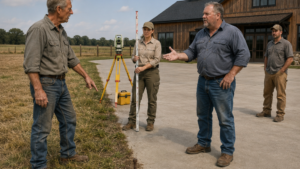
Beyond them, survey stakes would soon divide the ridge from the farm below.
Chapter 7: The Land They Saved Was Smaller
Survey stakes divided the upper pasture before the first repair shovel entered the ground.
They stood in a bright line along the ridge, each one topped with orange ribbon that snapped in the wind. From the lower road, the markers looked less like a property boundary than a warning no one had managed to remove.
Emma stopped beside the gate and counted them again.
Fourteen.
The grazing strip beyond them held the first grass of spring. It was thin but green, the kind cattle would nose through patiently after a winter on hay. By the following month, the strip would belong to someone else.
Debra stood near the surveyor’s last stake with her hands in her coat pockets.
“They moved the west line,” she said.
“By six feet.”
“That is six feet of the walnut shade.”
“The trees stay with us.”
“The roots will not know that.”
Emma looked at the nearest walnut. Its branches crossed both sides of the new boundary.
The sale had closed three days earlier. The payment had cleared enough of the oldest debt for the lender to restructure what remained. Samuel had covered excavation at the diversion junction and paid for half the stone. The county had provided plans and supervision, but no money.
Everything saved had required something removed.
A truck rattled up the road pulling a narrow equipment trailer. Joshua rode in the passenger seat beside Samuel. Behind them came only four mules.
Emma watched the empty space where the larger team should have been.
Samuel climbed out slowly. Six weeks had not made conversation easier between them.
“I thought you were bringing the full line,” she said.
“You said limited work.”
“I said no more animals than the ground required.”
“That is what I brought.”
Ruth and Amos stood at the front of the trailer. Behind them waited the gray gelding and the sorrel mare. All four were harnessed lightly, with no plow attached.
Samuel took the braided lead from the hook beside the trailer door.
He did not offer it to Emma.
Instead, he looked over the field, the open drainage cut, and the crew waiting near the repaired stone channel.
“Which pair do you want?”
The question carried no challenge. That made it harder to answer quickly.
Emma walked along the trailer. She checked Ruth’s legs, then Amos’s. The gray gelding favored no foot, though his left hind toe still dragged slightly when he shifted. The sorrel mare watched the chains behind her with alert ears.
“Ruth and Amos first,” Emma said. “The other pair waits until the upper edge dries.”
Samuel nodded once. “Your call.”
Joshua unlatched the trailer.
The repaired drainage line crossed the lower field in a shallow open cut before disappearing beneath new stone. Fresh soil lay piled along both sides, darker than the untouched ground but streaked with pale clay.
The soil-conservation officer stood near the junction with a measuring rod. “The water level dropped another inch overnight.”
Emma stepped down into the cut.
At the bottom, a narrow stream moved steadily toward the creek. It was not much water, but it was moving. For two seasons, the field had held what should have left.
She crouched and pressed a handful of earth together.
It held its shape briefly. When she touched it with her thumb, it broke into coarse pieces rather than smearing across her palm.
The officer watched. “That section can take a light pass.”
“Only one?”
“One today. Then we see how it settles.”
Emma stood and brushed the soil from her hand.
Samuel had already attached the light harrow. Joshua waited beside Ruth with the lead line looped awkwardly around his fingers.
Emma walked toward him.
He began to hand it over.
She closed his fingers around it instead.
“You take them.”
Joshua looked from her to Samuel. “Me?”
“You know the route.”
“I have not led them through repaired ground.”
“Neither have they.”
Samuel’s expression remained unreadable.
Joshua loosened his grip and rewound the line more carefully. “What if Ruth stops?”
“Find out why.”
“What if Amos pushes?”
“Do not pull against him. Change the angle.”
“What if I get it wrong?”
Emma looked at the field. “Then stop before wrong becomes damage.”
Joshua swallowed and stepped forward.
Ruth followed him through the gate.
Amos hesitated at the darker strip where the drainage cut had been closed. Joshua’s arm tightened. Emma saw him prepare to pull.
“Wait,” she said.
He stopped.
Amos lowered his head, sniffed the soil, and shifted one hoof onto the repaired ground. The earth compressed slightly but did not release water. He tested it again, then stepped across.
Joshua breathed out.
Emma walked beside him, close enough to reach the harness but far enough that the mules understood whose line they were following.
The harrow scratched lightly over the upper layer. It did not turn a deep furrow. It broke the crust and left a textured strip behind, modest and uneven compared with the clean line Emma had made six weeks earlier.
No neighbors gathered at the fence.
No one needed to be proved wrong.
Samuel worked near the junction, setting stones where the redirected runoff had once entered. His shirt darkened between the shoulders. Twice he removed stones Joshua had placed and reset them without comment. The third time, he showed the boy how to angle the broad face into the water’s pressure.
Debra carried the account ledger from the farmhouse just before noon.
Emma saw it beneath her arm and felt the old instinct to avoid it.
Debra opened the book on the wagon tailgate.
“I entered the stone payment,” she said. “And Samuel’s share.”
Emma removed her gloves. “The lender adjustment?”
“On the next page.”
They stood shoulder to shoulder over the figures.
The farm would survive the year if the lower field produced a modest late crop and if feed prices held. If either failed, there would be another decision before winter.
Debra tapped the projected income. “This assumes fewer animals.”
“I know.”
“It assumes no equipment failure.”
“I know.”
“It assumes I can keep covering the insurance through September.”
Emma looked at her. “You should not have to.”
“No. I should not have to do it without knowing.”
Emma lowered her eyes to the ledger.
Debra closed the cover.
“I was not angry because you chose the farm,” she said. “I was angry because you kept choosing for both of us.”
The words were quieter than the accusation in the kitchen, but they reached deeper.
Emma ran one finger along the worn edge of the ledger.
“I thought if I told you how bad it was, you would leave it.”
“I had already left.”
“That is not what I meant.”
“I know.”
Emma looked toward the ridge. Beyond the survey stakes, the sold pasture shone green in the sun. A fence crew would arrive the following week. After that, the road approaching the house would no longer pass entirely through Taylor land.
“I did not know how to keep something without holding all of it,” Emma said.
Debra’s gaze followed hers. “Neither did he.”
Emma knew she meant their father. Or her husband. Perhaps both.
Neither woman clarified.
At the lower end of the field, Joshua called for the team to stop.
Ruth stood calmly. Amos had begun to breathe harder, though the pass was only half complete.
Joshua looked toward Emma.
She did not answer for him.
He checked the harness, then ran a hand down Amos’s shoulder. After a moment, he unhooked the harrow and led both animals to the edge for water.
Samuel watched him, then looked at Emma.
“He stopped early,” Samuel said.
“He stopped in time.”
A trace of something moved beneath Samuel’s beard. Not quite a smile.
They completed the pass after the animals rested. The ground behind the harrow was not beautiful. Clods remained near the drainage cut. The upper end broke too fine. Along one edge, a damp patch required them to steer wide.
But the soil did not seal beneath the weight.
By late afternoon, the officer approved a second light pass for the following week and marked a small section for delayed planting.
“Your first crop will be half what you planned,” she said.
“Less than half,” Emma answered.
“Possibly.”
Emma looked over the reduced field. The new boundary had taken the upper pasture. The drainage cut claimed another strip. The wettest corner would remain unplanted all season.
What remained was smaller than the farm she had promised to keep.
It was also the first version of it she had stopped lying about.
Samuel came to stand beside her.
“I can bring the gray pair next week,” he said.
“If the ground says yes.”
“If you say yes.”
Emma studied him.
He looked tired. The repair cost had forced him to postpone work on his own barn roof. Joshua had mentioned it without meaning to. Samuel had not.
“You did not have to pay as much as you did,” Emma said.
“Yes, I did.”
“You could have argued.”
“I spent enough years doing that.”
The answer did not erase what he had done. It did not restore the lost pasture or return the seasons of trapped water. Emma found that she no longer needed it to.
“Bring the gray pair,” she said. “Leave the sorrel unless the chain is padded.”
Samuel nodded. “I will.”
He walked back toward the trailer.
Joshua approached with Ruth’s lead in his hand. He held it out to Emma again.
This time she took it only long enough to loosen a twist near the clip.
Then she returned it.
“Hang it in Samuel’s barn tonight,” she said. “Bring it here when the team works.”
Joshua looked uncertain. “Where does it belong?”
“With whoever is responsible for the animals at the time.”
He considered that, then wrapped the line neatly around his palm.
Emma walked to the first repaired furrow alone.
The sun had warmed the newly opened ground. She knelt where the old wet seam had crossed beneath her earlier handprint and pushed her fingers into the soil.
No water rose.
She gathered a handful and squeezed.
The earth held together, dark and cool. When she opened her hand, it remained in one rough piece. She pressed her thumb into the center, and the clod broke cleanly apart.
Behind her, Joshua led Ruth and Amos toward the road. Samuel walked near the harrow. Debra carried the ledger back to the house, no longer tucked out of sight beneath her coat.
Emma let the restored soil fall from her palm into the repaired furrow.
The wind carried a few grains across the ground they had lost and the ground that remained.
The story has ended.