They Said His Farm Was Part of Magnolia Creek—Until the Yellow Papers Reached the Meeting Table
Chapter 1: The Yellow Notice Nailed Beside the Cattle Gate
The yellow sheet had been nailed to Joseph Hall’s gatepost sometime before sunrise.
He saw it when he stepped down from his pickup, coffee still warm in the steel cup between the seats. The paper was too bright against the gray cedar post, just below the rust-dark hinge his father had installed more than thirty years earlier.
Joseph pulled the nail free with two fingers.
NOTICE OF VIOLATION.
He stopped reading after the first paragraph.
“Unauthorized agricultural traffic,” he muttered.
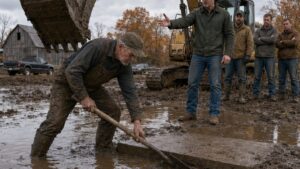
Behind the gate, twenty-eight cattle stood in the lower pasture, some already drifting toward the feed trough. Beyond them, the land rose toward his hay field. To Joseph’s right, where his gravel lane narrowed beside the newest edge of Magnolia Creek, fresh mulch and ornamental grasses followed the subdivision’s wooden privacy fence.
The yellow notice claimed that strip belonged to Magnolia Creek.
Joseph looked at the gravel beneath his boots.
His father had hauled stone onto that lane when Joseph was still in high school.
He folded the notice once and pushed it into his shirt pocket.
At seven-thirty, a feed truck turned off the county road.
Joseph opened the livestock gate and waved the driver in. The truck rolled twenty yards before slowing sharply.
A row of newly placed orange cones blocked the outside edge of the lane.
The driver lowered his window.
“You want me through there?”
Joseph stared at the cones.
They had not been there yesterday.
The truck could clear the gate, but not the bend farther in. Its rear wheels would have to swing onto the grassy strip Magnolia Creek now called a protected buffer.
Joseph walked ahead, kicked one cone aside, then stopped.
A small laminated sign had been tied to another cone.
NO HEAVY VEHICLES BEYOND THIS POINT.
The driver leaned farther out.
“I can back out.”
“You came to deliver feed.”
“I also came to leave with my mirrors attached.”
Joseph glanced toward the subdivision. Several houses backed onto the strip. Their decks faced the pasture. One homeowner stood beside a patio door watching him.
Joseph lifted the cone.
“Take it slow.”
The truck’s diesel engine deepened as it crawled forward. At the bend, the right rear tires pressed into the grass for perhaps eight feet before returning to gravel.
Nothing broke. No fence was touched.
But Joseph saw the homeowner raise a phone.
By the time the truck was unloading, Joseph had read the entire notice.
Magnolia Creek Residential Association asserted that the landscaped strip bordering the development was common-area property. It cited restrictions against commercial vehicles, agricultural equipment, livestock access, and damage to maintained landscaping.
The letter gave him ten days to cease use.
Joseph laughed once, without humor.
He walked to the oldest corner of the pasture, where a cedar post leaned slightly toward the road. Half its bark had worn away. A strand of woven wire, gray with age, disappeared beneath newer fencing.
That post had stood there before Magnolia Creek had streets.
Before its entrance sign.
Before anyone had named a retention pond.
Joseph set one hand on the cedar.
“You haven’t moved,” he said.
That afternoon, another email arrived.
The sender was Maria Lopez, Magnolia Creek’s property manager.
Mr. Hall,
We have received additional documentation of heavy-vehicle use within the association buffer. Please contact the management office so this matter can be resolved before formal enforcement proceedings become necessary.
Joseph read it on his phone while standing beside a round bale.
He put the phone away.
He had fences to repair.
The next morning another yellow notice appeared, this one tucked beneath the gate chain instead of nailed to the post.
Joseph carried it into the farmhouse and dropped it unopened on the kitchen counter.
By Wednesday there were three.
His late father had handled disputes face-to-face. A neighbor’s cow crossed a fence, you drove it home. A ditch clogged, you brought a shovel. Nobody needed seven pages of rules to say where a field ended.
Joseph had kept that habit even as the farmland around him changed.
Magnolia Creek had started with twelve houses. Then twenty-seven. Then forty-three.
The houses did not bother him.
The assumption did.
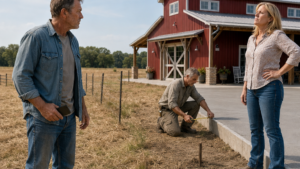
Late Wednesday afternoon, a white SUV stopped outside the gate. Carolyn Roberts stepped out wearing dark slacks, a pale jacket, and shoes that sank slightly into the soft shoulder.
Joseph knew her by sight from two earlier conversations.
“Mr. Hall.”
“Carolyn.”
She looked toward the lane.
“We need to stop pretending those notices aren’t reaching you.”
“They’re reaching me.”
“And yet trucks are still crossing association property.”
Joseph folded his arms.
“Show me where my property stops.”
Carolyn nodded toward the landscaped strip as though the answer were visible.
“The recorded development materials identify that as Magnolia Creek’s buffer.”
“My fence says otherwise.”
“A fence isn’t necessarily a property line.”
“That one was there when your development was still trees.”
Carolyn’s jaw tightened, but her voice stayed measured.
“I have forty-plus homeowners who were told that buffer is protected. They’re asking why cattle trucks and equipment are using it.”
“Because it’s part of my farm.”
“And I’m telling you the association has documents saying otherwise.”
Joseph looked at her for a long second.
“Then bring the right document.”
Carolyn reached into her folder.
“I’m scheduling an enforcement hearing for next Thursday.”
She handed him another yellow page.
This time Joseph did not fold it.
That night, after feeding cattle and checking a leaking trough valve, he sat at his kitchen table with the notices spread around his elbows.
His irritation had begun to feel heavier.
Not fear exactly.
Something closer to the realization that people could repeat the wrong thing long enough for it to acquire letterhead.
His phone buzzed.
Maria had sent another email.
Attached was a map.
Joseph enlarged it with two fingers.
Magnolia Creek’s lots appeared in neat pale rectangles. The landscaped strip ran behind them in green.
Then he saw the line.
According to the map, the association boundary cut across his gravel lane, passed inside the old fence corner, and continued through ground Joseph had paid taxes on for decades.
Joseph stared at it.
The line was not merely close.
It was wrong by enough to matter.
And somebody, somewhere, had drawn it that way.
Chapter 2: The Map Everyone Trusted Had One Missing Line
The county clerk studied Joseph’s deed, then the Magnolia Creek map, and said the one thing Joseph had not expected.
“They could both be accurate for what they were created to show.”
Joseph leaned toward the counter.
“They can’t both own the same dirt.”
“I didn’t say that.”
The clerk rotated the subdivision exhibit toward him.
“This is a planning exhibit. Your deed is a recorded legal description. They serve different purposes.”
“Then which one tells them they own my lane?”
“That’s the question you need answered.”
Joseph disliked answers that returned in the shape of questions.
He had come to the county office carrying what he considered the end of the argument: his deed, his latest tax statement, and an old farm plat he found in a steel filing cabinet.
Instead he left with photocopies and a headache.
Back home, he spread everything across the kitchen table.
The Magnolia Creek map showed the development boundary as a bold clean line. Joseph’s farm plat used bearings, distances, iron pins, old fence references, and language nobody would confuse with clean.
He followed the descriptions with one finger.
At the southern corner, his deed referenced an iron pin near the original fence line.
The subdivision exhibit seemed to jump from a drainage point to the landscaped strip without marking that old corner at all.
Joseph circled it.
There.
A missing line.
Or maybe a missing assumption.
He called Maria.
“I need the original development boundary documents.”
There was a pause.
“I can send what we have.”
“I’ve seen what you have.”
“Then what are you asking for?”
“The thing that came before your clean little map.”
Maria’s voice changed slightly.
“I’ll check the archived files.”
Joseph hung up before the conversation could become polite.
At noon he walked the disputed strip again.
Andrew Baker was standing near his backyard fence with a rake.
Andrew’s property was one of the closest to the lane. His deck faced Joseph’s pasture, and Joseph had seen him complain twice about early feed deliveries.
“You’re measuring now?” Andrew asked.
Joseph had a tape stretched between the old cedar corner and a newer survey cap near the road.
“I’m trying to understand what your association thinks it bought.”
Andrew rested both hands on the rake handle.
“We were told that whole strip was common open space.”
“By who?”
“The sales people. The site plan. Everybody.”
Joseph straightened.
“You were told my lane was yours?”
“We were told nothing agricultural would come any closer than the fence line.”
Joseph looked past him at the houses.
For the first time, he saw the issue from the other side of the privacy fence.
A family could have bought one of those homes believing the grassy strip was a permanent cushion between a backyard and a working farm. Maybe they paid extra for it.
That did not make the map right.
But it made Andrew’s irritation less ridiculous.
Andrew pointed toward the gravel.
“When we bought, they specifically called it protected open space.”
“That truck lane was here before your house.”
“I know that now.”
“Didn’t know it then?”
Andrew shook his head.
Joseph reeled in the tape.
That answer bothered him more than an argument would have.
By midafternoon, he had another small victory.
The county tax office confirmed his acreage had never been reduced after Magnolia Creek was developed. The disputed strip remained included in the assessed parcel on which Joseph paid taxes.
He wrote the number down twice.
It felt solid.
Finally, something did.
Then Carolyn called.
Her tone was businesslike.
“Until the hearing, no heavy agricultural equipment is to use the disputed area.”
Joseph looked out his kitchen window toward the lane.
“I have hay equipment moving Friday.”
“You’ll need another route.”
“There isn’t another route that fits the baler.”
“That doesn’t change the association’s position.”
“It might change my position about those cones.”
“Joseph.”
It was the first time she had used his first name.
“If equipment damages association landscaping after formal notice, that creates a separate issue.”
He gripped the phone.
“So you can’t prove it’s yours, but you’re going to punish me for using it anyway?”
“We have a recorded subdivision plan.”
“You have a drawing.”
“We have homeowners who relied on that drawing.”
“And I have a farm.”
Neither spoke for a moment.
Carolyn finally said, “That is why there is a hearing.”
After the call, Joseph sat alone at the table.
Yellow notices crowded one side. Tax records sat on the other.
His deed lay between them.
He had expected certainty to accumulate as the paper accumulated.
Instead each page seemed to make the disagreement larger.
That evening Maria called.
“I found something strange.”
Joseph stood immediately.
“What?”
“There’s an index entry for an agricultural boundary exhibit attached to an earlier phase submission.”
“And?”
“I don’t have the exhibit.”
“What do you mean you don’t have it?”
“I mean it isn’t in the current association file.”
“County?”
“I’m checking.”
Joseph looked at the subdivision map again.
The bold boundary line seemed suddenly less confident.
Maria continued.
“The index description says it references an existing agricultural parcel along the western edge.”
“My western edge.”
“It appears so.”
“Then why isn’t that on the map you sent me?”
“I don’t know.”
Joseph pressed his fingers against the table.
“Find it.”
“I’m trying.”
The next morning, before Joseph had finished checking the cattle, Maria sent a short message.
She had located an archived scan connected to the original county planning package.
It was incomplete and faint.
But the subject line was enough to keep Joseph standing beside the gate with his phone in his hand.
AGRICULTURAL PARCEL BOUNDARY EXHIBIT.
The document Magnolia Creek no longer had in its own files had once existed.
And whatever it showed was important enough that somebody had indexed it separately.
Chapter 3: When the Yellow Papers Covered the Meeting Table
“Mr. Hall has continued unauthorized agricultural use of Magnolia Creek property despite repeated written notice.”
Carolyn Roberts said it into the tabletop microphone as though the sentence had already become fact.
Joseph stood at the back of the meeting room with his jaw tight.
Every chair was occupied.
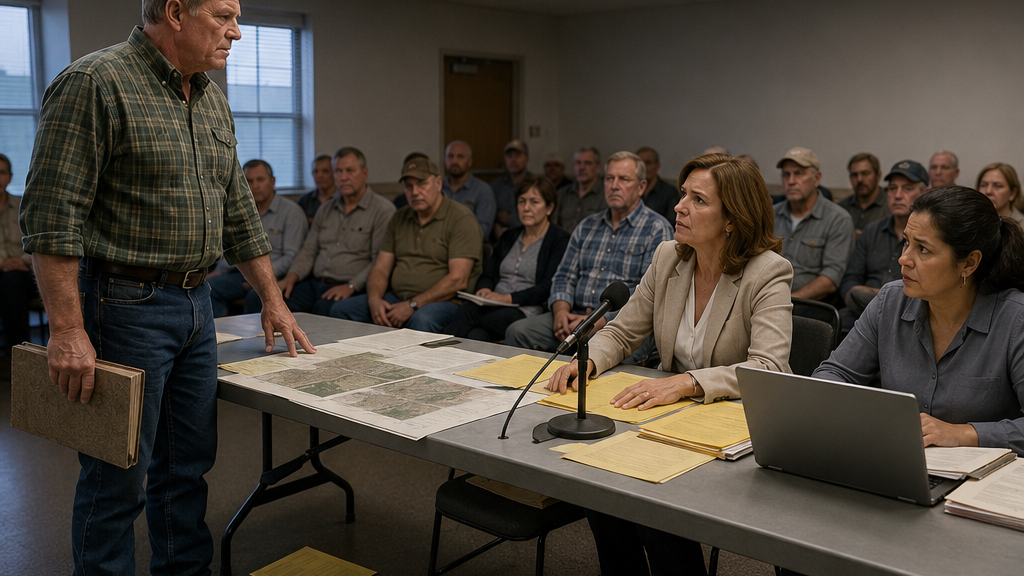
Some residents leaned against the walls. Maria sat at the long folding table beside two board members, a laptop open in front of her. Carolyn sat at the center with a stack of yellow notices arranged neatly to her right.
Joseph had brought his own stack.
He had spent most of Thursday afternoon at the county planning office, waiting while a clerk pulled an archived file from a scanned development submission.
The agricultural exhibit was faint and crooked when printed.
But it existed.
And the old cedar corner appeared on it.
Carolyn continued.
“The board has attempted informal resolution. The property owner has declined to cease the activity. Management therefore recommends escalating enforcement penalties and restricting vehicle use within the association buffer.”
A resident near the front muttered, “About time.”
Joseph felt the old reflex rise in him—the impulse to say something sharp enough to end the conversation.
Instead he looked at the papers in his hands.
He had come for a different purpose.
Carolyn glanced toward him.
“Mr. Hall, you may respond.”
Joseph walked forward.
His boots sounded too loud on the vinyl floor.
He stopped beside the empty chair at the end of the table but did not sit.
“You said association property.”
Carolyn nodded.
“Yes.”
“Which recorded transfer gave it to you?”
The room shifted.
Not dramatically. A chair creaked. Someone coughed.
Carolyn’s expression remained composed.
“The subdivision documents establish the common buffer.”
“That wasn’t my question.”
Joseph placed his deed on the table.
Then his tax parcel.
Then the Magnolia Creek map.
Finally, he unfolded the archived agricultural exhibit.
The yellow notices beneath them slid outward. One sheet slipped over the edge and fluttered to the floor beside the microphone stand.
Joseph pointed to the old fence corner on the archived exhibit.
“This is the corner on my property.”
He tapped the cleaner Magnolia Creek map.
“This version doesn’t show it.”
Carolyn leaned forward.
“The development boundary was approved.”
“Then show me where I transferred that strip.”
Maria stopped typing.
Carolyn looked toward her.
“Maria?”
Maria’s eyes moved between the exhibits.
“I searched the association records this week.”
“And?”
“I did not locate a conveyance from Mr. Hall for the strip in question.”
A murmur passed through the room.
Carolyn raised one hand.
“That does not mean no conveyance exists.”
Joseph nodded once.
“Fine. Find it.”
“Mr. Hall—”
“You’ve been sending me violations for land you can’t show you own.”
Andrew Baker stood near the side wall.
“That’s not exactly fair.”
Joseph turned.
Andrew’s expression was tense, but not hostile.
“We were given that map when we bought,” he said. “That buffer was part of how those lots were sold.”
Joseph looked at him.
“I believe you.”
That quieted the room more effectively than shouting would have.
Andrew seemed surprised.
Joseph continued.
“But believing the map doesn’t move my fence.”
Carolyn drew the subdivision exhibit toward her.
“The association did not invent this boundary last week. It has been maintained according to this plan for years.”
“Maintained isn’t owned.”
“And long use isn’t necessarily ownership either.”
Joseph’s mouth tightened.
She had a point, and he disliked that she had one.
Maria enlarged the archived scan on her laptop.
“Carolyn.”
“What?”
“There’s a notation here.”
She turned the screen slightly.
“Existing agricultural parcel—boundary to remain.”
Several people leaned forward.
Joseph stayed still.
Carolyn’s eyes narrowed.
“Can you confirm which line it refers to?”
“Not from this scan.”
“So we still need verification.”
“Yes.”
Carolyn looked back at Joseph.
“That is why we should not pretend this document settles everything.”
“I’m not pretending.”
Joseph tapped the map again.
“I’m asking why you’re fining me before you know.”
A board member finally spoke.
“I think enforcement should pause until we establish the line.”
Another member nodded.
Carolyn pressed her lips together.
“The board has complaints pending.”
“Complaints can wait a week,” the first member said. “Property ownership cannot be guessed.”
The motion to postpone penalties passed.
Not unanimously.
But it passed.
Joseph felt the pressure behind his ribs release slightly.
Only slightly.
He had wanted the meeting to end there.
He had imagined walking outside with the yellow notices meaningless in his hand.
Instead Carolyn remained seated.
She waited until the room quieted again.
“There is another part of the record.”
Joseph looked at her.
Carolyn reached into a separate folder.
“This discrepancy was not entirely unknown to Mr. Hall.”
Joseph’s stomach tightened.
She removed an envelope.
Old.
Cream-colored once, now yellowed at the edges.
Joseph knew it before she held it up.
He had seen that envelope years ago on his father’s desk after the first development signs appeared along the county road.
Carolyn slid it across the table.
The front carried Joseph’s name.
His address.
And, in the upper corner, the logo of the company that had developed Magnolia Creek.
“You were sent a boundary-verification request during the development approval process,” Carolyn said.
Joseph did not touch the envelope.
“I received a lot of developer mail.”
“This one asked you to review the agricultural boundary exhibit.”
Joseph’s throat went dry.
Maria looked at him.
“So you saw it?”
“I don’t remember.”
Carolyn turned the envelope over.
There was handwriting on the back.
Joseph’s handwriting.
RETURN TO SENDER — NO INTEREST.
He remembered then.
Not every detail.
Enough.
He had been angry that year.
His father had been sick. Survey crews had been walking near the fence. Developers kept calling. Joseph had decided that nothing involving the subdivision deserved one minute more of his time.
He had written those words himself.
Carolyn did not smile.
That made it worse.
“You had an opportunity to challenge the boundary representation before the final phases were marketed,” she said.
Joseph finally picked up the envelope.
The paper felt thin in his hand.
“Are you saying that made the land yours?”
“No.”
Carolyn’s answer came immediately.
“I’m saying this did not happen entirely without your knowledge.”
Joseph looked around the room.
Some of the residents who had been watching Carolyn now watched him.
Andrew lowered his eyes.
The board had postponed the penalties.
Joseph had proved Magnolia Creek could not establish ownership that night.
He should have felt vindicated.
Instead he stood beneath the fluorescent lights holding an old envelope that carried his own refusal in his own handwriting.
The wrong map might not have been his creation.
But for the first time, Joseph had to consider whether his silence had helped it become everyone else’s truth.
Chapter 4: The Letter Joseph Chose Not to Answer
Joseph recognized the envelope before he opened the drawer.
It was Saturday morning, two days after the hearing, and he had been searching the farmhouse office for an old livestock insurance policy when he found a second copy of the developer’s letter beneath a stack of machinery receipts.
The paper had yellowed around the fold.
His own handwriting crossed the corner.
RETURN TO SENDER — NO INTEREST.
Joseph stood with the drawer still open.
At the meeting, he had remembered writing those words. Here, holding the duplicate the developer had apparently mailed again, he remembered why.
His father had been failing fast that year. Survey crews were cutting ribbons along the road. A developer representative had called twice during feeding time and once while Joseph was trying to get his father to a medical appointment.
The last call had ended with a request that Joseph “review and acknowledge” a boundary exhibit.
Joseph had heard only one thing: another stranger wanted something from the farm.
He had refused to give it.
At the time, refusing had felt like protecting the place.
Now he unfolded the letter.
The language was dry and careful. The developer asked neighboring landowners to review an exhibit showing the interface between existing agricultural parcels and the proposed subdivision. Corrections were to be submitted within thirty days.
No signature was required for approval.
No response would be interpreted only as no requested correction.
Joseph read that sentence twice.
It did not transfer his property.
But it explained something worse.
Nobody had needed his permission to keep using a mistaken drawing.
They had only needed his silence.
He carried the letter into the kitchen and placed it beside the newer yellow notices.
Old paper. New paper.
Same color now.
He had spent days thinking Magnolia Creek’s mistake began with somebody drawing a line in the wrong place.
The possibility that he had once been invited to point at that line and had refused made his anger harder to hold cleanly.
A pickup stopped outside shortly after noon.
Andrew Baker came to the back door instead of the farm gate.
Joseph opened it but did not invite him in immediately.
Andrew held a folded subdivision brochure.
“I thought you ought to see this.”
Joseph stepped aside.
At the kitchen table, Andrew opened the brochure to a site illustration.
The disputed strip was shaded green.
“Open-space buffer,” Andrew said. “That’s what they called it.”
Joseph studied the page.
“No property lines.”
“No. Just the drawing.”
“And you bought based on this?”
“Partly.”
Andrew rubbed the edge of the brochure between his thumb and forefinger.
“Our lot cost more than the ones across the street.”
“How much more?”
“Enough that I remember it.”
Joseph looked toward him.
Andrew gave an uncomfortable half shrug.
“My wife liked the idea that nobody would build directly behind us. The sales agent said the buffer was controlled by Magnolia Creek. Maintained by the association. No agricultural traffic through it.”
Joseph sat back.
“And when my trucks came through?”
“I thought you were ignoring the rules.”
“You ever ask me?”
“No.”
“Why?”
Andrew looked down at the brochure.
“Probably for the same reason you didn’t answer that letter.”
Joseph’s eyes narrowed.
Andrew did not retreat.
“We both thought we already knew what the other side was doing.”
The sentence landed harder than Joseph wanted it to.
He looked at the old envelope.
Andrew followed his gaze.
“That the one Carolyn had?”
“A copy.”
“You really ignored it?”
“Yes.”
Andrew nodded slowly.
“That doesn’t make the map right.”
“No.”
“But it makes this mess less simple.”
Joseph almost told him he did not need help understanding that.
Instead he said, “How many people paid extra?”
“I don’t know. Several of the lots along this side.”
That changed the shape of the dispute again.
If Magnolia Creek simply withdrew its claim tomorrow, homeowners might ask why they had been sold premiums based on land the association never owned.
Joseph could already imagine Carolyn’s problem.
He did not feel sorry for her.
But he could see it.
By late afternoon, Joseph and Andrew were standing beside the old cedar corner.
Andrew looked from the post to the privacy fences behind the houses.
“So where do you think the actual line runs?”
“Close to this.”
“That would put part of the landscaping on your side.”
“Maybe.”
“The irrigation too.”
Joseph glanced toward the narrow drainage swale where Magnolia Creek’s maintenance crew had planted ornamental grasses years earlier.
The problem had stopped being theoretical.
A wrong line on a map had grown roots.
His phone rang.
Maria.
Joseph answered.
“I found something else,” she said.
“You keep saying that like I’m supposed to enjoy it.”
“You won’t enjoy this one.”
He turned away from Andrew.
“What is it?”
“Meeting notes from an executive session three weeks before your enforcement hearing.”
Joseph said nothing.
Maria continued carefully.
“The board discussed a mismatch between the subdivision exhibit and an older agricultural parcel reference.”
“Before the hearing?”
“Yes.”
“How much before?”
“Twenty-two days.”
Joseph looked toward Magnolia Creek.
“Who was there?”
“I can tell you Carolyn was.”
His jaw tightened.
“Did she know there might be a problem with the boundary?”
“The notes say management recommended verifying the agricultural line before further action.”
Joseph gripped the phone harder.
“And they did what?”
“There was no formal vote recorded.”
“Maria.”
“I’m still reading.”
Andrew watched him from several yards away.
Joseph asked, “Did Carolyn know before she stood at that microphone and called my use unauthorized?”
Maria was silent for a moment too long.
“Yes.”
The anger Joseph had spent the weekend complicating suddenly returned, but it was different now.
Not clean.
Not satisfying.
He knew what his own mistake had been.
Now he needed to know why Carolyn, after seeing uncertainty in black and white, had chosen to speak as if none existed.
Chapter 5: Carolyn Knew the Boundary Was No Longer Certain
Maria laid three packets on the association conference table.
Each had a yellow cover sheet.
Each was dated.
Joseph noticed that before he noticed anything else.
For the first time since the dispute began, the papers were not scattered, folded into his pocket, or nailed to a gate. Maria had arranged them in sequence.
The first packet contained the development map.
The second contained the archived agricultural exhibit.
The third contained the executive-session notes.
Carolyn Roberts sat opposite Joseph with her hands clasped.
No board members. No residents.
Just the three of them.
Maria pointed to a date highlighted near the top of the third packet.
“This is when I first raised the discrepancy.”
Joseph looked at Carolyn.
“Twenty-two days before the hearing.”
“Yes,” Carolyn said.
“You knew.”
“I knew there was a discrepancy.”
“You stood in front of a room and called it association property.”
“Because that remains the association’s recorded operating position until the boundary is formally resolved.”
Joseph gave a short laugh.
“Operating position.”
Carolyn’s expression hardened.
“You think changing one line on a map is simple?”
“If it’s wrong.”
“And if forty-three owners bought homes relying on it?”
Joseph stopped.
Carolyn continued.
“If I announced three weeks ago that the association might not own land represented as common space, what happens next?”
“You correct the record.”
“What happens next?” she repeated.
Joseph did not answer.
“Owners ask whether they overpaid. They ask who maintains the landscaping. They ask whether livestock can come closer to their fences. They ask whether the association insured property it did not own. They ask whether the developer misrepresented the lots. Then they ask why the board didn’t know.”
“That sounds uncomfortable.”
“It is more than uncomfortable.”
Her voice remained controlled, but Joseph could hear the strain under it now.
“I have residents who think every problem means someone on the board has been hiding something. I had two choices: declare the entire boundary uncertain before we had a survey, or continue enforcing the documents the association had relied on for years while trying to get you to engage.”
Joseph stared at her.
“By fining me.”
“By getting you to the table.”
“You could have called.”
“We did.”
“I mean after you knew.”
Carolyn looked down briefly.
That was enough.
Joseph leaned forward.
“You thought if you pushed hard enough, I’d make a deal quietly.”
Carolyn did not answer at first.
Maria watched her.
Finally Carolyn said, “I thought a negotiated access arrangement would be faster and less damaging than turning a mapping discrepancy into a community-wide property issue.”
Joseph sat back.
There it was.
Not theft.
Not some secret plan to take his farm.
Leverage.
She had known her ground was uncertain and pressed anyway because she wanted him to give her something easier than the truth.
“That was your choice,” he said.
“Yes.”
“And it was wrong.”
Carolyn looked directly at him.
“Yes.”
The admission gave Joseph less satisfaction than he had expected.
He had imagined catching her in denial. He had imagined forcing her to say what everyone at the meeting had seen.
Instead she simply accepted it.
Maria broke the silence.
“The surveyor can meet us at the site this afternoon.”
Carolyn nodded.
Joseph gathered his papers.
At the door, Carolyn said, “For what it’s worth, I don’t think your ownership claim is frivolous.”
Joseph turned.
“That’s a long way from unauthorized agricultural use.”
“I know.”
The surveyor began at the road with equipment Joseph did not pretend to understand.
Joseph understood the land instead.
He knew where water gathered after heavy rain, where his father had reset a fence after a storm, where a tractor tire had exposed an old stone twenty years ago.
The surveyor wanted monuments, bearings, reference points.
Joseph led him to the cedar corner.
The man brushed grass aside and found an iron pin several inches from the post.
“That helps.”
They worked northward.
Maria followed with a folder. Carolyn stood near the Magnolia Creek side. Andrew watched from behind his fence but kept his distance.
The first flag went into ground nobody disputed.
The second landed near the gravel lane.
The third caused everyone to stop.
The surveyor pushed it into a mulched flower bed maintained by Magnolia Creek.
Carolyn frowned.
“That can’t be right.”
The surveyor checked his equipment.
“I’m not giving you a final opinion today.”
“But?”
“But the deed call and monument we’ve located put the working line roughly here.”
Joseph stared at the yellow flag.
Three feet behind it stood ornamental grass.
Beyond that, an irrigation head.
Farther north, the line seemed likely to cross a narrow drainage swale Magnolia Creek’s crews cleaned every summer.
Andrew came through his side gate.
“That’s inside the buffer.”
Joseph glanced at him.
“Apparently.”
“How far does it go?”
The surveyor shook his head.
“Let me finish.”
They did.
Each new flag made the simple victory Joseph had wanted less simple.
One stood inside mulch.
Another appeared beside a drainage inlet.
A third was several feet closer to Andrew’s fence than the association map suggested.
Near the northern end, the line returned toward Joseph’s old woven-wire fence.
Carolyn walked beside the flags slowly.
“If this becomes the final line, we’ve been maintaining part of your land.”
Joseph nodded.
“And I’ve been driving over part of what you were maintaining.”
Maria said, “Which means we’ll need more than a corrected map.”
Joseph looked down the row of yellow markers.
Only a week earlier, he would have wanted Magnolia Creek to remove everything on his side—mulch, irrigation, shrubs, all of it.
Now he pictured maintenance trucks backing out, drainage being neglected while lawyers argued, residents waking to ripped-up landscaping they had paid for without knowing why.
The land was still his.
That fact mattered.
But ownership had accumulated consequences while everybody had been following the wrong line.
The surveyor packed his equipment.
“I’ll prepare the formal boundary analysis.”
Carolyn remained beside the flower bed.
“What do you want?” she asked Joseph.
He could have answered immediately.
Instead he looked from the old cedar corner to the new yellow stakes.
“A line everybody can live with without pretending it isn’t mine.”
Carolyn nodded once.
It was not agreement.
But it was the first conversation they had held without either one claiming certainty they did not possess.
Joseph turned toward the lane.
Behind him, the yellow flags continued through Magnolia Creek’s landscaping, each one marking several feet of ground the association had treated as its own for years.
The question was no longer whether Joseph had been right about his land.
It was how much everyone would have to change now that the line could no longer be ignored.
Chapter 6: The Survey Stakes Changed More Than One Property Line
The newest yellow stake stood in the middle of Magnolia Creek’s flower bed.
Joseph saw it from his truck before he opened the cattle gate.
The surveyor’s final field markings had been placed the previous afternoon. Overnight, someone from the landscaping crew had carefully worked mulch around the stake rather than pulling it.
That small act struck Joseph as strangely important.
For once, nobody had moved the marker because it was inconvenient.
He walked the line before breakfast.
Near the road, the corrected boundary was only a foot or two from what everyone had assumed. Farther north, it moved deeper into the maintained buffer. Part of the irrigation system crossed Joseph’s parcel. So did several shrubs and the edge of the drainage swale.
His gravel farm lane remained his.
So did enough land beside it to maneuver equipment.
That should have felt like the end.
Instead the special board session that afternoon began with Carolyn sliding a proposed agreement toward him.
Joseph read the first page.
Then the second.
On the third, he stopped.
“What’s this?”
Carolyn knew which paragraph he meant.
“The association would compensate you for the affected strip.”
“I’m not selling it.”
“It isn’t a purchase.”
“It says permanent exclusive landscape easement.”
“That would preserve the buffer.”
Joseph read farther.
“And restrict agricultural vehicle passage except in emergencies.”
Carolyn folded her hands.
“Residents were promised separation from farm traffic.”
“Residents were promised land you didn’t own.”
“And they bought based on that representation.”
“So now I’m supposed to make the mistake true?”
A board member shifted in his chair.
Maria said, “There are other ways to structure it.”
Joseph pushed the agreement back.
“I don’t want your money.”
Carolyn looked tired rather than angry.
“Joseph, I’m trying to find something that protects both sides.”
“Then don’t ask me to give up the reason we had this fight.”
He pointed toward the windows facing the disputed strip.
“That lane is how feed comes in. It’s how hay equipment comes out. If I sign permanent restrictions on it, I still own the dirt but I’ve lost the use.”
Carolyn said, “Unrestricted heavy traffic creates liability and maintenance concerns.”
“Then write rules about damage and notice. Don’t erase the farm.”
The room went quiet.
That sentence changed the discussion.
Maria pulled the rejected agreement back toward her and began marking sections.
“What if ownership is acknowledged in full,” she said, “but the association retains permission to maintain existing landscaping where it doesn’t interfere with agricultural access?”
Carolyn considered it.
“And drainage?”
“Shared maintenance protocol.”
Joseph nodded toward the lane.
“No gates. No cones. No restriction that lets somebody stop a feed truck because they don’t like seeing it.”
“Reasonable notice for unusually heavy equipment?” Maria asked.
“What counts as unusual?”
“Anything requiring temporary closure near residential access.”
Joseph thought about harvest season.
“That I can live with if it goes both ways. Your crews close part of my lane, I get notice too.”
One board member wrote something down.
Carolyn looked toward Andrew, who had come to the session with several other homeowners.
“You wanted to speak?”
Andrew stood.
A month earlier, Joseph would have expected another complaint.
Instead Andrew placed his old sales brochure on the table.
“I still think residents deserve to know what happened,” he said. “And I don’t like trucks at six in the morning.”
A few people smiled faintly.
“But that lane was there first.”
Joseph watched him.
Andrew continued.
“If we were sold something the association didn’t own, fixing that by taking access from him doesn’t make much sense.”
Carolyn’s face revealed nothing.
Andrew sat down.
No applause followed.
Joseph was glad.
This was not a victory that needed cheering.
It needed signatures that meant what they said.
Maria began outlining a revised agreement.
Joseph would retain legal ownership and agricultural passage. Magnolia Creek could maintain existing landscaping on specified portions by permission, not by ownership claim. Drainage responsibilities would be shared according to location and function. Damage caused by either side would be repaired by the responsible party.
For heavy seasonal equipment that might temporarily affect nearby access, Joseph would provide advance notice when practical.
That last phrase bothered him.
He tapped it.
“Define practical.”
Maria looked at him.
“You really want that in writing?”
A week ago he would have laughed at the question.
Now he said, “Yes.”
Carolyn noticed.
“So we don’t have this argument again?”
“So nobody gets to decide later what I meant.”
For the first time, something close to respect passed through Carolyn’s expression.
They took a recess and walked outside.
The yellow survey stakes aligned almost perfectly with the old cedar corner Joseph had pointed to from the beginning.
But they also cut through years of Magnolia Creek maintenance.
Carolyn stood beside an irrigation head.
“I could have handled this differently.”
Joseph looked at her.
“Yes.”
She exhaled.
“You could have too.”
He looked at the old fence.
“Yes.”
Neither apology erased the choices behind them.
That made the exchange feel more useful.
When they returned inside, Maria had reorganized the yellow papers into one draft packet.
Joseph read every page.
He asked questions about words he would once have dismissed as legal clutter. He made Maria change “association buffer” to “privately owned agricultural boundary strip subject to limited maintenance permission.”
Carolyn objected to the length.
Joseph did not care.
Near the end, she asked for one additional condition: Magnolia Creek needed written notice before exceptionally large farm equipment passed within the narrowest residential section, primarily so parked maintenance vehicles and contractors could be moved.
Joseph considered it.
“That’s not permission?”
“No.”
“Just notice?”
“Yes.”
He nodded.
“Then put the same obligation on your contractors when they work beside my lane.”
Maria added it.
The agreement was not finished by sunset.
But for the first time, nobody left because they had run out of patience.
As chairs began scraping back, Joseph remained at the table.
Maria gathered the drafts.
“I’ll revise this and circulate it before the regular meeting.”
Normally those words would have made Joseph want to disappear back to the farm until everything was over.
Instead he said, “Put it on the public agenda.”
Maria looked up.
Carolyn did too.
“You want the final discussion public?” Maria asked.
“Yes.”
Joseph collected his copy.
“People saw the first fight. They ought to see what actually fixes it.”
Outside, he passed the row of yellow survey flags glowing in the late light.
They no longer looked like warnings.
They looked like instructions.
And this time Joseph had decided he was going to read every one.
Chapter 7: The Boundary Stayed, but Joseph Stopped Ignoring the Paper
Joseph returned to the same microphone carrying a folder thick enough to make the table creak when he set it down.
A month earlier, yellow notices had been spread across that table like accusations. One had fallen to the floor. Another had been held up as proof that he had ignored a problem until it became everyone else’s problem too.
This time the papers were stacked square.
Tabs marked the survey, maintenance terms, agricultural access, drainage responsibilities, notice procedures, and corrected association map.
Joseph had read every page.
Twice.
Carolyn Roberts sat in the same chair she had occupied at the enforcement hearing. Maria Lopez sat beside her with a clean copy of the final agreement and a laptop open to the agenda.
The room was full again, though quieter than before.
Andrew Baker sat near the front.
Joseph could feel people watching him as he took the chair at the end of the table.
Maria turned on the microphone.
“The next item is final consideration of the corrected western agricultural boundary agreement.”
Nobody moved.
Maria continued.
“The survey confirms that the disputed strip remains part of Mr. Hall’s recorded parcel. The agreement before the board corrects association mapping, withdraws prior enforcement related to ownership of that strip, preserves agricultural access, and establishes limited maintenance permissions and notice procedures.”
Joseph looked at Carolyn.
Her face was composed, but the confidence she had carried into the first hearing was different now. Less absolute.
A board member asked, “Before we vote, do we need to address the prior violations separately?”
Maria nodded.
“Yes.”
Carolyn reached for the microphone.
Joseph noticed the small hesitation before she spoke.
“The association issued those notices based on a boundary claim we could not ultimately establish.”
No one interrupted.
“The board had relied for years on development materials that depicted the strip as association-controlled open space. Once conflicting records were identified, we should have paused enforcement sooner than we did.”
Joseph watched her carefully.
She did not look toward him for forgiveness.
That mattered.
“We did not,” she continued. “That was an error.”
A resident shifted in the second row.
Another whispered something and stopped when Carolyn glanced up.
“The proposed action withdraws the violations and any related penalties in full.”
Joseph had imagined hearing those words many times.
In some versions, they sounded like victory.
In the room, they sounded smaller.
Useful.
Necessary.
Nothing more.
The board voted.
The violations were withdrawn.
Then came the agreement.
Maria summarized the boundary first. The corrected association materials would no longer show the disputed strip as common property. Joseph’s ownership would be recognized according to the final survey and recorded parcel description.
Existing Magnolia Creek landscaping could remain on designated portions by written permission.
Not ownership.
Joseph had insisted on that word.
The association could maintain shrubs, mulch, and irrigation where they did not interfere with farm operations. Drainage maintenance would be divided according to the surveyed line and practical access.
Then Maria reached the paragraph Joseph had argued over longest.
“For exceptionally large agricultural equipment requiring temporary accommodation near the residential edge, Mr. Hall will provide reasonable advance notice when practical. The association and its contractors will provide equivalent notice for work that may interfere with agricultural passage.”
A homeowner raised her hand.
“What does ‘when practical’ actually mean?”
Joseph leaned toward the microphone.
“It means if I know a large piece of equipment is coming through Tuesday, I tell management before Tuesday.”
“And if something breaks?”
“I fix what I’m responsible for and move what needs moving.”
“What if it’s an emergency?”
“Then it’s an emergency.”
The woman nodded.
No speech.
No dramatic declaration.
Just an answer.
Andrew stood when public comment opened.
He carried the old subdivision brochure.
Joseph recognized the green shaded strip immediately.
“I want something in the record,” Andrew said.
Carolyn nodded.
“Go ahead.”
“I was one of the residents complaining about the trucks.”
Joseph looked at him.
Andrew continued.
“I still don’t enjoy hearing one before sunrise.”
A few people smiled.
“But when I bought my house, I was told that green strip belonged to Magnolia Creek and would stay separated from farm activity.”
He held up the brochure.
“That was part of what I believed I was paying for.”
The room grew quieter.
“I don’t think Mr. Hall made that representation to me.”
Joseph looked down at the folder.
Andrew went on.
“And I don’t think fixing the mistake means pretending his farm road somehow became ours because we were told the wrong thing.”
He sat.
Again there was no applause.
Joseph was grateful for that too.
The board moved into discussion.
One member worried about liability if a maintenance worker crossed into Joseph’s lane.
Another asked whether future buyers would understand the corrected boundary.
Maria explained that resale packets and association maps would be updated.
Joseph listened.
Months ago, he would have considered half the conversation pointless.
Now each question sounded different.
Not because he enjoyed the bureaucracy.
Because he understood what happened when nobody asked.
Carolyn turned toward him.
“There is one final issue.”
Joseph looked up.
Of course there was.
She slid a revised page across the table.
“The association’s insurer requested clearer language about unusually heavy farm traffic.”
Joseph read it.
The phrase “prior approval” appeared twice.
He felt the old anger arrive almost instantly.
He tapped the page.
“No.”
Carolyn looked at the language and exhaled.
“I told them you would object.”
“Then why is it here?”
“Because they asked.”
“Approval means somebody can say no.”
“Yes.”
“Notice means I tell you what’s happening.”
“Yes.”
“I agreed to notice.”
Carolyn turned toward Maria.
“Replace ‘prior approval’ with ‘advance notice consistent with the agreement.’”
Maria edited the document.
Joseph waited.
He would once have walked away the moment the wrong language appeared.
This time he stayed until the sentence became exact.
Maria read it aloud.
Joseph nodded.
“That works.”
The board approved the agreement.
Not unanimously.
One member abstained, citing unresolved concerns about homeowner representations made during early sales.
Joseph understood.
The corrected line did not erase those questions.
It simply stopped using his land to hide them.
Maria printed the signature page.
Carolyn signed first.
Joseph took the pen next.
For a moment he looked at the blank line beneath his name.
His father had never needed an agreement like this.
That thought still bothered him.
But his father had also lived in a world where the farm ended at a fence everyone nearby recognized.
That world was gone.
Joseph signed.
Afterward, the room emptied slowly.
Carolyn remained near the table while Maria gathered papers.
Joseph closed his folder.
Carolyn said, “You read the insurance language before I did.”
“I’ve developed a bad habit.”
She almost smiled.
“I’d call it an improvement.”
He looked at her.
“We’re not going to agree about how you handled this.”
“No.”
“And I’m not going to pretend ignoring that old letter was smart.”
“No.”
That was as close as either of them came to an apology.
It felt sufficient.
Outside, Andrew caught up with him near the parking lot.
“So the six-thirty feed truck stays?”
“If the cattle keep eating.”
Andrew shook his head.
“Had to ask.”
Joseph opened his truck door.
“I’ll tell you if something unusual is coming through.”
Andrew nodded.
“I’d appreciate that.”
The next morning Joseph stopped at the gatehouse before sunrise.
The little structure had once held mineral blocks, spare fencing staples, and whatever paperwork he did not want cluttering the pickup.
For years, documents had been shoved into its drawer until the edges curled.
Joseph opened that drawer.
He removed old receipts, rusted staples, a cracked pencil, and two notices he had forgotten were there.
Then he placed the final boundary packet inside.
The yellow cover page was visible on top.
He almost laughed.
A month ago he would have folded it, stuffed it somewhere, and trusted the land to explain itself.
Now the packet sat flat beside the farm records.
Outside, diesel brakes hissed at the county road.
The feed truck had arrived.
Joseph stepped back into the morning and opened the livestock gate.
The driver rolled down his window.
“Same way in?”
Joseph looked along the gravel lane.
The old cedar corner still leaned where it always had.
Beyond it, Magnolia Creek’s shrubs remained in place. The irrigation system still watered part of the strip. Fresh survey caps marked the legal line, less dramatic now that everyone knew what they meant.
Nothing about the land itself looked victorious.
That suited him.
“Same way,” Joseph said.
The truck eased forward.
Its rear wheels followed the curve beside the buffer without cones blocking the way.
Joseph stood at the gate and watched it pass.
Then he shut the gate behind it, returned to the gatehouse, and pushed the drawer fully closed.
The boundary had stayed where it had been all along.
Joseph was the one who had finally changed.
The story has ended.