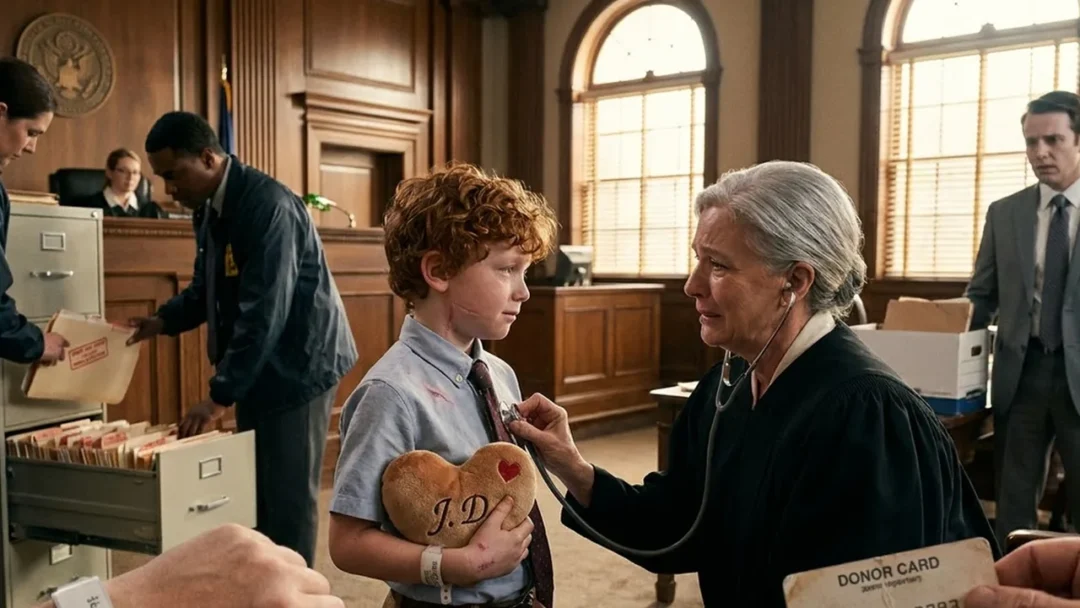
The Donor Heart And The Stethoscope In The Family Courtroom
CHAPTER 1: THE GAVEL ON THE MAHOGANY BENCH
The soaring mahogany-paneled walls of Courtroom 304 in the Cuyahoga County Juvenile Justice Center rose thirty feet toward a coffered plaster ceiling carved with the scales of justice. Through three towering, leaded-glass arched windows, the slate-gray waters of Lake Erie were visible under an early November sky, churned into whitecaps by a biting northern wind. Inside, the radiators along the wainscoting clanked with dry, steam-heated regularity, failing to dispel the clinical chill that permeated the room.
Sitting high behind the curved judicial bench was Judge Helena Marsh. At fifty-eight, she was the senior family division jurist in northeastern Ohio, a woman whose upright posture and calm, measured dignity had commanded respect from prosecutors and public defenders for twenty-two years. Her warm brown skin was framed by silver-streaked natural hair pinned into an immaculate low chignon, and over her black judicial robe she wore a single piece of personal jewelry: an antique oval silver mourning brooch set with a solitary freshwater pearl.
Before the bench, standing alone at the petitioner’s counsel table, stood a boy who looked no older than five, though the court docket listed his age as six years and four months. His name was Oliver. He was small, his frame delicate beneath an oversized, stiffly starched white school dress shirt and a navy clip-on tie that hung slightly crooked across his chest. His tousled, sandy-blond hair fell across a pale forehead dotted with faint autumn freckles, and his large, luminous blue eyes watched the court proceedings with a terrifying, unblinking stillness. Around his right wrist, visible where his cuff rode high, was a white plastic hospital identification bracelet, yellowed slightly at the edges by months of wear. In his small left hand, clutched so tightly that his knuckles were porcelain-white, he held a palm-sized plush red felt heart keychain, its surface worn fuzzy by constant nervous friction.
Beside him at the table stood Arthur Vance, the forty-four-year-old lead litigator for Midwest Guardian Services, the private, state-contracted foster management monopoly that controlled eight hundred wards of the court across three counties. Vance wore a tailored slate-gray Italian wool suit, rimless designer spectacles, and a silver agency lapel pin shaped like a shielding hand. His receding dark hair was clipped short, and his narrow, angular face carried the impatient, bureaucratic sneer of a man who viewed human misery through the prism of billable quarterly hours.
With deliberate theatricality, Vance lifted a thick, cardboard-bound file—its edges swollen with pediatric clinical charts, rejection letters, and state custody forms—and dropped it with a dull, heavy thud into an open cardboard storage crate stamped PERMANENT INSTITUTIONAL PLACEMENT.
“The state’s recommendation is clear, Your Honor,” Vance said, his nasal voice echoing sharply off the courtroom gallery’s empty oak pews. “Minor ward Oliver has spent forty-two months in temporary emergency receiving shelters following his abandonment as an infant. While his pediatric cardiac transplant three years ago was technically successful, the ongoing clinical maintenance—daily immunosuppressant therapies, quarterly endomyocardial biopsies, and potential chronic graft rejection—renders him an insurmountable medical liability. No prospective adoptive family in our registry is willing to assume this level of catastrophic financial and logistical risk. Midwest Guardian Services formally requests a final decree terminating all adoptive searches and remanding the ward to the Oakwood Long-Term Psychiatric and Medical Residential Center in Lima.”
Judge Marsh sat frozen, her hand resting on the turned walnut handle of her gavel. A cold, hollow ache throbbed in her temples. Oakwood was an understaffed, locked state facility sixty miles south, where children with severe physical disabilities and psychiatric trauma were warehoused until they aged out of the foster system into homelessness.
She leaned forward over the bench, her rectangular glasses catching the gray light from Lake Erie. “Mr. Vance, this child is six years old. You are asking this court to permanently foreclose his right to a family because his anti-rejection medication costs nine hundred dollars a month?”
“The agency cannot subsidize perpetual hope, Your Honor,” Vance replied smoothly, adjusting his cufflinks. “The law requires us to achieve permanency. In this case, institutional care is the only realistic permanent solution. We ask for the order.”
Helena lifted the gavel. The protocol was routine. Without a private petitioning sponsor or a licensed foster home willing to sign the medical waiver, the statutory framework gave her virtually no discretion. She closed her eyes, bracing herself to bring the walnut head down onto the sounding block.
From the petitioner’s table, a small voice broke the silence.
“Judge Marsh?”
The sound was tiny, high, and clear as a winter bell.
Arthur Vance snapped around, his rimless glasses flashing. “Bailiff, remove the child to the holding vestibule. Minor wards are not permitted to address the court without prior leave.”
Oliver did not look at Vance. He took three small steps forward, placing both of his small palms flat against the polished oak surface of the bar separating the counsel tables from the bench. He looked up at the elevated judicial seat, his large blue eyes locked onto Helena’s face.
“Judge Marsh,” Oliver said, his small chest heaving beneath his starched shirt. “You don’t have to send me to the locked house. I have your daughter’s heart.”
The heavy brass grandfather clock in the corner of the courtroom seemed to stop ticking.
A dead, suffocating hush fell over the room. The official court reporter’s fingers hovered motionless above her stenograph machine. Bailiff Hector Torres, a broad-shouldered forty-year-old sheriff’s deputy standing near the rear jury box, froze mid-stride, his hand resting on his leather duty belt.
Arthur Vance’s face turned an ugly, mottled crimson. He lunged across the counsel table, his fingers clawing for Oliver’s arm to drag the boy backward. “Sit down, you little lunatic! Your Honor, I apologize for this grotesque disruption! The child is clearly suffering from severe attachment-related delusional psychosis—”
“Nobody touches that child,” Helena whispered.
Her voice was barely above a breath, but it carried a lethal, freezing authority that made Arthur Vance yank his hand back as if he had touched an energized high-voltage line.
Helena stood up from the high-backed judicial chair, her black robes rustling in the breathless quiet. Her hands were shaking violently as she braced them against the mahogany rim of the bench, her gaze fixed entirely on the small boy standing beneath her.