The Donor Heart And The Stethoscope In The Family Courtroom
CHAPTER 2: THE INITIALS ON THE CRIMSON PLUSH
Judge Helena Marsh descended the three carpeted steps from the raised judicial bench with unhurried, trembling deliberate steps. In her twenty-two years on the Cuyahoga County bench, she had never stepped down from the dais during an active evidentiary hearing. Protocol, judicial decorum, and the canons of legal ethics strictly forbade physical contact between a presiding judge and a party to a custody dispute.
None of that mattered.
As Helena reached the floor of the well, she stopped three feet from Oliver. The boy did not flinch or retreat. He stood his ground on the polished parquet flooring, his small face tilted upward, watching her with a calm, gentle certainty that seemed impossible for a six-year-old child.
“Arthur,” Helena said, her eyes never leaving Oliver’s face. “Step away from the table. Move to the gallery.”
“Your Honor, with all due respect, this is an unprecedented breach of procedure,” Vance stammered, his smooth, corporate veneer cracking into shrill agitation. “If this hearing is being contaminated by outside medical rumors, Midwest Guardian Services must formally demand your immediate recusal—”
“Bailiff Torres,” Helena said quietly.
Deputy Hector Torres stepped between Vance and the counsel table, his imposing six-foot frame creating a solid wall of tan police wool and leather. “You heard the judge, Mr. Vance. Back of the room. Now.”
Vance swallowed hard, clutching his leather briefcase to his chest as he backed through the swinging oak gate into the first row of spectator pews.
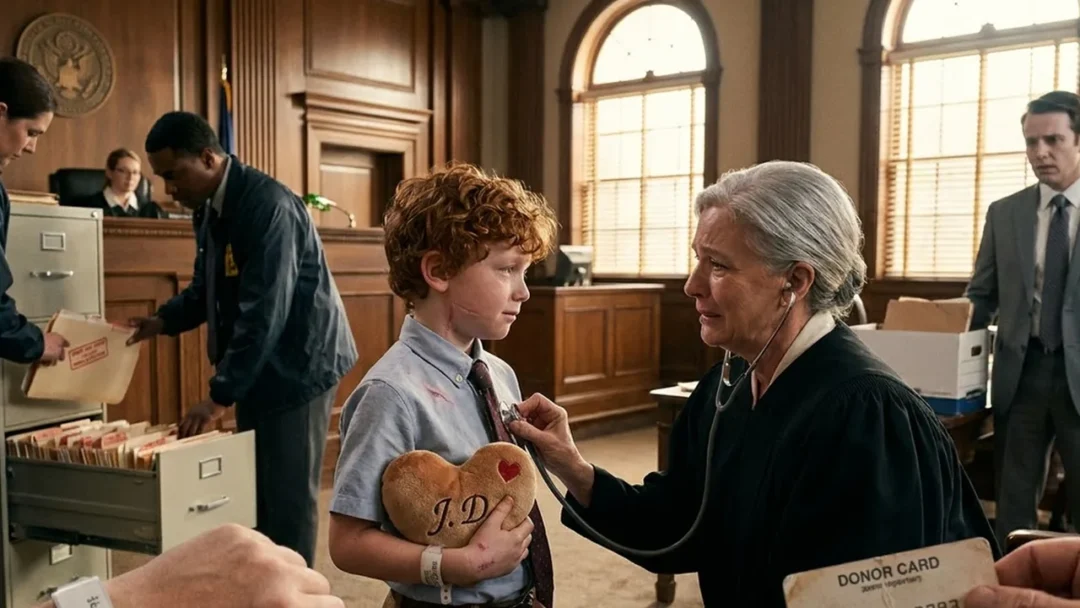
Helena knelt on the courtroom floor, the hem of her black silk judicial robe pooling across the parquet. Her eyes were level with Oliver’s.
“Oliver,” she said, her voice trembling with an emotion she had locked behind granite walls for thirty-six months. “Do you know whose photograph is inside this brooch?”
She reached up with trembling fingers, unpinning the oval silver mourning brooch from the left lapel of her robe. With a soft click, she opened the miniature hinged silver backing. Inside was a tiny, sepia-toned school portrait of an eight-year-old girl with bright hazel eyes, two puff braids, and a radiant, gap-toothed smile: Lucy Marsh, who had died in the pediatric intensive care unit of Rainbow Babies & Children’s Hospital three years ago following a catastrophic case of acute viral myocarditis.
Tucked behind the photograph was a worn, folded donor registry confirmation card printed by the United Network for Organ Sharing.
Oliver reached out with a small, gentle finger. He did not touch the photograph; instead, he touched the crimson felt plush heart keychain he had been clutching in his fist. He turned the toy over in his small palm.
Stitched into the lower curve of the felt heart, executed in uneven, yellow embroidery floss by a mother who had sat three days and nights beside a dying child’s ventilator, were two letters: L.M.
“Nurse Sarah gave this to me when they took the big breathing tube out,” Oliver whispered, his small eyes welling with clean, quiet tears. “She told me that a brave girl named Lucy had to go to sleep, but she gave me her heart so I could run in the grass. She told me to keep the little red heart in my pocket so I would never be scared of the doctors.”
Helena’s breath left her lungs in a sharp, ragged gasp. Her fingers shook so hard she nearly dropped the silver brooch. She had sewn that tiny plush heart at Lucy’s bedside while the monitors flatlined. When the organ recovery team arrived at midnight, Helena had placed that exact keychain into Lucy’s small cold hand, begging the nurses to let it travel with whatever part of her daughter could save another mother from this agony.
The hospital administration had promised her that donor protocols were completely blind. By state law and federal privacy regulations, donor families and pediatric recipients were strictly forbidden from knowing each other’s identities unless both parties filed mutual, uncoerced consent waivers after eighteen months. Helena had submitted three separate letters through Midwest Guardian Services—the custodial agency representing the anonymous recipient—begging for a single update on the child who had received Lucy’s heart.
Every single letter had been returned to her chambers, marked with a cold, administrative stamp: RECIPIENT FAMILY CONTACT DECLINED / WARD UNREACHABLE.
“Oliver,” Helena choked out, tears finally breaking past her glasses and tracing burning paths down her cheeks. “Show me your wrist.”
Oliver extended his right arm. He pulled back the frayed cotton cuff of his white school shirt, revealing the yellowed plastic hospital identification band secured around his thin wrist.
Stamped in permanent black thermal ink along the edge of the barcode was the national pediatric transplant serial number: TX-OH-884102.
Helena looked down at the worn donor registry card in her palm. Stamped in red ink across the bottom of Lucy’s anatomical gift certificate was the matching donor tracking sequence: DONOR PROTOCOL: TX-OH-884102.
Digit for digit.
A quiet sob tore from Helena’s throat. She reached forward, her hands gently touching Oliver’s small shoulders. “It’s you. It was you the whole time.”
Oliver reached up with both hands, unbuttoning the top two buttons of his stiff white shirt and pulling his navy clip-on tie to the side. Right down the center of his small, pale sternum was a neat, six-inch vertical surgical scar, healed into a faint, pale pink line that pulsed with a steady, rhythmic, vital beat.
“She’s right here, Judge Marsh,” Oliver whispered, taking Helena’s shaking hand and pressing her palm flat against his chest, directly over the scar. “Hear her? She’s beating real strong.”
Beneath Helena’s palm, through the thin cotton of the boy’s undershirt, came the unmistakable, powerful thud of a living human heart: lub-dub… lub-dub… lub-dub.
It was Lucy’s heart. The heart she had cradled against her chest in the delivery room eight years ago, beating with defiant, triumphant life inside the fragile chest of an orphan child.