The Room That Went Quiet
Part I — The Marble Floor
Michael Ward knew something was wrong before the doors finished opening.
The house was too quiet.
Two hours before the Ward Foundation gala, the estate should have been alive with controlled chaos—florists rushing through the east hall, servers carrying trays, Patricia correcting centerpieces by half an inch, Jessica somewhere near the staircase looking flawless enough to make everyone else feel unfinished.
Instead, the first sound Michael heard was a sponge dragging across marble.
Slow.
Wet.
Small.
He stepped through the black front doors with his suit jacket still buttoned from the airport and stopped beneath the chandelier.
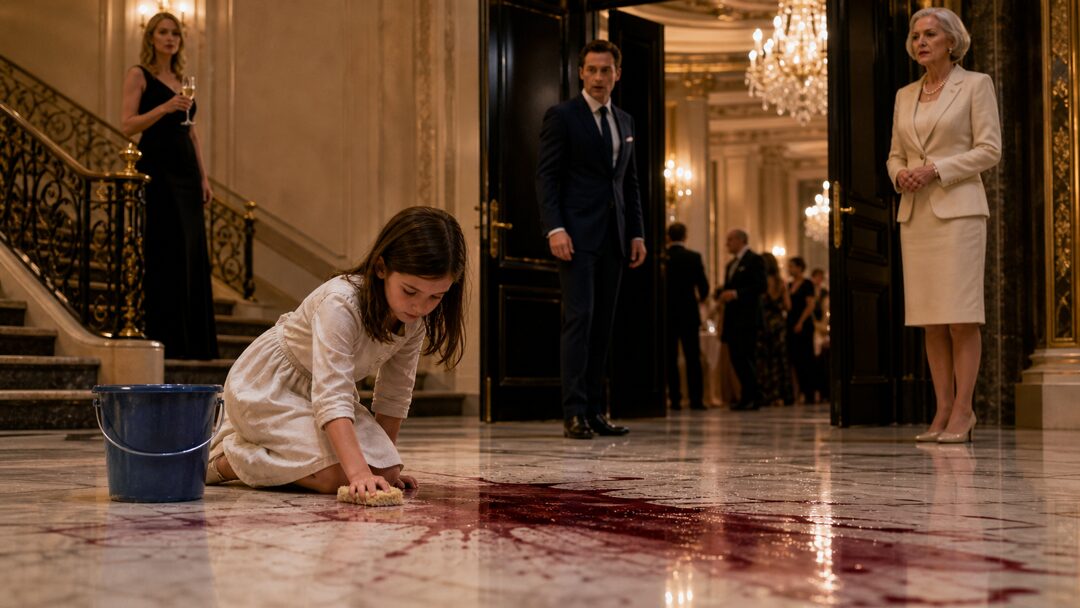
His daughter was on her knees in the middle of the foyer.
Emily wore a plain white dress he had never seen before. It was too thin for December and too simple for tonight. The sleeves were wet to her elbows. A blue bucket sat beside her, the water inside tinted pale pink. Red wine spread across the white marble in a long, uneven smear.
Emily bent over it with a sponge in her hand.
She was ten years old.
For one suspended second, Michael could not make the image arrange itself into meaning.
His daughter. The marble. The bucket. The wine.
Then he saw Jessica.
She stood halfway up the grand staircase in a black evening dress, one hand resting lightly on the banister, the other holding a champagne flute. Her blonde hair was smooth. Her lipstick was perfect. She looked ready for photographs.
Emily did not look up.
“Emily,” Michael said.
The sponge stopped.
His daughter’s shoulders tightened before she raised her face. She looked at him the way people looked at weather they had not expected—carefully, as if one wrong expression could make it worse.
“Daddy,” she said.
It came out flat.
Not guilty. Not relieved.
Trained.
Michael’s briefcase slipped from his hand and hit the floor.
“What happened?”
Jessica descended three steps, slow enough to make it clear she was not alarmed.
“She made a scene,” she said.
Michael looked from Jessica to Emily.
Emily looked back down at the wine.
“What scene?”
Jessica sighed with the soft patience of someone speaking about a problem already explained too many times.
“She knocked over a wine tray. In the foyer. Right before guests arrive.” She lifted her glass and gave a small, controlled smile. “I thought it was important she understand that actions have consequences.”
Michael took two steps forward.
Emily’s hands were red from the cold water.
“You made her clean it?”
Jessica’s smile tightened.
“I asked her to take responsibility.”
The house moved behind them. A florist appeared at the far end of the corridor carrying white roses, slowed when she saw the scene, then hurried away. A server in a black vest paused near the dining room and pretended not to.
Emily pressed the sponge back to the floor.
Michael’s gaze dropped to her wrist.
Bare.
He knew that wrist the way fathers know the small things they do not realize they know. Emily always wore a thin silver bracelet there. Always. She wore it with pajamas, school uniforms, swimsuits, even when it caught on her sweaters and annoyed her.
It had belonged to Sarah.
No. Not belonged. Sarah had made it for Emily.
“Where’s your bracelet?” Michael asked.
Emily froze.
Jessica took another sip of champagne.
“She was careless with that too.”
Michael looked up.
Jessica held his gaze.
“It’s safe,” she said. “Somewhere she’ll remember not to treat it like a toy.”
Emily’s chin lowered until her hair hid her face.
That was when Michael felt something open beneath his ribs. Not anger yet. Something worse. Recognition arriving late.
“Stand up, Emily.”
His daughter did not move.
“Emily,” he said more gently. “Stand up.”
She glanced toward the staircase.
Not at him.
At Jessica.
It was quick. Barely anything. A flick of the eyes.
But it landed harder than the briefcase had.
Jessica saw it too. Her expression did not change, but her fingers tightened around the stem of the glass.
“Michael,” she said, softer now. “The first guests are walking in within minutes. Please don’t make this into something ugly.”
He stared at her.
Something ugly was already on the floor.
Part II — What Her Name Required
Patricia Ward entered from the ballroom with a headset clipped discreetly behind one pearl earring.
She wore cream silk and the expression she used when people forgot they were part of a legacy. Behind her, the ballroom glittered with candlelight, white orchids, and the low murmur of staff testing microphones.
Her eyes went first to the wine.
Then to Emily.
Then to Michael.
Not concern. Calculation.
“Michael,” Patricia said. “You’re early.”
“I found my daughter cleaning the floor.”
Patricia looked toward a housekeeper near the archway.
“Move this before the photographers arrive.”
Michael turned.
“This?”
Patricia’s mouth barely moved.
“The situation.”
Emily pushed herself up slowly. Her knees were damp. The front of the white dress clung where water had splashed it. She held the sponge in both hands as if she did not know where to put it now that she had been told to stop.
A couple entered from the side gallery, donors Michael recognized but could not name in that moment. They saw Emily, saw the bucket, saw the wine, and performed the quick mercy of looking elsewhere.
Emily saw them see.
Her face did not crumple. That would have been easier.
She simply went still.
Patricia stepped closer to Michael and lowered her voice.
“Your daughter has had a difficult afternoon. Jessica handled it.”
“Jessica handled it by making her scrub wine off the floor?”
“She has to learn composure,” Patricia said. “Tonight is not only a party. It is the foundation’s most visible event of the year.”
Emily’s fingers tightened around the sponge.
Michael heard it then, the old Ward logic. It had raised him. It had dressed grief in black tie and taught children to cry behind locked doors. It had praised silence as discipline and called distance strength.
He hated that he understood it.
Jessica came down the last steps and touched his arm.
The gesture was intimate enough to be a claim.
“Michael,” she said, “you’ve been traveling all week. You walked in at the worst possible second and saw only the end of it.”
He wanted to pull away.
He also wanted, with a weakness that shamed him, to believe her.
For months, Jessica had been the person who made the house feel managed. She chose flowers Sarah would never have chosen. She changed the breakfast room curtains. She smiled through Patricia’s inspections. She touched Michael’s wrist when grief made him lose his words at dinner.
She had made herself useful in all the places he had abandoned.
And Emily had grown quieter.
He had told himself children adjusted slowly.
“Emily,” Michael said, keeping his voice low. “Come with me.”
Jessica’s hand slid from his sleeve.
“Michael—”
“Now.”
Emily placed the sponge in the bucket so carefully it did not splash.
That care made him want to break something.
He led her into the narrow hallway behind the library, away from the guests and flowers and Patricia’s perfect timing. The noise of preparation dulled behind the paneled walls.
Emily stood with her back to a portrait of Michael’s grandfather and stared at her wet shoes.
“Tell me what happened,” he said.
“I spilled it.”
“How?”
“I bumped the tray.”
“Why were you in the foyer?”
She rubbed one wet sleeve with the opposite hand.
“I don’t remember.”
“Emily.”
Her eyes flashed up, then away.
“I spilled it,” she repeated. “I’m sorry.”
It was not an answer.
It was a line.
Michael crouched in front of her. “You’re not in trouble with me.”
That should have helped.
It didn’t.
Emily looked past him toward the library doors.
A second later, Jessica entered without knocking.
“There you are,” she said, with a smile too smooth for the hallway. “Sweetheart, you need to go upstairs and change. Guests are arriving.”
Michael stood.
“I was speaking to her.”
Jessica moved beside him. Her perfume was warm and expensive.
“She’s embarrassed. Pushing her won’t help.”
“Then let her answer.”
Jessica’s eyes flicked to Emily.
Emily looked down again.
Michael saw it now, and once seen, it could not be unseen: the whole room shifted around Jessica’s gaze.
“Children test boundaries,” Jessica said. “Especially children who know their fathers feel guilty.”
Michael’s jaw tightened.
“Don’t.”
Her voice softened. “I’m not attacking you.”
“You just used Sarah to explain why my daughter is scared.”
Jessica’s face changed at Sarah’s name. Not much. Enough.
“No,” she said. “I’m saying you can’t keep letting the past run this house.”
Emily flinched.
Michael saw that too.
Jessica touched his chest with two fingers, a quiet claim no guest would notice. “I love you. I have tried so hard to make this work. But you cannot let a child decide whether we have a future.”
There it was.
Not shouted. Not cruel in shape.
Worse.
Reasonable.
Michael looked at Emily. “Go upstairs. I’ll come find you.”
Emily nodded at once, grateful for an instruction she could obey. She slipped past them with her wet sleeves held away from her sides.
Jessica watched her go.
“She needs consistency,” Jessica said.
Michael did not answer.
His phone vibrated in his pocket.
Unknown number.
A message.
No words.
Just a video.
Part III — The Missing Bracelet
At first, the image on Michael’s phone made no sense because he did not want it to.
The security feed showed the foyer from above, timestamped ninety minutes earlier.
Emily stood near the bottom of the staircase in her pale-blue party dress—the one Michael had sent from London because the color matched the bracelet. Her hair was half-pinned. She was crying already, silently, with her hands clenched at her sides.
Jessica stood in front of her.
There was no wine on the floor.
No tray.
No accident.
Michael felt Jessica step closer to see the screen. He turned slightly so she couldn’t.
On the video, Jessica reached for Emily’s wrist.
Emily pulled back.
Jessica said something the camera did not record.
Then she took the bracelet.
Even through the grainy footage, Michael saw Emily’s mouth open.
Not in a scream.
In a plea.
Jessica dropped the bracelet into the blue bucket.
Then she lifted a bottle from the side table, tilted it slowly, and poured red wine across the marble.
Michael stopped breathing.
The clip ended with Jessica placing the empty glass on a tray and pointing toward the floor.
Emily sank to her knees.
The message had no name attached.
Only the video.
Michael stared at the black screen after it ended, seeing nothing and every missed thing at once.
The nights he came home after Emily was asleep.
The mornings Jessica said Emily had already eaten.
The school event Patricia said Emily was too emotional to attend.
The bracelet missing from photographs.
The way Emily had stopped running to him at the door.
Jessica’s voice came from very far away.
“Who sent that?”
Michael looked up.
She was pale beneath her makeup, but not ashamed. Not yet.
Afraid.
“That’s your first question?”
Jessica swallowed. “It’s out of context.”
“It shows you taking my daughter’s bracelet.”
“She was being impossible.”
“It shows you pouring the wine.”
“She needed to understand—”
“Understand what?”
Jessica looked toward the hallway, where voices rose and fell as guests arrived. When she spoke again, her tone had sharpened into something private and raw.
“That this house does not belong to her grief.”
Michael stared at her.
Jessica’s eyes shone, but no tears fell.
“You think I don’t know what everyone sees when they look at me?” she whispered. “The replacement. The woman wearing Sarah’s rooms. The woman trying too hard at the table where your daughter leaves one empty chair for her mother.”
“That is not Emily’s fault.”
“She makes it mine.”
“She is ten.”
“She knows exactly where to press.” Jessica’s voice broke, then hardened to cover it. “At the engagement dinner, she told Mrs. Calloway I wasn’t family. In front of everyone.”
“She was hurt.”
“She wanted me humiliated.”
Michael stepped back as if she had touched something burning.
Jessica saw the movement and reached for him.
He did not let her.
Her face changed again. More frightened now. More desperate.
“Patricia told me the board was concerned,” she said. “That if I couldn’t bring stability to the house before the wedding, they would postpone the foundation transfer. She said donors don’t trust families that look unstable.”
Michael’s blood went cold.
“My mother told you to discipline Emily?”
“She told me to stop treating her like glass.”
“And you thought that meant this?”
Jessica’s mouth trembled. “I thought it meant I had to prove I belonged here.”
For one second, he saw the thing beneath her cruelty: a woman terrified of being temporary, fighting for a chair at a table that measured love by usefulness.
Then he thought of Emily kneeling on marble.
Compassion did not erase the stain.
“Where is the bracelet?”
Jessica looked away.
“Jessica.”
“In the bucket,” she said.
The words were small.
Michael left her in the hallway.
He found Patricia in the library, standing beside the fireplace with a donor list in one hand and a tablet in the other. She looked up, annoyed at first, then cautious when she saw his face.
“We need to talk.”
“Not now.”
“Yes,” Michael said. “Now.”
Patricia set down the tablet. “If this is about Emily, Jessica has already told me—”
“You knew?”
Patricia’s silence answered too quickly.
Michael stepped into the room and closed the door.
“You knew she was punishing Emily?”
“I knew Jessica was trying to create order.”
“Order.”
“Your daughter cried during the memorial luncheon last spring in front of half the board,” Patricia said. “She refused to attend the campaign photos. She disappears at dinners. She makes guests uncomfortable.”
“She misses her mother.”
“We all miss Sarah.”
“No,” Michael said. “We perform missing Sarah. Emily actually does it.”
Patricia’s face tightened.
Outside the library, someone laughed in the ballroom.
Inside, the air turned old.
Patricia lowered her voice. “You have spent two years grieving by leaving. Meetings. Flights. Acquisitions. I have been here.”
Michael flinched because it was true.
Patricia saw it and pressed.
“This family cannot be run around a child’s moods. Emily carries the Ward name. She must learn what that requires.”
Something in Michael went still.
There were sentences that revealed a person completely.
That was one.
“What it requires,” he said, “is being made to clean floors in front of strangers?”
Patricia looked away first.
Not long. But enough.
“She should never have been visible,” Patricia said.
Michael almost laughed.
That was the confession.
Not that it was wrong.
That people had seen it.
Then Patricia’s gaze fell to his phone. “What do you have?”
“Enough.”
Her composure cracked at the edges.
“Michael. Think carefully.”
“I am.”
“The foundation cannot survive a public family spectacle.”
“My daughter may not survive many more private ones.”
Patricia stiffened.
“That is an excessive thing to say.”
“No,” Michael said. “It’s a late thing to say.”
For the first time all night, Patricia looked older than her pearls.
He turned to leave.
“Michael.”
He stopped.
Patricia’s voice changed. Softer. Almost reluctant.
“That bracelet,” she said. “Sarah had it made because of me.”
Michael did not turn around.
“What?”
“When Emily was born, I told Sarah the timing was unfortunate. Your father had just died. The company was unstable. I said perhaps you and Sarah should have waited.”
Michael’s hand closed around the doorknob.
“She never forgave me for it,” Patricia said. “A week later, she showed me that bracelet. The engraving.”
Michael remembered Sarah laughing in the nursery, holding a tiny silver loop under the morning light.
He had forgotten the exact words.
Patricia had not.
“She wanted everyone to know,” Patricia said quietly, “that Emily was not an inconvenience.”
Michael opened the door.
The hallway was full of music now.
Part IV — The Gala Smile
The gala had begun without him.
The ballroom glowed gold and white, every surface polished, every face arranged. Glasses chimed. Donors smiled at paintings. The string quartet played near the windows as if nothing in the house had shifted.
Jessica stood near the center of the room.
She was laughing with a trustee.
A perfect laugh.
Michael watched her from the doorway and felt the strange ache of knowing he had loved something real inside something ruinous. Jessica had made coffee for him at midnight. She had sat with him through a board crisis. She knew when his migraines started behind his right eye and when not to mention Sarah.
And she had taken Emily’s bracelet off her wrist.
Both things were true.
That was the part that made it hard to breathe.
Patricia appeared beside him.
“Delay this,” she said. “After the speeches, we can handle it privately.”
“Privately is how we got here.”
Her eyes flashed.
“You are about to punish the entire family for one poorly handled afternoon.”
Michael looked at her.
“One?”
Patricia said nothing.
He moved past her before she could answer.
But he did not go to the ballroom.
He went down the service corridor.
The estate changed quickly behind the public rooms. Gold light became fluorescent. Music became muffled. The air smelled of starch, lemon cleaner, and hot trays waiting to be carried out.
He found Emily sitting on a low bench outside the laundry room.
She had changed into a gray cardigan over the white dress. Her hair had slipped loose on one side. She was pressing paper towels against her sleeves, trying to dry them before anyone noticed.
When she saw him, she stood so fast the towels fell.
“I’m sorry,” she said.
Michael stopped ten feet away.
For a moment, he could not cross the distance.
Not because he didn’t want to.
Because he suddenly understood she thought he had come to hear another apology.
“Emily.”
“I didn’t mean to make everyone mad.”
The sentence went through him cleanly.
He crouched in front of her, not touching yet.
“Who told you that?”
She looked down.
“Emily.”
Her voice was barely there. “I shouldn’t have said anything at dinner last time.”
“What did you say?”
“That Jessica wasn’t my mom.”
Michael closed his eyes.
When he opened them, Emily was watching him with terror in her careful face.
“She isn’t,” he said.
Emily blinked.
“She’s not your mother,” Michael said. “And you don’t have to pretend she is to make adults comfortable.”
Emily’s mouth moved, but no sound came.
He held out his hand, palm up.
“Where is your bracelet?”
Her eyes filled fast.
Not dramatically. Silently.
“The bucket.”
“I know. I’m going to get it.”
“She said…” Emily swallowed. “She said girls who embarrass their fathers don’t get to wear family things.”
Michael felt the sentence land in him and stay.
Girls who embarrass their fathers.
Family things.
He thought of Sarah fastening the bracelet around a newborn wrist too small to hold it. Sarah had said, “When she’s big enough, she’ll know she was wanted before she understood wanting.”
Michael had kissed Sarah’s forehead and promised, easily, that Emily would never doubt it.
Promises were cheap when no one had tested them yet.
“Listen to me,” he said.
Emily stared at his tie, not his face.
“You do not have to earn being my daughter.”
The first tear slipped down her cheek.
Michael did not wipe it away. He was suddenly afraid of doing anything too quickly, of making comfort another adult act she had to accept.
“I’m going to ask you to do something hard,” he said. “You can say no.”
That made her look at him.
“In a few minutes, I’m going to ask you to stand beside me in the ballroom.”
Her face drained.
“No.”
“Okay.”
She looked startled.
He nodded once. “Okay. You can say no.”
The words seemed to confuse her more than the request.
He stood and went back toward the foyer.
The bucket had been moved behind a floral screen near the side entrance, hidden but not emptied. Michael looked into the pink-gray water and saw the bracelet at the bottom, silver dulled by soap and wine.
He reached in.
The water was cold.
The bracelet slid against his fingers.
When he lifted it out, the tiny plate caught the light.
Emily Ward — always chosen.
For a few seconds he stood alone behind the flowers, holding the proof of everything he had failed to protect.
His phone buzzed again.
Another message from the unknown number.
This time, two words.
Tell her.
Michael looked toward the staff corridor, then the ballroom, then the bracelet in his palm.
He picked up the blue bucket.
Part V — The Room That Went Quiet
Patricia was at the microphone when Michael entered the ballroom.
“Tonight,” she was saying, “we celebrate legacy, responsibility, and the values that bind a family to its community—”
The room noticed the bucket before it noticed him.
Conversations thinned.
A server stopped near the champagne tower. Jessica turned from the trustee she had been charming. Patricia’s words faltered.
Michael walked through the center of the ballroom with the blue bucket in one hand and the bracelet in the other.
No one moved.
The quartet stopped one instrument at a time.
Patricia lowered the microphone.
“Michael,” she said, smiling without warmth. “This is not the time.”
He placed the bucket on the polished ballroom floor.
The sound was small.
Everyone heard it.
Jessica gave a light laugh and stepped forward. “Darling, I think you’ve brought the wrong centerpiece.”
A few guests smiled because she had told them to.
Michael did not look at her.
He looked toward the service corridor.
Emily stood half-hidden behind the doorway, her gray cardigan too big at the shoulders, her hair falling loose around her face.
He had told her she could say no.
She had come anyway.
Michael held out his hand.
Not demanding.
Waiting.
The room followed his gaze.
Emily saw them see her again.
This time, she did not kneel.
She walked to him.
Slowly.
Each step seemed to cost her.
When she reached him, she stood close enough that her sleeve brushed his suit.
Michael wanted to put his arm around her. He did not. Not yet. This had to be her standing, not him holding her upright.
Patricia spoke through her teeth.
“Michael. Stop this.”
He looked at his mother.
“No.”
The word changed the room.
Jessica’s smile thinned.
“Emily had a difficult afternoon,” she said, addressing the guests now. “Michael is upset. We should give the child privacy.”
“The child had privacy,” Michael said. “That was the problem.”
A murmur moved through the ballroom.
Patricia gripped the microphone.
Michael reached into the bucket and took out the sponge.
Emily made a tiny sound beside him.
He knelt.
In his navy suit, beneath the chandeliers, in front of donors and trustees and relatives who knew the value of every painting on the wall but not the cost of a child’s silence, Michael Ward knelt on the ballroom floor.
He dipped the sponge into the bucket.
Then he began to wipe the clean marble.
No stain remained there.
That was the point.
Jessica’s face went white.
“Michael,” she whispered.
He did not raise his voice.
“My daughter will never again be asked to earn her place in her own home.”
No one breathed loudly.
He stood, water darkening one knee of his trousers, and took out his phone.
“I came home tonight and found Emily cleaning a spill she did not make.”
Jessica stepped toward him.
“Don’t.”
He looked at her then.
There was pain in his face. Real pain. The kind that made the room uglier because it was not simple.
“I would have married you,” he said.
Jessica froze.
“I know,” she said.
Her voice was almost nothing.
“And you still did this.”
Her eyes filled, but she lifted her chin.
“She was turning you against me.”
“No,” Michael said. “You asked me to choose by making her smaller.”
Then he played the video.
Only fifteen seconds.
Jessica taking the bracelet.
Emily pulling back.
The bracelet dropping into the bucket.
The wine spilling by Jessica’s hand.
Emily sinking to her knees.
It was enough.
A woman near the front covered her mouth. One of the trustees looked at Patricia, then away. The housekeeper in the doorway stared at the floor.
Jessica stood perfectly still.
All her beauty remained.
None of it helped.
Patricia did not move either, but Michael saw the color leave her face when the video ended. She understood before anyone accused her. She understood that silence could be evidence too.
Jessica looked at Emily.
For the first time all night, she did not look powerful.
She looked like someone who had built a home inside another person’s weakness and just heard the walls crack.
“I loved your father,” Jessica said.
Emily did not answer.
Jessica looked at Michael. “I did.”
Michael nodded once.
“I know.”
That hurt her more than denial would have.
“You let her keep Sarah between us,” Jessica said.
Michael’s voice stayed quiet. “Sarah was never between us. Emily was beside me. You just wanted that place empty.”
Jessica’s mouth trembled.
Patricia stepped forward then, trying to reclaim the air.
“Our family owes everyone an apology for this private matter becoming—”
Michael turned on her.
“No.”
The second no was colder.
Patricia stopped.
“This family owes Emily an apology,” he said. “Not for what became public. For what stayed private.”
The room held itself still.
Michael took the bracelet from his palm. It was still wet.
He did not fasten it yet. Not here. Not as performance.
He simply closed Emily’s fingers around it.
“This is yours,” he said.
Emily looked at the silver in her hand.
Her lips pressed together.
For one impossible second, Michael thought she might cry in front of all of them.
Instead, she stepped closer and leaned her shoulder against his side.
That was all.
It was more than he deserved.
The gala did not resume.
It dissolved.
People spoke softly. Coats appeared. Cars were called. A thousand polite exits carried the story into the night, but Michael no longer cared who repeated it.
Jessica left before the last donors did.
She paused at the front doors with a wrap over her shoulders, no champagne, no smile.
Michael stood several feet away from her.
There was enough distance between them for the life they almost had.
“You’ll make me the monster,” she said.
“No,” he said. “You made choices. That’s different.”
She swallowed.
“You don’t know what it’s like to fight for a place in a family that only tolerates you.”
Michael looked toward the staircase, where Emily had disappeared with a housekeeper he trusted.
“I know what it looks like when someone else pays for that fight.”
Jessica flinched.
For a moment, he thought she would say something cruel to survive the shame.
Instead, she whispered, “I wanted you to choose me.”
“I did,” Michael said. “Too often.”
She left then.
The black doors closed behind her.
Part VI — Always Chosen
After midnight, the mansion looked almost innocent.
The flowers were still perfect. The candles had burned low. The marble foyer shone as if nothing had ever happened there.
That was the thing Michael hated most about marble.
It kept no memory unless someone did.
Patricia waited in the library, still in her cream silk, pearls still at her throat. She looked less like a matriarch now and more like a woman sitting inside the ruins of her own standards.
“You have damaged the foundation,” she said.
Michael was too tired to be surprised.
“No,” he said. “I revealed the house.”
Her mouth tightened.
“You think one dramatic gesture makes you a good father?”
The words found their mark because they were close enough to true.
Michael nodded slowly.
“No.”
Patricia looked up.
“It makes me late,” he said.
Something moved across her face then. Not surrender. Not apology. Something smaller and more uncomfortable.
Truth making itself unwelcome.
“I thought I was protecting us,” she said.
“You were protecting a picture of us.”
“For most families, that picture is survival.”
“Emily is not a smudge on the glass.”
Patricia looked away.
He waited. Some old part of him still wanted his mother to become softer because he needed it. Some old part of him still wanted permission.
He let that part go hungry.
“You can be Emily’s grandmother,” he said. “But not like this. Not if love means managing her into silence.”
Patricia’s eyes shone, and for a second he saw the woman beneath the pearls—frightened of disorder, frightened of grief, frightened that if one person broke down, the whole family would follow.
But fear had ruled the house long enough.
“I don’t know how to do it differently,” she said.
“Then learn before you come near her.”
He left her there.
In the kitchen, he washed the bracelet himself.
Soap. Warm water. A soft cloth.
The silver brightened slowly under his fingers. The engraved words appeared first in fragments, then whole.
Emily Ward — always chosen.
He stood at the sink longer than he needed to.
When he returned to the small sitting room off the foyer, Emily was curled on the sofa under a cashmere throw, still awake. Someone had brought her cocoa she hadn’t touched.
She watched him approach.
Not afraid exactly.
Careful.
He sat on the floor beside the sofa instead of on the cushion above her.
“I cleaned it,” he said.
She held out her wrist.
The trust in the gesture nearly undid him.
He fastened the bracelet carefully, though his hands were not steady. The clasp was tiny. Sarah used to laugh at him for struggling with it.
When it clicked into place, Emily turned her wrist under the lamplight.
For a while, neither of them spoke.
Then she asked, “Why didn’t you come home earlier?”
No accusation.
That made it worse.
Michael looked at his daughter’s face, at the little line between her brows, at the eyes too practiced in waiting for adult answers that made adult failures sound reasonable.
He could have told her about flights, meetings, grief, the way silence had become easier than rooms where Sarah was missing.
He could have told her he thought she was safe.
But excuses were another kind of polished floor.
“I should have,” he said.
Emily’s fingers moved over the bracelet.
“Did Mom really write it?”
“She chose the words.”
“Always chosen?”
He nodded.
Emily looked toward the foyer.
The bucket was gone now. The wine was gone. The guests were gone. Jessica was gone.
But Michael understood, sitting there in his stained suit, that gone was not the same as healed.
Emily tucked her wrist beneath her cheek.
“Are you going away again?”
“No.”
“Not tomorrow?”
“No.”
She studied him, deciding how much of that answer could be trusted.
Then she closed her eyes.
Michael stayed on the floor beside her until her breathing changed. He did not touch the bracelet again. He did not wake her to promise more. He had promised enough in his life.
The house settled around them, grand and quiet and finally unable to pretend it was untouched.
On the sofa, Emily slept with the silver words visible against her skin.
Michael sat beside her in the same suit he had knelt in, one knee still marked by water from the bucket, and watched the dark windows until morning began to lighten the glass.