The Farm Board Shut Down His Grandson’s Cider Stand—Then Samuel Found the Approval They Had Forgotten
Chapter 1: The Cider Stand at the Orchard Gate
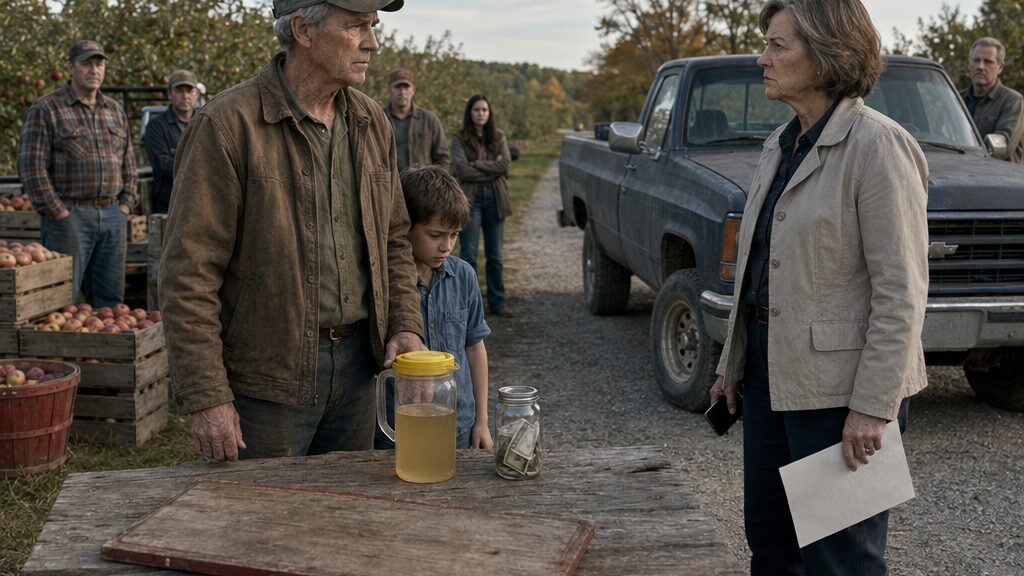
Patricia Clark’s truck stopped sideways across the orchard lane just as Brian lifted the yellow lid from the cider pitcher.
A customer’s pickup idled behind her, its turn signal blinking uselessly. Another car slowed on the county road. Brian stood behind the narrow table Samuel had built from packing-shed scraps, one hand around a paper cup and the other hovering over the pitcher.
Patricia got out without closing her door.
“You need to shut this down immediately.”
The words carried farther than they needed to. A neighboring farmer loading apples into his station wagon looked over. The feed-store owner, who had stopped for a half bushel, lowered his wallet.
Brian glanced toward Samuel.
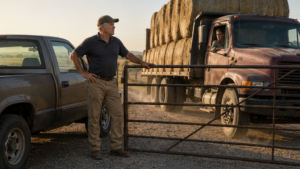
Samuel had been fifty yards up the lane, trimming a broken branch from a young Winesap tree. He folded his pruning knife, slid it into his pocket, and walked toward the gate without hurrying.
Patricia raised her phone and photographed the table.
The stand was simple: a board across two crates, six apples lined along the front, a clear pitcher of pale cider with a yellow lid, and a glass jar marked in Brian’s careful block letters:
USED BICYCLE FUND.
“This is a commercial roadside operation,” Patricia said. “No vendor registration. No inspection notice. No association approval.”
“It’s cider,” Brian said. “From our apples.”
“That doesn’t make it exempt.”
Samuel reached the table. The pitcher had begun to slide because one crate stood unevenly in the gravel. He caught it before it fell, but cider sloshed over the rim and ran across Brian’s sign.
“Step behind me,” Samuel told him.
Brian obeyed, though his shoulders stiffened.
Patricia kept her phone raised. “You know the rules, Samuel.”
“I know some rules.”
“You helped enforce them.”
The neighboring farmer looked away at that. Samuel felt the old pressure settle beneath his ribs—not fear exactly, but the familiar demand to keep a disagreement from becoming a spectacle.
A second customer leaned from her car. “Can we get through?”
Patricia pointed toward the road without looking back. “You’ll need to turn around until this unauthorized stand is cleared.”
The customer stared at the little table, then at Brian.
Samuel lifted the wet sign from the front and laid it flat.
“Granddad,” Brian said quietly.
“We’ll put it away for now.”
Patricia lowered her phone at last. “For now isn’t sufficient. I need confirmation that this was an unapproved commercial sale and that you’ll comply with the market rule.”
She took a tablet from her truck and opened a form. Her finger moved over the screen before she held it toward Samuel.
At the top, in bold letters, was an admission of deliberate violation.
Samuel read enough to understand what she wanted.
“I won’t sign that.”
“You’re refusing compliance?”
“I’m refusing your wording.”
Her jaw tightened. “Brian sold a processed farm product beside a public road.”
“He sold four cups.”
“Volume doesn’t erase the rule.”
Brian stepped sideways, no longer entirely behind Samuel. “I wasn’t trying to hurt the harvest fair.”
Patricia looked at him as if the interruption itself proved her point. “That isn’t the issue.”
“I’m saving for a bicycle.”
The feed-store owner shifted his weight. Patricia’s expression did not change.
Brian swallowed. “The county extension has summer classes. Soil testing and grafting. The bus doesn’t go out there, and Mom works mornings.”
Samuel turned toward him.
Brian had said he wanted a bicycle, but not why. Samuel had assumed it was the blue used mountain bike hanging outside the repair shop in town, another twelve-year-old’s wish that could wait until apple season improved.
“How far?” Samuel asked.
“Six miles from the school.”
“You could’ve told me.”
Brian stared at the wet cardboard sign. “You already drive me everywhere.”
The sentence landed harder than Patricia’s accusation.
Patricia tapped the tablet. “This is exactly why rules cannot depend on personal stories. Everyone has a reason.”
Samuel looked at the pitcher, at the four used cups in a paper bag beneath the table, and at the customers who had stopped expecting cider and now stood watching a child lose an argument he had not known was larger than him.
“Move your truck,” Samuel said.
“Sign first.”
“No.”
“If I file this as refusal, the association may review your farm-market permit.”
The orchard’s roadside permit covered apples, pears, preserves, and the late-season cider Samuel sold from the packing shed. Losing it would mean hauling every crate to the wholesale depot at a lower price.
Patricia knew that.
He met her eyes. “File what happened. Not what you hoped I’d admit.”
For a moment, neither moved.
Then Patricia pressed the screen several times.
“There,” she said. “Submitted.”
Brian flinched as though the sound had been louder than a finger against glass.
Patricia returned the tablet to her truck. “The stand stays closed until review.”
Samuel folded the damp bicycle sign once, then again. “Help me carry the table.”
Brian took one end without answering.
Patricia finally moved her truck. The waiting vehicles passed slowly, their drivers careful not to stare too openly. The feed-store owner placed a five-dollar bill on the table before leaving.
Patricia saw it.
“No sale took place,” Samuel said.
The man picked the bill back up, embarrassed.
Samuel and Brian carried the table toward the packing shed. Halfway there, cider began dripping from the edge onto Brian’s boots.
“I could’ve argued,” Samuel said.
Brian kept walking. “You didn’t.”
“I kept her from getting an admission she could use.”
“She still shut it down.”
“That form mattered.”
Brian looked toward the orchard rows instead of at him. “The stand mattered too.”
By afternoon, the table was stacked against the packing-shed wall. The pitcher sat empty beside the sink. Samuel worked until his hands smelled of cut wood and apple sap, but Brian did not come back outside.
Near dusk, a county vehicle turned into the lane.
The code officer did not stay long. He handed Samuel an envelope through the open truck window and said the notice had been requested by the farm-market association.
Samuel opened it beneath the shed light.
Effective immediately, all roadside sales from Baker Orchard were suspended pending review.
Chapter 2: The Rule Samuel Helped Write
Brian was scrubbing the cider stain from the stand when Samuel entered the packing shed Saturday evening.
The boy had dragged the table beneath the utility light and was working at the warped board with a stiff brush. Each pass spread the dark stain farther into the grain.
“You’ll take the paint off,” Samuel said.
Brian kept scrubbing.
“The table can be sanded.”
“So can the sign?”
Samuel saw the folded cardboard beside the sink. The marker had bled until USED BICYCLE FUND looked like a row of bruises.
He reached for the brush. Brian pulled it back.
“I can finish.”
Samuel let his hand fall.
On the counter behind them, the clear pitcher stood empty. Dried cider had formed an amber crust around its rim. The yellow lid rested beside it, clean and bright in a way that made everything else look older.
Michelle arrived after dark, still wearing the navy slacks and gray shirt she used at the county insurance office. She walked into the farmhouse holding the suspension notice.
“You let her do this in front of him?”
Samuel sat at the kitchen table with his coffee untouched. “I didn’t let her.”
“You took down the sign.”
“She had traffic blocked and her phone out.”
“So?”
“So a shouting match would’ve given her more than she came for.”
Michelle dropped the notice onto the table. “She already got the orchard shut down.”
“Temporarily.”
“There are three weekends left before early apples come in. Temporary can do plenty.”
Brian sat on the bottom stair in the hall, hidden from Michelle’s angle but not Samuel’s. Samuel did not tell him to leave.
Michelle leaned forward. “We contest it Monday.”
“There’s a review process.”
“You sound like the board.”
“I know how they work.”
“That is not comforting.”
Samuel looked toward the dark window. Years earlier, his wife had stood at that sink after meetings ran late, reminding him that neighbors still had to share roads, equipment, and funerals when arguments ended. Preserve the orchard, she had told him. Don’t turn every disagreement into a war.
He had treated that as wisdom so long it had hardened into something else.
“We’ll gather the facts,” he said.
Michelle laughed once without humor. “The fact is a grown woman threatened a twelve-year-old’s cider table.”
“The cider was processed. That puts it under a different section.”
Her face changed. “You’ve already checked?”
“I know the section.”
“How?”
Samuel did not answer quickly enough.
On Sunday morning, Michelle found the minutes in an old metal file box beneath the farmhouse desk.
Samuel heard the drawer slam, then paper striking the kitchen table.
The document was twelve years old. COUNTY FARM-MARKET ASSOCIATION—ROADSIDE SALES STANDARD. His initials appeared at the bottom of several pages.
Michelle looked from the paper to him. “You wrote this?”
“I helped draft it.”
Brian stood in the doorway holding a broom.
Samuel pulled out a chair but did not sit. “We had people buying cider from unwashed tanks. One family got sick. Nobody could prove whose product caused it because half the roadside sellers kept no records.”
“So you banned children’s stands?”
“No. We required approval for processed goods.”
“This says any roadside sale associated with a member property.”
“It was written broadly because people were using family tables to avoid inspections.”
Michelle tapped his initials. “And Patricia knows you helped write it.”
“Yes.”
“Then she knew exactly what accusing Brian would do to you.”
Samuel folded the paper along its old crease. “That doesn’t make the rule false.”
Brian leaned the broom against the wall. “Did I make somebody sick?”
“No.”
“Could I have?”
Samuel hesitated. “Not likely.”
Michelle stared at him. “Not likely?”
“The jug came from our press. The pitcher was washed. The cider stayed cold.”
“Then say that at the review.”
Samuel looked at Brian. “We tell all of it.”
Brian’s eyes dropped.
That small movement was enough.
“What else?” Samuel asked.
“Nothing.”
“Brian.”
The boy went to the packing shed without answering. Samuel followed him past the stacked crates and the idle sorting belt.
Brian crouched beneath the cider table and pulled out a sealed sleeve of paper cups. A bag containing six lemons followed.
Samuel recognized the harvest-fair logo printed faintly on the plastic.
“Where did those come from?”
“The association supply shed.”
Michelle had followed them. “You stole them?”
“I borrowed them.”
“Without asking,” Samuel said.
Brian’s face flushed. “Thomas left the shed open when we helped move tables last week. There were boxes of cups. I took one sleeve. The lemons were going soft.”
“You told me everything was ours.”
“I said the apples were ours.”
Samuel closed his eyes briefly.
The defense he had been building—small volume, clean equipment, family produce—had just acquired a dishonest edge. Patricia would use it to say the stand was tied directly to harvest-fair supplies.
“Why didn’t you ask?” Michelle said.
“Because they charge thirty dollars for a table at the fair. I only had twelve.”
“You could’ve asked me.”
Brian looked at Samuel. “I wanted to earn it myself.”
Samuel picked up the bag of lemons. Their skins were wrinkled but unbroken.
“What did you need the lemon for?”
“The cider was too sweet.”
Despite himself, Samuel almost smiled. The boy had tasted the batch, corrected it, and planned his cups like a grower thinking about customers. That mattered. So did the taking.
“You’ll repay the supplies,” Samuel said.
“With what? The stand’s closed.”
“We’ll find a way.”
Brian’s shoulders dropped. “Are you going to tell Patricia?”
“We’re not hiding it.”
Michelle turned sharply. “Dad, don’t hand her ammunition before she even asks.”
“If we challenge selective enforcement by hiding our part, we become what we’re accusing her of.”
“You’re protecting the board again.”
“I’m protecting the truth.”
“No. You’re protecting the version of yourself that can still walk into every feed store in the county and pretend nobody has reason to be angry with you.”
The shed went still except for the refrigeration unit clicking off.
Brian picked up the empty pitcher and wiped the rim with his sleeve.
Samuel looked at his grandson’s face and understood that winning the review would not repair what had happened at the gate. Brian had needed Samuel to stand beside him. Samuel had measured the danger, chosen restraint, and expected the boy to recognize strategy where he had felt abandonment.
The phone rang in the farmhouse.
Samuel answered on the fourth ring.
Thomas Williams spoke quietly. “Patricia called an executive session.”
“For a four-cup cider stand?”
“She’s saying it demonstrates intentional evasion. She has the photos, the fair cups, and your refusal to sign.”
Samuel glanced toward the packing shed. “How does she know about the cups?”
A pause.
“Her photos caught the logo.”
Samuel’s grip tightened.
Thomas continued. “She isn’t asking for a warning anymore. She wants the board to revoke your full roadside permit.”
“For how long?”
“She didn’t put an end date on it.”
Samuel looked through the window at the dark orchard, row after row of fruit that would need buyers within weeks.
“What is she afraid of, Thomas?”
Another pause, longer this time.
“That,” Thomas said, “is what you ought to ask before Monday.”
Chapter 3: The Harvest Fair Exception
Before the association office opened Monday morning, three vendors were already unloading cider barrels behind the fairgrounds.
Samuel parked across the road and watched a forklift carry two plastic tanks toward the exhibition barn. Each held more cider than Brian could have poured in a month. No inspection tags were visible.
A neighboring grower recognized Samuel and raised a hand, then seemed to remember the suspension and turned back to his truck.
Thomas arrived at eight carrying a ring of keys.
“You’re early,” he said.
“So are they.”
Thomas followed Samuel’s gaze. “Setup week.”
“Inspection happens after setup?”
“Usually.”
“Brian was shut down before anyone checked his pitcher.”
Thomas unlocked the office. “Don’t begin with me.”
“I haven’t begun anything.”
Inside, the association office smelled of paper, dust, and the burnt coffee Thomas kept on a warmer. Filing cabinets lined one wall. Samuel had bought two of them during his years as treasurer.
“I need the current roadside rule, amendment history, and harvest-fair approvals,” Samuel said.
“You can have the public copies.”
“I need the signed copies.”
Thomas set down his keys. “Patricia said the matter is under review.”
“Which makes the records more relevant, not less.”
“You know how this works.”
Samuel looked at him. “I know how we told ourselves it worked.”
Thomas’s mouth tightened. “I’m trying to prevent this from becoming a countywide fight.”
“It already reached the county.”
“Because Patricia filed too quickly.”
“And you think delaying the records will balance that?”
Thomas moved behind his desk. “Give me until the executive session.”
“No.”
For several seconds, Thomas studied him as though trying to decide whether the man in front of him was the same one who had once ended board arguments by suggesting everyone sleep on them.
Finally, he opened a cabinet and removed a thin binder.
“This is the member copy,” he said. “Nothing leaves the office.”
The roadside standard contained the section Samuel remembered. Processed agricultural goods sold from a member property required sanitation review and written approval. It did not state a minimum volume. It did not distinguish adults from children.
It also did not mention youth stands at all.
“The language is incomplete,” Samuel said.
“It was meant to be flexible.”
“Flexible for whom?”
Thomas did not answer.
Samuel copied the relevant pages, then drove to the agricultural-extension building. The clerk behind the counter remembered Brian from a spring pruning workshop.
“He signed up for the summer sessions,” she said. “Good questions. Doesn’t pretend to understand when he doesn’t.”
“He needs a bicycle to get here.”
“The transportation grant was cut.”
Samuel nodded. The statement gave Brian’s goal a sharper edge. The boy had not been saving for freedom from chores or a ride to friends’ houses. He had been trying to make himself less dependent on Samuel’s aging truck and Michelle’s schedule.
The clerk brought out a carton of archived meeting notes.
“I remember youth stands coming up,” she said. “The association asked whether low-volume sales could operate under a parent farm’s inspection.”
“What was decided?”
“Nothing formal. The health officer said a measurable exemption might work, but the board never submitted language.”
She found the note after several minutes. Samuel read the handwritten line twice:
Consider youth exemption under inspected farm umbrella; define volume and labeling.
“Who attended?” he asked.
The clerk pointed to the names.
Patricia Clark. Thomas Williams. Samuel Baker.
He had no memory of the discussion.
“That meeting was the week my wife went into the hospital,” he said.
The clerk softened. “You left early.”
“But I signed the attendance sheet.”
“You were there.”
Being there, Samuel thought, was not the same as carrying what happened afterward. Yet his name had still lent weight to the unfinished decision.
He asked the clerk to compare Brian’s setup with the association’s inspection guidance. They reviewed the refrigerated source jug, the washed pitcher, disposable cups, and approximate sales.
“Four cups?” she said.
“Four.”
“From inspected orchard cider?”
“Yes.”
“Then the practical risk was low. The technical issue is approval and labeling, not immediate danger.”
That was the narrow defense Samuel had wanted. It should have felt like relief.
Instead, he saw Patricia at the gate saying rules could not depend on personal stories, while commercial tanks entered the fairgrounds untagged.
Back at the association office, Thomas had placed another binder on the desk.
“You didn’t get this from me,” he said.
Samuel opened it.
The annual harvest fair operated under a blanket approval covering association vendors, temporary booths, demonstrations, tasting tables, and fundraising sales. The approval allowed inspection during setup or on the opening day. Individual vendors did not need advance written authorization if listed by the association.
Near the back was the signature page.
Patricia Clark had signed as chair.
Samuel let out a slow breath.
“She approved delayed inspection and broad coverage for the fair,” he said. “Then shut Brian down without checking whether the orchard inspection covered him.”
Thomas rubbed a thumb against the edge of his desk. “The fair is an association event.”
“So the same activity becomes safe when the association collects the fee?”
“That isn’t fair.”
“No. It isn’t.”
Thomas flinched at the phrasing.
Samuel turned back to the roadside standard, ready to mark the contradiction. On the final page, beside the adoption date, he found his own initials.
S.B.
He remembered the meeting now—not the exact words, but the mood. A family had been sick. Customers were threatening to avoid every roadside seller in the county. Patricia had wanted broad authority so the board could act quickly. Samuel had agreed because broad language was easier than arguing through exceptions.
Later, when favored growers received informal allowances, he had noticed. He had also told himself the board needed room to use judgment.
The signature in the fair binder was Patricia’s.
The permission for that signature to mean whatever the chair wanted had been partly his.
His phone rang.
Patricia’s name appeared on the screen.
Thomas looked toward the window. “You should answer.”
Samuel did.
“I understand you’ve been requesting records,” Patricia said.
“I’ve been reading them.”
“Then you know this can be resolved without damaging the association.”
“How?”
“I’ll withdraw the complaint and restore your roadside permit.”
Samuel waited.
“In return,” she continued, “you acknowledge Brian’s stand was outside approval and agree not to challenge the harvest-fair authorization.”
“And youth stands?”
“We can discuss them after the season.”
“Behind closed doors?”
“We can handle this privately, Samuel. The way responsible people handle community problems.”
He looked down at Patricia’s signature, then at his own initials on the rule beneath it.
“What else do you want?” he asked.
Her answer came without hesitation.
“Your silence.”
Chapter 4: The Price of a Quiet Settlement
Samuel found Patricia selling cider from the association’s packing shed before the harvest fair had officially opened.
Two stainless tanks stood beneath the loading awning, each fitted with a spigot and a handwritten price card. A delivery driver rolled shrink-wrapped cups toward the cooler while Patricia filled sample jugs for vendors arriving later in the week.
Samuel parked beside the gravel apron and carried Brian’s empty pitcher under one arm.
Patricia looked at it, then at him. “You brought a prop.”
“I brought a measure.”
She set down the jug she was filling. “The fair approval covers preparation.”
“So preparation counts as approved selling when you do it.”
“No money has changed hands.”
Samuel glanced toward the feed-store owner walking away with a gallon jug and a folded receipt.
Patricia followed his eyes.
“That is a wholesale transfer,” she said.
“Of course it is.”
She wiped her hands on a towel. “You came for an answer to my offer.”
“I came to understand what you’re protecting.”
Her face remained composed, but the hand holding the towel tightened.
Inside the packing shed, compressors hummed behind insulated walls. Pallets of labeled apple boxes stood ready for the fair. The place had once been a source of pride: a shared cooler, washer, sorting line, and press that allowed small growers to compete with larger operations.
Samuel had voted for the loan.
Patricia led him past the commercial tanks to a small office overlooking the packing floor. She closed the door and pushed a folder across the desk.
Inside were invoices, loan statements, and a notice from the lender. Several figures had been underlined in red.
Samuel read the final page twice.
“How far behind?”
“Two payments by the end of the month.”
“The association?”
“And my orchard.”
He looked up.
Patricia stood by the window, watching the delivery driver below. “I pledged equipment as part of the refinancing. If the shed fails, I lose more than a board title.”
“Why wasn’t this presented to the members?”
“Because half of them would pull their produce and run. The other half would spend three meetings deciding who to blame.”
“So you hid it.”
“I kept the operation moving.”
Samuel placed the empty pitcher on her desk. Against the files and loan statements, it looked smaller than ever.
“The fair revenue covers the payment?”
“It gets us close. Vendor fees, booth sales, cider tickets. Close enough to negotiate.”
“And Brian’s four cups threatened that?”
“No. His four cups did not.”
The admission was so direct that Samuel waited for what came after it.
Patricia sat across from him. “But if I allow his stand because it is small and sympathetic, every seller denied a booth will claim the same privilege. Then someone gets sick, or someone sells fruit bought from out of county, or somebody sets up beside the road and calls it a child’s project. We lose the fair’s authority, and the shed goes with it.”
“You could have inspected him.”
“I could have. I should have.”
Samuel studied her. “But you didn’t.”
“No.”
“Why?”
“Because I saw your orchard name on the sign.”
The answer struck deeper than an excuse.
Patricia continued before he could speak. “You helped write the rule. You knew what it said. When I saw Brian there with fair cups and a roadside table, I thought you were testing me.”
“I wasn’t.”
“I know that now.”
“Did you?”
Her gaze dropped briefly to the pitcher. “Not when I filed.”
There it was—not malice, but suspicion sharpened by years of private compromises. She had believed Samuel capable of using a child to challenge her authority because she knew how long he had watched the board bend its own standards.
“You wanted to make an example,” he said.
“I wanted to stop ten more stands from appearing before Friday.”
“So you chose the smallest one.”
“I chose the one attached to a man who knew the rules.”
Samuel leaned back. The old pruning knife pressed against his thigh through his pocket. His instinct was to reduce the problem to what could be cut away: withdraw the complaint, restore the permit, save the harvest.
Patricia slid another paper toward him.
It was a letter stating that Brian’s stand had been a misunderstanding and that Baker Orchard’s roadside permit would be reinstated immediately. Beneath it was a separate agreement. Samuel would acknowledge the stand had lacked authorization and agree not to challenge the harvest-fair permit or seek review of past exceptions until after the season.
“No fine,” Patricia said. “No mark against Brian. Your permit restored today.”
“And after the season?”
“We draft youth language.”
“With the same board?”
“With the people who understand what is at risk.”
Samuel read the agreement. It would reopen the orchard before the weekend. It would preserve the fair. Brian could still earn money later, perhaps through approved work at the orchard.
It also required no one to admit what had happened at the gate.
“You’re offering him secret permission to be innocent,” Samuel said.
“I’m offering a practical resolution.”
“Practical for whom?”
“For everyone who depends on this shed.”
The compressors kicked on below them. Through the window, a grower backed a trailer toward the loading dock. Samuel knew that farm. The owner had lost two seasons to hail and was carrying debt on replacement trees. Another vendor sorting jars near the cooler cared for an elderly husband. The packing shed was not an abstraction. Closing it would reach kitchens and mortgages all over the county.
Patricia lowered her voice. “You know what public fights do here. People stop sharing labor. They stop buying from each other. They remember who spoke against whom for twenty years.”
Samuel thought of his wife at the farmhouse sink: Don’t turn every disagreement into a war.
“I can have your permit restored before lunch,” Patricia said.
He looked again at the lender’s notice.
“If I sign, the complaint disappears?”
“Yes.”
“And the fair proceeds.”
“Yes.”
“And no one reviews the exceptions.”
“Not until after the season.”
Samuel picked up the pen.
The office door stood slightly open. He had not noticed it before.
A shadow moved beyond the glass.
Brian stood in the corridor holding a cardboard box of returned cups. Michelle was several steps behind him, frozen near the loading entrance.
Samuel set the pen down.
Brian’s eyes moved from the agreement to Patricia, then back to Samuel.
Patricia rose. “Brian, this isn’t—”
“I heard him ask if the complaint disappears.”
Samuel pushed back his chair. “You weren’t supposed to be here.”
“We came to return what I took.”
Brian placed the box on the floor. The lemons sat on top in a paper bag.
Samuel stepped toward him. “I haven’t signed anything.”
“But you were going to.”
“I was considering how many people this affects.”
Brian looked through the office window at the tanks, pallets, and workers below.
“It affected me too,” he said.
Then he turned and walked out of the shed, leaving the borrowed supplies at Samuel’s feet.
Chapter 5: What Brian Refused to Hide
Brian returned Patricia’s exemption form before Samuel knew one had been offered.
The envelope lay on the farmhouse table Wednesday morning, unopened except for a corner Brian had torn while removing the paper. Across the bottom of the form, beneath a temporary permission for one youth cider table, the signature line remained blank.
Samuel found Brian at the school bus stop with the pitcher beside his backpack.
It was clean now. He had stored it upside down overnight, and a circle of condensation darkened the wooden bench beneath it.
“Why did Patricia give you that?” Samuel asked.
“She dropped it off before breakfast.”
“What did she say?”
“That I could sell Saturday if I stayed under two gallons and didn’t tell people there had been a complaint.”
Samuel picked up the pitcher. “And you returned it.”
Brian kept his eyes on the road. “It says the exception is confidential.”
“That may be standard wording.”
“It isn’t standard if nobody else knows the standard.”
The school bus appeared at the far bend, yellow lights flashing through the trees.
Samuel sat beside him. “You need the money.”
“I know.”
“The class starts soon.”
“I know.”
“You could use the permit while we fix the rule.”
Brian looked at him then. “Would you?”
Samuel did not answer.
Brian tightened one backpack strap. “Secret permission is another kind of shame.”
The bus stopped. The driver opened the door and waited.
Brian stood, took the pitcher from Samuel, and placed it on the bench instead of carrying it aboard.
“Why bring that out here?” Samuel asked.
“So you’d see I’m not setting it up.”
He climbed onto the bus without looking back.
By noon, Michelle had drafted a formal complaint to the county agricultural office. She spread the pages across the farmhouse table, along with photographs of Patricia’s fair tanks and copies of the approval record.
“This goes to the county, the extension office, and every association member,” she said.
Samuel read the first paragraph.
It accused Patricia of selective enforcement, undisclosed conflicts, and retaliatory action. The next section named Samuel as a former board officer who had helped create the vague rule and failed to challenge its misuse.
“You included me.”
“You belong in it.”
He looked up. “You could have told me.”
“You’ve had twelve years to tell us.”
The words were sharp, but her hands trembled slightly as she gathered the pages. She was angry with him, yet anger was not the only thing driving her. If the orchard lost its permit, she would carry more of the family burden. If the conflict spread, Brian would bear the gossip at school and in town.
“Sending this now could shut down the fair,” Samuel said.
“Maybe it should.”
“No.”
“Why not?”
“Because people who had nothing to do with Patricia’s choice depend on it.”
“And Brian doesn’t count because he’s one child?”
“That’s not what I said.”
“It’s what you keep doing. You weigh his harm against everybody else’s until his becomes the easiest one to accept.”
Samuel folded the complaint closed.
“Give me until tomorrow.”
Michelle laughed bitterly. “Another private delay.”
“One day.”
“For what?”
He looked toward the orchard, where Brian had left several pruning tools beneath a tree the evening before. “To tell him what I should have told him at the gate.”
After school, Samuel found Brian among the young apple rows, tying a split branch to a support stake. The boy’s knot was too tight. It would hold now and scar the bark later.
Samuel crouched beside him and loosened it.
“You always cut bad parts off,” Brian said.
“Sometimes.”
“Mom says you keep that knife sharper than anything else you own.”
Samuel touched the pruning knife in his pocket but did not take it out.
“I helped write the rule Patricia used against you.”
Brian’s hands stopped.
“I knew that part.”
“You didn’t know all of it. I knew the board was allowing exceptions. Not every one, but enough. I told myself judgment was part of enforcement.”
“Did you agree with her?”
“Sometimes. Other times I didn’t say anything.”
“Why?”
Samuel adjusted the cloth around the branch. “Your grandmother hated public fights. She believed neighbors had to live with each other after meetings ended. I promised her I’d keep the orchard without making enemies of everyone around us.”
Brian watched him work.
“She didn’t tell you to let people do whatever they wanted.”
“No.”
“Then why do you act like she did?”
The question stripped away the protection Samuel had built around the promise. His wife had asked for restraint, not surrender. He had turned her practical wisdom into permission for his own fear.
“I was good at keeping peace,” he said. “Then I started calling it peace even when someone else paid for it.”
Brian looked down the row. “I don’t care if Patricia gets embarrassed.”
“I do.”
“Why?”
“Because embarrassment won’t fix the rule. And because she is wrong without being wrong about everything.”
Brian picked at the loose end of the support cloth. “She still chose me.”
“Yes.”
“And you chose not to stop her.”
Samuel nodded. “Yes.”
It was the first clean admission he had given.
Brian’s eyes shone, but he turned before Samuel could see more. “The bicycle isn’t just for class.”
Samuel waited.
“When your knee gets bad, you say you’re busy. Mom says you shouldn’t drive when it swells. I don’t want you taking me six miles and pretending it doesn’t hurt.”
Samuel looked at his hands.
The knee had worsened after spring pruning. He had hidden the brace beneath his jeans and shortened trips without explaining why. Brian had noticed anyway.
“You thought earning the bicycle would solve that.”
“It would help.”
Samuel wanted to promise the money, buy the bicycle himself, erase the whole need. But Brian had refused private permission because he wanted his work to count. A gift offered now would become another way of speaking over him.
“You should still have asked about the cups,” Samuel said.
“I know.”
“You’ll repay them.”
“I know.”
“And the bicycle remains yours to earn.”
Brian finally looked at him. “Even if the stand stays closed?”
“We’re going to change that.”
At the farmhouse, Michelle had addressed the complaint envelopes.
Samuel placed them back on the table.
“Don’t send them yet,” he said.
She crossed her arms. “What changed?”
“I did.”
He called Thomas before he could reconsider.
Thomas answered on the second ring. “I was wondering when you’d decide.”
“Call an emergency association meeting for Friday.”
“Patricia won’t approve it.”
“The bylaws allow the secretary to call one if three members request review.”
“You have three?”
“I’ll get them.”
Thomas was silent.
Samuel continued. “Bring the original roadside rule, the fair approval, and every exception record you can find.”
“That could implicate the whole board.”
“It should.”
“Including you.”
“Yes.”
The word left Samuel with nowhere to hide behind procedure or memory.
Thomas exhaled. “What are you planning to do?”
Samuel looked at Brian’s clean pitcher sitting upside down beside the sink.
“Put one rule in front of everyone.”
Chapter 6: One Rule in Front of Everyone
Patricia moved to revoke Samuel’s permit before he was allowed to speak.
The grange hall was nearly full by the time Thomas called the emergency meeting to order Friday evening. Growers sat in metal folding chairs beneath faded harvest banners. Vendors lined the back wall. The commercial permit ledger rested on the front table beside a stack of bylaws.
Samuel placed Brian’s clear pitcher next to it.
The yellow lid drew more attention than the documents.
Patricia sat at the center of the board table, her expression controlled. She waited until Thomas finished reading the meeting notice, then raised one hand.
“Before we discuss unrelated policy,” she said, “I move that the board complete the pending enforcement action against Baker Orchard.”
A low murmur passed through the room.
Thomas glanced at Samuel. “The member requested time to respond.”
“He refused the corrective agreement,” Patricia said. “He has since circulated association records outside proper review.”
“I gave him the member copies,” Thomas said.
Patricia’s eyes shifted to him. “Without authorization.”
“Members are entitled to them.”
“Signed internal files are not public records.”
Samuel remained standing beside the front row. Michelle sat behind him with Brian. He could feel the boy watching.
Patricia continued. “The facts are simple. An unapproved cider stand operated on a member property using association supplies. Samuel refused to sign an acknowledgment. Unless rules mean something, the board has no reason to exist.”
Several growers nodded. Others stared at the pitcher.
Thomas cleared his throat. “Samuel may respond.”
Samuel walked to the front carrying a gallon jug from the orchard cooler. He set it beside the pitcher.
“I’m not asking you to pretend Brian followed every rule,” he said. “He took cups and lemons without permission. He should not have. He’ll repay them.”
Brian shifted in his chair but kept his head up.
Samuel removed the yellow lid and poured cider into the pitcher until it reached a piece of tape marked near the middle.
“This is how much he sold.”
The room grew quiet.
“Four cups,” Samuel said. “All from inspected Baker Orchard cider. The extension office found the practical safety risk low. The violation was approval and labeling.”
Patricia folded her hands. “A low-volume violation remains a violation.”
“Yes.”
The agreement in the room changed slightly. She had expected denial. Samuel gave her none.
He placed the jug down.
“I helped write the rule.”
A neighboring farmer near the aisle leaned forward. Michelle did not move.
Samuel opened the original standard to the last page and turned it so the room could see his initials.
“I supported broad language after customers got sick from untraceable roadside cider. We needed inspection. We needed records. Patricia was right about that then, and she is right that personal sympathy cannot be the only standard now.”
Patricia’s face remained still, but one shoulder eased as if she had not expected the acknowledgment.
Samuel continued. “What I did not do was insist that exceptions be written down. I watched the board allow some sellers more time, some temporary tables, some delayed inspections. I told myself judgment was necessary. When it favored people we knew, I stayed quiet.”
One of the vendors at the back said, “That isn’t the same as a kid taking fair supplies.”
“No,” Samuel said. “It’s larger.”
He set the harvest-fair approval beside the roadside rule.
“This document allows temporary booths, tasting tables, delayed inspections, and association fundraising sales under one broad authorization. Patricia signed it.”
The murmur returned, sharper now.
Patricia did not reach for the paper. “The fair is inspected as a coordinated event.”
“Correct. Which proves exceptions can be safe when they are measurable and written.”
“Brian’s stand was neither.”
“Because we never finished the youth standard.”
Samuel lifted the extension notes.
“We discussed one. The health officer suggested a volume limit under an inspected farm. Patricia attended. Thomas attended. I attended until I left for the hospital. Afterward, no one completed the language.”
Patricia looked toward Thomas. “Those were informal notes.”
“They are still accurate,” Thomas said.
He opened a separate folder.
“As secretary, I reviewed the last six seasons. Temporary exceptions were granted to eleven vendors. Some were written, some noted only in email, and three have no recorded standard beyond chair approval.”
The room erupted into overlapping voices.
A grower near the wall stood. “Are you saying my booth is illegal?”
Thomas raised his voice. “I’m saying the records are inconsistent.”
“If we apply the roadside rule equally,” another farmer said, “half the fair can’t open.”
“That’s exactly why this meeting is reckless,” Patricia said. “The fair begins tomorrow. The packing shed needs the revenue. Do you want to explain to every member why their equipment note cannot be paid?”
The room fell silent again.
Samuel had known the figures would surface, but Patricia’s decision to say them publicly changed the shape of the conflict.
A vendor asked, “What equipment note?”
Patricia looked around the hall. Her control did not break, but something in her voice did.
“The association is behind on the packing-shed loan. The fair closes most of the gap.”
“How far behind?” someone called.
“Enough.”
“You never told us.”
“I kept the shed operating.”
The anger in the room turned, but not cleanly toward her. It spread among the growers—toward the board, toward one another, toward the possibility that equal enforcement could destroy the weekend they depended on.
One farmer pointed at Samuel. “You brought this up the night before opening.”
“My permit was suspended the week before opening.”
“So now everyone pays?”
“No.”
“That’s what equal means, doesn’t it?”
Samuel looked at Brian. The boy’s face had tightened. Justice had seemed simple at the orchard gate: one adult wrong, one child harmed. Here, every correction carried weight.
Samuel faced the room.
“I came prepared to prove Patricia was inconsistent and leave the rest of you to decide what that meant.”
Patricia watched him closely.
“That would have been another way of keeping my own hands clean,” he said. “I helped make this system. I benefited from it when the board trusted my judgment. I ignored it when exceptions spared neighbors trouble. Patricia did not create that alone.”
Michelle lowered her eyes to the complaint papers in her lap.
Samuel took a single sheet from his folder.
“I propose a temporary standard for tomorrow. Every vendor registers tonight. Every processed product is inspected before sale. Existing fair booths remain open if they meet the same sanitation checklist. Youth stands operating under an inspected member farm may sell no more than two gallons per day, with ingredients and prices posted. No chair-only exceptions.”
A grower near the front shook his head. “You can’t inspect everybody by morning.”
“The county officer and extension clerk agreed to start at six if the board requests it.”
“You arranged that already?” Patricia asked.
“I asked whether it was possible.”
Her gaze hardened. “Without board authority.”
“Yes.”
The admission cost him, but it also prevented her from turning procedure into concealment.
Thomas reviewed the proposal. “It can work as an emergency standard, but only if the board suspends current permits until each seller passes inspection.”
The vendors protested immediately.
Samuel felt the consequences settle over the hall. He had wanted a rule that protected Brian without punishing everyone. There was no version that required nothing from anyone.
Patricia rose.
For the first time that evening, she looked tired rather than composed.
“If I oppose this,” she said, “the records make it look as though I am protecting my own discretion.”
“You were,” Samuel said.
Her eyes met his. “And if I support it, vendors may lose tomorrow’s income.”
“Yes.”
“You always did prefer choices that let you sound reasonable.”
The remark was deserved.
Samuel answered quietly. “Not this time.”
Patricia looked at Brian, then at the pitcher on the table.
“I should have inspected the stand,” she said. “I should not have used the orchard permit to make the point.”
No one applauded. The room was too anxious for satisfaction.
She removed the chair’s gavel from in front of her and placed it beside Thomas.
“I will not exercise unilateral enforcement while the board reviews the exception records.”
Thomas stared at her. “Are you stepping aside?”
“For this matter.”
It was not a full resignation, but it was the first authority she had surrendered.
The board debated for another hour. Growers argued over inspection times, fees, labels, and whether the fair could survive the delay. Samuel answered questions without pretending his proposal was painless.
Near ten o’clock, Thomas called the vote.
The emergency standard passed by one vote.
Effective immediately, every roadside and harvest-fair permit in the association was suspended until inspection under the same temporary rules.
The hall emptied slowly.
Some farmers refused to look at Samuel. One told him the fair would remember who had put it at risk. Another quietly asked for a copy of the sanitation checklist.
Brian approached the front table after most people had gone.
“Did we win?” he asked.
Samuel looked at the suspended permit ledger, Patricia’s abandoned gavel, and the small pitcher between them.
“Not yet,” he said.
Chapter 7: The First Honest Pour
The county inspector arrived before Brian’s first customer and placed a red clipboard on the cider table.
Brian stood behind the rebuilt counter with both hands at his sides. The clear pitcher was full, its yellow lid fastened tightly. A strip of blue tape marked the new two-gallon limit, though the cider had not yet reached halfway.
Samuel remained several steps back.
Three weeks earlier, he would have moved beside Brian, answered every question, and watched the inspector’s face for signs of trouble. Now he kept his hands in his jacket pockets and let the boy explain his own setup.
“The cider came from our inspected press yesterday,” Brian said. “It stayed refrigerated overnight. The serving pitcher was washed and sanitized this morning. Ingredients and price are posted here.”
The inspector examined the small sign, checked the cooler temperature, and lifted the pitcher without opening it.
“Where are your cups stored?”
Brian pointed beneath the table. “Sealed sleeve, off the ground.”
“And your permit?”
Brian handed over a laminated card issued by the association under its new youth farm-stand rule.
The inspector compared the number to the register on her clipboard.
Around them, the orchard lane had begun to fill. Customers parked along the grass rather than blocking the road. Farther across the county, every harvest-fair vendor had passed through the same inspection process before reopening. Several had complained about the delay. Two had needed to replace unlabeled containers. One had chosen not to participate.
The fair had survived.
Barely.
Thomas had spent most of the three weeks moving between the extension office, the county health department, and the association’s records room. The new register listed each vendor, product, inspection date, and any temporary exception. No blank spaces. No chair-only permissions.
Patricia no longer sat as chair. The board had censured her for selective enforcement and failure to disclose the packing-shed debt. She had remained a member, and when the permanent youth rule came to a vote, she had supported it.
Samuel had not thanked her.
The inspector returned Brian’s permit.
“Everything meets the standard.”
Brian did not smile immediately. “I need to report something else.”
Samuel felt Michelle, standing near the apple bins, turn toward them.
Brian reached below the table and brought out an envelope. Inside were several folded bills and a receipt from the association supply office.
“I used cups and lemons from the harvest-fair shed before I had permission,” he said. “I returned what was left and paid for what I used.”
The inspector looked at the receipt, then at him.
“That matter is settled with the association?”
“Thomas signed it.”
She handed it back. “Then keep the receipt with your records.”
Brian placed it in a small metal cash box.
The inspector marked the final square on her clipboard and stepped away.
Only then did Brian look at Samuel.
“Can I open?”
“It’s your stand.”
Brian removed the yellow lid.
The first customer was the feed-store owner. He approached without the embarrassed five-dollar bill from the morning Patricia closed the stand. Instead, he studied the price card and placed two dollars on the table.
“One cup.”
Brian poured carefully, stopping below the rim.
The pale cider caught the morning light. Three weeks earlier, the same pitcher had tipped across a wet cardboard sign. At the grange hall, it had measured the difference between a child’s four cups and a commercial operation. Now it held only what the rule allowed, and the limit was visible to anyone who cared to look.
The man tasted the cider.
“Still too sweet?”
Brian nodded toward a small ingredient card. “I adjusted it.”
“Lemon?”
“A little.”
The man took another sip. “Better.”
By noon, Brian had sold nearly a gallon. He recorded each cup on a sheet Michelle had designed through the extension office. She had volunteered to help administer the youth permits, though Samuel suspected the volunteering was partly an effort to ensure no board member ever again mistook vagueness for authority.
Samuel worked at the apple bins, lifting less than he once had. When his knee tightened, he sat without pretending he needed to check invoices.
Brian noticed but said nothing.
The association had reimbursed the sales Brian lost during the suspension. The amount covered the spilled cider, the ruined sign, and the four cups Patricia had stopped. It did not buy the used bicycle.
Samuel had offered to add the difference.
Brian refused.
“It won’t be the same if you finish it,” he had said.
Samuel understood now.
Near midafternoon, Patricia walked up the orchard lane alone.
Conversation around the stand softened but did not stop. She wore work clothes rather than the association jacket she had favored as chair. Dust marked the knees of her jeans.
Brian straightened.
Samuel stayed beside the apple bins.
Patricia read the posted permit, the ingredient card, and the blue volume line on the pitcher.
“One cup,” she said.
Brian named the price.
She paid exactly that amount.
He filled the cup and handed it to her. Their fingers did not touch.
Patricia tasted the cider. “The lemon helps.”
“That’s what the feed-store owner said.”
She nodded once.
Samuel expected her to approach him. She did not. Before leaving, she looked toward the packing shed and said, “The lender accepted the revised payment plan.”
Brian glanced at Samuel, unsure whether the statement required an answer.
“I heard,” Samuel said.
The fair had produced less revenue than Patricia had hoped, but transparent records had persuaded members to approve a temporary assessment. The shared packing shed would remain open through the next season. Patricia’s orchard equipment was still pledged. Nothing about her position had become easy.
She looked at the pitcher again.
“I should have checked before I decided what you were doing,” she told Brian.
He held her gaze. “Yes.”
She waited, perhaps for forgiveness or a softer answer.
Brian closed the cash box.
Patricia carried her cider back toward the road.
No one applauded. No one called after her. Samuel thought that was right. Accountability did not require a public performance, and an apology did not erase the morning at the gate.
Late in the day, the pitcher reached the blue tape.
Brian replaced the yellow lid and turned the sign from OPEN to SOLD OUT.
“You could mix another batch,” a customer said.
“My permit says two gallons.”
The customer nodded and bought apples instead.
Samuel helped carry the table into the packing shed after the last car left. Brian counted the money twice, subtracted the cost of cider and cups, and wrote the remainder in a small notebook.
“How close?” Samuel asked.
Brian showed him.
The bicycle fund was still short, but no longer painfully so.
On Monday morning, Samuel drove Brian to the edge of town for the first agricultural class. A borrowed bicycle lay in the truck bed, loaned by the extension clerk until Brian could buy his own.
At the school parking lot, Samuel lowered the tailgate. His knee protested as he lifted one wheel, but Brian took the other end before he could hide it.
Together, they set the bicycle on the pavement.
“You don’t have to wait,” Brian said.
“I know.”
“I can ride home after class.”
“Six miles.”
“That was the point.”
Samuel checked the tire pressure with his thumb, then stopped himself from adjusting the seat. Brian had already measured it.
The boy put on his helmet and swung one leg over the frame.
It was not the blue bicycle outside the repair shop. The borrowed one was scratched along the crossbar and changed gears with a hard metallic click. Brian tested the brakes, pushed off, and circled once.
Samuel raised a hand.
Brian rode toward the extension building, steadying as he gained speed.
For years, Samuel had believed protecting the orchard meant cutting away every conflict before it spread. He had kept his pruning knife sharp and his disagreements quiet. Some branches had healed. Others had grown crooked around the damage he refused to name.
Brian reached the far end of the parking lot and turned toward the classroom entrance.
Samuel watched until the borrowed bicycle disappeared behind the building.
Then he climbed into the truck, leaving the passenger seat empty for the ride home.
The story has ended.