The Chair Above the Old Barn Looked Foolish Until the County Ordered It Removed
Chapter 1: The Chair Everyone Could See from the County Road
“Why is there a patio chair on your barn?”
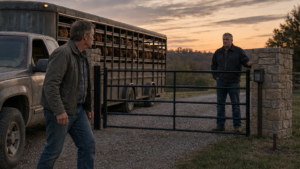
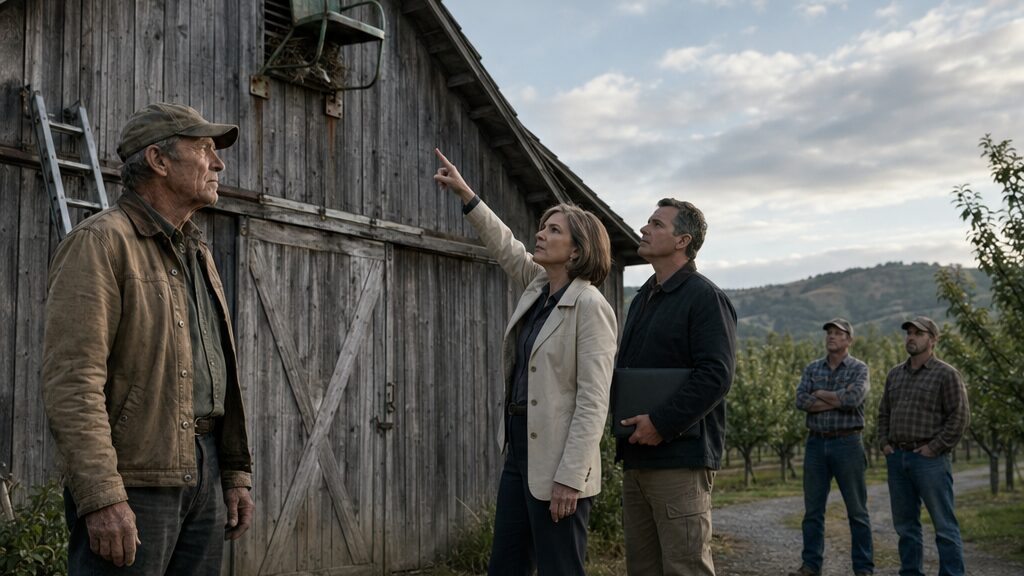
Deborah Wright stood beside the county road with one hand on the open door of her pickup and the other pointing over Jonathan Hall’s shoulder. Her voice carried cleanly across the first row of apple trees.
Jonathan did not turn around. He was tightening a loose irrigation coupling at the edge of the lane, and he finished the quarter turn before setting down the wrench.
“You can see it,” he said. “So I suppose you know where it is.”
“That isn’t an answer.”
Above the orchard, the old barn roof rose in a faded red slope. Near the western ridge sat a green metal patio chair, sun-bleached almost gray. Its legs were bolted through two steel crosspieces above a square vent. From the road, it looked as though someone had climbed onto the roof, become tired, and forgotten to come down.
Deborah shut her truck door. “People are talking about it.”
“People manage.”
“It looks ridiculous.”
Jonathan wiped his hands on his jeans. “Then don’t look at it.”
Her sunglasses hid her eyes, but her mouth tightened. Deborah owned the pear farm across the drainage ditch and served on the county agricultural board. She had never needed a title to tell other people what needed fixing, but the title had made her more efficient.
“That barn is visible from the road,” she said. “It’s visible from my south field. It’s visible from the school bus route.”
“The children have seen chairs before.”
“Not bolted to roofs.”
Jonathan picked up the wrench.
Deborah stepped closer to the fence. “Is it covering damage?”
“No.”
“Then why is it there?”
“It belongs there.”
She gave a short laugh. “Nobody puts a chair on a barn roof because it belongs there.”
Jonathan felt the old irritation rise, familiar and almost useful. Irritation was easier than explanation. Explanation required opening doors he had kept shut for years.
The wind moved through the upper branches. Somewhere behind him, a tractor coughed to life. A seasonal worker raised a hand from the far row and then lowered it when he sensed the argument.
Deborah took out her phone.
“What are you doing?” Jonathan asked.
“Documenting it.”
She walked several yards along the road, framing the chair against the roof. Jonathan watched her take one photograph, then another from a lower angle that made the chair lean farther than it did.
“You planning to sell postcards?” he asked.
“I’m planning to keep something from falling through your roof or into the lane.”
“It’s nowhere near the lane.”
“Wind carries sheet metal farther than people think.”
“It isn’t sheet metal.”
“That is not reassuring.”
She looked toward the barn again. The chair had been there for nearly four years. Most people had stopped asking after the first season. A few still joked about it at the feed store. Jonathan had let them. He preferred foolishness to pity.
Deborah lowered the phone. “Take it down before someone makes you.”
“No.”
“You didn’t even think about it.”
“I thought about it before you arrived.”
Her jaw shifted. For a moment, she seemed less angry than unsettled.
“Jonathan, roofs fail. Fasteners rust. Old structures burn. You know that.”
“My barn isn’t your responsibility.”
“When one neglected property brings inspectors into the district, it becomes everybody’s responsibility.”
There it was—not only the chair, but what she feared it represented. One citation could become a review. One review could become revised insurance conditions. Farmers who had spent decades repairing buildings with whatever fit the hole understood how quickly a county concern could spread.
Jonathan knew this. He also knew Deborah had chosen the public road for the conversation.
“Go home,” he said.
“I’ll give you until noon.”
“You don’t give me anything.”
“Then the county can.”
She climbed into her truck and drove away, gravel clicking against the undercarriage.
Jonathan remained beside the fence until the sound disappeared beyond the hill.
Then he looked up.
The chair sat exactly where he had left it. One back leg rested slightly higher than the other because of the roof pitch. The steel brackets beneath it were dark with age but still aligned. Nothing moved except a narrow strand of straw caught beneath the seat.
He returned the wrench to the shed, waited until the worker had taken the tractor into the north rows, and carried an extension ladder to the barn.
The ladder feet sank half an inch into the dry earth. Jonathan tested each rung before climbing. His knees complained by the gutter line. The roof smelled of hot dust, old paint, and apples beginning to form below.
He did not go near the chair immediately.
He crouched at the ridge, listening.
At first there was only wind passing through the broken louvers of the vent. Then came a thin rasp from beneath the seat. A second sound answered it, sharper and impatient.
Jonathan let out the breath he had been holding.
He moved sideways on hands and boots until he could see beneath the chair without casting his shadow across the opening. The straw tucked behind the vent lip had shifted since yesterday. A gray feather trembled near one bracket.
“Still there,” he murmured.
A small hooked beak appeared in the darkness and vanished again.
The adult kestrels had chosen the old vent after three empty seasons. The chair shaded the opening during the worst afternoon heat, kept rain from driving straight through the broken frame, and narrowed the angle from which raccoons and larger birds could reach the nest. It had started as a temporary measure. Most of the farm’s permanent fixes had.
Jonathan touched one of the forward bolts.
The metal was warm. The washer held firm.
The rear mounting plate showed a narrow orange line at its edge. Rust, but not enough to worry over today. He pressed his thumb against it until the skin blanched.
Below, a vehicle slowed on the road.
Jonathan froze.
Deborah’s pickup passed without stopping. Her phone was raised toward the barn through the open window.
He remained crouched until she was gone.
By the time he climbed down, the irritation had left him. In its place was a tightness beneath his ribs that followed him through the orchard.
At eleven forty, his phone rang. The county clerk asked whether he was the owner of the Hall orchard property and whether the barn was occupied.
“By equipment,” Jonathan said.
“Any livestock?”
“No.”
“Any residential use?”
“No.”
“Any unsecured structures mounted on the roof?”
Jonathan looked through the office window. The chair was visible above the apple trees.
“It’s secured.”
There was a pause and the sound of keys.
“A complaint was submitted alleging an unsafe roof attachment. An inspector will contact you.”
“Who filed it?”
“I’m not permitted to discuss the complainant.”
“You just described Deborah Wright without using her name.”
The clerk ignored that. “Do not alter or remove the reported structure before inspection unless an immediate hazard develops.”
“So now I’m forbidden to take down the thing I’m being reported for not taking down.”
“You’re being instructed to preserve the inspection condition.”
Jonathan hung up before his tone cost him something.
He spent the afternoon thinning fruit and pretending not to watch the road. Two neighboring growers drove past more slowly than usual. One lifted two fingers from the wheel. The other stared openly at the barn.
Near dusk, Jonathan returned to the yard and found a white sheet fastened to the barn door beneath a strip of orange county tape.
NOTICE OF INSPECTION.
The date was three days away.
At the bottom, under the printed warnings, someone had checked the box beside POSSIBLE IMMEDIATE REMOVAL.
Above him, hidden by the chair everyone could see, the kestrel chicks began calling for food.
Chapter 2: The Inspector Climbed Before Anyone Touched the Bolts
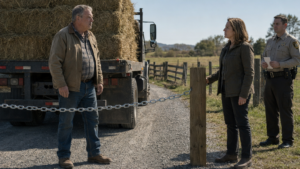
Benjamin Garcia arrived carrying an emergency-removal form on a metal clipboard.
Jonathan recognized the document before the inspector introduced himself. The red band across the top was visible from ten feet away.
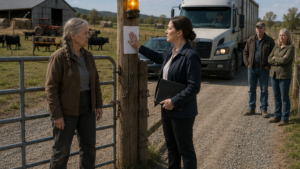
Deborah stood near the fence with two agricultural-board members and both neighboring growers. No one had invited them onto the property, but no one had stayed home either.
Benjamin shook Jonathan’s hand. He was younger than Jonathan expected, perhaps forty, with dust already on his work boots and a hard hat tucked beneath one arm.
“I haven’t decided anything,” Benjamin said quietly. “The form comes with the complaint packet.”
“Then keep it facedown.”
Benjamin glanced at the small audience. “That may be wise.”
Deborah stepped forward. “The chair has been exposed to storms for years. You can see the lean from the road.”
“You can see the roof pitch,” Jonathan said.
“I provided photographs.”
“You provided angles.”
Benjamin raised one hand. “I’ll inspect before we debate photography.”
He walked the barn perimeter, checking the foundation, roofline, and distance from the county road. He photographed the bolts through a telephoto lens, then studied the old vent beneath the seat.
“How do you access it?” he asked.
“Ladder on the west side.”
“Roof sound?”
“Sound enough.”
“That answer usually means I should ask twice.”
“It held me yesterday.”
Deborah folded her arms. “That isn’t a structural test.”
“No,” Benjamin said. “It isn’t.”
Jonathan disliked how quickly those two words changed the air. One of the growers looked down. The other moved farther from the eave.
Benjamin asked for maintenance records.
“Nothing formal for the chair,” Jonathan said.
“You installed it?”
“Yes.”
“Permit?”
“It’s a chair.”
“It became something else when you bolted it to a roof.”
Deborah made a small sound of satisfaction.
Jonathan met Benjamin’s eyes. “Before you touch the bolts, look beneath the seat.”
Benjamin glanced upward again. “What’s under it?”
“Look.”
“That’s what I’ve been asking him for a week,” Deborah said.
Jonathan ignored her. “You brought a ladder?”
Benjamin had one strapped to the county truck. He set it against the barn, tested the ground, and clipped a safety line to the ridge anchor Jonathan had installed years earlier.
As he climbed, the watchers shifted toward the yard. Deborah lifted her phone, but Benjamin looked down.
“No recording while I’m on the ladder, please.”
“This is a public inspection.”
“This is private property, and I’m asking you not to distract me.”
She lowered the phone, though not happily.
Benjamin reached the roof edge and moved carefully across the panels. From below, the chair seemed even more absurd beside his hard hat and safety harness. He stopped several feet away, then leaned to look beneath the seat.
For a moment, nothing happened.
Then Benjamin laughed.
It was not a mocking laugh. It escaped him in one surprised breath.
“What?” Deborah called. “What did you find?”
Benjamin adjusted his position. “A kestrel nest.”
The board members looked at each other.
Jonathan watched Benjamin’s expression change as he studied the arrangement. Straw had been packed behind the old vent frame. The chair seat projected beyond the opening, shading it. Its slatted back broke the force of westbound rain while leaving airflow above the louvers.
“There are chicks,” Benjamin said.
“How many?” one grower asked.
“Three that I can see.”
Deborah stepped toward the ladder. “That doesn’t make the structure safe.”
“No,” Benjamin said. “But it explains why it’s there.”
Jonathan felt the tension ease in his shoulders, though he did not let it show.
Benjamin touched one chair leg, then looked beneath the forward crosspiece. “You shaped the bracket around the vent frame?”
“Yes.”
“Water runs off to either side.”
“Yes.”
“And the back slats interrupt the hawks’ approach from the ridge.”
Jonathan nodded.
Benjamin looked down at him. “It’s crude.”
“Didn’t build it for a magazine.”
“It’s also clever.”
One of the growers laughed softly. Deborah did not.
“So it stays?” she asked.
Benjamin was still examining the chair. “Active nests are protected. We cannot simply pull the structure without determining whether removal would disturb the birds.”
“That wasn’t my question.”
“I’m getting to your question.”
He shifted toward the rear mounting plate.
Jonathan saw the moment before Benjamin spoke. The inspector’s hand stopped above the dark steel. He rubbed one gloved finger along the edge, then held it up. Orange flakes marked the leather.
“How long has this plate looked like this?” Benjamin asked.
Jonathan’s brief relief hardened.
“It’s surface rust.”
Benjamin pressed near the bolt head. The metal gave a faint click.
The sound was small enough that only Jonathan and Benjamin seemed to hear it.
Benjamin leaned closer. “Was this attached directly to the roof frame?”
“To a cross member below.”
“With what?”
“Carriage bolts.”
“What grade?”
Jonathan hesitated.
Deborah noticed. “He doesn’t know.”
“I know what I used.”
“What grade?” Benjamin repeated.
“Whatever the supply store stocked.”
Benjamin sat back on his heels. The amusement had left his face.
He inspected the second rear plate, then the roof seam beneath it. A rust stain ran downhill from the bolt and disappeared under the vent flashing.
“Jonathan, I need the barn kept clear until I finish this.”
“The barn is used every day.”
“Then move the equipment you need now.”
“The nest is stable.”
“I’m not worried only about the nest.”
Deborah stepped closer. “So it is dangerous.”
Benjamin looked down sharply. “I did not say that.”
“You brought an emergency form.”
“I brought every form attached to the case.”
“But you found corrosion.”
“I found enough to require a closer review.”
The distinction mattered to Benjamin. It did not matter to the people listening.
One board member whispered something to the other. The growers began looking at the chair as if it had changed shape above them.
Jonathan put a hand on the ladder. “Come down before they turn your inspection into a verdict.”
Benjamin descended without answering.
On the ground, he removed his hard hat and wiped sweat from his forehead. “The wildlife purpose is legitimate. The mounting may not be.”
“May not be,” Jonathan said.
“Yes.”
“So the complaint about an abandoned dangerous object was wrong.”
“The object isn’t abandoned.”
Deborah’s lips parted, but Benjamin continued.
“And the nesting function means removal requires care. That is the good news.”
“What’s the bad?” Jonathan asked.
“I need a structural inspection of the plates and the roof member beneath them. Until then, no one goes inside the western half of the barn.”
“That could take weeks.”
“I can schedule it tomorrow.”
“With whom?”
“County structural review, unless you provide a licensed contractor’s report first.”
Jonathan looked toward the barn door. His sprayer, ladders, spare irrigation lines, and half the harvest crates were stored in the restricted section.
“You’re closing my barn over one rusted plate.”
“I’m restricting access under a suspended object with an unknown connection.”
“A chair.”
“A chair becomes a falling object at the point it falls.”
Deborah looked almost vindicated, but not pleased. Jonathan noticed that. Her attention remained fixed on the rear plate rather than on him.
Benjamin turned the emergency-removal form facedown on his clipboard.
“I’m not ordering removal today,” he said. “I’m also not closing the complaint.”
The watchers began to disperse. One grower told Jonathan the kestrel setup was smart. The other said nothing.
Deborah paused by her truck. “You could have explained the birds.”
“You could have asked without bringing an audience.”
“I did ask.”
“You demanded.”
Her face changed, but only for a second. “Three years ago I watched that chair shift in a windstorm.”
Jonathan stared at her.
“You never mentioned that.”
“You never listened long enough.”
She drove away before he could answer.
Benjamin fastened a yellow restriction notice across the barn’s west door. “The structural reviewer will be here tomorrow morning.”
Jonathan looked up at the chair. A kestrel landed briefly on its back rail, prey clutched in its talons, then slipped beneath the seat.
For three days, Jonathan had imagined the inspection ending when someone finally understood why the chair was there.
Instead, understanding had only revealed the next problem.
Chapter 3: The First Victory Lasted Less Than One Afternoon
Emily Hall discovered the county agenda while standing in line for coffee.
Her phone buzzed with an automated notice from the agricultural board. She opened it expecting irrigation restrictions or an update on the summer burn schedule.
HALL ORCHARD — STRUCTURAL HAZARD REVIEW appeared halfway down the page.
Below it was a photograph of the old barn and the green chair on its roof.
Emily stepped out of line.
She called her father. He did not answer.
She called again.
On the third attempt, Jonathan picked up. “I’m working.”
“Why is the farm on the county agenda?”
Silence.
“Dad.”
“It’s a review.”
“A review of what?”
“The barn.”
“I can see the chair in the photograph.”
“Then you know.”
“No, I know that strangers online are asking whether you’ve lost your mind.”
“They’ve been asking that since I was thirty.”
“This is not funny.”
“I didn’t say it was.”
She heard metal scrape in the background.
“What are you doing?”
“Moving crates before the county tells me I need permission to own them.”
Emily closed her eyes. “I’ll be there in forty minutes.”
“You don’t need to come.”
“I handle the farm accounts.”
“This isn’t an account.”
“If there’s a citation, it becomes one.”
He hung up.
When Emily reached the orchard, yellow tape blocked the west half of the barn. Jonathan was dragging empty harvest bins into the yard. He had removed his jacket despite the heat, and sweat darkened the back of his work shirt.
She got out of her car and looked at the roof.
The chair was unchanged. From that angle, it looked almost peaceful.
“What happened?” she asked.
“Inspector found the birds.”
“What birds?”
“Kestrels.”
She stared at him. “There are birds under the chair?”
“Three chicks.”
“And you never told anyone?”
“They weren’t anyone’s business.”
“They became the county’s business when you attached furniture to a building.”
“It’s not furniture anymore.”
“That sentence is exactly why people think this is strange.”
Jonathan lifted another bin.
Emily caught the opposite handle. “Put it down.”
“I’m moving equipment.”
“You’re avoiding me.”
“I’m doing both.”
They lowered the bin between them.
She pointed to the yellow tape. “How bad?”
“Structural review tomorrow.”
“Why?”
“Rust.”
“On the chair?”
“On the plates.”
“Were they inspected when you installed them?”
“No.”
“Were they permitted?”
“No.”
Emily looked toward the farm office. “Show me the maintenance records.”
“There aren’t any for the chair.”
“For the barn.”
“I know what’s in them.”
“That wasn’t what I asked.”
He picked up the bin again. “You handle invoices. I handle buildings.”
“You asked me to handle the farm books because you were behind on taxes.”
“I was behind on filing.”
“You were behind on opening envelopes.”
He set the bin down hard enough to crack one corner.
The sound drew the seasonal worker’s attention from across the yard. Jonathan waited until the worker turned away.
“Go back to town,” he said.
Emily had heard that tone throughout childhood. It meant the discussion was finished because Jonathan had decided it was. Her mother had been the only person who could make him remain in the room after using it.
Emily walked past him toward the office.
The filing cabinets were older than she was. The top drawer held current bills, fuel receipts, and payroll records. The lower drawers contained property documents, equipment manuals, and folders labeled in her mother’s handwriting.
Jonathan entered behind her. “Leave those alone.”
“I need the barn file.”
“You don’t need anything.”
“The county may fine us. Insurance may ask questions. If they restrict equipment access during thinning season, we lose labor and time.”
“I’ll manage.”
“That is what you said before the tax penalties.”
His face tightened.
Emily pulled open the cabinet’s bottom drawer. Jonathan reached for it, then stopped before touching her hand.
“Emily.”
The warning in her name made her angrier than shouting would have.
She found a folder marked BARN — WEST ROOF. Inside were roofing invoices, photographs after a hailstorm, and a handwritten sketch of the vent.
A sealed envelope lay between two inspection reports.
The return address belonged to a roofing contractor.
The date was seven months earlier.
Emily held it up. “What is this?”
Jonathan looked away.
She opened it.
Inside was a two-page estimate for replacing damaged flashing and reinforcing the vent frame. A photograph showed the rear chair supports marked with red circles. Beneath it, the contractor had written: Exterior attachment should be removed or remounted before next severe-weather season.
The total was more than the farm could comfortably pay but less than the possible cost of a county shutdown.
“You knew,” Emily said.
“I knew he wanted the job.”
“He photographed corrosion.”
“He sells roofs.”
“He also wrote that the chair supports had shifted.”
Jonathan took the estimate from her. His fingers pressed into the paper without folding it.
“Did you call him back?”
“No.”
“Did you ask anyone else?”
“No.”
“Why?”
“It wasn’t the right repair.”
“What does that mean?”
He placed the estimate on the desk. “It means he wanted to remove everything around the vent.”
“The damaged vent?”
“The nest space.”
“There wasn’t a nest in winter.”
“There could be again.”
Emily stared at him. Beneath his stubbornness, she saw something she had missed over the phone: fear. Not fear of the county or the cost. Fear of the roof being opened.
A county truck entered the lane.
Benjamin Garcia stepped out carrying another roll of yellow tape and a camera. He explained that the structural reviewer had examined Jonathan’s photographs and requested immediate exclusion beneath the western roof bay.
“That includes the equipment aisle,” Emily said.
“I’m afraid so.”
“For how long?”
“Until tomorrow’s inspection, possibly longer.”
Jonathan’s mouth hardened. “You’re shutting down half a working barn based on photographs.”
“I’m preventing anyone from standing under it until we know.”
Benjamin fastened tape across the interior doors. Before leaving, he handed Emily a copy of the complaint packet because she was listed as the farm’s financial contact.
The top photograph showed the chair leaning dramatically against the sky.
The second was closer. It showed the rusted plate but cropped out the vent, the straw, and any sign of the kestrels.
“Who took these?” Emily asked.
Benjamin did not answer directly. “They were submitted with the complaint.”
Jonathan glanced at the road toward Deborah’s farm.
After Benjamin left, Emily returned to the office with the packet and the contractor’s estimate. She spread both across the desk.
The county photograph made the chair look senseless. The contractor’s photograph made it look dangerous. Neither explained why her father guarded it like a grave.
She turned the estimate over.
There, in blue ink faded by time, was a note written in her mother’s hand.
Jonathan—
Not this way. We can protect them without keeping every mistake exactly where it happened.
Below that, on the second page, another line had been added beside the proposed vent redesign.
Please don’t close the sky twice.
Emily read the words again.
When she looked up, Jonathan was standing in the doorway, and the color had gone from his face.
Chapter 4: What Jonathan Sealed Inside the Barn Years Ago
“Please don’t close the sky twice.”
Emily read the sentence aloud.
Jonathan crossed the office in two steps and took the estimate from the desk. He did not tear it or fold it. He only held it against his chest as though she had opened a window in winter.
“That wasn’t written for you,” he said.
“It was attached to a farm repair estimate.”
“It was between your mother and me.”
“She has been gone six years.”
His eyes moved toward the barn beyond the office window. The green chair cut a crooked shape above the roofline. A kestrel passed over it, wings held still against the rising air.
Emily waited.
Jonathan placed the papers in the drawer and pushed it closed.
“We have a structural inspection tomorrow,” she said. “You can tell me now, or I can start pulling every old file until I find the rest.”
“You always did prefer paper to people.”
“And you prefer silence to both.”
The words landed harder than she intended. Jonathan’s face did not change, but his hand remained on the drawer handle.
Fifteen years earlier, the vent had not held birds.
It had been a broken square beneath the western ridge, its louvers warped and two of its boards pulled loose by wind. Kestrels nested inside the wall cavity below it, entering through a gap near the frame. Jonathan had known they were there. His wife had marked the opening with chalk so the workers would leave it alone.
That summer, the orchard was expanding.
A buyer had offered a better contract if Jonathan could increase storage capacity before harvest. The western wall of the barn needed reinforcing. The new interior sheathing would cover the cavity, close the draft, and make space for another line of stacked bins.
His wife had stood beneath the vent with one hand shading her eyes.
“Wait until they leave,” she had said.
“We’ll lose the contractor.”
“Then lose him.”
“We may lose the buyer.”
“The birds will be gone in a few weeks.”
“We don’t have a few weeks.”
Jonathan had believed urgency made him practical. He had believed every delay was weakness and every objection emotional.
The contractor sealed the cavity on a Tuesday morning.
Jonathan found the first dead chick behind the barn two days later.
The adult kestrels remained through the end of the week, flying at the closed vent and striking the siding with their feet. Then they disappeared.
He did not tell Emily that part immediately.
He took her into the barn instead.
The yellow tape barred the western aisle. Dust floated in the light passing through gaps in the boards. Jonathan stopped beneath the vent, where a darker rectangle remained on the wall from the old reinforcement work.
“Your mother marked this place,” he said.
Emily touched the chalk line still faintly visible near one beam.
“You closed it?”
“Yes.”
“While there was a nest?”
“Yes.”
Her hand fell away.
Jonathan looked toward the floor. “I thought the birds would move. I thought she was making it larger than it was.”
“What happened?”
“The chicks didn’t make it.”
The barn seemed to tighten around them.
Emily did not offer comfort. That was one of the things Jonathan respected and feared about her. She let the truth remain the size it was.
He continued.
The following spring brought mice into the orchard in numbers Jonathan had never seen. They stripped bark from young trees and burrowed beneath irrigation lines. The damage spread through two blocks before he understood how much hunting the kestrels had done without being noticed.
He had blamed the mild winter. Then the feed supplier. Then the county ditch.
His wife kept records.
She had counted damaged trunks, dates, droppings, and sightings. When she placed the pages beside the storage-expansion invoices, the pattern was plain.
Emily found those records in a narrow ledger behind the barn plans. The numbers rose sharply in the year after the vent was sealed.
“You knew the birds mattered to the farm,” she said.
“I learned.”
“After she warned you.”
“Yes.”
On the last page, her mother had written: Some losses announce themselves. Others begin as silence.
Emily closed the ledger.
The chair had appeared years later, after rot opened another gap near the same vent. A kestrel pair investigated it in early spring. Jonathan bought the green chair at a farm auction for four dollars, cut steel crosspieces in the workshop, and bolted it above the opening before rain arrived.
His wife had called it the ugliest apology she had ever seen.
She had also carried a cup of coffee into the yard each evening and watched the birds use it.
After her diagnosis, the chair became part of their routine. She sat below the barn while Jonathan checked the bolts. Some evenings they spoke. Others they listened to the kestrels rasping inside the vent.
“Why didn’t you build a proper box?” Emily asked.
“I intended to.”
“But you kept the chair.”
“She liked it.”
“Did she?”
Jonathan looked at the contractor estimate in his hand.
The proposal included a permanent vent shelter—wood-framed, flashed, removable for inspection, and set away from the roof surface. His wife had circled the design and written her note beside it.
Not this way. We can protect them without keeping every mistake exactly where it happened.
Jonathan had read that sentence. He had stopped there.
“You never approved the work,” Emily said.
“It would have opened the roof during nesting season.”
“The estimate is dated November.”
He had no answer.
A truck door shut outside.
Deborah entered the barnyard carrying a folder. She stopped when she saw Emily and Jonathan beneath the vent.
“The inspector asked for the district fire-history records,” she said. “I brought copies.”
Jonathan’s voice cooled. “You can leave them at the office.”
Deborah did not move. “You think I filed that complaint because I don’t like the way your barn looks.”
“You said it lowered the appearance of the road.”
“I said neglected structures affect all of us.”
“You sent photographs that hid the nest.”
“I sent photographs of the mounting plates.”
“You framed them to make the chair lean.”
“Because I saw it move.”
Emily looked between them. “When?”
“Three winters ago. During the ice storm.”
Jonathan shook his head. “It didn’t move.”
“I was in my south field when the wind lifted one side. I called you.”
“You called about branches in the ditch.”
“I called about both. You told me to mind my property.”
Deborah opened the folder. Inside were photographs of a blackened equipment shed on another farm, roof panels scattered beyond a fence, and a county report.
“My parents’ farm nearly disappeared because a neighbor kept saying his wiring and roof were his own business,” she said. “The shed caught fire. Wind carried it into our hay storage. Insurance fought us for eighteen months because the buildings shared an access road.”
Her voice remained controlled, but one thumb rubbed the edge of the folder until it bent.
“That doesn’t make my chair a fire,” Jonathan said.
“No. It makes me unwilling to wait until something becomes obvious.”
Emily watched her father absorb this. His anger did not vanish, but it lost its simple shape.
Deborah placed the records on a crate.
“I should have included the nest in the complaint,” she said. “I thought it would distract from the risk.”
“It would have told the truth,” Emily replied.
“It would have told one truth.”
Before anyone could answer, Jonathan’s phone sounded.
A county weather alert filled the screen: severe thunderstorms, damaging winds, possible hail. Arrival expected before midnight.
The agricultural-board hearing remained scheduled for the following afternoon.
From above them came a faint scrape of metal across metal.
All three looked up.
The chair had not moved, but the sound continued for one long second beneath the roof.
Chapter 5: The Storm Made the Argument Real
The bolt struck the roof before dawn.
Jonathan heard it from the farmhouse porch—a single hard knock against sheet metal, followed by a sliding rattle that disappeared into the rain gutter.
He was across the yard before the porch light stopped swinging behind him.
Wind drove rain through the orchard in pale sheets. The barn stood black against the lightning, its western roof flashing silver each time the sky opened. Above the vent, the chair rocked forward and settled back.
Jonathan reached the taped exclusion line.
Another gust lifted the rear corner.
The chair moved.
Not much. Less than an inch. Enough.
He dragged the extension ladder from the equipment shed, but the wind shoved it sideways before he could raise it. The legs scraped through mud.
Headlights swept across the barnyard.
Deborah’s pickup stopped beside the fence. She stepped out in a raincoat, carrying a coil of rope and two portable work lights.
“What are you doing here?” Jonathan shouted.
“I saw the roof from my kitchen.”
“This isn’t your property.”
“Then stop arguing and tell me where to put the lights.”
A second vehicle arrived behind her. Emily climbed out with a tarp, her hair already soaked.
“You called her?” Jonathan asked.
“She called me.”
Deborah pointed upward. “The right rear leg is loose.”
Jonathan looked again. One chair leg hung several inches above the roof, held only by the crosspiece attached to the remaining mounts. Each gust twisted it toward the vent.
The chicks began calling.
The thin sound reached the ground between bursts of wind.
Emily looked toward the ladder. “You cannot climb in this.”
“I’m not leaving them under that.”
“You won’t help them if you fall.”
Jonathan tied one end of Deborah’s rope to the ladder and anchored the other around a fence post. Together, the three of them pulled the ladder upright against the sheltered side of the barn.
Deborah aimed the lights at the roof.
“Keep everyone clear of the western wall,” Jonathan said.
“I know where falling metal goes.”
There was no sharpness in her reply. Only fear.
Jonathan climbed until his head rose above the gutter. Rain struck his face. The roof was too slick to cross safely, and the chair stood nearly twelve feet away.
He could see the failed plate now. Rust had eaten through one edge. The bolt had not broken; it had pulled free with part of the weakened metal around it.
The chair tipped again.
A kestrel burst from beneath the seat and vanished into the storm.
Jonathan descended.
Emily grabbed his arm when his boots reached the mud. “What?”
“I can’t reach it from there.”
“What can we do?”
“Keep the area empty. Wait for the wind to ease.”
The words tasted like surrender.
For forty minutes they stood in the rain while the chair rocked above them. Deborah moved the work lights twice as branches bent across their beam. Emily held the tarp over a crate containing ropes and tools. Jonathan watched the vent.
At last the storm shifted east. The rain weakened. The chair stopped moving.
Benjamin Garcia arrived just after sunrise with the structural reviewer and a wildlife rehabilitation volunteer. He took in the rope, lights, mud, and three exhausted people without comment.
The reviewer used a lift from the county truck to approach the roof. The wildlife volunteer watched the nest through binoculars.
“One plate has failed,” the reviewer called down. “Second rear plate is severely thinned. Front mounts are holding.”
“Can we brace it in place?” Jonathan asked.
“Temporarily.”
“Without moving the nest?”
The volunteer nodded. “If the chicks remain settled.”
Benjamin looked at Jonathan. “A brace buys time. It does not clear the violation.”
“How much time?”
“Forty-eight hours for a correction plan. Removal or engineered remounting.”
“The birds aren’t ready to leave.”
“Then the plan must protect them.”
Jonathan’s gaze moved to Deborah.
Mud streaked the hem of her raincoat. She had wrapped the loose rope around one hand so tightly that her fingers were pale.
“You really saw it shift three years ago,” he said.
“Yes.”
“Why didn’t you come over?”
“I did.”
He remembered her pickup at the gate after the ice storm. He had been replacing a split irrigation valve. She had mentioned the ditch, branches, and something about the barn. He had dismissed her before she finished.
“You should have said it plainly,” he said.
“I did not realize I needed to earn a full minute.”
The reviewer installed a temporary cable from the chair frame to the roof anchor. The metal settled, no longer rocking.
The volunteer confirmed that the chicks appeared unharmed.
For the first time since the bolt fell, Jonathan breathed fully.
Benjamin handed him a yellow form.
“Forty-eight-hour correction order,” he said. “You can submit a design, contractor certification, and wildlife-transfer method. If there is no approved plan by then, the county will seek emergency authority to remove the attachment.”
“Before the hearing?”
“The hearing can be advanced.”
Emily took the form and read it. “What qualifies as an approved design?”
“Permanent shelter, proper flashing, removable inspection access, rated fasteners, and sufficient clearance from combustible debris.”
Deborah spoke from beside the truck. “And the west wall needs the brush cut back.”
Jonathan looked at her.
“That was in the fire review,” she said. “Not my invention.”
Benjamin nodded. “It would strengthen the plan.”
By noon, Emily had spread drawings across the kitchen table. She used the contractor’s old proposal as a base and adjusted the measurements to keep the nest opening untouched until the fledglings left. A temporary platform could support the chair while a new box was built beside the vent. Afterward, the chair could be removed.
Jonathan stood at the window.
The chair’s reflection floated in the glass above Emily’s shoulder.
“We can submit this today,” she said. “The contractor can start the frame tomorrow.”
“No.”
Emily looked up. “Which part?”
“The chair stays.”
“The failed plate cannot stay.”
“Replace the plate.”
“The roof beneath it has to be opened.”
“Then work around it.”
“There is no safe way to keep the exact chair mounted through the repair.”
Jonathan turned from the window. “You haven’t tried.”
“I have spent four hours trying.”
“It protected them.”
“And last night it nearly crushed them.”
The words silenced the room.
Emily pushed the drawing toward him. “This protects the birds. It preserves the opening. It uses proper fasteners. The chair comes down.”
Jonathan stared at the lines, dimensions, and neat arrows.
His wife’s original note lay beside them.
He placed one hand over it.
“No,” he said. “The original chair stays.”
Outside, the temporary cable tightened in the wind with a low metal hum.
Chapter 6: His Daughter Asked Which Promise He Meant to Keep
Emily placed the approved shelter design beside her mother’s note.
Jonathan remained at the kitchen window, his back to the table. In the glass, the roof chair appeared suspended above his reflection.
“The board moved the vote,” Emily said. “Ten tomorrow morning.”
He did not turn.
“If we submit this before eight, Benjamin says the county crew will wait.”
“I heard you.”
“Then look at it.”
“I already did.”
“You looked at the chair.”
Jonathan’s reflection shifted.
Emily tapped the final page of the old contractor estimate. “You did not look at this.”
He faced her then. “I read what she wrote.”
“You read the first note.”
“There was only one.”
Emily slid the page across the table.
The paper had been folded beneath the proposed vent-shelter diagram. Her mother’s handwriting filled the bottom margin, smaller and less steady than the note Jonathan remembered.
The birds do not need our guilt. They need a safe opening, clean water, and someone willing to keep checking after we are gone. Let the chair come down when it no longer helps.
Jonathan did not touch the page.
Emily watched his eyes move across the lines.
“You never saw it,” she said.
His mouth opened, then closed.
“Dad?”
“I didn’t turn the page.”
The admission was barely audible.
“Why not?”
He pulled out a chair but did not sit. “She gave me the estimate after the hospital visit.”
Emily remembered that period as fragments: medication bottles near the sink, meals left untouched, her mother sleeping in the afternoon. Jonathan had turned the farm into a schedule no one could interrupt.
“She said the contractor could start after harvest,” he continued. “I read the first line. I thought she was telling me to remove it.”
“She was.”
“I thought she was asking me to erase it.”
Emily sat opposite him. “The chair was not her.”
“I know that.”
“Do you?”
His hand closed around the edge of the table.
“I put it there because I had closed the first nest,” he said. “Every time I checked those bolts, I knew I had not forgotten.”
“That is not the same as fixing what happened.”
“No.”
“Then why keep punishing yourself?”
His eyes lifted sharply. “You think this is punishment?”
“I think you made one temporary repair carry everything you would not say.”
The farmhouse clock clicked above the stove.
Jonathan looked again at the final note. “She watched those birds from the yard.”
“She also approved a replacement.”
“She never saw it built.”
“Because she died.”
Emily regretted the bluntness as soon as she spoke, but Jonathan did not flinch. He lowered himself into the chair.
“She died before I could do it right,” he said.
“No. She died after telling you how.”
For a long moment, neither moved.
Outside, a kestrel landed on the chair back. Its tail dipped once, balancing against the morning breeze.
Emily softened her voice. “Which promise are you keeping?”
Jonathan watched the bird through the window.
“The one where you protect them,” she continued, “or the one where nothing is ever allowed to change?”
He pressed both palms against his knees.
“I told her I would never close the sky again.”
“Then don’t.”
“The new shelter changes the vent.”
“It keeps the opening.”
“It moves the protection.”
“It makes it safe.”
He shook his head, but the refusal had lost force.
Emily opened her laptop. “The county plan includes the temporary platform, the wildlife volunteer, the fire clearance, and inspection access. Deborah’s concern is in it. Benjamin’s requirements are in it. Your dimensions are in it.”
“My dimensions?”
“I used the measurements from your sketch.”
He looked at the drawing more closely.
The shelter roof extended beyond the vent by the same distance as the chair seat. Side rails narrowed the approach angle without blocking airflow. A removable panel allowed seasonal cleaning. The design did not imitate the chair, but its function was unmistakably descended from it.
“You already solved the runoff,” Emily said. “You already solved the shade. I just drew what you knew.”
Jonathan traced one line with his finger.
A notification sounded on Emily’s phone.
She read it and pushed the screen toward him.
AGRICULTURAL BOARD EMERGENCY SESSION CONFIRMED — 10:00 A.M.
Below it, the county crew was scheduled to arrive at nine thirty.
“We have less than a day,” she said.
Jonathan stood and walked to the counter. He filled a glass with water, drank half, then set it down untouched.
“You should submit the plan,” he said.
“Do you approve it?”
He did not answer.
“If I send it without your approval, the county still needs the property owner’s signature.”
He looked through the window once more.
The kestrel left the chair and disappeared beneath the seat.
Jonathan folded his wife’s final note along its old crease and placed it carefully in his shirt pocket.
Then he went to the mudroom.
Emily heard the cabinet open, followed by the familiar clink of metal tools. When Jonathan returned, he carried a wrench set, a coil of safety rope, and the worn leather belt he used for roof work.
“What are you doing?” she asked.
He paused at the back door.
“I’m going to see which bolts still listen.”
“That is not an answer.”
“No,” he said. “It’s the first thing I should have done months ago.”
He stepped into the yard and walked toward the barn before the county could arrive and choose for him.
Chapter 7: Jonathan Removed the Chair Before the County Could
The county crew arrived to find Jonathan already on the roof.
Their truck stopped beside the barn at nine twenty-eight, two minutes ahead of schedule. A lift trailer rattled behind it. Benjamin stepped from the passenger side, looked up, and removed his sunglasses.
Jonathan had clipped his safety line to the ridge anchor. His tool belt hung low against his hip. Below him, the temporary cable still held the green chair against the roof, though the loose rear leg floated above the metal.
Emily stood near the ladder with the replacement plans tucked under one arm.
“What is he doing?” Benjamin asked.
“What he should have done months ago,” she said.
Deborah’s pickup turned into the lane before Benjamin could respond. She parked near the fence and walked toward them carrying a folder from the agricultural board.
“The emergency session starts in thirty minutes,” she said.
Benjamin pointed upward. “Jonathan, stop working until we establish a removal method.”
Jonathan did not look down. “Method’s already established.”
“You do not have authorization to disturb an active nest.”
“I’m not disturbing it.”
The wildlife volunteer arrived in a second county vehicle. She raised binoculars toward the vent while Jonathan secured a temporary wooden platform beneath the chair’s front edge. Emily had built the platform from his measurements before dawn. It rested on two roof brackets anchored away from the corroded plates.
Benjamin studied the arrangement.
“That is from the submitted plan,” he said.
Emily nodded. “The signed plan is in my hand.”
He looked at her. “Signed?”
She unfolded the last page.
Jonathan’s name crossed the bottom in dark ink.
Deborah saw it and said nothing.
On the roof, Jonathan loosened the first front bolt. It resisted, then turned with a dry metallic crack. Rust dust slid down the panel.
The kestrel chicks called beneath the seat.
Jonathan stopped.
One of them shifted close to the vent opening, its downy head appearing between the broken louvers. The nest material moved with it.
The wildlife volunteer lifted one hand. “Hold.”
Everyone below went still.
The chick stretched toward the light. For several seconds, it remained exposed beneath the chair, blinking at the barnyard. Then an adult kestrel swept across the roof, calling sharply. The chick withdrew.
“Clear,” the volunteer said.
Jonathan resumed.
He detached the front crosspiece and transferred the chair’s weight onto the temporary platform. The remaining rear plate groaned.
Benjamin moved to the ladder. “You need another person up there.”
“I need someone who follows instructions.”
“I can manage that.”
Jonathan looked down at him. “Harness is in the truck?”
“Yes.”
“Bring the padded cradle and nothing else.”
Benjamin climbed only after Jonathan directed where to place each boot. Together they slid the cradle beneath the nest material inside the vent, supporting it without pulling it from the cavity. The new shelter frame waited several feet away, already fixed to reinforced roof members.
The work slowed around the final rear bolt.
The corroded plate had fused to the chair leg. Turning the bolt twisted the whole assembly toward the vent.
“We cut the plate,” Benjamin said.
Jonathan shook his head. “Vibration.”
“Then we brace the leg and remove the roof section.”
“Too close to the nest.”
“What do you suggest?”
Jonathan studied the rust line. For four years he had checked the chair from the same side, pressing the same bolts with the same confidence. He had treated familiarity as proof.
“Lower the chair with the plate attached,” he said. “Leave the bolt in the roof until the nest transfers.”
Benjamin nodded.
They tied two ropes to the chair frame. Emily and the county crew took the load from below. Deborah stood near the exclusion line, watching the loose leg.
Jonathan cut the temporary cable.
The chair shifted.
For one instant, its empty seat faced the orchard as if someone had risen from it only moments before.
“Take the weight,” Jonathan called.
The ropes tightened. Slowly, the chair lifted away from the vent. Straw trembled beneath it, but the nest remained cradled inside the opening.
Jonathan guided the frame over the gutter.
“Lower.”
The chair descended past the faded barn siding, turning gently at the end of the ropes. Its failed plate hung from one leg like a broken hinge.
No one applauded. No one spoke.
When the chair touched the ground, Jonathan remained on the roof.
The vent stood exposed behind him.
It looked smaller without the chair and more vulnerable than he remembered. He fitted Emily’s shelter frame over it, aligned the runoff lip, and checked the removable side panel twice. Benjamin secured the rated fasteners only where Jonathan directed. The wildlife volunteer watched until an adult kestrel returned to the new shaded ledge.
Only then did Jonathan climb down.
Deborah was waiting beside the chair.
Up close, the damage was undeniable. Rust had eaten through nearly half the rear plate. One more hard storm might have torn it loose.
“You were right about the support,” Jonathan said.
Deborah looked at him. “I was wrong about why it was there.”
“You left that out when you complained.”
“Yes.”
“And pushed for removal before anyone inspected the nest.”
“Yes.”
Her answers were quiet, without defense.
Benjamin reminded them that the board session had already begun. They drove to the county building in separate vehicles.
Inside the meeting room, the agricultural-board chair summarized the complaint, the inspection, and the emergency order. Deborah sat at one end of the table. Jonathan and Emily sat opposite her. Benjamin stood near the wall with the approved shelter plan.
When invited to speak, Jonathan placed the corroded mounting plate on the table.
“I installed the chair without a permit,” he said. “I ignored a written repair warning. The purpose was sound. The maintenance was not.”
The room remained still.
He did not mention his wife’s illness or ask the board to excuse him because of grief. He explained the nesting function, accepted the correction requirements, and presented the redesigned shelter with seasonal inspections and fire-clearance work.
The chair had protected the kestrels. It had also become unsafe. Both facts belonged in the record.
The chair looked foolish from the road, he said, because no one could see what was underneath it. He had made the same mistake in reverse: he had seen only what the chair meant to him and not what was happening beneath its bolts.
The chairperson turned to Deborah. “Do you still request emergency removal authority and additional penalties?”
Deborah looked at the failed plate.
“No,” she said. “The emergency condition has been corrected.”
She paused.
“I withdraw that motion.”
Jonathan felt Emily’s hand relax beside the folder.
Deborah continued. “I do not withdraw the maintenance citation. The county should not teach people that a good intention cancels an unsafe structure.”
Jonathan met her eyes.
“I agree,” he said.
The board upheld the citation, approved the shelter, and reopened the barn subject to final inspection.
It was not victory in the form Jonathan once would have demanded. There was a fine to pay, roof work to complete, and trust that would not return because a form had been signed.
But when he walked back into the sunlight, the county had not taken the choice from him.
The chair lay in his truck bed, lowered by his own hands.
Chapter 8: The New Shelter Left One Seat on the Ground
The young kestrels circled the completed vent box before Jonathan finished locking the ladder.
Three dark shapes crossed the late-summer sky, climbed above the orchard, and returned toward the barn in uneven loops. One landed on the shelter’s narrow ledge. Another missed, beat its wings furiously, and tried again.
The new structure did not resemble a chair. Its sloped roof carried rain away from the vent. Side rails protected the opening without trapping heat. A removable panel bore the date of the last inspection in Emily’s handwriting.
Below it, the western wall had been cleared of brush. The damaged flashing was replaced. The barn doors stood open again.
The old chair sat beneath an apple tree near the orchard edge.
Jonathan had repaired the loose leg but left the failed mounting plate on the workshop shelf. The green paint remained faded. Small rust marks showed where years of rain had collected beneath the seat.
He was tightening one armrest when Deborah crossed the lane.
She carried an envelope.
Jonathan set down the screwdriver.
“The county clerk said this needed your signature,” she said.
He opened the envelope. Inside was the receipt for the maintenance citation, stamped paid.
“You didn’t need to bring it.”
“I was coming this way.”
Her farm lay in the opposite direction.
Jonathan folded the receipt once and slipped it into his pocket.
Above them, a kestrel called from the barn. Deborah looked toward the new shelter.
“The board approved the outbuilding guide yesterday,” she said. “Voluntary inspections, wildlife checks before repairs, approved mounting details.”
“Voluntary?”
“For now.”
“Your compromise?”
“Benjamin’s. Emily wrote half of it.”
Jonathan looked toward the farmhouse. Emily sat at the outdoor table with farm accounts spread around her laptop. She had begun spending two days a week at the orchard, though neither of them had named the arrangement.
Deborah touched the chair back.
“It was not foolish,” she said.
Jonathan waited.
“It was overdue for repair.”
“That sounds less like an apology.”
“It is more accurate than one.”
He considered this and nodded.
“I should have told you about the nest.”
“I should have shown it in the photographs.”
“You made me look unfit to manage my property.”
“You made it easy.”
The old irritation returned, but lightly now, with room around it.
Deborah withdrew her hand from the chair. “My father used to say that neglect is just a decision no one wants to admit making.”
“My wife would have argued with him.”
“Your wife argued with everyone.”
“She usually brought records.”
Deborah almost smiled.
They stood beneath the tree while the fledglings moved above the barn. The sound from the vent had changed. No longer the trapped rasp of hidden chicks, it was open wingbeats, claws on wood, calls crossing the orchard.
Deborah left without asking to sit.
Jonathan carried the paid receipt to the workshop and placed it beside the failed plate. He did not hide either one in a drawer.
By evening, the heat softened. Emily closed her laptop and walked toward the orchard edge.
“You kept the chair,” she said.
“On the ground.”
“That seems safer.”
“I ran the numbers.”
She sat on the grass rather than in the chair.
Jonathan lowered himself into it. The repaired frame creaked under his weight but held.
For years, the chair had been visible to everyone and understood by almost no one. Then it had become evidence: first of care, then of danger, then of the part of Jonathan’s grief he had mistaken for duty.
On the ground, it was only a chair again.
He looked at the empty space beside him.
“There’s room,” he said.
Emily brushed dirt from her palms. “You have one seat.”
“It’s wide enough if neither of us complains.”
“That has never been our strength.”
Still, she moved closer and sat on the broad edge of the chair beside him. The metal dipped slightly toward her, forcing their shoulders together.
Above the barn, an adult kestrel returned with prey. One fledgling followed it to the new shelter while the others circled the orchard.
Jonathan listened until he could distinguish the wind through the vent from the birds moving inside it.
His wife was not restored by the sound. The lost nest remained lost. The years Emily had spent waiting for him to speak could not be folded away with a county receipt.
But the opening in the barn remained.
The birds had somewhere safe to return.
And when Emily leaned forward to watch them land, Jonathan did not sit beside her in silence because he had nothing to say.
He began telling her what to check before the next storm.
The story has ended.