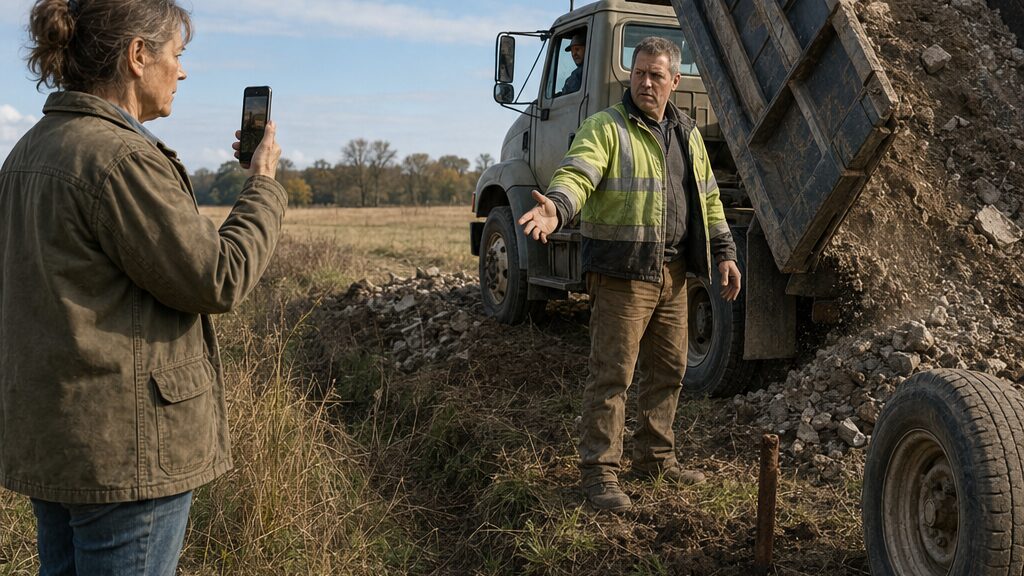
They Called Her Farm’s Back Field “Unused” Until Margaret Measured Where Their Trucks Were Dumping
Chapter 1: The Truck That Backed Past Margaret’s Fence Line
The first load came down while Margaret Harris was still walking toward the truck.
The yellow dump bed rose above the cab, groaning at its hinge, and a slab of broken concrete slid backward with a grinding roar. Behind it came chunks of asphalt, snapped lumber, crushed drainage pipe, and pale gray dirt that burst into dust when it struck the rough strip between the county road and Margaret’s hayfield.
Margaret stopped at the fence opening.
For a second she thought she had misunderstood what she was seeing.
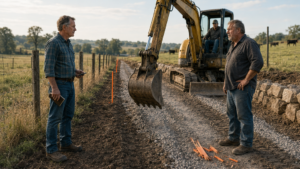
The road project had been moving closer for two weeks. Survey flags had appeared along the shoulder. Excavators had cut a new drainage channel beyond the bend. Trucks passed her mailbox from dawn until late afternoon.
But this truck was not on the road shoulder.
Its rear wheels were sitting on the rough grass she had mowed every fall since her father died.
“Hey!”
The driver either did not hear her or pretended not to. The bed climbed higher.
More material slid out.
Margaret crossed the strip, waving one arm.
“Hold it. Stop.”
A man in a hard hat turned from an excavator parked farther down the lane. He walked toward her without hurrying.
The dump bed lowered behind them.
The man looked to be somewhere in his forties, sun-reddened above the collar, fluorescent vest dusty at the shoulders.
“You with the farm?” he asked.
“I own the farm.”
He glanced toward the field as if checking whether that changed anything.
Margaret pointed at the fresh pile.
“You can’t put that there.”
The man followed her finger.
“It’s spoil.”
“I can see what it is.”
“It’s temporary.”
“That doesn’t matter.”
He gave her the kind of patient expression people used when they had already decided the other person was making a problem larger than it was.
“We’re widening the culvert and cutting the subdivision drainage. We need somewhere to stage material until haul-out.”
“Then stage it on land you have permission to use.”
He looked down the strip.
Tall foxtail grew along the shallow swale. Beyond it, Margaret’s hayfield started in a clean green sweep.
“There’s nothing back here.”
Margaret stared at him.
He must have seen something change in her face, because he added, “I mean, it’s not planted.”
“It doesn’t have to be planted.”
He shifted his weight.
“This strip’s been used for access for years.”
“By neighbors. With permission.”
The man gave a short nod, as if she had just helped his argument.
“Right. So it’s access ground.”
“No. It’s my ground.”
A road-project laborer nearby suddenly found something interesting to do with a shovel.
Margaret folded her arms.
“What’s your name?”
“Jason Miller.”
“Are you in charge?”
“Site superintendent.”
“Then I’m telling you not to dump another load here.”
Jason looked past her toward the road.
“Do you have a marked boundary?”
Margaret felt the question more sharply than she expected.
“My boundary is where it’s always been.”
“That’s not what I asked.”
She disliked him for the calmness of it.
She also disliked that she did not have an answer ready.
Her father had known every line on the farm without needing a painted post every twenty feet. The corner near the pear orchard had an old stone. The north line followed a fence that had leaned since the nineties. This lower strip had once been marked by iron pins, she thought, but she had not seen one in years.
“The county plat shows it,” she said.
Jason nodded once.
“Then show me.”
Margaret glanced at the pile.
“Until then, stop dumping.”
“We have project staking.”
“On my land?”
“Staking says this side is available.”
She looked toward a wooden stake with orange ribbon twenty or thirty feet nearer the field than she remembered any boundary being.
“Who put that there?”
“Our survey crew.”
“That doesn’t make it mine to give away.”
Jason exhaled through his nose.
“We’re not trying to take anything from you, Mrs.—”
“Harris.”
“Mrs. Harris. We’re moving dirt. That’s all.”
“There’s concrete in that pile.”
“It came out of the culvert.”
“And lumber.”
“Old form boards.”
“And pipe.”
“Temporary.”
He kept using that word as if temporary things could not do permanent damage.
Margaret stepped closer to the pile. One piece of pipe had cracked lengthwise. Mud coated its inside.
“You need to move it.”
Jason’s radio crackled against his vest.
He lifted it, listened, then lowered it again.
“We can straighten this out once you bring something showing the line.”
Margaret felt heat climb into her face.
“You dumped first and now I have to prove you shouldn’t have?”
“I’m telling you what our plan shows.”
“I’m telling you what I own.”
For the first time, Jason’s expression hardened.
“And I’ve got fourteen trucks cycling between here and the cut. If I stop every load because somebody says a line is somewhere else, I don’t have a jobsite.”
Margaret almost said, That is not my problem.
Instead she heard her father’s voice in the back of her mind: Don’t turn a fixable thing into a feud.
George Harris had settled broken fences, escaped calves, borrowed equipment, even a disputed ditch with conversation first. Margaret had inherited that instinct almost as surely as the land.
So she kept her voice level.
“Fine. Give me until this afternoon. But nothing else gets dumped here.”
Jason looked at his watch.
“I’ll tell the drivers we’re checking it.”
It was not quite a promise.
Margaret knew that.
But she let herself accept it.
She walked back toward the farmyard, angry mostly because she had needed to argue about something she had always considered obvious.
At the gate she turned.
Jason was speaking into his radio.
The first truck pulled away.
For several seconds the road was empty.
Then another engine sounded from beyond the bend.
A loaded dump truck appeared, slowed, and turned onto the farm-side staging lane.
Chapter 2: Every Morning the Debris Rose Higher
By Tuesday morning, the pile had grown tall enough to be seen from Margaret’s kitchen window.
She stood at the sink with a mug untouched beside her and watched a truck reverse toward it.
The backup alarm carried across the field in sharp, mechanical pulses.
Beep.
Beep.
Beep.
She reached for her phone.
By the time she crossed the yard, the truck was leaving.
Fresh gray dirt covered part of Monday’s concrete. A length of bent metal mesh stuck from the side.
Margaret called the number printed on the project information sheet attached to a post beside the county road.
A woman at the field office answered.
Margaret explained what had happened.
There was a pause.
“Are you talking about the designated spoil area?”
“I’m talking about my property.”
Another pause.
“Our site superintendent has the approved work limits.”
“Jason Miller told me he was checking them.”
“I can have him call you.”
“He already knows.”
“I’m not sure what else I can do from here.”
“Tell the drivers to stop.”
“I don’t dispatch the trucks.”
The conversation ended politely enough that Margaret could almost pretend progress had been made.
At eleven thirty, another load arrived.
She photographed the truck from the porch.
On Wednesday, she drove a steel probe into the ground where she thought one of the old boundary pins should have been.
Nothing.
She tried farther north.
Nothing.
The grass was thick, and years of runoff had pushed silt into the lower ground.
She spent almost an hour walking the strip before giving up.
Her father used to keep a red-handled post driver in the machine shed. When he wanted a boundary remembered, he put something above it.
But this stretch had been left open because neighboring equipment occasionally crossed through during harvest.
Nobody had needed a sign.
At least that was what Margaret had believed.
Thursday brought rain.
Not much—just enough to darken the road and turn the spoil pile slick.
Margaret noticed the runoff while checking the lower fence.
A thin black sheen sat on water collecting in a shallow depression below the pile.
She crouched beside it.
The surface reflected blue sky with an oily rainbow around the edges.
Margaret did not touch it.
She photographed it.
Then she photographed the pile.
Then the drainage path.
Then the field beyond.
Something in her changed after that.
Until then she had treated the problem as an argument that reasonable people would eventually correct.
Standing over that dark water, she stopped assuming correction was coming.
She opened a note on her phone.
Thursday, 9:14 a.m. Runoff after overnight rain.
She walked back through the photographs from earlier in the week and began labeling them by date and approximate time.
Monday: first load.
Tuesday: two visible loads.
Wednesday: three trucks photographed.
She zoomed in on plates where she could read them and copied the numbers.
That afternoon Jason finally called.
“We’re still looking at your concern.”
“You’re still dumping.”
“We’re operating off our project limits.”
“Your project limits do not change my deed.”
“I didn’t say they did.”
“Then why are trucks on my property?”
Jason was silent for a moment.
“Mrs. Harris, the ground we’re using has been treated as access ground for years.”
“Access isn’t ownership.”
“I understand that.”
“Do you?”
Another pause.
“I’m saying this may not be as clear as you think.”
Margaret looked out the kitchen window.
A slab of broken asphalt had rolled almost to the swale.
“What would make it clear enough for you to stop?”
“A current boundary verification.”
“Current?”
“Something we can tie to the project survey.”
Margaret gripped the phone tighter.
“So now the survey I already own may not be current enough?”
“I haven’t seen your survey.”
“You haven’t asked to.”
“I told you Monday to bring proof.”
“And I told you Monday to stop dumping until you checked.”
Neither spoke.
Jason finally said, “I can’t shut down a hauling operation based on a verbal property claim.”
Margaret gave a short, humorless laugh.
“You’re standing on a verbal permission you never got.”
She ended the call before he could answer.
For the rest of Thursday and most of Friday, she worked around the farm with her phone in her pocket.
Each backup alarm pulled her attention toward the road.
She photographed every truck she could.
By Friday evening she had created a folder on the kitchen table.
Truck numbers.
Plate numbers.
Times.
Photographs.
The project office number.
A rough sketch of the field.
It looked excessive.
That bothered her.
George Harris would have hated a folder like that. He had distrusted paperwork when a five-minute conversation could solve something.
Margaret could almost see him at the table, rubbing a thumb along the edge of an envelope and telling her not to make enemies she still had to wave to at the feed store.
But George had been dead six years.
The people dumping on his ground had never met him.
Saturday morning, no trucks came.
Margaret used the quiet to search the cabinet in the mudroom where old farm documents had collected for decades.
Tax statements.
Equipment receipts.
A soil report.
An insurance map.
A yellowed packet from when the west barn roof had been replaced.
She nearly stopped after an hour.
Then a stiff cream-colored envelope slid from between two folders and landed at her feet.
Across the front, in her father’s block handwriting, were three words.
SOUTH FIELD SURVEY.
Margaret stood very still.
Then she carried the envelope to the kitchen table and opened it.
Chapter 3: The Rusted Pin Beneath the Truck Tire
The shovel struck metal on the fourth try.
Margaret felt the impact travel through the wooden handle into her wrists.
Not rock.
Not root.
Metal.
She dropped to one knee and scraped damp soil away with the edge of the blade.
A rusted circle slowly emerged beneath the packed dirt.
Her breath caught.
The iron pin was no wider than her thumb.
For years it had sat beneath grass, runoff, tire tracks, and everyone’s assumptions.
Margaret wiped the top with her glove.
The survey lay folded on the hood of her farm truck.
She had spent Sunday evening reading it until the symbols stopped looking like a private language. The document was old but clear enough about distances from the southern road corner.
Monday morning, she had measured from the identifiable corner monument twice.
Then a third time.
The numbers brought her to this spot.
And this spot sat directly inside the contractor’s traveled lane.
Margaret stood and looked toward the road.
A dump truck was coming.
Its diesel engine deepened as it turned.
She did not move the pin.
She did not cover it.
Instead, she took out her phone.
The truck reversed toward the existing pile.
Its rear tire stopped less than three feet from the iron marker.
Margaret photographed the tire and pin together.
Then the truck number.
Then the plate.
Then the load.
Jason appeared from near the excavator.
He saw the shovel first.
Then he saw Margaret.
“What are you doing?”
“I found it.”
“Found what?”
She pointed.
Jason walked over.
For the first time since they met, he did not answer immediately.
He bent slightly and looked at the iron.
“That could be anything.”
“It’s where my recorded survey says the boundary monument should be.”
“Could be an old fence pin.”
“There was never a fence here.”
“You don’t know when that was put in.”
Margaret held out the folded survey.
Jason did not take it.
“I measured from the south corner.”
“With what?”
“A hundred-foot steel tape.”
He looked at her.
“That’s not a professional survey.”
“I didn’t say it was.”
“Then this doesn’t establish anything.”
“It establishes enough for you to stop until somebody checks it.”
Behind them, the truck’s engine idled.
The driver leaned toward his open window.
Jason glanced at him.
Margaret saw the calculation happen.
Not whether she might be right.
Whether he could afford to act as if she were.
Jason turned back.
“Our staking has the work limit farther east.”
“Then one of the two is wrong.”
“Exactly.”
“That is a reason to stop.”
“It’s a reason to verify.”
“Before you dump.”
Jason rubbed at the dust on his jaw.
“Mrs. Harris, I’ve got material coming out of the drainage cut all morning. I can’t park loaded trucks on a county road.”
“Then send them where they were supposed to go before somebody decided my field was free.”
His mouth tightened.
“This ground is weeds and runoff.”
Margaret looked past him toward the green edge of the hayfield.
Then she looked down at the iron pin.
“That doesn’t make it yours.”
Jason reached for his radio.
For one hopeful second, Margaret thought he was going to stop the load.
Instead he pressed the button.
“Go ahead and tip it.”
The driver hesitated.
Margaret heard the hydraulic pump engage.
The dump bed began to rise.
Jason looked at her as though expecting her to step in front of the truck, shout, threaten, do something that would turn the dispute into a story about her behavior instead of his decision.
Margaret stayed where she was.
She lifted her phone.
One photograph caught Jason in profile, the truck tire behind him and the exposed iron pin near the bottom of the frame.
Another caught the rising bed.
Another caught the first broken pieces sliding backward.
Dust jumped from the pile.
Margaret photographed that too.
Jason watched her.
“You planning to take pictures all day?”
“If that’s how long you keep doing it.”
“I told you this marker doesn’t prove the line.”
“And I told you it might.”
A chunk of concrete struck the pile with a heavy crack.
Margaret lowered her phone.
“You know there’s a boundary question now.”
Jason’s expression shifted slightly.
Not guilt.
Something more guarded.
“I knew you disputed it.”
“No. Monday I disputed it. Today you can see the marker.”
He looked down at the rusted iron.
Margaret continued.
“You’re choosing to dump after seeing it.”
Jason’s radio crackled.
He turned away.
“Document whatever you want.”
Margaret did.
She photographed the finished load.
She photographed the wheel tracks.
She photographed the orange project stake that stood several yards beyond the iron pin.
Then she placed a five-gallon bucket upside down several feet from the marker so she could find it again without disturbing the ground.
She went home and spread the survey across her kitchen table.
For an hour she checked measurements.
The southern reference point.
The bearing.
The distance.
The shape of the parcel.
Something troubled her.
At first she thought she had made an error.
She started over.
The result was the same.
Margaret pulled out the county tax map she had printed years earlier.
It was less precise, but the general line matched the survey.
She laid a ruler across both.
The contractor’s orange stakes were not merely a little off.
If Margaret was interpreting the documents correctly, the legal boundary sat closer to the county road than even she had remembered.
That meant the iron pin was not an odd isolated marker inside some uncertain strip.
It fit the geometry of the original parcel.
Margaret leaned back in her chair.
She should have felt triumphant.
Instead she felt uneasy.
Because if the survey was right, there was another question she could not explain.
The contractor had not invented the old tracks crossing that ground.
People had used the strip for years.
Farm equipment had passed through it. Tire ruts appeared after harvest seasons. Nobody had treated the path like trespassing.
Somewhere along the way, permission had begun to look like ownership—or perhaps like no ownership at all.
Margaret stared at the iron pin’s position marked on the survey.
Then she remembered something her father had said years earlier while opening the lower gate for a neighboring tractor.
Leave him room. He’ll be through by dark.
She had never asked whether that arrangement had ended.
More importantly, after George died, she had never told anyone that it had.
The survey gave Margaret a line.
It did not yet explain how so many people had forgotten it was there.
Chapter 4: The Handshake That Outlived George Harris
The neighboring cattle farmer did not hesitate when Margaret asked about the lower strip.
“Your dad let me run through there every fall.”
Margaret stood beside his gate with the folded survey tucked under one arm.
“How often?”
“Depends on the year. Maybe three or four days during hay season. Sometimes when the north lane washed out.”
“Did he ever say you could use it whenever you wanted?”
The farmer frowned.
“No.”
“Did he call it a road?”
“No.”
“An easement?”
That brought a small laugh.
“George barely used the word easement when the county put one across his creek.”
Margaret looked toward the low ground separating their properties.
The tracks were easy to see now that she knew what she was looking for. Old tire depressions crossed the rough strip at an angle, softened by years of grass.
They looked permanent.
They had never been permanent.
The farmer rested his forearms on the top rail.
“He’d open the gate if I needed through. I’d close it when I was done.”
“And after he died?”
“You never told me not to.”
The answer landed harder than accusation would have.
Margaret said nothing.
“I probably crossed it twice since then,” he added. “Maybe three times.”
“With permission?”
He looked uncomfortable.
“I figured the arrangement stood.”
Margaret nodded slowly.
That was the problem.
Not theft.
Not a secret agreement.
An assumption allowed to grow because nobody had forced it into words.
Her father’s generosity had been specific. Temporary. Personal.
After he died, Margaret had left the gate as it was and never told anyone what changed.
She had wanted the farm to keep feeling like George Harris’s farm.
She had not considered that people who remembered his habits might eventually forget the conditions attached to them.
At the county records office later that morning, Margaret unfolded the survey beneath fluorescent lights.
The records clerk pulled up the parcel history.
Margaret expected an answer.
Instead she got more questions.
The clerk traced the southern boundary on the screen.
“This recorded plat matches the legal description attached to your deed.”
Margaret pointed to the rough access strip.
“Is there anything showing a public right-of-way there?”
“Not in this record.”
“Recorded easement?”
The clerk searched again.
“One drainage easement farther east. Nothing where you’re pointing.”
Margaret felt some tension leave her shoulders.
Then she remembered the farmer.
“What about informal use?”
“That’s not something this office decides.”
“So if people have driven across it for years—”
“You’d need legal advice if someone is claiming a right based on long-term use.”
“No one is claiming that.”
“Yet.”
The single word chilled the relief she had started to feel.
Margaret thanked her and asked for certified copies of the plat and deed description.
Outside, she sat in her truck without starting it.
The county documents supported her.
But they did not erase the years of ambiguity.
She thought about every time she had seen tire tracks and ignored them.
Every time she had told herself there was no reason to put up a marker because everyone around there knew whose ground was whose.
Jason had been wrong to dump.
That did not mean Margaret had done everything right.
By afternoon, he was waiting near the project entrance when she returned.
He had two rolled plan sheets tucked beneath his arm.
“You talked to the neighbor,” he said.
Margaret stopped several feet away.
“How do you know?”
“He talked to one of our guys.”
“That doesn’t change the deed.”
Jason nodded.
“No. But it explains why this area was represented to us as an established access route.”
“Represented by whom?”
“People familiar with the site.”
“That sounds convenient.”
“It’s also true.”
Margaret held up the certified copy.
“There’s no recorded access easement here.”
Jason did not reach for it.
“You keep saying recorded.”
“Because records matter.”
“So does actual use.”
“Not enough for you to dump construction debris.”
“I’m not saying it gives us ownership.”
“What are you saying?”
Jason looked toward the spoil pile.
“I’m saying this wasn’t somebody looking at your farm and deciding to steal eleven feet.”
“Then stop acting like that makes it acceptable.”
His jaw tightened.
“Our survey crew staked the project based on the information they had. The ground had established vehicle use. Nobody had it fenced. Nobody had it posted. Nobody flagged a conflict before work started.”
“You could have asked.”
“We thought we had.”
Margaret stared at him.
There it was—the first thing he had said that sounded less like dismissal than explanation.
It did not absolve him.
But it complicated the version of the story in which he had known from the beginning exactly what he was doing.
“You saw the pin yesterday,” she said.
Jason’s face closed again.
“I saw an old iron marker.”
“And kept dumping.”
“I told you we were getting it checked.”
“You kept dumping while you checked.”
“We have a schedule.”
Margaret almost snapped back.
Instead she folded the certified plat once, carefully.
Her father would have tried one more conversation.
That instinct was still in her.
But something else was growing beside it.
A distinction.
Being fair did not require pretending uncertainty belonged equally to both sides.
Jason’s crew had entered first.
Jason’s crew had dumped first.
And after an old boundary marker appeared beneath their own tires, Jason had chosen production over caution.
“I’ll bring the documents to the county tomorrow,” Margaret said.
Jason watched her.
“You’re making this bigger than it has to be.”
“No.”
She looked at the pile.
“You did that one load at a time.”
The next morning, the records clerk called before Margaret had finished feeding the barn cat.
“I found the archived survey index you asked about.”
Margaret leaned against the kitchen counter.
“And?”
“The original survey was recorded with the county. Same parcel geometry. Same southern monument references.”
Margaret closed her eyes.
“So the plat is still controlling?”
“As far as the county record goes, yes.”
She thanked the clerk and wrote the file reference on the top page of her folder.
For the first time, the argument had moved beyond what her father remembered, what the neighbor assumed, what Jason’s crew had been told, or what Margaret believed.
The line existed in the public record.
Now she needed to know exactly how far the trucks had crossed it.
Chapter 5: Eleven Feet Changed the Entire Argument
The number on the survey comparison was small enough to fit beneath Margaret’s thumb.
11.2 ft.
She stared at it anyway.
Christine Nelson had drawn the offset in pencil between the recorded property line and the outer edge of the contractor’s main spoil area.
“Approximately,” Christine said. “I want to be careful with that word.”
Margaret looked across the desk.
“Approximately eleven feet.”
“Based on the documents and field references you brought, yes.”
“That isn’t inches.”
“No.”
“That isn’t somebody parking a tire on the wrong side.”
“No.”
Christine turned the plat around.
She was younger than Margaret had expected, with a county badge clipped to her belt and a desk so orderly that even her paper clips seemed assigned positions.
Margaret had arrived expecting validation.
Instead, Christine had spent forty minutes trying to dismantle her case.
Where was each photograph taken?
Could Margaret establish dates?
Were the truck plates readable?
Had she moved the iron pin?
Had anyone else?
Was the black sheen in the runoff tested?
Did Margaret personally see every load dumped?
Had the debris been placed continuously or relocated afterward?
At first Margaret found the questions irritating.
Then she understood what Christine was doing.
Not deciding whether Margaret sounded truthful.
Deciding which parts of what she said could survive someone determined to dispute them.
Christine tapped one photograph.
“This one is useful.”
It showed Jason beside the truck, the rear tire, and the exposed iron pin.
“Why?”
“Because the relationships are visible in a single frame.”
“The pin, the truck and Jason.”
“Yes. But it still doesn’t prove the pin is legally controlling by itself.”
Margaret nodded.
“I know that now.”
Christine glanced at her.
“Good.”
That single word felt more valuable than sympathy.
Christine sorted the material into three groups.
The first involved the boundary.
“That portion may remain primarily civil unless there’s a separate county violation.”
The second involved waste placement.
“These materials can’t simply be assumed acceptable because somebody calls them clean fill.”
The third involved drainage.
Christine pointed to Margaret’s photographs of dark runoff.
“We cannot identify that substance from a picture. Don’t call it contamination unless it’s tested.”
Margaret felt herself stiffen.
“I didn’t.”
“You did in the note attached here.”
Margaret looked down.
She had written possible contaminated runoff.
Christine drew a line through contaminated.
“Write unidentified sheen.”
Margaret almost objected.
Then she replaced the phrase herself.
That was another lesson she disliked enough to remember.
Facts were strongest when she did not ask them to carry more weight than they actually could.
Christine continued.
“If debris has altered drainage, that may be a code issue. If regulated material has been placed outside an approved area, that may be another. Land-use restrictions depend on what the contractor is actually doing and under whose permit.”
“So you can stop them.”
“I didn’t say that.”
Margaret sat back.
Christine folded her hands.
“I can open a compliance review. I can request project records. I can inspect conditions that fall under county authority.”
“And my land?”
“If they are trespassing, that remains your property issue.”
Margaret felt some of the satisfaction drain away.
“So after all this, you might tell me it’s private.”
“I might tell you part of it is private.”
Christine’s voice remained even.
“That doesn’t mean the rest disappears.”
By the time Margaret left, the county had opened a formal review.
It was not victory.
But there was now a case number attached to the pile beside her field.
Two days later Christine met her at the farm.
Margaret had marked the recovered iron pin with a temporary stake several feet away so nobody would strike it accidentally.
She did not paint the pin.
She did not move it.
Christine photographed it, then photographed its relation to the road, project stake, and spoil pile.
Jason arrived halfway through the inspection.
“What’s going on?”
“County compliance,” Christine said.
Jason looked at Margaret.
She said nothing.
Christine asked him for the approved spoil plan, field revisions, disposal logs, and staking information.
Jason’s expression changed slightly.
“What exactly are you investigating?”
“Several things.”
“Is this about the property line?”
“Partly.”
“That’s a civil issue.”
“Partly.”
Christine’s repetition was almost identical.
Jason looked toward Margaret as though she had brought someone who refused to play the role he expected.
“Our survey crew is reviewing the boundary,” he said.
“When did you request that review?” Christine asked.
Jason paused.
“Recently.”
“Date?”
“I’d have to check.”
Christine wrote something down.
Margaret noticed.
Jason noticed her noticing.
The next afternoon Christine called.
“I received their initial project records.”
Margaret was standing near the orchard, pruning shears in hand.
“Anything?”
“Something I want you to understand carefully.”
Margaret waited.
“The original project staking appears to have put the usable work area farther onto your parcel than the recorded plat indicates.”
“So they were wrong.”
“Likely. But there’s more.”
Christine rustled paper.
“The contractor requested a staking clarification.”
“When?”
There was a pause.
Margaret looked toward the distant spoil pile.
Christine gave her a date.
Margaret stopped moving.
“That was before I found the pin.”
“Yes.”
“How long before?”
“Two days.”
Margaret did the calculation.
Jason had already asked someone to recheck the staking before Monday morning.
Before he stood beside the exposed marker.
Before he told her it could be anything.
Before he ordered the driver to tip the load.
“Why would he request clarification if he thought the line was fine?”
“I don’t know his reason.”
Margaret said nothing.
Christine continued.
“And don’t assume more than the document says. A request for clarification proves he had a question. It doesn’t prove what he believed the answer would be.”
Margaret understood.
She also understood something else.
Jason’s certainty had been cracking before she ever put a shovel into the dirt.
Yet the trucks had kept coming.
That evening Margaret arranged her photographs chronologically across the kitchen table.
Monday.
Tuesday.
Wednesday.
Thursday.
The exposed pin.
Jason beside it.
The load falling.
Then another image from the following morning.
And another after that.
The county records did not show that Jason had known she was right.
They showed something almost more troubling.
He had known he might be wrong.
And he had kept the trucks moving anyway.
Chapter 6: The Day Jason Stopped Calling It a Mistake
William Green placed Margaret’s photograph flat on the table and tapped the corner with one finger.
“This does not show where the truck ultimately deposited the load.”
Margaret looked at the picture.
Jason stood in profile. The rusted iron pin sat near the truck’s rear tire. The dump bed was raised behind him.
“It shows the bed going up.”
“It shows a raised bed.”
“There are photographs thirty seconds later with debris coming out.”
William slid those forward.
“And those do not show the boundary marker.”
Margaret had expected a lawyer to sound aggressive.
William did not.
His voice was almost mild, which made every sentence feel more deliberate.
They were meeting in the contractor’s field office, a temporary building that smelled of coffee, printer toner, and damp work boots.
Jason sat at the far end of the table.
He had barely looked at Margaret.
William turned to the survey.
“This document is several years old.”
“It is recorded.”
“That doesn’t mean every physical monument remains undisturbed.”
“The county confirmed the parcel geometry.”
“Yes.”
The answer surprised Margaret.
William did not seem interested in denying facts he could not reasonably dispute.
He was interested in narrowing them.
“You also photographed what you described as contaminated runoff.”
“Unidentified sheen.”
William glanced up.
Margaret held his gaze.
“County compliance corrected the wording.”
A faint change crossed Christine Nelson’s face where she sat beside Margaret. Not a smile, exactly.
Approval perhaps.
William continued.
“We’re prepared to remove the disputed spoil.”
Margaret waited.
“That sounds different from last week.”
“We’re trying to resolve the matter.”
“Are you saying the spoil is on my property?”
“I’m saying resolution may be more economical than litigating every factual issue.”
Jason shifted in his chair.
There it was again.
Not an apology.
Not admission.
Cost.
Schedule.
Containment.
William pushed a document across the table.
“The company will remove material from the disputed area, regrade the surface, and restore ordinary drainage.”
Margaret read the first page.
For several seconds, the offer looked like everything she had wanted.
Then she reached the release.
She read it twice.
“This says I waive claims for damage discovered later.”
“It is a standard release.”
“It also says I accept the cleanup as full satisfaction.”
“Yes.”
“You haven’t tested the soil.”
William folded his hands.
“We have no evidence of contamination.”
“I didn’t say contamination.”
Jason finally looked at her.
Margaret continued.
“There’s compacted ground under that pile. There are ruts across the drainage swale. I don’t know what’s buried beneath the top layer because your trucks have been dumping there for more than two weeks.”
“Our proposal includes grading.”
“Grading isn’t the same as restoration.”
Jason leaned forward.
“What do you want, Margaret?”
It was the first time he had used her first name.
She looked at him.
“I want you to stop asking me to sign away problems you haven’t checked.”
His face hardened.
“You wanted the material gone.”
“I still do.”
“Then we’re offering to remove it.”
“With a paper saying I can’t object afterward.”
William intervened.
“That is how settlements create finality.”
Margaret looked back at the release.
A week earlier she might have signed.
Not because it was fair.
Because the trucks would disappear.
Because the pile would disappear.
Because signing would let everyone stop talking about boundaries and permits and photographs.
It would restore quiet.
She had spent years mistaking quiet for peace.
Christine opened a folder.
“There’s another issue.”
William looked at her.
The county had received additional project correspondence that morning.
A printed email chain showed a request from Jason to the project survey team asking them to verify the southern staking after a discrepancy was raised during grading.
Margaret read the date.
Two days before she uncovered the pin.
William read it too.
Jason’s shoulders shifted.
“I asked them to check the staking,” he said.
“Why?” Margaret asked.
“Because one of the operators thought the distances looked off.”
Margaret felt something inside her settle.
Not triumph.
Clarity.
“You knew there was a problem.”
“I knew there might be.”
“And you kept dumping.”
Jason rubbed a hand across his mouth.
“We were already behind.”
William gave him a quick look.
Jason ignored it.
“The off-site disposal route added almost forty minutes a cycle. We had rain coming. The drainage cut had to stay open. If we stopped hauling, everything backed up.”
“So you used my ground because it was cheaper.”
“I used ground I had been told was within the work area.”
“After you questioned whether it was.”
Jason looked away.
That was the moment the dispute changed for Margaret.
The iron pin had never proved Jason began as a liar.
The email did not prove he knew exactly where the legal boundary was.
But his own answer revealed the choice beneath the paperwork.
He had doubted the line.
He had also had a schedule.
One of those things had mattered more.
Margaret slid the release back toward William.
“No.”
William did not touch it.
“What would you consider?”
“A written cleanup plan.”
“This is written.”
“A restoration plan. Material removed under county observation where required. Soil checked where the runoff collected. Compaction corrected. Drainage restored. And the boundary verified before equipment comes back onto the strip.”
William studied her.
“That will cost more.”
Margaret glanced toward Jason.
“For once, that’s not my part of the problem.”
No one spoke for several seconds.
Christine closed her folder.
William finally gathered the release.
“I’ll take your request to the company and insurer.”
Jason pushed his chair back.
“You understand this could drag on.”
Margaret did.
That was what frightened her.
A quick cleanup was sitting on the table within reach. She had just refused it.
She thought of her father opening the gate for a neighbor and trusting him to close it again.
George had not been foolish.
He had lived in relationships where the person asking permission and the person receiving it expected to meet again.
Margaret was dealing with a company whose people changed, whose plans changed, whose responsibility moved from superintendent to lawyer to insurer.
A handshake could not do the work she kept asking it to do.
She stood.
“I’m not asking for more than you damaged.”
William nodded once.
“And you’re not signing today.”
“No.”
Outside the field office, she could hear equipment working beyond the temporary wall.
For the first time in seventeen days, none of it was moving toward her farm.
Margaret drove home and stopped beside the disputed strip.
The rusted iron pin remained exposed beneath its temporary marker.
She crouched and brushed loose dirt from its top.
Then she left it exactly where it was.
By late afternoon, William sent a revised message.
The company’s insurer would review a formal restoration proposal.
Margaret opened a new document at her kitchen table.
At the top she typed three words:
RESTORATION REQUIRED BEFORE RELEASE.
Then, line by line, she began listing what the ground would need before she would call the matter finished.
Chapter 7: What Margaret Chose to Leave Above Ground
The excavator came back to Margaret’s farm carrying an empty bucket.
For the first time, it was there to take something away.
Margaret stood beside the lower strip as the operator eased the machine toward the spoil pile. Two dump trucks waited on the county side of the verified line, their beds empty and their tires kept off her ground.
A temporary row of stakes marked the boundary in bright intervals.
The old iron pin remained untouched between them.
Christine Nelson arrived before the first bucket went into the pile. An insurance adjuster followed, carrying a clipboard and wearing boots that were too clean for the field.
Jason Miller came last.
He parked near the road and walked down alone.
Margaret had not seen him since the meeting in the field office.
He stopped beside Christine rather than approaching Margaret.
“All equipment stays outside the restoration area unless the operator is actively removing material,” Christine said.
The adjuster nodded.
“And anything uncovered that doesn’t match the listed debris gets documented before removal.”
Jason glanced toward the pile.
“Understood.”
The excavator bucket lowered.
Concrete, broken pipe, compacted dirt, and splintered lumber disappeared one load at a time.
There was no satisfying instant when the damage vanished.
The work was slower than the dumping had been.
Every bucket had to be sorted enough to determine where it went. Material near the drainage swale had to be removed carefully. The dark sheen Margaret had photographed had not produced evidence of serious contamination when the affected soil was tested, but the insurer had agreed to remove the visibly impacted soil and replace it rather than argue over a few cubic yards.
Margaret had learned to appreciate conclusions that were smaller than her fears.
Not everything uncertain became dangerous.
Not everything unfair became criminal.
And not every victory required proving the worst possible version of the other side.
By midday, the top of the original ground began to reappear.
It looked worse than Margaret expected.
Truck tires had pressed deep parallel grooves into the soil. The weight of the spoil had flattened part of the drainage swale. In places the ground was hard enough that a shovel barely entered it.
The adjuster pushed a metal probe down and stopped halfway.
“Compaction is significant here.”
Jason stood several feet away.
Margaret looked at him.
He did not argue.
The restoration plan required loosening the compacted soil, reshaping the swale to its original drainage pattern, replacing damaged topsoil, and reseeding the rough grass cover.
No ornamental landscaping.
No improvements Margaret had not possessed before.
Just repair.
That had been important to her.
When William Green’s revised proposal arrived two weeks earlier, there had been an allowance for replacing the entire strip with a graded, seeded access lane.
It would have looked cleaner than anything Margaret had ever maintained there.
She rejected it.
She did not want a better road.
She wanted her land back.
In the afternoon, the excavator operator uncovered a section of old tire rut beneath the newest compacted layer.
Jason noticed it.
“So that’s the old access path.”
Margaret followed his gaze.
“Part of it.”
He looked toward the cattle farm beyond the field.
“That’s what threw us.”
Margaret waited.
Jason kicked at a clod of dirt.
“The project team saw tracks on the aerials. People around here said equipment used the strip. The staking lined up close enough that nobody questioned it at first.”
“You did eventually.”
His face tightened slightly.
“Yes.”
“When the operator said the measurements looked wrong.”
“Yes.”
Margaret said nothing.
Jason looked toward the trucks.
“I should’ve stopped then.”
It was not dramatic.
No apology followed immediately.
No explanation about deadlines.
No request that she understand.
Just the sentence.
Margaret found that she preferred it that way.
“Yes,” she said.
Jason nodded once.
They stood without speaking while another bucket of debris dropped into a truck bed.
After a moment he said, “I kept thinking the revised staking would come back and show we were fine.”
“And if it had?”
“I would’ve been right.”
Margaret almost smiled.
“That sounds like you.”
Jason looked at her.
“Probably.”
It was the closest either of them had come to humor.
Later that afternoon, two road-project laborers arrived with Jason to verify the corrected work line before the temporary markers were removed.
Margaret watched him measure from the confirmed monument.
He called out distances.
One laborer checked them against the revised sheet.
At the iron pin, Jason stopped.
He crouched and brushed a little dirt from its rim.
“This stays?”
Margaret nodded.
“It stays.”
“You want us to put a taller marker over it?”
“I’ll handle that.”
He stood.
For several seconds she could see him considering another sentence.
Then he simply said, “All right.”
By the end of the second cleanup day, the pile was gone.
By the fourth, the compacted ground had been loosened.
The drainage swale once again curved gently toward the lower ditch instead of holding water against the spoil area.
Fresh topsoil darkened the damaged patches.
Seed and straw covered the roughest sections.
Christine completed her final inspection the following week.
She checked the drainage first.
Then the restored surface.
Then the boundary.
“The county violations can be closed once the final disposal documentation is filed,” she said.
Margaret looked toward the field.
“So that’s it?”
“For my part.”
The phrase made Margaret think of how badly she had wanted someone else to arrive and take the entire problem from her.
The county never had.
Christine had not rescued her.
She had forced Margaret to distinguish what could be proved, what could be regulated, and what Margaret herself had to insist upon.
That had been more useful.
The insurance payment covered the documented restoration, testing, survey verification, and damage directly connected to the dumping.
There was no fortune in it.
After expenses, Margaret was left with exactly what she had asked for.
Ground that drained properly.
Soil she could use.
A boundary everybody involved could identify.
A few days later, the neighboring cattle farmer stopped beside the gate while Margaret was working near the lower strip.
“I heard they finally got everything cleaned up.”
“They did.”
He nodded toward the restored ground.
“You want me staying off that path from now on?”
Margaret leaned on the handle of her post driver.
There was a time when the question would have embarrassed her.
It did not now.
“If you need through during hay season, call me.”
The farmer nodded.
“Fair enough.”
“I’ll probably say yes.”
He smiled.
“I figured.”
“But ask.”
“I will.”
After he drove away, Margaret carried a steel marker post toward the old iron pin.
She did not drive it through the monument or directly against it. She set it several feet away, visible from the lane but clear of the survey point.
Each strike of the post driver rang across the open field.
When she finished, the marker stood chest-high above the grass.
Nothing about it was decorative.
Nothing about it threatened anyone.
It simply made the line difficult to forget.
Margaret crouched beside the old pin one last time.
For years, dirt had covered it while everyone relied on memory.
Her father had believed a person could open a gate for someone and still trust them to understand whose gate it was.
Margaret still believed in opening gates.
She just no longer believed the boundary had to disappear in order to prove she was generous.
She brushed the loose earth from the rusted metal and stood.
Across the restored strip, new grass had already begun showing through the straw in thin green lines.
Margaret left the iron pin above ground.
The story has ended.