The Locked Red Door at the Edge of Michael Green’s Farm Hid More Than Flowers
Chapter 1: The Red Door Beyond the Last Apple Row
Susan Mitchell was already standing at the red door when Michael reached the last row of apple trees.
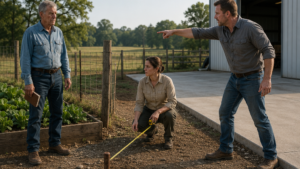
She had crossed the drainage ditch and come through the gap where the old wire fence sagged, though she knew he did not allow anyone beyond the packing shed without asking. One hand rested on her hip. The other pointed toward the damp soil beneath the stone wall.
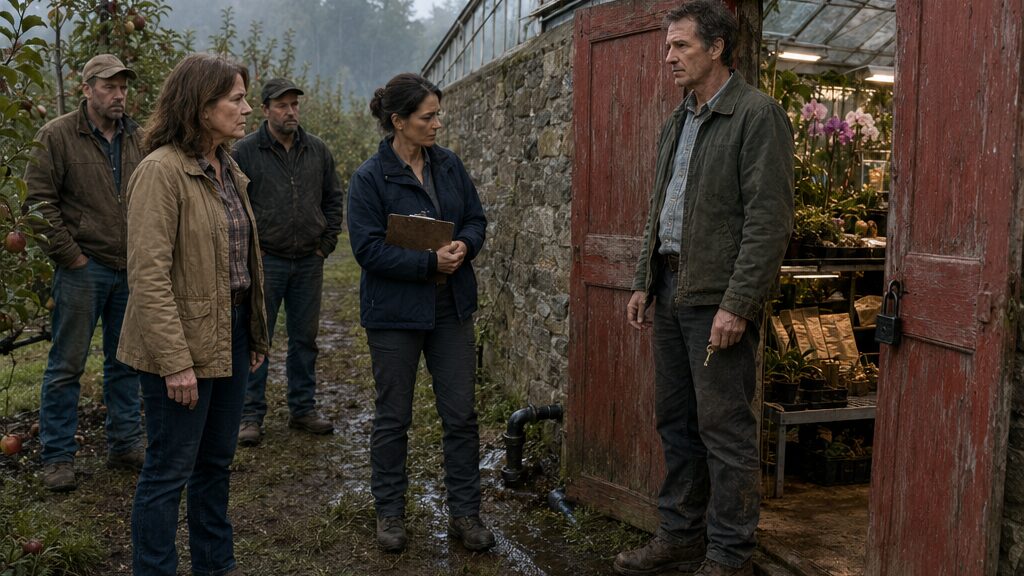
The door stood between two rough limestone pillars, its paint faded from barn red to the color of dried blood. A black padlock hung from the iron latch.
Michael stopped ten feet away.
“You’re on my land.”
Susan glanced at him, then back at the base of the wall. “And your water may be on mine.”
He carried a pruning saw in one hand and a canvas picking bag over his shoulder. Neither object felt useful now.
“That ground’s always damp in September.”
“Not like this.”
Susan pressed the toe of her boot into the mud. Water shone in the mark.
Michael looked at the short length of dark pipe emerging beside the stonework. Condensation had gathered along its underside. One drop fell while they watched.
Susan noticed him noticing it.
“What’s behind the door?”
“You’ve asked before.”
“You’ve refused before.”
“That should’ve been the end of it.”
She gave a humorless breath. Beyond her, the orchard descended toward the property line, where Michael’s grass gave way to Susan’s lower pasture. The pasture had turned yellow-brown after the last flood. A section near the ditch remained flattened, the weeds bent in the direction the water had moved.
“My south field was under six inches,” she said. “Fence posts leaned. Feed washed out of the trough. I lost two weeks of grazing.”
“I saw the water.”
“Then you know why I’m asking.”
Michael set the pruning saw against a tree trunk. “That door has nothing to do with your pasture.”
“Then tell me what does.”
He did not answer.
A breeze moved through the apple leaves, carrying the faint sweet smell of fruit beginning to soften on the ground. From behind the red door came the quiet hum of the ventilation fan. Michael heard it clearly. Susan did too.
Her eyes narrowed.
“That’s powered.”
“Most buildings are.”
“What kind of building?”
He stepped past her and tested the padlock with his thumb. It was secure. He had checked it at dawn. He checked it every morning, and sometimes again before supper, though nobody had tried to break in.
Susan watched his hand remain on the lock.
“You act like there’s something in there worth stealing.”
“There is.”
The answer came out before he could stop it.
Her expression changed, not to satisfaction but to alertness.
“What?”
Michael removed his hand. “Plants.”
“What kind of plants?”
“It’s a greenhouse.”
She stared at the red door, then at the stone walls, which gave no view of the glass structure hidden behind them.
“A greenhouse with a padlock.”
“Raccoons don’t respect signs.”
“I’m not talking about raccoons.”
“I know.”
That was the problem. Susan had not come for an answer. She had come for an explanation large enough to relieve her fear, and Michael did not intend to give her one.
She opened the canvas tote hanging from her shoulder and pulled out a clear plastic sleeve. Inside were four printed photographs.
“Taken the morning after the storm.”
She held them toward him.
The first showed water spread across her lower pasture, reflecting the gray sky. The second showed debris caught against a fence. In the third, the ditch along their boundary had overflowed. The fourth had been taken from farther uphill. A thin line of water appeared to run from Michael’s side toward hers.
Michael studied it longer than he meant to.
“You see that?” Susan asked.
“I see water.”
“It starts near this wall.”
“The grade starts near this wall.”
“The pipe starts here too.”
He handed the sleeve back.
Susan did not put it away. “The drainage association has no record of that connection.”
“It predates the association.”
“So does half the county. That doesn’t exempt it.”
“It doesn’t feed the ditch.”
“Then where does it feed?”
Michael looked at the red door.
Susan followed his gaze.
For one moment he considered opening it. Not for her. To end the questions. He imagined the smell of damp bark and warm soil meeting the sharp September air. He imagined her walking past the first row of orchids, reading the tags Laura had written, touching something without permission, asking why certain benches were empty.
He saw Laura at the potting table, hair tied with a blue bandanna, tapping a pencil against a notebook.
Don’t preserve it so carefully that nobody can use it, she had once told him.
He had laughed then because she had been talking about seed stock.
Now Susan said, “I’ve requested an inspection.”
The orchard seemed to go still.
Michael turned from the door. “From who?”
“The county agricultural office.”
“For a private greenhouse?”
“For an unrecorded structure connected to a shared drainage corridor.”
“It was recorded.”
“Under the old use designation. Before the expansion.”
His jaw tightened. “You’ve been digging through my filings?”
“They’re public.”
“You could’ve asked.”
“I did.”
“You asked what was behind a door.”
“And you treated me like I had no right to know whether something on your property was damaging mine.”
Michael picked up the pruning saw. “You don’t have a right to everything you’re curious about.”
“No. But I have a right to dry ground.”
She put the photographs away and walked toward the gap in the fence. At the ditch she stopped.
“They’ll contact you,” she said. “I told them I wanted it handled before the next storm.”
Michael said nothing.
Susan crossed onto her land without looking back.
The ventilation fan clicked off behind the wall. In the sudden quiet, Michael heard water moving somewhere underground, a faint metallic rush through the old line.
He crouched beside the pipe and touched it.
Cold.
He could disconnect it in an hour. Two, if the coupling had seized. But doing so before an inspection would look worse than leaving it. And if the greenhouse lost the supplemental line, the misting system would have to run from the main well, whose pressure had been unreliable since July.
He stood and tested the padlock a second time.
That evening he worked until the light thinned between the trees. He picked windfall apples, repaired a torn irrigation sleeve, and avoided the red door until there was no reason left to remain outside.
When he finally returned, a white sheet of paper had been fastened to the wood beneath the latch.
The county seal was printed at the top.
NOTICE OF SITE REVIEW.
Michael read the inspection date twice.
Then he saw the line beneath it requiring access to all structures, water connections, records, and stored agricultural materials.
His hand closed around the padlock.
For the first time in four years, the lock did not feel like protection.
It felt like evidence.
Chapter 2: Rumors Cross the Fence Faster Than Water
“Michael Green storing chemicals in that stone place?”
The neighboring cattle farmer asked the question loudly enough for everyone near the counter to hear.
Susan had been comparing culvert fittings at the farm-supply store. She kept her eyes on the price labels.
“I didn’t say that.”
The man leaned one elbow against a stack of mineral tubs. “Heard the county’s coming out.”
“They’re reviewing the drainage complaint.”
“Same difference.”
It was not the same difference. Susan knew that. She also knew that correcting him would require admitting exactly what she had reported: that she suspected unregistered water use and could not verify what Michael stored behind the locked door.
Instead, she returned the fitting to the shelf.
“The county can decide what matters.”
The cashier glanced up. At the end of the aisle, two drainage-association members stopped talking.
The cattle farmer lowered his voice without making it private. “Green’s always been peculiar since his wife passed.”
Susan’s mouth tightened. Laura Green had taught horticulture classes at the community college and brought cut flowers to Susan’s father after his surgery. There had been nothing peculiar about her.
Michael had changed afterward. He had stopped attending association meetings. He paid assessments by mail. He answered questions with as few words as possible and treated every request as an intrusion.
Still, Susan knew how quickly a person’s silence became a story once enough people were bored or frightened.
She bought the cheapest fitting and left.
At home, she drove the utility cart down to the lower pasture. The tires pressed dark tracks into soil that should have been firm by now.
The flood had left a brown line across the fence posts. Grass lay matted around the trough. One gate dragged because its lower hinge had shifted in the wet ground.
Susan crouched beside the ditch and measured the bank with a folding ruler. Four inches had slumped since spring.
Her phone buzzed.
The care facility’s billing office had left another message.
She did not play it. She knew what it would say. Her father’s insurance review remained unresolved. The balance due at the end of the month was more than the profit from her last hay cutting.
Across the ditch, past Michael’s orchard, the red door showed between the trees like a warning flag.
She had told the county there might be hazardous storage because Michael used heat, power, and water behind a locked entrance. That was true.
She had also used the word chemicals.
That was not entirely true.
Every farm had chemicals. Herbicide. Copper spray. Fuel. Cleaning compounds. Michael probably stored some somewhere. But she had no evidence they were behind that door.
The distinction had seemed small when she filled out the complaint form at midnight, listening to water strike the foundation of her house.
Now it felt less small.
A truck came along the gravel road and turned into Michael’s drive. Justin Thomas climbed out carrying two orchard crates. He was young enough to move as if his knees would always forgive him.
Susan called across the ditch. “Justin.”
He looked over, hesitant.
“You work inside that greenhouse?”
“No, ma’am.”
“You know what’s in it?”
“Plants, I guess.”
“You guess?”
“Michael doesn’t let me in.”
That answer settled into her more heavily than she expected.
“Does he use the old irrigation branch?”
Justin looked toward the orchard. “You should ask him.”
“I did.”
“And?”
“He wouldn’t answer.”
Justin lifted the crates. “That doesn’t mean you get to ask me behind his back.”
He walked away before she could respond.
By late afternoon Susan had received an email from Catherine Nelson at the county agricultural office requesting photographs and the drainage-association map. Susan sent both. Catherine called ten minutes later.
“I’ve reviewed the site history,” Catherine said. “The original greenhouse was permitted as an accessory agricultural structure.”
“So it exists on paper.”
“The original footprint does. There appears to have been an expansion about eleven years ago.”
“Without approval?”
“I said it appears. I haven’t inspected it.”
Susan stood at her kitchen counter. Through the window she could see her father’s old coffee cup beside the sink, though he had not lived in the house for eight months.
“What about the water line?”
“The association map shows an inactive lateral near Green’s property. Your photographs suggest flow, but photographs don’t establish the source.”
“My pasture didn’t flood itself.”
“No. But several things can overwhelm a drainage corridor.”
Susan pressed her fingertips against the counter. “What happens now?”
“I conduct a site review. I’ll inspect the structure, agricultural use, storage, and water connection.”
“You’ll make him open it?”
“If it falls within the complaint.”
“It does.”
Catherine paused. “You sound certain.”
“I’m certain something is being concealed.”
“That is different from being certain it’s causing damage.”
Susan looked through the kitchen window toward the unseen property line.
“He won’t tell anyone what’s back there.”
“Privacy isn’t a violation.”
“No. But unreported water use is.”
“Then let the inspection determine that.”
Susan should have stopped there. Instead she said, “There may also be unsafe materials inside.”
“What kind?”
“I don’t know.”
“Have you observed containers, odors, runoff, dead vegetation?”
“No.”
“Has anyone?”
Susan thought of the farm-supply store, of the cattle farmer saying chemicals as though repeating something established.
“Not directly.”
Catherine’s voice cooled. “I’ll record that as an unverified concern.”
After the call, Susan sat at the kitchen table with the drainage map spread before her. The old irrigation lateral was marked in blue pencil, ending near Michael’s greenhouse wall. Another line crossed beneath the association culvert and continued toward her pasture.
Her father had helped install that culvert thirty years earlier. He had always said the ditch needed clearing before every wet season. The association had postponed the work twice because there was not enough money.
Susan traced the line with one finger.
The flood might have several causes.
But Michael’s refusal had given one cause a face.
The next morning Catherine emailed the inspection notice to all association members because the drainage corridor crossed shared easement land. Attendance was optional, but the time and location were public.
Susan read the message twice.
SITE REVIEW AND DRAINAGE WALK-THROUGH.
Thursday, 9:00 a.m.
She had wanted an official answer.
Now half the valley had been invited to watch Michael provide it.
Chapter 3: What Opened Behind the Locked Red Door
“Mr. Green, I need you to unlock the door.”
Catherine Nelson stood three feet from Michael, clipboard tucked against her dark field jacket. Behind her, Susan waited with two drainage-association members and the cattle farmer from the road.
Justin stood farther back beneath an apple tree, arms folded.
Michael held the key in his right hand.
It was a small brass key, worn smooth along one edge. Laura had kept it on a blue cord around her wrist during harvest season because she was always misplacing her pockets under aprons and gloves.
Susan pointed toward the pipe at the wall’s base.
“That’s where the flow starts.”
Catherine did not turn. “We’ll inspect the connection after the structure.”
“There are no chemicals in there,” Michael said.
The cattle farmer shifted his weight.
Susan’s expression tightened. “That isn’t what you said last week.”
“You didn’t ask about chemicals.”
“You refused to say anything.”
“Because it wasn’t your business.”
Catherine raised one hand. “We’re not settling the argument at the door.”
Michael looked past her at the people assembled in his orchard. Nobody met his eyes except Justin.
The red paint had peeled near the lock, exposing a pale strip of wood. Michael inserted the key and felt the resistance of the old mechanism.
For a moment he could not turn it.
He remembered Laura laughing behind him, telling him he always forced the lock before lifting the latch.
Lift first, she had said. Then turn.
He lifted.
The key moved.
The padlock opened with a blunt metallic click.
Nobody spoke.
Michael removed the chain, pulled the latch free, and opened the door inward.
Warm, damp air moved into the orchard.
Beyond the stone entrance stood the greenhouse, its glass roof bright with morning light. Rows of orchids hung in slatted baskets, their roots pale and exposed. Purple, white, and yellow blooms rose above benches crowded with grafted seedlings. Ferns filled the shaded north wall. Trays of young rootstock stood beneath misting lines, each cell marked by a narrow label written in Laura’s hand.
The cattle farmer took off his cap.
One of the association members whispered, “Good Lord.”
Susan did not move.
Michael stepped aside. “Catherine first. Nobody touches anything.”
Catherine entered slowly. She checked the floor drains, electrical conduit, ventilation controls, and shelving. Her expression changed as she moved—not into admiration exactly, but attention.
“How many varieties?” she asked.
“Orchids?”
“And the seedlings.”
“Forty-three orchid varieties. Twelve apple rootstock lines still viable. Maybe thirteen.”
“Commercial sales?”
“Some flowers to a nursery. Not enough to call it a business.”
“That isn’t the county definition.”
“No.”
Catherine wrote something.
Susan entered after being invited. She stopped beside a bench where small white orchids curved over dark leaves.
“I thought—”
Michael looked at her.
She did not finish.
The cattle farmer remained at the threshold. His face had gone red.
Catherine opened a storage cabinet. Inside were pruning tools, rooting compound, disinfectant, and sealed fertilizer containers, all labeled and separated.
“No restricted chemicals,” she said.
Susan clasped her hands in front of her. “I reported a concern.”
“You reported possible unsafe storage,” Catherine said. “I see no evidence of that.”
The statement was quiet, but it landed harder than any rebuke.
One association member cleared his throat. The other studied the floor.
Michael felt a brief, sharp satisfaction. It was not kindness. It was relief with an edge.
He walked to the central bench and adjusted a misting nozzle that had shifted. “You’ve seen it. Now inspect the pipe.”
Catherine looked at the rows of seedlings. “These tags are old.”
“Some are.”
“How old?”
“Ten years. A few more.”
“Your work?”
“Laura’s, mostly.”
Susan looked toward him. At the mention of Laura, something in her face softened, but Michael turned away before it could become sympathy.
Catherine moved toward the back wall. “The county record lists a smaller accessory structure. When was this section added?”
“Eleven years ago.”
“Permit amendment?”
“Laura filed something.”
“You have a copy?”
“Not here.”
Catherine examined the baseboard where a pipe entered through the stone foundation. Condensation silvered its surface. She crouched and traced it toward a valve beneath the propagation bench.
“This line is active.”
“It supplies the misting reserve.”
“Source?”
“Old irrigation lateral.”
Susan took one step forward. “The shared branch.”
Michael’s shoulders tightened. “It branches before the drainage corridor.”
“Is it metered?” Catherine asked.
“No.”
“Backflow preventer?”
“Yes.”
“Inspection date?”
He did not answer.
Catherine touched the metal tag wired to the preventer. The stamped date had faded, but the year remained legible.
Four years earlier.
The year Laura died.
Catherine rose.
“Why wasn’t this connection included in your agricultural-use update?”
“There was no update.”
“You expanded the structure.”
“Laura handled the paperwork.”
“And after her death?”
Michael looked at the orchids above them. A white blossom trembled in the moving air from the fan.
“I kept the system running.”
“That wasn’t my question.”
“No,” he said. “It wasn’t.”
Susan’s face had changed again. Her public certainty was gone, but in its place came something more complicated: recognition that the ugliest story had been false and the smaller one might be true.
Catherine walked along the pipe until it disappeared beneath the floor channel.
“We’ll need a flow test and a survey of the connection,” she said. “I’m not concluding this caused the flooding. I am concluding the line should have been documented and inspected.”
Michael nodded once.
The cattle farmer finally spoke from the doorway. “So there’s no chemical problem.”
“No,” Catherine said.
“And the greenhouse is legal?”
“The original use was approved. The expansion and current water connection require review.”
The distinction disappointed him. Michael could see it. A clean villain or clean victim would have been easier to carry back to the store.
Susan looked around the greenhouse. “Why lock flowers behind stone?”
“They’re not all flowers.”
Michael regretted the answer as soon as he gave it.
Catherine turned toward the seedling benches. “What are they?”
“Rootstock.”
“For your orchard?”
“Some.”
“What are the others for?”
Michael reached for a tray, then stopped before touching it. The narrow paper labels had blurred from years of moisture. Laura’s handwriting remained visible on only a few.
He could have explained the blight. The lost rows. The trials. The nights Laura stayed out here until her hands cramped. He could have told them that some of the seedlings represented crosses no nursery sold, that she had believed small farms deserved disease resistance without paying licensing fees to companies three states away.
Instead he said, “They’re unfinished.”
Catherine watched him for a moment.
“Mr. Green, I’ll need the structure records, water-line documentation, purchase records for stored materials, and any agricultural-use filings related to propagation.”
“How long?”
“Ten business days for the initial review.”
Michael stared at the clipboard.
Susan said, “If the line contributed to the flooding—”
“We’ll determine that separately,” Catherine said. “This inspection does not prove your drainage claim.”
Susan fell silent.
Catherine tore a page from her pad and handed it to Michael.
He read the list once.
Laura’s files were in the greenhouse office, inside metal drawers he had not opened since the week after the funeral. He had paid bills, kept temperature logs, renewed the nursery license, and maintained every living thing she had left.
But he had never found the amended filing.
Because he had never looked.
Catherine closed her clipboard. “Can you produce those records?”
Michael folded the page along its center.
Behind him, the red door remained open. Sunlight crossed the floor and reached the first row of seed envelopes, illuminating Laura’s faded labels one by one.
“No,” he said.
Then, because everyone was still waiting, he added the truth he had spent four years avoiding.
“I don’t know where they are.”
Chapter 4: Laura’s Labels and the Work Michael Stopped
Justin found the green shoot beneath a bench Michael had marked for disposal.
It rose from a cracked black pot no wider than a coffee mug, two pale leaves pushing through dry moss beside a graft union wrapped in brittle tape. Justin carried it across the greenhouse as if it might break from being looked at too hard.
“This one’s alive.”
Michael did not turn from the metal filing cabinet.
“They’re all alive. That’s the point.”
“No, this one was in the dead tray.”
Michael glanced over and stopped moving.
The label had faded to a gray strip, but the number remained visible: L-17.
He crossed the room and took the pot from Justin. The stem was thin, almost colorless near the soil, yet the new growth was clean. No spotting. No blackened edge. Michael rubbed one leaf between his thumb and forefinger.
He had thrown out three other L-17 plants after the blight trials failed.
Laura had insisted on keeping this one.
“Where was it?”
“Under the west bench. Behind the old misting pump.”
Michael set it on the potting table.
The red door stood open behind them, allowing a rectangle of cool air into the greenhouse. Since the inspection, he had stopped locking it while he worked. The padlock remained on a nail beside the frame, close enough to reach without thinking.
Justin looked toward the office.
“You said Catherine needs the records by Friday.”
“I know what day it is.”
“You’ve spent three mornings cleaning gutters.”
“They needed cleaning.”
“You cleaned the same one twice.”
Michael opened the top drawer of the filing cabinet. Empty plastic folders leaned inside it. The second drawer contained invoices, electrical receipts, and nursery licenses arranged by year. He had searched both already.
The bottom drawer had not moved.
Rust marked the edges. Laura used to kick it closed with her boot because the slide caught halfway.
Justin reached for the handle.
Michael put his hand over it.
“I’ll do it.”
Justin stepped back.
The drawer resisted, then released with a sound like tearing cloth. Inside were six field notebooks, three binders, seed catalogs, and dozens of brown envelopes bundled with blue rubber bands gone brittle from age.
Laura’s handwriting covered everything.
Michael stood without touching any of it.
Justin waited.
“You can go check the south irrigation,” Michael said.
“I checked it.”
“Check it again.”
“You want me gone?”
“Yes.”
Justin did not move.
Michael looked at him. “That wasn’t unclear.”
“No.”
The young man picked up his cap from the bench. At the red door, he paused.
“I’m not trying to take anything from you.”
Michael’s eyes remained on the drawer.
“That makes one of us.”
Justin’s face tightened, but he left.
The words stayed behind.
Michael lifted the first notebook. Soil dust had settled into the cloth cover. Laura had labeled it ROOTSTOCK TRIALS, YEAR ONE.
Her first pages were neat: dates, parent trees, graft methods, weather conditions. By the middle, the writing leaned harder to the right. Notes crowded the margins. Certain lines were underlined twice.
L-17—vigorous after inoculation. Leaf damage limited. Repeat under field stress.
Michael sat at the small office desk.
The orchard blight had arrived eleven years earlier, first as dark tips on the new growth, then blackened shoots curling like burned fingers. By August, entire rows smelled sour beneath the heat. Michael cut until his shoulders failed. Laura carried infected branches to the burn pile, then returned with pruning alcohol and marked the next tree.
They lost one hundred and twelve trees.
Laura began the rootstock work that winter.
Michael had treated it as grief given a useful shape. She treated it as a problem that could be solved.
A loose sheet slid from the notebook.
It listed six farms within twenty miles. Beside each was an acreage number and a short note.
Mitchell—wet lower ground, mixed soil.
Michael read the name again.
Justin returned before noon carrying a broken sprinkler head. He found Michael in the same chair, three notebooks open around him.
“Line’s fine,” Justin said. “This one cracked at the threads.”
Michael pointed to the door. “Close it.”
Justin did, but did not fasten the latch.
Michael turned the notebook around. “Read that.”
Justin leaned over the desk.
“Field partners?”
“Laura wanted trial plots.”
“At these farms?”
“She never asked them.”
“Maybe she planned to.”
“She planned plenty.”
Justin looked through the next pages. “These numbers are good.”
“They’re greenhouse numbers.”
“Some of them have field notes.”
Michael pulled the book back. “Small plots. One season.”
“Still field data.”
“Not enough.”
Justin picked up the L-17 pot and placed it beside the notebook. “This one lived under a bench for four years.”
“That proves neglect, not resistance.”
“It proves you haven’t killed it.”
Michael’s chair scraped the floor as he stood.
“Watch yourself.”
Justin’s jaw worked. “You want me to act like this is normal?”
“You’re paid to work the orchard.”
“I’m paid sixteen hours a week because that’s all you say you can afford. I stay longer because you know things nobody at school teaches.”
“That doesn’t make this yours.”
“I didn’t say it did.”
Justin looked toward the rows beyond the office glass. “But keeping all of it alive and doing nothing with it doesn’t make it finished.”
Michael carried the notebooks to the propagation shed behind the greenhouse. The building had not been used since Laura’s last spring. Dust softened the edges of the grafting table. A roll of labeling tape lay beside a rusted knife.
He found two more metal boxes beneath a tarp.
One contained invoices for greenhouse glass, fans, and heating lines. The other held permits and county correspondence. Michael searched page by page.
The expansion plan was there.
The stamped amendment was not.
Near the bottom, he found an irrigation sketch. Laura had drawn the old lateral in blue ink. Beside the valve she had written:
ACTIVE RESERVE—INSPECT BEFORE TRANSFER.
Michael stared at the final word.
Transfer.
Catherine’s inspection request lay folded in his pocket. The old line had not been forgotten. Laura had known it needed review. She had intended to transfer something—ownership, use, responsibility—but to whom, and when, she had not written.
Anger arrived before grief.
She had ordered materials without telling him the full cost. She had added two benches while their operating account was already thin. She had promised field trials to farms whose owners knew nothing about them. And she had left him a system whose rules existed mostly in her head.
“You always did that,” he said into the empty shed.
Justin stood in the doorway.
Michael had not heard him approach.
“Did what?”
“Made the decision first. Explained it when it was too late to object.”
He was speaking to Laura, but Justin lowered his eyes as if the accusation belonged to him.
Michael looked down at the blue line on the irrigation sketch.
“She knew the connection was active.”
“So you weren’t hiding it.”
“I was maintaining it.”
“That’s not the same thing.”
“No.”
The answer came quietly.
Michael sat on the edge of the grafting table. For four years he had blamed paperwork, the county, the timing of Laura’s illness, and the uncertainty of the trials. Yet every season he had renewed the nursery license and paid the electric bill. He had chosen which parts of her work to preserve and which questions not to ask.
Justin opened another folder.
“What’s this?”
He held up a packet clipped beneath several supply receipts. The first page bore the community college seal.
COOPERATIVE PROPAGATION AND FIELD-TRIAL APPLICATION.
The form had been completed in Laura’s handwriting. The greenhouse address, plant inventory, trial goals, and proposed student hours were all filled in.
Only the signature lines were blank.
A yellow note was attached to the final page.
Talk to Michael after harvest. He’ll say no if I ask before the numbers are ready.
Justin read the note, then looked at him.
Michael took the application.
Below the proposed partner section, Laura had listed the college horticulture program and three farms. Susan’s was one of them.
The final question asked what would happen to the project if the principal grower could no longer continue.
Laura had written:
Supervised access may transfer to the community college program, provided ownership of all parent stock remains with Green Farm.
Michael read the sentence until the words stopped looking handwritten.
Justin’s voice was careful. “She wanted this to continue.”
Michael folded the application once.
Then again.
He did not tear it.
Outside, the red door shifted in the wind and struck the stone stop with a hollow knock.
Chapter 5: The Flood Was Real, but the Story Was Not
“The greenhouse line did not cause the main flood.”
Catherine said it without preamble.
Susan sat across from her in the county office, a survey map spread between them. Michael occupied the chair nearest the door, his work jacket still dusty from the orchard. He had not looked at Susan since entering.
Catherine placed one finger on the blue drainage line.
“The old irrigation lateral contributes discharge during pressure release. That should be metered and documented. But the volume measured during testing was too low to account for what crossed Mrs. Mitchell’s pasture.”
Susan stared at the map.
“Then where did it come from?”
Catherine moved her finger downstream.
“The association culvert beneath the access road is partially collapsed. Sediment and root intrusion reduced its capacity by more than half. Water backed up along the corridor and entered the lowest available ground.”
“My field.”
“Yes.”
Susan looked toward Michael. He remained still.
“So his line had nothing to do with it?”
“I didn’t say nothing. It added water to an already overloaded system. But it was not the primary cause.”
One of the drainage-association members shifted at the far end of the table. The association had postponed culvert replacement twice. Everyone in the room knew it.
Susan pressed her palms together.
She had expected relief if the source were found. Instead she felt exposed, as though the floodwater had withdrawn and left every careless thing she had said lying in the mud.
“The chemical concern?” Catherine asked.
Susan’s throat tightened.
Michael finally looked at her.
“There wasn’t evidence,” Susan said.
“That isn’t what I asked.”
Susan forced herself to meet his eyes. “I repeated something I couldn’t prove.”
The association member glanced down at his papers.
Michael’s face did not change.
Catherine wrote a note. “For the record, the inspection found no unsafe chemical storage.”
“I understand.”
“Do you?”
Susan nodded.
Michael stood. “Are we done?”
“No,” Catherine said. “Your connection still requires corrective action.”
He sat again.
“The lateral must be disconnected or brought into compliance with metering, backflow recertification, and association approval.”
“I’ll disconnect it.”
Susan looked at him. “You don’t have to do that if it barely contributed.”
Michael’s gaze moved to her slowly.
“I’m not doing it for you.”
Catherine continued. “The greenhouse expansion also lacks a completed agricultural-use amendment. The original permit covers the smaller footprint, not the current operation.”
“It’s not an operation,” Michael said.
“You sell plant material and maintain propagation stock.”
“Barely.”
“The volume does not decide the classification.”
“What does?”
“Use, structure, utilities, and records.”
Michael’s jaw tightened. “And if I file now?”
“That depends on whether the current use meets county standards and whether you submit a corrective plan.”
“And if I don’t?”
Catherine turned a page.
“The greenhouse could lose its agricultural-use designation. Utilities serving the expanded section may be ordered shut off.”
The room went quiet.
Susan pictured the orchids beyond the red door, the seedling benches, the labels in Laura’s handwriting. She had wanted the county to force Michael to answer a question. She had not imagined the answer might be destroyed by the asking.
“How long?” Michael said.
“Thirty days from formal notice.”
He nodded once, as if Catherine had given him a delivery date.
Outside the county building, Susan caught him beside his truck.
“Michael.”
He opened the driver’s door.
“I owe you an apology.”
“No.”
She stopped.
He placed the survey packet on the seat. “You owe the truth to everyone you told.”
“I can do that.”
“Then do it.”
“I was afraid of losing the pasture.”
“So you gave people something uglier to be afraid of.”
Susan looked across the parking lot. “My father’s care costs more each month. If I have to sell, flooded ground won’t carry the loan balance.”
Michael’s hand remained on the door.
“I didn’t know that.”
“I didn’t tell you.”
“No.”
The word held both accusation and recognition.
Susan stepped closer. “I should have.”
“You think that excuses it?”
“No.”
“Good.”
“I’m trying to explain why I kept pushing.”
Michael looked tired rather than angry now, which was worse.
“You asked me to open a door,” he said. “When I didn’t, you decided you could fill the space yourself.”
Susan had no answer.
He got into the truck.
“Michael, I am sorry.”
He closed the door without responding.
That afternoon Susan went to the lower pasture with the association crew. They excavated around the culvert until the crushed metal appeared beneath mud and roots. One side had folded inward. Branches packed the opening tight.
The repair cost would consume most of the association reserve.
Susan signed the emergency authorization anyway.
Across the ditch, Michael worked beside the greenhouse wall. He shut off the old lateral, drained the line, and loosened the coupling with a pipe wrench. Water spilled over his boots before the flow stopped.
Susan watched him cap the branch.
He could have waited for the association vote. He could have argued that the measured volume was too small to matter. Instead he removed the option before anyone could use it against him again.
The red door remained open behind him.
She walked to the fence but did not cross.
“Need a hand?”
“No.”
She expected that.
Michael tightened the cap, tested it, then gathered his tools.
Susan said, “The culvert’s being replaced.”
He looked toward the excavator.
“It should’ve been replaced two years ago.”
“Yes.”
“That’s association land.”
“Yes.”
“You were secretary then.”
Susan swallowed. “Yes.”
He lifted the toolbox.
Neither of them had been innocent enough to leave the conversation clean.
The formal notices arrived the next morning.
Susan received confirmation of the drainage repair order and an association assessment increase. Michael’s envelope was delivered by hand and fastened to the greenhouse door.
She could read the bold heading from her side of the ditch.
CORRECTIVE COMPLIANCE PERIOD—THIRTY DAYS.
Michael stood before it for a long time.
Then he removed the notice, entered the greenhouse, and shut the red door behind him.
Chapter 6: The Promise Michael Had Turned Into a Lock
Frost had formed inside the greenhouse glass.
Michael saw it first along the northern panes, a thin white bloom spreading from the metal frames. His breath showed in the beam of his flashlight.
The heater had stopped.
He crossed the greenhouse and pressed the restart switch. Nothing happened. The control panel displayed a dead screen, and the circulation fans were slowing one by one.
Outside, the temperature had dropped twelve degrees below the forecast.
Michael opened the utility cabinet. The breaker had not tripped. Power reached the panel, but the ignition relay remained silent.
He called Justin.
The young man answered on the fourth ring.
“What happened?”
“Main heater’s down.”
“I’ll come.”
“No.”
Silence.
Michael looked toward the seedling benches. Tender new leaves had begun to curl.
“I need the spare unit from the propagation shed,” he said. “Tell me where you put the extension cord.”
“I didn’t move it.”
“It’s not on the wall.”
“Then you moved it.”
Michael shut his eyes.
Justin said, “The horticulture instructor has two portable greenhouse heaters at the college. We can bring them.”
“No college equipment.”
“Michael—”
“Just tell me where the cord is.”
“You can lose the orchids if you want to prove a point. Those seedlings aren’t only yours.”
The line went dead.
Michael stood with the phone in his hand.
He found the extension cord beneath the workbench, connected the spare heater, and watched its coils glow. The unit warmed one corner. It could not protect the entire structure.
The orchids would tolerate a few cold hours. The young rootstock would not.
Headlights swept across the red door.
Michael went outside and found Justin climbing from a pickup. The community-college horticulture instructor stepped out from the passenger side. Two heaters were strapped in the bed.
“I told you not to bring anyone.”
Justin pulled on his gloves. “You also told me L-17 was dead.”
“This is private property.”
The instructor stayed beside the truck. “We won’t enter without permission.”
“Good.”
Justin stared at the frost whitening the roof. “How cold is it inside?”
“Forty-one.”
“The grafts start failing below thirty-eight.”
“I know.”
“Then unlock the door.”
Michael had locked it after receiving the compliance notice. The key rested in his pocket.
He did not move.
Justin’s voice lowered. “You called me because you needed help.”
“I called about a cord.”
“No. You called because you didn’t want to be alone when it failed.”
Michael’s hand closed around the key.
Another vehicle approached along the orchard lane. Susan’s utility truck stopped behind the pickup. A portable heater stood upright in its bed.
She climbed out without greeting anyone.
“My father used this in his workshop,” she said. “It runs on propane.”
Michael looked at the heater.
“I didn’t ask you.”
“No.”
“You expect something?”
“No.”
“Then take it home.”
Susan opened the tailgate. “You can refuse the apology. You don’t have to freeze the plants to make the refusal clear.”
The instructor turned away, giving them the small privacy of not being watched directly.
Michael looked from Susan to Justin, then at the red door.
Laura’s cooperative application lay on his kitchen table. He had unfolded it so many times that the creases had begun to split. Her sentence about supervised access had remained visible all week.
He unlocked the padlock.
The door opened into a rush of cold, damp air.
“Justin and the instructor only,” he said. “Susan, heater at the threshold.”
Susan nodded without argument.
They moved quickly. The college heaters went to opposite ends of the greenhouse. Susan’s propane unit warmed the central aisle from the doorway. Justin checked bench temperatures while the instructor inspected the failed control panel.
“The relay’s burned,” she said. “We can bypass it, but not safely for the whole night.”
“How long until the temperature stabilizes?” Michael asked.
“With these units? Depends on heat loss.”
A sharp crack sounded overhead.
One of the northern panes split from the corner. Cold air entered through the line.
Justin looked up. “We need to move the youngest trays.”
“There’s nowhere heated enough.”
“The propagation shed.”
“Not insulated.”
“Your packing room is.”
Michael hesitated. The packing room sat beyond the orchard, nearly two hundred yards away.
“We’d have to carry everything outside.”
“Yes.”
“There are four hundred trays.”
“Then we start now.”
Michael looked at the labels. Many had blurred beyond reading. Some seedlings could be replaced. Others existed nowhere else.
He began issuing instructions.
“Orchids stay. Rootstock under six months moves first. Keep each bench order. Do not combine trays. Justin, photograph every label before it leaves.”
The red door was propped wide with a stone.
For the next three hours, plants passed through it in both hands, on carts, in orchard crates, and against winter coats. Cold air entered each time someone crossed the threshold, but the vulnerable stock moved toward safety.
Susan carried trays from the doorway to the utility cart. Michael did not thank her. She did not ask him to.
Near midnight Justin brought a binder from the office.
“This was under the temperature logs.”
Michael kept working. “Put it back.”
“It has my school’s name on it.”
“Justin.”
The instructor opened it before Michael could stop her.
Inside was Laura’s cooperative application, along with a later page he had not seen. The page was signed by Laura and witnessed by the former program director.
The instructor read silently.
“What?” Michael asked.
“She filed an intent memorandum with the college.”
“That isn’t a contract.”
“No. It gave the program permission to request supervised access if she became unable to continue.”
Justin looked at Michael.
The instructor handed him the paper. “It also says access requires your approval as property owner.”
Michael read Laura’s added note:
Michael will know when the stock is ready. If I cannot finish, ask him to teach before you ask him to give.
He lowered the page.
She had anticipated his refusal. She had also protected it.
The final tray left the greenhouse at two in the morning. The packing room smelled of apples, wet coats, and warm soil. Seedlings covered every sorting table.
Susan’s heater kept the greenhouse above forty degrees. The orchids survived. The old parent plants survived. L-17 sat alone on Michael’s desk, its two new leaves untouched by frost.
Justin found him there just before dawn.
“You could still shut all this down,” he said.
“Yes.”
“You could file the amendment and keep everyone out except inspectors.”
“Yes.”
“What are you going to do?”
Michael looked toward the open packing-room door, where the instructor checked labels and Susan refilled paper cups from a thermos she had brought for herself.
For years he had believed that continuing Laura’s work meant preventing change. He had kept every bench in its place, every label in her hand, every decision suspended at the point where she had left it.
He had not kept a promise.
He had kept a room.
Michael picked up his phone and called Catherine.
She answered with sleep in her voice. “Mr. Green?”
“I need the cooperative-use forms.”
A pause followed.
“For the greenhouse?”
“Yes.”
“Are you requesting an amendment?”
“I’m requesting the process. I’ll decide the access terms.”
Catherine’s voice became clearer. “You’ll need a propagation plan, a utilities correction, ownership language, and a named educational partner.”
“I have those.”
“You have thirty days from the notice.”
“I know.”
“Why are you calling before sunrise?”
Michael looked through the packing-room window. The red greenhouse door remained propped open in the distance, a dark rectangle against the first gray light.
“Because the work is ready,” he said.
Chapter 7: The Door Stayed Red, but It No Longer Stayed Shut
Justin waited outside the greenhouse even though the padlock hung open from the latch.
He stood with a flat of young rootstock balanced against his hip, looking through the doorway toward Michael, who was checking the temperature log at the central bench.
“You know you can come in,” Michael said.
“I know.”
“Then why are you standing there?”
Justin glanced at the open lock. “You said scheduled access starts at eight.”
Michael checked the wall clock.
It was seven fifty-eight.
Six months earlier, Justin would have walked in anyway and defended it as necessary. Now he waited beneath the stone arch while morning light caught the red door’s peeling paint.
Michael closed the logbook.
“Close enough.”
Justin stepped across the threshold.
The greenhouse no longer looked preserved in the exact shape Laura had left it. One row of orchid benches remained untouched except for regular maintenance, but the west section had been reorganized for propagation trials. New aluminum tags replaced the labels moisture had erased. A whiteboard listed watering times, graft dates, and student responsibilities.
Nothing on it contained Laura’s handwriting.
That had taken Michael longer to accept than the county paperwork.
Justin carried the tray to the workbench. “These are the L-17 crosses.”
“All twelve?”
“Eleven.”
Michael looked up.
“One failed overnight,” Justin said. “Stem collapse.”
“Which graft?”
“Third from the end.”
Michael examined the empty cell. “You removed it?”
“I bagged it and wrote down the symptoms.”
“Good.”
Justin seemed relieved, though Michael had not raised his voice in months.
Outside, vehicles moved along the orchard lane. Catherine’s county truck arrived first, followed by a college van and Susan’s utility vehicle. Two drainage-association members parked near the repaired culvert rather than at the greenhouse.
The day’s field trial was not a ceremony. Michael had refused banners, photographs for the county newsletter, and the college’s suggestion of refreshments. It was a work session: twelve trial seedlings, three test plots, soil readings, graft evaluations, and signatures acknowledging ownership and access terms.
That was enough.
Catherine entered carrying a folder.
“Final inspection copy,” she said.
Michael wiped his hands before accepting it.
The county had approved the greenhouse under a cooperative agricultural-use amendment. The old irrigation branch had been permanently disconnected. A new metered line ran from Michael’s well, protected by a certified backflow valve. The parent stock remained Green Farm property. Students and instructors could enter during listed hours or emergencies with Michael’s consent.
Catherine pointed to the open padlock.
“You know the amendment doesn’t require that.”
“I know.”
“Just checking.”
Michael placed the folder in the office drawer Laura’s records had once filled. Her notebooks now occupied a separate locked cabinet. Copies of the trial data were stored at the college and with the county extension office.
He had kept the originals.
He had not kept the only key.
The horticulture instructor entered with two students carrying tools. Susan stopped at the doorway behind them.
Unlike Justin, she did not assume the open lock applied to her.
Michael met her eyes.
“Drainage review is at ten,” he said.
“I know. I came early because Catherine said the field trial was first.”
“You joining that too?”
“No.”
Susan looked toward the seedling trays. “I only wanted to see whether they made it.”
Michael turned one of the pots so she could read the new aluminum tag.
L-17B.
“Eleven did.”
She nodded. “That’s better than most things planted in my lower field.”
The pasture had begun recovering after the culvert replacement. The association had raised its annual assessment, and Susan had taken additional bookkeeping work for the feed cooperative rather than sell the acreage. Her father remained in care. None of those problems had disappeared because the flood’s cause had been identified.
Michael understood that more clearly now.
Susan held out a folded form. “I’m stepping down as association secretary after spring inspections.”
He did not take it. “That’s your business.”
“I know. I’m asking to stay on the drainage review committee.”
“That’s different.”
“I thought so.”
She had publicly corrected the chemical rumor at the farm-supply store, the association meeting, and in a written notice attached to the review minutes. Some people accepted the correction. Others preferred the first version because it had been more interesting.
Susan had not asked Michael to forgive that.
He respected her slightly more for not asking.
“The committee needs someone who checks the culverts before blaming a pipe,” he said.
A trace of embarrassment crossed her face. “I expect that was meant as a recommendation.”
“It was.”
She folded the form again and put it in her jacket.
The work began in the orchard’s northern trial row, where blight had first appeared eleven years earlier. Michael had left three gaps between mature trees rather than replanting them. Laura had once marked those spaces for future tests.
Justin set the first seedling beside the nearest gap.
The horticulture instructor handed Michael a grafting knife from the tool case.
He shook his head.
“Not that one.”
He returned to the greenhouse office and opened the narrow drawer beneath Laura’s notebooks. Her propagation knife lay inside a cloth sleeve, its wooden handle darkened by years of use. Michael had sharpened the blade in winter and then put it away again.
He carried it outside.
Justin’s attention fixed on the knife.
“Laura’s?” he asked.
Michael held it toward him, handle first.
Justin did not take it immediately.
“You want me to do the first graft?”
“I want you to show me you listened when I explained the angle.”
A small smile appeared, then vanished as Justin reached for the knife.
Michael did not release it.
“This stays with the program kit,” he said. “It doesn’t go home with you.”
“I understand.”
“You clean it before and after every tree.”
“I know.”
“And if you lose it—”
“You’ll make me search the orchard until I’m ninety.”
Michael let go. “You have been listening.”
The first graft took less than three minutes. Justin made the cut carefully, aligned the cambium layers, and wrapped the union without pulling the tape too tight.
Michael inspected it.
“Well?”
Justin asked.
“It might live.”
From Michael, that was approval.
They planted the grafted seedling in the first gap. The soil there was dark and cool below the surface. Michael steadied the trunk while Justin pressed the earth around the roots.
Laura had imagined this moment, but not exactly this version of it. She would have made the cut faster. She would have corrected Justin twice. She would have argued that three farms were not enough and that waiting for a perfect season was another way of refusing to begin.
Michael could hear the shape of those arguments without pretending she was present.
That difference mattered.
By midday, the seedlings stood in three test plots: Michael’s orchard, the community-college field, and a small section of Susan’s lower acreage. Susan had agreed to the trial only after insisting that the water-use terms be written clearly and that she would owe nothing if the stock failed.
Laura would have liked that too.
The drainage review followed. The repaired culvert carried a steady shallow flow beneath the road. The committee approved quarterly inspections, debris clearing after major storms, and a shared record accessible to every affected landowner.
No one was granted control simply because they were worried.
No one was excused from responsibility simply because they valued privacy.
As the others left, Justin returned the grafting knife to Michael.
“You said it stays with the program kit.”
“It does.”
Michael handed it back.
Justin looked toward the greenhouse. “Where should I keep it?”
“Second drawer in the office. Right side.”
“That drawer locks.”
“The spare key is on the hook.”
Justin nodded and carried the knife through the red doorway.
Susan remained near the repaired water line. “You giving out keys now?”
“One.”
“That seems reckless.”
“It might be.”
She smiled faintly. “I’ll make sure everyone hears.”
Michael looked at her.
“I’m joking,” she said.
“I know.”
It was the closest they had come to ease.
By late afternoon the college van was gone, Catherine had returned to the county office, and Susan had crossed back to her pasture. Justin finished cleaning the tools and signed out in the greenhouse log.
At the doorway, he touched the hanging padlock.
“Do you want this fastened?”
“What time is it?”
“Five twenty.”
“Work hours ended at five.”
Justin waited.
Michael looked down the central aisle. The orchids rested in warm rows beneath the glass. New propagation trays occupied the western benches. Laura’s seed envelopes remained sealed in their cabinet until each could be cataloged and tested.
The greenhouse was still private.
It was simply no longer silent.
“Close the door,” Michael said. “Leave the lock.”
Justin pulled it shut without fastening the latch and headed toward his truck.
Michael reopened the door a few minutes later and carried the temperature log outside. He walked to the first trial tree as the sun lowered beyond Susan’s pasture.
The graft union was firm beneath its wrapping. The seedling bent slightly in the evening breeze and returned upright.
No test could yet prove it resistant. One surviving line did not redeem the lost orchard, guarantee another farm’s future, or complete Laura’s unfinished work. Seasons would be needed. Mistakes would be made by people whose hands she had never guided.
That was what continuation meant.
Michael returned to the greenhouse.
The red door waited between the stone pillars, scarred by weather and still bright enough to be seen from across the ditch. He placed his hand on the iron latch.
For years he had locked it to keep the past from being disturbed.
Now he closed it because the workday was over.
The padlock remained hanging open beside the frame.
Michael left it there and walked toward the house as the last light disappeared from the glass.
The story has ended.