They Filled the Shared Farm Lane With Equipment—Then He Documented Every Day They Blocked His Cattle Route
Chapter 1: The Lane Was Narrower Every Night
Timothy Clark knew the livestock trailer would not make the bend before his truck reached it.
A blue plastic feed tub sat where his right trailer tire normally tracked. Two wooden pallets leaned against a rusted cultivator farther ahead, and an empty mineral feeder had been dragged close enough to the gravel that the lane seemed to pinch inward.
He stopped with the engine running.
The lane had never been generous. It came off the county road, crossed a shallow drainage pipe, then bent between Timothy’s pasture fence and Gregory Moore’s frontage before widening briefly into a gravel pull-off. That wider section was what let a truck towing livestock swing through without clipping a fence post.
For most of Timothy’s sixty-one years, nobody had talked much about the pull-off. They used it.
Lately, Gregory had been filling it.
Timothy lowered his window and studied the turn. The trailer behind him was empty, which helped. Twelve cattle would have shifted their weight every time he changed direction.
A pickup came up behind him and stopped.
The driver leaned out. “You getting through?”
“I intend to.”
Timothy pulled forward until the trailer angle tightened, backed six feet, turned again, then stopped before the rear corner came too close to the cedar fence.
The cultivator had not been there Monday.
The pallets had.
The feed tub was new.
Gregory appeared from beside his equipment shed carrying a pair of work gloves. He walked toward the lane without hurrying.
“You can clear that,” Timothy said.
Gregory looked at the trailer, then at the objects. “Looks like you nearly got it.”
“Nearly isn’t access.”
“It’s my stuff on my side.”
“The lane isn’t your side.”
Gregory’s mouth tightened.
Timothy regretted the sentence almost as soon as he heard himself say it. Not because he thought it was wrong, but because of the way he had said it—as if the matter had been settled before Gregory opened his mouth.
Gregory pointed toward the gravel under the cultivator.
“My dad put that base down.”
Timothy shut off the truck.
Gregory continued. “He graded this stretch every spring. Cleaned the ditch when it washed full. Hauled stone when the rest of you complained about assessments.”
“The road association exists for maintenance.”
Gregory gave a short laugh. “On paper.”
“That still doesn’t make the pull-off storage.”
“It makes me less interested in hearing lectures about who gets to use what.”
Timothy climbed down from the truck. Behind him, the empty trailer sat crooked across the lane.
He had spent too many years timing farm work around gates, weather, livestock haulers, feed deliveries, and narrow windows when equipment could move. Access was not theoretical to him.
Once, years earlier, a disabled truck had blocked another farm entrance on sale morning. The livestock hauler had waited, then left. Timothy had eaten the loss.
He remembered the sound of that truck pulling away more clearly than the amount on the missed check.
“You know I bring cattle through here,” Timothy said.
“And you get through.”
“Because I keep backing up until I find an angle.”
Gregory folded the gloves once in his hands. “Then you know how.”
That was the moment Timothy stopped seeing the objects as careless storage.
He looked again at the pull-off.
The pallets were not piled naturally beside the shed. The tub was not where someone would leave it after feeding. The cultivator’s hitch pointed away from Gregory’s field and toward the lane.
There was arrangement in it.
“You put these here to narrow the turn?”
Gregory did not answer directly.
“My family earned some consideration on this road.”
“Consideration isn’t ownership.”
“There you go again.”
Timothy stepped closer. “Your father doing road work twenty years ago doesn’t let you choke down access today.”
Gregory’s face changed.
It was slight, but Timothy saw it.
He had crossed from arguing about equipment into insulting something Gregory considered inherited.
“Twenty years ago,” Gregory repeated.
“That’s not what I meant.”
“It’s exactly what you meant.”
Gregory turned away.
Timothy stood beside the truck, aware that the other pickup was still waiting behind him. The driver had backed far enough away to pretend he was not listening.
Timothy could have softened the sentence.
Instead, pride held it in place.
“Move the tub,” he said.
Gregory did not turn around. “Move it yourself if you’re so sure.”
Timothy stared at the blue plastic.
He almost did.
It weighed little. One hand could have dragged it clear.
But moving Gregory’s property would change the argument. Timothy knew that much.
So he climbed back into the truck.
He pulled forward. The trailer tires crunched near the ditch. He backed again, cut the wheel hard, straightened, then eased ahead until the rear axle cleared the cultivator by inches.
It took seven minutes to get through a bend he normally crossed without stopping.
Once he was past, he drove another hundred yards and pulled into his pasture entrance.
He sat there with both hands on the wheel.
Getting through should have felt like winning something.
Instead, it proved Gregory’s point in the worst possible way: technically, Timothy had managed.
By evening the livestock trailer was unhitched beside the barn. Timothy walked back to inspect the lane on foot.
The blue tub had not moved.
Neither had the pallets.
Gregory was tightening a chain on the cultivator.
Timothy stopped at the edge of the pull-off.
“I need this kept open.”
Gregory glanced at him. “You said that.”
“I’m serious.”
“So am I.”
“For a trailer. For feed trucks. If emergency equipment ever needs through here.”
Gregory straightened and wiped his hands on his jeans.
“You want the whole pull-off empty whenever you decide to haul.”
“I want the route usable.”
“You want everybody else to arrange themselves around your farm.”
Timothy almost laughed. “It’s an agricultural access lane.”
“And whose gravel is under your boots?”
Timothy looked down despite himself.
Gray stone, packed hard with years of tires.
He had always thought of it as the road.
Gregory thought of it as labor.
That difference irritated Timothy more than it should have.
“The recorded access is what matters,” he said.
Gregory nodded slowly.
There it was again—the sentence Timothy could not stop reaching for.
Paper over history. Right over memory.
Gregory picked up his gloves.
“All right.”
Timothy waited.
Gregory walked toward his shed.
“Gregory.”
He stopped.
“You keeping it open?”
Gregory looked back across the pull-off, first at Timothy, then at the empty space where a livestock trailer needed to turn.
“No,” he said. “I think tomorrow it’ll be tighter.”
Chapter 2: The Barrels Appeared Before Sunset
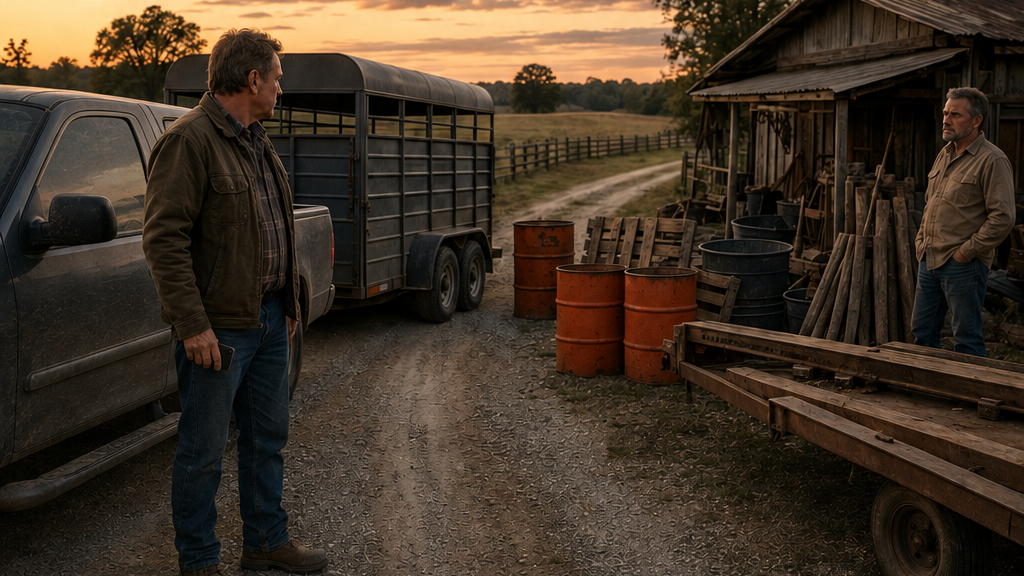
Two days later, Timothy arrived with the livestock trailer and stopped forty feet before the bend.
Gregory had kept his promise.
Three orange barrels stood along the outside of the pull-off. Behind them were two feed tubs, the wooden pallets, a stack of fence posts, and the cultivator Timothy had squeezed past earlier.
A low flatbed implement had been added near the far end.
There was enough width for Timothy’s pickup.
There was not enough for the trailer.
He sat behind the wheel while the cattle shifted behind him.
Their hooves struck the trailer floor with dull, uneven knocks.
Timothy had picked up four bred heifers from a farm thirty miles south. They were calm animals, but they had already been on the road an hour.
He could not leave them sitting there while he argued.
Gregory stood near his shed.
Not working.
Waiting.
Timothy saw that immediately.
Gregory had one foot on the edge of the gravel and his arms folded.
He wanted Timothy to get out.
More specifically, he wanted Timothy to move something.
Timothy shut off the engine.
The heifers shifted again.
He climbed down.
Neither man spoke at first.
Timothy walked forward, examining the available width.
Gregory finally said, “Pickup fits.”
“I’m towing cattle.”
“You could’ve come through earlier.”
Timothy turned. “Earlier than what?”
“Before I needed this area.”
“For what?”
Gregory gestured toward the equipment. “My place.”
“You’re storing things in the road.”
“I’m storing them beside the road.”
“You moved the barrels into the turning area.”
“They mark where I don’t want people running.”
Timothy looked at the nearest barrel. Its base sat on compacted gravel polished by years of trailer tires.
“This is where people run.”
“Then they can stop.”
Timothy felt heat rise into his neck.
The cattle shifted again behind him, amplifying every second.
“You knew I was hauling today.”
Gregory shrugged. “You haul all kinds of days.”
Timothy stepped toward the first barrel.
Gregory unfolded his arms.
That movement stopped him.
It was small, almost nothing.
But Timothy understood.
Touch it.
Give me something else to argue about.
He looked from Gregory to the barrel.
Then he took out his phone.
Gregory frowned. “What’re you doing?”
Timothy stepped backward until the entire bend fit in the frame.
He took a photograph.
Then another.
He walked to the center of the lane and photographed the trailer behind him, showing its width in relation to the barrels.
“What’s that supposed to do?”
Timothy ignored him.
He photographed each object separately.
Barrel one.
Barrel two.
Barrel three.
Two feed tubs.
Two pallets.
Fence posts.
Cultivator.
Flatbed implement.
A metal trough.
A damaged gate panel Timothy had not noticed from the truck.
Gregory watched him.
The silence changed the scene more effectively than shouting would have.
“You planning to send those to somebody?” Gregory asked.
“I’m documenting what’s here.”
“Document away.”
Timothy took another photograph from the fence corner.
He knew enough about disputes to understand that a close-up proved an object existed but not what it did. He needed the arrangement. The lane. The angle.
He walked back toward the truck.
One heifer bumped the trailer wall.
Timothy stood beside the driver’s door and looked at Gregory.
“I’m backing down to the county road.”
“That’s your choice.”
“No. It’s the choice left.”
Gregory’s expression tightened, but he said nothing.
Timothy climbed in.
Backing a livestock trailer that distance was possible. It was also slow, especially along a narrow gravel lane with shallow drainage on one side.
He eased backward using the mirrors.
Ten feet.
Twenty.
The trailer drifted.
He corrected.
One of the heifers stamped.
By the time Timothy reached a farm entrance wide enough to turn the rig, his jaw ached from clenching it.
He took the longer route around and entered his property from a secondary field gate that was serviceable but poorly suited for regular livestock hauling.
When he finally unloaded the heifers, the sun was low.
He stayed beside the trailer after the last animal walked into the holding lot.
For several minutes he considered calling Gregory.
He imagined exactly how the conversation would go.
You blocked me.
You got home.
That is not the point.
Then what is?
Nothing would change.
He took out the phone again.
The photographs carried the time automatically.
5:47 p.m.
5:48.
5:49.
Timothy opened a notes screen.
He began listing.
Three orange barrels.
Two plastic feed tubs.
Two wooden pallets.
One stack of fence posts.
One cultivator.
One flatbed implement.
One metal trough.
One gate panel.
He paused.
Twelve.
There had been more.
He enlarged the wide photograph.
Near Gregory’s shed stood two trash barrels partly on the gravel. A length of corrugated drainage pipe lay parallel to the road. Two portable fencing panels leaned outward far enough to matter.
Sixteen.
Then he noticed the old mineral feeder behind the cultivator.
Seventeen.
Timothy stared at the number.
Seventeen objects did not prove seventeen violations of anything. He did not yet know whether there was a violation.
But seventeen objects arranged along one bend looked different on a screen than they did one at a time from the driver’s seat.
They formed a pattern.
The next evening Timothy walked the lane at nearly the same time.
He used the same camera positions.
The barrels remained.
The flatbed implement had shifted several feet closer to the gravel center.
He photographed it.
The following morning, before starting chores, he took another set.
Gregory was not outside.
That made it easier.
Timothy did not measure. He did not touch. He did not step onto Gregory’s yard.
He stood on the shared lane and photographed what the lane looked like.
For the first time since the dispute began, he felt less like he was reacting to Gregory and more like he was doing something deliberate.
That feeling lasted until late afternoon.
A feed truck arrived.
The driver slowed before the bend, stopped, and called Timothy.
“You expecting me to thread this?”
Timothy was already walking toward the lane.
“No.”
“Want me to try?”
Timothy looked at the truck. It was wider than his pickup and longer through the rear axle.
“No. Don’t risk it.”
The driver sighed. “Where you want me?”
Timothy directed him to another entrance and spent forty minutes moving feed farther than usual with his own equipment.
When the truck left, Timothy returned to the bend.
Gregory stood beside one of the barrels.
“Everybody got where they needed to go,” Gregory said.
Timothy lifted his phone.
Click.
Gregory stared at him.
Timothy moved to the next fixed position.
Click.
“Is this what you’re doing now?”
Timothy said nothing.
He photographed the feed tubs, the fence panels, the drainage pipe, the pallets, the implement and the barrels.
Then he walked home.
At the kitchen table that night, he laid a legal pad beside his phone and counted everything visible in the clearest set of pictures.
This time he counted twice.
Seventeen separate obstructions sat along the shared farm lane.
And for the first time, Timothy began wondering not how quickly Gregory could move them, but how long he had been getting away with putting them there.
Chapter 3: Seventeen Objects Became Twenty-Six
By Thursday evening, Timothy’s count had reached twenty-six.
He stood at the same fence corner where he had taken the first wide photograph and checked the number again.
Gregory had added two stacks of lumber, another barrel, a portable hay ring, lengths of irrigation hose, and an old spreader tongue.
Some objects were clearly stored.
Others looked almost theatrical in their placement.
Timothy no longer tried to guess which was which.
He photographed all of them.
Seven days of images now sat in a folder on his phone.
Same bend.
Same fence post.
Same gravel shoulder.
Different objects.
The narrowing lane changed subtly from picture to picture until Timothy swiped quickly through them. Then the effect became obvious. The open strip seemed to breathe inward.
Friday morning he drove to the small association office, a converted room attached to an agricultural supply building.
Deborah Davis sat behind a desk crowded with invoices, road-association notices, and a calculator.
She listened while Timothy explained.
At first, her expression barely changed.
“Have you and Gregory tried working this out directly?”
“Yes.”
“And?”
“He added barrels.”
Deborah looked over the top of her glasses.
Timothy set his phone down.
“I’m not asking you to referee an argument.”
“That’s what half these things become.”
“This one has a trailer involved.”
“Most of them have something involved.”
He slid the phone toward her.
The first photograph showed the empty trailer unable to make the turn.
The next showed the same bend the following day.
Then another.
Deborah stopped scrolling.
“How many pictures?”
“Seven days.”
“How many objects?”
“Twenty-six as of yesterday.”
“That many?”
“Depending on whether you count a stack as one.”
Deborah looked at him again.
“You counted them.”
“Yes.”
Something about that seemed to change her understanding of why he had come.
She scrolled more slowly.
Timothy said, “I need to know the required width.”
Deborah turned toward a filing cabinet.
“That’s not as simple as you’re hoping.”
“I’ve got recorded access.”
“You do.”
“For agricultural use.”
“You do.”
“So what’s complicated?”
She pulled a folder and opened it.
“The original access language says the route must remain usable for agricultural passage.”
“That sounds uncomplicated.”
“It doesn’t say twelve feet. Fourteen. Sixteen. It doesn’t define the pull-off separately. It predates some of the equipment using this road now.”
Timothy leaned back.
For a week he had imagined reaching this point and finding one sentence that settled everything.
Instead, Deborah was giving him grammar.
“So Gregory can block it?”
“I didn’t say that.”
“He says he can.”
Deborah searched through another set of papers.
“Gregory says his family has longstanding use of the pull-off.”
“Storage isn’t passage.”
“I know.”
“Then tell him.”
She closed the folder.
“Timothy, this association has never adopted a storage rule.”
He stared at her.
“You’re telling me nobody thought to prohibit leaving farm equipment in an access lane?”
“I’m telling you people managed it informally.”
“That’s going well.”
Deborah ignored the remark.
“Most people kept things clear because they needed the road too.”
“Gregory needs it.”
“He also believes that wide section is different.”
“Because his father dumped gravel there.”
Deborah’s eyes lifted.
“He told you that?”
“Several times.”
She was quiet for half a second too long.
Timothy noticed.
“What?”
“Nothing.”
“That wasn’t nothing.”
Deborah aligned the folder with the edge of her desk.
“Gregory’s father did more than dump gravel.”
“How much more?”
“This isn’t the part I’m dealing with today.”
“Then what part are you dealing with?”
“The documented obstruction.”
She asked Timothy to email the photos.
He did.
She opened the attachments on her computer and began moving through them.
“Same locations?”
“Every day.”
“Approximately same time?”
“Within an hour.”
She paused at the wide shot with the livestock trailer.
“This is useful.”
It was the first thing anyone had said that made the week feel productive.
“Useful enough to clear the lane?”
“Useful enough to show a pattern.”
That was less satisfying.
Still, it was something.
Deborah printed three photographs and placed them beside each other.
Tuesday.
Wednesday.
Thursday.
The barrels were easy to track.
The implement was not.
It crept outward a little farther each day.
Deborah pointed to it.
“Did you move any of these?”
“No.”
“Did anybody with you?”
“No.”
“Did you tell Gregory you were documenting?”
“He figured it out.”
“Any threats?”
Timothy hesitated.
“He told me if I wanted something moved, I could move it myself.”
“That isn’t exactly a threat.”
“I know.”
“And you didn’t?”
“No.”
“Good.”
The word landed strangely.
Timothy had spent days feeling ridiculous for photographing feed tubs.
Now restraint looked less like passivity.
Deborah gathered the printouts.
“I’ll contact Gregory.”
“When?”
“Today.”
“And tell him what?”
“That the association is reviewing whether his storage interferes with recorded agricultural access.”
Timothy stood.
“You already know it does.”
“I know what your photographs show.”
“My trailer couldn’t get through.”
“And he may say you could have used another entrance.”
“That’s not his decision.”
“No,” Deborah said. “It isn’t.”
Timothy stopped.
That was the clearest statement she had made.
He left the office feeling better than when he arrived.
By midafternoon, that feeling was gone.
Gregory called him.
“You took this to Deborah?”
Timothy stood beside a water trough while cattle crowded the shade behind him.
“Yes.”
“You couldn’t leave it between us?”
“We tried between us.”
“No, you told me what I could do.”
“You blocked my trailer.”
“You’ve got another gate.”
“That doesn’t erase this one.”
Gregory’s voice sharpened. “My family has used that pull-off since before Deborah had that desk.”
“For storage?”
“For whatever needed doing.”
“That isn’t a rule.”
“It’s custom.”
“Custom doesn’t override recorded access.”
There it was again.
Timothy heard himself fall back into the same certainty.
Gregory went quiet.
Then he said, “You really don’t know, do you?”
“Know what?”
“How that road stayed open.”
The call ended.
Timothy stared at the screen.
That evening, the equipment remained where it had been.
He took photographs anyway.
Twenty-six objects.
Saturday morning brought no removal.
Instead, Robert Taylor’s old pickup rolled into Timothy’s yard while he was repairing a section of hay rake.
Robert was nearly seventy, broad through the shoulders despite his age, and slow in a way that suggested choice rather than weakness.
He climbed out holding a coffee cup.
“Deborah called me.”
Timothy kept one hand on the wrench.
“About Gregory?”
“About the road.”
“That means Gregory.”
Robert leaned against the truck.
“You keeping pictures?”
“Yes.”
“Probably smart.”
Timothy waited.
Robert did not immediately defend Gregory, which made Timothy more cautious than if he had.
“He’s blocking an agricultural lane,” Timothy said.
“I’ve seen it.”
“And?”
“And he ought to move the stuff.”
Timothy set the wrench down.
“All right.”
Robert took a drink.
“But you’re missing something.”
“I keep hearing that.”
“You keep arguing before anybody gets to tell you.”
Timothy looked at him.
Robert did not smile.
For a moment Timothy was tempted to send him away.
Instead, he wiped his hands on a rag.
“What am I missing?”
Robert glanced toward the lane beyond the pasture fence.
“You remember the ice winter when the ditch collapsed below the Moore place?”
“Some of it.”
“You remember who dug it out?”
“The association.”
Robert shook his head.
“You remember who paid for the stone after the spring washout?”
Timothy said nothing.
Robert looked back at him.
“You know who kept that road passable for twenty-three winters?”
Timothy felt the certainty he had carried into Deborah’s office begin to shift under him.
Robert opened the passenger door of his pickup.
“I’ve got the old maintenance notebooks in my machine shed.”
He put the coffee cup inside.
“You ought to read them before you decide Gregory’s father only dumped a little gravel.”
Chapter 4: The Work Nobody Had Paid For
Robert Taylor did not show Timothy a deed, a survey, or a forgotten agreement.
He showed him a grease-stained spiral notebook.
It lay open on the workbench inside Robert’s machine shed, its cardboard cover curled at the corners and darkened by years of handling. Several pages had been reinforced with clear tape. Others carried numbers written in different inks, some faded nearly gray.
Timothy looked at it, then at Robert.
“This is what you wanted me to see?”
Robert turned the notebook around.
“Read.”
The first page Timothy studied was dated twenty-one years earlier.
Gravel, six loads.
Culvert cleaned.
South ditch opened.
Moore tractor, six hours.
No amount charged beside the labor.
The next entry was similar.
Then another.
Names appeared beside occasional payments from association members, but many lines ended with nothing except the work itself.
Timothy flipped ahead.
“Who kept these?”
“Gregory’s father at first. Then me for a few years when I handled collections.”
“Why wasn’t this in the association records?”
“Some of it was.”
“Some?”
Robert leaned against the bench.
“The association kept bills. What it didn’t always keep was a good accounting of favors.”
Timothy turned another page.
Spring washout.
Stone at lower bend.
Moore hauled.
No labor billed.
There were receipts folded between pages. Quarry slips. Fuel totals. A handwritten note showing money collected from four landowners and a larger amount paid personally by Gregory’s father.
Timothy’s irritation did not disappear.
But it lost its clean edges.
“How many years?”
“Depends what you count.”
“You said twenty-three winters.”
Robert nodded. “There were years he did nearly everything. Other years, not much. But when a culvert plugged at midnight, nobody called a contractor first. They called him.”
“That still doesn’t make the pull-off his.”
“No.”
Robert said it immediately.
Timothy looked up.
Robert’s expression had not changed.
“I’m not telling you Gregory is right.”
“Then what are you telling me?”
“That you were wrong about one part.”
Timothy closed the notebook.
He knew exactly which part Robert meant.
Your father doing road work twenty years ago doesn’t let you choke down access today.
It was not the second half of that sentence that bothered him now.
It was the first.
“Gregory heard me dismiss all this.”
“He probably heard what he expected to hear.”
“That doesn’t excuse what he’s doing.”
“No.”
Robert picked up a small metal ruler from the bench and turned it in his fingers.
“Two things can stay true at the same time.”
Timothy gave him a tired look.
“I know that.”
Robert raised an eyebrow.
“Knowing it and liking it are different.”
They drove separately down to the drainage ditch beneath Gregory’s frontage.
Robert stopped near the lower bend and pointed toward a stretch where the bank had been cut back years earlier.
“That washed out twice in one spring.”
Timothy remembered the mud. He did not remember who had repaired it.
Robert walked along the ditch.
“Gregory’s father dug this with an old backhoe. Didn’t bill his time.”
“How much did the association pay for material?”
“Some.”
“Some again.”
“That was the arrangement.”
“There was an arrangement?”
Robert shook his head. “That’s the problem. There wasn’t.”
Timothy looked toward the lane.
From this angle, the gray gravel seemed ordinary.
He had driven over it thousands of times without wondering which load came from whose pocket.
Robert continued.
“People would give money when something got bad enough. His father kept working because he needed the road himself. After a while, everyone treated that as normal.”
“Including my family?”
Robert hesitated.
That hesitation was enough.
Timothy stared at him.
“How much?”
“I don’t know exactly.”
“You kept the notes.”
“Not all years.”
“Did my father pay?”
“Sometimes.”
“And other times?”
Robert looked toward the ditch.
“Other times he said he’d settle after hay sold.”
Timothy felt something tighten in his chest.
“Did he?”
“Sometimes.”
The answer was gentle.
That made it worse.
Timothy remembered his father complaining about assessments, about gravel costs, about people who wanted too much money for simple work. He remembered hearing those conversations as a teenager without ever asking who had actually climbed onto the tractor afterward.
Robert tapped the notebook against his leg.
“That’s what I meant when I said everybody benefited.”
Timothy walked several yards down the lane.
The same packed surface he had regarded as a right now carried another meaning beneath it.
Not ownership.
Debt.
Unrecorded, uneven, old enough that no one agreed on the amount.
Gregory drove past in his pickup while they stood there.
He slowed.
His window was open.
“You giving history lessons now, Robert?”
Robert answered calmly. “Somebody should have earlier.”
Gregory looked at Timothy.
Timothy expected a remark.
Instead Gregory drove on.
That silence stayed with him.
By afternoon, Timothy was back at Deborah Davis’s office.
She had more papers spread across her desk than before.
“You talked to Robert,” she said.
“Yes.”
“I thought you might.”
“Why didn’t you tell me this?”
Deborah removed her glasses.
“Because I was trying to answer the access question first.”
“You knew the association let Gregory’s father do all that work.”
“Everyone knew some version of it.”
“That’s not what I asked.”
Deborah looked down at the records.
“Yes.”
“And kept dues low because of it?”
Her jaw tightened.
“Dues stayed low for several reasons.”
“Was one of them that Gregory’s father kept grading the lane without billing his labor?”
“Yes.”
There it was.
No ambiguity.
Timothy pulled out the chair and sat.
“So the association benefited.”
“Yes.”
“And never formalized his role.”
“No.”
“And now Gregory thinks that history gives him the pull-off.”
“That part is Gregory’s interpretation.”
“Did anyone ever tell him otherwise?”
Deborah did not answer quickly.
Timothy leaned back.
“That’s a no.”
“We never had to.”
“You mean until I needed the width.”
Deborah folded her hands.
“Timothy, this association has functioned for years on people doing what was practical.”
“That works until practical means different things to different people.”
“I know.”
He studied her.
For the first time she looked less like someone holding the solution and more like someone standing inside the problem.
“What happens now?”
“I’ve been through every recorded vote I could find.”
“And?”
“There is no grant of exclusive use.”
Timothy let out a slow breath.
“No storage right?”
“None that I can find.”
“No vote assigning that pull-off to Gregory?”
“No.”
That should have felt like the answer.
A week earlier it would have.
Instead Timothy heard Robert’s voice.
Two things can stay true at the same time.
“So he has to clear it.”
“The association can direct him to clear anything that materially interferes with agricultural passage.”
“Then do it.”
Deborah looked at him carefully.
“We can.”
The hesitation irritated him.
“What?”
“The moment we do, Gregory is going to ask the other question.”
“What other question?”
“Who pays to maintain the lane once he stops doing what his father did.”
Timothy said nothing.
Deborah pushed one of his printed photographs toward him.
The image showed the narrow bend crowded by barrels and implements.
“You documented the obstruction very well,” she said. “Now we have to deal with why nobody stopped this arrangement years ago.”
Timothy stared at the photograph.
For the first time, the lane did not look like something Gregory had simply taken.
It looked like the place where several people’s old choices had finally run out of room.
Chapter 5: The Rule They Never Wrote Down
Deborah laid Timothy’s photographs in a straight row across the association table before anyone spoke.
Seven days of the same bend.
Open space shrinking one object at a time.
Beside them she placed copies of old maintenance records.
Gregory sat on the opposite side of the table with his arms folded.
Robert sat two chairs away from him. Three association board members filled the remaining seats.
Timothy took the chair closest to the door.
Deborah tapped the first photograph.
“This is Tuesday.”
Then the next.
“Wednesday.”
She moved along the row.
“Thursday. Friday. Saturday.”
One board member leaned closer.
“That flatbed really moved that far?”
Timothy answered. “Yes.”
Gregory looked at him. “You act like I shoved it under his truck.”
“No,” Timothy said. “I act like you moved it farther into the turn.”
Gregory’s mouth tightened.
Deborah raised a hand before either man continued.
“The purpose of this meeting is not to decide who can phrase the best accusation.”
She slid the maintenance records forward.
“We have two problems.”
Gregory looked at the papers.
Timothy looked at Deborah.
“First, the lane has to remain usable for agricultural passage. Timothy’s documentation strongly suggests the present storage pattern interferes with that use.”
“Suggests?” Timothy said.
Deborah gave him a look.
“Strongly demonstrates, if you prefer.”
Gregory leaned forward.
“He’s got another entrance.”
Timothy answered immediately. “Not for regular hauling.”
“You used it.”
“Because you blocked this one.”
A board member cleared his throat.
“What if we set hauling hours?”
Timothy turned.
The board member continued.
“Gregory could keep equipment where it is most days. Timothy could give notice when he needs the full turn. Twelve hours, maybe twenty-four.”
Timothy stared at him.
“You want me to schedule access to my own farm around somebody else’s storage?”
“I’m trying to find a practical solution.”
“That isn’t a solution. That transfers the problem to me.”
Gregory shook his head. “Everything’s a problem if you decide it is.”
Timothy almost answered sharply.
Then he saw Robert watching him.
Not Gregory.
Him.
Timothy looked back at the board.
“I’ll give notice when I’m bringing an oversized piece of equipment through if that helps people coordinate. I will not ask permission to use the normal agricultural lane.”
The room went quiet.
It was less satisfying than saying absolutely not.
But it was more accurate.
Deborah nodded once.
“That’s reasonable.”
Gregory shifted in his chair.
“And my part?”
Deborah pulled the maintenance records closer.
“That’s the second problem.”
Gregory’s expression changed.
“Your father performed substantial road maintenance over many years without full reimbursement.”
One board member looked down.
Another rubbed his chin.
Deborah continued.
“The association benefited from that. We also failed to establish a formal maintenance schedule, cost-sharing formula, or storage policy.”
“So now that matters?” Gregory asked.
“It should have mattered before.”
He gave a bitter laugh.
“That’s convenient.”
“No,” Deborah said. “It’s overdue.”
Timothy watched Gregory.
The anger in him was different from the anger Timothy had seen beside the barrels.
Less theatrical.
Older.
Gregory pointed at the photographs.
“Everybody wants that stuff gone. Fine. Who’s grading the road next month?”
A board member said, “We can hire somebody.”
“With what money?”
“We have reserves.”
Gregory looked at Deborah.
“How much?”
Deborah did not answer.
That answer was also clear.
“Exactly,” Gregory said.
Timothy looked toward the maintenance records.
“How much have we been spending?”
“Not enough,” Deborah said.
Gregory laughed again.
“My father told you that for fifteen years.”
No one disputed it.
A board member tried to steer the conversation back.
“We’re talking about the obstruction.”
“We’re talking about why the obstruction exists,” Gregory said.
Timothy expected himself to bristle.
Instead he said, “He’s right about that part.”
Gregory turned toward him.
So did everyone else.
Timothy kept his voice even.
“You still can’t block the lane.”
Gregory’s expression closed again.
“I didn’t say I could.”
“You’ve been doing it.”
“I’ve been using the only leverage anybody ever notices.”
The words landed harder than Timothy expected.
Deborah leaned forward.
“Say that again.”
Gregory shook his head.
“No.”
“You said leverage.”
“I know what I said.”
Timothy studied him.
Something had shifted.
All week Gregory had argued ownership, custom, his family’s place, his father’s gravel.
Now he had used another word.
Leverage.
A board member said, “Are you admitting you put the equipment there to force a maintenance discussion?”
Gregory stared at the table.
“I’m saying people notice things when they can’t get through.”
“That doesn’t help you,” Deborah said.
“I’m not trying to help myself.”
“That’s not true,” Timothy said.
Gregory looked up.
“You want the association to start paying its share.”
Gregory’s face stayed still.
Timothy continued.
“You could have asked.”
“I did.”
“When?”
“For years.”
“Not me.”
“Your family was on this road longer than you’ve been signing the checks yourself.”
Timothy felt the old instinct rise—to defend, to separate himself from his father’s decisions.
He stopped it.
“My family benefited.”
The admission made the room quieter than any argument had.
Gregory’s shoulders shifted slightly.
Timothy went on.
“That still doesn’t buy you the turn.”
“No.”
Gregory said it without hesitation.
The same simple answer Robert had given him.
Timothy looked at him.
“You know that?”
“I know what the records say.”
“Then why keep saying the pull-off is yours?”
“Because when people think they might lose something, they show up.”
Timothy understood then that Gregory’s claim had always been partly performance.
A bad one.
A damaging one.
But not entirely delusion.
Deborah collected the papers into two stacks.
“We need a usable-width determination before we draft anything.”
A board member asked, “From who?”
“County road inspector.”
Gregory sat back. “For a private agricultural lane?”
“For access impact, not ownership.”
Timothy said, “When?”
“I called this morning.”
Gregory looked at her sharply.
“You called before the meeting?”
“I did.”
“Already decided, then.”
“No. I decided we need a measurement that does not belong to either of you.”
That silenced him.
The board voted to request the inspection and table any permanent storage rule until the lane could be evaluated under normal farm use.
No one left happy.
Outside, Gregory walked toward his truck.
Timothy followed far enough to speak without the board listening.
“Gregory.”
He stopped.
“I meant what I said.”
“Which part?”
“Your father’s work should have been accounted for.”
Gregory looked toward the lane.
“You think saying that now fixes it?”
“No.”
“Good.”
“I also mean the equipment has to move.”
Gregory nodded once.
“There it is.”
Timothy let the silence hold.
He could feel how easy it would be to turn the moment back into the old argument.
Instead he said, “Both things are true.”
Gregory looked at him then.
For the first time, there was no smirk and no challenge in his face.
Only exhaustion.
“You finally figured that out.”
He got into his truck and drove away.
Timothy remained beside the meeting building until Deborah came outside holding her phone.
“He can be there at eight tomorrow morning,” she said.
“Who?”
“The county inspector.”
Timothy looked toward the bend in the distance.
The orange barrels were still visible.
“So tomorrow we find out what usable means.”
Deborah shook her head.
“No. Tomorrow we find out what the lane physically requires.”
She slipped the phone into her pocket.
“Then you all still have to decide what fairness requires.”
Chapter 6: The Width of a Livestock Trailer
The county inspector did not begin with a tape measure.
He pointed at Timothy’s truck and said, “Drive it.”
Timothy stood beside the loaded livestock trailer in the pale morning light.
“Through the bend?”
“Exactly how you normally would.”
Gregory was already there near the pull-off.
So were Deborah, Robert, and two board members.
The barrels remained in place. The flatbed implement sat where it had for three days. Gregory had moved nothing overnight.
Timothy climbed into the truck.
The inspector stepped back.
“Don’t exaggerate the turn for me. Don’t make it look better either.”
Timothy nodded.
He pulled forward.
The trailer followed steadily until the truck nose entered the bend. Then Timothy began the usual swing.
The right trailer tire approached the first barrel.
He turned farther.
The trailer angle tightened.
The rear corner moved toward the stacked pallets.
He stopped.
The inspector walked around the rig.
“Back up and try your normal correction.”
Timothy did.
Six feet backward.
Wheel left.
Then forward again.
The rear axle moved closer to the ditch.
The trailer still could not complete the turn without crossing the section Gregory had filled.
The inspector raised a hand.
“That’s enough.”
Timothy set the brake.
He climbed down.
No one spoke for several seconds.
The proof looked simpler in person than in photographs.
Truck.
Trailer.
Lane.
Barrier.
The inspector walked the curve, studying tire marks in the gravel.
“These are established tracks?”
Timothy said, “For years.”
Gregory answered at the same time. “Mostly his.”
The inspector looked at both men.
“Doesn’t matter whose if this is the access route and this equipment requires that swing.”
He pointed toward the flatbed.
“How long has that been there?”
Gregory said, “A week.”
Timothy said nothing.
The inspector moved to the barrels.
“And these?”
“Temporary.”
“Temporary can still obstruct.”
Gregory’s jaw tightened.
The inspector crouched near the polished gravel where trailer tires had run before the objects appeared.
“This turning area is functioning as part of the route whether somebody calls it a pull-off or not.”
Deborah asked, “Enough to require clearance?”
“For normal agricultural passage? Based on what I just watched, yes.”
A board member shifted his weight.
“So everything comes out?”
The inspector stood.
“I’m not writing your association policy. I’m telling you the access cannot be narrowed below what ordinary agricultural traffic here reasonably requires.”
Timothy felt the answer settle through him.
For more than a week, he had wanted one sentence that could not be argued around.
Now he had it.
Gregory looked toward the trailer.
“You brought the widest thing you own.”
Timothy shook his head.
“No.”
Gregory looked at him.
“I own wider equipment.”
That silenced the objection.
The inspector asked Timothy to try once more after one barrel and the nearest pallet stack were moved.
Gregory did not volunteer.
The board member moved the barrel. Robert shifted the pallets.
Timothy drove again.
The trailer nearly cleared.
Nearly.
The inspector stopped him.
“One more obstruction.”
The flatbed implement had to move.
This time Gregory walked over and hooked his tractor to it without a word.
He pulled it back toward his shed.
Timothy tried the turn again.
The trailer passed cleanly.
The difference was only several feet.
But once the rig was through, the bend looked like a road again.
The inspector took notes.
Gregory stood beside the tractor, arms loose at his sides.
His face had lost its challenge.
Deborah approached the inspector.
“What can the association require immediately?”
“Removal of items that interfere with the established agricultural passage.”
“Penalty?”
“That depends on your governing documents and whatever enforcement authority you actually have.”
Timothy heard the word penalty and looked toward Gregory.
A week earlier, the idea would have pleased him.
Fine him for every day.
Every object.
Make the lesson expensive enough that nobody tried it again.
Deborah turned to Timothy.
“You’ve documented repeated interference. If the board wants to pursue the maximum enforcement provisions, we can review them.”
Gregory looked at him.
It was not defiance this time.
It was calculation.
He knew Timothy’s photographs could become more than evidence for clearance.
Timothy looked down the lane.
The marks from his trailer tires curved across the gravel where the pull-off had been.
He remembered the notebook.
The unpaid tractor hours.
His father saying he would settle after hay sold.
He remembered Gregory’s sentence from the meeting.
People notice things when they can’t get through.
Timothy hated the method.
But he understood the grievance.
“I want the lane cleared,” he said.
Deborah waited.
“And?”
“I’m not interested in stacking every penalty we can find if he clears it.”
One board member frowned. “After all this?”
“Yes.”
Gregory stared at him.
Timothy continued.
“That doesn’t mean nothing happened. It means I want the problem corrected more than I want him punished.”
The inspector closed his notebook.
“That’s association business.”
“Understood.”
Deborah looked at Gregory.
“You heard him.”
Gregory gave a short nod.
“I heard.”
“Will you clear the rest?”
Gregory looked at the barrels.
Then at the pallets.
Then back toward his property.
“What happens next time the ditch washes out?”
A board member exhaled impatiently.
“We’re dealing with the obstruction now.”
Gregory shook his head.
“That’s what everybody always does. Deal with what’s in front of the tires. Ignore what put it there.”
Timothy stepped closer.
“What do you want?”
Gregory looked at him.
“Written maintenance.”
Deborah said, “We’re already discussing that.”
“No. Discussing means next month somebody forgets.”
“What specifically?”
“A schedule. Who grades. Who clears drainage. Who pays for gravel. And no more pretending one family just handles it because they’ve got a tractor.”
Robert nodded slowly.
The board members did not.
Timothy saw the resistance immediately.
Money.
It had always been money.
Gregory pointed toward the remaining equipment.
“I move all of it. Not just enough for his trailer.”
Deborah said nothing.
“In return,” Gregory continued, “you put one rule in writing. Everybody using the lane pays their share of maintenance. Labor gets valued, not treated like a favor forever.”
A board member said, “You can’t condition compliance.”
Gregory looked at him.
“I can clear it because it’s right and still tell you what I need before I keep doing everybody else’s work.”
The sentence changed the tone.
Timothy looked at him carefully.
“Are you saying you’ll move it regardless?”
Gregory hesitated.
Then nodded.
“Yes.”
It was the first concession he had made without disguising it.
Timothy stepped forward and held out his hand.
Gregory looked at it but did not take it.
“Not yet,” he said.
Timothy lowered his hand.
Fair enough.
Gregory walked to the tractor.
Before starting it, he looked back.
“I’ll have everything clear by sundown.”
Timothy nodded.
Gregory started the engine.
Then he added over the noise, “But if you want it to stay open, you back me on the maintenance rule.”
Timothy looked toward the full width of the lane his trailer had just used.
For the first time, keeping it open no longer seemed like a question of what Gregory had to stop doing.
It had become a question of what everyone else would finally agree to do.
Chapter 7: What the Open Lane Cost Everyone
Two weeks later, Timothy turned off the county road and nearly missed the pull-off because there was nothing in it.
No orange barrels.
No pallets.
No feed tubs.
No flatbed implement angled toward the gravel.
The wide section beside Gregory Moore’s frontage was empty from ditch to fence, with fresh tire marks where the last equipment had been dragged away.
Timothy slowed his pickup.
For months, his eyes had trained themselves to search for obstacles before the bend. Now the absence of them looked almost unnatural.
Gregory was standing near his shed with a shovel in one hand.
Timothy stopped.
Gregory glanced toward him.
“You checking?”
Timothy looked down the open lane.
“Habit.”
“Everything’s off it.”
“I see that.”
Gregory drove the shovel into a pile of loose gravel beside the shed.
Neither man mentioned the inspection.
Neither mentioned the penalties Timothy had decided not to pursue.
Timothy looked at the drainage shoulder.
Fresh stakes marked a narrow strip beyond the established travel area. Deborah had arranged for the association to mark temporary storage limits until a permanent rule could be voted on.
Gregory followed his gaze.
“They give me enough room to keep a couple things beside the shed.”
“As long as they stay behind the stakes.”
“That’s what they said.”
Timothy nodded.
He started to roll up his window.
Gregory spoke before he could.
“Meeting’s tonight.”
“I know.”
“You still backing the maintenance rule?”
Timothy looked at him.
“Yes.”
Gregory studied his face as if waiting for a qualification.
There wasn’t one.
Timothy drove on.
That evening the association meeting room was fuller than he had ever seen it.
People who had ignored road meetings for years had found time once the proposed maintenance assessment arrived in their mailboxes.
Deborah sat at the front with copies of the draft policy stacked beside her.
Robert occupied his usual chair.
Gregory sat across the aisle from Timothy instead of directly opposite him.
The change felt deliberate.
Deborah called the meeting to order.
“We have three items,” she said. “Minimum usable lane width, storage boundaries, and annual maintenance funding.”
The first two passed with little trouble.
The route would remain clear for normal agricultural traffic. Storage could not extend into the established turning area. Temporary materials had to remain behind marked shoulders unless the association approved otherwise.
Then Deborah reached the money.
The room tightened.
A board member read the proposed annual assessment.
Someone near the back immediately said, “That’s nearly double.”
Another voice followed.
“For gravel we’ve been getting anyway?”
Gregory leaned back in his chair.
Timothy saw his expression harden.
There it was again.
The old problem appearing in a new form.
A landowner near the door said, “Why don’t we just hire Gregory when something needs done and pay him then?”
Gregory laughed once.
“No.”
The room turned toward him.
Deborah said, “Let him finish.”
Gregory folded his hands.
“That’s exactly what we did before. Something breaks. Somebody calls. I bring a tractor. Then three months later we argue about what it was worth.”
The landowner shrugged.
“You’d get paid.”
“If everybody agrees afterward.”
“You could submit an invoice.”
“My father submitted plenty.”
Robert looked down.
The room became quieter.
Timothy watched several faces avoid Gregory’s.
Deborah said, “The proposed policy values labor before work begins. Equipment rates are established annually. Emergency work requires two approvals when possible. Gravel and contracted repairs come from the maintenance fund.”
A board member tapped the paper.
“It’s still a lot of money.”
Timothy heard himself almost agree.
The figure was not insignificant.
Hay prices had not been generous. Fuel had climbed. Cattle expenses were never considerate of association meetings.
He could have argued for a smaller assessment.
Two months earlier, he probably would have.
Then he remembered Robert’s notebook.
His father promising to settle after hay sold.
He remembered driving across repairs someone else had made while thinking only of the road as something he had a right to use.
Timothy raised his hand.
Deborah nodded.
“I don’t like the number either,” he said.
A few people smiled.
“But I liked the old number because it wasn’t the real number.”
The smiles disappeared.
Timothy continued.
“We paid less because somebody else carried part of the cost.”
A landowner said, “Nobody forced them.”
“No,” Timothy replied. “That’s part of how we got here.”
Gregory looked toward him.
Timothy kept his eyes on the room.
“We let informal work become expected work. Then we acted surprised when the person doing it believed that gave him some authority over the road.”
Gregory shifted.
Timothy glanced at him.
“He was wrong about the authority.”
Gregory gave the smallest nod.
“But the rest of us were wrong about the obligation.”
No one applauded.
Timothy was glad.
It was not that kind of room or that kind of problem.
A board member asked, “What happens if costs are lower than projected?”
Deborah explained the reserve balance.
Another member asked about contractors.
Then another about emergency drainage.
The conversation moved away from blame and into numbers.
That felt more productive than agreement.
Half an hour later, the vote was taken.
The maintenance policy passed by one vote.
Gregory exhaled but did not smile.
Afterward, people folded papers, moved chairs, and left in small groups.
Timothy stayed while Deborah gathered the ballots.
Gregory approached the table.
“So that’s it?” he asked.
Deborah looked up.
“That’s the rule.”
“Until somebody changes it.”
“Rules can change.”
Gregory’s expression darkened.
Deborah added, “But not by leaving twenty-six objects in the road.”
Robert laughed quietly.
Even Gregory almost smiled.
Timothy stood.
Outside, Gregory caught up with him beside the parking area.
For a while they walked without speaking.
Then Gregory said, “You know I never thought that whole lane belonged to me.”
Timothy stopped.
Gregory kept his eyes toward the darkening fields.
“You argued like you did.”
“I wanted you to argue back.”
“I did.”
“That wasn’t what I meant.”
Timothy waited.
Gregory rubbed a hand over his jaw.
“My dad complained for years. People nodded. Then the bill came and suddenly nobody remembered agreeing.”
“So you decided if the road became inconvenient, people would notice.”
“Pretty much.”
“You blocked cattle.”
“Yes.”
“You turned a real grievance into something I couldn’t ignore.”
Gregory looked at him.
“That was the point.”
Timothy shook his head.
“It was still wrong.”
“I know.”
The answer came without resistance.
Timothy had expected it to feel better.
Instead, it made the whole dispute seem smaller and sadder.
“What were you afraid would happen?” Timothy asked.
Gregory looked back toward the meeting room.
“That I’d clear everything, everybody would get comfortable again, and next spring when the ditch washed out somebody would call me.”
He paused.
“And I’d go.”
Timothy understood that part better than he wanted to.
Gregory continued.
“Because if I didn’t, I’d be the one driving through the washout too.”
“So the work would start again.”
“And the forgetting.”
There was the truth beneath the barrels.
Not ownership.
Not even mostly pride.
Leverage against being useful for free.
Timothy looked down at the gravel under their boots.
“My father owed your father money sometimes.”
Gregory’s eyes shifted toward him.
“Robert told you.”
“Yes.”
“He owed everybody something at one time or another.”
“That doesn’t erase it.”
“No.”
Timothy held out his hand again.
This time Gregory took it.
The handshake was brief.
Not forgiveness.
Not friendship restored to something that had never quite existed.
But enough.
A few days later, Timothy hitched the livestock trailer before sunrise.
He checked the lights, latched the rear gate, and drove toward the shared lane.
At the bend, he slowed from habit.
The turn stood completely open.
The temporary stakes had been replaced with short permanent markers along the shoulder. Beyond them, Gregory’s equipment sat in an orderly row beside his shed.
A tractor was working farther down the opposite side.
Gregory was grading the shoulder.
Timothy stopped beside him.
Gregory idled the tractor down.
“You’re cutting that low.”
“Drainage needs somewhere to go.”
“Just saying.”
“You volunteering?”
Timothy smiled despite himself.
“Not today.”
Gregory pointed toward the trailer.
“You can clear that turn without backing now.”
“I know.”
The new maintenance agreement lay behind the scene in ways no one passing through would notice.
Gregory’s tractor hours would be recorded.
The fuel would be reimbursed.
The gravel would come from a funded account instead of somebody’s pocket and somebody else’s promise.
Timothy eased the truck forward.
The livestock trailer followed.
Its tires curved through the exact stretch where the orange barrels had once stood.
No backing.
No correction.
No need to fold the mirrors or watch the ditch.
Just the ordinary movement of a farm rig through a road built for it.
In his side mirror, Timothy saw Gregory lower the grader blade and return to work on the opposite shoulder.
For months, Timothy had thought an open lane meant Gregory had finally stopped taking something that belonged to everyone.
Now he understood it differently.
The lane stayed open because everyone had finally agreed that using it came with a cost.
And for the first time in years, that cost belonged to all of them.
The story has ended.