They Tried to Shut Down His Farm Workshop, Then Their Own Complaint Exposed the Rental Next Door
Chapter 1: The Morning They Called His Workshop a Business
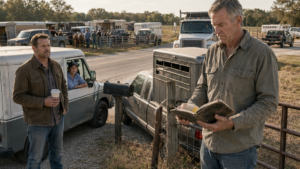
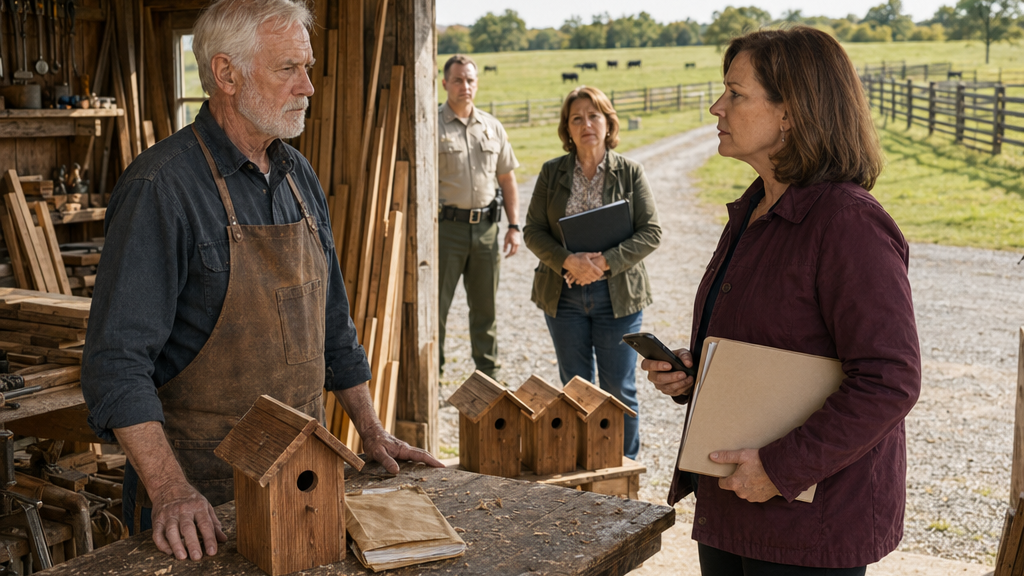
The county deputy stepped out of his cruiser just as James Walker pushed a cedar board through the table saw.
James killed the switch.
The blade wound down with a thin metallic whine, leaving the workshop suddenly quiet except for the cattle bawling beyond the back pasture and gravel crunching beneath another pair of shoes.
Katherine Harris came through the open side of the machinery shed carrying a folder against her burgundy jacket.
She did not say good morning.
“James, you need to stop work.”
He looked at the board still resting against the fence of the saw. A clean strip of pale cedar had curled away from it.
“Stop what part?”
“The commercial operation.”
James glanced past her toward the lane. The deputy remained beside the cruiser, one hand hooked over his belt, studying the scene without much expression.
James wiped sawdust from his palms onto his leather apron.
“I’m making a birdhouse.”
Katherine opened the folder.
“That is not the issue.”
She placed a sheet of paper on the workbench. It landed beside a half-finished cedar birdhouse whose roof James had not yet attached.
The association letterhead was familiar. James had seen enough envelopes with it to recognize the shape without reading a word.
He had thrown two of them into the drawer of his kitchen desk over the past month.
Katherine tapped the page.
“The association has received confirmation that you regularly manufacture goods on this property and sell them off-site. That makes this a commercial use.”
James stared at her.
For thirty-six years, the shed had held something noisy. First it had been a tractor, then a baler, then cattle panels, seed bags and broken machinery waiting to be repaired. After he reduced the herd, he had moved in the saw and planer.
Nobody had cared.
His wife had once joked that the shed changed jobs more often than he did.
After she died, he stopped joking about it.
He built things instead.
Birdhouses. Feed-bin lids. Small cedar boxes. Once, a toy barn for a neighbor’s grandson.
Katherine’s finger remained on the paper.
“You’ve also displayed these items for sale at the Saturday farmers market.”
“I take a few down there.”
“A few is still commercial.”
The deputy had moved closer now, though he stopped just outside the shed.
James looked at him.
“Did she call the sheriff’s office because I make birdhouses?”
The deputy cleared his throat.
“We were asked to stand by during an association compliance notice. I’m not here to decide anybody’s covenant dispute.”
Katherine’s mouth tightened.
“The concern is that Mr. Walker has continued operating after notice.”
James turned back to her.
“I didn’t answer your letters.”
“That is not the same as permission.”
“No. It isn’t.”
The admission surprised her enough that she paused.
James picked up the notice. It cited a section restricting commercial enterprises on properties using the private association road. Below that was language about continuing violations and escalating daily assessments following formal determination.
His attention stopped on the figures.
“You’re talking about charging me every day?”
“If the board determines that you continue after notice.”
“How much?”
Katherine gave him the number.
James read it again himself.
It was enough that the birdhouses on his bench stopped looking harmless.
He set the notice down carefully.
“You know what I made last year selling these?”
“That isn’t relevant.”
“Eight hundred and twelve dollars.”
The deputy looked toward the birdhouse.
Katherine did not.
James continued, “That includes the Christmas market.”
“You advertise custom work.”
“I made two custom orders last year.”
“You accept money.”
“I also sell hay. You planning to close the barn?”
“This restriction has an agricultural exception.”
“And you’re certain it doesn’t have any other exceptions?”
For the first time, Katherine hesitated.
Only briefly.
“The board reviewed the relevant language.”
James almost smiled.
Almost.
Ten years earlier he would have told her what he thought of that sentence. Five years earlier, he might have walked back to the saw and turned it on while she was still speaking.
At seventy-one, he had discovered that anger cost more energy than it returned.
But that did not mean he was calm.
He could feel something hard gathering behind his ribs.
The workshop was not a business to him.
He had begun spending full mornings there after his wife’s funeral because the farmhouse was too quiet. In the shed, there were switches to flip, measurements to check, boards that became square if a man paid attention.
Grief did not become square.
Wood sometimes did.
Katherine picked up the notice again.
“Until the review is complete, you should cease production and sales.”
“Should?”
“James.”
“I’m asking what the paper says.”
Her expression sharpened.
“It says continued activity may result in penalties.”
“Then I suppose we’ll find out what it means.”
The deputy shifted his weight.
Katherine closed the folder.
“This would be easier if you had responded when Brenda contacted you.”
James knew she was right about that.
He disliked that most of all.
The first notice had arrived during calving. He had tossed it aside.
The second had come a week later. By then, ignoring it had felt like a principle.
People had been using that road before Katherine ever bought property at the far end. James had helped spread gravel on it before there was an association bank account. He had remembered every winter washout, every culvert repair, every neighbor who had borrowed his tractor.
He had mistaken memory for authority.
Katherine turned toward the lane.
“Friday morning,” she said. “Nine o’clock. Formal inspection.”
James looked at the deputy.
He raised both hands slightly.
“I won’t be involved unless there’s a separate reason for us to be.”
Katherine seemed dissatisfied by that clarification.
She walked back toward her vehicle.
James waited until both engines had started before he touched the cedar board again.
He did not restart the saw.
Instead, he carried the unfinished birdhouse into the small office at the rear of the shed, where old farm records were stacked in metal cabinets.
He opened one drawer.
Seed receipts.
Cattle records.
Tax statements.
His wife’s handwriting on a manila envelope from twelve years ago.
Nothing from the association.
He opened another.
At the bottom, beneath a faded county plat and an instruction manual for a baler he no longer owned, lay a black three-ring binder.
ROAD AND PROPERTY ASSOCIATION.
James took it to the bench and blew dust from the cover.
He could not remember the last time he had opened it.
That bothered him more than Katherine’s notice.
He sat down, slid the unfinished cedar birdhouse aside, and opened the rules he had spent years assuming he understood.
Chapter 2: The Paragraph James Had Never Bothered to Read
James found the exemption eleven pages in.
His relief lasted less than thirty seconds.
The paragraph began well enough.
Owner-produced crafts, seasonal goods and incidental sales connected to an owner-occupied property could be exempt from the association’s general restriction on commercial use, provided annual receipts remained beneath a stated threshold.
James read the threshold twice.
Five thousand dollars.
He leaned back from the kitchen table.
“Eight hundred and twelve,” he said aloud.
The farmhouse did not answer.
He reached for the coffee he had forgotten to drink and found it cold.
Then he read the next sentence.
The exemption required the activity to remain incidental, create no regular customer traffic, employ no nonresident workers and maintain whatever basic documentation the association reasonably requested.
James stopped smiling.
He went back to the first sentence.
Then the second.
Then the third.
The words had not changed.
By noon, the kitchen table held three years of farmers-market envelopes, tax folders, feed receipts and scraps of paper on which James had written totals in pencil.
His bookkeeping was good where cattle were concerned.
It was less impressive where birdhouses were concerned.
He found market stall fees. Cedar purchases. A handwritten list of sales from the previous Christmas. Cash amounts written beside initials he no longer recognized.
Then he found the small printed cards he had used one summer at the market.
CUSTOM ORDERS AVAILABLE.
James held one between two fingers.
“That was foolish.”
He had not thought of himself as advertising a business when he printed them. A woman had asked whether he could build a birdhouse with a larger opening. Someone else wanted three matching ones for Christmas.
The cards had seemed practical.
Now they looked different.
He called Brenda Martin.
She answered on the fourth ring.
“Association office.”
“Brenda, it’s James.”
There was a pause.
“Hello, James.”
He could hear papers moving.
“I’m looking at the commercial-use section.”
“That’s good.”
The restraint in her voice annoyed him.
“You could sound less surprised.”
“I sent you two letters.”
“I got them.”
Another pause.
“That was not the question I expected you to answer.”
James rubbed a hand over his beard.
“I should’ve called.”
“Yes.”
“You don’t need to enjoy it.”
“I’m not enjoying anything. Katherine has me preparing an inspection packet.”
James looked at the binder.
“I found the craft exemption.”
“So did we.”
That stopped him.
“You did?”
“We maintain the same documents you have.”
“Then why did she come out here talking like making birdhouses was automatically prohibited?”
“I can’t speak for how Katherine presented it.”
“You’re the secretary.”
“I keep records. I don’t interpret everybody’s motives.”
James heard the correction.
Fair enough.
He lowered his voice.
“What do you have on me?”
Brenda was silent long enough that he knew the answer would not be nothing.
“Two unanswered notices.”
“I know that.”
“One farmers-market listing from last fall describing custom cedar work.”
James closed his eyes.
“And?”
“A complaint that vehicles were stopping at your property.”
“What vehicles?”
“The complaint didn’t identify them.”
“Nobody comes here for birdhouses.”
“Then document that.”
The phrase irritated him because it was sensible.
James looked through the window toward the workshop.
“So the exemption might apply.”
“It might.”
“That’s not what Katherine said.”
“Katherine believes the custom-order language creates a question about whether your activity is truly incidental.”
“I sold eight hundred dollars’ worth.”
“Then bring the records.”
James drummed his fingers against the table.
“Five thousand is the threshold.”
“Yes.”
“I’m nowhere near it.”
“That helps you.”
“Helps?”
“James, you ignored the notices. The board can still require clarification.”
He nearly snapped at her.
Instead, he looked down at the printed card.
CUSTOM ORDERS AVAILABLE.
His own words.
His own problem.
“When did I get so old that answering a letter became surrender?”
Brenda’s voice softened slightly.
“I don’t think this is about age.”
“No?”
“I think you decided years ago that if you didn’t respect the association, it couldn’t matter to you.”
James said nothing.
That one landed.
After the association had formalized the gravel road contributions, James stopped attending meetings. He had resented paying dues into a system for a road he had maintained with his own tractor before half the newer houses existed.
When meeting notices arrived, he stacked them under farm mail.
When amendments arrived, he skimmed them.
When Katherine became president, he stopped opening some envelopes altogether.
He had told himself he was refusing unnecessary interference.
Now he was asking Brenda what his own rules said.
“What time Friday?” he asked.
“Nine.”
“Who’s coming?”
“Katherine. Me, probably. One board member may attend. The deputy is not required.”
“Good.”
“Katherine may still request one to stand by if she thinks there’ll be conflict.”
James almost laughed.
“Does she think I’m going to attack her with a birdhouse?”
“I didn’t say that.”
“No. You didn’t.”
He thanked Brenda and hung up.
For the next two hours, James did something he had avoided for years.
He organized.
Every market receipt went into one envelope.
Every cedar purchase went into another.
He made a simple annual tally.
The number was slightly higher than he had remembered after adding two cash sales.
Eight hundred forty-six dollars.
Still nowhere near five thousand.
That was the good news.
The bad news was that the word custom appeared more than once.
A receipt for a neighbor’s three matching boxes.
A note for a larger birdhouse.
The printed cards.
He gathered everything anyway.
Near dusk, James walked out to the workshop carrying the envelope.
Cedar dust still lay across the bench where he had stopped cutting that morning.
He brushed a space clean and placed the records beside the unfinished birdhouse.
The object looked almost ridiculous next to a dispute involving deputies and daily penalties.
James fitted the roof panel loosely into place.
He considered finishing it.
Instead, he left it as it was.
At seven twenty, his phone rang.
Katherine.
He answered.
“James, I’m confirming Friday’s inspection.”
“Brenda already did.”
“There will also be a formal inventory of goods associated with sales and a review of vehicle activity connected to the workshop.”
James frowned.
“Vehicle activity?”
“Any traffic tied to commercial use.”
“I don’t have customer traffic.”
“That’s what the inspection will determine.”
He looked out through the open shed toward the gravel lane.
A pickup passed in the distance without slowing.
“Fine,” James said.
Katherine paused, perhaps expecting resistance.
“Fine?”
“Friday at nine.”
After they disconnected, James wrote one sentence on the front of the receipt envelope.
Ask her to read the exemption.
Then he placed the envelope beside the cedar birdhouse and turned off the workshop light.
Chapter 3: One Birdhouse on the Bench Changed the Inspection
Katherine photographed the birdhouses before she said hello.
James saw the flash of her phone from across the workshop.
Three finished cedar houses stood on a shelf near the open doorway, their roofs pale against the darker wall.
Katherine took one photograph, stepped sideways and took another.
James came out of the office carrying the worn receipt envelope.
“Morning.”
She lowered the phone.
“These are finished inventory?”
“They’re birdhouses.”
“That wasn’t my question.”
“It’s the answer I’ve got.”
Brenda Martin stood a few feet behind Katherine with a legal pad and the association binder. Samuel Lewis had come as the board representative.
And beside the lane, once again, stood the county deputy.
James looked at him.
“You’re back.”
The deputy gave a small shrug.
“I’m keeping the peace. Nothing more.”
James glanced at Katherine.
“You expecting a riot?”
“I asked for a neutral presence.”
“Then let’s give him a boring morning.”
Katherine opened her folder.
She began listing what she wanted documented: finished goods, work area, any signage, customer parking, employee activity, delivery frequency.
James listened without interrupting.
That was harder than he expected.
When she finished, he put the receipt envelope on the saw bench.
Beside it sat the birdhouse he had finally completed the night before.
Katherine pointed toward the shelf.
“You have multiple finished units ready for sale.”
“Yes.”
“Which supports the association’s concern that this is ongoing commercial production.”
James looked at Brenda.
“Did you bring the full rules?”
Brenda raised the binder.
“Yes.”
“Commercial-use section?”
“Yes.”
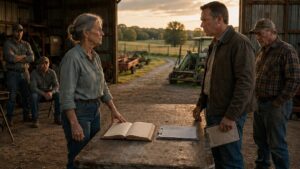
“Open it.”
Katherine’s gaze sharpened.
“James, we are not going to turn this into—”
“I’m not turning it into anything.”
He rested one hand on the bench.
“I sell birdhouses. I’ve never denied that. So before anybody walks through my shop deciding what that means, I’d like the rule read.”
Samuel shifted slightly.
Brenda opened the binder.
James looked at Katherine.
“You’re president. Read the exemption.”
For several seconds, nobody moved.
Even the deputy seemed interested now.
Katherine held out her hand.
Brenda passed her the binder.
Katherine found the paragraph.
Her eyes moved across it.
James waited.
Finally she read the language covering owner-produced crafts and incidental sales.
Then she reached the threshold.
“Five thousand dollars in annual gross receipts.”
James slid the envelope across the bench.
“Eight hundred forty-six last year.”
Katherine did not touch it.
Brenda did.
She opened the flap and removed James’s simple tally sheet along with the receipts.
Samuel leaned closer.
“You kept all that?”
“Not neatly.”
Brenda worked through the pages.
James watched her expression instead of Katherine’s.
At last Brenda looked up.
“The receipts are consistent with his total.”
Katherine spoke quickly.
“The income threshold is not the only condition.”
“I know,” James said.
“Custom orders can indicate ongoing commercial solicitation.”
“I know that too.”
That answer slowed her down.
James reached into the envelope and removed one of his old market cards.
CUSTOM ORDERS AVAILABLE.
“I printed these.”
Samuel looked at him.
Katherine said, “Then you admit—”
“I admit exactly what I did.”
James placed the card beside the birdhouse.
“Two custom orders last year. Maybe three the year before. Nobody works here but me. Nobody comes here to shop. I take a few pieces to the Saturday market.”
He looked at Brenda.
“Is there anything in those receipts showing customer traffic here?”
“No.”
“Any employee wages?”
“No.”
“Any commercial deliveries besides material I’d buy for the farm anyway?”
“Not in what you provided.”
Katherine folded her arms.
“The association still has authority to investigate whether the activity qualifies as incidental.”
James nodded.
“Yes.”
That seemed to irritate her more than an argument would have.
The deputy stepped closer to the doorway.
“I want to make one thing clear,” he said. “Nothing I’m hearing here sounds like a criminal matter. I’m not making a determination on the association rules. But absent something else, there’s no law-enforcement action for me to take.”
Katherine’s face changed only slightly.
James noticed.
Not defeat.
Adjustment.
She had arrived expecting resistance she could characterize as defiance.
James had given her receipts.
She turned to Brenda.
“Document the deputy’s position.”
Brenda wrote it down.
Then Katherine looked around the workshop again.
“The board review will proceed.”
Samuel frowned.
“For what exactly?”
“The exemption has multiple conditions.”
“His income fits.”
“That is one condition.”
Samuel looked at the shelves, then at James’s receipt envelope.
“I thought the concern was that he was running a business.”
“He is conducting sales.”
“So are half the farms around here.”
“Agricultural sales are treated differently.”
James heard something in Katherine’s tone now.
Not confidence.
Urgency.
She flipped to another section.
“We also have complaints about traffic associated with this property. The board is entitled to review vehicle activity related to commercial use.”
James stared at her.
“What traffic?”
“That is what we need to establish.”
“I told Brenda I don’t have customers coming here.”
“Then a review should confirm that.”
Samuel looked toward the gravel lane.
His expression had changed.
James noticed because Samuel had spent most of the morning avoiding his eyes.
“What?” James asked.
Samuel shook his head.
“Nothing.”
“That didn’t look like nothing.”
Katherine closed the binder.
“We’ll request vehicle-use information and discuss this at the next board meeting.”
James felt the first flare of anger he had managed to suppress all morning.
“You came out here calling three birdhouses inventory. I showed you the exemption. Brenda checked the receipts. Now you want my traffic?”
“I want the same standard applied consistently.”
The sentence hung there.
James looked at Katherine.
Then Samuel.
Then the gravel road beyond them.
The deputy returned to his cruiser once it became clear there would be no confrontation. Brenda gathered the receipts carefully and handed them back.
“You should keep copies,” she told James.
“I will.”
She gave him a look that said she was pleased to hear it.
Katherine left without photographing anything else.
Samuel stayed.
James waited until Brenda’s car disappeared around the bend.
Samuel walked toward the edge of the lane and stared down the road.
“What is it?” James asked.
Samuel rubbed a boot against the gravel.
“You really don’t get people coming here on weekends?”
“For birdhouses?”
“For anything.”
“No.”
Samuel nodded slowly.
Then he motioned for James to follow.
They walked fifty yards toward the bend where the road narrowed beside Samuel’s pasture fence.
Deep paired grooves had formed along the softer shoulder.
Some were fresh.
Others had been filled with loose stone and pressed open again.
Samuel pointed at them.
“Those aren’t yours?”
James stared at the ruts.
“No.”
“Feed truck?”
“Comes Tuesdays.”
“These are mostly Fridays and Saturdays.”
James looked back toward his workshop.
“You thought they were coming to me?”
Samuel did not answer immediately.
That silence was answer enough.
James turned toward him.
“Samuel.”
“I didn’t know.”
“You voted to investigate me.”
“I voted to find out what was generating traffic.”
“You could’ve asked.”
Samuel stared down the road.
“So could I.”
James waited.
Samuel exhaled through his nose.
Then he asked, very quietly, “How many unfamiliar vehicles do you see coming up this road every weekend?”
James looked toward the bend beyond Katherine Harris’s property.
For the first time since the complaint began, the birdhouses seemed like the smallest part of the problem.
Chapter 4: The Traffic Problem Was Never About Birdhouses
Samuel Lewis did not point toward Katherine’s property.
He did not have to.
The gravel lane bent past James’s lower field, crossed a shallow drainage pipe, then climbed between Samuel’s pasture fence and a row of newer houses. Katherine’s acreage lay beyond the second bend.
James could not see her house from where they stood.
He could see the ruts.
Two deep tracks cut along the soft shoulder beside Samuel’s fence, narrow enough for passenger vehicles and repeated often enough that the grass between them had been pressed flat.
“You’ve been filling these?” James asked.
“Twice.”
Samuel kicked loose gravel into one rut.
“Last load was three weeks ago.”
“And you thought the cars were mine.”
“I didn’t know whose they were.”
“That isn’t what I asked.”
Samuel looked across his pasture.
A cow stood near the water trough, chewing slowly.
Finally he said, “I knew you sold things.”
“Birdhouses.”
“I didn’t know how much.”
“So you voted to investigate me.”
Samuel’s jaw tightened.
“Yes.”
James waited for something more.
It came reluctantly.
“Katherine said if we started making exceptions, everybody would claim they were different.”
James gave a short laugh with no humor in it.
“And I was the easy one.”
Samuel did not deny it.
That landed harder than James expected.
He and Samuel had worked the same stretch of road after storms. Years earlier, when Samuel’s tractor lost a hydraulic line during hay season, James had loaned him one without keeping track of the hours.
They were not close anymore.
But James had thought they were at least familiar enough for a question before a vote.
“You could’ve come down the road,” James said.
“I should have.”
“That’s all?”
“What do you want me to say?”
“The truth would be a start.”
Samuel’s eyes lifted.
“All right.”
He leaned against a cedar fence post.
“The road account is short.”
James said nothing.
“Gravel cost went up. Culvert work cost more than expected. We’ve got owners complaining their dues keep rising while somebody else is bringing traffic through.”
“Somebody else.”
Samuel looked toward the bend.
“There are cars on this road nearly every weekend that I don’t recognize.”
“You asked Katherine about them?”
“Once.”
“And?”
“She said she’d handle commercial-use enforcement consistently.”
James understood then.
Not everything.
Enough.
“You let her start with me.”
Samuel looked away.
“I thought if the board established the rule with something obvious, we could use the same standard after.”
“Obvious.”
“You had signs at the market.”
“And a saw.”
Samuel’s face hardened.
“I said I was wrong.”
“No. You said you didn’t know.”
The distinction made Samuel quiet.
James looked down at the road.
A strip of fresh cedar dust still clung to the cuff of his work shirt. He brushed at it with his thumb.
The dust had seemed important that morning.
Now it felt almost absurd beside the damaged gravel.
“Those weekend cars,” James said. “They ever turn into my place?”
“Not that I’ve seen.”
“Where do they go?”
Samuel did not answer.
This time James did not press him.
He could see the answer in the direction Samuel kept refusing to look.
The following Monday, the association held its monthly meeting in the converted equipment room behind the volunteer fire hall.
James had not attended one in four years.
Brenda noticed when he entered.
She raised her eyebrows but said nothing.
Katherine sat at the folding table in front with a printed agenda and three binders arranged square to the edge.
Samuel took a seat two chairs away from her.
James sat in the second row.
Katherine began with routine road maintenance, culvert estimates and unpaid assessments. For fifteen minutes, everything sounded ordinary enough that James almost wondered whether Friday had mattered.
Then she reached commercial-use review.
“The Walker property remains under examination,” she said.
James raised his hand.
Katherine looked mildly surprised.
“James?”
“You’ve reviewed my receipts.”
“Yes.”
“And the amount fits the craft exemption.”
“The board has not completed its determination.”
“Because of traffic?”
“Among other factors.”
James saw Samuel’s shoulders move.
“Then I’d like the traffic issue explained.”
Katherine folded her hands.
“The association has a duty to identify uses that increase road burden.”
“I agree.”
That answer caused another small pause.
James continued.
“So how are you identifying them?”
“Complaints, observation, disclosed activity.”
“Disclosed by who?”
“Property owners.”
James looked toward Brenda.
“Is there a list?”
Brenda glanced at Katherine before answering.
“There are annual road-use declarations.”
“Everybody files one?”
“They’re supposed to.”
James felt irritation rise, mostly at himself.
He had no memory of filing one.
Brenda must have seen it on his face.
“You haven’t returned yours for two years,” she said.
A couple of people shifted in their chairs.
James nodded.
“There it is.”
Katherine said, “Which is part of the present problem.”
“Yes.”
James let the word stand.
“I should’ve answered.”
Nobody seemed prepared for that either.
Then he looked at Samuel.
“But if traffic is the concern, mine isn’t the only declaration that matters.”
Samuel inhaled.
Katherine’s gaze moved to him.
He did not speak.
James waited.
The silence became uncomfortable.
Finally Samuel said, “There’s been heavier weekend traffic by my pasture.”
Katherine’s face did not change.
“We’ve discussed general road volume.”
“No,” Samuel said. “I mean regular vehicles. Different plates. Usually staying a day or two.”
The room became still.
James watched Katherine.
She capped her pen.
“Do you have evidence connecting those vehicles to a commercial use?”
Samuel looked down at the table.
“No.”
Katherine nodded once.
“Then speculation is not useful.”
James almost stepped in.
Instead, Brenda did.
“Actually, there is another provision we should probably review.”
Katherine turned.
“What provision?”
Brenda pulled one of the older binders toward her.
“The access agreement.”
“That concerns maintenance allocation.”
“And traffic-generating use.”
She opened to a tab marked with faded yellow paper.
James could hear pages turning.
Brenda found the paragraph and read silently.
Her expression shifted.
Not dramatically.
Just enough.
“What?” Katherine asked.
Brenda looked at the room.
“The agreement requires any member using the shared road for recurring income-producing visitor traffic to disclose that use for maintenance allocation.”
Samuel leaned forward.
“Any member?”
“Yes.”
James looked toward Katherine.
She did not look back.
For the first time since this began, the question was no longer whether James’s birdhouses counted as a business.
The question was who else had been using the road to make money without saying so.
Chapter 5: The Rule Katherine Wanted Applied to Everyone
Brenda’s ledger put Katherine Harris’s parcel at the top before James even understood what he was looking at.
He stood beside her desk two mornings after the meeting while she turned the bound access log sideways so he could read it.
The entries were not accusations.
Dates. Vehicle descriptions. Temporary gate codes issued for service access. Notes recorded after maintenance complaints.
But one parcel number appeared again and again beside Fridays, Saturdays and Sundays.
Katherine’s.
James counted six entries before Brenda turned the page.
“There’s another month,” she said.
“Why are these recorded?”
“Mostly because people called about vehicles blocking the narrow section or missing the turn.”
James followed one line with his finger.
“Out-of-state plate.”
“Yes.”
“Another one.”
“Yes.”
“And another.”
Brenda pulled the ledger slightly back.
“I need to be clear. This does not prove why they were there.”
“I know.”
“Some could be friends. Family. Contractors.”
“I know.”
She studied him.
“You’re being unusually agreeable.”
“I’m trying something new.”
That almost made her smile.
James looked at his own entries.
There were very few.
One feed delivery.
One lumber pickup.
One note from the farmers-market manager confirming James transported his goods himself rather than receiving customer traffic at the property.
Then came the declaration column.
His was blank.
James tapped it.
“That’s mine.”
“Yes.”
“I didn’t file.”
“No.”
He turned another page.
Katherine’s declaration was present.
Residential use only.
No recurring commercial visitor traffic.
James read it twice.
“When was this signed?”
“Last January.”
He felt vindication rise so quickly that it embarrassed him.
There it was.
A neat little line.
The kind of thing he could carry into a meeting and hold up.
Then Brenda closed the ledger.
“You’re not entitled to copies of everything in here without a formal records request.”
James looked at her.
“You showed me enough.”
“I showed you what relates to the review you requested.”
“I didn’t request a review.”
“Not yet.”
The last two words changed the room.
Brenda folded her hands.
“If you want the board to apply the traffic-use provision beyond your property, someone has to request a uniform review.”
“Someone.”
She did not answer.
James stared at the closed ledger.
If he filed, his own omissions went into the same process.
The unanswered notices.
The missing declarations.
The custom-order cards.
He would not get to stand outside the rule and point inward.
He would be stepping into it.
“Where do I check county permits?” he asked.
Brenda exhaled.
“Planning office.”
The county planning counter was twenty-five minutes away in a low brick building beside the courthouse annex.
James disliked the place immediately.
Numbered windows.
Plastic chairs.
Signs instructing him which forms not to use.
He nearly left.
Then he remembered Katherine photographing his birdhouses before she had bothered to greet him.
He took a number.
The planning clerk searched the parcel information James provided.
He was careful with his question.
“I’m trying to determine whether an outbuilding has an active approval for short-term lodging.”
The clerk clicked through several screens.
“There was an application.”
James leaned closer.
“When?”
“A little over two years ago.”
“Approved?”
“For limited occupancy, yes.”
“Current?”
The clerk looked again.
“No renewal showing.”
James felt his pulse quicken.
“Could it be somewhere else?”
“It could have been filed under a different permit category, but I’m not seeing one attached to this parcel.”
“Can you tell me whether the county considers that a violation?”
“No. I can tell you what our system shows.”
The restraint reminded James of the deputy.
Nobody was going to hand him a perfect conclusion.
That was probably good.
“Can I get a public copy?”
The clerk explained the request.
James filled it out.
On his way home, he stopped at the farmers market and spoke with the manager, who confirmed what Brenda already knew: James rented one table most Saturdays in season and carried his own goods in his pickup.
“No customers go out to your farm through us,” the manager said.
“Never asked them to.”
“You’re not starting deliveries, are you?”
“No.”
James almost laughed.
“I’m trying to prove I’m less successful than somebody thinks.”
Back at the farm, he spread everything across the workshop bench.
On the left: his birdhouse receipts.
Eight hundred forty-six dollars.
On the right: copies of association road entries tied to dates and Katherine’s parcel.
Not proof of rental income.
Not yet.
But a pattern.
James placed the cedar birdhouse between the two stacks.
For several minutes he simply looked at them.
He could imagine how easy it would be to turn this into revenge.
Katherine had come onto his property with a deputy.
She had threatened penalties before reading the exemption aloud.
She had treated the objects he made after his wife’s death as evidence against him.
Part of James wanted her embarrassed.
He did not like that part, but it existed.
Then he looked at his blank road declaration.
Katherine had used authority as though it excused her from scrutiny.
James had used history the same way.
Different scale.
Same temptation.
The phone rang.
Samuel.
“You find anything?”
“Enough to ask questions.”
“That means yes.”
“It means enough to ask questions.”
Samuel was quiet.
Then he said, “If you file for a full review, I’ll support it.”
James leaned against the bench.
“Why now?”
“Because I should’ve asked the right person about the traffic before I voted to investigate you.”
“That doesn’t undo it.”
“I know.”
James appreciated the answer because Samuel did not ask to be forgiven.
“What happens if Katherine’s use is legitimate?” Samuel asked.
“Then it’s legitimate.”
“And if it isn’t?”
“Then the rule applies.”
“To her?”
“To everybody.”
After the call, James drove back to the association office.
Brenda had the form ready.
She did not slide it toward him immediately.
“You understand this review will include your own compliance history.”
“Yes.”
“The board could reprimand you for failure to respond.”
“I know.”
“You might be required to submit regular declarations going forward.”
“Probably should’ve been doing that already.”
Brenda placed the form on the desk.
James picked up the pen.
For years he had treated paperwork as something other people needed because they did not know the land.
The idea looked childish now.
Knowing where the water crossed after a storm did not tell anyone who was paying for the gravel.
Remembering who built the first gate did not answer what the road had become.
James signed.
His handwriting was rougher than it used to be.
He pushed the form back.
Brenda read the request once.
Uniform review of recurring income-producing uses relying on shared association access.
“You sure?” she asked.
James thought about the two unanswered letters sitting in his kitchen drawer.
“No,” he said.
Then he tapped the signed page.
“But file it.”
Chapter 6: Thirty-One Thousand Dollars Behind a Farm Gate
Brenda placed two revenue summaries side by side on the folding table.
James’s took half a page.
Katherine’s required three.
No one spoke.
The board hearing had been moved to the larger meeting room because more property owners had requested access to the records review, though only a dozen chairs were occupied.
James sat at the end of the first row.
On the table in front of him rested his thin receipt envelope and one cedar birdhouse Brenda had asked him to bring as an example of the goods under review.
Across the room, Katherine sat rigidly with her hands folded.
Brenda began with James.
“Reported gross receipts from craft sales for the reviewed twelve-month period: eight hundred forty-six dollars.”
One board member looked at the birdhouse.
Brenda continued.
“No employees. No documented customer visits to the property. Owner transports goods to the farmers market. Occasional custom work is reflected in records.”
Katherine said, “Which still raises the solicitation issue.”
Samuel looked toward her but stayed quiet.
Brenda nodded.
“That issue is addressed in the recommendation.”
Then she moved to the second summary.
James saw Katherine’s jaw tighten before a number was spoken.
“The review identified recurring guest vehicle traffic associated with the Harris parcel over approximately twenty-two months.”
Katherine lifted a hand.
“I want the record to reflect that those visits were not concealed.”
Brenda looked at her.
“The declaration on file lists residential use only.”
“I considered the detached unit part of my residential property.”
“That is not the same question.”
Katherine’s eyes hardened.
For a moment James saw the woman who had walked into his workshop and announced what his birdhouses meant.
Then something in her expression gave way.
Not guilt.
Fatigue.
Brenda continued.
“Records supplied during review show short-term lodging receipts totaling approximately thirty-one thousand dollars over the period examined.”
A board member leaned back.
Samuel stared at the table.
James had expected satisfaction.
Instead he felt strangely cold.
Thirty-one thousand dollars.
The number was large beside eight hundred forty-six, but the contrast no longer felt funny.
It felt like a problem that had been waiting under the road.
Katherine spoke before anyone else could.
“Yes. I rented the building.”
The room changed.
James looked at her.
She did not deny it.
“I applied for county approval when I began,” she said. “I was approved.”
Brenda answered carefully.
“The county record shows the original authorization. It does not show a current renewal.”
“I believed the renewal issue was administrative.”
“Did you disclose the recurring guest traffic to the association?”
Katherine looked down at her hands.
“No.”
Samuel finally spoke.
“Why?”
Katherine looked at him sharply.
“You know what the road budget has been.”
“That doesn’t answer him,” James said.
Katherine turned toward him.
For the first time during the hearing, they looked directly at each other.
“You want the answer?”
“Yes.”
“When I took over, this association was barely functioning. People paid when they felt like it. Nobody returned declarations. Half the maintenance decisions were made by whoever had a tractor.”
James felt the sting because part of it was aimed at him.
And part of it was true.
Katherine continued.
“We had washouts, unpaid bills, arguments over whose truck caused which damage. Every time I tried to enforce anything, someone told me how things had been done twenty years ago.”
James lowered his eyes briefly.
“So I pushed consistency,” she said.
Samuel shook his head.
“Except at your place.”
Katherine’s mouth pressed thin.
“Yes.”
The admission was quieter than the first.
She looked toward the revenue summary.
“I kept telling myself the rental was different because it was one building and the guests stayed overnight. I paid regular dues. I had an original county approval.”
“But you didn’t disclose the traffic,” Brenda said.
“No.”
“Why not?”
Katherine hesitated.
James understood the answer before she gave it.
“Because if I listed it,” she said, “every person I was trying to get into compliance would point at me.”
No one spoke.
There it was.
Not a secret conspiracy.
Not some elaborate fraud.
Something smaller and more recognizable.
She had been afraid of losing authority.
So she had demanded rules from others that she could not afford to have measured against herself.
James looked at the birdhouse.
For weeks he had imagined this moment as a reversal.
Katherine’s paperwork turned back on Katherine.
He had not imagined how ordinary she would look when it happened.
Brenda moved to the recommendations.
The board found James’s woodworking activity eligible for the craft exemption, subject to proper annual disclosure and limits on on-site customer traffic.
James released a breath he had not realized he was holding.
Then Brenda kept reading.
“The review also finds Mr. Walker failed to answer two compliance notices and failed to return required road-use declarations.”
James nodded before anyone asked him to.
“That’s correct.”
A formal reprimand would be entered into the association record.
He would have thirty days to correct his documentation.
He disliked it.
He also knew he deserved it.
Katherine’s rental would be referred for county permit review, and she would be required to suspend association-recognized commercial guest use until current approval and appropriate road-maintenance allocation were established.
One board member asked whether Katherine should be removed as president.
James looked up.
Katherine did too.
The question hung there.
Samuel turned toward James.
Perhaps everyone expected him to answer.
He could have made a case.
He could have described the deputy at his workshop.
The photographs.
The threat of daily penalties.
Instead he said, “That’s a board question.”
The member frowned.
“You don’t have an opinion?”
“I’ve got plenty.”
A couple of people shifted.
James continued.
“But this started because one person decided the rules meant whatever was useful at the moment. I don’t see how fixing that means I get to do the same thing.”
Katherine looked at him differently then.
Not gratefully.
That would have been too easy.
More like she had expected a blow and discovered he had refused to swing.
The board moved on.
Samuel proposed that all recurring income-producing uses be subject to the same traffic disclosure standard, regardless of agricultural, craft, rental or professional classification.
Another board member objected that the current language was too confusing to enforce fairly.
Brenda agreed.
“We need a procedure before we need another penalty.”
James almost smiled.
That sounded like something he wished he had heard a month earlier.
Then one of the board members turned toward him.
“You’ve been on this road longer than most of us.”
James stiffened.
He knew that kind of sentence.
It usually came before someone asked him to haul gravel for free.
The member pushed a copy of the commercial-use policy across the table.
“You also just spent three weeks finding every hole in this process.”
James looked at the pages.
“What are you asking?”
The board member glanced at Samuel, then Brenda.
“We’re asking you to help write the replacement procedure.”
James stared at the same type of rule he had once left unopened beneath old farm papers.
A month earlier, he would have refused before the sentence was finished.
Now Katherine’s revenue records sat on one side of the table, his reprimand on the other, and between them stood a cedar birdhouse nobody could honestly call the biggest problem anymore.
James put his hand on the policy.
He did not say yes.
But he did not push it back.
Chapter 7: The Birdhouse He Left Outside the Meeting Hall
The first thing James saw on the table was the policy that had started all of it.
Same heading.
Same commercial-use section.
Same paragraph he had ignored for years until Katherine Harris brought a deputy to his workshop and forced him to care.
A board member pushed the pages toward him.
“You said you’d look at the procedure.”
James remained standing.
“I said I wouldn’t push it back.”
Samuel Lewis sat near the end of the table. Brenda Martin had three marked-up copies in front of her and a yellow legal pad already filled halfway down the first page.
Katherine was there too.
She looked different without the president’s folder in front of her.
Not smaller exactly.
Less armored.
The board had left her in office pending the county review, but she had stepped away from enforcement matters involving commercial use until that review was finished.
James had not asked for that arrangement.
He had not objected to it either.
He finally sat down.
“What’s the problem with the old rule?” one of the board members asked.
James looked at the page.
“The rule isn’t the whole problem.”
Katherine’s eyes lifted.
James continued.
“You can write a decent rule and still make a mess of it if the first thing anybody gets is a threat.”
Brenda nodded once.
Samuel said, “So what would you change?”
James leaned back.
He had spent the previous week thinking about that question while sanding cedar roofs in the workshop.
At first he had imagined writing something simple.
One standard.
One declaration.
One penalty.
Then he remembered how quickly Katherine had turned his three birdhouses into “inventory.”
He remembered how quickly he had turned her rental records into a reason to want her punished.
Rules could be blunt even in careful hands.
In angry hands, they became hammers.
“I’d start with notice,” James said.
Brenda wrote.
“Plain notice. Tell people what somebody thinks the problem is. Give them time to answer before anybody starts talking about fines.”
“How much time?” Samuel asked.
“Enough that a man in calving season doesn’t become a criminal because he left an envelope unopened for a week.”
Katherine said, “You left yours unopened for more than a week.”
James looked at her.
“Yes, I did.”
The room went quiet.
He added, “That should be in the record too.”
Something passed across Katherine’s face.
He could not tell whether it was surprise or disappointment that he had not taken the easier route.
Brenda said, “Thirty days for initial cure?”
James shook his head.
“Depends on the issue.”
“That makes enforcement harder.”
“It makes enforcement require judgment.”
Katherine spoke before Brenda could answer.
“That’s exactly what created inconsistency before.”
There it was.
The old argument.
James turned toward her.
“And removing judgment created this.”
He tapped the policy.
Katherine held his gaze.
“For years, people made private exceptions for one another. Nobody knew which rules mattered.”
“You’re right.”
That answer caught her off guard.
James continued.
“You walked into a bad system.”
Samuel shifted.
Katherine’s expression softened by a fraction.
“And then you made a different kind of bad system,” James said.
The softness disappeared.
But she did not argue.
Brenda drew a line across her legal pad.
“What if we separate disclosure from punishment?”
James looked at her.
“Meaning?”
“Everyone with a recurring income-producing use files a basic annual declaration. Craft, agricultural, rental, professional, whatever applies. But failure to file does not automatically mean the use itself is prohibited.”
Samuel nodded.
“Then traffic impact gets reviewed separately.”
“And if someone ignores the request?” Katherine asked.
Brenda said, “Written cure period.”
James added, “Then a hearing before fines.”
One of the other board members frowned.
“That gives people several chances to drag it out.”
James glanced at him.
“Good.”
The man looked surprised.
James continued.
“If you’re going to put a daily penalty on somebody’s property, they ought to have more than one chance to explain themselves.”
Samuel leaned forward.
“What about obvious cases?”
“Obvious to who?”
That ended the question.
For the next hour they worked through the procedure.
Income alone would not define prohibited use.
Traffic alone would not define it either.
Agricultural uses would retain their existing protections, but recurring visitor traffic connected to any income-producing activity would have to be disclosed for road-maintenance purposes.
Small owner-produced craft sales would remain exempt below the existing threshold.
Failure to disclose would trigger notice, not immediate penalties.
A written cure period would follow.
Only after that could the board schedule a hearing.
Katherine objected twice.
Both times, her objections were practical.
“How do we stop somebody from claiming every business is just a hobby?”
“Receipts,” James said.
“How do we deal with somebody who lies on the declaration?”
“Same way you deal with any false filing. But you prove it first.”
She looked down at the draft.
James noticed she had stopped saying “we” when referring to enforcement.
Near the end of the meeting, Brenda placed one final page in front of the group.
“County planning sent an update.”
Katherine went still.
James did not reach for the page.
Brenda read it.
The detached rental unit could not operate under its old approval. Katherine would need a renewed county permit and updated occupancy review before hosting paying guests again.
Until that happened, the rental would remain suspended.
There was no dramatic reaction.
No shouting.
Katherine simply nodded.
“I already canceled the next two bookings.”
Samuel looked at her.
“You’re going to renew?”
“I haven’t decided.”
James watched her carefully.
“Why not?”
She turned toward him.
“Because once I add the new road-use allocation and county requirements, I’m not sure it makes financial sense.”
James could have said something sharp.
Thirty-one thousand dollars came to mind.
So did the morning she photographed his birdhouses without saying hello.
Instead he asked, “Will you tell the board if you start again?”
Katherine’s mouth tightened.
“Yes.”
It was the closest thing to an apology either of them was likely to offer.
Brenda moved to the final item.
“Road committee.”
James looked down.
He already knew what was coming.
Samuel smiled slightly.
“Thought you might.”
“No.”
“You haven’t even heard it.”
“I have.”
The board member beside Brenda said, “One year.”
James shook his head.
“I spent years avoiding these meetings.”
“That’s part of why we want you.”
“That is a terrible qualification.”
Samuel laughed.
Even Katherine looked as though she nearly did.
James stared at the draft procedure.
He thought about the old black binder buried under machinery manuals.
About his wife’s handwriting on the manila envelope.
About how many times he had said, in one form or another, that everybody knew how things worked around there.
Everybody had known.
Until they didn’t.
“One year,” James said.
Samuel extended his hand across the table.
James did not take it.
“Don’t make it ceremonial.”
“It won’t be.”
“Then I’ll do it.”
The board approved the new procedure by a clear majority.
Katherine voted for it.
James noticed that more than he wanted to.
When the meeting ended, chairs scraped backward and people gathered papers.
James carried the marked-up policy outside.
He had parked near the porch beneath the old metal awning.
Before leaving the farm that afternoon, he had placed something in the truck bed.
He went back for it now.
The cedar birdhouse was one of his better ones.
Simple roof.
Clean joint lines.
No paint.
He had sanded the edges smooth enough that the grain caught the light.
Samuel followed him outside.
“What’s that for?”
James nodded toward the meeting hall porch.
“Needs something besides notices nailed up there.”
Samuel looked at the birdhouse.
“You giving it to the association?”
“Don’t make it sound generous.”
“Wouldn’t dream of it.”
They mounted it on a wooden post beside the porch where the overhang would keep most of the rain off.
Katherine came out while James tightened the last screw.
She stopped several feet away.
“That one for sale?”
James looked at her.
Samuel lowered his head, trying not to laugh.
James wiped cedar dust from his fingers.
“No.”
Katherine glanced toward the birdhouse.
“Good.”
Then she walked to her car.
A month earlier, James would have spent the drive home replaying the exchange, deciding who had won it.
This time he barely thought about it.
At the farm, he carried the revised disclosure form into the workshop and placed it in the office where he would actually see it.
Then he opened both wide shed doors.
He had kept them mostly closed during the dispute.
Not because anyone had ordered him to.
Because somewhere along the way, he had started behaving as though his work needed to be hidden until someone gave him permission.
He switched on the saw.
The motor rose into its familiar steady hum.
On the bench lay a fresh cedar board and an empty space where the old birdhouse had been.
James measured twice.
Cut once.
By late afternoon, another small house stood finished beside the doorway.
He carried it outside.
There was an old fence post near the entrance to the workshop, visible from the gravel lane.
James set the birdhouse on top and stepped back.
No price tag.
No sign.
Nothing explaining what it meant.
A pickup passed on the road.
The driver lifted a hand.
James lifted his in return.
Then he went back inside the workshop, leaving the doors open behind him.
The story has ended.