The Farm Association Ordered Her Barn Light Dimmed—Then Complained When Their Own Road Went Dark
Chapter 1: The Notice Beneath the Barn Light
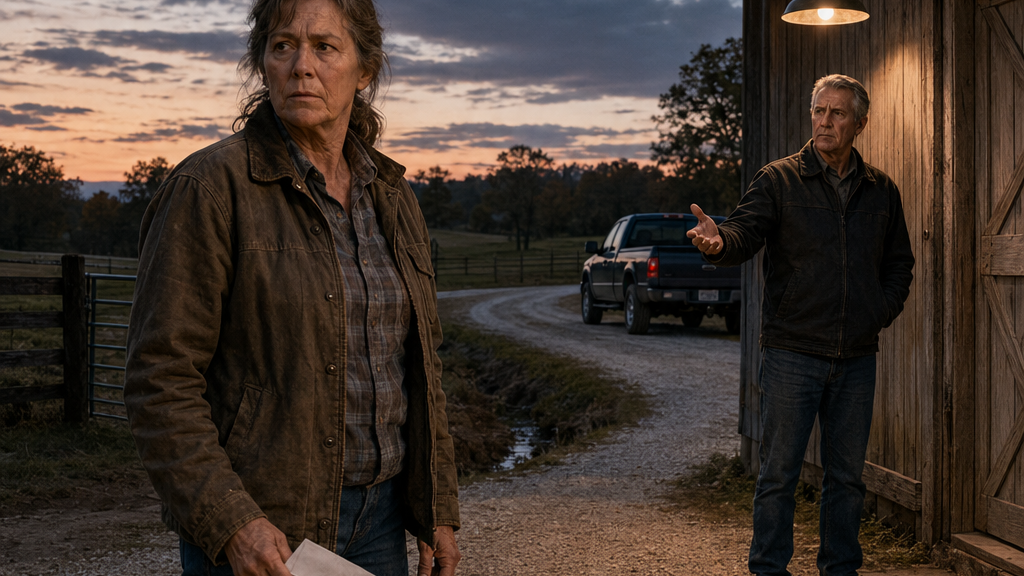
Ronald Baker was standing beneath Sarah Harris’s barn light when he handed her the paper saying the light had to change.
The irony would have been funny if his face had not been so serious.
Sarah had just shut the equipment barn after checking a hydraulic leak on the hay mower. Dusk had settled into the lower pasture, leaving the gravel road gray between the fences. Above the gate, the old metal fixture clicked on automatically and poured a broad circle of warm light across the entrance, the drainage ditch, and the sharp bend where the private farm road met the association lane.
It had done that for years.
Ronald held out a white envelope.
“Official notice,” he said.
Sarah wiped her hands on the thighs of her work pants before taking it.
“Official from who?”
“The road association.”
“You mean Janet?”
“I mean the board.”
Sarah looked at him over the envelope. “Since when does the road association inspect barn lights?”
Ronald’s jaw tightened slightly.
“Since the board elected me chair last month.”
That explained the tone.
Sarah opened the envelope with her thumb.
The notice was brief. Her fixture was described as creating excessive illumination and unreasonable glare affecting neighboring property. She was instructed to reduce the light within ten days and maintain lighting consistent with association standards.
Sarah read the paragraph twice.
Then she looked up at the fixture.
A moth was circling it.
Beyond the gate, nothing looked unusual. The light showed the pale gravel, the edge of the ditch, and the fence corner. A person coming around the bend could see where the road narrowed before crossing in front of her barn.
“What’s excessive?” she asked.
Ronald folded his arms.
“You can see how bright it is.”
“That isn’t a measurement.”
“It doesn’t need to be complicated.”
“You made it paperwork. That usually makes things complicated.”
His mouth flattened.
For years they had managed to remain neighbors without becoming friends. Ronald owned acreage across the association road. He kept his fences straight, his culverts clean, and his opinions available whether anyone asked for them or not.
Sarah had never minded that much.
What she did mind was someone standing on her gravel telling her a fixture attached to her barn had suddenly become unacceptable.
Ronald pointed toward his property.
“That light throws across the road.”
“It always has.”
“That doesn’t make it reasonable.”
“Did somebody complain?”
“I’m handling it as chair.”
“That wasn’t my question.”
Ronald glanced toward the road instead of answering.
Sarah felt an old familiar irritation rise in her chest.
It was not really about the bulb.
Over the years, she had watched the road association grow from four landowners splitting gravel invoices into something that produced forms, deadlines, procedures, and discussions about standards. Some of that had been necessary. More traffic used the lane now. Feed deliveries were larger. Property had changed hands.
But Sarah remembered when a washout meant three neighbors showed up with tractors.
Now it sometimes meant two meetings before anyone ordered stone.
She folded the notice.
“Tell me what standard I’m violating.”
“It says so there.”
“It says ‘excessive.’ I’m asking what excessive means.”
Ronald exhaled through his nose.
“Sarah, this is exactly why things get difficult. Somebody asks for a reasonable adjustment and you turn it into a boundary fight.”
That hit close enough to irritate her further.
She had heard versions of it before.
When the association wanted a wider drainage easement along her fence, she had asked them to mark the exact width. When someone suggested moving the road entrance six feet farther onto her property, she had asked for the survey. When Ronald had once mentioned that hay trailers should perhaps stop using the shoulder near his mailbox, she had asked who owned the shoulder.
She did not consider that difficult.
She considered it knowing where things stood.
“Ten days?” she asked.
“That’s standard.”
“According to what?”
Ronald gave her a tired look.
“Read the handbook.”
“I intend to.”
He stepped back toward his pickup.
The barn light caught the side of his face, and Sarah noticed him squint slightly before turning away.
For half a second, she wondered if the glare really did bother him.
Then he said, “You could solve this tonight with a lower bulb.”
That erased the thought.
“Or,” Sarah said, “you could tell me what the rule actually requires.”
Ronald opened his truck door.
“The board isn’t going to debate every word with you.”
“Then it shouldn’t use words it can’t define.”
He looked at her for a moment, got in, and drove away.
His taillights disappeared beyond the bend.
Sarah stayed at the gate with the notice in her hand.
The fixture buzzed faintly overhead. It was an ordinary agricultural light with a dusk-to-dawn sensor, the same kind used around equipment sheds and cattle lots all over the county. She could not remember the exact wattage of the bulb inside it, only that she had replaced it the previous winter with whatever comparable bulb the farm-supply store carried.
A feed truck had come through at five that morning. The driver had used the light to line up at the bend before backing toward the storage bin.
Sarah looked down the road.
Without the fixture, the ditch on the inside curve would vanish after dark.
She told herself that was beside the point.
Ronald was not talking about the road. He was talking about her light.
Her phone rang before she reached the house.
Samuel Lewis’s name appeared on the screen.
“You get a love letter too?” he asked when she answered.
Sarah stopped.
“What kind?”
“Road association. Apparently my trailer was parked too close to the gravel last Tuesday.”
“Was it?”
“Probably.”
Despite herself, Sarah laughed.
Samuel said, “Ronald’s taking his new job seriously.”
“That one way to put it.”
“What’d you do?”
“My barn light is offensive.”
There was a pause.
Then Samuel said, “The light by the bend?”
“Yes.”
“The one everybody uses to keep from driving into your ditch?”
Sarah looked back toward the glow.
“That one.”
Samuel gave a low whistle.
“Well. Good luck with that.”
After the call, Sarah carried the notice into the kitchen and laid it beside the unopened mail.
She found the old association handbook in the bottom drawer beneath tax receipts, cattle vaccination records, and a folder of road-maintenance invoices.
Its cover was softened at the corners from years of handling.
She flipped past drainage provisions, shared gravel assessments, gate clearances, and vehicle access.
Lighting had its own short section near the back.
Sarah started reading.
Then she stopped.
She read the paragraph again.
Nothing in it looked like the language Ronald had used.
The next morning she called Janet Wright.
Janet answered on the fourth ring.
“Road association office.”
“Janet, it’s Sarah Harris.”
A short silence followed.
Sarah could almost hear the paperwork shifting on the other end.
“I figured I might hear from you.”
“I need the exact illumination provision Ronald says I violated.”
“You have the handbook?”
“I do.”
“Then you have the provision.”
“I have a sentence. I want to know whether there’s another standard somewhere.”
Janet hesitated.
“Another standard like what?”
“Maximum wattage. Lumens. Distance. Glare measurement. Anything that defines excessive.”
This time the silence was longer.
Sarah looked through the kitchen window toward the barn.
The light had switched off with sunrise.
Finally Janet said, “Let me pull the original file.”
“Good.”
“Sarah—”
“Yes?”
“Don’t turn this into a war before I read it.”
Sarah rested one hand on the handbook.
“I’m not asking for a war.”
“What are you asking for?”
“The rule.”
Chapter 2: The Rule Said Something Else
Janet Wright read the sentence twice before she answered.
Sarah could tell because she heard the same soft murmur over the phone, followed by the scrape of paper against paper.
“Well,” Janet finally said.
Sarah waited.
“That is not written very well.”
“Which part?”
“Most of it.”
Sarah leaned against the kitchen counter.
Outside, morning light stretched across the pasture. Cattle stood near the water trough, and a tractor engine turned over somewhere beyond the barn.
“Read it to me exactly,” Sarah said.
Janet cleared her throat.
“Lighting maintained at junctions adjoining the common access road shall provide not less than the illumination ordinarily produced by a forty-watt utility fixture, or equivalent, sufficient to identify the roadway edge and entrance.”
Sarah looked at the handbook open in front of her.
“That’s what mine says.”
“Yes.”
“Keep going.”
“That’s the whole lighting provision.”
“No maximum.”
“Not in that paragraph.”
“No glare standard.”
“No.”
“No direction requirement.”
“No.”
“No lumens.”
“Sarah.”
“I’m asking.”
“No lumens.”
Sarah sat down.
There it was.
Ronald’s notice had used words like excessive, unreasonable, and disruptive. The actual provision did none of that.
“What year is that from?” she asked.
“I’m checking.”
Another shuffle.
“Nineteen ninety-eight.”
Sarah glanced toward the barn again.
“Why did they write it?”
“I don’t know.”
“You just said you pulled the original file.”
“I pulled the rule file, not the minutes.”
“Can you get the minutes?”
Janet sighed.
“I knew you were going to ask me that.”
“Because you know me.”
“Unfortunately.”
Sarah smiled despite herself.
“I’ll call you back.”
Janet called near noon.
Sarah was replacing a mineral block in the lower pasture when her phone vibrated in her shirt pocket.
“I found the meeting notes,” Janet said.
“And?”
“The original issue was road visibility.”
Sarah stopped beside the utility vehicle.
“What kind?”
“Two trucks missed the entrance after dark. One damaged a culvert.”
“So the lighting rule wasn’t written to control neighboring glare.”
“No.”
“It was written to keep people from missing junctions.”
“That appears to be the reason.”
Sarah wiped dust from her forehead.
“And Ronald has these minutes?”
“He has access to everything I have.”
“That isn’t what I asked.”
“No, I don’t know whether he read them.”
Sarah looked toward the road.
The absurdity of it made something inside her settle.
Not disappear. Settle.
Ronald had given her ten days to comply with a standard that did not exist.
“Can you email me copies?”
“I can.”
“And the current handbook page.”
“I’ll send both.”
Janet paused.
“Sarah?”
“Yes?”
“Don’t enjoy this too much.”
Sarah almost laughed.
“I haven’t done anything.”
“That’s what concerns me.”
The email arrived an hour later.
Sarah printed the pages and spread them across her kitchen table.
The old minutes were plain enough. Lighting at common-road junctions had been added after nighttime access problems. The association wanted entrances visible, not beautiful. There was no discussion of neighboring windows, aesthetic harmony, excessive brightness, or maximum output.
She highlighted one line.
Sufficient to identify the roadway edge and entrance.
At four that afternoon Ronald’s pickup appeared at the gate again.
Sarah was ready for him.
She walked out carrying the handbook page and the printed minutes.
Ronald stayed beside his truck.
“Janet told me you requested records.”
“She sent them.”
“You could have called me.”
“You were standing here yesterday.”
“You know what I mean.”
Sarah handed him the lighting provision.
“I want you to show me where my light violates this.”
Ronald looked at the page.
“I know what it says.”
“Then show me.”
“The board has discretion over reasonable conditions.”
“Where?”
“Sarah, not every situation is going to have a numerical limit.”
“Then how did you decide mine was too bright?”
“Because it is.”
“That’s your opinion.”
“It’s affecting neighboring property.”
“Did you measure it?”
He looked at her.
“No.”
“Did anyone?”
“No.”
“Did the board inspect it?”
“I inspected it.”
“You stood under it.”
His face tightened.
“You’re proving my point.”
“What point?”
“That you’d rather fight over language than make a reasonable adjustment.”
Sarah folded her arms.
“And you’d rather call your preference a rule than admit the rule doesn’t say what you want.”
The two of them stood in the gravel between the barn and Ronald’s truck.
Neither spoke.
Finally Ronald said, “The notice remains in effect.”
Sarah blinked once.
“On what basis?”
“The association has authority to address unreasonable glare affecting common access.”
“Is that written down?”
“The board has judgment.”
“There are three people on the board. Did three people vote?”
“That isn’t required for a compliance notice.”
“Did Janet agree with you?”
“Janet keeps records.”
Sarah noticed the shift.
He was not answering anymore.
That told her enough.
Ronald reached for the truck door.
“If you want to appeal it, appeal it.”
“How?”
“At the next meeting.”
“That’s after my deadline.”
“Then correct the problem before the deadline.”
Sarah watched him get into the truck.
For several seconds, she was furious.
Then something colder replaced it.
Precision.
She returned to the kitchen, took a picture of the rule, and studied the wording again.
Not less than the illumination ordinarily produced by a forty-watt utility fixture, or equivalent.
It was old language. Poor language.
It confused fixture rating, light output, and practical visibility. Modern bulbs did not correspond neatly to the assumptions people had made nearly thirty years earlier.
The rule said enough to create an obligation.
It did not say enough to define the result.
Sarah stared at it for a long time.
She knew what Janet had meant when she said not to enjoy this too much.
That evening the barn light came on at dusk.
Sarah stood at the gate and watched its glow reach the road.
From there she could see Ronald’s house across the fields and trees, farther away than his complaint made it sound.
One upstairs window reflected a faint point of light.
Sarah noticed it, then dismissed it.
If Ronald had a real problem, he could have asked for a real solution.
Instead he had chosen paper.
Fine.
Sarah could work with paper.
The next afternoon she put the photographed rule on her phone, climbed into her truck, and drove toward the farm-supply store.
Chapter 3: The Dimmest Light That Still Counted
“I need the least illuminating bulb you’ve got that can honestly go in this fixture.”
The hardware-store clerk looked from Sarah’s phone to Sarah.
“Most people ask the opposite.”
“I’m not most people today.”
She showed him a picture of the barn fixture, then the old association rule.
He read it, frowned, and read it again.
“This was written before LEDs were common.”
“I know.”
“And whoever wrote it didn’t understand the difference between wattage and light output.”
“I know that too.”
The clerk looked toward the bulb aisle.
“What are you trying to accomplish?”
“Compliance.”
That answer made him study her more carefully.
Sarah did not explain further.
He walked her past shelves of bright white security bulbs, daylight floods, motion lights, and high-output agricultural fixtures. Near the end of the aisle he stopped in front of a row of specialty lamps.
“You could use a low-output amber utility bulb,” he said. “Still appropriate for the socket. Still a real working lamp. But it won’t throw much useful light.”
“How little?”
He pointed to the specifications.
Sarah read them.
A smile almost reached her face.
“I’ll take two.”
The clerk gave her a look.
“You sure?”
“One for the fixture.”
“And the other?”
“In case compliance burns out.”
Two evenings later, Sarah stood on a ladder beneath the barn eave.
She had waited until close to dusk because she wanted to see the difference immediately.
The old bulb was warm from its last cycle. She twisted it out, held it for a moment, then screwed in the amber replacement.
Ronald’s original notice was folded in her shirt pocket.
The new bulb came on with a faint orange glow.
Sarah climbed down.
At first she thought the daylight was making it look weaker than it really was.
Then the sun dropped behind the trees.
The bend disappeared.
Not gradually.
One moment Sarah could still make out the pale road beyond the gate. Ten minutes later, the amber bulb seemed to illuminate little more than the metal shade surrounding it.
The gravel twenty feet away became dull gray.
The drainage ditch vanished into shadow.
The fence corner dissolved against the pasture.
Sarah stood with her hands on her hips.
It was ridiculous.
It was also, she had to admit, satisfying.
Ronald wanted less light.
Ronald now had less light.
She took two photographs from the same spot where he had stood when he delivered the notice. One showed the fixture glowing weakly. The other showed how little of the road could be seen beneath it.
Then she emailed Janet.
Fixture adjusted within notice period. Please place this in the compliance file.
She attached the photograph.
Janet replied less than five minutes later.
What did you install?
Sarah typed:
A compliant agricultural bulb.
Three dots appeared.
Then disappeared.
A minute later Janet sent:
Sarah.
Sarah put the phone away.
Across the road, Ronald’s pickup slowed as it approached the bend.
Its headlights swept across Sarah’s fence, then caught the gate.
He stopped.
For one gratifying second, Sarah wondered if he was going to get out.
Instead the truck moved forward and turned toward his house.
The following morning Ronald sent no message.
Nor the morning after that.
By the third day, Sarah considered the matter won.
She continued her normal routine.
Cattle were moved between pastures. A delivery driver brought mineral supplement. Sarah replaced the hydraulic hose on the mower and stacked square bales against the east wall of the barn.
During daylight, nothing about the road had changed.
At night, however, the bend looked wrong.
Sarah noticed that the first time she returned after checking a cow near the creek.
Her headlights illuminated the gate, but when she switched them off, the entrance vanished behind her.
The little amber bulb hung above it like an ember.
She told herself that anyone driving at night had headlights.
That was what headlights were for.
The following evening Samuel Lewis arrived with an empty livestock trailer.
Sarah heard him before she saw him, diesel engine pulling slowly up the lane.
She was inside the barn sorting fencing tools when the sound changed.
The truck revved.
Stopped.
Reversed.
Revved again.
Sarah stepped outside.
Samuel’s headlights were angled across the pasture instead of down the road.
His trailer sat crooked at the bend.
Sarah walked toward him.
“What are you doing?”
His window came down.
“Trying not to remodel your ditch.”
“You’ve made this turn a hundred times.”
“Usually I can see it.”
“You have headlights.”
“Yes, Sarah. Those are the two bright things currently pointing at your cows.”
She looked at the trailer.
Its right wheels were close to the road edge.
Not dangerously close.
But closer than usual.
Samuel backed another foot, corrected, and eased forward.
Once the trailer straightened, he stopped beside her.
“That your new light?”
“It meets the rule.”
Samuel leaned toward the windshield and looked at the amber glow.
“Does the rule require darkness?”
“It requires a qualifying fixture.”
“That’s not what I asked.”
Sarah felt irritation return.
“You taking Ronald’s side now?”
Samuel looked at her for a second.
“I don’t have a side.”
“Good.”
“I have a trailer.”
He pointed toward the ditch.
“And I almost had less of one.”
Sarah crossed her arms.
“You weren’t going into the ditch.”
“No. Because I stopped.”
He rested one forearm on the open window.
“Look, Ronald can be a pain in the neck. Everybody knows that. But that old light showed where your driveway ended and the road started.”
“That isn’t what he complained about.”
“I know.”
“He said it was excessive.”
“I know.”
“He wanted dimmer.”
Samuel nodded.
“And now it’s dimmer.”
There was no sarcasm in his voice.
That made the words harder to dismiss.
Sarah looked toward the gate.
The amber light barely touched the gravel below it.
Samuel shifted the truck into gear.
“You proved your point.”
“I followed the rule.”
“Those aren’t always the same thing.”
Sarah’s head turned sharply toward him.
He lifted one hand.
“I’m not looking for an argument.”
“Then don’t start one.”
“I’m not.”
His truck rolled forward.
The trailer followed him around the bend, its red marker lights disappearing one by one behind the trees.
Sarah stayed in the road.
She could still hear the tires crunching gravel long after she could no longer see them.
For the first time since Ronald had delivered the violation, winning did not feel quite as clean as she had expected.
She walked to the gate and stood where Samuel’s trailer had been.
From a driver’s height, the ditch was nearly invisible until headlights struck it directly. The pale gravel no longer separated clearly from the grass. The metal gate reflected a little amber light, but not enough to mark the curve.
Sarah remembered the old meeting minutes.
Two trucks had missed the entrance.
One damaged a culvert.
That had been the reason for the lighting rule.
She slipped her hands into her coat pockets.
She could put the old bulb back.
The thought lasted less than a second.
No.
Ronald would read that as surrender.
And worse, he would believe the original notice had been justified.
Sarah turned toward the barn.
There had to be another answer.
Before she reached the door, Samuel called from farther up the road.
She answered.
His voice had lost the casual tone.
“Sarah.”
“What?”
“I wasn’t exaggerating back there.”
She stopped.
“I know.”
“No. I mean I got closer than you think.”
She said nothing.
“My right trailer wheel dropped off the gravel before I corrected.”
Sarah looked back at the black edge of the drainage ditch.
Samuel continued.
“Another six inches and I’d have put that trailer down into it.”
The weak amber bulb buzzed above her.
Sarah stared at the road she had made darker to prove that Ronald Baker did not understand his own rule.
For the first time, she wondered whether the person who understood the rule best had also missed what it was for.
Chapter 4: Now He Said It Was Too Dark
The second notice arrived fourteen days after Sarah changed the bulb.
She found it clipped beneath the handle of her storm door when she came in from checking cattle.
For several seconds she simply stared at the first sentence.
Insufficient illumination at a shared-access junction may create a safety hazard for association road users.
Then she laughed.
Not loudly. Just once.
Sarah carried the notice into the kitchen, set it beside Ronald’s first one, and flattened both sheets with her palms.
The first said her light was excessive.
The second said it was inadequate.
She placed them side by side.
Same association letterhead. Same signature at the bottom.
Ronald Baker, Chair.
Sarah took a photograph.
Then another.
By the time she called Janet, the amusement had sharpened into something close to triumph.
“Tell me this is a joke.”
Janet was quiet.
“You got the new notice.”
“I have both notices in front of me.”
“I know.”
“Two weeks ago I was lighting half the county. Now I’m apparently endangering traffic.”
“Sarah—”
“No. Read them.”
“I’ve read them.”
“Out loud, if necessary.”
“I understand the contradiction.”
“Good. Then withdraw both.”
Janet sighed.
“It isn’t that simple.”
Sarah leaned back in her chair.
“It is exactly that simple.”
“There have been complaints about the bend.”
“From Ronald?”
“Not only Ronald.”
That stopped her.
Sarah looked through the window toward the road.
“Who?”
“I’m not giving you names from private calls.”
“How many?”
“Enough that the board has to address it.”
Sarah felt the satisfaction drain slightly.
“What does ‘enough’ mean?”
“Two road users besides Ronald mentioned visibility.”
“Before I changed the light?”
“No.”
“So Ronald causes this whole mess, I comply with his notice, and now I’m responsible for the result?”
“I didn’t say that.”
“You didn’t have to.”
Janet lowered her voice.
“The meeting is Thursday. Bring both notices. That is the proper place to challenge them.”
Sarah almost told her exactly what she thought of the proper place.
Instead she said, “I’ll be there.”
Samuel arrived that afternoon for a load of hay.
Sarah waited until he had shut off his truck before walking over with the notice.
He read it.
His eyebrows rose.
“That’s impressive.”
“You think so too.”
“I didn’t say good.”
“He says the light is a safety hazard now.”
Samuel handed the paper back.
“He may be right about that part.”
Sarah stared at him.
“Whose side are you on?”
“Still the trailer’s.”
“You called them?”
“No.”
“Then who did?”
“I don’t know.”
“But you think this is reasonable?”
“I think the road’s harder to see.”
“Because I followed the notice.”
“Yes.”
“That seems important.”
“It is.”
Samuel lowered the tailgate.
“So is the ditch.”
Sarah helped him shift two bales without answering.
At last he said, “You want me to tell you Ronald’s wrong about everything because he was wrong first.”
“I want people to notice what happened.”
“I noticed.”
“And?”
“And he shouldn’t have written the first notice the way he did.”
Sarah waited.
Samuel lifted another bale.
“And you knew exactly what you were doing with that bulb.”
The bale landed against the truck bed with a dry thump.
Sarah’s face warmed.
“I followed the rule.”
“You followed the words.”
She turned away before he could see how neatly that landed.
Thursday night, the association meeting was held in the small back room of the volunteer fire station.
Janet sat behind a folding table with the handbook, minutes binder, and a yellow legal pad. Ronald occupied the chair beside her. Two board members sat farther down.
Sarah took the seat directly across from him.
She placed both notices on the table.
“I’d like those entered together.”
Janet looked at them.
“They already are.”
“I want everyone looking at them at the same time.”
One board member shifted uncomfortably.
Ronald said, “We all understand your argument.”
“I haven’t made it yet.”
“You intend to say the notices contradict each other.”
“They do.”
“The conditions changed.”
“Because your first notice ordered me to change them.”
Ronald’s expression hardened.
“You deliberately reduced the light to a level that compromises visibility.”
“You ordered me to reduce it.”
“I ordered you to correct unreasonable glare.”
“Show me that phrase in the rule.”
Janet touched the edge of the handbook.
“Let’s keep this focused.”
Sarah slid the first notice toward the board.
“This says excessive illumination.”
Then the second.
“This says insufficient illumination.”
She opened the handbook.
“The actual rule says a qualifying light must identify the roadway edge and entrance. It gives no maximum brightness. No glare measurement. No direction standard.”
One board member picked up the first notice.
“Ronald, was the original fixture measured?”
“No.”
“Was there a board inspection?”
“I inspected it.”
“That isn’t what I asked.”
Sarah said nothing.
Ronald glanced at her, then back at the board member.
“No formal inspection.”
Janet wrote something down.
For one brief moment Sarah felt the meeting tilt in her direction.
Then Samuel’s name came up.
Not as a witness. As one of several road users who had mentioned the darkness informally.
Sarah looked at Janet.
“You said you wouldn’t give me names.”
“I didn’t. Samuel told Ronald directly after the trailer incident.”
Sarah turned toward Ronald.
He said, “He almost left the road.”
“He didn’t.”
“That isn’t much of a defense.”
Sarah wanted to tell him the whole problem existed because of him.
The words rose.
She stopped them.
Because somewhere beneath her anger, she heard Samuel’s voice again.
You knew exactly what you were doing.
The board recessed for five minutes.
Sarah went outside.
The fire-station parking lot was dark except for a security lamp over the side door. Across the road, fields disappeared into blackness.
Ronald came out but did not approach her. He stood near his pickup checking his phone.
Sarah watched him for a moment.
He looked tired rather than victorious.
When they returned inside, Janet spoke first.
“The board is pausing enforcement on both notices.”
Sarah blinked.
“Pausing?”
“Neither notice will carry a fine while we review the lighting provision.”
“So the first notice wasn’t valid.”
“That isn’t what we voted.”
“The second one?”
“Also paused.”
Ronald said, “The road still needs to be visible.”
Sarah looked at him.
“And your glare complaint?”
“The glare still existed.”
“According to you.”
His eyes shifted away.
The meeting ended without the clean victory she had expected.
Sarah drove home irritated with everyone, including herself.
As she turned into her entrance, her headlights caught Ronald’s house across the road.
One upstairs room was lit.
Before Sarah’s amber barn bulb came fully on, Ronald crossed that room and pulled the blinds shut.
Sarah noticed because the movement was sudden.
The next evening she saw it again.
The room glowed.
Her barn sensor clicked on.
Within seconds, the blinds closed.
On the third night, Sarah deliberately stood outside before dusk.
She watched the window.
The light above her gate flickered alive.
Across the road, Ronald appeared in the upstairs room and reached immediately for the blinds.
Sarah’s irritation changed shape.
He had never mentioned that window.
Not once.
Chapter 5: The Reason Behind Ronald’s Blinds
From Ronald’s yard, Sarah finally understood the problem.
She stood beside the fence line Saturday evening, facing her own barn across the road and lower field.
The old fixture was back in place temporarily for the test, not because Sarah had surrendered but because she wanted to see what Ronald had been seeing.
The bulb came on.
A broad wedge of light crossed the road, skipped over the pasture, and struck one upstairs window of Ronald’s house with surprising precision.
Sarah narrowed her eyes.
From her barn, the window had seemed distant.
From here, the fixture looked aimed directly at it.
Ronald stood several feet away with his hands in his coat pockets.
“Well?” he asked.
“It reaches the glass.”
“I told you.”
“No. You told me it was excessive.”
His mouth tightened.
“That is excessive.”
“That’s not the same sentence.”
They stood without speaking.
Sarah looked again at the window.
“Why that room?”
Ronald did not answer immediately.
Then he said, “My father sleeps there.”
Sarah turned.
She had known Ronald’s father was living with him. Everybody along the road knew that much. She had seen an older man on the porch twice during summer.
She had not known Ronald was caring for him.
“He can’t use the downstairs bedroom anymore,” Ronald said. “Bathroom’s too far. Stairs are worse.”
The explanation came reluctantly, as though every word cost him leverage.
“We converted that room in July.”
Sarah looked at the bright rectangle of glass.
“And the light bothers him?”
“He wakes easily. Some nights he thinks morning has come when that thing hits the room.”
Sarah felt something uncomfortable settle under her ribs.
“Why didn’t you say that?”
Ronald gave her a look.
“I did ask about the light.”
“You said it was bright.”
“I asked if you’d point it down.”
“You said, ‘That thing lights up everything but the moon.’”
“That was asking.”
“That was complaining.”
He looked away.
Sarah almost smiled, but there was no humor in it.
“Why the formal notice?”
Ronald rubbed a hand across his chin.
“Because talking to you doesn’t usually move anything.”
The words were quiet.
That made them sting more.
Sarah crossed her arms.
“You mean I don’t agree just because somebody asks.”
“I mean every request turns into a property-line question.”
“Sometimes property lines matter.”
“Yes.”
“Sometimes rules matter.”
“Yes.”
“Then why didn’t you read this one before sending me a violation?”
Ronald looked back toward her barn.
For several seconds he said nothing.
“When I took over as chair, the insurer had already asked about inconsistent enforcement. We’ve got culvert damage, delivery traffic, people parking equipment on shoulders. Everybody wants exceptions.”
“That doesn’t answer me.”
“I thought if we started making exceptions immediately, the whole thing would be useless.”
“So you made my light an example.”
His jaw moved.
“I thought it was an obvious problem.”
“For your father.”
“For the property.”
“Those aren’t the same.”
“No.”
There it was.
Not an apology.
But not denial either.
Sarah looked toward the upstairs window again.
Ronald continued.
“I should have measured it. I should have checked the wording.”
“Yes.”
“You don’t have to sound pleased.”
“I’m not.”
That surprised both of them.
He studied her.
Sarah shoved her hands into her coat pockets.
“I put in that amber bulb because I wanted you to have exactly what you asked for.”
“I know.”
“I knew it wouldn’t light much.”
“I know that too.”
“Samuel nearly put his trailer in my ditch.”
Ronald’s expression changed slightly.
“He told me.”
Sarah kicked a small stone off the edge of the drive.
“I kept telling myself headlights were enough.”
“They should be.”
“But that bend was designed badly before either of us owned half the equipment we use now.”
Ronald nodded.
For the first time since the conflict began, they were discussing the same problem.
Sarah looked at him.
“You should withdraw the first notice.”
“You should restore road visibility.”
“There it is.”
“What?”
“The part where you ruin a reasonable conversation.”
Ronald almost smiled.
Almost.
“The second complaint isn’t fake, Sarah.”
“I know.”
Saying it aloud irritated her.
It also relieved something.
Ronald stepped toward the fence.
“I won’t withdraw the safety issue while the bend stays dark.”
“And I’m not putting the old light back like nothing happened.”
“I didn’t ask you to.”
“You were about to.”
“I was about to ask what else we can do.”
Sarah studied him, suspicious of the sentence because it sounded too sensible.
Then she looked toward the barn fixture.
A metal shade. A bulb. A mounting arm.
Nothing sacred about any of it.
“What if it pointed down?”
Ronald shrugged.
“Might help.”
“What if it were shielded on your side?”
“Might help more.”
“You could have said that three weeks ago.”
“You could have listened three weeks ago.”
Sarah inhaled sharply.
Then stopped.
He was not entirely wrong.
That was becoming inconvenient.
They walked toward the road together.
From the bend, the old light made the gravel easy to follow. Sarah could see the drainage ditch, gatepost, and entrance clearly.
She turned around.
From that same position, Ronald’s upstairs window sat squarely inside the fixture’s spill.
It was not a question of bright or dim.
It was direction.
The rule had never accounted for that.
Neither had they.
On Monday morning Sarah called the rural electric cooperative.
The technician who answered listened while she described the fixture, road, neighboring window, and old association requirement.
“So you want useful light without spill,” he said.
“I want the bend visible.”
“And the house dark.”
“Yes.”
“Shielded fixture. Better angle. Maybe different mounting height.”
“Can you look at it?”
“We can advise on the setup. If it’s customer-owned equipment, installation’s your responsibility.”
“That’s fine.”
Sarah gave him the location.
Before ending the call, she looked across the kitchen at both notices still lying on the table.
“Bring a light meter if you have one.”
The technician paused.
“You planning to settle an argument?”
Sarah looked toward Ronald’s house.
“No,” she said. “I’m planning to stop having one.”
Chapter 6: A Better Answer Than Winning
Sarah tested the redesigned light from Ronald’s side of the road first.
That mattered to her more than she wanted to admit.
The cooperative technician had recommended a simple metal shield, a downward-angled fixture, and a slightly lower mounting position. Nothing elaborate. Nothing expensive enough to justify three weeks of paperwork and resentment.
At dusk, Sarah stood near Ronald’s fence with the technician and watched the new fixture switch on.
The upstairs window remained dark.
No pale rectangle appeared on the glass.
Ronald stepped outside.
“Well?” Sarah asked.
He looked toward the bedroom, then across the road toward her barn.
“Nothing on the window.”
“Good.”
She did not smile.
Not yet.
They crossed the road.
From Sarah’s gate, the difference was immediate.
The gravel bend was visible.
Not flooded with light. Visible.
The ditch had an edge again. The fence corner separated from the pasture. The gate reflected enough light to give an approaching driver a clear reference point.
The technician held up the light meter and took readings at several places.
Sarah wrote each number on a legal pad.
Ronald watched.
“You always do this much homework?”
“When somebody gives me a violation.”
“That explains a lot.”
She looked at him.
He said, “Not necessarily as criticism.”
“Generous.”
The technician packed his meter.
“You can solve most glare problems with direction before you solve them with darkness.”
Sarah glanced at the weak amber bulb she had removed and placed on the tailgate.
That sentence felt uncomfortably applicable beyond lighting.
Two nights later Samuel brought a loaded livestock trailer through the bend.
Sarah waited near the barn without telling him why.
His truck rounded the curve steadily.
No braking.
No awkward reverse.
No headlights sweeping across the pasture.
He pulled beside the barn and lowered his window.
“Well,” he said.
Sarah raised an eyebrow.
“Well what?”
“I can see again.”
“And?”
“And Ronald’s house isn’t on fire from the glare.”
Sarah nodded toward the road.
“That enough?”
“For me.”
He started to pull forward, then stopped.
“You know what’s irritating?”
“Several things about you.”
“You could’ve done this first.”
Sarah gave him a flat look.
Samuel laughed and drove on.
At the association meeting the following Thursday, Sarah brought more paper.
Not complaints.
Measurements.
Janet looked at the pages.
“What is this?”
“A replacement lighting standard.”
Ronald, seated beside her, looked up sharply.
One board member said, “I thought we were settling Sarah’s case tonight.”
“We are,” Sarah said.
She handed copies around the table.
The draft was short.
Fixtures at shared-road junctions would be required to provide measurable minimum illumination at the roadway edge. Light spill beyond property boundaries would be addressed through shielding, direction, or documented measurement rather than subjective descriptions like excessive or unreasonable.
Janet read the first page.
“This is considerably more specific.”
“That’s the point.”
Ronald turned a page.
The other board member leaned back.
“We could just exempt Sarah’s existing fixture. Grandfather it and close both complaints.”
For three weeks, Sarah would have accepted that offer immediately.
A personal exemption meant victory.
Her land. Her fixture. Her decision.
She looked at Ronald.
Then at Janet.
Then at the old handbook lying on the table.
“No.”
The room went quiet.
The board member frowned.
“No?”
“If the rule is bad, exempting me doesn’t fix it.”
“You’re the only current dispute.”
“Until next year.”
Ronald’s eyes stayed on her.
Sarah continued.
“If my fixture has to meet a measurable standard, fine. So should everybody else’s. If somebody complains about glare, measure it or inspect direction. Don’t write notices based on whoever uses the strongest adjective.”
Janet hid the beginning of a smile by looking down at her notes.
Ronald said, “Your draft also limits board discretion.”
“Yes.”
“That can create problems.”
“So can unlimited discretion.”
“We need room to address unusual conditions.”
“Then write a process for unusual conditions.”
He tapped the paper.
“You’ve thought about this.”
“I’ve had time.”
One board member looked between them.
“Can we separate Sarah’s complaints from the rule revision?”
Sarah said, “You can.”
Ronald said, “We probably shouldn’t.”
Sarah turned toward him.
That was the first unexpected thing he had said all evening.
He continued.
“The first notice was based on glare. The second was based on road visibility. A revised rule should address both before we pretend either complaint taught us nothing.”
Janet placed her pen down.
“That sounds almost reasonable.”
Ronald ignored her.
Sarah folded her arms.
“So you’ll support it?”
“I didn’t say that.”
“Of course not.”
“I said it needs work.”
They spent forty minutes working through it.
The discussion was not friendly.
That made Sarah trust it more.
Ronald wanted an exception for emergency conditions. Sarah insisted any enforcement notice identify the actual standard allegedly violated. Janet required the rule to specify who maintained inspection records. The board members argued about whether measurements should be mandatory for every complaint or only contested ones.
By the end, the draft had changed.
But it had not become vague again.
The board agreed to circulate it for a final vote the following month.
Then Janet returned to Sarah’s notices.
“The enforcement pause remains until the rule review is complete.”
Sarah nodded.
Ronald said, “The current fixture solves the immediate issue.”
Sarah looked at him.
“Both issues.”
He gave a small nod.
“Both.”
That was as close to acknowledgment as she expected to get.
After the meeting, Sarah returned home after dark.
The shielded fixture came on as she approached.
Its light fell across the gravel instead of across the fields.
She stopped her truck at the bend.
The ditch was visible.
The gate was visible.
Ronald’s upstairs window remained black.
Sarah sat behind the wheel for a moment.
The weak amber bulb was still on the passenger floor where she had tossed it after the test.
She picked it up.
For weeks, it had felt like proof that Ronald could not push her around.
Now it looked like what it was.
A bulb too dim for the job.
Sarah put it in the glove compartment and drove home.
The next morning she printed the final draft of the revised standard.
At the bottom, beneath Janet’s suggested changes and beside the measurements from the road, Sarah left one blank line.
At the next meeting, she slid the document across the folding table until it stopped directly in front of Ronald.
He looked down at it.
Sarah rested both hands on the table.
“You wanted a rule,” she said. “Vote on one.”
Chapter 7: The Rule They Should Have Written
The first item on the meeting agenda was no longer Sarah Harris’s barn light.
It was the rule itself.
Janet Wright had typed the revised language onto a single clean page and placed copies at every chair. The old handbook sat beside her, its faded cover looking almost embarrassed by comparison.
Sarah took her usual seat across from Ronald.
He had the draft in front of him already.
For once, there was no violation notice between them.
Janet tapped her pen against the table.
“We have two things to settle tonight. First, whether to adopt the revised lighting provision. Second, what happens to the two open complaints involving Sarah’s junction.”
One of the board members looked at Sarah.
“There’s still an easier way.”
Sarah knew what was coming.
“We can grandfather your fixture,” he said. “Close the complaints, leave the old language in place, and deal with anything new case by case.”
A month earlier, she would have called that a win.
Now she shook her head.
“No.”
The board member frowned.
“You’d be exempt.”
“That’s the problem.”
Ronald looked up.
Sarah continued.
“If the old rule is too vague to apply fairly to me, it’s too vague to apply fairly to the next person.”
Janet stopped tapping the pen.
Sarah could feel everyone in the room watching her, which made her want to shorten the explanation rather than improve it.
“My light meets the new measurements,” she said. “So make me meet them. Don’t give me special treatment because I argued long enough.”
Ronald’s eyes remained on the paper.
The other board member said, “You understand this means you’d be subject to the same inspection process.”
“Yes.”
“And if your fixture changes—”
“Measure it.”
The answer came easily.
That surprised Sarah.
Ronald turned the page over though there was nothing on the back.
Janet asked, “Any objection to the measurement language?”
Ronald finally spoke.
“No.”
Sarah looked at him.
He kept his attention on Janet.
“What about the requirement that a complaint identify the standard allegedly violated?” Janet asked.
“That should stay.”
Sarah had expected an argument.
Janet apparently had too.
She raised one eyebrow.
Ronald exhaled.
“The first notice shouldn’t have gone out without that.”
The room became very still.
He did not look at Sarah when he said it.
He did not apologize either.
But the sentence was plain enough.
Sarah felt the old urge to press him.
To make him say exactly how wrong he had been.
To make the acknowledgment larger.
Instead she let it stand.
Janet wrote something on her legal pad.
“Then we have agreement on that point.”
They worked through the remaining language.
Minimum illumination at the roadway edge.
Shielding or directional correction when measurable spill affected neighboring property.
An inspection before contested enforcement.
A written identification of the standard involved.
Emergency discretion when immediate road safety required it, followed by documentation afterward.
Nothing dramatic.
Just words that said what everyone had assumed the old rule meant.
When Janet called for the vote, Sarah watched Ronald.
One board member voted yes.
The second voted yes.
Ronald was last.
He looked once toward Sarah.
“Yes.”
Janet marked the result.
“Adopted.”
Sarah expected satisfaction.
What she felt instead was something quieter.
Relief, perhaps.
Or simply the absence of needing to fight.
Janet pulled the two notices from the folder.
“The original excessive-light complaint is closed because it was issued without a defined standard or measurement.”
She placed it aside.
“The insufficient-light complaint is also closed because the redesigned fixture meets the new roadway requirement.”
The second paper joined the first.
Two sheets that had occupied Sarah’s kitchen table for weeks were suddenly finished.
Ronald gathered his copy of the rule.
Sarah stood.
Neither moved toward the other.
That seemed appropriate.
Outside, Ronald reached his truck before she reached hers.
He paused with one hand on the door.
“Your measurements were useful.”
Sarah looked at him.
“That sounded painful.”
“It was.”
She almost smiled.
He added, “The shield works.”
“Yes.”
“My father hasn’t mentioned the light since you changed it.”
Sarah nodded.
“Good.”
There were several things either of them could have said after that.
Neither did.
Ronald got into his truck.
Sarah followed him out of the parking lot several minutes later.
By the time she reached the farm road, dusk had settled.
The barn fixture came on automatically.
Its beam fell downward across the gravel, catching the gatepost and the edge of the ditch.
Ahead of her, Ronald’s taillights approached the bend.
For weeks, he had slowed there at night, sometimes nearly stopping.
This time he came through at an ordinary speed.
No sudden braking.
No headlights sweeping across the pasture.
He turned toward his house.
Sarah stopped her truck beside the barn.
Across the road, the upstairs window where Ronald’s father slept remained dark.
The road in front of her was not.
Chapter 8: The Light Stayed Where It Belonged
The barn light failed on one of the coldest evenings of winter.
Sarah noticed because the bend vanished.
She was coming back from the lower pasture after putting out extra feed when her headlights reached the entrance and found nothing waiting there—no pale gravel edge, no reflected gatepost, no familiar pool of light beneath the barn eave.
She slowed hard.
The fixture above the gate was black.
“Of course,” she muttered.
Ice had formed along the fence wire, and the metal gate clicked faintly in the wind.
Sarah parked beside the barn and tested the switch.
Nothing.
She checked the breaker.
Still nothing.
A few months earlier, she would have climbed the ladder immediately and handled it herself.
Instead she looked toward the road.
Feed trucks still used the bend.
Samuel still came through after dark.
And Ronald’s house sat across the field.
Sarah pulled out her phone.
She stared at Ronald’s name for half a second before calling.
He answered quickly.
“What happened?”
“You can see it’s out?”
“I noticed about ten minutes ago.”
There was no accusation in his voice.
That was new enough that Sarah almost missed it.
“I’m checking the fixture.”
“You want me to bring a flashlight?”
She looked up at the dark eave.
“Yes.”
Ronald arrived in his pickup before she had finished dragging the ladder from the barn.
He stepped out carrying a work light.
“You think it’s the bulb?”
“Could be the photocell.”
He aimed the light upward.
“You getting on that ladder with ice on the ground?”
Sarah looked at him.
“I’ve been using ladders longer than you’ve been chair.”
“That doesn’t make the ice younger.”
She opened the ladder anyway.
Ronald took hold of the side.
“I’ll brace it.”
Sarah almost told him she did not need him to.
The words reached the back of her throat.
Then she climbed.
The wind felt sharper near the eave.
Ronald kept both hands on the ladder while she opened the fixture housing.
The bulb was intact.
The sensor connection was not.
Moisture had worked into the small photocell fitting, leaving corrosion around one contact.
“Found it,” Sarah said.
“Can you fix it?”
“I’ve got a replacement inside.”
She climbed down.
Ronald did not let go of the ladder until both her boots were on the ground.
They carried it into the barn together.
Sarah found the spare component in a drawer beside fence staples and electrical connectors.
Ronald noticed the amber bulb lying farther back on the shelf.
He picked it up.
“This the famous one?”
Sarah looked over.
“The infamous one.”
He held it toward the light.
“Still works?”
“Probably.”
“You keeping it for sentimental reasons?”
“I keep things that might be useful.”
“That one wasn’t.”
Sarah gave him a look.
Ronald put the bulb back.
“Fair.”
They returned outside.
This time Ronald held the work light while Sarah climbed.
The repair took less than ten minutes.
When she restored power, the fixture blinked once.
Then the beam settled across the road.
The gravel edge appeared.
The ditch became visible.
The gatepost caught the light.
Sarah looked across the field.
Ronald’s house remained untouched by the beam.
He released the ladder.
“There.”
“There.”
They stood beneath the fixture.
Neither seemed in a hurry to leave.
Ronald looked toward the road.
“I probably would’ve called Janet six months ago.”
Sarah folded the ladder.
“I probably would’ve ignored you six months ago.”
“That too.”
A truck appeared at the far end of the association lane.
Its headlights approached the bend.
The driver came through without slowing, tires staying centered on the gravel.
Ronald watched until the truck disappeared.
“Working right.”
Sarah looked up at the fixture.
“Seems to be.”
He picked up his work light.
At his truck, he paused.
“My father’s doing better.”
Sarah nodded.
“Glad to hear it.”
“He still complains about everything.”
“Runs in the family.”
Ronald stared at her for one beat.
Then he laughed.
It was the first time she had heard him do that in months.
Not enough to turn them into friends.
Enough to make the road between their properties feel less crowded.
After Ronald left, Sarah carried the ladder back into the barn.
She passed the shelf where the amber bulb sat among spare parts.
For a moment she considered throwing it away.
She left it there.
Not as a trophy.
Not as proof.
Just as a reminder that something could satisfy the words and still fail the work.
Sarah shut the barn door.
The fixture above her hummed steadily.
Its light reached the roadway edge, the ditch, and the gate—no farther than it needed to.
Across the field, Ronald’s upstairs window stayed dark.
A set of headlights rounded the bend smoothly and continued down the lane.
Sarah stood beneath the light for a moment before walking toward the house.
It was neither brighter nor dimmer than the job required.
It simply stayed where it belonged.
The story has ended.