What Remained at the Table
Part I — The Smallest Plate
The plate Emily set in front of Daniel looked like an insult before anyone said a word.
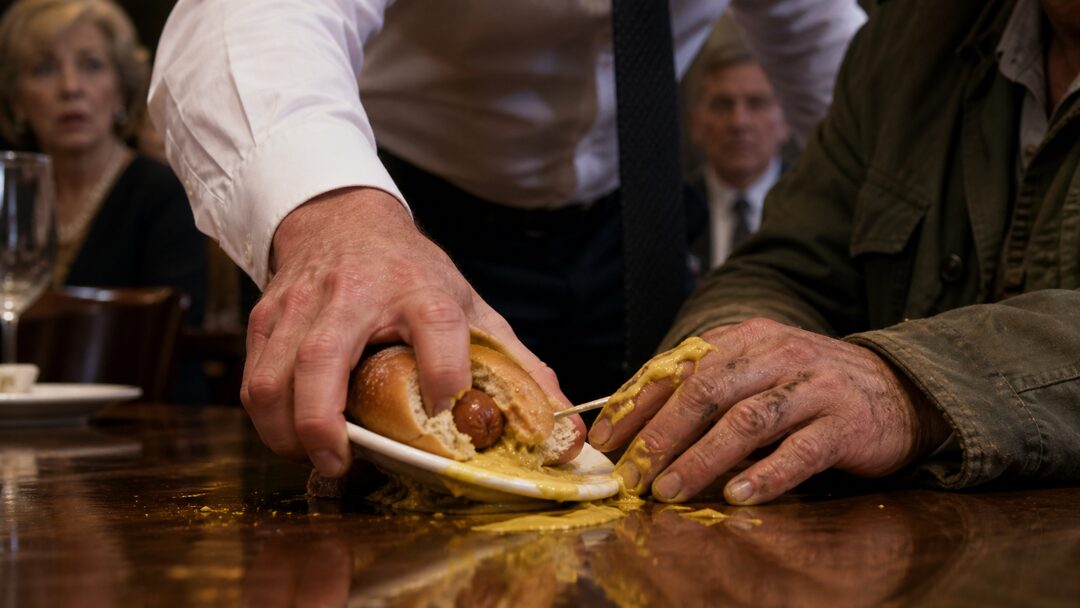
One plain hot dog sat in the center of white porcelain too fine for it, the bun already splitting at one end, a thin yellow line of mustard trembling down the side. Someone in the kitchen had pushed a tiny paper American flag into the top, the kind meant for cupcakes at school fundraisers.
Daniel looked at it for a long second.
Then he looked up at Emily.
She was young, maybe twenty-four, with a brown ponytail pulled too tight and a black apron tied around her waist. Her hands stayed near the plate after she set it down, as if she wanted to take it back.
“I’m sorry,” she whispered.
Daniel heard her over the low restaurant music, over the clink of wineglasses, over the warm laughter of people who had paid thirty dollars for appetizers and never had to wonder if they belonged in a room.
He gave her the smallest nod.
“It’s fine.”
It was not fine. But Daniel had learned years ago that not every insult needed an answer. Sometimes the answer only gave it more room.
Across the restaurant, a banner hung between two brass sconces.
THANK YOU FOR YOUR SERVICE.
Below it, couples in pressed jackets and pearl earrings leaned over candlelit tables. A few older men wore lapel pins. One table near the back had reserved cards and folded programs for the evening’s Veterans Day dinner. Daniel had not come for that.
He had seen the sign outside.
Complimentary meal for veterans.
He had almost kept walking.
Then his stomach had cramped, and the cold November wind had gone through the seams of his old field jacket, and he had thought, just this once, maybe he could take what was offered without owing anyone a story.
Emily shifted her weight.
“I told him you showed your ID,” she said quietly.
Daniel placed his hands in his lap.
They were steady if he kept them still.
“It’s all right,” he said again.
Behind her, the manager appeared.
Mark moved like a man who believed every room required his correction. Pressed white shirt. Tight tie. Flushed face. Hair combed so carefully it looked angry with itself.
His eyes went first to the plate.
Then to Daniel’s jacket.
Then to Daniel’s boots, clean but worn thin at the soles.
“What is this?” Mark said.
Emily turned too quickly. “I put in the order you told me to.”
“I didn’t ask you.”
The nearby tables quieted by degrees. Not all at once. First one conversation fell away, then another, until the silence had edges.
Mark stepped closer to Daniel.
“You think this is funny?”
Daniel looked at him.
“No.”
“You walk in here looking like that, flash some old card, and expect us to comp you a steak?”
“I didn’t ask for steak.”
“No,” Mark said, smiling without warmth. “You asked for dignity on the house.”
Emily’s face changed.
Daniel saw it because he was watching everything except his own anger.
“Sir,” she said, “he didn’t ask for anything. The sign says—”
Mark’s hand came down on the plate.
Hard.
The sound cracked through the dining room.
The bun split open. The hot dog rolled sideways. Mustard jumped across the polished table and smeared over Daniel’s fingers, bright and cheap against his knuckles. The tiny paper flag snapped loose and skidded toward the edge.
No one moved.
Daniel looked down at his hand.
For one moment, he was somewhere else.
A plastic meal tray. Dust in his teeth. Someone yelling his name through smoke. A man’s hand slipping out of his because command had said wait.
He folded the memory shut.
Then he picked up his napkin and began wiping mustard from his fingers.
Slowly.
That made Mark angrier than shouting would have.
“You hear me talking to you?”
Daniel kept wiping.
“I hear you.”
Mark leaned over the table. “Then stand up.”
Daniel did not.
Part II — The Room Begins to Watch
Phones came out before anyone decided whether they were brave.
A woman near the window raised hers halfway, pretending to check a message. A man in a navy blazer angled his camera toward the table while staring down at his menu. Someone whispered, “Is he really a veteran?”
Daniel heard that too.
He heard more than people thought.
Emily stepped between Mark and the table, but only by a few inches.
“Mark,” she said, her voice low. “Please. He showed me his card. It matched his name.”
Mark turned on her. “And now you’re in charge of verifying military service?”
“No, but—”
“But nothing. You’re here to serve, not embarrass this restaurant in front of donors.”
The word donors landed heavily. It explained the reserved table, the polished programs, the old men with pins, the banner no one had wrinkled.
Daniel looked at the ruined plate.
The flag had fallen to the floor near Emily’s shoe.
He wanted to leave.
He wanted to stand, take the humiliation with him, and let the room go back to its wine and gratitude. He knew that trick. Make yourself smaller. Let them mistake your silence for consent. Walk out before anyone has to decide what kind of person they are.
But Mark was blocking the way.
“You know what the problem is?” Mark said, louder now. “Real soldiers don’t come in here demanding freebies.”
Daniel’s napkin stopped moving.
Emily’s eyes flicked to his hand.
Only the fingers had changed. They curled once against the cloth, then relaxed.
Mark saw it too and mistook restraint for weakness.
“I’ve got a dining room full of actual heroes arriving tonight,” he continued. “Men who don’t need to prove themselves with a discount card and a sad jacket.”
Daniel set the napkin beside the plate.
His voice, when it came, was quiet enough that the nearest table leaned in to hear.
“I didn’t ask to prove anything.”
“Exactly,” Mark snapped. “Because you can’t.”
Emily said, “Stop.”
It was not loud, but it cut through the room because no one expected it from her.
Mark looked at her as if she had knocked over a tray.
“What did you say?”
Emily swallowed.
“I said stop.”
The silence changed shape.
Daniel looked at her then. Really looked. Her face had gone pale, but she held her ground. One hand gripped the edge of her apron. The other trembled at her side.
He wanted to tell her not to spend courage on him.
People like him were expensive to defend.
Mark stepped closer to Emily. “Go to the kitchen.”
“No.”
His face reddened further. “You want to lose this job over him?”
Emily glanced at Daniel, then at the phones, then at the fallen flag.
“I don’t know him,” she said. “But I know what you’re doing.”
That was when Mark reached past her.
He grabbed Daniel by the front of his jacket and yanked.
Daniel rose halfway out of the chair, not because he chose to, but because Mark had a fistful of fabric and fury. The chair legs scraped against the floor. A glass toppled somewhere behind him. Emily gasped.
For the first time, Daniel’s face changed.
Not fear.
Calculation.
He could break Mark’s wrist before the manager understood what had happened. He knew the angle. He knew the pressure. He knew how little force it took when someone grabbed with anger instead of training.
His right hand lifted an inch.
Then stopped.
He saw himself reflected in the dark window behind Mark: thin, tired, half-standing, one hand raised, everyone watching.
He lowered it.
Mark shook him once. “Stand up when I talk to you.”
A voice from the front of the restaurant said, “Take your hand off him.”
It was not loud.
It did not need to be.
Mark turned.
So did everyone else.
An older man stood just inside the entrance, dressed in a dark suit that fit him like discipline. His silver hair was combed back. His shoes were polished. A small pin rested on his lapel. He held his coat over one arm, but his other hand hung still at his side.
The room knew him before Daniel let himself look.
Mark released Daniel’s jacket.
“Colonel Harris,” he said, suddenly bright with relief. “Sir, I’m so sorry you had to walk into this.”
Daniel sat back down.
His heart had started beating wrong.
Robert Harris looked past Mark.
Straight at Daniel.
And the restaurant fell into a silence Daniel had not heard in eleven years.
The kind before an order no one wanted.
Part III — The Man in the Suit
Robert did not move for several seconds.
That was how Daniel knew the older man had recognized him.
Not by a smile. Not by a name. By the pause.
Robert had always been controlled. Even when the radios broke. Even when the road vanished under fire. Even when men looked at him with the helpless hope that someone above them understood the shape of the disaster.
He had looked composed then too.
That had been the worst part.
Mark stepped toward him, eager now, rescued by rank.
“We had a situation, sir,” he said. “This gentleman came in claiming veteran status. My staff failed to handle it properly.”
Emily’s head snapped toward him. “That’s not what happened.”
Mark ignored her.
Robert’s eyes stayed on Daniel.
“Name,” he said.
The word struck like a hand on a table.
Daniel did not answer.
Mark laughed once, nervous. “See? That’s what I mean. He won’t even—”
“Not you,” Robert said.
Mark closed his mouth.
Robert walked forward.
The room made space for him without being asked. Chairs shifted. A waiter froze by the bar. The phones stayed up, but lower now, as if people had realized they might be recording something they did not understand.
Robert stopped beside Daniel’s table.
The ruined hot dog lay open on the plate. Mustard streaked the wood. The little flag was still on the floor near Emily’s shoe.
Robert looked at the plate.
Then at Daniel’s hand.
Then at his face.
“Daniel.”
Emily inhaled softly.
Mark blinked. “You know him?”
Daniel looked up.
Robert was older, but not smaller. Age had thinned his face and deepened the lines beside his mouth, but the authority remained. It was in his stillness. In the terrible patience of a man who had spent his life being answered.
Daniel hated that his body remembered it.
“Yes, sir,” he said.
The words came out before he could stop them.
Robert flinched.
Only slightly.
But Daniel saw it.
Mark saw something else: opportunity.
“Well,” he said quickly, “then you understand why I had to be careful. People take advantage of these offers all the time. We’re honoring men like you tonight, Colonel. Not—”
Robert turned.
Mark stopped speaking.
“Not what?”
The manager’s throat moved. “I only meant—”
“What did you mean?”
No one breathed.
Mark gestured toward Daniel, then seemed to realize the gesture itself was ugly.
“He caused a disturbance.”
Robert looked at the broken plate. “Did he?”
“He refused to leave.”
“After you served him that?”
Mark’s confidence flickered. “It was a complimentary item.”
“It was a message.”
The line landed hard enough that even the people recording seemed ashamed of their hands.
Emily bent slowly and picked up the paper flag from the floor.
No one noticed except Daniel.
She held it in her palm as if it were evidence.
Robert stepped closer to Daniel.
“Stand up,” he said.
Daniel’s jaw tightened.
The whole room seemed to tilt.
For a moment, it looked like Robert was about to do what Mark had done, only with more authority and better manners.
Daniel remained seated.
“I’d rather not.”
Robert’s face changed again. Not anger. Pain, contained so tightly it almost looked like anger.
“Please,” he said.
That word had never belonged to him.
Daniel stood.
Robert reached for him.
Daniel went still.
The older man placed both hands on Daniel’s shoulders.
The restaurant saw command.
Daniel felt apology.
Robert’s fingers pressed once through the old field jacket, and Daniel remembered a different grip: Robert’s hand on his shoulder before the evacuation, before the order, before the report.
Hold position, Sergeant. That road is not cleared.
Sir, there are civilians at the east gate.
Hold position.
They will not last ten minutes.
That is an order.
Daniel had disobeyed.
He had carried a child with one arm and dragged a wounded corporal with the other. He had gone back twice. He had saved lives he was not authorized to save.
Then the convoy had been hit.
Then the questions had started.
Then the report had needed one name.
Robert’s hands stayed on his shoulders.
Daniel said, very quietly, “Don’t.”
Robert knew what he meant.
Don’t make me into your speech.
Don’t clean your conscience in public.
Don’t turn me into applause.
Robert removed his hands.
Mark’s voice broke in, thin with confusion. “Sir?”
Robert turned slowly.
“You said real soldiers were coming.”
Mark swallowed. “Yes. The event—”
Robert looked at Daniel.
“One was already here.”
Part IV — The Story No One Ordered
The room did not erupt.
That would have been easier.
Instead, the sentence stayed suspended over the tables, entering people one at a time.
Mark gave a weak laugh. “Of course. If you’re vouching for him, Colonel, then there’s been a misunderstanding.”
“No,” Robert said. “There has not.”
Daniel closed his eyes for half a second.
He heard the door of the kitchen swing open. Heard someone whisper, “That’s Colonel Harris.” Heard a phone camera refocus with a small digital click.
Emily stepped forward.
“He showed me his ID,” she said. Her voice shook, but she did not stop. “I told Mark. Daniel didn’t ask for anything special. He asked if the offer was real.”
Mark spun toward her. “Emily.”
She lifted the broken paper flag.
“And then you gave him this.”
The tiny flag drooped from its toothpick.
Something in Mark’s face hardened because shame had nowhere else to go.
“You don’t know what you’re talking about,” he said.
Daniel looked at Emily.
She looked terrified.
Still, she held up the flag.
Robert saw it too.
His expression tightened.
“Daniel,” he said, “I need to say something.”
“No,” Daniel said.
It was the first sharp word he had spoken.
Robert stopped.
Daniel lowered his voice, but everyone leaned closer anyway.
“You don’t need to do anything. You can go to your dinner. They’ll clap. You’ll say the words they came to hear. He’ll apologize to the room, not to me. And I’ll leave.”
Robert’s face held.
“That is what you want?”
Daniel looked at the ruined plate.
“It’s what I know how to do.”
The answer moved through Robert like a wound reopening.
Mark seized the opening. “Maybe that’s best for everyone. We can comp something else, handle this privately—”
Robert turned on him.
“You put your hands on him in public. You do not get privacy now.”
Mark’s mouth closed.
A man at the reserved table stood uncertainly, one of the evening organizers. “Colonel Harris, we can move into the private room if—”
“No.”
The word was final.
Robert looked at the phones.
Then at Daniel.
Then at the banner.
THANK YOU FOR YOUR SERVICE.
For the first time since entering, his composure seemed less like strength and more like a wall cracking from the inside.
“I commanded Sergeant Daniel Reed during Operation Harbor Light,” Robert said.
Daniel stared at the tabletop.
Emily’s eyes moved to him.
Mark looked around as if searching for someone to tell him this was not happening.
Robert continued. “Eleven years ago, during an evacuation, I gave an order to hold position. Sergeant Reed disobeyed that order.”
A murmur passed through the restaurant.
Mark’s face almost recovered. Almost.
Daniel did not move.
Robert’s voice stayed even, but the effort showed.
“He disobeyed because there were civilians trapped beyond the east checkpoint and two wounded men cut off from the convoy. He told me they would not survive the delay. I told him the risk was unacceptable.”
He paused.
No one interrupted now.
“He went anyway.”
Daniel’s hand closed around the edge of the table.
Robert saw it, but did not stop.
“He brought back the civilians. He brought back the wounded. Then the convoy was hit on the road we had been told was secure.”
There it was.
Not the full memory. Not the sound. Not the smell of burning rubber and dust and fear. But enough of it to make Daniel’s throat close.
Robert looked at Mark.
“The investigation needed a clean answer. Command failures are difficult to print. Disobedience is easier.”
The restaurant had become still in a way no restaurant should be.
Emily slowly lowered the flag.
Robert’s voice dropped.
“I signed the report.”
Daniel looked up then.
Robert met his eyes.
“I let them make his choice look reckless because it protected mine.”
Mark’s lips parted, but no sound came out.
The organizer sat back down.
Someone lowered a phone.
Then another.
Daniel said, “You don’t owe them this.”
Robert’s face broke for one second.
“I don’t owe them,” he said. “I owe you.”
Daniel shook his head once.
“Too late.”
The words were not cruel.
That made them worse.
Robert accepted them like he deserved them.
“Yes,” he said. “It is.”
Part V — The Cost of Being Seen
Mark tried to apologize in the way men apologize when they are still negotiating the damage.
“Mr. Reed,” he said, voice careful now, “I had no idea—”
Daniel turned toward him.
That was all.
Mark stopped.
The apology died because everyone could hear what was missing from it.
Robert did not raise his voice.
“Your staff member told you he had identification. You chose not to believe her. You chose to shame him. You chose to put your hands on him.”
Mark’s face had gone pale beneath the flush.
“I was protecting the restaurant.”
“No,” Robert said. “You were protecting the kind of honor that costs you nothing.”
That line stayed in the air.
Emily looked down at the broken flag in her hand.
Daniel wished Robert had not said it so well.
A woman near the window wiped at her cheek. Daniel hated that too. Not because feeling was wrong, but because pity had a way of standing too close.
He reached for his jacket.
“I’m leaving.”
Emily stepped back from his path.
Robert did not.
“Daniel.”
“No ceremony,” Daniel said.
Robert nodded.
“No ceremony.”
“No speech.”
“No.”
“No reporters.”
Robert looked at the phones around the room.
“Put them down,” he said.
It was not a request.
One by one, people lowered their phones. Some looked ashamed. Some looked annoyed to lose the ending they thought they were owed.
Daniel saw both.
Mark’s voice came small. “Colonel, the event—”
Robert looked at him as if remembering he existed.
“You will not manage this floor tonight.”
The organizer stood again, more decisive now. “Mark, come with me.”
Mark’s eyes darted from Robert to Daniel to Emily.
For a moment, his old anger flashed. Not remorse. Not yet. Just humiliation changing owners.
Then he walked away.
No one applauded.
Daniel was grateful for that.
Emily moved toward the table.
“I’ll clean this,” she said.
Daniel reached for his wallet.
She shook her head. “Please don’t.”
“I don’t want anything free.”
“I know.”
That stopped him.
Emily looked at the ruined plate, then toward the kitchen, then back at him.
“Then let me serve it right.”
Daniel did not know what to do with that.
He had been offered apologies before. Paper apologies. Institutional apologies. We regret the outcome. We appreciate your service. We thank you for your understanding.
No one had ever asked to do the small thing again correctly.
Robert pulled out the chair across from Daniel.
Then he stopped, hand on the back of it.
“May I?”
Daniel almost laughed.
Not because it was funny.
Because once, Robert Harris had ordered vehicles through fire without blinking. Now he was asking permission to sit down.
Daniel looked at him for a long moment.
Then he sat first.
Robert sat after.
Emily took the broken plate away.
The table looked worse without it. Mustard streaks remained. A wet mark shone where the glass had spilled. The place where the flag had fallen was empty.
Robert folded his hands.
They were older now. More spotted. Still steady.
Daniel wondered if he had ever envied that steadiness.
“I read about you,” Robert said quietly.
Daniel stared at him.
“Don’t.”
“I tried to find you.”
“No, you didn’t.”
Robert absorbed that.
Daniel’s voice stayed low. “You looked in the places that would make you feel like you tried. That’s different.”
Robert looked down.
For a moment, he was no colonel. No guest of honor. No man with programs printed in his name.
Just an old man at a table he had not earned.
“You’re right,” he said.
Daniel had expected denial.
The absence of it left him with nowhere to put the next blow.
Emily returned with a clean cloth and wiped the table herself. Not hurried. Not performative. She cleaned the mustard from the wood, lifted the fallen napkin, removed the cracked smear of cheap yellow from where Daniel’s hand had rested.
Then she placed something beside his water glass.
The little paper flag.
Its stick was bent. The corner was stained faintly with mustard. But she had smoothed it flat as much as she could.
Daniel looked at it.
Emily said, “I didn’t know whether to throw it away.”
Daniel’s throat tightened.
“Neither did I.”
She nodded as if that answer made sense.
Then she left.
Part VI — What Stayed
The real meal came fifteen minutes later.
Not steak. Daniel would not have accepted that.
Emily brought him roast chicken, mashed potatoes, green beans, and coffee in a heavy white mug. The kind of meal that did not try to prove anything.
She set it down carefully.
No flag in the food.
The small paper one remained beside the glass.
“I checked with the owner,” she said. “No charge. Not because of the sign. Because of what happened.”
Daniel looked at her.
“Will you get in trouble?”
Emily glanced toward the back hallway where Mark had disappeared.
“I don’t think he’s the one deciding that anymore.”
Almost a smile touched Daniel’s mouth.
Almost.
Robert had not spoken for several minutes. That was the first decent thing he had done all night.
Daniel picked up his fork.
His hand trembled once.
Robert saw it.
Daniel saw him seeing it.
Neither man said anything.
Around them, the restaurant slowly remembered how to be a restaurant. Conversations returned, softer than before. Silverware resumed. The banner still hung on the wall, but it looked different now. Less like gratitude. More like a question.
The organizer approached once, asking Robert if he still intended to speak.
Robert looked at Daniel.
Daniel did not give him an answer.
So Robert gave his own.
“No,” he said. “Not tonight.”
The organizer hesitated. “People came to hear you.”
Robert’s eyes stayed on the table.
“They heard enough.”
When the man left, Daniel set down his fork.
“You shouldn’t have done that for me.”
“I didn’t.”
Daniel looked up.
Robert’s voice was quiet.
“I did it because I have been standing in rooms like this for eleven years letting people thank me for a version of events that left you outside in the cold.”
Daniel wanted to hate him cleanly.
It would have been easier if Robert had defended himself. Easier if he had wrapped his guilt in rank and necessity. Easier if he had remained the man from the report.
But age had done something to him.
Not enough.
But something.
“You don’t get forgiven because you finally told the truth,” Daniel said.
Robert nodded.
“I know.”
“You don’t get to make me the good part of your story.”
“I know.”
Daniel picked up the paper flag.
The toothpick had bent near the middle. He turned it between his fingers, careful not to tear it.
“I saved people,” he said.
Robert looked at him.
Daniel kept his eyes on the flag.
“I know everyone says that like it should be enough. But I lost people too.”
Robert’s face tightened.
“I know.”
Daniel shook his head.
“No. You know the number.”
Robert did not answer.
Daniel set the flag down again.
The chicken cooled between them.
Emily watched from near the service station, pretending not to.
Daniel took one bite because leaving the plate untouched would have made the whole night belong to Mark. Then another because his body needed food more than his pride needed purity.
Robert sat across from him and did not ask for anything.
That was almost mercy.
When Daniel finally stood, the restaurant quieted again.
He hated that, but less this time.
Emily came over with his jacket before he reached for it. She held it open, then seemed embarrassed by the gesture and lowered it.
Daniel took it gently.
“Thank you,” he said.
Her eyes brightened.
“For what?”
He looked at the clean plate, the coffee mug, the little flag.
“For serving it right.”
She pressed her lips together and nodded.
Robert stood too.
For one second, the old shape returned: commander and subordinate, one man waiting for the other to move.
Then Robert stepped aside.
Daniel walked past him.
At the door, he stopped.
The cold outside pressed against the glass. His reflection looked back at him: tired face, old jacket, clean boots, shoulders a little less folded than when he came in.
He turned.
Robert was still beside the table.
Emily stood near him, holding the check folder no one needed.
The ruined plate was gone.
The flag remained.
Daniel walked back, picked it up, and slipped it carefully into the inside pocket of his jacket.
Not because it was patriotic.
Not because it fixed anything.
Because someone had taken the thing meant to mock him and treated it like it mattered.
Robert watched him.
Daniel met his eyes.
There were a hundred things Robert could have said.
I’m sorry.
Thank you.
Forgive me.
Instead, he said nothing.
For once, he did not give an order.
Daniel gave him a small nod.
Not absolution.
Not friendship.
Just proof that he had been seen standing there.
Then Daniel stepped out into the November cold, carrying the bent paper flag close to his chest, while inside the restaurant, an old man in a dark suit sat back down at the table and faced the empty chair he had spent eleven years earning.