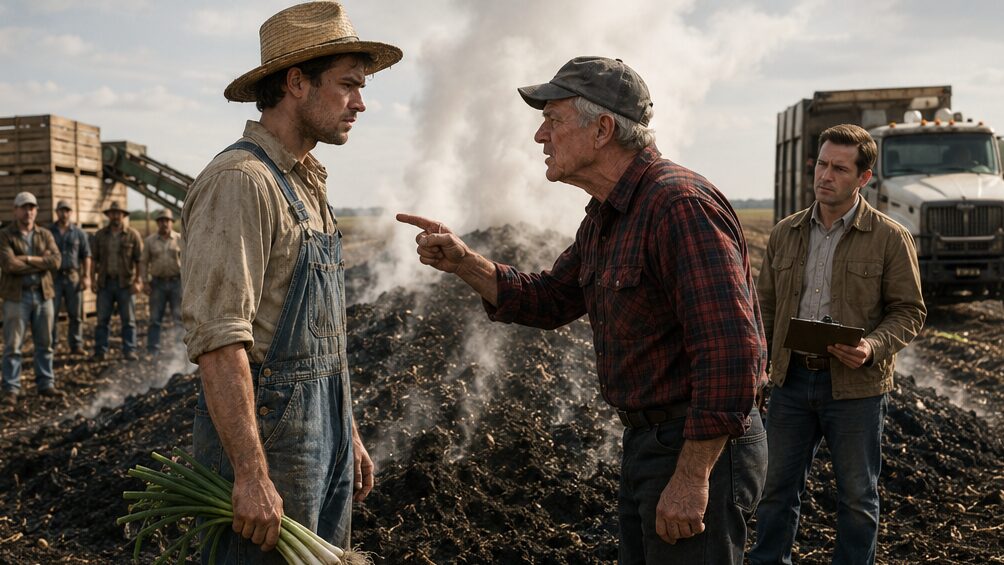
The Day Jacob Grabbed His Father’s Shirt Beside the Burning Onion Pile
Chapter 1: The Steam Rising Behind Stephen’s Accusation
Stephen Taylor’s finger was already pointed at Jacob when the first ribbon of steam curled out of the black mound behind them.
“You did this,” Stephen said.
The field hands stopped lifting onion crates. The diesel conveyor kept rattling for several seconds before one of them reached over and killed the engine. In the sudden quiet, the only sound was the dry hiss of wind moving through cut onion tops.
Jacob stood with a bundle of green onions in his left hand. Their roots were pale and clean, their stalks firm enough to creak against one another when his grip tightened. Behind him, twenty yards of buried crop waste lay under dark soil and compost. Heat pushed through cracks in the mound, carrying a sweet, spoiled smell that caught at the back of the throat.
Brandon Scott stood near the loading truck with a clipboard pressed against his thigh. He had arrived to inspect the morning shipment. Now he watched father and son with the careful stillness of a man deciding whether a private argument had become his business.
Stephen stepped closer.
“You ran that loader,” he said. “You mixed wet crop with dry waste. You piled it too tight, and now it’s cooking.”
Jacob glanced toward the field hands. Three of them had worked for the Taylors through four harvests. One had a mortgage payment due. Another sent part of every check to family out of state. None of them needed to hear Stephen turn a failed field into a public trial.
“We can talk in the office,” Jacob said.
“No. We’ll talk right here.”
Stephen’s face had gone red above the collar of his plaid shirt. His gray cap sat crooked, as if he had shoved it back with an impatient hand and forgotten it. He pointed toward the mound.
“Tell Brandon what happened.”
Jacob looked at Brandon. The buyer’s expression remained neutral, but his eyes moved from Jacob’s onion bundle to the steaming soil.
Stephen answered for him.
“He ignored the moisture reading. Didn’t turn the pile. Didn’t separate the damaged crop. I’ve told him a dozen times that field waste doesn’t manage itself.”
That was not how it had happened.
Three nights earlier, Stephen had stood beside the loader in the dark and told Jacob to bury the onions before morning. No tags. No samples. No photographs. Just get them out of sight before the cooperative truck arrived.
Jacob had asked why so much marketable crop was being discarded.
Stephen had said, “Because I own the field, and I’m telling you what to do.”
Now Jacob could feel that order sitting between them, as hot and sour as the mound.
He set the onion bundle on a crate.
“Move the crew to the north rows,” he told the field foreman. “Keep everyone away from the drainage ditch.”
Stephen caught his arm as he turned.
“You don’t give orders while I’m speaking.”
Jacob looked down at his father’s hand, then back at his face.
“Let go.”
Stephen released him, but only to point again.
“You walk away now, you’re admitting it.”
Jacob took one step toward the packing shed.
Behind him, Stephen said, louder, “You’ve been waiting to run this place, haven’t you? Thought you knew better. Thought the old man was in your way.”
The words carried across the field.
Jacob stopped.
He had learned young that Stephen mistook silence for agreement. When Jacob was sixteen, silence had kept a broken tractor from becoming a week-long argument. At twenty-two, it had kept his father from firing a mechanic over a mistake Stephen himself had made. After his grandfather died, silence had become a kind of labor—another task Jacob performed because somebody had to hold the farm together.
He started walking again.
Stephen followed.
“Look at me when I’m talking to you.”
Jacob kept moving.
“You ruined a whole section and now you won’t even own it.”
Stephen came close enough that Jacob could hear the roughness in his breathing.
“Tell him,” Stephen said. “Tell Brandon you made the decision.”
Jacob turned.
Their faces were inches apart. Stephen’s eyes were bright with anger, but beneath it Jacob saw something else—something frantic and guarded. It lasted only a second.
“I made no decision,” Jacob said.
Stephen’s jaw shifted.
“You operated the equipment.”
“Because you told me to.”
The field seemed to contract around them.
Brandon lowered his clipboard.
Stephen’s voice dropped. “Careful.”
“You ordered the onions buried. You told me not to tag the pile.”
Stephen stepped into him.
“You’re confused.”
“No.”
“You’re angry because I corrected you.”
“You ordered it.”
Stephen shoved one finger into Jacob’s chest.
“You will not stand in my field and call me a liar.”
Something in Jacob gave way.
His right hand came up and closed around the front of Stephen’s shirt. The fabric bunched hard in his fist. He pulled his father half a step forward, stopping him so abruptly that Stephen’s cap nearly slipped off.
One of the field hands inhaled sharply.
Jacob’s other hand remained open at his side.
For one dangerous second, he wanted Stephen to feel every accusation Jacob had swallowed, every mistake he had carried, every time protecting the family had meant disappearing inside it.
Stephen stared at him, shocked into silence.
Jacob did not strike him.
He held him there and said through his teeth, “Do not make me confess to your decision.”
The anger drained from Stephen’s face, leaving something colder.
“You just proved exactly what you are.”
Jacob released him.
Stephen stumbled back, smoothed his shirt, and looked immediately toward the witnesses. That hurt more than the accusation. Even shaken, his first instinct was to recover the room.
Brandon walked closer.
“No more loading,” he said.
Stephen turned. “This has nothing to do with the shipment.”
“A crop-disposal pile is heating beside a commercial field, and the two people running the farm disagree about who ordered it.” Brandon looked at Jacob, then at Stephen. “It has everything to do with the shipment.”
“The onions on that truck are clean.”
“Maybe. But until I know why that section was buried, the cooperative isn’t taking another pallet.”
Stephen’s mouth opened, but Brandon raised one hand.
“I’ll need your field treatment logs, disposal records, moisture readings, and any disease reports from the last thirty days.”
Jacob felt the weight of the missing report before Brandon even named it.
Stephen glanced at him.
The look was brief, but Jacob understood it.
Say nothing.
Brandon tore a sheet from his clipboard and handed it to Stephen.
“Inspection hold starts now. No Taylor produce leaves this farm until we review the records.”
Behind them, steam rose steadily through the cracked black soil.
Chapter 2: The Report Jacob Never Finished Filing
The disease report was gone from the office computer.
Jacob searched the farm drive twice, then checked the deleted folder, the shared archive, and the old desktop beneath the packing schedule. Nothing remained except an empty file path and the date he had created it.
Four days earlier.
He sat at the scarred metal desk while the packing shed groaned around him. The conveyor was silent. Without workers sorting and stacking, the building felt too large. Outside, loaded onion bins waited under tarps, each hour reducing their value.
Brandon stood behind him.
“You’re sure you saved it?”
“I drafted it here.”
“Submitted?”
Jacob did not answer immediately.
Brandon leaned against a filing cabinet. “That wasn’t a complicated question.”
“No. I didn’t submit it.”
Stephen stood near the office door, arms crossed.
“Because there was nothing to report,” he said.
Jacob turned in the chair. “You told me to hold it.”
“I told you not to panic over one soft patch.”
“It wasn’t one patch.”
“It was three rows after irrigation. We’ve seen rot before.”
Brandon looked between them. “What symptoms?”
Jacob remembered kneeling in the east section, pulling an onion that offered almost no resistance. Its roots had been dark and wet. The base had softened beneath his thumb. Several neighboring plants looked healthy above ground, but their leaves had begun bending at the neck.
“Root discoloration,” Jacob said. “Soft bulbs. Wilted tops.”
Stephen gave a dismissive breath. “After heavy rain.”
“And a sour smell.”
The office became still.
Brandon’s expression sharpened. “You saw those signs four days ago?”
Jacob nodded.
“And did not report them.”
“I started the report.”
“That is not the same thing.”
“No.”
The word cost him more than he expected.
He had entered the office furious at Stephen, ready to expose the burial order and clear his own name. Instead, the unfinished report sat between them like another witness. He had known enough to be concerned. He had allowed his father’s certainty to become his excuse.
Brandon opened the top drawer of the desk and began sorting through paper folders.
Stephen stepped forward. “You don’t go through my office without permission.”
“The cooperative agreement allows record inspection during a contamination hold.”
“There is no contamination.”
“Then the records will help establish that.”
Stephen put one palm on the drawer and pushed it closed.
Brandon did not argue. He took his phone out instead.
“I can request a county inspection.”
“You do that,” Stephen said, “and you’ll shut down a farm over wet onions.”
“I’m trying to avoid shutting down five farms over diseased ones.”
Jacob rose from the chair.
“Where are the disposal sheets?”
Stephen looked at him. “Where they belong.”
“They’re not in the binder.”
“Then you misplaced them.”
“I filled them out after we buried the crop.”
“Did you?”
Jacob knew the trap in the question. He had recorded the loader hours and estimated tonnage, but he had left the reason for disposal blank because Stephen had refused to specify one.
The office door opened.
Ruth Taylor stood there holding a tray with three mugs of coffee nobody had asked for. She took in the closed drawer, Brandon’s phone, Stephen’s posture, and Jacob’s face.
“What happened?” she asked.
“The disease report is missing,” Jacob said.
Stephen’s head turned sharply.
Ruth set the tray down too carefully. Coffee moved against the rims without spilling.
Brandon watched her. “Did you see a report?”
“No.”
“Did you remove anything from this office before I arrived?”
Ruth looked at Stephen.
That was answer enough.
Jacob stepped toward her. “Mom.”
She pressed her lips together.
“Your father asked me to clear the desk,” she said.
Stephen’s voice hardened. “Ruth.”
“You asked me.”
“What did you move?” Jacob said.
“Some invoices. A few notes. The treatment binder.”
“Where?”
“In the house.”
Brandon straightened. “I’ll need all of it.”
Ruth looked suddenly tired. “There wasn’t anything hidden. Stephen said the buyer would misunderstand rough notes.”
Jacob felt heat rise into his face.
“Did you see my report?”
“I saw a printed page with your handwriting on it.”
“Where is it?”
“I don’t know now.”
Stephen moved toward the door. “This conversation is finished.”
Jacob blocked him.
“No. The conversation in the field finished when Brandon froze the shipment. This is the part where we find out why you wanted everything cleared.”
Stephen’s eyes went to Jacob’s hand, as though remembering it twisted in his shirt.
“Move.”
Jacob did, but only because he could feel Brandon measuring every exchange.
Ruth retrieved the records from the farmhouse in a cardboard produce box. Wilted onion tops clung to one corner where it had previously been used during grading. Inside were invoices, handwritten irrigation notes, chemical receipts, and a treatment binder with several loose pages.
Jacob found his report folded between two equipment bills.
The first half was typed. The second half contained his field notes in pencil.
Possible basal rot. East section. Spread uncertain. Recommend sampling before harvest continuation.
Below that, in darker pencil, was a line he had added after speaking with Stephen:
Monitor forty-eight hours. No external report pending confirmation.
Brandon read it twice.
“Whose instruction was that?”
Jacob looked at Stephen.
“My decision,” Jacob said.
Stephen’s eyebrows lifted slightly.
It would have been easy to say otherwise. Stephen had told him the cooperative would overreact. Stephen had said they could not afford inspectors walking the property during harvest. Stephen had reminded Jacob how often wet ground produced harmless soft bulbs.
But Jacob had written the sentence.
Brandon tapped the page.
“This establishes that you observed symptoms and delayed reporting.”
“I know.”
“It also shows you recommended sampling.”
“I didn’t follow through.”
“No.”
Stephen spoke from the wall. “Because I inspected the field and determined there was no need.”
Brandon turned toward him. “Yet two days later, you buried that section.”
Stephen did not answer.
Jacob said, “He ordered the burial.”
“Did you object?”
“Yes.”
“Did you refuse?”
Jacob looked down at the folded report.
“No.”
There it was: the difference between being blamed for everything and being innocent of everything.
Brandon photographed the document.
“I’m taking a copy. The original stays here.”
Stephen laughed once without humor. “You already decided what this is.”
“I decided I need facts.”
A truck horn sounded outside. One of the field hands called through the shed that Christine Clark was at the south gate.
Jacob found her standing beside her pickup, still wearing mud-streaked rubber boots. She held a plastic grocery bag away from her body.
Inside were six onions with bent tops and darkened roots.
“These came from my lower rows,” she said. “Along the shared drainage line.”
Stephen had followed them out.
“Your field floods every spring,” he said. “Don’t bring your problems over here.”
Christine’s gaze moved past him toward the steaming mound.
“My problems weren’t steaming yesterday.”
She handed the bag to Jacob.
The smell reached him before he opened it.
Sour. Wet. Familiar.
Christine watched his face.
“You know what it is, don’t you?”
Jacob looked toward the drainage ditch running from Taylor land beneath the fence.
For the first time, the buried onions no longer looked like a family secret.
They looked like something moving.
Chapter 3: The Disease Moving Under the Fence Line
Christine pulled the onion from the ground with two fingers.
It came free too easily.
The leaves were green except for a bend near the neck, but the roots beneath them were black at the tips. When she pressed the bulb, cloudy moisture seeped through the papery skin.
“This row was clean last week,” she said.
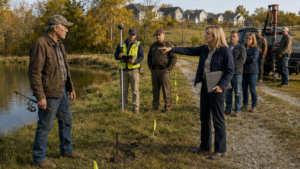
Jacob crouched beside the open furrow. Across the fence, the Taylor disposal mound stood low against the horizon. Steam drifted from it in pale threads, visible even in the warming morning air.
Stephen remained on his side of the boundary.
“No one crosses onto our property,” he said.
The county extension agent glanced at him. “I was invited by both farms.”
“Christine invited you to hers.”
“And the drainage channel begins on yours.”
Stephen hooked his thumbs into his belt. “That ditch has carried runoff for fifty years.”
“Which is why I need access.”
Jacob studied the soil around Christine’s infected plants. The ground was damp despite two dry days. A shallow groove led from the culvert beneath the fence toward the lower rows.
He had opened the irrigation gate the night they buried the crop. Stephen had told him to wash loose soil from the loading area before dawn.
At the time, the water had seemed like cleanup.
Now he pictured it moving around the edge of the mound, entering the ditch, and passing beneath the fence.
Christine folded her arms.
“How much did you bury?”
“About eleven tons,” Jacob said.
Stephen snapped, “Estimated.”
“Eleven tons,” Jacob repeated.
The agent looked up. “Why was it buried?”
“Heat damage,” Stephen said.
“Possible disease,” Jacob said at the same time.
Christine’s face tightened.
Stephen stepped toward the fence. “You don’t know that.”
“No,” Jacob said. “Because we didn’t test it.”
“You’re not helping anyone by guessing.”
“I’m done pretending the guess only affects us.”
The words landed more heavily than Jacob intended. Stephen’s face changed, not with anger at first, but with recognition. Jacob had broken a private rule: family disputes could be ugly, but they stayed inside the property line.
Christine looked at Jacob.
“When did you first see this?”
“Four days before the burial.”
Her jaw set. “And you didn’t tell me.”
“I didn’t confirm it.”
“You didn’t tell me.”
“No.”
She looked away toward her field. Rows of onions stretched behind her, thousands of plants tied to a contract, a payroll, and a year of borrowed money.
“My crew worked the lower rows yesterday,” she said. “They moved equipment to the north field afterward.”
The extension agent sealed the uprooted onion in a sample bag.
“We’ll test plants from both properties, water from the ditch, and material from the disposal mound.”
Stephen opened the gate only wide enough to stand in it.
“You’re not cutting into that pile.”
“I need a core sample.”
“You’ll spread whatever you think is in there.”
“I’ll use containment procedures.”
“No.”
The agent remained calm. “Refusal will be included in my report.”
“Write what you like.”
Jacob walked toward the gate.
Stephen blocked him. “I said no access.”
“This isn’t just your decision anymore.”
“It is my land.”
“The runoff left it.”
For several seconds, neither moved.
Jacob could sense Christine and the agent behind him. This was not the field confrontation from the day before. There was no shouting crew, no buyer, no sudden grip to seize control. If Jacob forced his way through, Stephen could make the entire dispute about disrespect again.
So Jacob stopped.
Then he reached into his pocket and took out the ring of farm keys.
Stephen’s gaze dropped to them.
“The chemical shed,” Jacob said. “The treatment logs. The sampling tools. I’m giving the agent access.”
“You don’t have authority.”
“I manage field operations.”
“You manage them under me.”
“Then tell everyone why you won’t let us test.”
Stephen’s face hardened.
He turned and walked toward the equipment yard without answering.
The chemical shed stood behind the packing building. By the time Jacob and the others reached it, Stephen was at the door. He opened the heavy padlock, stepped inside, and emerged carrying the red treatment binder.
For an instant Jacob thought he had relented.
Then Stephen placed the binder inside a steel cabinet, shut the doors, and locked them.
Christine stared at him. “Are you serious?”
Stephen pocketed the key.
“The records stay secured until our attorney reviews the cooperative request.”
“We don’t have an attorney,” Jacob said.
“We will.”
The extension agent wrote something on a field form.
Stephen pointed toward the road. “You’ve taken your samples from Clark land. That’s enough for today.”
“No,” Jacob said. “It isn’t.”
He walked past Stephen to the tool rack and pulled down a soil probe, sample sleeves, and disposable gloves.
Stephen caught the probe with one hand.
“If you open that mound, you’re finished here.”
Jacob held on.
The threat was familiar. Stephen had used versions of it for years: finished with the tractor, finished running crews, finished making decisions, finished inheriting responsibility. Until that moment, Jacob had always heard the same thing beneath it.
You will lose the farm.
Now he heard something different.
You will lose my permission to protect me.
Jacob released the probe.
Stephen took a breath, believing he had won.
Then Jacob turned to the extension agent.
“Can the county obtain an access order?”
“Yes.”
“How fast?”
“If the potential spread involves a neighboring commercial crop, today.”
Stephen’s hand tightened around the probe.
“You would bring the county onto this land against me?”
Jacob looked at the steam drifting beyond the shed roof.
“I should have brought them four days ago.”
The extension agent made the call from Christine’s truck. While they waited, Jacob returned to the boundary row and examined the infected plants. He cut one bulb open with a pocketknife.
The interior was soft near the base. The smell rose immediately.
He had smelled it in the east section before the burial.
He had told himself Stephen might be right. Heavy rain. Bruising. Temporary stress.
But standing beside Christine’s crop, Jacob remembered another detail: a faint dark line where the roots met the bulb, present in several samples. He had seen it. He had even photographed one plant, then deleted the image after Stephen called it useless evidence of ordinary rot.
Christine knelt opposite him.
“You knew enough to worry,” she said.
“Yes.”
“But not enough to warn me.”
“I thought we had time.”
“You thought your father had it handled.”
Jacob closed the onion in his hand.
“Yes.”
Her anger did not soften, but her voice did.
“That’s not the same thing as trust, Jacob.”
A county vehicle arrived before noon. Faced with a written inspection order, Stephen stepped aside without speaking.
The mound was opened near its lowest edge. Heat rolled from the cut like breath from an animal. Beneath the soil lay compressed onions, slick and collapsing, mixed with wet stalks and compost. The extension agent collected samples while the volunteer fire chief checked internal temperature.
Jacob watched Stephen watch the pile.
There was no surprise on his father’s face.
Only calculation.
The treatment binder was removed from the steel cabinet under the order. Stephen handed over the key himself, his movements slow and deliberate.
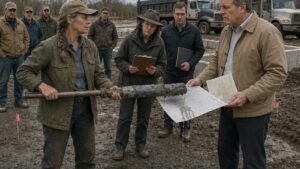
The extension agent spread the records across the hood of the county vehicle. Several entries showed treatment in the east section ten days before harvest. Product names, rates, weather conditions, and application dates had been written in Stephen’s square block handwriting.
Jacob leaned closer.
One date had been overwritten.
So had another.
The original numbers remained faintly visible beneath darker ink.
The agent compared them with a chemical purchase receipt.
“These dates don’t align,” she said.
Stephen looked toward the field.
Jacob felt the last of his defensiveness turn into something colder.
The altered entries placed treatment before the first symptoms appeared. The purchase receipt showed the product had not arrived until three days later.
The agent tapped the page.
“Who changed this log?”
No one answered.
Across the fence, Christine’s crew stood idle beside equipment they no longer knew was safe to move.
Steam continued rising from the opened mound while Stephen kept his eyes on the land and Jacob waited for him to speak.
Chapter 4: The Loan Renewal Hidden Inside the Crop Ledger
The bank notice was folded beneath a stack of produce receipts inside an old onion crate.
Jacob found it while searching the kitchen for the missing chemical invoices. The crate had once carried clean yellow bulbs to market; now its slatted sides held unpaid fuel bills, equipment statements, and envelopes stamped past due. The bank letter lay at the bottom, its white paper creased into quarters.
NOTICE OF CONDITIONAL RENEWAL.
He read the first paragraph standing beside the kitchen table. By the second, he sat down.
The farm’s operating loan would renew only if the cooperative contract remained active through the end of harvest. A suspension for contamination, unreported disease, or record irregularities would trigger review. The final sentence was plain enough to make everything else disappear.
Collateral remedies may include foreclosure proceedings against secured acreage.
Ruth entered carrying a basket of laundry and stopped when she saw the paper.
“Where did you get that?”
“The onion crate.”
She set the basket down.
“You weren’t supposed to see it like this.”
“How was I supposed to see it?”
Ruth looked toward the hall, as if Stephen might appear.
“He was going to tell you after harvest.”
Jacob placed the notice on the table. “There may not be an after harvest.”
“He thought he could fix it before the bank knew.”
“By burying eleven tons of onions?”
“By containing one bad section.”
“And blaming me.”
Ruth pulled out a chair but did not sit. Her fingers rested on its back.
“He was afraid.”
Jacob laughed once, quietly. “That explains a lot. It doesn’t undo any of it.”
“No.”
The answer surprised him.
Ruth looked down at the letter.
“Your father has slept three or four hours a night since spring. The south well repair cost twice what they estimated. Fertilizer went up. The buyer cut the early contract. Then the bank said they wanted stronger numbers before renewal.”
“You knew.”
“I knew about the loan.”
“And the field?”
“I knew he thought the east section might be a loss.”
“Did you know he planned to call it equipment failure?”
Her silence lasted too long.
Jacob pushed back from the table.
“Mom.”
“He said the loader mixed the pile wrong. He said if anyone asked, that was the simplest explanation.”
“You knew he meant me.”
“He didn’t say your name.”
“He didn’t have to.”
Ruth sat then, suddenly smaller in the chair.
“I thought it would stay inside the farm. A bad pile. A missed shipment. Maybe an insurance claim. I thought if we could get through the week—”
“That is what everyone keeps saying. Get through the day. Get through harvest. Get through the loan review. And every time we do, the lie gets bigger.”
Her eyes sharpened. “You think I don’t know that now?”
Jacob looked away.
On the counter, an onion had rolled from a grocery sack. Its papery skin was intact, but a soft place had formed near the base. He pressed it lightly and felt the give beneath his thumb.
Ruth followed his gaze.
“Your grandfather nearly lost the farm once,” she said. “You were little. A freeze wiped out the first planting, and the bank came out to measure everything. Your father sold two tractors and worked nights hauling grain. He never told you.”
“He told me plenty about sacrifice.”
“He told you the parts that made him look strong.”
Jacob folded the notice along its old creases.
“That still doesn’t make this right.”
“I know.”
“Then stop asking me to protect him.”
Ruth’s face tightened.
“I’m asking you to wait until tomorrow.”
“For what?”
“The loan officer is meeting with him this afternoon. If the bank extends the review, we may have room to work something out with the cooperative.”
Jacob stared at her.
“You want me to stay quiet until Stephen gets another promise.”
“I want you not to burn down the only bridge left while we’re standing on it.”
The image of the steaming mound came to him. The farm had already tried burying heat and calling it contained.
He left the kitchen with the bank notice in his pocket.
The bank office sat twenty miles away in a low brick building beside a feed store. Stephen was already inside when Jacob arrived. Through the glass wall of the conference room, Jacob could see him sitting upright across from the loan officer, hat on the table, both hands flat beside it.
Stephen looked older without the cap.
The loan officer opened the door.
“Jacob. Your father said you might join us.”
Stephen’s expression said otherwise.
Jacob took the empty chair.
The loan officer arranged several pages.
“The inspection hold complicates renewal. The bank cannot ignore a suspended commercial contract.”
“The suspension is temporary,” Stephen said.
“That depends on the county findings.”
“They don’t have findings.”
“They have altered treatment dates.”
Stephen’s hand moved slightly on the table.
Jacob noticed.
The loan officer continued. “The bank is not determining fault. We’re assessing exposure. If the cooperative restores purchasing quickly, we may extend the current line thirty days.”
“And if they don’t?” Jacob asked.
“We revisit the collateral.”
The acreage.
Stephen leaned forward. “The cooperative wants one responsible operator. We can give them that.”
Jacob turned toward him.
Stephen did not look back.
The loan officer closed the folder. “Then I suggest you resolve the operational question before tomorrow morning.”
Outside, Stephen walked toward his truck without speaking.
Jacob followed him across the parking lot.
“What did you mean, one responsible operator?”
Stephen opened the driver’s door.
“The cooperative needs someone accountable.”
“They already have two.”
“They don’t want two men contradicting each other.”
“So which one are you offering?”
Stephen finally looked at him.
“You can recover from this.”
The words were quiet.
Jacob felt them more sharply than any accusation in the field.
“You think I can take the blame because I’m younger.”
“I think the farm can survive if the failure is limited to one manager’s decision.”
“And you stay clean.”
“I stay in a position to keep the land.”
Jacob stepped closer, then stopped himself before the distance became another threat.
“You were ready to put my name under all of it.”
“I was ready to save what your grandfather left us.”
“He left it to the family, not to your fear.”
Stephen’s eyes hardened, but his voice did not rise.
“You promised him you’d keep it too.”
That landed where Stephen intended.
Jacob remembered his grandfather’s hospital room, the dry hand over his, the whispered request that had sounded simple at twenty-three: Don’t let the place leave us.
Stephen climbed into the truck.
“Brandon has a proposal,” he said. “Come to the cooperative office at eight.”
He drove away.
Jacob remained in the parking lot until his phone rang.
Brandon’s voice was brisk.
“I’m sending you a statement. Read it before morning.”
“What kind of statement?”
“A responsibility agreement. If you sign, the cooperative may treat the incident as isolated operator negligence rather than farmwide concealment.”
“And the altered records?”
“Still under review.”
“Stephen’s name?”
“Not in the admission section.”
The document arrived before the call ended.
Jacob opened it on his phone.
His own name appeared three times on the first page.
At the bottom, beneath a blank signature line, was the deadline.
8:30 a.m.
Chapter 5: The Confession That Would Save the Farm
Jacob’s confession was already printed when he entered the cooperative meeting room.
It lay centered before the empty chair, clipped neatly to a yellow folder. A pen rested across the signature line.
Brandon sat at one end of the table. Two cooperative board members occupied the other side. Stephen stood near the window, looking over the loading yard where trucks from other farms moved steadily through inspection.
A sealed sample bag sat beside the folder. Inside were two diseased onions from the Taylor mound, their skins gray and damp.
Jacob pulled out the chair but did not sit.
“You prepared it before hearing me.”
Brandon folded his hands. “We prepared an option.”
“It says I failed to identify and report crop disease, mishandled contaminated waste, and allowed runoff from the disposal site.”
“Those are the operational failures under review.”
“It leaves out who ordered the burial.”
One board member shifted in her chair. Brandon glanced toward Stephen.
“The cooperative is not asking you to settle every internal family dispute.”
“This isn’t internal anymore.”
“No,” Brandon said. “Which is why we need a clear accountable party.”
Jacob picked up the statement.
The language was careful. It did not call him reckless. It called him responsible. It did not accuse Stephen of anything. It referred to Jacob as the field manager with direct control over disposal and irrigation practices.
All of it was close enough to truth to be dangerous.
He had run the loader.
He had opened the irrigation gate.
He had delayed the report.
Stephen spoke without turning from the window.
“Sign it.”
Jacob looked at him.
“The bank gives us thirty days if the cooperative restores limited purchasing,” Stephen said. “Thirty days gets us through the remaining clean acreage.”
“And after that?”
“We deal with after that when it comes.”
One board member pushed a second document forward.
“If the agreement is signed, we can consider accepting product from tested, unaffected sections under additional oversight.”
“Consider,” Jacob said.
“Nothing is guaranteed.”
Brandon leaned forward.
“Jacob, this is not a declaration that you acted maliciously. It is an operational admission. Farms survive mistakes when responsibility is clear.”
“And when it isn’t?”
“They often don’t survive the uncertainty.”
Stephen came to the table.
“The land matters more than either man’s pride.”
Jacob met his eyes.
“This is not about pride.”
“It became pride when you grabbed me in front of the crew.”
The board members looked down at their papers.
Jacob felt the old instinct rise: absorb it, end the argument, keep the larger structure standing. He could sign. Stephen would secure the loan extension. Ruth would stop looking toward the road every time a vehicle approached. The field hands might return to work. The farm would have thirty days.
His name would carry the failure, but names recovered.
Land did not.
Stephen seemed to read the calculation in his face.
“You can work somewhere else if you have to,” he said quietly. “You have time.”
Jacob stared at him.
There it was again. Not contempt. Something worse because it contained love twisted beyond recognition.
Stephen believed he was choosing the person most able to survive being sacrificed.
Jacob sat down.
He uncapped the pen.
Brandon exhaled, almost imperceptibly.
Jacob read the statement from the beginning, slower this time. Halfway down the second page, one sentence stopped him.
The affected crop was disposed of immediately upon discovery according to standard isolation procedure.
He looked at the sample bag.
“When was the product applied to the east section?” he asked.
Brandon frowned. “What product?”
“The treatment listed in the altered log.”
Stephen’s face went still.
Jacob turned to him.
“You said it was applied before symptoms.”
“It was.”
“The purchase receipt says it arrived later.”
Stephen said nothing.
Jacob looked at Brandon. “Was the material from that treatment put into the disposal pile?”
“We don’t know yet.”
“I do,” Jacob said.
The memory had been sitting in pieces until then: empty containers near the shed, the sharp chemical smell on the loader bucket, Stephen telling him not to separate the waste because they needed it gone before dawn.
Jacob put the pen down.
“You mixed untreated diseased onions with treated plant waste,” he said to Stephen. “Near the drainage line.”
Stephen’s jaw tightened. “The treatment was approved.”
“For field application. Not for an open wet disposal mound.”
“It was all going to decompose.”
“It was going to heat, leak, and disappear before anyone looked.”
One of the board members closed the yellow folder.
“Mr. Taylor, is that accurate?”
Stephen directed his answer to Jacob.
“You don’t know enough to say what happened.”
“I know what I did.”
The room quieted.
Jacob turned back to the board.
“I saw the first symptoms four days before the burial. I drafted a report. I did not submit it.”
Brandon’s gaze sharpened.
“Why not?”
“Stephen told me the signs were ordinary wet rot. I wanted him to be right. I let him make the decision because contradicting him meant risking the harvest.”
Stephen’s face changed.
Jacob continued before he could interrupt.
“I operated the loader. I opened the irrigation gate. I buried the crop after he ordered me to. Those were my actions.”
He pushed the confession away.
“But I will not sign a statement that turns concealment into one employee’s mistake.”
The older board member said, “Without an agreement, the suspension remains.”
“I understand.”
“The bank may act.”
“I understand.”
Stephen placed both palms on the table.
“You understand nothing. You sign that paper, and we keep breathing. You refuse, and you hand the farm to the bank.”
Jacob looked at the onions in the clear bag. Their roots had darkened into threads against the plastic.
“If we keep selling while we don’t know where this spread, somebody else pays for us to breathe.”
Stephen shook his head.
“Fine words from a man who waited four days.”
Jacob felt the accusation strike cleanly because it was true.
“Yes,” he said. “I waited.”
Stephen went silent.
“I should have filed the report. I should have called Christine. I should have refused the burial. Put that in the record.”
Brandon looked toward the board members.
Jacob continued.
“I’m requesting a full quarantine of Taylor production until the county identifies the affected areas. I’m also requesting equipment sanitation and testing along the shared drainage line.”
Stephen’s chair scraped backward.
“You have no authority to request that.”
“I’m the field manager named in your agreement.”
The sentence held no triumph.
Brandon removed the pen from the table.
“If you make that request formally, the cooperative must suspend all Taylor shipments pending review.”
“I’m making it formally.”
One board member began writing.
Stephen stared at Jacob as though trying to recognize what remained of him.
The office printer started behind the reception wall.
A minute later, Brandon returned with a single-page notice.
He placed it over the unsigned confession.
“Effective immediately, all Taylor Farm lots are suspended from cooperative receiving, pending county clearance and board review.”
Stephen did not read it.
He looked at Jacob.
“You just chose the truth over the land.”
Jacob picked up the diseased sample bag.
“No,” he said. “I chose to stop making other people pay for our silence.”
Chapter 6: What Stephen Was Really Trying to Preserve
Stephen was burning the old field maps in a steel sorting bin.
Jacob found him alone in the packing shed after dark, feeding curled sheets into a small orange flame. The maps were hand-drawn acreage plans, some older than either of them, marked with irrigation routes, soil changes, and dates in his grandfather’s narrow handwriting.
Jacob crossed the concrete floor and pulled the top sheet away before the fire caught it.
“What are you doing?”
Stephen held another map over the bin.
“Cleaning.”
“Those are records.”
“They’re memories.”
“That doesn’t mean you burn them.”
Stephen let the page fall. Flame climbed along one edge.
Jacob stamped it out with his boot.
The packing shed smelled of ash, onions, and disinfectant. Empty pallets stood where the week’s shipments should have been. Red quarantine tape crossed the loading doors.
Stephen sat on an overturned crate.
On the table beside him lay a single onion and a small knife. He picked it up and cut away a brown patch near the root. Beneath it, the flesh was soft. He cut deeper. More rot appeared.
He kept trimming.
“It’s gone,” Jacob said.
Stephen shaved off another piece.
“You always cut until you find clean tissue.”
“Sometimes there isn’t any.”
Stephen stopped.
For a while, the only sound was the refrigerator compressor cycling in the empty cold room.
“The bank called,” Stephen said. “They’re sending someone to assess the acreage.”
“I know.”
“Your mother tell you?”
“The loan officer did.”
Stephen placed the knife down.
“My father stood in this shed the night before his surgery and made me promise I would never be the one to lose it.”
Jacob looked at the scorched maps.
“You never told me that.”
“Wasn’t yours to carry.”
“You made it mine anyway.”
Stephen rubbed his thumb over the onion’s cut surface.
“He came here with nothing but rented equipment and three acres nobody wanted. Every ditch out there, he dug. Every fence line, he fought to keep. When the freeze came, I sold what I had and worked nights because I told him I would.”
“And now?”
“Now I am the one who watched it slip.”
The words came without anger. That made them harder to hear.
Stephen looked toward the dark loading bay.
“I thought if we buried the section, finished the clean harvest, and renewed the loan, we could tear out the east field afterward. One bad decision to prevent a permanent loss.”
“You changed the treatment dates.”
Stephen did not deny it.
“I moved them to make the application look preventative.”
“You made the records false.”
“I made them survivable.”
“For who?”
Stephen’s eyes lifted.
“For everyone.”
Jacob shook his head.
“No. You decided for everyone.”
“That is what running a farm is. You decide before you know. You choose which loss can be carried.”
“And you chose me.”
Stephen looked back at the onion.
“Yes.”
The honesty struck deeper than another denial would have.
“Why?”
“Because you could recover.”
Jacob said nothing.
Stephen’s voice roughened.
“You’re thirty. You can manage another farm. Start over somewhere. Christine would hire you tomorrow if she trusted you again. I cannot start again. Your mother cannot. The crew cannot wait a year while land changes hands.”
“So you thought I should take it.”
“I thought your name could survive what the farm could not.”
Jacob leaned against the sorting table.
“That is not sacrifice when you choose it for somebody else.”
“I know that now.”
“Do you?”
Stephen’s face tightened, but he did not retreat into anger.
“I watched you in that meeting. You admitted your part when you could have placed all of it on me.”
“It was my part.”
“You always were better at that.”
“At what?”
“Knowing where your responsibility ends.”
Jacob almost laughed.
“I grabbed your shirt in front of six people.”
“You stopped before you hit me.”
“That is a low standard.”
“It is still a line.”
Stephen turned the ruined onion in his hand. Most of it was gone now, reduced to wet fragments and a small pale core.
“They’ll ask me to testify at the county review,” he said.
“Yes.”
“I’m not going.”
Jacob straightened.
“You have to.”
“No.”
“They need your account.”
“They have the logs.”
“They need to hear why.”
Stephen’s expression hardened again, but it was exhaustion rather than authority.
“I will not sit in a room while strangers explain my father’s land to me.”
“This is not about your father’s land anymore.”
“It is all about that.”
“No. It is about Christine’s field. The workers. The water line. The records. Me.”
Stephen stood.
“You want me to confess so they can call you honest.”
“I want you to speak because you did it.”
“And if I don’t?”
Jacob looked at the scorched map beneath his boot.
“Then I tell them what I know.”
Stephen’s mouth tightened.
“You would destroy me publicly.”
“I don’t want to.”
“But you will.”
Jacob thought about the field, the finger against his chest, the shirt clenched in his fist. He had believed that moment was when he stopped being silent. It was not. It had only been anger finding a body.
This was different.
“I will tell them what I did,” he said. “I will tell them what you ordered. I will tell them why I think you did it. I won’t call fear greed, and I won’t call concealment protection.”
Stephen looked at him for a long time.
Then he reached beneath the sorting table and pulled out a black field notebook.
Its cover was swollen from years of use. Jacob recognized it. Stephen carried it through every planting and harvest, recording weather, treatments, yields, equipment hours, and decisions he never entered in official files.
He set it on the table.
“You’ll find what you need.”
Jacob opened to the east section entries.
The notes were complete. First symptoms. Product purchase. Burial instructions. Rainfall. Irrigation gate opened. Each detail appeared in Stephen’s handwriting, including a sentence dated the night before the mound was built:
Hold report until contract load clears.
Jacob closed the notebook.
“Come with me to the review.”
“No.”
“Dad.”
Stephen flinched slightly at the word.
“I have nothing left to say in that room.”
“You have plenty. You just don’t want to hear what it sounds like outside your own head.”
Stephen picked up the trimmed onion. The pale center slipped from his fingers and struck the floor.
Neither man bent to retrieve it.
Jacob tucked the field notebook under his arm.
At the loading door, he paused beside the red quarantine tape.
“I’m not testifying against you,” he said.
Stephen stared at the extinguished maps.
Jacob pushed through the door into the dark yard.
He would testify to the whole chain—Stephen’s order, Ruth’s silence, Brandon’s convenient agreement, and his own four-day delay.
For the first time, he understood that protecting his father and protecting the truth could no longer be the same act.
Chapter 7: The Hearing Where Jacob Refused a Cleaner Lie
Stephen entered the county review hall after Jacob had already begun testifying.
The door opened behind the rows of folding chairs, and several heads turned. Stephen paused with one hand on the frame, cap held against his chest. He looked smaller beneath the fluorescent lights than he ever had in the field.
Jacob saw him, then looked back at the review panel.
On the table before him sat two onion samples in clear bags. One had firm white roots and a green crown. The other was gray at the base, its roots dark and collapsed against the plastic.
The field notebook lay between them.
The county extension agent had asked Jacob to describe the first symptoms.
“I found soft bulbs and darkened roots in the east section,” he said. “I drafted a report but did not submit it.”
One panel member glanced down at the report copy.
“Why?”
“My father said the symptoms were ordinary wet rot. I accepted that because reporting during harvest would have stopped movement from the field.”
“Did you believe him?”
Jacob looked at the healthy onion.
“I wanted to.”
Stephen took a seat in the last row.
The panel member continued. “Two days later, the affected crop was buried.”
“Yes.”
“On whose instruction?”
“Stephen Taylor’s.”
A murmur moved through the cooperative representatives seated along the wall. Jacob did not turn.
“And who operated the loader?”
“I did.”
“Who opened the irrigation gate afterward?”
“I did.”
The room settled again.
Brandon Scott sat at a separate table with the board members. He leaned toward his microphone.
“The cooperative’s position is that field operations were under Jacob Taylor’s direct management. Whatever verbal disagreement occurred, he retained responsibility for execution.”
Jacob looked at him.
“That is partly true.”
Brandon seemed almost relieved.
Jacob continued. “It is also incomplete.”
He opened Stephen’s notebook to the dated entry and slid it toward the panel.
“The disposal order, the decision to hold the disease report, and the altered treatment sequence were recorded here.”
One panel member adjusted his glasses.
“Is this Stephen Taylor’s handwriting?”
“Yes.”
Brandon spoke again. “Then the panel has a clear chain of command.”
“No,” Jacob said.
Brandon frowned.
“It has a chain of failure.”
He placed one finger beside the report.
“I saw signs and stayed quiet. Stephen ordered the crop buried and changed the dates. My mother removed records because she believed delay would protect the loan. The cooperative offered to restore purchasing if I accepted sole responsibility.”
One board member shifted sharply.
Brandon’s face tightened. “That proposal was an attempt to preserve commercial stability.”
“It was a cleaner lie.”
The room went still.
Jacob had imagined this moment during the nights before the hearing. In some versions, he exposed Stephen and felt lighter. In others, the panel believed nothing and the farm disappeared beneath legal notices and bank signatures.
He had not imagined how ordinary the truth would feel once spoken aloud.
No thunder. No vindication.
Only a series of choices, each small enough when made, joined into one large harm.
The panel chair turned toward Stephen.
“Mr. Taylor, would you come forward?”
Stephen remained seated.
Jacob waited.
After several seconds, Stephen rose and walked down the center aisle. He placed his cap on the table and took the chair beside Jacob without looking at him.
The panel chair indicated the notebook.
“Are these your entries?”
“Yes.”
“Did you alter the treatment dates?”
“Yes.”
“Why?”
Stephen’s eyes moved to the two onion samples.
“To keep the cooperative from suspending us before the loan renewed.”
“Did you know the disposal mound could affect neighboring property?”
“I knew there was risk.”
Christine Clark sat behind the county agent. Her arms tightened across her chest.
The panel chair asked, “Why did you proceed?”
Stephen drew one breath.
“Because I thought I could contain it.”
Jacob heard no apology in the answer, but neither did he hear defiance. It sounded like a man describing a calculation he had once trusted and no longer could.
Brandon leaned toward his microphone.
“The cooperative accepts that Mr. Taylor made improper decisions. We believe corrective measures can focus on management replacement and field containment.”
“Management replacement meaning Stephen,” Jacob said.
Brandon looked at him. “Based on the evidence, yes.”
Jacob shook his head.
“That still leaves my delay out of the cause.”
“You have already admitted it.”
“But you keep treating it as secondary because one responsible person is easier for the contract.”
The panel chair raised a hand. “Mr. Taylor, what remedy are you requesting?”
Jacob had prepared numbers, sanitation steps, testing intervals, and field maps. He opened the folder but did not read from it.
“Destroy the current Taylor crop under county supervision. Quarantine the east field and drainage corridor. Test equipment that moved between Taylor and Clark land. Require direct reporting from field managers to the cooperative instead of only through owners.”
Stephen looked at him for the first time.
Jacob continued.
“And do not permanently exclude Christine’s farm because our runoff reached her boundary.”
Christine stood.
“My lower acreage needs another season of monitoring,” she said. “But I support a corrective plan if Taylor equipment stays out and the county verifies sanitation.”
The panel chair asked, “You would support continued future participation?”
“I would support limited participation after compliance. I would not support pretending no damage occurred.”
Jacob met her gaze.
That was more than forgiveness would have given him. It was a boundary built from fact.
The hearing broke for forty minutes.
When the panel returned, the decision was narrow.
The Taylor farm would retain ownership and access to its land. The county would supervise destruction of the current onion crop and remediation of the disposal site. The cooperative contract would terminate for the season, with eligibility for limited reinstatement after testing, sanitation, and revised reporting procedures.
Christine’s lower field would remain under monitoring but not automatic exclusion.
Stephen sat motionless as each condition was read.
The loss was severe enough that no one could call it victory.
But the land would not be seized that day.
Outside the hall, the bank loan officer waited beside a stack of documents. Ruth stood near him, hands clasped at her waist.
“The bank will extend review through remediation,” the loan officer said. “But it requires a change in operational control.”
Stephen looked toward the parking lot.
The transfer document named Jacob as managing operator.
Ruth touched Stephen’s sleeve.
He did not pull away.
For a moment, Jacob expected another refusal. Another attempt to bargain for time.
Stephen took the pen.
His signature moved slowly across the page.
When he finished, he handed the pen to Jacob without meeting his eyes.
“Don’t lose it,” he said.
Jacob looked at the document, then at his father.
“The pen?”
Stephen put on his cap.
“The land.”
Chapter 8: New Green Rows Beyond the Blackened Ground
Steam no longer rose from the old disposal site.
The mound had been removed under county supervision, the soil excavated and treated, the drainage path reshaped with a planted buffer. What remained was a broad dark patch at the edge of the field where nothing had been planted for the season.
Jacob crossed it carrying the first healthy bundle from the new onion rows.
The roots were white. The stalks stood upright in his hand.
Beyond the cleared ground, workers moved through the field in measured lines, placing test flags every fifty yards. The cooperative had approved limited purchasing from the north acreage that morning. Every pallet would be sampled. Every treatment entry would be uploaded before harvest movement.
It was slower.
It was also honest.
Jacob set the onion bundle on a clean wooden crate near the former mound.
A truck pulled into the equipment yard.
Stephen climbed out.
He had worked only occasional days since the hearing, mostly repairing irrigation pipe at home or helping the mechanic rebuild an old cultivator. He had not entered the farm office once.
Now he walked toward Jacob carrying the ring of master keys.
“I thought you’d be at the cooperative,” Jacob said.
“Brandon called.”
“He calls everyone now.”
Stephen glanced toward the test flags.
“That your idea?”
“Christine’s. I agreed.”
“She always did like markers.”
Jacob almost smiled, but the old ease did not return. Not yet.
Stephen held out the keys.
“The house key is on there too. Your mother says she has another.”
Jacob did not take them immediately.
“You don’t have to surrender every key.”
“I’m not running the place.”
“No.”
Stephen looked past him at the replanted rows.
“I know.”
The words carried no challenge.
Jacob took the ring, removed two keys, and handed the rest back.
Stephen looked at them in his palm.
“South shed and pump station,” Jacob said. “I need someone overseeing soil repair and runoff checks. Written schedule. No treatment changes without approval.”
“You offering me a job?”
“A defined role.”
Stephen turned one key between his fingers.
“And if I disagree with you?”
“You put it in the log.”
“That simple?”
“No.”
Stephen nodded once.
The field crew moved farther down the rows. One worker lifted a hand toward Jacob, waiting for a signal about the next section. Jacob motioned for them to continue.
Stephen watched the exchange.
“You don’t shout much,” he said.
“They hear me.”
“That wasn’t always true.”
Jacob looked at him.
“No. It wasn’t.”
The silence between them held more than either could repair in one morning: the accusation, the missing report, Ruth’s fear, Christine’s damaged rows, the shirt twisted in Jacob’s fist.
Stephen touched the front of his plaid work shirt as though the memory lived in the fabric.
“I shouldn’t have followed you that day,” he said.
Jacob waited.
“I kept pushing because if you walked away, everyone would look at me.”
“They should have.”
“Yes.”
It was not a full apology.
Jacob found he preferred it to a polished one.
He picked up the onion bundle and placed it on the dark ground where the mound had once steamed.
Stephen studied it.
“Good roots.”
“We cut the infected starts before planting.”
“Lost nearly a quarter of them.”
“Saved the rest.”
Stephen crouched and touched the soil beside the crate. He rubbed a small amount between his fingers.
“Still too compacted.”
“The county report says another cover crop.”
“They’re right.”
Jacob glanced at him.
Stephen gave a tired shrug.
“I can be wrong more than once.”
The words were awkward enough to be sincere.
At the office, Jacob had installed a new reporting system on the shared computer. Every field observation required a date, photograph, and submission status. Owners, managers, and the cooperative could see the same entries.
Nothing could vanish into a desk drawer without leaving a gap.
Stephen looked toward the packing shed.
“Show me the new ledger.”
Jacob picked up the crate.
“You planning to argue with it?”
“Probably.”
“You’ll sign your comments.”
“I heard you.”
They walked across the field together, not side by side at first. Stephen stayed half a pace behind, then gradually came even.
At the edge of the new rows, Jacob stopped to check one plant whose leaves leaned slightly lower than the others.
He pulled it carefully.
The bulb was firm. The roots were clean.
Stephen waited without telling him what it meant.
Jacob photographed the plant, recorded the location, and marked it for monitoring.
Then he replanted it.
Inside the office, sunlight fell across the metal desk where Jacob’s unfinished report had once disappeared. The old red treatment binder sat on one shelf, retained as evidence and warning. Beside it was a new black ledger.
Jacob opened the first page.
Stephen stood across from him, the pump-station key still in his hand.
Jacob turned the screen so they could both see it.
The story has ended.