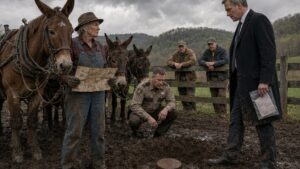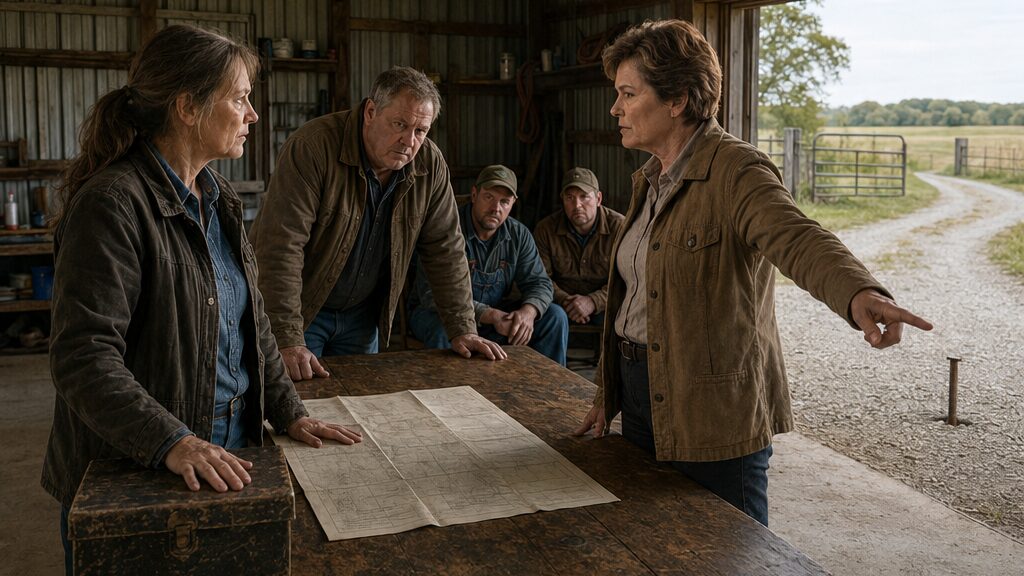
She Paid the Farm-Road Fine, Then Found the Survey That Changed Who Owned the Lane
Chapter 1: The Fine Beside Her Own Gate
Someone had wired the envelope to Mary Walker’s cattle gate.
Not tucked beneath the latch. Not left in the mailbox. Wired there with two tight twists of baling wire so that the white paper snapped in the morning breeze directly above the chain.
Mary killed the engine of her pickup and sat looking at it.
Behind her, the feed truck that had caused the trouble was already disappearing over the rise. It had spent eleven minutes backed across part of the gravel lane while the driver maneuvered around a soft shoulder and lined up with Mary’s grain bin.
Eleven minutes.
Mary climbed out, cut the wire with the pliers she kept in the door pocket, and opened the envelope.
PRIVATE FARM ROAD ASSOCIATION.
ROAD ACCESS VIOLATION.
The amount at the bottom was higher than the last one.
She folded the paper once and put it in her jacket pocket.
Across the lane, a dark utility pickup sat beside the drainage ditch. Deborah Moore stood near it with a clipboard tucked beneath one arm.
“You got it, then,” Deborah called.
Mary looked toward the feed truck’s fading dust.
“I got something.”
“The lane has to stay clear.”
“It was a feed delivery.”
“So are half the things that block it.”
Deborah was dressed for town rather than fieldwork: clean boots, pressed khaki pants, pale blouse beneath a fitted jacket. She had served as president of the road association for almost six years, long enough that neighbors sometimes spoke about association decisions as though Deborah herself had written them into county law.
Mary stepped through the gate.
“The driver couldn’t make the turn from the road without using the shoulder.”
“He could have waited until you moved the hay wagon.”
“The wagon was inside my fence.”
Deborah glanced at the gate approach.
“The maintained access area includes the shoulder.”
Mary almost answered.
Instead, she closed the gate.
For years she had learned the usefulness of not answering immediately. After her husband died, every disagreement seemed to arrive carrying extra weight. Fence repairs. Delivery schedules. Ditch cleaning. Neighbors who remembered arrangements differently from the way she did.
Arguing rarely made any of it smaller.
So she kept things.
Receipts.
Invoices.
Photographs.
Letters.
Anything that might someday matter.
She drove toward the barn and added Deborah’s newest notice to the battered document box on a shelf behind her desk.
The cardboard corners had softened. One side was darkened by an old coffee spill. Her husband had once written FARM ROAD in black marker across the lid, although the box now held far more than road papers.
Mary pulled out the earlier notices.
Forty dollars.
Fifty.
Sixty-five.
Now eighty-five.
Different reasons, same strip of gravel.
A delivery parked too long.
A trailer wheel extending onto the shoulder.
Loose hay after loading.
A tractor left near the gate overnight.
She lined the notices up by date.
The amounts were climbing.
Outside, an engine revved.
Mary looked through the office window.
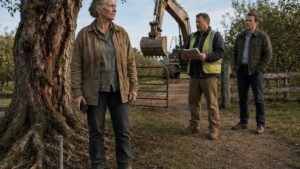
The association’s road-grading contractor had stopped near her front field. Two workers were unloading string trimmers.
She walked out.
One worker had already stepped beyond the old woven-wire fence, swinging the trimmer through weeds along the inside edge.
Mary crossed the yard fast enough that he shut the machine down before she reached him.
“Hold up.”
The worker pushed his hearing protection aside.
“Morning.”
“That’s inside my fence.”
He looked toward the lane.
“We were told to clear the association shoulder.”
“The shoulder is outside the fence.”
He hesitated.
The other worker pointed toward a line of pale paint marks running through the grass.
“That’s what they gave us.”
Mary looked down.
A painted mark sat nearly four feet inside the fence.
She had seen marks there before. She had assumed they were guides for mowing around the drainage ditch.
Now she followed them.
They continued past the cattle gate, through grass where her husband used to stack temporary fence posts, then disappeared beside a stand of sumac.
“Who gave you that line?”
“Association map.”
The answer landed harder than the fine.
Mary took out her phone and photographed the paint, the workers, the fence posts and the location of the trimmer.
“Don’t cut anything else inside here.”
“We need to call Deborah.”
“Call her.”
By noon Deborah’s pickup had returned.
This time two board members came with her.
The conversation stayed beside the gate.
Deborah kept her voice level.
“The maintained corridor has always extended through here.”
Mary pointed toward the paint.
“That line is inside my pasture.”
“It has been maintained that way for years.”
“That doesn’t answer me.”
“It answers the practical question.”
Mary looked at her.
“What practical question?”
“Whether trucks can get through.”
Deborah shifted the clipboard against her hip.
“And we have another issue now. If violations keep happening, the board can restrict commercial access until the obstruction is corrected.”
Mary stared at her.
“You mean you’ll stop my feed trucks.”
“I mean we’ll enforce the road rules consistently.”
Timothy Allen’s cattle pasture lay farther up the same lane. So did two hayfields, a rental farmhouse and a machine shed used by three families. Nobody liked the road association, but everybody needed the road.
Mary knew that was Deborah’s strongest weapon.
Not the fine.
Access.
She also knew what her husband would have said.
Don’t turn a lane into a war if you still have to drive it tomorrow.
Mary had lived by that advice long after there was nobody left to say it.
She looked again at the painted line in her grass.
“All right,” she said.
Deborah seemed surprised.
“All right?”
“I heard you.”
Mary went back to the house.
She did not pay the fine.
Instead, she carried the battered document box to the kitchen table.
For two hours she sorted everything by year.
Maintenance invoices. Ditch assessments. Notes from association meetings. Gravel bills. Old photographs showing the lane before the shoulder had been widened.
Near the bottom was a bundle of papers held with a brittle rubber band.
Her husband’s handwriting appeared on several.
Mary stopped sorting.
Under the bundle lay something rolled tightly around a cardboard tube.
She lifted it free.
Heavy yellowed paper.
County stamps.
Fine black lines.
She carried it to the table and carefully unrolled it beneath two coffee mugs.
It was an old recorded plat of their property and the shared farm road.
Mary leaned closer.
Then she looked toward the window, where the pale painted association line ran through her grass.
On the plat, the recorded line appeared to stop well before her gate.
Chapter 2: The Line Missing From the Map
Mary put the association map beside the old county plat and stared at the space between their two lines.
On Deborah’s map, the access corridor widened near Mary’s gate like the mouth of a funnel.
On the recorded plat, it did not.
The easement stayed narrow, followed the gravel road, and ended at a marked point several yards before the shoulder the association had been trimming, grading and policing.
Mary measured the difference with an old steel ruler.
Then she measured it again.
She disliked discoveries that agreed too quickly with what she wanted.
By seven that morning she had photographed both documents, marked nothing on the originals and written the measurements in a notebook.
At nine she drove to the county records office.
The clerk behind the counter studied the plat number, then disappeared into a back room.
Mary waited beneath fluorescent lights while a printer clicked somewhere beyond the wall.
When the clerk returned, she carried a thin folder.
“This is the recorded easement tied to that parcel.”
“Any amendments?”
“I’ll check.”
Mary watched the clerk search.
There were drainage agreements.
A utility crossing.
A later transfer correcting an acreage figure.
Nothing widening the farm-road easement beside Mary’s gate.
“You’re sure there isn’t another filing?”
The clerk gave her a patient look.
“I’m sure there isn’t one indexed to this parcel. That doesn’t tell you what somebody might claim through use. It tells you what’s recorded.”
Mary appreciated the distinction.
“Can I get copies?”
The clerk nodded.
On the drive home, Mary expected to feel vindicated.
Instead she felt uneasy.
The lane had looked the same for years.
Deborah had not invented the widened shoulder last Monday. Gravel had been spread there long before she became association president. Trucks routinely swung wide through the approach because the drainage ditch narrowed the turn.
If the land was clearly Mary’s, why had nobody treated it that way?
She stopped at the gate and got out.
The painted marks were still visible.
Now she saw them differently.
Not as a line drawn one morning.
As the latest version of something that had been creeping outward for years.
She spent the afternoon emptying the document box across her kitchen table.
For once she did not return papers after looking at them. She made separate stacks.
ROAD.
DITCH.
GRADING.
BOARD.
DELIVERIES.
Her husband had been less organized. He folded invoices around notes and wrote phone numbers on seed receipts.
Mary found a photograph from fourteen years earlier.
The gate was visible behind him. The shoulder beside it was grass.
Another photograph, eight years later, showed pale gravel extending farther outward.
No one had moved the fence.
The road had simply grown toward it.
A pickup slowed outside.
Timothy Allen leaned through his open window.
“I heard you were down at records.”
Mary stepped onto the porch.
“News moves fast.”
“Faster than cattle.”
He turned off the engine.
Timothy was younger than Mary by several years, broad-shouldered and permanently sun-browned from working outside. His family had grazed cattle beyond the ridge since before Mary and her husband bought their first baler.
“You trying to close the lane?”
“No.”
“That’s what people are saying.”
“People or Deborah?”
He frowned.
“Does it matter if half of us use that turn?”
Mary went inside and came back with copies of the maps.
She handed him the association map first.
“This is what they say they control.”
Then the county plat.
“This is what’s recorded.”
Timothy looked from one to the other.
His finger stopped at Mary’s gate.
“That can’t be right.”
“Which one?”
He gave her a tired look.
“You know what I mean.”
“I know what everyone has been doing. That isn’t necessarily the same thing.”
“If you fence that shoulder off, my cattle trailer won’t make the corner without backing down the hill.”
“I didn’t say I was fencing it.”
“Not yet.”
Mary took the maps back.
The accusation irritated her because it reached something true. Since finding the plat, she had imagined setting two steel posts exactly along the recorded line.
Not to hurt Timothy.
Not even to hurt Deborah.
Simply to make the ground say what Mary had spent years refusing to say herself.
Mine.
Timothy rested an arm on the truck door.
“Your husband never had a problem with us using it.”
There it was again.
Not Deborah.
Her husband.
“Did he tell you that?”
“He opened that gate plenty of times when the ditch was bad.”
Mary looked toward the low ground.
The drainage ditch collected water after hard spring rains. Before the county replaced a culvert farther down, the gravel lane sometimes became soft enough that loaded trucks hugged the higher edge near Mary’s pasture.
That was years ago.
She remembered trucks there.
She remembered mud.
She remembered her husband standing in the rain, waving somebody through.
But memory had no property lines.
That evening Mary returned to the box.
The old county copies had given her one answer: there was no recorded amendment widening the easement.
Now Timothy had given her a larger question.
She searched her husband’s papers more carefully.
Not for plats this time.
For notes.
He had a habit of writing reminders on whatever paper was closest. Fuel receipts. Feed tags. Envelopes.
Near the bottom of the box, folded inside a drainage invoice, Mary found a yellowed piece of notebook paper.
Three short lines.
She recognized the blocky handwriting immediately.
North ditch soft again.
Let Allen trucks through pasture edge if needed.
Keep gate open when wet.
Mary read it twice.
The satisfaction she had carried home from the county office thinned.
The association might not have possessed a recorded right.
But someone had given them permission.
And that someone had been the man whose papers Mary had trusted to prove everyone else wrong.
Chapter 3: The Permission Everyone Called a Right
The iron pin was exactly where the old plat said it should be.
Mary found it Saturday morning beneath six inches of weeds and packed soil near the drainage ditch.
She had started with a tape measure, using the corner of the barn foundation as the plat’s reference point. Twice she lost the line in tall grass. The third time the shovel struck something with a sharp metallic ring.
Mary knelt.
She cleared the dirt with her gloved fingers until a rust-dark circle appeared.
Not a fence staple.
Not scrap.
A survey monument.
She sat back on her heels and looked toward the association’s pale paint mark.
The paint lay several yards closer to her pasture.
For a few seconds the discovery felt wonderfully simple.
Metal did not argue.
Recorded measurements did not remember conversations differently.
Then she thought of the note in her husband’s handwriting.
Keep gate open when wet.
She photographed the pin, measured its position and covered the hole with an upside-down bucket so nobody would drive over it.
By midmorning Timothy’s truck stopped beside her.
He climbed out when he saw the bucket.
“You find something?”
Mary lifted it.
Timothy stared down.
“Well.”
“You remember this pin?”
“No.”
“You remember using this side of it?”
He looked toward the ditch.
“Sure.”
“When?”
He rubbed his jaw.
“Wet years mostly.”
“That’s what you told me.”
“That’s what happened.”
Mary stood.
“How did it start?”
Timothy was quiet long enough that she knew the answer mattered.
“Your husband.”
She waited.
He pointed down the slope.
“Before they put the bigger culvert in, water used to sit across that low section. One March my father had a loaded cattle trailer coming out. Wheels started sinking. Your husband opened your gate and waved him across the high side.”
“One time?”
“At first.”
Timothy looked toward Mary’s pasture.
“Then if it got bad, people knew they could swing wide. Feed truck. Vet. Equipment. Your husband usually left the chain loose.”
“Did the association maintain it then?”
“Not much of an association back then.”
“That isn’t what I asked.”
“No. Not that I remember.”
Mary brushed soil from her gloves.
“So when did permission become a road?”
Timothy exhaled.
“Probably the same way most things out here become permanent. Nobody complains for long enough.”
That answer followed Mary the rest of the morning.
She drove the length of the lane slowly.
What she had started calling an encroachment now showed its history.
Near her gate, newer gravel rested over older packed soil.
Farther up, Timothy’s fence bent away from the road to accommodate a turnout.
At another farm, a drainage pipe extended beneath ground everybody casually called the association shoulder.
No single decision had created the arrangement.
People had solved problems.
Then forgotten they were temporary solutions.
Mary stopped near Timothy’s upper pasture.
He was repairing a gate hinge.
“If I stopped access tomorrow,” she said, “what happens?”
He did not look up.
“My trailer makes a three-point turn near the hill.”
“Possible?”
“Dry day, yes.”
“And feed trucks?”
“Depends on the truck.”
“Ambulance?”
That made him stop.
“It could get through.”
“But?”
“But nobody wants an ambulance testing a tight corner for the first time.”
Mary nodded.
She remembered another part of her husband’s promise, though he had never phrased it formally.
Keep the place workable.
After he died, Mary had translated that into avoiding fights. Pay the smaller charge. Take photographs. Put paperwork away. Fix what she could herself.
She had believed restraint preserved relationships.
Now she wondered whether her silence had simply transferred decisions to louder people.
That afternoon she drove to Robert Green’s house with copies of the plat and photographs of the pin.
Robert had spent most of his career working with county survey records before retiring. He did not call himself a surveyor because, as he reminded everyone, his old certification and current legal authority were not the same thing.
He examined Mary’s copies at a workbench in his garage.
“This pin looks consistent with the monument reference.”
“Meaning?”
“Meaning I’d want a licensed survey before somebody builds a fence based on my opinion.”
Mary almost smiled.
“And without building a fence?”
“Your recorded easement appears narrower than the maintained area.”
“Does twenty years of using it change that?”
Robert removed his glasses.
“That’s where you stop asking the retired records guy and start asking a lawyer.”
“I’m not asking you to settle ownership.”
“Good.”
“I’m asking whether Deborah’s map is the recorded easement.”
Robert looked again.
“No.”
The word gave Mary less pleasure than she expected.
She showed him her husband’s note.
Robert read it.
“That matters.”
“To Deborah?”
“To the truth.”
Mary folded her arms.
“She’ll say it proves the association has always had the right.”
“It proves your husband allowed somebody through when it was wet.”
“Exactly.”
“Those aren’t the same sentence.”
Mary took the paper back.
By Sunday afternoon Deborah knew about the pin.
Mary never learned who told her.
Deborah appeared at the farm entrance while Mary was replacing a cracked gate board.
She walked directly to the bucket, lifted it, looked down and replaced it.
“So that’s what this is about now.”
“It was always about where the line is.”
“No. It was about keeping the road usable.”
“That’s your argument.”
“It’s everybody’s argument who has to drive it.”
Mary set down the drill.
“My husband let trucks across here when the ditch was bad.”
Deborah’s expression changed slightly.
“So you know.”
“I know he gave permission.”
“He understood the road had to function.”
“Permission isn’t the same as giving away control.”
Deborah’s jaw tightened.
“For fifteen years nobody made that distinction.”
“I’m making it now.”
The words sounded harsher than Mary intended.
Deborah looked toward the lane.
“What happens the next time Timothy has cattle coming through and you decide you’re angry at the board?”
Mary felt the insult in that—more because part of the community probably believed it.
“You think I’d block him to get at you?”
“I think people behave differently once they start drawing lines.”
Mary glanced at the survey pin.
“And I think people behave differently once they stop seeing them.”
Deborah left without another word.
The notice arrived that evening by email and again, printed, beneath Mary’s mailbox flag.
EMERGENCY MEETING.
The board would meet Monday morning to vote on “formal road-access protections and maintenance authority” covering the disputed shoulder.
Mary read the page standing beside the gate.
For years the arrangement had survived because nobody had forced it into exact language.
Now Deborah intended to do exactly that.
Not merely defend how they had used Mary’s land.
Turn that use into official authority before Mary could stop it.
Chapter 4: The Meeting Where Mary Asked One Question
Deborah had placed Mary’s newest penalty notice in the exact center of the folding table before anyone else arrived.
Mary saw it from the equipment-shed doorway.
White paper. Black print. Her name near the top.
Beside it sat a stack of association forms, two coffee cups and a yellow legal pad. Beyond the open shed doors, the gravel lane curved past Mary’s pasture, and the upside-down bucket still protected the iron survey pin from passing tires.
Deborah looked up.
“You brought quite a collection.”
Mary carried the battered document box against her hip.
“I brought what I needed.”
Timothy stood near the wall with several neighboring landowners. Robert Green had taken a folding chair near the end of the table but made no move to join either side.
Deborah waited until everyone settled.
“This meeting was called because uncertainty over the access corridor is creating a safety and maintenance problem.”
Mary heard the phrasing.
Not a boundary problem.
Not an ownership problem.
A safety problem.
Deborah picked up the penalty notice.
“We also have a current obstruction violation that remains unpaid.”
Mary stayed seated.
One board member glanced at her.
“Mary, are you disputing the fine?”
“Yes.”
“On what basis?”
“The same basis I’m disputing the association’s authority to issue it there.”
Deborah leaned forward.
“We are not reopening fifteen years of road practice because one landowner has decided she dislikes enforcement.”
A few people shifted in their chairs.
Mary felt the old instinct rise in her: wait, let the room tire itself out, take notes, answer later.
That habit had kept her from saying several things when they first mattered.
She put both hands on the document box.
“I’m not asking anyone to take my word for it.”
Deborah motioned toward the legal pad.
“The proposal is simple. The maintained shoulder will be formally designated association access so commercial, livestock and emergency traffic can continue using it.”
“Formally designated by whom?”
“The association.”
“On whose land?”
Deborah’s expression hardened.
“The land has functioned as part of the corridor for years.”
Mary opened the box.
She removed the county plat, the current association map and photographs of the iron pin.
She did not speak quickly.
That mattered.
If she hurried, Deborah could turn the meeting into an argument.
Mary unfolded the old plat carefully.
“I have one question.”
Deborah crossed her arms.
Mary slid the county plat across the table.
“Show me the recorded easement line.”
Nobody spoke.
Deborah looked at the paper.
“You know perfectly well where the road runs.”
“That isn’t what I asked.”
Mary placed the association map beside the plat.
“Show me where the recorded easement reaches my gate shoulder.”
Deborah’s finger moved across the newer map first.
“This is the maintained corridor.”
“That’s your map.”
Mary tapped the county plat.
“This one is recorded.”
A board member leaned closer.
Timothy stepped away from the wall.
Mary pointed through the open shed door toward the bucket.
“The monument referenced here is still in the ground.”
Robert finally spoke.
“I’ve looked at the plat and the location she uncovered.”
Deborah turned toward him.
“And?”
Robert remained seated.
“And the monument appears consistent with the recorded description. I’m not performing a legal survey here. But the association map and the county record are not showing the same width at that location.”
The room changed.
Not dramatically.
Nobody gasped.
But chairs scraped closer to the table.
One neighbor asked, “How much difference?”
Mary had measured enough times to answer without looking down.
“Several yards at the gate.”
Timothy walked to the shed entrance.
From where he stood, he could see the pale paint mark in Mary’s grass and the bucket over the pin.
“That painted line is well inside it,” he said.
Deborah set her pen down.
“This proves nothing about use.”
Mary looked at her.
“It proves something about the recorded boundary.”
“It proves your husband never objected.”
There it was.
Deborah turned toward the others.
“Mary’s husband opened that gate himself. He allowed trucks to cross the pasture edge when the ditch was wet. Everyone here knows that.”
Several faces turned back toward Mary.
For one heartbeat she could have denied knowing the extent of it.
She could have let Deborah sound like she was reaching for an excuse.
Instead Mary reached into the document box and removed the yellowed note.
“She’s right about that part.”
Timothy looked surprised.
Mary held the note flat against the table.
“My husband told people to use the higher ground when the ditch was bad.”
Deborah’s shoulders eased slightly, as though she had regained control.
Mary continued.
“He gave permission.”
A board member asked, “Doesn’t that settle it?”
“No.”
Mary looked at the man, then at Deborah.
“It explains why people started using it. It does not show when permission became a permanent right.”
Deborah’s face tightened again.
“You cannot invite a road to function one way for fifteen years and suddenly pretend nobody relied on it.”
“I’m not pretending nobody relied on it.”
“Then what exactly do you want?”
Mary looked around the shed.
That question was harder than the map.
She had spent days proving what she did not want.
She had not yet decided what she was willing to preserve.
“I want the board to stop treating an assumption like a deed.”
Silence settled for a few seconds.
Then Deborah pushed the proposed resolution toward the board members.
“We still need a vote. The road must remain operational while lawyers sort out whatever historical language Mary wants to challenge.”
Mary felt the pressure immediately.
If the board voted now, the association would put its own formal claim on paper before anyone had examined how the arrangement began.
She turned to Robert.
“Can they do that?”
He shook his head slightly.
“I can’t answer what they can legally do. I can tell you a vote doesn’t change what the county recorded.”
Deborah said, “And a county plat doesn’t erase years of accepted use.”
Mary saw the opening.
Not victory.
A narrower thing.
Doubt.
She slid the photographs of the iron pin toward the board.
“Then don’t vote today.”
One board member looked at Deborah.
“We should probably review the records.”
“The records have been reviewed for years.”
“Which records?” Mary asked.
Deborah’s eyes moved to her.
Mary did not look away.
The question hung there longer than she intended.
Eventually the board postponed the vote for one week.
No one congratulated Mary.
Timothy left without speaking to her.
Two neighbors remained near Deborah, quietly asking what the delay meant for deliveries.
Mary packed the plat back into her battered box.
As she carried it toward the door, Robert caught up with her.
“You’re looking at the wrong paper now.”
Mary stopped.
“The survey?”
“The survey tells you where the recorded line is.”
“What am I missing?”
Robert glanced toward Deborah, who was gathering the association documents.
“The old meeting minutes.”
Mary waited.
“If your husband gave permission,” Robert said, “somebody may have written down what the permission was for.”
Mary looked back at Deborah.
The question was no longer whether the board had relied on an informal arrangement.
It was whether the board had known it was informal all along.
Chapter 5: The Minutes Deborah Did Not Mention
The invoice was twelve years old, but Mary’s name was still printed clearly at the top.
ROAD SHOULDER GRADING.
Below it, the association had charged her household a proportional share of the work.
Mary read the location twice.
Her gate approach.
She sat at the county archive table with the invoice beneath her palm and felt anger arrive in a quieter form than before.
The association had not merely used the disputed strip.
It had billed her for maintaining it as though it belonged to the association.
She photographed the invoice and added it to a folder.
Across the table, Robert scanned a stack of photocopied board minutes.
Mary had asked him to come because she did not trust herself to interpret every phrase in the way that hurt Deborah most.
That was another thing she had learned in the past week: wanting to be correct could make a person read selectively.
Robert tapped one page.
“Here.”
Mary leaned across.
The meeting was nearly thirteen years old.
A paragraph discussed seasonal road access following spring flooding.
The language was plain.
Owner-permitted seasonal access along the Walker pasture edge.
Mary read the sentence again.
“Owner-permitted.”
Robert nodded.
“Not easement.”
“Not permanent.”
“No.”
She sat back.
For a moment she remembered Deborah at the equipment shed saying everyone had understood the land functioned as part of the corridor.
Apparently the board had once understood something more precise.
Permission.
Seasonal.
Owner.
Mary looked through the older minutes.
The same description appeared twice more over four years.
Then it vanished.
Later records simply called the area “maintained shoulder.”
No vote appeared converting one term into the other.
No recorded agreement.
No purchase.
No easement amendment.
Just a gradual change in vocabulary.
Mary ran a finger down the page.
“That’s how it happened.”
Robert looked at her.
“How what happened?”
“They stopped saying whose land it was.”
By afternoon they were back at Mary’s kitchen table.
The battered document box no longer looked battered so much as busy.
She had replaced loose bundles with labeled folders.
Invoices.
Minutes.
Maps.
Photographs.
Penalties.
Her husband’s note remained by itself.
Mary opened the road-grading statements.
The charges were not enormous individually.
A few hundred dollars one year.
Less another.
Added across a decade, they mattered.
More important was what they represented.
The association had been billing her to maintain ground it simultaneously claimed authority over.
Robert looked at the numbers.
“You may have an accounting argument.”
“I have a common-sense argument.”
“That isn’t always the same thing.”
Mary gave him a look.
He almost smiled.
She set another set of minutes beside the invoices.
“When did Deborah become president?”
Robert checked the dates.
“Six years ago.”
Most of the transition from owner-permitted access to maintained corridor had happened before that.
Mary stared at the page.
She had wanted a clean answer.
Deborah did this.
Deborah took the land.
Deborah invented the rule.
Instead, the paperwork showed something messier.
Deborah had inherited a practice that was already drifting away from its original terms.
That did not excuse the new fines.
But it changed the beginning.
Mary felt some of her anger lose its easiest target.
Late that afternoon, she and Robert met one board member at the association’s storage cabinet in the cooperative shed.
The cabinet contained years of binders, receipts and maintenance contracts.
Mary worked chronologically.
She found newer grading invoices.
Vegetation-clearing bills.
A contractor map showing the widened shoulder exactly where the association paint line now ran.
Then she found a memo clipped inside a board packet from the previous year.
It was not dramatic.
No red stamp.
No legal threat.
Just a paragraph summarizing a question raised during an insurance review.
The wording stopped Mary.
Historical access at Walker gate appears based on longstanding permissive use. Recorded easement width should be verified before future capital improvement or enforcement action.
Mary read it once.
Then again.
The date was fourteen months earlier.
Deborah’s initials appeared beside the notation acknowledging receipt.
Robert saw them too.
Neither spoke for several seconds.
The board member shifted uneasily.
“I don’t remember discussing that.”
“Was it distributed?” Mary asked.
“It must have been in the packet.”
“Was it discussed?”
“I said I don’t remember.”
Mary photographed the page.
She felt no rush of triumph.
Only a cold rearrangement of what she thought she knew.
Deborah had not created the original confusion.
But by the time she fined Mary, ordered trimming inside the fence and threatened commercial access, somebody had already warned her that the legal footing might be weak.
That evening Mary carried the records box inside and left it open on the kitchen table.
She separated the older mistakes from the newer choices.
Her husband’s permission.
The early board’s language.
The gradual widening.
The charges.
Then Deborah’s warning memo.
She could see the line now.
Not the property line.
The responsibility line.
Before bed, Timothy stopped by.
He stood at the kitchen door without coming in.
“You find what you were looking for?”
“Some of it.”
“Deborah says the old board handled all that.”
“Some of it, yes.”
Timothy frowned at the papers behind her.
“You going after her?”
Mary considered the question.
“I’m trying to find out why she kept enforcing something after she was told it might not be enforceable.”
Timothy looked toward the lane.
“She thinks if everybody starts questioning every old agreement, the road falls apart.”
“That answer come from her?”
“Mostly.”
Mary nodded.
Timothy shifted his weight.
“I don’t want the lane closed.”
“I know.”
“I also don’t love the idea that a board can paint a line across somebody’s ground and make it true.”
It was the first time he had said anything that sounded like support.
Not support for Mary.
Support for a limit.
After he left, Mary returned to the table.
The warning memo lay on top.
She had spent years assuming silence kept people from choosing sides.
Now she saw what silence actually did.
It let the existing choice stand.
Her phone rang.
Deborah.
Mary answered.
For several seconds neither woman spoke.
Then Deborah said, “I’d like to talk before the vote.”
“About what?”
“The memo you found.”
Mary looked down at Deborah’s initials.
Deborah’s voice lowered.
“Before you bring that into a room full of people, you should hear why I didn’t stop.”
Chapter 6: Why Deborah Would Not Let Go
“Don’t bring the warning memo to the vote.”
Deborah said it before Mary had even sat down.
Her barn office was narrow, functional and cleaner than Mary expected. Veterinary receipts were pinned beside road-maintenance schedules. A shelf held binders labeled by year. Through the window, the disputed lane was visible beyond a hay field.
Mary placed the battered document box on Deborah’s desk and opened the lid.
“You asked me here to tell me not to use evidence?”
“I asked you here because once you put that memo in front of everybody, nobody will hear anything after it.”
“Maybe they should.”
Deborah stood by the window.
“You think I ignored it because I wanted your ground.”
“I don’t know why you ignored it.”
“That’s why I called.”
Mary waited.
Deborah did not begin with the road association.
She began with an ambulance.
Seven years earlier, before she became president, an older landowner farther up the lane had collapsed in his machine shed.
Heavy rain had softened the road.
A livestock trailer had been left near the narrow turn.
The ambulance got through, but slowly. Then a second emergency vehicle had to stop and reposition before reaching the property.
“The man survived,” Deborah said. “That isn’t the point.”
Mary said nothing.
“The point is everybody blamed everybody afterward. Trailer owner blamed the mud. Road committee blamed the ditch. Family blamed the association. Nobody knew who could order anybody to move anything.”
Deborah turned from the window.
“I joined the board because I was tired of watching five families treat access like a favor.”
Mary looked at her.
“So you turned favors into authority.”
“I turned them into rules.”
“On land you knew might not be yours to regulate.”
Deborah’s mouth tightened.
“There’s the sentence you’ve been saving.”
“I haven’t been saving it. I’ve been trying to verify it.”
Deborah sat down.
The defiance did not disappear, but something beneath it showed now.
Fatigue, maybe.
Or fear.
“When that insurance memo came, I asked what would happen if we stopped maintaining the shoulder until someone surveyed everything.”
“What did they say?”
“They said we’d lose the wide turn until it was resolved.”
“That’s not the same as losing access.”
“Not to you.”
Mary felt the sting.
Deborah continued.
“You haul gravel. You know what a loaded truck does on a soft narrow corner. Timothy knows. Every feed driver knows. If I had told everybody last year that our authority was uncertain, somebody would have put up posts the next morning.”
“Somebody?”
“You.”
Mary leaned back.
“You don’t know that.”
“No. I know you stopped talking to the board years ago and started documenting us instead.”
That landed.
Mary looked at the open box.
Deborah had seen something Mary preferred to call prudence.
From the outside, perhaps it looked like withdrawal.
“You could have come to me.”
“So could you.”
Neither woman spoke.
The old rhythm between them was suddenly visible: Deborah deciding because Mary did not object publicly; Mary documenting because Deborah had already decided.
Each woman had treated the other’s habit as proof that her own was necessary.
Mary touched the edge of the warning memo.
“You still issued penalties.”
“Yes.”
“You still sent crews inside my fence.”
“Yes.”
“You threatened to restrict my feed deliveries.”
Deborah’s eyes lowered briefly.
“Yes.”
“After you knew.”
“I knew the footing was uncertain.”
“And you decided uncertainty gave you permission.”
“I decided the road could not wait for three years of lawyers.”
Mary closed the folder.
“There were choices between doing nothing and pretending the question didn’t exist.”
Deborah nodded once.
That small acknowledgment mattered more than an apology would have.
“I know.”
Mary studied her.
“Then why call me now?”
“Because if you force the board to abandon the shoulder completely, people will panic.”
“I haven’t said I’m doing that.”
“Everybody assumes you are.”
“Including you.”
“Yes.”
Deborah looked toward the lane again.
“And because if you show them that memo without the rest, they’ll think I knowingly stole your land.”
“Did you?”
“No.”
“Did you knowingly enforce beyond a boundary you had been warned might be wrong?”
Deborah looked back at her.
“Yes.”
The answer was quiet.
No excuse attached.
Mary felt something inside her shift.
Understanding did not erase responsibility.
It made responsibility harder to enjoy.
She had imagined the final meeting more than once.
Deborah cornered.
The fine withdrawn.
The board forced to admit the line was wrong.
Mary had even imagined driving two steel posts beside the old iron pin afterward.
A chain between them.
Not because she needed the chain.
Because everyone would understand it.
Now she pictured Timothy backing a livestock trailer down the hill.
A feed truck struggling through the narrow angle.
An ambulance arriving at night.
She resented that practical consequences had complicated what should have been her clean victory.
Then she recognized the resentment for what it was.
She had accused Deborah of choosing control because it was simpler than uncertainty.
Mary was in danger of choosing closure because it was simpler than negotiation.
“What would you accept?” she asked.
Deborah looked surprised.
“For the lane?”
“For access across my shoulder.”
Deborah sat straighter.
“A permanent easement.”
“No.”
“Then we’re back where we started.”
“No. We’re finally not.”
Mary took out a blank sheet of paper.
“Emergency vehicles always.”
Deborah said nothing.
“Farm deliveries when the turn is physically necessary. Livestock trailers. Maintenance only with notice and only inside a defined strip.”
“Who defines it?”
“A licensed survey.”
“And if you sell?”
“The agreement can run with whatever portion actually needs to.”
Deborah’s expression sharpened.
“That sounds like an easement.”
“It sounds like one with limits.”
Mary tapped the warning memo.
“Not a painted line that grows every time somebody finds it convenient.”
For the first time that afternoon, Deborah almost smiled.
Not warmly.
More like someone recognizing an opponent had become harder to dismiss.
“You’ve thought about this.”
“I started five minutes ago.”
“That’s not reassuring.”
“It shouldn’t be.”
They spent the next hour arguing over width, drainage maintenance and advance notice.
Nothing was settled.
But the shape of a choice emerged.
When Mary finally stood, Deborah touched the warning memo.
“Are you still bringing it?”
“Yes.”
Deborah’s face tightened.
Mary continued.
“And I’m bringing my husband’s note.”
Deborah looked up.
“You don’t have to.”
“Yes, I do.”
That surprised Deborah more than anything else.
Mary lifted the battered box.
“If I expect everybody to look at your part, they get to see mine too.”
She drove home before dark.
At the gate she stopped beside the iron survey pin.
The steel posts she had considered buying were never ordered.
Instead she went to the kitchen, opened a legal pad and began writing.
Not a demand to close the road.
Not another private note to save in a box.
A proposal.
Defined access.
Defined maintenance.
Defined limits.
By midnight, Mary had crossed out nearly as much as she had written.
But one sentence remained unchanged at the top of the page:
Permission must be written clearly enough that nobody can mistake it for ownership again.
Chapter 7: The Gate Stayed Open, But the Line Moved
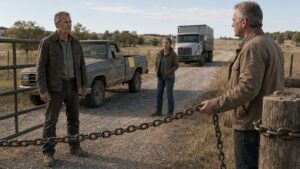
Mary arrived at the equipment shed without the chain everyone expected her to bring.
She knew they had expected it because Timothy was standing near the doorway, staring past her toward the back of her pickup.
“No posts?” he asked.
“No.”
“No chain?”
“No.”
He looked almost embarrassed by his relief.
Inside, the folding tables had been pushed together into one long row. Copies of Mary’s proposed access agreement sat in front of each board member.
Deborah was already there.
So was Robert.
The battered document box rested against Mary’s leg as she took her seat.
Deborah opened the meeting without mentioning the previous fine.
“We have two issues,” she said. “Recorded ownership and continued access.”
Mary noticed the change immediately.
A week earlier Deborah had spoken about maintained corridors and enforcement authority as though those things settled ownership by themselves.
Now ownership came first.
One board member lifted Mary’s proposal.
“This allows emergency access at all times?”
“Yes.”
“Commercial farm deliveries when necessary?”
“Yes.”
“Livestock trailers?”
“Yes.”
“And maintenance?”
“With notice, within the surveyed strip, unless there’s an emergency.”
Deborah leaned back.
“And Mary retains the right to revoke access?”
Mary shook her head.
“Not arbitrarily. That’s why I want it written properly.”
Timothy looked down at his copy.
“So you’re not closing the turn.”
“No.”
A low murmur moved through the room.
Mary waited for it to pass.
Then she opened the document box.
“I need to say something before we talk about Deborah.”
Every face turned toward her.
Mary removed her husband’s yellowed note.
She had almost left it at home.
It complicated her case.
That was exactly why she brought it.
“My husband allowed trucks across our pasture edge when the ditch was wet.”
She placed the note on the table.
“He did it on purpose. Timothy remembers it. Other people probably do too.”
Deborah watched without expression.
Mary continued.
“He wanted the road usable. So did I. I still do.”
One board member asked, “Then why are we here?”
“Because permission changed into something nobody ever agreed to.”
Mary unfolded the old county plat.
“First people crossed when they needed to. Then gravel was added. Then the association started calling it a shoulder. Then it was maintained. Then it was enforced.”
She placed the newer association map beside it.
“None of those steps changed the recorded line.”
Robert slid his chair closer.
Mary pointed toward the open shed doors.
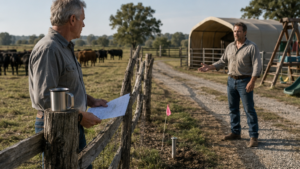
Outside, two temporary survey stakes marked the limits indicated by the licensed field work completed earlier that week. The old iron pin remained visible near the ditch.
The difference between the markers could be seen without explanation.
Deborah followed Mary’s gaze.
Mary reached into the box again.
This time she removed the warning memo.
“The harder part is this.”
Deborah’s jaw tightened.
Mary placed the page in front of the board.
“Last year, the association was warned that the access near my gate appeared to be permissive and that the recorded width should be verified before more enforcement.”
One board member read the paragraph.
Another looked at Deborah.
“You received this?”
“Yes.”
“You knew?”
Deborah took a breath.
“I knew there was uncertainty.”
“And you kept issuing fines?”
“Yes.”
The room went still.
Mary felt the moment tilt toward her.
It would have been easy to let it.
She could have said nothing else.
Instead she looked at the board members.
“That doesn’t mean Deborah created the whole problem.”
Several people looked surprised.
“She didn’t.”
Mary touched her husband’s note.
“This started before her. My husband helped create the arrangement. I helped it continue because I didn’t speak when the lines moved. The association inherited something informal and kept treating it as more official every year.”
Deborah looked at Mary for the first time since the meeting began.
Mary met her eyes.
“But once Deborah knew the footing might be wrong, she had a choice.”
Deborah said quietly, “Yes.”
No defense followed.
Mary appreciated that.
A board member cleared his throat.
“So where does that leave us?”
Mary slid the proposal forward.
“Here.”
The agreement was not elegant.
It established emergency access without delay.
It allowed livestock trailers and commercial farm deliveries to use the wider turn when needed.
It permitted drainage and surface maintenance within a defined strip after notice.
It prohibited the association from extending gravel, cutting vegetation, placing markers, or issuing obstruction penalties beyond that strip without the landowner’s written consent.
It also required a licensed survey to be attached to the final agreement.
Timothy read the last page twice.
“What about charges already paid?”
Mary looked at Deborah.
Deborah looked at the board.
“The penalties tied specifically to the disputed shoulder should be voided.”
One board member nodded.
“And maintenance assessments?”
Mary opened another folder.
“I was billed for grading on my own land.”
The room grew uncomfortable again.
“I’m not asking for every road fee back. I used the road too. I’m asking for the charges tied to work outside the recorded corridor to be reviewed and reimbursed where they shouldn’t have been assessed.”
Deborah rubbed a thumb along the edge of the table.
“That’s reasonable.”
The words were so simple that Mary almost missed them.
Robert did not smile.
Timothy did.
Only slightly.
The board discussed the proposal for nearly an hour.
There were objections.
One landowner worried about what happened if Mary sold the farm.
Another wanted a wider maintenance strip.
Timothy pushed for enough turning room to keep cattle trailers off the ditch bank.
Mary rejected language allowing unrestricted improvements.
Deborah rejected anything that required unanimous approval for emergency repairs.
They crossed out sentences.
Added definitions.
Argued over the word necessary.
Then, slowly, the document stopped belonging to Mary alone.
It became something everyone had to live with.
That was harder than winning.
It was also more useful.
Near the end, Deborah looked down the table.
“If we approve this framework, the current shoulder penalties against Mary are withdrawn pending final survey attachment.”
A board member asked, “All in favor?”
Hands rose.
Not every hand at once.
But enough.
No one applauded.
Mary was grateful.
She did not want applause.
She wanted the line fixed.
Two days later, corrected stakes stood beside the lane.
The association’s old pale paint marks disappeared beneath fresh grass and dirt where the contractor had removed them.
Mary received copies of the voided penalties and a notice that the disputed maintenance charges would be credited against future road assessments.
The amounts were smaller than the argument had made them feel.
The principle was not.
That evening, Mary carried the battered document box from the kitchen table back to her office.
For years it had been where she stored everything she was unwilling to confront.
Now the folders inside were labeled, copied and settled.
She closed the lid.
The next morning, she heard a diesel engine at the gate.
A feed truck approached slowly from the county road.
The driver stopped before the turn and looked toward Mary.
She stepped out of the barn.
He pointed toward the new stakes.
“Am I good?”
Mary looked at the line.
The old iron survey pin sat low in the grass beside the ditch, rusted and plain.
The gate was open.
“Yes,” she said. “You’re good.”
The truck swung wide through the marked access strip, cleared the ditch and continued toward the grain bin without touching the pasture beyond it.
Timothy’s pickup appeared farther up the lane.
He slowed when he saw the truck make the turn.
Then he lifted two fingers from the steering wheel and kept going.
Mary stood beside the gate until the dust settled.
Nothing about the road looked dramatic.
No barricade.
No warning sign.
No victory marker.
Just gravel, grass, an open gate and a line that finally meant what everyone had agreed it meant.
Mary rested one hand on the gate post.
For years she had thought keeping peace meant leaving certain things unsaid.
Now she understood the cost of that silence.
The road remained open.
The farms remained connected.
And for the first time in years, the line beside Mary Walker’s gate was neither a favor nor an assumption.
It was clear.
The story has ended.