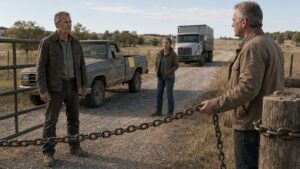
They Marked Her Family Orchard for Demolition, but the Oldest Apple Tree Held a Promise Nobody Had Read Correctly
Chapter 1: The Survey Stake Beside the Oldest Tree
The first blow of steel against hard ground carried all the way to Ruth Carter’s kitchen.
She set down the coffee mug without drinking and listened.
Clang.
Not a hammer on the equipment shed. Not a loose gate. Metal striking packed earth.
The third blow came before she reached the porch.
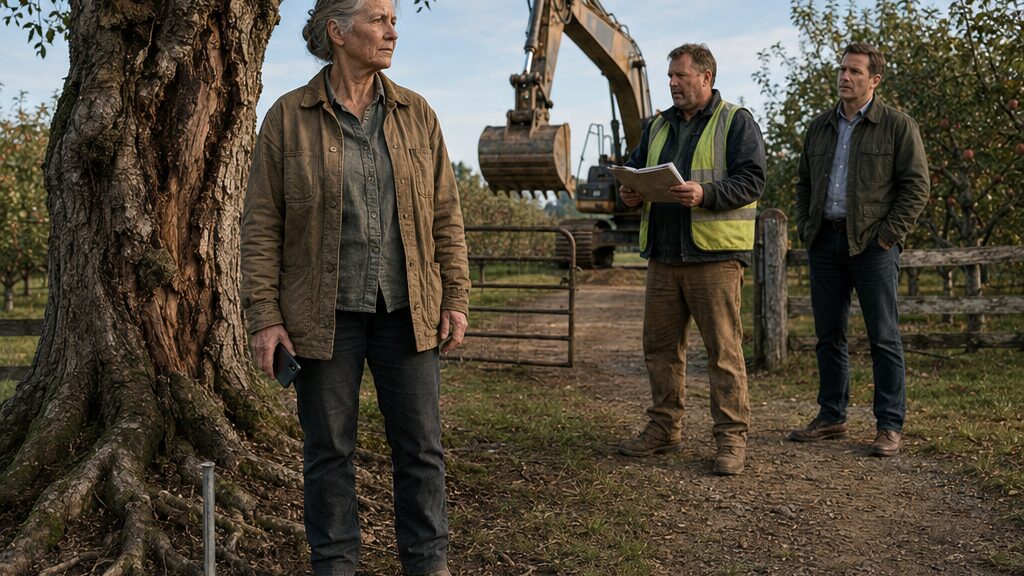
At the lower edge of the orchard, beside the oldest apple tree, a man in a navy suit stood with one polished shoe braced against a survey stake. A younger surveyor held a tripod several yards behind him. Orange flags dotted the grass beyond the fence.
Ruth crossed the yard without bothering with her jacket.
“Get that out of the ground.”
Gregory Davis looked up.
He was in his early sixties, silver at the temples, dressed for an office instead of wet grass. He rested one hand on the top of the stake as if she had interrupted him measuring his own property.
“Morning, Ruth.”
“You heard me.”
His gaze moved to the tree.
The old apple tree leaned slightly toward the east, its trunk hollowed on one side by age. A dark scar ran down the bark where lightning had opened it decades earlier. Ruth’s great-grandfather had planted it in 1909, when the hillside had been more pasture than orchard.
The stake stood less than two feet from an exposed root.
Gregory nodded toward the surveyor. “We’re verifying the connector alignment.”
“You’re on my land.”
“We’re verifying a line.”
“With a hammer?”
The surveyor lowered his eyes.
Gregory pulled a folded sheet from inside his coat. “The offer is still open.”
Ruth did not take it.
Beyond him, through the bare spaces between rows, she could see the roofs of Gregory’s new development on the north side. More houses were going up on the south side. Her orchard sat between the two sections like a green wedge someone had forgotten to erase from a drawing.
Gregory held the paper farther out.
“The number changed.”
“I didn’t ask.”
“It’s more than fair.”
“Then buy somebody else’s farm.”
His mouth tightened, but only for a moment. “I already did.”
That was the problem.
He had purchased most of the parcels surrounding the eastern edge. The county had approved the development in phases, and for more than a year trucks had been moving dirt where cattle once grazed. Ruth had watched roads appear, utilities go in, then streetlights.
She had told herself none of it mattered as long as the orchard remained hers.
Gregory pointed through the trees. “The north phase and south phase need a direct connection. Fire access, utilities, traffic circulation. Your eastern strip is the logical route.”
“It’s an orchard.”
“It’s eleven acres.”
“To you.”
“To the county too.”
Ruth stepped toward the stake.
A fresh patch of bark had been knocked from a root where the steel had glanced against it. She crouched, picked up the loosened piece, and turned it between her fingers.
Gregory watched her.
“It’s a tree,” he said.
Ruth stood.
“No. That is where your problem starts.”
He gave a short laugh. “My problem is a missing road.”
“My problem is you standing in my orchard pretending a survey makes ownership.”
He handed her the offer anyway.
The figure was larger than the previous one. Large enough to repair the irrigation pump. Large enough to pay the equipment note, the property taxes, the line of credit she had renewed twice without telling Emma.
For one dangerous second, Ruth imagined what it would feel like to have every envelope on the kitchen table disappear.
Then she folded the check once.
Gregory’s expression softened, mistaking the movement.
“Ruth, nobody is asking you to walk away empty-handed.”
She tore it down the middle.
The surveyor looked up.
Ruth tore it again and placed the four pieces against Gregory’s chest. He caught them before they fell.
“I’m not selling.”
“You may not have much choice by Monday.”
The words landed more heavily than his raised voice would have.
Ruth stared at him.
Gregory slid the torn pieces into his coat pocket.
“We have crews scheduled. Contractors. Financing conditions. I have given you months.”
“You have given me offers.”
“I’ve given you time.”
“You don’t get to give me time on my own land.”
Something changed in his face then. Not anger exactly. Impatience stripped of politeness.
“Tomorrow morning we’ll begin preparatory work along the approved boundary. If your attorney wants to challenge it, he knows where to find mine.”
“Approved by whom?”
“The appropriate people.”
“That isn’t an answer.”
“It is the only one I have time for.”
He motioned to the surveyor. They walked back toward a dark SUV parked near the lane.
Ruth remained beside the tree.
The orange flags ran in a crooked sequence along the eastern rows. From where she stood, the line seemed wrong. Not dramatically wrong. Six feet here. Perhaps ten there. But she had driven tractors through those rows since before Gregory Davis had ever heard of the property.
She knew where the old access lane had been.
Or thought she did.
By noon, she had called her local attorney twice. Both times she reached voicemail.
At one thirty, a flatbed carrying an excavator slowed at the county road, then continued past. Ruth watched it from the packing shed until it disappeared.
At three, Emma called.
Ruth nearly answered. Instead she let the phone ring out.
Emma would ask about the loan payment.
Or the leaking cooler.
Or whether Ruth had finally considered the developer’s offer.
Ruth was tired of explaining why some things were not numbers.
Near dusk, she walked the orchard again.
The survey stake remained beside the old tree. She resisted the urge to pull it out. Her father had taught her never to move a marker during a boundary dispute. “You leave their mistakes where everybody can see them,” he used to say.
Her father had been dead nine years.
At the farmhouse, Ruth opened the narrow cabinet above the desk and pulled down his old farm ledger. The red cloth cover had faded almost brown. Inside were harvest totals, spray dates, labor payments, equipment repairs, and decades of handwriting that became less steady toward the end.
She was looking for an old sketch of the east rows.
Instead, when she closed the ledger, she noticed something burned faintly into the back cover.
Numbers.
Not arithmetic. Not a date.
A parcel reference.
Ruth carried the ledger beneath the kitchen light.
She ran her thumb across the characters, remembering her father writing notes on whatever happened to be within reach.
The number did not match the parcel number on her current tax bill.
It did not match the number on Gregory’s last offer either.
Ruth found an old county map in the desk drawer and searched until her eyes hurt.
The number was nowhere on it.
She picked up her phone.
This time she did not call her attorney.
She called the county records office and asked when the archive opened.
Chapter 2: The Morning the Backhoe Reached Her Gate
The diesel engines woke Ruth before sunrise.
For a few seconds she lay still, listening to the low mechanical idle beyond the bedroom window.
Then came the metallic rattle of a trailer ramp.
She was dressed before the coffee maker finished dripping.
At the orchard gate, an excavator sat on a flatbed with its boom folded inward. A utility truck blocked half the lane. Two workers in reflective vests stood beside the fence while the foreman fastened a laminated notice to a post.
Gregory was not there.
Ruth preferred it that way.
“What are you doing?”
The foreman turned.
He was thick through the shoulders, mid-fifties, with mud already dried along his boots.
“Morning, ma’am.”
“Answer the question.”
“We’re clearing to the marked limit.”
“You are not.”
He glanced at the notice. “I’ve got a work order.”
“You have a truck.”
“I’ve got paperwork too.”
Ruth walked past him toward the oldest tree.
The survey stake from yesterday was still there. Overnight damp had darkened the damaged root. One of the orange flags continued east, then another farther south, cutting across ground Ruth remembered as part of the old tractor approach.
She took out her phone and photographed the stake.
The foreman followed.
“Ma’am, you need to stay outside the work area.”
Ruth took another photograph, wider this time, including the tree trunk, stake and fence corner.
“Which parcel number did they give you?”
He frowned. “What?”
“Parcel number.”
“I don’t know.”
“Then look.”
“I’m not authorized to discuss—”
“Then you’re not authorized to tell me where my land ends either.”
The man exhaled through his nose. He was irritated, but not eager for a fight.
Behind him, one of the workers had started unfastening the excavator chains.
Ruth pointed at the truck.
“If that machine crosses this gate before you answer me, I’m documenting that too.”
The foreman studied her for a moment, then pulled a clipboard from the cab.
He read the number.
Ruth felt a small pressure behind her ribs.
It was not the number burned into her father’s ledger.
It was the modern parcel number from the tax map.
“Show me the description.”
He hesitated.
“You can hold it. I’ll read it from there.”
He turned the clipboard.
The legal description was dense, all bearings and distances. Ruth could not interpret every line, but one phrase caught her attention: beginning at the northeastern corner of the Carter tract.
“What corner?”
He tapped the page.
“That’s what it says.”
“I’m asking where you were told that corner is.”
He pointed.
Not at the current fence.
At the survey stake beside the 1909 tree.
Ruth looked from his finger to the old trunk.
“No.”
“Ma’am—”
“That’s not the northeast corner.”
“The surveyor marked it.”
“The surveyor marked something.”
The excavator engine turned over.
Ruth stepped away from the machine, not toward it. She photographed the clipboard, then the position of the bucket on the trailer.
“Shut it down,” she said.
The foreman shook his head. “I can’t do that because you disagree with a survey.”
“I’m not asking because I disagree.”
She held up her father’s ledger, which she had tucked under her arm on the way out.
“I’m asking because you’re standing on a parcel description that didn’t exist when this access strip was created.”
The foreman stared at the ledger.
Behind him, the excavator engine continued idling.
“Created by who?”
“That is what I intend to find out.”
A black SUV appeared at the end of the lane.
Gregory.
He stopped beside the work truck and got out without a coat, shirt sleeves rolled once at the cuffs.
“You’re delaying my crew.”
Ruth turned toward him.
“Your crew is using the wrong corner.”
Gregory looked at the stake. “According to you.”
“According to a parcel number older than your subdivision map.”
For the first time since the previous morning, his expression changed before he could control it.
Only slightly.
But Ruth saw it.
“You found an old number,” he said.
“So you know there is one.”
“I know properties get renumbered.”
“Then why is your survey line starting at a tree instead of the recorded fence corner?”
Gregory looked at the foreman.
“Give us five minutes.”
The workers moved back toward the trucks.
Gregory lowered his voice.
“Ruth, you’re confusing historical records with current title.”
“Maybe.”
He seemed surprised by the answer.
She held up her phone.
“That’s why I’m not moving your stake. I’ve photographed the line, the tree, your notice, the machine and your crew’s parcel description. If you cut across that strip and the line is wrong, nobody gets to call it a misunderstanding later.”
“You think threatening litigation changes the survey?”
“No. But it changes what happens if you ignore a disputed survey.”
Gregory rubbed a hand over his jaw.
The gesture made him look older.
“Do you know how many contracts are tied to this connector?”
“No.”
“Do you know how many crews I have scheduled?”
“No.”
“Then perhaps you don’t understand what you’re interfering with.”
Ruth glanced at the excavator.
“I understand exactly what can’t be put back.”
A branch above them shifted in the morning breeze. The old tree had not produced well in years. Its apples were small, often blemished, and Ruth had been told more than once that removing it would improve the row.
She had refused every time.
Gregory followed her gaze.
“You’re holding up a development over a dying tree.”
“No.”
Ruth turned back to him.
“I’m holding you up because you don’t know what the tree is standing on.”
That silenced him.
Not for long.
Gregory walked to his SUV and made a phone call.
Ten minutes later he returned.
“We’ll pause the eastern cut this morning.”
The foreman looked relieved.
Ruth did not.
“What about tomorrow?”
“That depends on the county.”
“What did you just do?”
“Asked my attorney to move the variance.”
Her stomach tightened.
“You already filed one?”
Gregory’s eyes held hers.
“The county has a process for resolving obsolete restrictions.”
There it was.
Not proof. Not yet.
But he knew.
He had known enough to prepare a way around something Ruth had only rediscovered the night before.
The crew loaded nothing back onto the trailer. They simply waited, engines off, as if the orchard had been granted a temporary stay.
Ruth went inside, changed out of her muddy boots and drove to the county building.
The records office occupied the ground floor behind glass doors. Metal shelves were visible through an open doorway.
A woman at the counter looked up.
“Can I help you?”
“I hope so.”
Ruth placed the ledger down carefully.
“My name is Ruth Carter. I need the original deed chain for an orchard parcel, and I don’t mean the version in the current computer system.”
The woman looked at the burned number.
“I’m Sharon Wright.”
She pulled the ledger closer without touching the fragile cover.
“How far back are we going?”
Ruth thought of Gregory’s variance.
“Far enough to find out why somebody wanted this number forgotten.”
Chapter 3: The Promise Ruth Never Explained to Emma
Sharon Wright returned carrying a gray archival box with both hands.
“This predates the indexing system we use now,” she said. “So before you get excited, old does not mean controlling.”
Ruth had not told her she was excited.
She had been sitting beneath fluorescent lights for forty minutes while Sharon traced the burned parcel number through handwritten grantor books and microfilmed indexes.
The box landed on the counter with a soft thump.
“What does it mean?”
“It means somebody kept paper.”
Sharon pulled on cotton gloves and opened the lid.
Inside lay folded deeds, plats and transfer sheets enclosed in protective sleeves. The oldest document was browned at the edges and written in narrow type crowded with handwritten notations.
Ruth leaned closer.
A familiar surname appeared near the top.
Carter.
Her great-grandfather.
She felt a childish urge to touch the page.
Sharon noticed.
“Please don’t.”
Ruth withdrew her hand.
“Sorry.”
“No problem. You’d be amazed.”
Sharon began laying out the chain in order.
The orchard had once been part of a larger farm, divided over generations into three tracts. Some transfers were between relatives. Others went to neighboring families. Parcel numbers changed after county-wide remapping. Boundaries were described first by stones and roads, later by measured bearings.
Ruth recognized locations beneath the old language.
The creek bend.
The eastern lane.
The hill where the packing shed now stood.
And the oldest apple tree.
Not by name, but by a notation beside a hand-drawn agricultural lane.
“What’s this?”
Sharon looked.
“An access reference.”
“For what?”
“I can tell you what the document says. I can’t tell you what it legally means.”
Ruth leaned closer.
The language referred to continued agricultural passage between three adjoining tracts.
Her heart began to beat faster.
“So it’s an easement?”
“I did not say that.”
“A restriction?”
“I didn’t say that either.”
Sharon tapped the desk gently.
“You need an attorney for interpretation.”
Ruth almost smiled.
“What I need first is a copy.”
“That I can give you.”
The door behind Ruth opened.
“Mom.”
Ruth closed her eyes for half a second.
Emma Carter stood near the counter holding her car keys.
She wore office clothes and the expression she usually reserved for unpaid invoices.
“How did you know I was here?”
“You didn’t answer your phone. I drove to the farm. There was an excavator at the gate.”
“It’s stopped.”
“For how long?”
Ruth gathered the copies Sharon had made.
“We’re handling it.”
Emma looked at Sharon, then at the documents.
“Who is ‘we’?”
“Thank you,” Ruth told Sharon.
Sharon understood dismissal when she heard it.
“If you need later instruments, ask for the continuation file under the modern number.”
Outside, Emma followed Ruth down the concrete steps.
“You tore up another offer, didn’t you?”
Ruth stopped.
“How would you know that?”
“Gregory’s office called me.”
Ruth turned sharply.
“They what?”
“They asked whether I had any ownership interest.”
“You don’t.”
“I know.”
“Then they had no reason to call.”
Emma’s mouth hardened.
“They said you rejected an offer that would clear every debt attached to the property.”
Ruth said nothing.
That was enough.
Emma stared at her.
“How much?”
“Not here.”
“How much debt?”
“Emma.”
“How much?”
A county employee passed them toward the entrance. Ruth waited until the door closed.
“Less than the orchard is worth.”
“That is not what I asked.”
Ruth walked toward the parking lot.
Emma kept pace.
“The cooler barely made it through harvest. The irrigation pump is older than I am. You told me the equipment loan was almost paid.”
“It is.”
“How almost?”
Ruth unlocked her truck.
Emma caught the door before she could open it.
“You’re asking everybody to defend something you won’t even tell us the truth about.”
Ruth looked at her daughter’s hand on the door.
“Move.”
Emma did, but only after a moment.
They said nothing else until that evening.
At the farmhouse, the archival copies lay across the kitchen table while the old tree darkened beyond the window.
Emma stood at the sink.
“You know Uncle Tyler talked about selling the east side.”
Ruth looked up.
“Don’t.”
“He did.”
“He talked about a lot of things.”
“He had a survey done.”
Ruth went still.
Emma turned.
“You knew?”
“I knew he was worried.”
“He told me the orchard couldn’t keep carrying itself forever.”
“He didn’t own it alone.”
“I’m not saying he did.”
“You sound like him.”
Emma laughed once, without humor.
“That’s convenient.”
Ruth pushed back from the table.
“What do you want me to say? That he was right? That Dad was wrong? That my grandfather was wrong too?”
“I want you to stop talking like everybody who considers change is betraying the dead.”
The words struck harder than Ruth expected.
She looked toward the window.
The oldest tree stood in silhouette, crooked and stubborn.
“When your grandfather was dying,” Ruth said, “he made me promise I wouldn’t be the one who lost this place.”
Emma’s voice softened, but only slightly.
“And what did he mean by lost?”
Ruth turned.
“He meant sold.”
“Did he?”
“I was there.”
“You were also the one he knew would say yes.”
Ruth stared at her.
Emma looked down at the papers.
“Maybe that’s why he asked you instead of me.”
The room became very quiet.
Ruth gathered the deed copies too quickly. One slid to the floor.
Emma bent to pick it up.
“Wait.”
She held the page beneath the kitchen light.
“What?”
“This part.”
Ruth moved beside her.
The language was old-fashioned but readable. It referred to three tracts, agricultural passage and a condition tied to division that would prevent continued use of the remaining farm.
Emma traced the paragraph with one finger without touching the ink.
“This isn’t saying nobody can ever sell anything.”
Ruth took the page.
“I know what it says.”
“No. I don’t think you do.”
Ruth started to argue, then stopped.
She read it again.
Not the family story she had carried for decades.
The words.
The actual words.
The restriction did not protect eleven acres because eleven acres were sacred.
It protected the ability of the farm to remain workable when surrounding pieces changed hands.
Ruth sat down slowly.
Emma pulled the modern development map across the table.
Three original tracts.
One historic agricultural lane.
Two modern development phases.
And somewhere between them, a string of renumbered parcels that no longer matched the language in the old deed.
Ruth placed her father’s ledger beside the map.
For the first time, Gregory’s confidence made sense.
He was not ignoring the old papers because he had never heard of them.
He believed the modern map had buried them.
Ruth picked up a pencil and drew a careful line from the old access notation toward Gregory’s proposed connector.
The line passed directly through the place where the survey stake stood beside the 1909 tree.
If the old restriction had survived the parcel changes, Gregory had a serious problem.
If it had not, Ruth had spent two days defending a boundary that existed only in family memory.
She looked at Emma.
“Tomorrow we find out which one.”
Chapter 4: The Clause Was Real, but Not Simple
“The clause exists,” Ruth’s attorney said, “but that does not mean we win.”
Ruth sat across from him with the archival copies spread between them.
She had expected questions about dates, signatures, parcel numbers. She had not expected the first sentence to take the air out of the room.
Emma sat beside her with her arms folded.
Ruth tapped the old deed.
“It says agricultural access.”
“It does.”
“It identifies three tracts.”
“It does.”
“And Gregory’s road crosses the strip.”
“Maybe.”
Ruth leaned back.
Her attorney turned the modern county map toward her.
“Here is the problem. The original tracts do not exist under those numbers anymore. Pieces were conveyed, recombined, renumbered, and replatted. A court or hearing officer is going to ask whether this restriction followed the land through all of that.”
“It did.”
“You believe it did.”
“My father used that lane.”
“That helps.”
“My grandfather used it.”
“That helps more.”
“We hauled apples across it until the county widened the south road.”
“That helps too.”
Ruth stared at him.
“But?”
“But history is evidence. It is not magic.”
Emma shifted beside her.
Ruth heard the sentence as an accusation even though it was not meant that way.
For two days she had carried the old deed like a shield. Now it had become another thing she had to prove.
Her attorney pointed to a handwritten reference near the bottom of one page.
“We need the later instruments. Every transfer touching these three tracts. We need to see whether anyone expressly released the condition, relocated the access, or incorporated it into another description.”
“And if nobody did?”
“Then we have an argument.”
“An argument.”
“That is how these things work.”
Ruth gathered the documents.
“Where do we start?”
“The mapping department.”
By late morning, she and Emma were standing over a waist-high counter beneath a wall of county plats.
A technician brought out three maps from different decades.
The oldest showed the orchard and surrounding tracts in broad shapes. The second had road improvements, new numbers, and two subdivisions. The current map looked almost nothing like the first.
Ruth placed tracing paper over them one at a time.
The eastern farm lane moved on paper without ever moving on the ground.
“What happened here?” Emma asked.
The technician leaned closer.
“That line is not a boundary change.”
“What is it?”
“Looks like a mapping convention. They stopped showing the old agricultural access when the southern public road went in.”
Ruth looked at Emma.
“So it disappeared.”
“From this map,” the technician said. “That is not the same as being terminated.”
Ruth felt something loosen in her chest.
Not victory.
Direction.
They kept working.
Transfer after transfer referenced modern parcel numbers, but none of the documents they found expressly released the older access condition.
Then Ruth noticed something else.
Gregory’s proposed connector road did not merely cross the old strip.
It followed it.
Almost exactly.
She put the current development plan beside the historical map.
The alignment ran north to south through the orchard edge, passed the oldest tree, then connected the two residential phases.
Emma frowned.
“He is using the same corridor.”
“Because it is the easiest grade.”
“Or because somebody already knew there was a corridor.”
Ruth said nothing.
Her phone rang.
The number belonged to Gregory’s office.
She almost ignored it.
Then she answered.
“This is Ruth Carter.”
A man’s voice said, “Mrs. Carter, Jason Moore. I represent Gregory Davis.”
“I know who you are.”
“I’m calling regarding tomorrow’s land-use hearing.”
“I thought it was Friday.”
“It was moved.”
Ruth straightened.
“To when?”
“Friday morning remains the formal hearing, but the variance review has been advanced for staff consideration.”
“Advanced by who?”
“The county.”
“That is convenient.”
A pause.
Jason’s tone changed slightly.
“I am trying to keep this from becoming more expensive than it needs to be.”
“For Gregory?”
“For everyone.”
Ruth looked at the maps.
“Did your office know about the old restriction?”
Silence.
Emma looked up.
Jason finally answered.
“We were aware of historic language.”
“Before the survey?”
“Yes.”
“Before the excavator?”
“Yes.”
Ruth’s fingers tightened around the phone.
“And you told him to proceed.”
“I told him the restriction appeared unlikely to control the modern parcels.”
“That is not what I asked.”
Another pause.
“No,” Jason said. “I did not tell him to begin physical work across a disputed line.”
Ruth looked toward the window.
For the first time, Gregory and his attorney no longer seemed like one solid wall.
“What did you tell him?”
“That the county had a variance process and that title issues should be resolved before permanent construction.”
“And he sent the backhoe anyway.”
“I am not discussing privileged advice.”
“You just did.”
“I clarified my position.”
Ruth almost smiled.
Jason continued.
“You should also understand something. Even if the old restriction is valid, it may not do what you think.”
“I am beginning to understand that.”
“Good.”
His voice softened, though not kindly.
“Then perhaps you will stop treating this like a choice between keeping eleven acres untouched and losing everything.”
Ruth did not answer.
Because Emma was looking at her.
Because that was almost exactly what Emma had said.
Jason continued.
“The development has financing deadlines. Contractors are committed. Road improvements are tied to occupancy permits. Gregory believes he can solve the problem by compensating you and rerouting certain elements if necessary.”
“If necessary.”
“Yes.”
“And if I do not agree?”
“Then we argue about applicability.”
“You already filed a variance.”
“We did.”
“Why seek relief from something you say does not apply?”
Jason was quiet for one beat too long.
Ruth looked down at the old maps.
There.
Not proof that Gregory was wrong.
But proof that he had never been as certain as he acted.
“Friday,” Jason said. “Come prepared.”
He ended the call.
Emma exhaled.
“Well.”
Ruth wrote one word in the margin of her notes.
Variance.
Her attorney had told her history was not magic.
Fine.
She would stop asking the old deed to win for her.
She would build the chain.
By midafternoon, they found another recorded plat.
The original agricultural lane was shown as a narrow strip continuing through the three tracts before the land was broken apart. A later deed described one transfer as subject to “existing rights of agricultural ingress and egress.”
Emma pointed.
“That is after the renumbering.”
Ruth nodded.
They traced forward again.
Another transfer.
Then another.
No release.
No relocation.
No formal termination.
The wording became shorter as the decades passed, but the burden did not vanish.
The technician brought the current connector plan back to the counter.
Ruth laid the transparent copy of the old plat over it.
The lines nearly matched.
One strip in faded ink.
One road in modern black.
Both running beneath the exact point where Gregory’s survey stake stood beside the old apple tree.
Ruth stared until Emma touched her arm.
“Mom.”
Ruth did not move.
The old access lane had not merely survived as family memory.
Gregory’s new road depended on the same ground.
And Gregory had known enough about the restriction to ask the county for permission around it before he ever sent machinery to her gate.
Chapter 5: What Gregory Davis Thought He Was Saving
Gregory’s first offer Thursday morning surprised Ruth more than another threat would have.
“I’ll preserve the house,” he said. “The packing shed. And the old tree.”
They stood on the unfinished development road north of the orchard.
Gravel ended fifty yards behind Gregory. Beyond that, earth-moving machines sat idle beside graded lots. Framing had started on several houses. Utility trenches ran along the roadside under temporary covers.
Gregory held a rolled plan beneath one arm.
Ruth looked at him.
“The old tree.”
“I know it matters to you.”
“You called it dying.”
“It is dying.”
“That did not stop you from offering to save it.”
His jaw tightened.
“I am trying to find a solution.”
He opened the plan over the hood of his SUV.
A new line curved around the farmhouse. The orchard itself was mostly shaded for development.
Gregory pointed.
“We fence this area. House, shed, tree. You retain roughly two acres. I purchase the rest. The connector goes through the eastern rows.”
Ruth studied the drawing.
“You think that is the orchard?”
“I think that preserves what you care about.”
“No. It preserves what photographs well.”
His hand flattened on the paper.
“Ruth, I have crews sitting idle.”
“That is your choice.”
“I have contractors who scheduled around this work.”
“Also your choice.”
“I have road improvements promised to the county, utility extensions ordered, buyers under contract, and lenders who do not care that your great-grandfather wrote a sentence a century ago.”
She looked up.
“There it is.”
“What?”
“The part where you explain why your problem has to become mine.”
Gregory stepped away from the SUV.
For a moment Ruth expected anger.
Instead, he rubbed his forehead.
“You want to know why I pushed?”
“I know why you pushed.”
“No, you know the version that makes you right.”
That stopped her.
He pointed toward the houses.
“The north phase was approved first. The south parcel came available later. The county wanted a second access route before full buildout. Your strip was the cleanest connection. Shortest distance, lowest grade, least drainage work.”
“Cheapest.”
“Yes. Cheaper matters.”
“At least you said it.”
“I employ people, Ruth. I borrow money. I sign contracts. I cannot make every decision like land has feelings.”
“And I cannot make every decision like it does not.”
Gregory looked toward the orchard.
From this side, the oldest tree was barely visible.
“I grew up on six acres,” he said.
Ruth did not respond.
“My father sold it when I was twenty-three. Said he was tired of fixing fences for land that did not pay him back.”
“That supposed to make me feel better?”
“No.”
Gregory rolled the plan halfway closed, then stopped.
“I thought he was weak for selling. Then I spent thirty years buying property from people who waited too long.”
Ruth watched him.
There was no performance in his face now.
Only fatigue.
“I have seen farms become tax problems,” he said. “Children inherit land they do not want. Equipment fails. One bad season turns pride into debt. Then somebody buys for half of what was offered five years earlier.”
Ruth thought of the cooler.
The pump.
The unopened envelope in her desk.
“You think that is me.”
“I think it could be.”
She looked back at the plan.
“And you thought sending machinery would help?”
“No.”
The answer came quickly.
Ruth looked at him.
Gregory glanced away.
“I thought the title issue was weak. I thought once the county moved the variance forward, you would understand the road was happening one way or another.”
“So you wanted the machine there before I could make trouble.”
“I wanted momentum.”
“You wanted me scared.”
He did not answer.
That was enough.
The meeting ended without agreement.
When Ruth reached the orchard, Emma was sitting on the farmhouse steps.
“You talked to him.”
“Yes.”
“What did he offer?”
Ruth told her.
Emma looked toward the eastern rows.
“That would clear everything.”
Ruth stopped.
Emma did not look away.
“You think I should take it.”
“I did.”
The word hit Ruth harder than she expected.
Emma stood.
“I did at first.”
“At first.”
“When I thought this was about keeping every tree because Grandpa told you to.”
Ruth’s face went cold.
Emma continued before she could interrupt.
“I saw the statements, Mom.”
Ruth said nothing.
“The equipment loan. The tax payment. The irrigation estimate.”
“You went through my desk?”
“You left the folder open.”
“That does not make it yours.”
“No. But this becomes mine eventually whether you talk to me or not.”
Ruth turned away.
Emma followed her into the orchard.
They walked between rows without speaking.
Some trees were strong and evenly spaced. Others had dead limbs that should have been removed months ago. Irrigation tubing lay patched in two places with mismatched couplings.
Ruth saw each defect more clearly because Emma was beside her.
At the old tree, she stopped.
A few small green apples had begun to set on one branch.
Gregory had offered to build a fence around it.
Two acres.
A farmhouse.
One tree.
A preserved symbol surrounded by houses.
Ruth placed her palm against the rough bark.
For years she had treated this tree as evidence that nothing should change.
But the old deed had not said that.
Her great-grandfather had allowed transfers.
Her grandfather had allowed road work.
Her father had replaced half the orchard when older varieties stopped producing.
They had all changed something.
What they had protected was the ability to keep farming.
Emma stood beside her.
“I do not want you to lose this place.”
Ruth looked at her.
“You said sell.”
“I said survive.”
“Sometimes those sound the same.”
“Sometimes keeping everything sounds like losing it slower.”
Ruth almost snapped back.
Instead, she looked down at the survey stake.
Still bent slightly from where Gregory had driven it into hard ground.
Two days ago she had wanted nothing except to pull it out.
Now she pictured the maps from the county office.
The strip.
The road.
The old agricultural access.
The working core of the orchard.
Not every inch mattered equally.
That realization frightened her more than Gregory’s offer.
Because if she admitted that, she would have to choose.
Not between selling and refusing.
Between what the farm needed and what her pride wanted.
Ruth took her phone from her pocket and called her attorney.
“What do you want me to tell him?” he asked.
“Nothing yet.”
“Then why are you calling?”
“Because tomorrow I am not asking the county to freeze all eleven acres.”
A pause.
Emma watched her.
Her attorney said, “What are you asking for?”
Ruth looked east, toward the strip beneath Gregory’s proposed road.
“I am asking them to protect enough land that this place can still function as a farm.”
She ended the call.
Emma’s expression changed.
Not relief.
Not victory.
Something closer to trust returning cautiously.
Ruth touched the oldest tree once more.
For the first time in years, protecting it no longer meant protecting everything around it.
Chapter 6: The Map They All Thought Was Obsolete
Jason Moore called the covenant obsolete before Ruth had even taken her seat.
The county hearing room was smaller than she expected.
No courtroom benches. No flags arranged for drama. Just rows of chairs, a long table for applicants, another for staff, and maps pinned to portable boards.
Gregory sat beside Jason.
Emma sat behind Ruth.
The hearing officer adjusted his glasses.
Jason stood.
“This restriction was written when the property was agricultural acreage divided among family-held tracts. Those tracts have been altered repeatedly. Public road access now exists. Modern parcel numbers bear little resemblance to the original descriptions. We believe the language is obsolete and should not prevent an otherwise compliant connector.”
Ruth listened.
Three days earlier she would have wanted to interrupt.
Now she wrote one sentence on her legal pad.
Some of that is true.
Her attorney glanced at it.
When Jason finished, county staff summarized Gregory’s variance request. The connector satisfied grade and emergency-access requirements. Utilities had been designed around it. Moving the road farther east would require additional drainage work and affect lots already under contract.
Then Ruth was called.
She carried two maps to the front.
One modern.
One copied from the archive.
Her hands were steady.
The hearing officer said, “Mrs. Carter, your attorney can present argument.”
“I know.”
She looked at Jason.
“I want to answer one thing first.”
The hearing officer nodded.
Ruth faced the room.
“Mr. Moore is right that part of this old language does not fit the land the way it exists now.”
Gregory looked up.
Jason stopped writing.
Ruth continued.
“There are references to boundaries that moved when the county road was built. There are descriptions using markers that are gone. I am not asking anyone to pretend it is 1909.”
The hearing officer leaned forward.
That small motion told Ruth she had their attention.
She placed the archival map beside the current one.
“What did not change was this.”
She pointed to the narrow strip running between the three original tracts.
“This was agricultural passage. It allowed equipment and harvest traffic to move between the orchard and the road without crossing somebody else’s working ground.”
Jason stood.
“We do not dispute that such a lane once existed.”
Ruth nodded.
“Good.”
She overlaid the transparent tracing on the modern map.
The old strip lined up almost exactly with Gregory’s proposed connector.
A quiet movement passed through the room.
Not applause.
Chairs shifting.
People leaning closer.
Ruth pointed again.
“The county stopped drawing this lane after the south road went in. But later transfers still reference existing agricultural ingress and egress. No release has been found. No relocation has been recorded.”
Jason said, “And public road access makes the original purpose unnecessary.”
Ruth looked at him.
“For a house, maybe.”
She turned toward the hearing officer.
“The orchard does have road frontage. But tractors cannot reach the eastern rows from the public road without crossing the packing area and turning through ground too narrow for equipment during harvest. This strip remained in use for decades after the road was built.”
Her attorney placed photographs on the table.
Old equipment tracks.
Harvest wagons.
Aerial images.
A photograph of Ruth’s father driving a tractor along the eastern approach years earlier.
Jason objected to the relevance of the family photograph.
The hearing officer allowed it as context, not proof of title.
Ruth was grateful for the distinction.
She did not need sentiment to do legal work.
She needed it to explain use.
The county planning director asked, “Mrs. Carter, are you claiming the entire eleven acres cannot be developed under this language?”
The question filled the room.
Ruth felt Emma behind her.
Three days earlier the answer would have been yes.
She looked at Gregory.
He expected the same answer.
“No.”
Jason’s head turned sharply.
Ruth continued.
“I am claiming you cannot approve a connector across the burdened strip until the title question is resolved and until the remaining agricultural access is protected.”
The hearing officer studied her.
“So you are not opposing development of all neighboring parcels?”
“I am opposing the assumption that an old farm right disappears because a new map stopped drawing it.”
Gregory whispered something to Jason.
Jason did not respond.
The hearing officer called for a short recess.
In the hallway, Emma came to Ruth.
“You did not tell me you were going to say that.”
“I did not know until yesterday.”
“You just gave up part of your argument.”
“I gave up the part I could not defend.”
Emma looked at her for a long moment.
Then she nodded.
Across the hall, Gregory and Jason argued quietly.
Ruth could not hear the words, but she saw Gregory’s hand cut through the air once.
Jason remained still.
When the hearing resumed, Jason changed course.
“If the county is concerned specifically with the historic access strip, we would request that any delay be limited to permits associated with the connector.”
Ruth’s attorney leaned toward her.
“That is a concession.”
Ruth whispered back, “It is also what we asked for.”
The hearing officer reviewed the maps again.
Then he spoke.
“The county is not deciding ownership today. We are not adjudicating the full enforceability of a private deed restriction.”
Ruth’s stomach tightened.
“However, the record shows enough unresolved overlap between the proposed connector and a historically documented agricultural access area that proceeding would create avoidable risk.”
Gregory stopped moving.
“Therefore, permits associated with construction of the connector are suspended pending title clarification or recorded agreement between the affected parties.”
Ruth breathed out.
The officer continued.
“All other approved work outside the disputed corridor may proceed.”
There it was.
Not a collapse.
Not Gregory ruined.
Not the orchard declared untouchable.
Leverage.
Real and limited.
Gregory stared at the map.
The hearing ended with no celebration.
Staff gathered papers. Chairs scraped. People filed toward the door.
Outside, Ruth stood beneath the concrete overhang while Emma spoke with her attorney.
Gregory approached alone.
His face was pale with fatigue.
“You got your freeze.”
“On the connector.”
“Yes.”
“That is what I asked for.”
His mouth tightened.
“My lenders do not care about the distinction.”
“Mine do not care about your lenders.”
“I know.”
For once there was no sharpness in his reply.
He looked toward the parking lot.
“If I cannot show them a path forward by Monday, they can pull part of the financing.”
Ruth said nothing.
Gregory turned back to her.
“I could fight this for a year.”
“So could I.”
“Yes.”
He looked at her more carefully.
“But I do not think either of us wants the land paying attorneys while nothing grows and nothing gets built.”
That was the first sentence he had said all week that sounded less like pressure than truth.
Ruth folded her copy of the hearing order.
“What do you want?”
“One meeting.”
“With lawyers.”
“Yes.”
“And Emma.”
Gregory glanced past her toward her daughter.
“If you want.”
“I do.”
“When?”
“Tomorrow morning.”
He shook his head.
“Tonight.”
Ruth looked at him.
“My lenders start reviewing at eight tomorrow.”
She almost refused simply because he had asked urgently.
The impulse embarrassed her.
That was the old reflex.
Make him wait because he had made her afraid.
Instead she said, “Seven.”
Gregory nodded.
As he walked away, Ruth looked back through the glass doors at the two maps still lying on the hearing table.
The obsolete one had stopped the modern road.
But only because she had finally understood what it was meant to protect.
Not every acre.
Not every tree.
A working path.
A farm that could still function.
At seven that evening, Gregory would ask what she was willing to give up.
For the first time, Ruth had an answer that was not nothing.
Chapter 7: What Ruth Chose to Keep Growing
Ruth arrived at the Saturday meeting with a map Gregory had never seen.
She spread it across the farmhouse kitchen table before he could unroll his own.
Gregory stood on the opposite side with Jason Moore beside him. Emma sat near the window. Ruth’s attorney took the chair at the end.
Gregory studied the lines.
“This isn’t the county plan.”
“No.”
“Whose is it?”
“Mine.”
He looked at her.
Ruth tapped the eastern boundary.
“The connector moves here.”
Gregory leaned closer.
Her proposed route curved outside the productive rows, crossed a narrow strip of rocky ground near the northern edge, then joined the development farther east.
Jason traced it with one finger.
“You’re moving us off the historic access corridor.”
“Yes.”
“And onto land you own.”
“For now.”
Gregory frowned.
“That curve adds distance.”
“Less than you think.”
“It adds drainage.”
“Some.”
“It takes part of your parcel.”
Ruth nodded.
“That part does not grow much of anything.”
Gregory looked toward the window as if he could see the ground from there.
The strip had always been poor orchard land. Shallow soil. Too much stone. Two attempts at replanting had failed.
For years Ruth had refused even to discuss separating it from the farm because it belonged to the same deed.
Now she understood the difference between belonging to a deed and belonging to the work.
“You’re offering to sell that piece?” Gregory asked.
“I’m offering to discuss it.”
Emma looked at her mother but said nothing.
Gregory straightened.
“What do you want?”
“A recorded agricultural buffer along the old access strip. Wide enough for equipment.”
Jason began taking notes.
“Permanent?”
“Yes.”
“Appurtenant to the retained orchard?”
Ruth’s attorney answered. “That would be the intent.”
Ruth continued.
“No construction traffic through the working rows. No utility trench across the irrigation main. And the area around the oldest tree stays outside your grading limits.”
Gregory gave her a tired look.
“So the tree still gets special treatment.”
Ruth almost smiled.
“The tree is standing where your first survey mistake started.”
“That does not make it sacred.”
“No.”
The word surprised him.
Ruth rested both hands on the table.
“It makes it useful.”
Emma lowered her eyes, hiding a small smile.
Gregory looked back at the map.
“How much for the edge parcel?”
Ruth named a figure.
Jason glanced at Gregory.
Gregory shook his head immediately.
“No.”
“Then build somewhere else.”
“You know that number is high.”
“You know the connector freeze is costing you more every day.”
Gregory looked at her.
There was no anger in his face this time.
Only recognition.
“You learned quickly.”
“I had reason.”
They negotiated for almost three hours.
Gregory reduced the size of the land he wanted. Ruth widened the agricultural buffer. Jason proposed language allowing emergency utility access. Ruth rejected the first version because it allowed too much equipment movement through the orchard.
Emma surprised everyone by interrupting over the irrigation clause.
“If the development damages the main line during construction, who pays?”
Gregory looked at her.
“The contractor.”
“That is not what the agreement says.”
Jason reread the paragraph.
Emma was right.
The language was changed.
Ruth said nothing, but something inside her settled.
For years she had imagined keeping the orchard meant carrying it alone.
Now Emma was arguing over pipe responsibility as if the future already included her.
By noon, the broad terms were there.
Gregory would purchase the narrow, nonproductive edge parcel.
His connector would curve around the historic agricultural strip.
A permanent farm-access buffer would be recorded with the county.
The oldest tree and the productive eastern rows would remain untouched.
In return, Ruth would withdraw opposition to the revised connector once the new documents were recorded and the county approved the revised plan.
It was not victory in the way Ruth would have defined victory on Monday.
Gregory would still build houses.
The hillside beyond the orchard would still change.
A section of Carter land would become part of a road.
But the orchard would remain workable.
Before Gregory left, he paused at the door.
“You could have asked for more.”
“So could you.”
He nodded.
“That tree really planted in 1909?”
“Yes.”
Gregory looked toward it through the window.
“My father would have cut it down ten years ago.”
“Maybe that is why it is mine.”
He gave a short laugh.
Then he left.
Two weeks later, Ruth stood at the county recorder’s counter beside Emma.
The final agreement was thicker than the old deed and much less beautiful.
No browned edges. No handwritten flourishes.
Just modern legal pages, exhibits, maps, signatures, and recording stamps.
Ruth signed where her attorney indicated.
Then Emma signed the separate succession documents.
That part had been harder.
Not because Emma resisted.
Because Ruth did.
The orchard would remain Ruth’s while she lived and worked it, but Emma now had a defined role in future management. Major debts would be disclosed. Capital repairs would be planned together. The farm would no longer depend on one person refusing to talk about what came next.
Outside the county building, Emma held the folder against her chest.
“You all right?”
Ruth looked at her.
“No.”
Emma waited.
Ruth added, “But I think I will be.”
The sale of the edge parcel paid the equipment loan and funded replacement of the failing irrigation pump.
By early autumn, new pipe ran along the lower rows.
Gregory’s crews worked beyond the recorded buffer. The new connector curved visibly away from the orchard before disappearing behind the rise.
The development was still there.
So was the farm.
One afternoon Ruth walked to the oldest apple tree carrying a small pry bar.
The original metal survey stake remained beside the exposed root, bent slightly where it had been struck into the hard ground.
She had left it untouched through the entire dispute.
Now she worked it loose.
The stake came free with a scrape of soil and stone.
For a moment she held it in both hands.
Monday morning returned to her in a flash: Gregory’s polished shoes, the torn check, the certainty in his voice, her own certainty answering it.
Neither of them had understood the land as well as they thought.
Ruth carried the stake east.
At the new recorded boundary, fresh wooden markers followed the agricultural buffer. Beyond them, the graded connector curved toward the development.
Emma was checking an irrigation valve several rows away.
“Need help?” she called.
“No.”
Ruth pushed the old metal stake into the soil beside the new line.
Then she reconsidered.
“Actually, yes.”
Emma came over.
Together they straightened it.
Behind them, the 1909 tree carried a thin crop of late apples, fewer than the younger trees but enough to bend one weathered branch.
Ruth looked from the tree to the new boundary and then to Emma.
Her father had asked her not to be the generation that lost the orchard.
For years she had believed that meant never surrendering an inch.
Now she understood the promise differently.
Do not let it become unusable.
Do not let pride make the decision.
Leave the next person something that can still grow.
Ruth pressed the soil firmly around the old survey stake.
This time, it marked a boundary she had chosen.
The story has ended.