They Mocked the Farmhand Who Rode an Old Bicycle—Then Trusted Him With the Harvest Account
Chapter 1: The Bicycle Beside Six Expensive Pickups
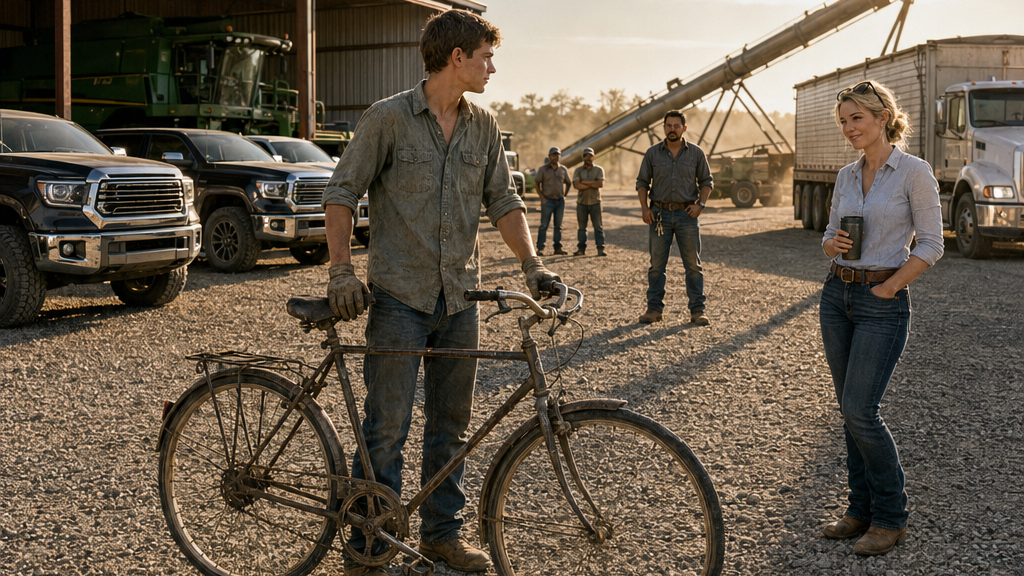
Jessica Baker looked from Brian Lewis’s bicycle to the row of pickups outside the machinery shed and laughed before he had both feet on the gravel.
“You ride that thing twelve miles out here?”
Brian slid the cable lock through the rear wheel.
“Eleven and a half.”
Jessica leaned against the fender of a new diesel pickup, coffee in one hand, sunglasses pushed into her hair. Beyond her, six trucks sat in a dusty line beside two combines and a grain cart worth more than Brian’s father had earned in years of painting houses.
She looked at his faded bicycle again.
“And you think they’re going to trust you around this equipment?”
Two members of the irrigation crew heard her. One smiled and looked away.
Brian tightened the lock.
“I’ll try not to run over the combine with it.”
Jessica’s smile thinned.
He regretted the line immediately. Not because it was cruel. Because he had promised himself he would not give anyone here a reason to call him difficult.
Brandon Ramirez came out of the shop carrying a ring of keys large enough to announce him before he spoke.
“Brian.”
At least Brandon knew his name this morning.
“Stack those irrigation fittings behind the west wall. Sort the six-inch from the eight-inch. We’ve got trucks coming through.”
Brian glanced toward the grain-handling crew gathered beside the auger.
“I thought I was scheduled on harvest systems.”
“You’re scheduled where I need you.”
“My placement sheet says—”
“I know what your placement sheet says.”
Brandon’s tone remained calm, which somehow made the dismissal worse.
“You’re still learning. Start with what needs doing.”
Brian could have told him he had already completed two semesters of irrigation design, machinery systems, and grain handling. He could have pointed out that he had spent the previous week logging moisture levels while Jessica had been inside printing scale tickets.
Instead he put on his gloves.
“Yes, sir.”
Jessica walked toward the office.
“Careful with those fittings,” she called. “Might be worth more than the bike.”
Brian picked up the first length of aluminum pipe without answering.
That was how he survived Campbell Family Farms: not by pretending the remarks did not bother him, but by giving them nowhere to land.
At least that was what he told himself.
By seven thirty the sun had cleared the eastern tree line, and the equipment yard had turned loud. Diesel engines idled. The grain-haul driver backed beneath the loading auger. Dust lifted from every tire.
Then the auger shut down.
A warning tone chirped from the control panel.
Brandon crossed the yard at once.
“What happened?”
“Sensor’s kicking it out,” one of the crew said.
They restarted the system.
The motor engaged for three seconds and stopped again.
Brandon opened the control housing. He checked a connector, closed it, then called the local equipment mechanic.
Brian kept stacking fittings.
He had seen the same failure in a machinery lab the previous spring.
He tried not to watch.
The auger restarted.
Stopped.
The grain-haul driver climbed down from his cab.
“I’ve got another pickup after this one.”
“We know,” Brandon said.
Brian carried another fitting to the west wall.
A metal tab beneath the intake housing vibrated every time the motor tried to engage.
He stopped.
Brandon noticed.
“What?”
Brian nodded toward the auger. “The proximity sensor bracket looks high.”
“We checked the sensor.”
“I mean the bracket.”
Brandon stared at him.
Brian almost went back to the fittings.
Instead he took off his gloves.
“Can I look?”
The question seemed to irritate Brandon more than if Brian had simply walked over.
“You’ve got two minutes.”
Brian crouched beside the intake. Dust coated the sensor assembly, but the problem was visible once he knew where to look. The mounting bracket had shifted enough that the sensor read the safety gate as partly open.
He pressed the bracket down.
It moved.
“That bolt’s walked loose.”
One crew member crouched beside him.
Brian pointed.
“If the vibration lifts it another eighth inch, it reads open and kills the motor.”
Brandon frowned. “You sure?”
“No.”
Brian looked up.
“But I’d tighten it before paying a mechanic to drive out here.”
The crew member handed him a wrench.
Brian loosened the bracket, reset the gap, and tightened the bolt.
Brandon hit the start switch.
The auger came alive.
Everyone waited.
Five seconds.
Ten.
Twenty.
Grain began moving.
The driver climbed back into his truck.
“That saved me an hour.”
Brandon shut the control cover.
“Probably worked loose yesterday,” he said. “Good thing we caught it.”
We.
Brian looked at the wrench in his hand.
Jessica stood outside the office doorway, watching.
For half a second Brian expected her to say something.
She didn’t.
Brandon handed the wrench back to the crew member.
“Okay. Let’s keep moving.”
Then to Brian:
“Those fittings aren’t going to stack themselves.”
Brian pulled his gloves back on.
The irritation inside him had changed shape.
He no longer felt embarrassed about the bicycle.
He felt angry that the easiest way to remain employed was to pretend he did not notice when people took from him what cost them nothing to acknowledge.
Still, he stacked the fittings.
At noon he ate a sandwich sitting on the concrete loading step behind the scale room. His phone showed an email from his agricultural program reminding him that his placement evaluation was due in five weeks.
Failure to complete the required hours could delay graduation.
Brian read the line twice, then locked the screen.
That was why he stayed.
Not because Jessica’s jokes did not matter.
Not because Brandon’s dismissals were fair.
He stayed because leaving with five weeks remaining would cost him a semester he could not afford.
A pickup rolled past the yard. Brian watched dust settle across the frame of his bicycle.
Near three that afternoon, Katherine Campbell returned from a lender meeting.
She drove an older white pickup instead of one of the newer trucks and parked beside the farmhouse office. Katherine was in her late fifties, silver beginning at her temples, sleeves rolled neatly to her forearms. She spoke to the grain-haul driver, checked something on the scale ticket, and disappeared into the office.
She passed Brian twice without speaking.
Brian had been at the farm almost six weeks.
He had exchanged fewer than fifty words with her.
That, more than Jessica’s laughter, had shaped his opinion of the place.
People noticed what mattered to them.
Apparently he did not.
At four twenty, the bookkeeper came through the equipment yard carrying her purse and pressing a hand to her stomach.
Brandon followed.
“You heading home?”
“I’m not staying another minute.”
She looked pale.
“Katherine knows. Vendor tickets still need entering, though.”
Brandon glanced around the yard.
Then his eyes settled on Brian.
Brian felt the decision before he heard it.
“You know the invoice screen?”
“I entered fuel receipts Monday.”
“Same system.”
“I’m supposed to be at the diner by six.”
Brandon checked his watch.
“Then work fast.”
Brian said nothing.
That was his other bad habit.
He could feel resentment hardening inside him while his mouth kept making things easy for everyone else.
Brandon pulled a small brass key from his ring.
“Office side door. Don’t lose it.”
Brian took the key.
It was warm from Brandon’s hand.
“Just invoices?”
“Vendor tickets and grain-haul receipts. Nothing else.”
“What login?”
“I’ll set you up.”
Brandon started toward the office, then turned.
“You wanted more responsibility, didn’t you?”
Brian looked past him toward the machinery shed.
His bicycle stood alone at the end of the pickup row.
“Yes,” he said.
“Good. Tonight you’ve got it.”
Chapter 2: The Work He Never Told Them About
At five forty-eight, Brian pedaled away from Campbell Family Farms already eleven minutes late for his second job.
Dust from the county road clung to his jeans. His work shirt smelled faintly of diesel and grain chaff. He changed behind the roadside diner using the restroom sink, rolled the farm shirt into his backpack, and tied on a black apron before the evening manager could ask where he had been.
His shift started at six.
At six twelve, he was carrying iced tea to booth seven.
Nobody at the farm knew he worked evenings.
He preferred it that way.
Jessica already thought the bicycle explained everything about him. Brian had no interest in giving her more pieces to arrange into whatever story she wanted.
By nine, his feet hurt.
By ten, he had stopped noticing.
His phone vibrated twice in his pocket while he cleared plates.
The first notification was from his college account.
PAYMENT REMINDER.
The second was from Larry.
Call when you can.
Brian ignored both until closing.
At eleven seventeen he stepped beneath the security light behind the diner. His bicycle was the only vehicle left except the manager’s sedan.
He opened the college message first.
His remaining program balance was due in nine days.
Brian stared at the date.
He had thought he had until the end of the month.
He checked the amount.
Then he checked it again, as though the number might become smaller if he gave it a second chance.
It did not.
He called his father.
Larry answered on the fourth ring.
“You off?”
“Just.”
“You eat?”
“Yes.”
That was not exactly true. Brian had eaten half an order of fries someone had sent back untouched.
“How was work?”
“Which one?”
Larry laughed quietly.
“That bad?”
“Not bad.”
Brian unlocked the bicycle.
“What did you need?”
There was a pause.
Brian recognized it immediately.
Larry only paused like that when the next sentence involved money.
“You remember that exterior job I told you about?”
“The house outside Lubbock?”
“Yeah.”
“What about it?”
“They’re late paying.”
“How late?”
“Couple weeks.”
Brian stopped moving.
“Why?”
“Owner says he’s waiting on a draw.”
“You finished that job.”
“I know.”
“You paid for paint.”
“I know that too.”
Larry’s voice sharpened slightly.
“Don’t start.”
Brian looked through the diner window. The manager was counting the register.
“What about rent?”
“Handled.”
“Utilities?”
“Handled.”
“Dad.”
“They’re handled.”
Brian hated the word because he knew what it usually meant.
Larry had found another job.
“What are you doing tomorrow?”
“Working.”
“Painting?”
“Fence repair.”
“At your age?”
“At my age I remain uniquely qualified to hold a post straight.”
Brian did not laugh.
“You said your shoulder was bothering you.”
“And you said you were eating.”
They sat in the silence of two men who recognized the other’s lie and had agreed not to say so.
Larry finally spoke.
“How’s the farm?”
“Fine.”
“You getting the hours you need?”
“Yes.”
“They teaching you anything?”
Brian thought of the grain auger. Brandon saying, Good thing we caught it.
“Some.”
“Then finish it.”
“I know.”
“Don’t quit five weeks from the end because somebody gets under your skin.”
Brian stared down at the gravel.
“I didn’t say anybody did.”
“You didn’t have to.”
Larry knew him too well and not well enough.
Brian wanted to tell him about Jessica. About Brandon. About the way Katherine could pass within three feet of him without appearing to notice he existed.
Instead he said, “I’ll finish.”
“Good.”
Brian opened his banking app after they hung up.
He transferred enough money to cover Larry’s electric bill.
The account balance dropped until the number looked almost decorative.
Then Brian opened the college payment notice again.
Nine days.
He put the phone away.
The bicycle chain clicked once every wheel rotation as he rode toward Larry’s rental house.
He had meant to fix it for a week.
There was always something else first.
Larry was asleep when Brian arrived. A porch light had been left on for him, and a foil-covered plate sat in the refrigerator with a note written on the back of a hardware-store receipt.
EAT.
Brian smiled despite himself.
He ate half the plate standing at the counter.
Then he saw Larry’s work boots beside the back door.
White paint marked the toes. One sole was splitting near the heel. Next to them lay a pair of leather gloves stiff with old fence stain.
Brian looked away.
On the kitchen table sat one of his textbooks and a legal pad covered in figures.
Tuition.
Gas.
Rent.
Materials.
Larry had written Brian’s name beside one of the totals.
Brian folded the page shut.
The next morning, he was back at the farm before seven.
Brandon caught him beside the scale room.
“Bookkeeper’s still out.”
Brian felt his stomach tighten.
“Okay.”
“You’ll enter invoices tonight again.”
“I’ve got another shift.”
Brandon looked genuinely surprised.
“Where?”
Brian immediately regretted saying it.
“Doesn’t matter.”
“You working nights?”
“Sometimes.”
Brandon studied him for a moment.
Something almost human entered his expression.
“You should’ve said something.”
Brian nearly laughed.
Would it have changed the fittings? The hours? The assignments?
Instead he said, “I can do the invoices.”
Brandon reached into his pocket and handed Brian a folded piece of paper.
A username.
A temporary password.
“I made you a harvest account. Don’t use mine this time.”
Brian unfolded it.
“Permissions?”
“Invoice entry, vendor lookup, grain tickets.”
“That’s all?”
“That’s all you need.”
Brian put the paper in his shirt pocket.
Brandon started away, then stopped.
“We’ve got a lot of money moving right now. Don’t click around.”
Brian’s irritation returned.
“You think I would?”
“I think temporary people don’t need permanent access.”
There it was.
Not quite an accusation.
Not quite an insult.
Just a boundary drawn where Brandon believed Brian belonged.
Brian nodded.
“Understood.”
That afternoon his phone buzzed again.
The college billing office had moved his account into final-notice status.
Seven days remained.
Brian looked across the equipment yard.
Brandon’s truck sat beside Katherine’s.
Jessica’s was parked near the office.
His bicycle leaned against the shed.
He closed the message.
At nine forty that night, after the last grain truck pulled away, Brian unlocked the side office door using the brass key Brandon had given him.
He sat at the bookkeeper’s computer and unfolded the temporary credentials.
For the first time since he had arrived at Campbell Family Farms, someone had given him access to something that mattered.
He typed the password.
The system opened.
Chapter 3: The Account That Should Have Been Locked
The payment screen appeared when Brian clicked an ordinary diesel invoice.
He stared at it for three seconds before touching the mouse again.
The invoice had been entered correctly: fuel supplier, delivery date, quantity, total.
But beside the vendor name was a blue link Brian had never seen on the bookkeeper’s screen.
EDIT VENDOR.
He should not have had that.
Brian moved the cursor away.
The farm office was silent except for the air conditioner and the faint mechanical ticking of the wall clock.
9:47 p.m.
He clicked back to the invoice list.
Then he stopped.
A line at the top of the screen read:
ADMINISTRATION.
Brian leaned closer.
He had spent enough time in agricultural systems classes to understand permission tiers. Invoice-entry users did not get administration tabs.
Temporary harvest accounts definitely did not.
He opened the permissions menu.
Every category was checked.
Vendor management.
Payroll preparation.
Banking reconciliation.
Grain settlements.
Equipment purchasing.
User administration.
Brian sat back.
“Come on.”
He logged out.
Then he logged in again using the credentials Brandon had written down.
The same menu appeared.
Maybe it was a display problem.
Maybe the buttons would fail when used.
He clicked vendor lookup and selected the fuel company attached to the invoice.
The profile opened.
Address.
Tax information.
Payment method.
Bank-routing field.
Editable.
Brian took his hands off the keyboard.
He told himself that proved nothing.
Viewing a field did not mean the system would accept changes.
He selected the vendor’s mailing-address line, added a single period after the abbreviation for Road, then pressed Save.
The system responded:
CHANGES SAVED.
Brian’s pulse jumped.
He immediately removed the period and saved again.
No approval request.
No secondary login.
No warning.
He looked toward the office door although he knew nobody was there.
The brass key sat beside the keyboard.
Brandon had told him not to click around.
Brian almost laughed at the absurdity of it.
The problem was not that he had clicked around.
The problem was that the farm had handed him the whole building and told him not to open the doors.
He should have logged out then.
Instead he clicked grain settlements.
Later, that choice would matter.
A list of pending receipts appeared.
Campbell Family Farms had several grain payments scheduled, some modest, some large.
One settlement was marked pending deposit.
$287,460.18.
Brian stopped breathing for a moment.
The figure was not abstract.
He saw the college balance first.
Then Larry’s work boots.
Then the legal pad on the kitchen table.
Then the cracked heel of his father’s hand where paint thinner had dried the skin.
Two hundred eighty-seven thousand dollars.
Enough to pay every debt Brian had ever worried about and still leave an amount he had no personal scale for.
He closed the settlement.
Then opened it again.
The deposit account displayed beneath it.
Editable.
Brian stood up.
He walked to the water cooler and filled a paper cup even though his mouth was too dry to swallow comfortably.
Outside the office window, the yard was nearly black.
One security light burned above the machinery shed.
His bicycle stood directly beneath it.
Small.
Thin.
Ridiculous beside the parked farm trucks.
Brian looked away.
He returned to the desk and opened the invoice-entry screen.
That was what he had been asked to do.
He entered three chemical invoices.
A repair bill.
Two fuel deliveries.
He scanned a grain-haul receipt.
Then the administration tab remained at the top of the screen, bright and impossible to ignore.
He thought about Brandon telling him temporary people did not need permanent access.
Jessica’s voice followed.
Someone who cannot afford a truck should not be trusted around six-figure farm equipment.
Brian entered another invoice.
He mistyped the amount.
Deleted it.
Started again.
The injustice of the situation became almost funny.
They did not trust him with a tractor unsupervised.
But he could redirect a six-figure settlement.
They did not think he was worth steady wages.
But the system would let him edit payroll.
They thought the bicycle proved what sort of person he was.
Brian clicked payroll.
Names appeared.
Hourly rates.
Projected hours.
Adjustments.
He found his own employee number.
Seasonal.
No benefits.
The number beside his hourly rate looked insulting in a new way when surrounded by the farm’s larger financial machinery.
Brian closed the payroll tab.
He knew exactly what he was doing now.
He was no longer checking whether there was an error.
He was measuring the error.
That distinction bothered him.
He opened vendor management once more.
There were old vendor accounts marked inactive.
One belonged to a fencing contractor the farm had not used in almost two years.
The vendor still had banking information attached.
Brian imagined changing it.
Not stealing $287,000.
That would be insane.
Something smaller.
A payment adjustment.
A few thousand.
An amount buried among fuel, repairs, seed, labor, chemicals.
Enough to get the college account current.
Enough to give Larry breathing room.
Nobody at the farm even knew he worked nights.
Nobody knew Larry was repairing fences with a bad shoulder.
Nobody would connect an old vendor record to a seasonal trainee whose placement ended in five weeks.
Brian stared at the inactive account.
A thought came to him so smoothly that it frightened him.
They would never miss what they refused to pay attention to.
He leaned back.
“No.”
The word sounded weak in the empty room.
He shut the profile.
Then he reopened it.
His anger supplied arguments faster than his conscience could answer them.
He had fixed their equipment.
Brandon took the credit.
He had worked beyond his assigned hours.
Nobody asked whether he had somewhere else to be.
Jessica could ridicule him in front of the crew because she was related to the owner.
Katherine walked past all of it.
Why should honesty always cost the person who could least afford it?
Brian’s phone buzzed.
For one dangerous second, he thought someone knew what he was looking at.
It was only the college billing system.
FINAL PAYMENT DEADLINE: 7 DAYS.
He turned the phone face down.
The office clock showed 10:26.
Brian opened the inactive vendor again.
This time he looked more carefully.
A payment-history icon sat beside the banking field.
He clicked it.
The last transaction was eighteen months old.
There were no current invoices.
No active purchase orders.
Nothing that would naturally draw attention.
If a new payment appeared, someone might question it.
Unless it did not appear new.
Brian found an option labeled adjustment routing.
He frowned.
That feature should not have been available to him either.
It allowed a payment associated with one vendor record to be temporarily redirected during account verification.
Brian read the help text twice.
No new vendor needed.
No new bank-account profile visible on the standard invoice page.
The adjustment would still exist in the audit trail, of course.
But not where an ordinary reviewer would first look.
His heartbeat quickened.
He was no longer imagining a vague theft.
He could see the mechanism.
That changed everything.
Brian’s hands rested flat on the desk.
He thought of the bicycle outside.
This one was not even the bicycle he had started the summer with.
That bicycle had disappeared two months earlier from a rack near the highway bus stop.
He had come to work the next morning anyway.
He remembered that much.
He remembered walking the final miles.
He remembered hiding how angry he had been.
But he pushed the memory away before it could become anything else.
Not now.
He looked back at the screen.
The adjustment-routing field waited for an account number.
Brian knew he had gone too far just by understanding what could fit there.
He could still close everything.
He could still report it.
But another part of him—the part that had swallowed six weeks of jokes, dismissals, and other people deciding what he deserved—asked one final question.
If nobody here trusted him anyway, what exactly was he protecting?
The cursor blinked inside the empty routing field.
Chapter 4: The Note He Never Knew Who Wrote
The cursor blinked inside the empty routing field.
Brian could hear the wall clock behind him.
Tick.
Tick.
Tick.
He moved one hand toward the keyboard.
Then stopped.
The field itself was not the temptation. The temptation was everything he could attach to it.
Seven days until the college balance was due.
Larry’s unpaid painting job.
The split sole of his father’s boot.
Jessica laughing at the bicycle.
Brandon telling him temporary people did not need permanent access.
Brian stared at the screen until the numbers blurred.
He could enter an account.
He could create an adjustment.
He could tell himself he was taking only what the farm had already denied him in wages, training, credit, respect.
That was the dangerous part.
He could make it sound fair.
Brian pushed back from the desk hard enough that the chair rolled into a filing cabinet.
The sound cracked through the empty office.
He stood.
Outside, the security light threw a pale circle over the machinery shed. His bicycle leaned inside it.
For a moment he saw only what Jessica saw: scratched frame, patched rear tire, mismatched handlebar grips.
Then another image came with it.
Not this morning.
Two months earlier.
Brian had arrived at the farm on foot that day.
His first bicycle had disappeared from the bus-stop rack sometime during his evening shift. He had come out after closing to find the cable cut and the rack empty.
He had stood there under the diner light holding half a lock in his hand.
The next morning he had taken the early bus as far as it ran and walked the remaining miles to Campbell Family Farms.
He had told nobody why.
Brandon had looked at the clock when Brian arrived eleven minutes late.
“Rough start?”
“Bus.”
“That’s why people out here need reliable transportation.”
Brian had nodded.
Jessica had asked whether his truck was in the shop.
“I don’t have one.”
She had looked genuinely confused.
“How do you live out here without a truck?”
Brian had shrugged and gone to work.
For three days he walked, borrowed rides when offered, and planned routes around the bus schedule without telling Larry. His father would have driven across half of Texas if he knew, which was exactly why Brian kept quiet.
On the fourth afternoon, he came around the machinery shed and stopped.
A bicycle stood beside the wall.
Not new from a showroom, but much newer than the one he had lost. Good tires. Straight wheels. Working lights. A rear rack strong enough for his backpack.
A folded note had been tucked beneath the brake cable.
Brian still remembered the handwriting.
Every person on this farm should have a way to show up.
No name.
Only a single letter at the bottom.
K.
At the time, Brian had assumed someone was making a joke.
He had carried the bicycle into the office and asked Jessica whether she knew anything about it.
She had barely looked up.
“No.”
Brandon had said the same.
“Maybe somebody had one sitting around.”
Brian had waited for a punch line that never came.
There had been no announcement.
No one asked for thanks.
He started riding it home that night.
A week later, after enough rain had soaked through his backpack, Brian moved the note into his wallet.
He had not looked at it since.
Now, in the dark office, he took out his wallet.
The paper was folded into quarters.
He opened it on the desk beside the brass key.
Every person on this farm should have a way to show up.
K.
Brian traced the letter with his thumb.
Katherine.
He had never seriously considered her.
She barely spoke to him.
She seemed to move through the farm according to a map of responsibilities too large to include someone like him.
But Jessica would have signed her name.
Brandon would have handed him the bicycle personally and explained the cost.
Katherine was the only K who had access to everything and no habit of advertising what she did.
Brian looked through the window again.
The bicycle was no longer an accusation.
Someone had noticed.
That did not erase anything.
It did not make Jessica’s words harmless.
It did not excuse Brandon taking credit or withholding training.
It did not fix his pay.
But it damaged the story Brian had been telling himself.
Nobody here cares what happens to me.
That story had made the routing field easier to justify.
Now it was no longer completely true.
Brian sat down again.
The screen had dimmed.
He moved the mouse.
The empty account field returned.
He clicked Cancel.
Then he opened a blank document.
He wrote the time.
10:41 p.m.
He listed how he had reached the vendor screen from the diesel invoice.
He recorded the temporary username.
He documented the administrative menus visible to the account.
He wrote down the test change he had made to the vendor address and that he had immediately reversed it.
That sentence stopped him.
He could leave it out.
Nobody knew.
Including it would make him look worse.
Maybe suspicious.
Brian stared at the line.
Then left it.
He added the grain-settlement screen.
The payroll screen.
The inactive vendor.
The adjustment-routing option.
He did not enter any bank number.
He did not change any payment data.
At 10:58, he took screenshots showing the permission level and the relevant menus without opening additional private records.
Then he started an email to Katherine.
He read the first paragraph three times.
It sounded defensive.
He deleted it.
The second version sounded angry.
Deleted.
Finally he wrote only what had happened.
Temporary account issued for invoice entry.
Administrative access present after login.
Vendor banking fields editable.
Grain settlements and payroll visible.
One nonfinancial address-field test completed and reversed to confirm whether Save functionality was active.
No funds moved.
No routing data changed.
Credentials should be disabled immediately.
He attached the screenshots.
His finger hovered over Send.
A different fear arrived.
What if reporting it was what got him fired?
Brandon had specifically told him not to click around.
Brian had done exactly that.
He had opened payroll.
He had opened grain settlements.
He had explored an inactive vendor account far beyond what invoice entry required.
He had even tested whether a field could be changed.
The truth did not make him innocent in the clean, uncomplicated way he wished it did.
He had been tempted.
He had looked for a path.
He had found one.
Reporting it would preserve the farm’s money, but it might not preserve him.
Brian looked down at the note.
Every person on this farm should have a way to show up.
Showing up was easy when the right decision cost nothing.
He clicked Send.
The message disappeared.
Brian immediately opened a second email.
Katherine,
Please freeze the temporary account before morning. I will not attempt another login.
Brian Lewis
He sent that too.
Then he logged out.
The desktop returned.
He closed the browser.
For several seconds he remained sitting there.
Nothing dramatic happened.
No alarm sounded.
No one called.
The farm did not know yet what he had almost done.
Brian picked up the brass key and the folded note.
Before leaving, he finished entering the remaining invoices from the paper stack.
At 11:32, he locked the office.
His bicycle waited beneath the security light.
Brian slid the note back into his wallet and put the key in his pocket.
He had chosen what kind of man he wanted to be.
By morning, he would find out whether anyone believed him.
Chapter 5: The Man Who Issued the Password
Brian knew something had changed before he reached the office door.
Brandon was standing beside it with his arms folded.
Katherine Campbell sat inside at the bookkeeper’s desk.
On the screen in front of her was the login page.
Brian stopped with one hand still on the bicycle handlebars.
Brandon glanced at the bike, then at him.
“Your account’s disabled.”
Brian leaned the bicycle against the wall.
“I asked for that.”
“I know.”
Katherine looked through the open doorway.
“Come in, Brian.”
Her voice was neither warm nor angry.
That made him more nervous.
Brian entered.
Brandon followed and shut the door.
The brass key from the previous night was already on the desk.
Brian touched his pocket automatically before remembering he had left it in the drop box after locking up.
Katherine turned the computer monitor slightly.
His email was open.
“I read your report at five twelve this morning.”
Brian nodded.
“You understand why I need to ask some questions.”
“Yes, ma’am.”
Brandon shifted beside the filing cabinet.
Katherine tapped the page.
“You were assigned invoice entry.”
“Yes.”
“How did you get from the invoice screen to payroll?”
Brian felt Brandon’s eyes on him.
“There was an administration tab at the top.”
“That doesn’t answer the question.”
“I clicked it.”
Brandon let out a short breath.
Katherine did not look at him.
“And after you saw the menu?”
“I checked what the account could access.”
“You opened payroll.”
“Yes.”
“Grain settlements.”
“Yes.”
“Vendor banking.”
“Yes.”
Brandon spoke.
“So he went looking.”
Brian turned toward him.
“I was checking permissions.”
“You were told not to click around.”
“I was also told the account only had invoice access.”
“That doesn’t mean you explore financial records.”
Katherine raised one hand.
“Brandon.”
He stopped.
She looked at Brian again.
“You made a test change.”
“An address-field punctuation change. I reversed it.”
“Why?”
“To see if the access was real.”
“You could have reported the visible menu without doing that.”
“Yes.”
Brian hated how simple the answer sounded.
Katherine waited.
He understood what she wanted.
“Doing the test was farther than I should have gone.”
Brandon’s expression shifted slightly, as if Brian had finally supplied the sentence he needed.
“There.”
Brian looked at him.
Brandon continued.
“He admits it. He was inside areas he had no business being in.”
Katherine closed the email.
“That is not the only question here.”
“It should be a pretty important one.”
“It is.”
She turned to Brandon.
“What permissions did you assign his account?”
“Invoice entry.”
Katherine’s face did not change.
“Show me.”
Brandon hesitated.
Brian noticed.
It was tiny, but it was the first moment all morning that Brandon looked uncertain.
“The account’s frozen.”
“I know. I can still view the user record.”
Brandon moved to the computer.
He logged into the administrator console using his own credentials.
Katherine pointed toward the permissions history.
“Open that.”
He did.
The screen displayed the account creation from the previous morning.
Brian’s username.
Creation time.
Created by: B. RAMIREZ.
Permission template: HARVEST ADMIN.
Brandon stared at it.
Katherine asked, “Is that invoice entry?”
“No.”
“Why did you use it?”
“I was moving fast.”
“That template has banking access.”
“I know what it has.”
“Then why?”
Brandon rubbed the back of his neck.
“The bookkeeper was out. Trucks were waiting. We had three temps needing access this week. I copied an existing profile because I didn’t have time to build another one.”
Katherine’s voice remained level.
“You copied an administrator profile.”
“I intended to strip it down.”
“But you didn’t.”
“No.”
Brian felt something inside him loosen.
Not relief exactly.
The mistake existed outside him now.
Brandon turned.
“That still doesn’t explain why he opened everything.”
Brian pulled his phone from his pocket.
“I wrote down the sequence.”
Brandon almost smiled.
“You made notes while you were browsing our finances?”
“I started after I realized how much access there was.”
Brian opened the document.
“9:47, diesel invoice. Vendor-edit link. 9:51, permissions menu. 9:55, vendor address test. Reversed immediately. 10:03, grain settlements. 10:11, payroll.”
Katherine took the phone.
Brian continued.
“I should’ve stopped sooner.”
Brandon crossed his arms.
“Yes.”
Brian looked directly at him.
“But I didn’t search for salaries. I didn’t copy account information. I didn’t change routing data.”
“You opened an inactive vendor.”
“Yes.”
“Why?”
There it was.
The question Brian had hoped nobody would ask.
Katherine lowered the phone.
Brian could lie.
He could say he was tracing system reach.
Mostly true.
He could say the inactive vendor was random.
Not true.
He looked at the desk.
Then at Katherine.
“Because I wanted to know how hard it would be to move money without anyone noticing right away.”
Silence filled the office.
Brandon stared at him.
Katherine’s expression changed for the first time.
Not anger.
Attention.
Brian kept going before fear could stop him.
“I didn’t move any.”
“You considered it,” Katherine said.
“Yes.”
Brandon gave a disbelieving laugh.
“And we’re still discussing this?”
Brian felt heat rise into his face.
Katherine ignored Brandon.
“How close did you get?”
Brian thought about the empty routing field.
“Close enough that I’m not going to stand here and pretend I was only doing security work.”
Brandon stepped forward.
“That should settle it.”
“No,” Katherine said.
He stopped.
She turned the phone screen toward him.
“These timestamps match the system log.”
Brandon looked.
“The first administrator page opened directly from the vendor invoice. The account had permissions Brian should never have possessed.”
“That’s on me,” Brandon said. “I said that.”
“You said you were moving fast.”
“We are moving fast. Harvest doesn’t stop because the bookkeeper gets sick.”
“I know.”
Katherine leaned back.
For the first time, the exhaustion in her face became visible.
“We have grain settlements arriving while the operating note is being reviewed. We have a lender asking whether our controls are adequate. We have crop-insurance documentation due. And the person issuing system access decided saving ten minutes was worth exposing payroll and banking.”
Brandon’s jaw tightened.
“I’ve run harvest here seven years.”
“And that is exactly why you know better.”
The words landed without volume.
Brandon looked toward the window.
Brian suddenly understood part of him that he had not before.
Brandon was not careless because he did not care about the farm.
He cared enough to believe he could keep every part moving himself.
He had become so certain of his own indispensability that rules seemed optional when they slowed him down.
Katherine looked at Brian.
“You’re not cleared here either.”
“I know.”
“You went farther into the system than your job required.”
“Yes.”
“And you need to understand that reporting a bad decision afterward does not erase the decision.”
Brian nodded.
It stung because it was true.
She gave his phone back.
“But you documented your actions, including the part that makes you look worse.”
Brian slipped it into his pocket.
“Because that part happened.”
Katherine’s eyes stayed on him for a second longer.
Then she stood.
“Brandon, give me your master keys.”
He frowned.
“What?”
“Physical keys first.”
“Katherine—”
“Office. Fuel. Chemical storage. Grain bins. Equipment room.”
Brandon did not move.
“I still have a harvest to run.”
“You have field operations to run.”
“So what is this? You’re putting him in charge?”
Brian looked at Katherine.
She did not answer immediately.
“No.”
Brandon’s shoulders eased by a fraction.
Then Katherine added, “I’m removing financial and unrestricted access until I know exactly what else was copied, reused, or left open.”
Brandon stared at her.
“Katherine, come on.”
“You want me to explain this to the lender?”
“That’s not fair.”
“No,” she said quietly. “It isn’t.”
The words carried more than one meaning.
Brandon reached into his pocket.
The ring of keys came out with a metallic scrape.
He removed several one by one.
Fuel.
Shop.
Office.
Bins.
Then he set the remaining ring on the desk.
Katherine pointed to the computer.
“Now the digital accounts.”
Brandon stood very still.
For the first time since Brian had met him, the keys in Brandon’s hand looked less like authority than responsibility he had failed to carry carefully.
Katherine looked at Brian.
“You can go back to field work for now.”
Brian reached the door.
“Brian.”
He turned.
She held up the brass office key.
“This stays with me.”
“Yes, ma’am.”
Outside, Jessica was crossing the yard toward them. She slowed when she saw Brandon emerge without his key ring.
Brian walked past her.
He did not feel victorious.
He felt exposed.
Everyone in that room now knew something Brian himself wished were not true: faced with an open door, he had looked inside longer than he should have.
But the money remained where it belonged.
Behind him, Katherine’s voice carried through the doorway.
“Brandon, every master credential. Not just the ones you think I know about.”
Brian stopped for half a second.
Then kept walking.
Whatever Katherine was doing, it was larger than deciding whether he had made one good choice.
Chapter 6: What Katherine Had Already Seen
Two days later, Katherine stopped Brian beside the grain bins and asked a question that made him forget the moisture reading in his hand.
“Do you still have the note from the bicycle?”
Brian looked at her.
“What?”
“The note.”
She nodded toward the machinery shed.
“The one that was attached when you found it.”
Brian’s first thought was not gratitude.
It was suspicion.
He reached toward his wallet anyway.
“Yes.”
“Bring it to the farmhouse office when you finish here.”
Then Katherine walked away.
Brian stood beside the bin fan with the folded moisture sheet in one hand.
He did not need to ask anymore.
Still, he made himself wait until the grain reading was logged, the sample sealed, and the scale ticket placed where it belonged.
Only then did he cross toward the farmhouse.
Katherine had left the office door open.
No Brandon.
No Jessica.
No computer screen waiting with logs.
Just two chairs and a legal pad.
Brian remained standing.
Katherine looked at his wallet.
“You brought it?”
He unfolded the note.
The creases had nearly worn through.
She did not reach for it.
“I wrote that.”
Brian nodded once.
“I figured.”
“When?”
“Two nights ago.”
That seemed to surprise her.
“Because of the K?”
“Because nobody else here would do something like that without making sure I knew who did it.”
A small, uncomfortable smile touched her face.
“That may not be the compliment you think it is.”
“It wasn’t.”
Katherine accepted that.
Brian looked at the note.
“Why didn’t you tell me?”
“I didn’t think you needed to owe me.”
“It was a bicycle.”
“That was the point.”
She folded her hands on the desk.
“I saw you walking in from the county road after yours disappeared. I asked what happened. Brandon told me.”
Brian looked up.
“He knew?”
“He knew enough.”
Something old and bitter moved inside Brian.
Katherine saw it.
“Before you decide what that means, he also told me you refused a ride twice.”
Brian said nothing.
That sounded like him.
She continued.
“I had an employee’s son selling that bicycle. I bought it and left it by the shed.”
“Why?”
“Because you kept showing up.”
The answer was so plain that Brian almost distrusted it.
“You barely talked to me.”
“I know.”
“You saw me enough to buy a bicycle, but not enough to notice how things were going?”
Katherine looked toward the window.
The equipment yard lay beyond it.
“I noticed more than I acted on.”
Brian waited.
She did not try to soften the sentence.
“I heard Jessica joke about the bicycle.”
His jaw tightened.
“You heard her?”
“Once.”
“And?”
“I told myself she was being immature and that you seemed capable of handling yourself.”
Brian gave a short laugh without humor.
“Convenient.”
“Yes.”
The answer stopped him.
Katherine leaned forward.
“I had lender meetings, contracts, insurance claims, harvest staffing, and a hundred things I considered more urgent. I treated workplace culture like something adults should solve among themselves.”
“You’re the owner.”
“I know that too.”
Silence settled between them.
This was not the conversation Brian had imagined.
He had thought learning Katherine bought the bicycle would simplify her.
Instead it made her harder to categorize.
She had been kind in private and negligent in public.
She had noticed him and still allowed him to feel invisible.
Both things were true.
Katherine opened a folder.
“I’m considering moving you into year-round operations after your placement.”
Brian looked at the papers but did not touch them.
“Because I didn’t take the money?”
“No.”
He almost smiled.
“That’s hard to believe.”
“Then don’t.”
She pushed the folder toward him.
“I had notes on you before the access issue.”
Inside were copies of his placement evaluations.
Grain moisture logs.
Equipment maintenance observations.
A handwritten line beside an early report:
Notices small failures before they become expensive.
Brian looked up.
Katherine said, “The auger sensor wasn’t the first thing you caught.”
“You knew about that?”
“I know Brandon said his crew found it.”
Brian closed the folder.
Something sharp entered his voice.
“And you let that stand too?”
Katherine’s face tightened.
“Yes.”
Brian pushed the folder back.
“I don’t want a favor.”
“It isn’t one.”
“I don’t want another quiet thing nobody knows about.”
She watched him.
Brian felt his pulse accelerate, but he forced himself to continue.
This was exactly what he usually avoided.
Saying the thing while it could still cost him something.
“If you think I can do the job, write the job down.”
Katherine did not interrupt.
“Pay me for it. Train me for whatever access I’m supposed to have. Tell Brandon what my responsibility is so I’m not fixing things and pretending somebody else did. And if Jessica talks to me like I’m a joke again, I’m not going to keep swallowing it because she’s family.”
Katherine leaned back.
Brian heard his own breathing.
“I should’ve said some of that weeks ago,” he added.
“Yes.”
He frowned.
“That’s all you’ve got?”
“You want me to tell you your silence was noble?”
“No.”
“Good, because it wasn’t.”
The words hit cleanly.
Katherine continued.
“You let resentment build until you were sitting in front of a vendor-routing field deciding whether other people’s behavior gave you permission to become someone you didn’t respect.”
Brian looked down.
“That’s true.”
“And I let problems stay informal because informal problems were easier than stopping harvest long enough to address them.”
She tapped the folder.
“We both paid for that.”
Brian looked at her.
“What about Brandon?”
“He stays in field operations while the review is completed. No financial administration.”
“And Jessica?”
“She and I have already had a conversation she did not enjoy.”
Brian almost asked what had been said.
He decided he did not need to know.
Katherine stood.
“I have a lender meeting tomorrow.”
Brian’s stomach tightened.
“About the breach?”
“Among other things.”
“Are we in trouble?”
“We’re a farm in September.”
That was the closest thing to a joke he had heard from her.
Then her expression grew serious.
“Our operating note is being reviewed. They want stronger controls before the next release. What happened did not help.”
Brian looked toward the folder again.
“So this job you’re considering—”
“Depends on whether I can create it responsibly, not whether I feel grateful.”
He nodded.
That answer mattered more than he expected.
Katherine held out the note.
Brian had forgotten it was still between them.
He took it.
“You should know something else,” she said.
“What?”
“I wasn’t looking for the sharpest person here.”
Brian waited.
“I have plenty of people who know how to run equipment. I need people who understand what should happen when nobody is standing over them.”
The phrase came close to praise.
Brian did not let himself lean on it.
“Trust doesn’t fix the pay.”
“No.”
“Or the training.”
“No.”
“Or what happened.”
“No.”
Katherine nodded toward the door.
“That is why I’m not asking you to answer today.”
Brian folded the note and returned it to his wallet.
“What are you asking?”
“Come back after the lender meeting.”
“And then?”
“Then decide whether you want to stay.”
Brian reached the door.
Katherine spoke again.
“Brian.”
He turned.
“If what I put in writing isn’t fair, tell me.”
He looked at her for a long moment.
Two months earlier, he would have said yes and taken whatever was offered.
Now he understood that gratitude could become another form of silence if he let it.
“I will.”
Outside, his bicycle stood beside the shed.
For the first time, Brian looked at it without seeing what it said about how little he owned.
He saw instead the evidence of a kindness that had been real, incomplete, and insufficient.
Tomorrow, Katherine would have to decide whether seeing him was enough—or whether she was willing to change what happened after she did.
Chapter 7: Someone Worth Trusting With the Keys
The envelope was waiting on the farmhouse office desk beside a newly cut key.
Brian stopped in the doorway.
For a second he thought he had come in at the wrong time.
Katherine was standing by the filing cabinet with the agricultural lender representative, both of them looking through a stack of documents. Brandon was visible through the window near the grain bins, talking to a driver. Jessica sat at the far desk with a headset on, entering scale tickets.
Nobody looked surprised to see Brian.
Katherine closed the folder in front of her.
“We’re finished.”
The lender representative shook her hand, nodded once to Brian without explanation, and left through the side door.
Brian remained where he was.
Katherine pointed toward the chair.
“That’s yours to read.”
Brian crossed the room.
The key was plain brass, stamped with a small number.
Beside it lay three sheets of paper.
The first line named a position:
YEAR-ROUND OPERATIONS ASSISTANT.
Brian read it twice.
Below that was an hourly rate significantly higher than what he had been making as a seasonal farmhand.
Health coverage after the waiting period.
Paid training.
Tuition assistance tied to completion of his agricultural program.
Defined responsibilities for grain systems, maintenance logging, vendor documentation, and supervised financial reconciliation.
Brian turned the page.
The second sheet described access levels.
No shared passwords.
No copied administrator profiles.
No unrestricted account access by default.
Every employee would receive permissions tied to assigned work.
Any temporary elevation in access required written approval and automatic expiration.
The third page described reporting procedures for financial or safety problems.
Brian looked up.
“You wrote all this in a week?”
“Some of it should’ve been written years ago.”
Katherine sat across from him.
“The lender wanted stronger controls. I wanted them too.”
Brian touched the brass key.
“What’s this?”
“Equipment room.”
“Not the office?”
“No.”
He almost smiled.
Katherine noticed.
“You seem disappointed.”
“I’m learning to appreciate limited permissions.”
That earned the smallest hint of a smile from her.
Then Brian looked back at the employment offer.
“Is this because of what happened?”
“No.”
He raised an eyebrow.
Katherine amended the answer.
“What happened forced decisions I had already delayed.”
“That sounds more believable.”
“I thought it might.”
She tapped the first page.
“I had considered keeping you after your placement before the access problem. Your maintenance reports were better than half the ones I’ve been getting from permanent staff. You catch details. You ask why something failed instead of just restarting it.”
Brian thought of the auger sensor.
“And the money?”
“The lender didn’t lose anything. Neither did we.”
“That wasn’t what I meant.”
“I know.”
Katherine folded her hands.
“You are not being paid for keeping quiet.”
Brian watched her face.
“If you tell your college exactly what happened, including the fact that you went farther into the system than you should have, I won’t dispute it.”
That mattered.
More than praise would have.
“You’re not asking me to protect the farm.”
“I’m asking you to work here under rules that are clear enough that nobody has to protect us from our own shortcuts.”
Brian looked again at the access-control page.
“And Brandon?”
Katherine’s gaze shifted briefly toward the yard.
“He stays.”
Brian had expected that answer and still felt something tighten inside him.
“No financial administration. No user-account authority. Field operations only while he retrains on the systems.”
“He nearly blamed me for his mistake.”
“Yes.”
“And he still stays.”
“He made a serious error. He also knows this farm better than almost anyone here, and he admitted every account he had copied after I made him sit down and list them.”
Brian said nothing.
Katherine continued.
“I’m not pretending that makes what he did acceptable. I’m deciding whether accountability means removal or correction.”
“And Jessica?”
“Formal warning. Clear conduct expectations.”
Brian let out a breath.
Some small, childish part of him had imagined a cleaner ending.
Jessica gone.
Brandon gone.
Brian proven right.
Instead they would all still have to see one another tomorrow morning.
That was harder.
Maybe more useful.
Katherine slid a pen toward him.
“You do not have to sign today.”
Brian picked up the offer but not the pen.
“What authority does the job actually have?”
She answered without hesitation.
“You’ll maintain equipment-failure logs and coordinate service scheduling. You’ll learn the grain-settlement workflow with the bookkeeper. You’ll have read access to vendor records and limited entry privileges where needed. You’ll also be expected to speak up before a small problem becomes expensive.”
Brian looked at her.
“Even if Brandon doesn’t like it?”
“Especially then.”
The office door opened.
Brandon stepped inside carrying a black binder.
He saw Brian with the papers.
For a moment neither man spoke.
Then Brandon set the binder on the desk.
“Equipment log.”
Brian waited.
A week earlier Brandon would have handed it to Katherine.
This time he pushed it directly toward Brian.
“South auger needs a new bearing before the next heavy run. I marked the part number.”
No sarcasm.
No congratulations either.
Brian opened the binder.
“You check the alignment?”
“Yes.”
“Vibration?”
“Higher than last week.”
Brian nodded.
“I’ll look at it.”
Brandon remained there.
His expression was guarded.
“I should’ve built your account correctly.”
Brian looked up.
It was not an apology for everything.
Maybe Brandon did not have one.
But it was specific.
“Yes,” Brian said.
Brandon nodded once and walked out.
Brian watched him cross the yard.
Katherine said, “That may be all you get from him for a while.”
“It’s more than I expected.”
Jessica approached the desk next.
She stopped farther away than usual.
“Katherine said you’ll need the vendor filing cabinet if you take the job.”
“If.”
Jessica glanced at the papers.
“Right.”
She set a small key on the desk beside the larger brass one.
“I made a label for the drawer sections.”
Brian waited for the joke.
None came.
Jessica shifted her weight.
“I shouldn’t have said what I said about the bike.”
Brian looked at her.
She seemed almost irritated by her own apology.
That made it feel more genuine.
“No,” he said. “You shouldn’t have.”
Her face reddened slightly.
He did not rescue her from the silence.
Finally she nodded.
“Okay.”
Then she returned to the scale desk.
Brian looked down at the two keys.
For weeks he had imagined recognition as something louder.
A moment when everyone who had underestimated him would be forced to admit it.
Instead it arrived as paperwork, restricted permissions, an awkward apology, and a bearing number written in a maintenance log.
He found that he preferred it.
He picked up the pen.
Then stopped.
“There’s one thing missing.”
Katherine waited.
“Seasonal workers.”
“What about them?”
“If somebody gets temporary access again, they need actual training. Not a password on a folded piece of paper and somebody saying don’t click around.”
Katherine leaned back.
Brian continued.
“And there needs to be a way to report something without wondering whether the person who caused it is also the person deciding whether you keep your job.”
She studied him.
“That would mean documented onboarding for every temporary account.”
“Yes.”
“More time during harvest.”
“Yes.”
“More work for the office.”
“Yes.”
Katherine looked toward Jessica’s desk.
Then toward the window, where trucks were moving steadily between the bins.
“All right.”
Brian did not move.
“You mean that?”
“I mean put it on the procedure sheet before you sign. If I don’t approve the wording, we argue about it.”
Brian smiled despite himself.
“That sounds fair.”
Twenty minutes later, the revised page lay in front of him.
Temporary system users would receive defined permissions, basic access training, expiration dates, and a reporting contact outside their direct supervisor when necessary.
Brian read every line.
Then he signed.
Katherine signed beneath him.
She held out the equipment-room key.
This time Brian took it deliberately.
Not as a favor.
Not as proof that he belonged.
As part of a job with terms both of them understood.
His phone buzzed.
Another message from the college billing office.
Brian opened it.
The payment deadline was tomorrow.
He had enough from the diner and farm wages to cover part of it, not all.
For one brief instant, the old shame returned.
Katherine noticed his expression.
“Problem?”
Normally he would have said no.
The answer reached his mouth.
Then he stopped it.
“Yes.”
He turned the phone around.
“My school balance.”
Katherine read the screen.
Brian felt exposed in a way that was almost worse than the financial-system meeting.
“I can cover some of it,” he said. “Not all before tomorrow.”
Katherine pointed at the employment agreement.
“Call the program office. The tuition-assistance provision can begin with the current term if they’ll accept employer verification.”
Brian stared at the page.
“You’d do that now?”
“It’s part of the job.”
Not charity.
Not a secret envelope.
Not a bicycle left under a shed.
Part of the job.
Brian swallowed.
“I’ll call.”
Later that afternoon, the college confirmed that the employer documentation would hold his account in good standing while the assistance paperwork processed.
Brian stepped outside after the call.
He dialed Larry.
His father answered over the sound of a power sander.
“You busy?”
“Always.”
“I got the position.”
The sander stopped.
“Permanent?”
“Year-round.”
“Pay decent?”
Brian laughed.
“That’s your first question?”
“It should be yours too.”
“It is.”
Brian told him the number.
Larry went quiet.
Then he said, “That’ll do.”
“There’s tuition help.”
Another pause.
This one was different.
“Good.”
Brian leaned against the machinery shed.
“And Dad?”
“Yeah?”
“You can stop taking my share out of your jobs.”
Larry did not answer immediately.
Brian could picture him somewhere on a ladder, paint on his jeans, pretending his shoulder did not hurt.
“We’ll talk about it,” Larry said.
“No. We’re talking about it now.”
There was silence.
Then Larry gave a tired laugh.
“Look at you getting a salary and becoming difficult.”
“I learned at work.”
“That worries me.”
Brian smiled.
“Go home before dark.”
“You too.”
When Brian ended the call, the equipment yard was beginning to empty.
The harvest crew had parked the tractors.
The grain-haul driver pulled onto the county road.
Brian walked toward the machinery shed.
A farm pickup was parked beside it.
Katherine had left the keys on the tire.
A tag attached to them read OPERATIONS.
Brian picked them up.
Then he looked at his bicycle.
The frame still bore scratches from two months of use. The rear tire was patched. Dust lay across the seat.
He could drive the pickup home.
Katherine had already told him he could use it for farm-related transportation and, when necessary, his commute.
Six expensive pickups had once made his bicycle look like evidence against him.
Now one of those trucks was available because the farm trusted him with it.
Brian placed the pickup keys back on the tire.
He slid the new equipment-room key into his pocket.
Then he unlocked the bicycle.
Jessica came out of the office carrying her bag.
She looked from him to the pickup.
“You know you can take that, right?”
“I know.”
“Then why are you riding?”
Brian swung one leg over the bicycle.
He thought about the first morning.
Her laughter.
His anger.
The long weeks of believing the machine beside him measured his worth.
He looked toward the road.
“Because tonight I want to.”
Jessica nodded.
That was all.
Brian pushed off across the gravel.
The farm key tapped softly against his leg as he pedaled past the grain bins, past the trucks, and toward the county road.
For the first time since he had arrived at Campbell Family Farms, the bicycle did not mean he had no other choice.
It meant the choice was his.
The story has ended.