He Said the Livestock Trailer Had Always Stayed There—Until Fourteen Inches Changed Everything
Chapter 1: The Trailer That Was Not Moving
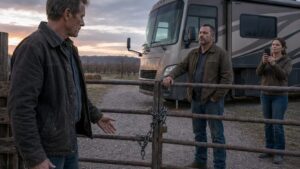
The cedar post had not merely fallen. It had been split through the middle and driven into the gravel beneath the steel tongue of Gary Mitchell’s livestock trailer.
Jonathan Campbell stood over it with one glove still tucked into his back pocket.
For several seconds, he did nothing.
The trailer filled the narrow farm lane like a wall. Gray aluminum sides rose above him, streaked with dried mud and manure. One rear tire sat in a rut deep enough to hold yesterday’s rainwater. Beyond it, the lane bent toward Jonathan’s hay barn, where a morning feed delivery was supposed to arrive before nine.
Jonathan looked at the broken post again.
Then he heard boots grinding gravel behind him.
“Don’t start with that.”
Gary Mitchell came through the open gate from his pasture. He wore faded work jeans and an old sleeveless shirt despite the cool morning. His arms were folded before he reached Jonathan.
Jonathan pointed at the post.
“You hit my fence.”
Gary glanced down as if the broken cedar were an inconvenience someone else had left there.
“That post was half-rotten.”
“It was standing yesterday.”
“So was everything else.”
Jonathan looked along the trailer. It was too large for the lane even when centered carefully. Gary had parked it at an angle, with the front end toward his pasture and the back wheels riding close to Jonathan’s fence. The gravel had been churned for twenty feet where the driver had apparently backed, pulled forward, and backed again.
“You moving it?” Jonathan asked.
Gary’s mouth tightened.
“No.”
Jonathan waited.
Gary stepped closer.
“It’s been sitting through here since before you started acting like a county inspector.”
“It hasn’t been sitting here.”
“You know what I mean.”
“No. I know you’ve driven through here.”
Gary gave a humorless laugh.
“My dad drove through here. I drove through here. Your dad watched us drive through here.”
Jonathan felt the old reflex rise in him: say less, show less, wait for the other man to run out of heat.
It had worked often enough with cattle buyers, repairmen, and neighbors who wanted to turn every disagreement into a contest.
Gary took Jonathan’s silence as surrender.
“This lane has been used between our places for thirty years.”
“Used isn’t owned.”
“Didn’t say I owned it.”
“You parked a trailer on it.”
“For a couple days.”
“You broke the fence.”
“That fence was in the way.”
Jonathan’s eyes lifted.
Gary seemed to hear the sentence only after he had said it. His jaw shifted, but he did not take it back.
A truck horn sounded from the county road.
Both men looked toward the entrance.
A white farm-supply truck had stopped outside the gate. The driver leaned from the cab and waved.
Jonathan walked past Gary without another word.
The driver climbed down as Jonathan approached.
“You Campbell?”
“Yeah.”
The man pointed past him at the trailer.
“I’m supposed to get six pallets up to the barn.”
“You are.”
“I’m not getting around that.”
Jonathan looked back.
The livestock trailer blocked nearly the entire lane. On one side sat the damaged fence and a shallow ditch. On the other, the ground dropped toward Gary’s pasture.
“How long before you’ve got to leave?” Jonathan asked.
“About ten minutes. Got two more stops before lunch.”
Jonathan pulled his phone from his pocket.
Gary called from behind them. “Tell him to come back tomorrow.”
Jonathan turned.
“Will it be gone tomorrow?”
Gary spread his hands.
“Might be.”
The driver looked between them, then looked away.
Jonathan disliked that more than Gary’s anger. Rural disagreements rarely stayed private once another truck had to reverse out of a gate.
He called the feed office, rescheduled the delivery, and stood aside while the truck backed carefully toward the county road.
When the noise faded, Gary said, “See? Problem solved.”
Jonathan walked back to the broken cedar post.
“No. Delivery postponed.”
“Same difference.”
Jonathan crouched and pulled at the splintered wood. It was trapped under the trailer tongue. The lower half remained attached to the fence wire, which had gone slack toward the corner.
He could probably drag the post free with the tractor.
He could hook the trailer tongue too, if he wanted.
The thought lasted less than a second.
Jonathan stood.
Gary had seen where he was looking.
“Don’t touch my trailer.”
“I wasn’t going to.”
“You hook anything to it, we’ll have a different problem.”
Jonathan brushed cedar splinters from his glove.
“Then move it.”
“It’s staying.”
The words landed with more force than Gary’s raised voice.
Jonathan looked past him toward the pasture, then back along the lane. His father had kept this road graded every spring. Jonathan could remember riding on the fender of the old tractor while the blade scraped potholes smooth. He remembered trucks coming through from Gary’s side too, though memory made poor measurements. Hay wagons. A cattle trailer once or twice. Maybe more.
Gary followed his gaze.
“You remember.”
“I remember people passing through.”
“Your dad never stopped us.”
“That doesn’t tell me where the line is.”
Gary laughed.
“You suddenly forgot where your own land ends?”
Jonathan did not answer.
That was exactly the problem.
The old fence had been repaired so many times that portions of it wandered several inches from the original line. Some posts leaned inward. Others had been moved when drainage work was done. Jonathan had assumed the fence represented the practical boundary because no one had challenged it.
Gary stepped closer until only a few feet separated them.
“You want to turn this into paperwork because you don’t want to admit your father let us use it.”
Jonathan felt the accusation strike somewhere deeper than he wanted it to.
His father had been dead four years. People still told Jonathan what his father would have done.
Loaned the baler.
Opened the gate.
Waited another month for payment.
Let a neighbor cross.
Jonathan had heard it so often that sometimes generosity sounded less like praise and more like a debt he had inherited.
“What exactly did he let you use?” Jonathan asked.
Gary answered immediately.
“This lane.”
“For what?”
“To get through.”
“Not to park.”
Gary shook his head.
“You’re splitting hairs now.”
“I’m asking.”
“You weren’t asking when he was alive.”
Jonathan looked at him.
That was true.
He had never asked.
When their father handled neighbor arrangements, Jonathan handled cattle, equipment, bills, weather, and whatever else was breaking. Agreements floated around the farm in half-sentences. Somebody could use a gate. Somebody could cut across after harvest. Somebody could stack hay under a shed until winter.
Jonathan had hated that way of doing business.
He had also never forced it to change.
Gary slapped one hand against the trailer’s metal side.
“My family has used this way longer than you’ve been running things.”
Jonathan heard the hollow boom roll through the empty trailer.
Then he looked again at the broken post.
“Maybe.”
Gary frowned, apparently expecting an argument.
Jonathan pulled out his phone.
“What are you doing?”
“Finding out where the line is.”
“You know where it is.”
“I know where the fence is.”
“That’s the line.”
“Then a survey won’t hurt you.”
For the first time that morning, Gary had no immediate answer.
Jonathan walked toward the house while searching his contacts.
Behind him, Gary called, “Spend your money if you want. Trailer’s still not moving.”
Jonathan stopped at the gate but did not turn around.
He found the number he wanted and pressed call.
“David Anderson?” he said when the surveyor answered. “Jonathan Campbell. I need you to mark a farm boundary.”
Chapter 2: Fourteen Inches Across the Orange Line
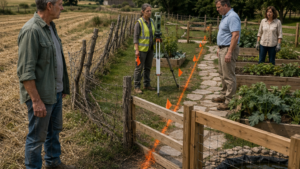
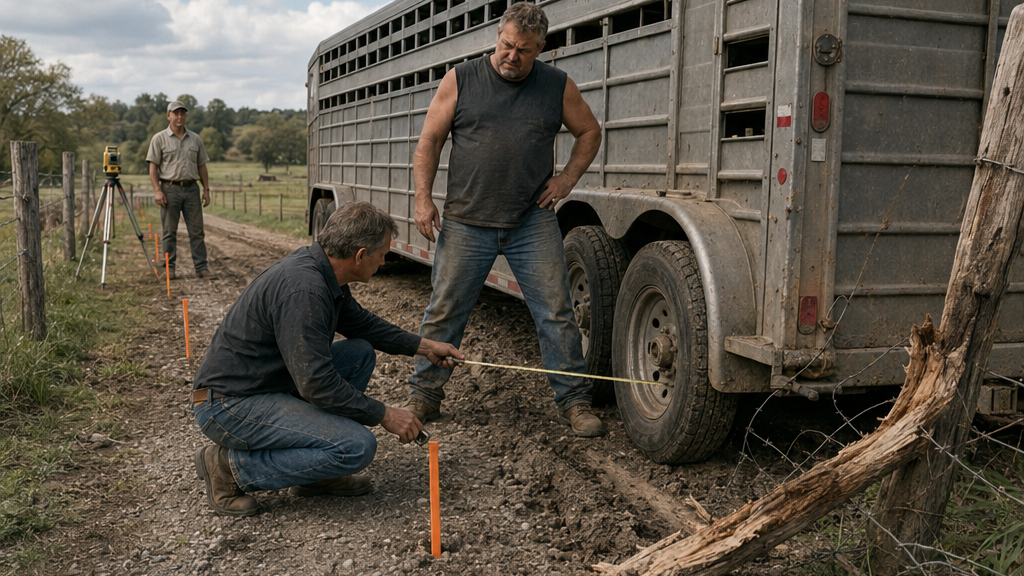
David Anderson drove the first orange stake into the ground so close to Gary’s trailer tire that Gary laughed.
It was not an amused laugh.
“You serious?”
David straightened, pushed his cap back, and checked the instrument mounted on its tripod.
“I’m marking what I measured.”
Gary looked at Jonathan.
“You paying him by the stake?”
Jonathan stood near the damaged cedar fence with his arms loose at his sides.
“Let him work.”
Tuesday morning had begun with David locating two old reference points near the county road, then moving slowly up the disputed lane. He had said little. That suited Jonathan.
Gary had arrived twenty minutes later and had not stopped talking since.
“That fence has been there longer than that machine,” Gary said.
David sighted through the instrument.
“Fence isn’t what I’m locating.”
“What are you locating?”
“The recorded parcel line.”
Gary gestured toward the ground.
“The parcel line is the fence.”
David looked up.
“Sometimes.”
“And sometimes?”
“Sometimes it isn’t.”
That answer seemed to offend Gary more than if David had simply disagreed.
Jonathan watched the orange stakes accumulate one by one along the lane. Most fell near the existing fence, but not exactly on it. Near the county road, the legal line sat several inches inside Jonathan’s side of the old posts. Farther uphill, it drifted the other direction.
The fence had wandered over the decades.
Gary pointed at one section.
“See? Your fence is on my side there.”
Jonathan nodded.
“It is.”
Gary blinked.
Jonathan could almost see the argument he had prepared collapsing.
“I’m not claiming the fence is perfect,” Jonathan said. “I’m trying to find out what is.”
David moved another twenty feet toward the trailer.
The next stake went into the gravel rather than the grass.
Gary stopped smiling.
Jonathan stepped closer.
The orange plastic stood bright against the gray stone, almost beneath the trailer’s rear quarter.
David checked again.
Then he set another stake farther forward.
The line ran straight between them.
The trailer did not.
Its rear section angled across the marked boundary.
Gary folded his arms.
“That proves nothing about access.”
“No,” David said. “It shows the boundary.”
“I’ve driven here thirty years.”
David packed one measuring rod under his arm.
“That’s between you two.”
Gary looked at Jonathan.
“You hear that?”
“I did.”
“Thirty years.”
Jonathan crouched beside the nearest orange stake.
He had brought a tape measure from the shop. He hooked the case against the line David had marked and extended the blade toward the outside edge of the trailer tire.
Gary stepped nearer.
“What are you doing now?”
“Measuring.”
“I can see that.”
Jonathan held the blade flat against the gravel.
Fourteen inches.
He checked again.
The number remained the same.
Gary stood over him.
“You going to call fourteen inches a crisis?”
Jonathan looked up.
“No.”
He retracted the tape halfway and extended it again from the stake.
“Fourteen inches.”
David stayed out of it.
Gary kicked a loose stone aside.
“That trailer has crossed that spot a hundred times.”
“Crossing isn’t parking.”
“There you go again.”
Jonathan stood and wiped grit from the tape.
“You’re fourteen inches over the recorded line.”
Gary looked down at the stake as if he might pull it out.
David noticed.
“If you want another surveyor to verify it, that’s your right. I’d leave the markers where they are.”
“I don’t need another surveyor.”
“Then we’re finished.”
David began loading equipment into his truck.
Jonathan expected satisfaction. He had spent a day wondering whether the fence had fooled him, whether Gary’s trailer might technically sit on Gary’s own property despite the damage.
Now he had an answer.
Fourteen inches.
A hard number.
Instead of relief, he felt the question shift.
Gary walked along the orange line.
“This is what you think settles it?”
“It settles where the property line is.”
“No, it doesn’t.”
Jonathan frowned.
David paused beside his truck.
Gary pointed down the lane.
“My father used this road before either one of us had gray hair. Your father told us we could.”
Jonathan said nothing.
Gary’s voice dropped.
“Not once. Not because of some emergency. He told us we could use it.”
Jonathan looked toward David.
The surveyor shut his tailgate.
“Don’t look at me,” David said. “I can tell you where the recorded line sits. I can’t tell you what your father told somebody twenty-five years ago.”
Gary spread his arms.
“There. Finally.”
Jonathan’s irritation sharpened.
“Finally what?”
“Somebody says out loud that your orange sticks don’t erase history.”
“They don’t give you the right to break my fence.”
“I already told you that post was rotten.”
“And the ruts?”
“Wet ground.”
“And the trailer?”
“I needed it out of my loading lot.”
“So you put it on mine.”
Gary’s face hardened.
“I put it where we have always put equipment when we needed the lane.”
That sentence caught Jonathan.
“Always?”
Gary hesitated a fraction.
Then nodded.
“Plenty of times.”
Jonathan searched his memory.
He remembered moving cattle through the opening after storms. He remembered Gary’s father coming through with a tractor. He remembered pickups cutting across.
He did not remember trailers being stored there.
But memory did not become more reliable simply because he wanted it to.
David pulled away shortly before noon.
The orange stakes remained.
Gary stayed by the trailer.
Jonathan repaired what he could of the fence without touching the section trapped beneath the steel tongue. He replaced a loose staple, tightened wire farther uphill, and tried to ignore Gary’s presence.
Eventually Gary said, “You could save yourself trouble and leave it alone.”
Jonathan set down the fencing pliers.
“How long are you planning to keep it here?”
“A few more days.”
“That’s not an answer.”
“It’s the answer I have.”
Jonathan looked at the trailer.
“Move it by tomorrow.”
Gary gave him a flat stare.
“Or what?”
Jonathan did not know yet.
That bothered him.
He hated threats people made before they knew what they were prepared to do.
“I’ll figure out what my options are.”
Gary smiled without warmth.
“That sounds like your dad.”
Jonathan’s expression changed.
Gary saw it.
“No,” he said. “Actually, it doesn’t. He would’ve just talked to me.”
Jonathan looked away before Gary could see how accurately the remark had landed.
By late afternoon, he had photographed the stakes, the damaged post, the trailer tire, and the ruts. He saved copies of David’s preliminary measurements and wrote down the feed delivery he had been forced to postpone.
Everything was orderly.
Everything could be proven.
Yet one sentence kept intruding into the neatness.
Your father told us we could.
Jonathan drove into town for a hydraulic fitting before the supply store closed. On his way back, his phone rang through the truck speakers.
Rebecca.
He nearly let it go to voicemail.
Instead, he answered.
“You busy?” she asked.
“Driving.”
“I heard you had David Anderson surveying the Mitchell line.”
Jonathan tightened his grip on the steering wheel.
“News travels.”
“Gary called me.”
That surprised him.
“What for?”
“To complain about you, mostly.”
Jonathan waited.
Rebecca did not sound amused.
“He said you’re trying to shut the old crossing.”
“I’m trying to get his trailer off my lane.”
There was a pause.
“You know those aren’t exactly the same thing.”
Jonathan slowed as he approached the farm entrance.
“What do you know about it?”
Rebecca exhaled.
“More than you do, apparently.”
Jonathan turned into the driveway. The orange stakes were visible ahead, bright in the evening light. So was Gary’s trailer, still exactly where it had been.
Rebecca spoke before Jonathan could.
“He isn’t making that part up.”
Chapter 3: What Their Father Actually Allowed
“He had permission.”
Rebecca said it before Jonathan had even taken his jacket off.
She sat at the kitchen table with both hands around a coffee mug she had not touched. Jonathan remained standing by the counter.
“For what?” he asked.
“To use the crossing.”
“That can mean ten different things.”
“I know.”
“Then tell me which one.”
Rebecca looked toward the darkening window over the sink.
“You could sit down.”
“I’m fine.”
“That’s what Dad used to say when he wanted everybody else uncomfortable.”
Jonathan pulled out a chair.
Rebecca gave him a brief look but did not smile.
“He let the Mitchells through during wet seasons,” she said. “Mostly cattle. Sometimes equipment.”
“How long?”
“Years.”
“Every year?”
“Often enough that nobody thought much about it.”
Jonathan leaned back.
“That’s not the same as giving them the lane.”
“I didn’t say it was.”
“You called it permission.”
“Because it was.”
Jonathan rubbed one thumb across a scratch in the tabletop.
The kitchen had belonged to their parents long before it belonged to him. His mother had chosen the cabinets. His father had ruined the corner of the table with a hot skillet and refused to replace it because, according to him, furniture on a farm was supposed to look used.
Somehow, even four years after his death, the room still made Jonathan feel as if any disagreement about the farm ought to include him.
“Why didn’t I know?” Jonathan asked.
Rebecca’s eyebrows lifted.
“You did know they crossed.”
“I knew they crossed. I didn’t know Dad gave them some standing arrangement.”
“That’s because you never asked.”
Jonathan’s jaw tightened.
Rebecca continued before he could answer.
“You handled the cattle. Dad handled neighbors. That was how the two of you divided the world.”
“He handled neighbors by never writing anything down.”
“Yes.”
“And now Gary thinks he owns an access lane.”
“No. Gary thinks something was promised to his family.”
Jonathan stood again.
Rebecca watched him walk to the sink.
“That sounds like the same thing when somebody parks a forty-foot livestock trailer on it.”
“It isn’t the same thing.”
“He broke the fence.”
“I know.”
“He blocked my feed truck.”
“I know that too.”
Jonathan turned.
“Then what exactly are you defending?”
Rebecca’s expression hardened.
“I’m not defending what Gary did. I’m telling you that if you treat the whole story like he invented it yesterday because it’s convenient, you’re wrong.”
Silence settled between them.
Jonathan hated being wrong more when the correction came from someone who knew why.
“What was the agreement?” he asked finally.
Rebecca set down her mug.
“The lower part of their place used to turn into soup after heavy rain. You remember that.”
“Some.”
“They couldn’t get a loaded trailer out toward the county road without tearing their own ground to pieces. Dad told Gary’s father they could come through our lane when they needed to.”
“Temporarily.”
Rebecca nodded.
“That was how I understood it.”
“How did Dad understand it?”
“The same way.”
“You sure?”
“No.”
Jonathan gave a short laugh.
“That’s useful.”
“I was seventeen when most of this started.”
“Then why are we sitting here like you’re the record book?”
“Because I was there when Dad told Gary, years later, that he could still bring cattle through after a storm.”
Jonathan looked up.
“Gary himself?”
“Yes.”
“How many years ago?”
“Maybe fifteen. Maybe more.”
“And what exactly did Dad say?”
Rebecca frowned, reconstructing it.
“Something like, ‘If the lower road’s bad, use ours until it dries.’”
Jonathan repeated the important part.
“Until it dries.”
“That’s what I remember.”
“Not park equipment.”
“No.”
“Not widen it.”
“No.”
“Not break fence.”
“Obviously not.”
Jonathan sat again.
For the first time since Monday, the dispute looked larger rather than smaller.
The survey had given him a straight line through the gravel. Rebecca had just put a bend in everything else.
They walked outside after dark.
Jonathan carried a flashlight. Rebecca led him past the damaged section and farther downhill, where the present fence curved toward a shallow drainage swale.
“Here,” she said.
Jonathan swept the beam across the posts.
One was older than the rest, gray nearly to silver. The top had weathered into a rounded shape. Beside it, newer cedar posts followed a slightly different alignment.
Rebecca stepped through the grass.
“There used to be a wider gap here.”
“For a gate?”
“No gate. Just an opening.”
Jonathan crouched near the old post.
The modern orange survey stake stood several feet away, marking David’s straight boundary.
The old passage had not followed the current lane exactly.
Jonathan saw it now: the ground sloped more gently here toward Gary’s pasture. Before the newer fence repairs and gravel widening, livestock could have crossed at an angle without using the full lane.
“Dad changed the fence,” Jonathan said.
“After the drainage work.”
“And nobody talked about the crossing afterward.”
“Probably because everybody kept using whatever worked.”
Jonathan touched the old cedar.
That sentence described half the arrangements their father had ever made.
If it worked, leave it alone.
Until it stopped working.
Rebecca crossed her arms against the evening chill.
“You already sent Gary something?”
“Not yet.”
“But you were going to.”
“I was finding out what I could do.”
“Before calling me.”
Jonathan looked at her.
“You knew this for years.”
“And didn’t think it mattered.”
“That’s convenient.”
“Yes,” Rebecca said. “It is.”
The blunt admission stopped him.
She looked toward Gary’s dark pasture.
“I should have said something after Dad died. I figured Gary knew the arrangement was with Dad, and you knew they used the crossing. Everybody assumed everybody understood.”
Jonathan gave a tired nod.
“That seems to be the family system.”
Rebecca looked at him.
“You’re doing your version of it.”
“How?”
“You don’t tell people what you’re thinking. You just get more precise.”
Jonathan almost dismissed it.
Then he pictured himself kneeling with the tape measure, reading fourteen inches as though the number could answer every other question.
The next morning he called Gary.
“Come down to the lane,” Jonathan said.
Gary arrived ten minutes later.
He did not look surprised to see Rebecca there.
Jonathan pointed toward the old crossing.
“She told me about Dad.”
Gary glanced at Rebecca, then back at him.
“So now you believe me.”
“I believe you had permission to pass through when your lower road was bad.”
Gary’s eyes narrowed.
“That’s not all.”
“What else?”
“It became the way we moved stock.”
“Because Dad kept allowing it.”
“Because it was understood.”
Jonathan shook his head.
“Understood by who?”
“Both families.”
“Not me.”
“You weren’t running the place.”
“I am now.”
Gary stepped forward.
“And that means history disappears?”
“No.”
Jonathan pointed toward the trailer.
“It means history doesn’t let you store that on my property.”
Gary’s face colored.
“You keep saying ‘my property’ like we’re strangers.”
“You made us strangers when you broke my fence and told me it was in your way.”
For once, Gary looked away.
Rebecca stayed silent.
Jonathan continued.
“I’m willing to talk about seasonal passage. Actual passage. Under conditions we agree on.”
Gary stared at him.
“Conditions.”
“Yes.”
“Written down?”
“Yes.”
Gary laughed once.
“You really are something.”
“Maybe.”
“My father never needed a contract to cross this farm.”
“My father left us this mess because he didn’t make one.”
Gary’s expression changed.
That landed harder than Jonathan intended.
“You calling your dad foolish now?”
“I’m saying he trusted people to remember the same conversation the same way forever.”
“He trusted my family.”
“And I’m trying to find out whether you still deserve that trust.”
Gary took two steps toward Jonathan.
Rebecca shifted, but Jonathan did not.
Gary spoke quietly.
“You want that trailer moved?”
“Yes.”
“You want to shut that crossing?”
“I just told you I’m willing to discuss it.”
“No. You want me asking permission every time I need to move cattle.”
Jonathan held his gaze.
“Yes.”
Gary’s mouth tightened.
“There it is.”
“That’s what permission means.”
For several seconds, neither man moved.
Then Gary turned toward the trailer.
Jonathan thought he might finally hitch onto it.
Instead Gary slapped the steel side with his palm.
“It stays until I’m ready.”
“Gary.”
Gary looked back.
“You got your orange stakes. You got your survey. You got your sister telling you half the story. Do whatever you think you have to.”
Jonathan felt Rebecca watching him.
This was the moment he usually avoided—the one where the other person forced him either to retreat or to say plainly what would happen next.
He had spent most of his life letting silence occupy that space.
Not this time.
“I will.”
Gary walked toward his pasture.
Jonathan called after him.
“I’m going to verify the removal process. If the trailer is still here after proper notice, I’ll have it moved professionally.”
Gary stopped but did not turn.
“You do that,” he said.
Then he kept walking.
Jonathan looked at the orange stake nearest the broken fence.
The survey line was still straight.
Nothing else was.
Chapter 4: The Notice Nailed Beside the Broken Post
“Don’t move it yourself.”
The county land-records clerk said it without looking up from the parcel map spread across the counter.
Jonathan had expected questions about surveys, access, perhaps easements. Instead, that warning came first.
He rested both hands on the edge of the counter. “Even if it’s sitting over my line?”
“Especially if there’s a dispute about historic access.”
The clerk tapped the copy of David Anderson’s survey.
“This tells you where the recorded boundary is. It doesn’t make me your lawyer, and it doesn’t authorize me to tell you what you can tow.”
Jonathan nodded.
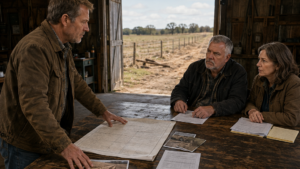
He had driven into town Wednesday morning carrying photographs of the broken cedar post, the tire ruts, the orange stakes and the trailer. He had also brought the county parcel record and David’s measurements.
He had imagined bureaucracy would irritate him.
Instead, he found himself grateful for every cautious answer.
The clerk slid a sheet toward him with contact information for the county office that handled property complaints and recommended he document notice before taking further action.
“Get clear on process,” she said. “You don’t want to turn one disagreement into two.”
That sentence stayed with him all the way back to the farm.
Gary’s trailer was still there.
Nothing about it had changed except Jonathan’s understanding of what could go wrong if he acted too fast.
He parked beside the barn and spent the next two hours making calls.
A heavy-haul operator told him the same thing.
“If you want me touching somebody else’s equipment, I need proof you’ve done what you’re supposed to do first.”
“What do you need?”
“Written notice. Photos. Survey if the placement is disputed. And I’m not coming while two men are standing there threatening each other.”
Jonathan looked toward the lane through his office window.
“That can be arranged.”
The operator paused.
“You sure?”
Jonathan almost smiled.
“No.”
By afternoon, Jonathan had a written notice drafted in plain language. The trailer was partly beyond the recorded boundary. It had damaged fencing and blocked farm access. Gary was being given a specific deadline to remove it voluntarily. If it remained after that period, Jonathan would arrange licensed removal.
He read the page three times.
Then he removed two sentences.
The first sounded angry.
The second sounded like something meant to win an argument rather than solve one.
Rebecca arrived while he was printing the final copy.
“You look like you’re doing your taxes.”
“I’d rather.”
She picked up the notice.
“You talked to him again?”
“Not since yesterday.”
“You could.”
“I already told him what I was going to do.”
“That isn’t the same as talking.”
Jonathan looked at her.
Rebecca returned the paper.
“I’m not saying don’t serve it.”
“Sounds like you are.”
“I’m saying you like documents because they don’t interrupt you.”
Jonathan folded the notice in half.
“That supposed to be helpful?”
“No. Accurate.”
He took a hammer, two small nails and a plastic sleeve from the workshop.
The trailer cast a long shadow across the lane when he reached it.
Gary came out of his pasture before Jonathan got to the broken post.
“What’s that?”
Jonathan held up the paper.
“Notice.”
Gary stopped ten feet away.
“You actually went through with this.”
“I said I would.”
Jonathan slipped the notice into the clear sleeve and positioned it on the intact fence post beside the broken one.
Gary walked closer.
“You’re nailing paperwork to a fence now.”
“One nail.”
“You know what I mean.”
Jonathan tapped the nail in.
Gary stared at the notice.
“You think because you went downtown and got somebody to print a map, you can erase what our fathers agreed?”
“No.”
Jonathan drove the second nail.
“I think your trailer is over the line, it damaged my fence, and you refused to move it.”
Gary’s face tightened.
“My father used this crossing with your father’s blessing.”
“I know.”
That answer stopped him.
Gary had come ready to argue against denial. Jonathan did not give him any.
“I know you had access,” Jonathan continued. “I know Dad allowed it when the lower route was bad.”
Gary pointed toward him.
“Then take that down.”
“No.”
“Why?”
“Because access isn’t storage.”
Gary stepped nearer.
Jonathan did not move.
“You touch that trailer,” Gary said, “and we’re going to have problems long after it’s gone.”
Rebecca’s warning passed through Jonathan’s mind.
Documents don’t interrupt you.
So he made himself answer.
“Is that a threat?”
Gary’s jaw worked.
“It’s a promise that I won’t forget this.”
“That’s your choice.”
“You think people around here are going to see you as reasonable?”
Jonathan looked toward the orange stake beside the trailer tire.
“I’m not asking them to.”
That seemed to anger Gary more.
He looked at the notice again.
“How long?”
“The deadline is on the page.”
Gary read it.
His eyes narrowed.
“You scheduled somebody already?”
“Not yet.”
“You’re enjoying this.”
Jonathan felt irritation rise sharply.
“No.”
Gary gave him a skeptical look.
“I’ve postponed deliveries. I’ve spent money on a survey. My fence is broken. I found out three days ago there was an arrangement on my own property nobody bothered to explain to me.”
For the first time, Jonathan heard his own frustration come out without being sharpened into accusation.
“I’m not enjoying any of it.”
Gary looked away.
The anger did not disappear, but something in his posture changed.
Only briefly.
Then he said, “Trailer stays.”
Jonathan nodded toward the notice.
“Then the deadline stays too.”
By Friday afternoon, nothing had moved.
Jonathan had checked the process twice more. He had photographed the notice where it remained attached to the fence. He had sent Gary a copy electronically as well so there could be no argument that he had not received it.
He had also contacted the licensed heavy-haul operator again.
“What day?” the operator asked.
“Monday.”
“Early?”
“Before we’ve got traffic coming through.”
“Six-thirty?”
Jonathan looked at his calendar.
The feed delivery had been postponed again. A hay customer needed access later in the week. Rain was forecast after Monday.
“Six-thirty works.”
“We’ll bring the flatbed and winch equipment. You have somebody there if things get heated?”
“I can ask the sheriff’s office if a deputy can keep the peace.”
The operator laughed softly.
“That’s a better sentence than ‘my brother-in-law will be there.’”
Jonathan did not laugh.
After the call ended, he walked down to the lane.
The notice was still there.
So was the trailer.
The orange survey stake nearest the tire had been bent slightly sideways.
Jonathan crouched and straightened it.
Fourteen inches remained fourteen inches whether the plastic stood straight or not.
He heard Gary’s tractor running somewhere across the pasture, but Gary did not come over.
That evening, an email from the hauling company arrived confirming Monday morning.
Jonathan read it once.
Then he forwarded the confirmation to Gary with a single sentence.
Removal is scheduled for Monday at 6:30 a.m. if the trailer remains after the notice deadline.
He stared at the screen before pressing send.
This time, there was nothing left unsaid about what would happen next.
Chapter 5: The Promise Was Never About Ownership
Rebecca stopped beside a cedar post Jonathan would have walked past without seeing.
“This one.”
He looked at it.
The post was older than the others, bleached pale gray and leaning toward the lower pasture. No wire was attached to it now.
“That?”
“That was one side of the opening.”
Jonathan looked across the slope.
Sunday afternoon light flattened the old tracks in the grass, but once Rebecca pointed them out, he could follow the shallow depression toward Gary’s property.
It did not align with the present gravel lane.
Not exactly.
The route crossed at an angle, farther downhill, where the ground broadened before narrowing toward the county road.
Jonathan stepped through the grass.
“So Dad let them through here.”
“Originally.”
Rebecca stood near the old post.
“When the lower field flooded.”
Jonathan looked toward Gary’s farm.
“You keep saying flooded like it was ordinary mud.”
“It wasn’t.”
She waited until he looked at her.
“You remember the big spring flood?”
“Some of it.”
“You were away buying heifers.”
Jonathan searched his memory.
He remembered returning to torn fences and cattle penned in places they did not belong. His father had dismissed it afterward as a bad week.
Rebecca pointed toward the creek bottom.
“The water came up fast. Dad had cows trapped down there. Gary’s father brought his tractor over before the road disappeared.”
Jonathan said nothing.
“He and Gary moved cattle for hours. They opened their upper pasture and kept part of our herd there until the water dropped.”
Jonathan looked back toward the old crossing.
“Dad never told me that.”
“He probably figured you knew.”
Jonathan let out a dry breath.
“Of course he did.”
Rebecca ignored the bitterness.
“Afterward, Dad told them that if their own lower road turned bad, they could use this side to move stock. He said nobody who helped him save cattle was going to get stuck because of a muddy road.”
Jonathan crouched near the post.
There were old staple scars in the wood.
“So it was gratitude.”
“Yes.”
“Not ownership.”
“No.”
“Not permanent unrestricted access.”
Rebecca hesitated.
“I don’t think Dad thought in those terms.”
“That’s the problem.”
“Yes.”
The easy answer would have been to blame their father.
Jonathan wanted to.
But looking at the faded post, he understood what his father had actually done. A neighbor had helped him when cattle, money and time were all slipping away at once. He had answered with something valuable: access.
The mistake had come later.
No one had ever named its limits.
Jonathan walked uphill toward the current lane.
Over the years, the original opening had narrowed as fence lines changed. Gravel had been spread wider. Equipment got larger. Gary’s passage shifted gradually until the practical route became Jonathan’s lane itself.
No single day had created the problem.
That almost made it worse.
“He didn’t steal the crossing all at once,” Jonathan said.
Rebecca followed.
“No.”
“He just kept using more of it.”
“And nobody stopped him.”
Jonathan looked at her.
Rebecca held up one hand.
“That includes me.”
He turned toward the trailer visible at the top of the lane.
“And me.”
They stood there for a while.
Jonathan thought of the survey tape.
Fourteen inches had felt enormous on Tuesday.
Now it felt like the final piece of a movement that had happened a few inches at a time for years.
At three that afternoon, Jonathan walked to Gary’s place.
Gary was repairing a hydraulic hose beside the equipment shed.
He did not look up when Jonathan approached.
“Come to remind me what time the tow truck gets here?”
“Heavy-haul truck.”
“That distinction keeping you warm at night?”
Jonathan stopped a few feet away.
“I saw the old crossing.”
Gary’s hands paused.
“Rebecca show you?”
“Yes.”
Gary returned to the hose.
“So now what?”
“Now I understand why Dad gave your family access.”
Gary tightened a fitting harder than necessary.
“My father helped yours.”
“He did.”
“More than once.”
“I’m not arguing with that.”
Gary finally looked at him.
Jonathan continued.
“I also saw where the crossing actually was.”
Gary’s expression closed.
“That changed over time.”
“It did.”
“Because your family changed the fence.”
“Partly.”
“And the gravel.”
“Partly.”
Gary wiped his hands on a rag.
“So you finally understand.”
“I understand how we got here.”
“That’s not the same thing.”
“No.”
Jonathan took a breath.
“I’m asking you one last time to move the trailer yourself.”
Gary laughed softly.
“There it is.”
“I’m not pretending Dad never gave you access.”
“You’re taking it away anyway.”
“I’m saying we can discuss seasonal passage after the trailer is gone and the fence is repaired.”
Gary threw the rag onto the workbench.
“Every time I need to move stock, I come ask Jonathan Campbell?”
“If it’s my lane, yes.”
“Your father never made us do that.”
“Dad also never agreed you could park equipment there.”
“You don’t know everything he agreed.”
“Neither do you.”
Gary stared at him.
Jonathan expected another burst of anger.
Instead, Gary leaned against the bench.
“You know what going around costs me now?”
Jonathan frowned.
Gary looked toward the far side of his property.
“Fuel. Time. Another person some days. Feed’s up. Diesel’s up. Half the things that used to make sense don’t anymore.”
Jonathan heard the pressure beneath the words.
It did not excuse the trailer.
But for the first time, Gary had spoken about something other than history.
“You could’ve told me that Monday.”
Gary gave him a bitter look.
“And you’d have done what?”
“Maybe we’d have talked before you broke my fence.”
“That post was old.”
Jonathan’s jaw tightened.
“You keep hiding behind that.”
Gary looked away.
Jonathan waited.
Gary finally said, “I didn’t mean to split it.”
That was the nearest thing to an admission Jonathan had heard.
“It split.”
“I know.”
“And the trailer?”
Gary looked toward the lane.
“Still there.”
“Why?”
The question was quieter than either man expected.
Gary’s answer took longer.
“Because the minute I move it after you put those stakes in, everybody knows you were right.”
Jonathan almost said, About the line, I am.
He stopped himself.
There it was.
Not land.
Not all of it.
Pride.
The same thing Jonathan had accused Gary of carrying while pretending he carried none himself.
“If you leave it,” Jonathan said, “the truck comes at six-thirty.”
Gary’s eyes returned to him.
“You going to stand there and watch?”
“Yes.”
“You bringing the deputy?”
“I asked for someone to keep the peace.”
Gary nodded once.
“Then I guess you planned your show.”
“It isn’t a show.”
“It will be to everybody who drives by.”
Jonathan looked toward the road.
Two neighboring farmers already knew enough of the dispute to have opinions. By Monday afternoon, most of the community would know some version.
“I can’t control that.”
Gary picked up the rag.
“You could cancel it.”
“You could move the trailer.”
Neither man spoke.
The choice sat between them, clean and ugly.
Jonathan turned to leave.
Gary called after him.
“My dad would’ve never treated yours this way.”
Jonathan stopped.
He looked back.
“My dad would’ve never parked a trailer on your place and dared your father to move it.”
Gary’s face tightened.
Jonathan continued.
“What our fathers did for each other mattered. That’s why I’m willing to talk about access after this.”
He pointed toward the distant lane.
“But their gratitude doesn’t give either of us ownership of the other man’s ground.”
Gary said nothing.
Jonathan walked home.
At dusk he checked the lane one last time.
The trailer remained beside the orange stakes.
The broken post remained trapped underneath.
Jonathan stood there until there was no longer enough light to read the fourteen-inch mark he had made in the gravel.
At six-thirty the next morning, the removal would proceed.
Chapter 6: The Morning the Trailer Finally Moved
Headlights appeared at the farm entrance before sunrise.
Jonathan was already standing beside the gate.
The heavy-haul truck turned slowly off the county road, amber lights flashing across the fence and the dark aluminum sides of Gary’s livestock trailer. Behind it came a second service vehicle carrying rigging and wheel equipment.
The trailer had not moved.
Jonathan had checked at five-thirty.
Then again at six.
Part of him had expected to find the lane empty at the last possible minute.
Gary had chosen otherwise.
The heavy-haul operator climbed from the cab.
“You Campbell?”
Jonathan nodded.
The man looked down the lane.
“That it?”
“Yes.”
“Owner around?”
“Next property.”
The operator studied Jonathan for a second.
“You got your documentation?”
Jonathan handed him a folder.
Survey. Photographs. Notice. Delivery confirmation. The operator flipped through it under the truck’s cab light.
Then he looked at the trailer.
“We’ll keep everything inside the marked boundary as much as physically possible.”
Jonathan pointed toward the orange stakes.
“That’s David Anderson’s line.”
The operator nodded.
A sheriff’s cruiser arrived several minutes later and parked near the gate without lights or siren. The deputy stepped out, greeted Jonathan, and made his role clear before anything else happened.
“I’m not deciding whose land belongs to who.”
“I know.”
“I’m here to keep this from turning into something else.”
“That’s all I asked.”
The first chain rattled from the service truck.
That sound brought Gary.
He came across the pasture quickly, pulling on a jacket as he walked.
“What are you doing?”
No one answered at first.
The operator was examining the trailer hitch.
Gary moved past him toward Jonathan.
“You actually called them.”
“I told you I would.”
Gary looked at the deputy.
“You can stop this.”
The deputy shook his head.
“I can’t adjudicate a property dispute standing in a driveway.”
“He’s taking my equipment.”
The heavy-haul operator spoke without looking up.
“I’m not taking ownership of anything. I’ve been contracted to relocate equipment from a disputed obstruction.”
Gary pointed at the trailer.
“That trailer is on an access route my family has used for decades.”
Jonathan stepped forward.
“He’s telling the truth about that part.”
Everyone looked at him.
Gary seemed most surprised.
Jonathan continued.
“My father allowed his family seasonal passage when their lower road was bad.”
Gary stared at him.
The deputy said, “Then you two may need to resolve that separately.”
“We will,” Jonathan said. “But the permission was for passage. The trailer is parked over the surveyed boundary, it damaged the fence, and notice expired.”
Gary’s face flushed.
“You don’t get to tell the story like you’re doing me a favor.”
“I’m not.”
“You’re making sure everybody hears your version.”
Jonathan glanced toward the county road.
One pickup had slowed before continuing past.
“This isn’t for them.”
Gary laughed bitterly.
“Everything becomes for them once a tow truck shows up.”
The operator corrected him automatically.
“Heavy-haul.”
Neither man acknowledged him.
Gary turned to the deputy again.
“My father crossed here. My grandfather crossed through this property.”
The deputy held up one hand.
“I believe you believe you have a right to use it. I’m not saying you do or don’t. I’m telling you I’m not making that decision this morning.”
“So you’re letting him steal my trailer?”
“I’m preventing either of you from making this physical.”
Gary took a step toward Jonathan.
The deputy shifted slightly.
Jonathan raised one hand.
“I’m not fighting him.”
Gary stopped.
For a moment, Jonathan saw the same man who had stood over him while he measured fourteen inches beside the tire.
But the balance had changed.
Gary no longer had the trailer sitting immovable behind him as proof that his refusal mattered.
Now there were straps on the ground.
A winch cable.
Workers checking wheel positions.
A deadline that had already passed.
Gary looked from the crew to Jonathan.
“You could stop this right now.”
“Yes.”
The simple answer seemed to catch him.
Jonathan felt the temptation.
Not to stop the removal.
To enjoy refusing.
That frightened him more than Gary’s anger.
He lowered his voice.
“I offered you the chance to move it yourself.”
“You offered me surrender.”
“I offered you a way to keep this private.”
Gary looked away.
The operator called from the trailer tongue.
“We’re ready.”
Jonathan looked at Gary.
“Last chance. If you want to hitch it yourself and move it completely onto your property, I’ll tell them to stand down.”
Gary’s jaw tightened.
Nobody spoke.
The deputy looked away deliberately.
Gary stared at the trailer.
For one second, Jonathan thought he might accept.
Then Gary shook his head.
“No.”
The operator nodded to his crew.
Metal clinked.
A worker attached the winch.
Gary cursed under his breath and stepped back.
The cable drew tight.
The trailer moved half an inch.
Stopped.
Then moved again.
Its tires rolled out of the ruts with a wet grinding sound.
Jonathan watched the nearest orange stake.
That tiny piece of plastic had seemed ridiculous when David first hammered it into the gravel.
Now every movement of several tons of steel was being judged against it.
The trailer shifted slowly toward the center of the lane.
Gary stood beside the deputy, arms at his sides.
He no longer looked angry.
He looked tired.
When the rear tire approached the measured point, Jonathan found himself holding his breath.
The steel side passed the stake.
Fourteen inches became twelve.
Eight.
Four.
Then nothing.
The trailer cleared the line.
No one applauded.
No one said anything.
The crew kept working.
Jonathan felt the satisfaction he had imagined all week.
It lasted perhaps two seconds.
Then he saw the broken cedar post exposed beneath the raised tongue, split open and gray with dirt.
Winning had not repaired anything.
Gary saw it too.
“That could’ve been replaced Monday,” he said.
Jonathan looked at him.
“So could this whole argument.”
Gary gave a short, bitter laugh.
“You think you’re different from your father because you write things down.”
Jonathan said nothing.
“You’re not,” Gary continued. “He decided what was fair too.”
That struck deeper than Gary probably intended.
Jonathan stepped closer.
“My father decided things and assumed everybody understood.”
“He trusted people.”
“He left people guessing.”
Gary’s face hardened.
“Don’t rewrite him because you want to feel better.”
“I’m not.”
Jonathan looked at the old line of fence.
“He helped your family because your father helped ours. I know that now.”
Gary’s eyes narrowed.
“Then why are we standing here?”
“Because you turned permission into something I wasn’t allowed to question.”
“That isn’t what happened.”
“You parked a trailer on my side of the line and told me it wasn’t moving.”
Gary opened his mouth.
Jonathan kept going.
“You broke the fence and said the fence was in your way.”
Gary’s gaze dropped toward the post.
“I said it was old.”
“You said both.”
Silence.
The crew began securing the trailer for relocation.
Gary rubbed one hand over his face.
“You have any idea what it costs me to run stock around the other way?”
“Yes.”
“No, you don’t.”
“You told me yesterday.”
Gary looked up.
Jonathan continued.
“I should’ve asked before this got this far.”
That admission changed the air.
Gary stared at him.
Jonathan almost regretted saying it, which was how he knew it needed to be said.
“I should’ve asked Rebecca about the old arrangement before I started paperwork,” he said. “I thought knowing where the line was meant I understood the whole problem.”
Gary said nothing.
“But you should’ve asked before you treated the lane like it was yours.”
Gary looked toward the trailer.
The heavy-haul operator signaled that they were ready to leave.
“Where are you taking it?” Gary asked.
Jonathan gave him the location they had arranged—a clear area on Gary’s side where the trailer could be placed without blocking access.
Gary blinked.
“You’re not taking it to an impound yard?”
“No.”
“I thought—”
“I want it off my lane.”
Jonathan looked directly at him.
“I don’t want your trailer.”
Something in Gary’s expression loosened.
Only slightly.
The truck began forward.
The trailer followed.
Its tires crossed the place where it had sat since Monday, leaving deep impressions in the gravel.
Jonathan watched until the last axle cleared the broken fence.
The deputy approached.
“You two finished for this morning?”
Gary looked at Jonathan.
Jonathan looked back.
“Yes,” he said.
Gary did not disagree.
The deputy left first.
The service vehicle followed.
Finally the heavy-haul truck rolled slowly through the gate with the livestock trailer behind it.
Gary watched it go.
When it disappeared around the bend, the lane seemed unusually wide.
Jonathan walked to the orange stake and straightened it with his boot.
Gary came closer.
“You keeping those?”
“For now.”
Gary stared at the exposed strip of ground.
“My father never thought he needed permission every year.”
Jonathan nodded.
“I believe that.”
“You still expect me to ask.”
“Yes.”
Gary’s mouth tightened again.
Jonathan did not retreat into silence.
“The old crossing can be discussed. Seasonal use. Where it runs. When it applies. What equipment fits.”
Gary looked at him.
“On paper.”
“Yes.”
“You really can’t help yourself.”
“Probably not.”
A reluctant sound escaped Gary—not quite a laugh.
Jonathan continued.
“But it won’t be assumed again.”
Gary looked toward the pasture where his trailer was being set down.
After a long pause, he said, “We’ll see.”
Jonathan nodded.
That was not agreement.
It was not forgiveness.
But it was no longer a threat.
Behind them, the broken cedar post lay exposed beside the orange line.
For the first time in a week, the lane itself was clear.
Chapter 7: A Boundary Both Men Had to Name
Three weeks later, Gary Mitchell came through the Campbell gate carrying two new cedar posts.
There was no livestock trailer behind him.
Jonathan noticed that first.
Gary had the posts balanced on one shoulder and a small bundle of fencing tools in his other hand. He stopped beside the repaired section of lane, where the damaged post had been removed but the wire still sagged between temporary braces.
Jonathan set down the post-hole digger he had been cleaning.
“What are those for?”
Gary lowered the cedar onto the grass.
“Figured I owed you a fence.”
Jonathan looked at the posts, then at Gary.
“That an apology?”
“Don’t push it.”
Jonathan almost smiled.
Gary glanced along the gravel lane. David Anderson’s orange stakes remained in place, though one had faded from sun and dust. The bright line that had once looked temporary had survived longer than either man’s anger.
“I brought wire too,” Gary said.
“I’ve got wire.”
“Then keep mine for something else.”
Jonathan let the silence sit for a moment.
Three weeks earlier he would have used that silence as a wall. Now he recognized the habit before it closed around him.
“I appreciate the posts.”
Gary nodded once.
They worked without much conversation at first.
Jonathan marked the hole beside the old fence alignment. Gary dug while Jonathan steadied the new post. They tamped soil around it, checked the line, then moved to the second.
The labor made things easier because neither man had to choose where to put his hands.
After twenty minutes, Gary said, “Feed bill went up again.”
Jonathan glanced at him.
Gary kept tamping.
“I’m not telling you so you feel sorry for me.”
“Didn’t think you were.”
“The long route adds almost six miles every time I move stock to the upper loading lot.”
Jonathan had known it added distance. He had not known how much.
“Six?”
“Depending on which gate I use.”
Gary leaned on the tamping bar.
“Fuel’s one thing. Time’s worse. If I have to make two runs, I lose half a morning. Sometimes I need another person because of the road turn.”
Jonathan said nothing.
Gary looked at him.
“There. That’s the part I should’ve told you before I dumped a trailer in your lane.”
Jonathan appreciated the sentence because it did not excuse anything.
“Probably.”
Gary snorted.
“You could make that sound less satisfying.”
“I could.”
“You won’t.”
“No.”
That time, Gary did laugh.
Only briefly.
When the second post stood straight, Jonathan went to the truck and returned with a folder.
Gary’s expression changed immediately.
“You brought paperwork to fix fence?”
“No.”
Jonathan handed him two pages.
Gary did not take them at first.
“What is it?”
“What we should’ve had years ago.”
That got his attention.
Gary wiped his hands on his jeans and accepted the papers.
Jonathan had kept the language simple. During periods when Gary’s lower farm road was unsafe or impractical because of saturated ground, livestock and appropriate farm equipment could cross a specified portion of the Campbell lane. Passage had to be requested in advance when reasonably possible. Nothing could be parked, stored, widened, excavated or altered without separate permission. Damage caused during use had to be repaired.
The crossing followed the route Rebecca had shown Jonathan rather than the whole gravel lane.
Gary read the first page without speaking.
Then he looked up.
“You’re offering this?”
“I’m offering seasonal passage.”
Gary tapped the paper.
“With permission every time.”
“Yes.”
“You know what my problem with that is.”
“I do.”
“It means the arrangement depends on you.”
Jonathan shook his head.
“It means the arrangement depends on what we both agree to.”
Gary looked back at the document.
“I want permanent access.”
“No.”
The answer came without anger and without hesitation.
Gary’s face tightened.
Jonathan continued before silence could turn into another contest.
“I’m not giving up control of the lane.”
“Your father didn’t act like he owned every inch of dirt.”
Jonathan glanced toward the faded orange stake.
“My father owned it. He just didn’t talk about it that way.”
“And you do.”
“Yes.”
Gary studied him.
Jonathan felt no need to soften the answer.
“I’m willing to preserve what he meant to give your family,” he said. “I’m not willing to pretend he gave something he didn’t.”
Gary folded the pages once, then unfolded them again.
“What happens if you sell?”
Jonathan had considered that.
“It gets disclosed with whatever agreement we sign. If we decide it should survive ownership changes, we get proper advice and document it the right way.”
Gary raised an eyebrow.
“That sounds expensive.”
“Less expensive than another heavy-haul truck.”
Gary looked toward the lane.
“Fair.”
They returned to the fence.
Jonathan stretched fresh wire between the posts while Gary held tension at the far end.
The repaired section ran close to the surveyed line but not directly on top of it. Jonathan had decided there was no reason to move every old fence post simply because David’s stakes showed that some wandered by inches.
The fence could remain practical.
The boundary could remain clear.
Those were not the same thing.
Gary secured the wire.
“You know why I left the trailer there?”
Jonathan looked at him.
“You told me. You didn’t want people thinking I was right.”
“That was part of it.”
“What was the other part?”
Gary worked the pliers against a staple.
“When you put those stakes in, it felt like you were telling me everything my family had done here counted for nothing.”
Jonathan considered that.
“I thought you were telling me everything my family owned counted for nothing.”
Gary stopped.
For several seconds they stood on opposite sides of the new cedar post.
“That’s probably how we got there,” Gary said.
“Probably.”
Gary drove the final staple.
The fence tightened with a low metallic vibration.
Jonathan retrieved the folder.
“I’m not asking you to sign today.”
Gary looked surprised.
“Rebecca help you write this?”
“She helped me make it less irritating.”
“That explains why it’s only two pages.”
Jonathan ignored that.
“Read it. Mark what you disagree with. We talk again before anybody signs.”
Gary nodded slowly.
Then he pointed toward one paragraph.
“This width is too narrow for my bigger livestock trailer.”
“That trailer doesn’t fit through the old crossing.”
“I know.”
“Then it goes around.”
Gary looked ready to argue.
Jonathan waited.
Finally Gary said, “Maybe six feet wider at the upper turn.”
“No.”
“Four.”
Jonathan looked toward the ground.
“Show me.”
They walked downhill together.
Gary explained where the larger trailer would swing and why the existing angle forced its rear axle toward the fence. Jonathan listened instead of deciding before Gary finished.
At the bend, Gary stepped into the grass.
“From here to about there.”
Jonathan shook his head.
“That puts you into the drainage strip.”
“Two feet, then.”
“That might work.”
Gary looked at him suspiciously.
“You just agreed?”
“I said it might work.”
“Close enough.”
Jonathan retrieved a tape measure from the truck.
Gary laughed when he saw it.
“Of course.”
Jonathan handed him one end.
“You want access measured or guessed?”
Gary took the tape.
“Measured.”
They worked from the existing orange stake toward the old crossing.
The tape stretched between them.
This time fourteen inches was not an accusation. It was simply distance.
They marked the proposed width, checked the trailer angle as best they could, and adjusted the route once more.
When they finished, Jonathan pulled the faded orange stake from the gravel.
Gary watched him.
“I thought those were sacred.”
“They marked the dispute.”
Jonathan walked several yards downhill to the edge of the proposed seasonal crossing.
“This is where the agreement needs a marker.”
He pressed the stake into the ground.
It stopped halfway.
Gary stepped over.
“You’re hitting rock.”
“I know.”
Jonathan pushed again.
The stake tilted.
Gary held out his hand.
“Give it here.”
Jonathan did.
Gary found a softer spot only a few inches away and drove the stake straight with the heel of his boot.
Jonathan looked at its new position.
“You moved it.”
“Three inches.”
“That’s how this whole thing started.”
Gary froze.
Then Jonathan smiled.
Gary stared at him for a second before shaking his head.
“You’ve been saving that?”
“No.”
“Should’ve kept saving it.”
They walked back toward the gate.
The new cedar posts stood pale against the older fence. The repaired wire was straight but not perfect. Jonathan could still see the scars in the gravel where the trailer had sat.
Gary stopped before crossing into his pasture.
“I’ll pay the survey portion that dealt with the trailer.”
Jonathan had not asked for that.
“You don’t have to.”
“I know.”
Gary glanced at the repaired fence.
“I’ll cover the posts too.”
“You already brought them.”
“I mean all of it.”
Jonathan nodded.
“All right.”
Gary folded the draft agreement and put it in his jacket pocket.
“I still think permanent access makes more sense.”
“I still don’t.”
“I’ll argue it next time.”
“I expect you will.”
Gary reached for the gate.
Then he stopped.
“My dad would’ve liked that you kept the crossing.”
Jonathan looked down the lane toward the orange marker.
“My dad would’ve liked that you fixed the fence.”
Gary gave a small nod.
Neither man offered a handshake.
It would have felt too finished.
Gary walked through the gate and closed it behind him.
Jonathan checked the latch, then looked once more at the marker they had moved together.
For years, both families had treated an undefined kindness as if its meaning could survive without anyone naming it. One man remembered permission. Another inherited property. Neither memory had been entirely wrong, and neither had been enough.
Now the line had a place.
So did the crossing.
Jonathan turned toward the barn.
Behind him, the repaired gate stayed closed, waiting for the next time someone needed it opened—and for the first time, both men knew exactly what had to happen before it was.
The story has ended.