He Paid for the Farm Road for Twenty-Seven Years—Then the Cooperative Locked His Gate
Chapter 1: The Gate Was Chained Before the Hay Wagon Arrived
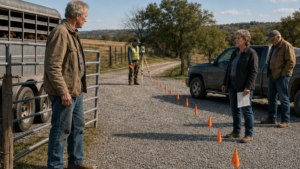
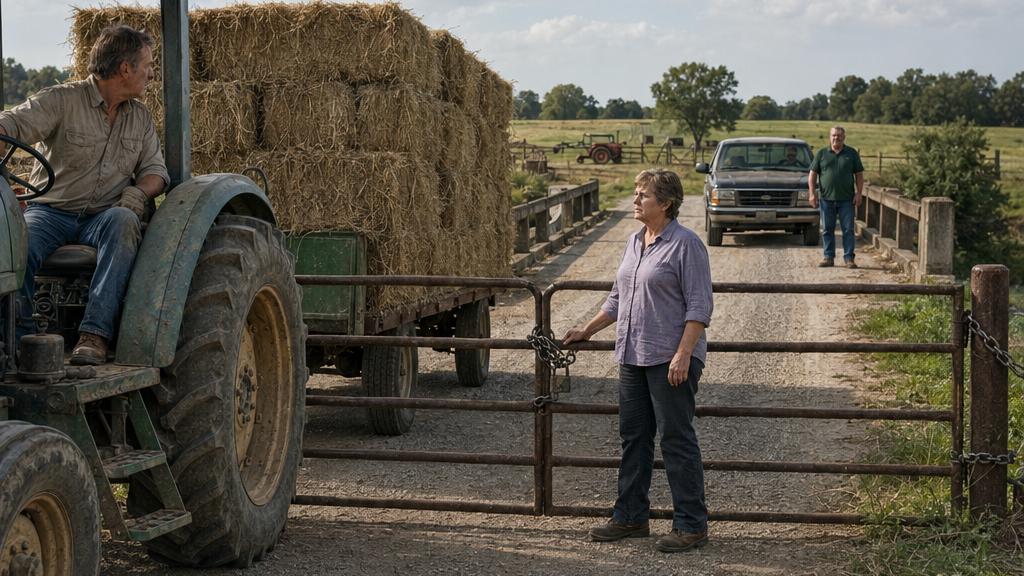
James Carter saw the chain before he saw Margaret Anderson.
It hung through the bars of the old iron gate in two bright loops, pulled tight around the post beside the cooperative bridge. Beyond it, the gravel connector ran straight across the creek and climbed toward the county road.
James eased off the tractor throttle.
Behind him, the hay wagon settled with a wooden groan under four high rows of square bales. He had loaded before sunrise because the buyer’s truck was supposed to meet him at the north field entrance by nine. The cooperative road cut nearly four miles from the alternative route and, more important, kept the wagon off the soft bottom ground behind his cattle pasture.
He stopped ten feet short of the gate.
Margaret stood on the other side with a clipboard tucked beneath one arm.
“You can’t bring that across.”
James looked at the bridge, then at her.
“I brought one across last fall.”
“That was before we started enforcing the restricted-parcel rule again.”
James killed the engine.
The sudden silence made the creek louder.
He climbed down slowly, removed his work gloves, and tucked them into his back pocket.
Margaret shifted the clipboard against her hip. She had known James most of her life. Their families had shared equipment, attended funerals, patched fence after storms. That familiarity made the chain look stranger, not less serious.
“What changed?” James asked.
“Nothing changed. We’re applying the rule consistently.”
“What rule?”
Margaret gave him a tired look.
“James.”
“I’m asking.”
“Your tract is classified restricted access for loaded agricultural equipment.”
James glanced past her toward the bridge. A feed truck had crossed there three days earlier on its way to Daniel Harris’s place.
“You mean my equipment.”
“I mean restricted parcels.”
“And Daniel’s isn’t one?”
“No.”
“Same bridge.”
“Different classification.”
A vehicle approached from behind James. He stepped aside as the feed-truck driver slowed, realized the lane was blocked, and stopped farther back.
The driver leaned out his window.
“Problem?”
“Give us a minute,” James said.
Margaret lowered her voice. “This doesn’t need to become a roadside show.”
James looked at the chain.
“You put a chain on the road at seven-thirty Monday morning.”
“For safety.”
“Then why can Daniel cross?”
“His parcel has full-use status.”
James let that sit for a moment.
He had grown up hearing phrases like full-use, restricted tract, old bridge rules. They belonged to the same category as fence lines that had always been there and drainage ditches nobody remembered digging. His father had spoken about them with resignation.
Don’t make trouble over a road, son. Roads outlive arguments.
James had accepted that logic for years.
But a loaded hay wagon behind a locked gate had a way of making inherited patience feel different.
“How much is my road assessment this year?” he asked.
Margaret frowned. “That isn’t relevant.”
“It feels relevant.”
“You received the same assessment notice everybody did.”
“How much?”
“James, you know how much.”
“Twenty-four hundred.”
She did not answer.
He nodded toward the bridge.
“So I pay twenty-four hundred dollars toward this road and bridge.”
“That covers maintenance throughout the cooperative.”
“And I can’t use the bridge with the same kind of load Daniel can.”
“You can use the south route.”
“The south route is half mud after Friday’s rain.”
“That doesn’t change the classification.”
James turned toward the feed truck. The driver had shut off his engine.
No one was yelling. That somehow made the scene feel more exposed.
James faced Margaret again.
“All right.”
Her shoulders eased slightly, as if she thought he had finally agreed to turn around.
James pointed to the clipboard.
“Write it down.”
“What?”
“Write that my parcel pays the standard road assessment and is denied loaded-equipment access across this bridge because it is classified restricted.”
Margaret stared at him.
“You know that already.”
“I want the cooperative to say it.”
“This is unnecessary.”
“So is the chain if the rule is as clear as you say.”
Her mouth tightened.
“I’m not standing here drafting legal language beside a hay wagon.”
“Doesn’t have to be legal language.”
He took a folded delivery ticket from his shirt pocket, flipped it over, and held it toward her.
“Plain language will do.”
Margaret did not take it.
A pickup appeared on the far side of the bridge.
Daniel Harris slowed beside Margaret, rolled down his window, and looked from her to James.
“What happened?”
“Nothing happened,” Margaret said.
James answered at the same time.
“I’m trying to find out why I’m paying for a bridge I’m not allowed to use.”
Daniel rested one arm on the window frame.
“You can use it. Just not with loaded equipment.”
“Can you?”
Daniel hesitated.
“With my feed trailer, yes.”
“You pay more than I do?”
Daniel looked at Margaret.
James waited.
“No,” Daniel said.
The answer landed more heavily than James expected.
Margaret stepped toward Daniel’s truck.
“This is exactly why we don’t handle policy questions in the road.”
James heard the word policy.
“Good,” he said. “Then tell me when the policy was adopted.”
Margaret turned.
“It’s been in place for years.”
“That isn’t what I asked.”
“You want a history lesson while you’re blocking traffic?”
“I want the vote.”
Daniel rubbed the side of his jaw.
“There’ll be something in the minutes.”
“What year?”
“I don’t know off the top of my head.”
“Roughly.”
Daniel looked toward the bridge.
“Before I was treasurer.”
“You’ve been treasurer twelve years.”
“I said I don’t know.”
Margaret exhaled through her nose.
“James, take the south road today. Bring this up at the next meeting.”
He glanced at the hay behind him. Turning the wagon around on the narrow connector would cost time and possibly two fence posts. The buyer might leave before he reached the other entrance.
That was the practical problem.
The thing forming underneath it was no longer practical.
James extended the delivery ticket again.
“Sign the restriction.”
Margaret stared at him long enough that Daniel opened his door.
“Margaret,” he said quietly. “Just write what the rule says.”
She took the paper.
Her handwriting was small and hard, pressed deep enough to mark the cardboard beneath it.
Restricted parcel. Loaded agricultural equipment prohibited across cooperative creek bridge. Alternate access required.
She signed Margaret Anderson, Chair.
Then she handed it back.
“If you keep attempting to cross after being notified, the board can assess a violation fee.”
James read the sentence twice.
“A fine for trying to use the road I pay for.”
“For violating cooperative rules.”
James folded the paper carefully and put it in his shirt pocket.
He climbed onto the tractor without another word.
Margaret began unwrapping the chain so Daniel could cross.
James paused with his hand on the ignition.
“Daniel.”
Daniel looked over.
“When you get back to the shed, find me the vote.”
Daniel nodded once.
James started the tractor.
He spent twenty minutes backing the hay wagon into a field entrance before turning toward the south route. One tire sank to the rim in soft ground before he cleared the lower pasture. By the time he reached the buyer, the man had been waiting forty-five minutes.
James apologized and helped reload two bales that had shifted.
Only after the truck pulled away did he take Margaret’s signed restriction from his pocket.
The paper was damp from sweat.
That evening, he called Daniel.
“You find the minutes?”
There was a pause on the line.
“I found the policy sheet.”
“That isn’t what I asked.”
“I know.”
“What year was the vote?”
Another pause.
Daniel’s voice had lost its easy tone.
“James, I can’t find one.”
Chapter 2: Everyone Paid the Same, but Nobody Asked Why
Daniel slid the oldest ledger across the scarred folding table with both hands.
“Start there.”
The cooperative equipment shed smelled of grease, dust, and cut grass. Outside, a mower attachment leaned against the wall beside a stack of culvert pipe. Inside, six accounting ledgers covered twenty-seven years.
James sat opposite Daniel.
“Every year?”
“As far back as I could pull without going to county storage.”
James opened the first book.
The pages were ruled by hand. Parcel numbers ran down the left side, assessments across the top. His father’s name appeared beside the Carter tract.
James Carter Sr.
The figure in the assessment column matched Daniel Harris’s farm.
He turned another page.
Same.
Another year.
Same.
Daniel stood with his thumbs hooked into his belt.
“Assessments weren’t based on access class.”
“What were they based on?”
“Parcel share.”
“And restricted parcels had the same share?”
“Usually.”
James looked up.
“Usually?”
Daniel pulled another ledger closer.
“Some smaller residential tracts paid less. Working farms mostly paid the standard share.”
James followed the entries.
Carter: standard.
Harris: standard.
Anderson: standard.
Lewis: standard.
Year after year.
He found a gate-key list from the early 2000s tucked between two account sheets.
Harris. Anderson. Several other farms.
No Carter.
No Lewis.
James laid the key list beside the assessment ledger.
Same contribution on one page.
Different access on the other.
Daniel noticed what he was doing.
“You’re making it look worse than it was.”
“I’m not making anything.”
“You know what I mean.”
“I’m putting two pieces of paper next to each other.”
Daniel sat down.
“For most years nobody cared.”
“My father cared.”
“Did he complain?”
James looked again at his father’s name.
“No.”
“Then maybe he understood the arrangement.”
That irritated James more than he expected.
His father had understood plenty of arrangements he disliked.
He had paid bills he considered unfair because he hated public disputes. He had driven the south route without asking why Daniel’s family could use the bridge. Once, when James was in his thirties, he had asked why their farm was restricted.
His father had been fixing a hydraulic line.
Because that’s how they set it up.
Who’s they?
Doesn’t matter. You still have hay to cut.
James had let the answer stand.
Now his father’s payments sat in ink across more than two decades.
“What did restricted mean originally?” James asked.
Daniel shrugged.
“Bridge limits, I think.”
“Then why not restrict weight instead of parcels?”
“I don’t know.”
“Who does?”
“Margaret might.”
“Margaret told me it was policy.”
“It is policy.”
James closed the ledger.
“You keep saying that like it answers where it came from.”
Daniel’s chair creaked as he leaned back.
“Look, James, I’m not defending every decision that was made before either of us got on a committee. I collect assessments. I pay gravel bills. I send out notices when the culvert washes. That’s what I know.”
“You’re treasurer.”
“Yes.”
“Do you know what the cooperative has charged my farm since my father started paying?”
Daniel looked at the ledgers.
“Not without adding it.”
James had brought a calculator.
By noon, he had a rough total.
It was not enough money to make him rich. It was enough to make the words temporary inconvenience feel insulting.
Daniel returned with a cardboard records box.
“I found meeting minutes.”
“How far back?”
“Nineteen ninety-nine in here. Earlier stuff may be at the county office or in Margaret’s storage.”
James opened the box.
The first folders contained annual budgets, gravel bids, ditch repairs, bridge inspection notes.
He expected to find the vote within minutes.
He did not.
Two hours later, Daniel was opening another cabinet.
“Maybe it’s under easements.”
“Parcel classification should be in a vote.”
“You’d think.”
James stopped turning pages.
“You don’t remember ever seeing one?”
Daniel did not answer immediately.
“No.”
“Not once?”
“I never had a reason to look.”
James almost laughed, but there was nothing funny in it.
“That may be the whole problem.”
A shadow moved across the shed doorway.
Katherine Lewis stood outside with a canvas orchard hat in one hand.
“I heard James was digging through the cooperative’s bones.”
Daniel sighed.
“News travels.”
“In this county? Faster than feed prices.”
Katherine stepped inside.
Her orchard sat east of James’s place, and her parcel appeared on the same restricted list. Since her husband died, she had run it with seasonal help and one aging tractor.
James tapped the ledger.
“You know you pay the same road share as Daniel?”
“I’ve known what I pay for thirty years.”
“You know he gets full bridge access?”
She looked at him steadily.
“Yes.”
James had expected surprise.
That unsettled him.
“And that’s fine with you?”
“I didn’t say that.”
“Then why hasn’t anybody challenged it?”
Katherine placed her hat on the table.
“Because the bridge needs work, James.”
“That has nothing to do with whether we have equal rights.”
“It has everything to do with what happens next.”
He pushed the key list toward her.
“Look at this.”
“I know I don’t have a key.”
“You’ve been paying the same assessment.”
“I know.”
“Then why are you acting like I’m the problem?”
Daniel stood.
“Nobody said that.”
Katherine did.
“I’m saying if you turn this into a repayment fight before you know the numbers, you may get exactly what you ask for.”
James stared at her.
“And what’s that supposed to mean?”
“It means the cooperative reserve is thin. The bridge engineer has been warning about deck work for two years. If everybody who thinks they were overcharged demands money back, where do you think repairs come from?”
“Maybe they should have thought of that before charging everybody equally.”
“Maybe they should have. That doesn’t make the bridge repair itself.”
Her calmness felt like resistance.
James knew that was unfair, but he felt it anyway.
“I’m trying to find whether this rule was ever adopted.”
“Then find that first.”
“I intend to.”
Katherine picked up her hat.
“And if you prove it wasn’t?”
James glanced at the ledger.
“Then they owe people.”
Katherine’s expression changed slightly.
“Maybe.”
“Maybe?”
“Being right about the rule and knowing what to do about twenty-seven years of it are two different things.”
She left before he answered.
Daniel watched her cross the gravel yard.
“She’s not wrong about the reserves.”
James returned to the minutes.
“Neither am I.”
Late that afternoon, they found references to restricted parcels but nothing creating them.
One set of minutes instructed the secretary to “continue existing access classifications.”
Another approved replacement locks.
A later board discussed issuing keys only to full-use tracts.
Each document assumed the classifications already existed.
None explained who made them.
James gathered copies.
At the door, Daniel held up Margaret’s policy sheet.
“I’ll ask her for the amendment.”
“Ask for the vote too.”
Daniel nodded.
Two days later, James received an email from the cooperative office.
Attached were the current access policy, three bridge inspection summaries, and a page of board procedures.
No amendment.
No recorded vote.
At the bottom, Margaret had written a single sentence:
No additional authorizing document has been located in cooperative files.
James read it twice.
Then he printed it and placed it beside his father’s first assessment ledger entry.
If the cooperative did not have the document that created the rule, there was only one place left to look.
The county records office held the original agreement.
Chapter 3: The Old Agreement Said Nothing About Second-Class Farms
The county records clerk placed the oversized book on the counter and said, “Your parcel is in here.”
James had expected another afternoon of searching.
Instead, she pointed to the index.
Carter tract.
Recorded cooperative easement.
He followed the reference to a document filed decades before he had taken over the farm. The copy was faint in places, the type uneven, but the parcel descriptions were clear.
Carter.
Harris.
Anderson.
Lewis.
Participating tracts.
James leaned closer.
The agreement granted the participating owners common use of the connector road, drainage structures, and creek crossing, subject to maintenance rules and temporary safety limitations.
He read the paragraph again.
Common use.
No full-use parcels.
No restricted parcels.
No permanent split.
“Can I get a certified copy?”
The clerk nodded.
“Whole document?”
“And the exhibits.”
“That’ll take a little while.”
“I’ll wait.”
While she copied the pages, James studied the survey exhibit.
A thin line marked the gravel connector. At the creek crossing, a handwritten notation described an iron gate near the bridge approach.
The gate had existed almost from the beginning.
The classification had not.
That distinction lodged in his mind.
He called Daniel from the hallway.
“The original agreement includes my parcel.”
“I figured it probably did.”
“It gives participating tracts common use.”
Daniel went quiet.
“No restricted language?”
“None I’ve seen.”
“Well.”
“That’s all you have?”
“What do you want me to say?”
“I want to know when it changed.”
Daniel sighed.
“Margaret says there was bridge damage years ago. Maybe that’s where it started.”
James looked through the glass window at the clerk feeding pages into a copier.
“Temporary damage doesn’t create permanent parcel classes.”
“No. But before you decide anybody stole your rights, find out what happened.”
That irritated James because it sounded reasonable.
He spent the next hour in archived cooperative filings and county correspondence.
The first useful record was from a period of heavy flooding.
A bridge inspection noted damaged timber members and recommended limiting loaded vehicles until repairs could be completed.
James sat back.
There it was: a legitimate restriction.
Not by parcel.
By load.
He read further.
The cooperative minutes from that year recorded temporary limits on feed trucks, loaded wagons, and heavy trailers. Owners were directed to use alternate routes when possible.
For the first time since Margaret had chained the gate, James felt the clean edge of his certainty dull.
Maybe the policy had not begun as favoritism.
Maybe somebody had been trying to keep a damaged bridge from dropping into the creek.
He kept reading.
The following spring, repairs were approved.
A later inspection said the bridge could reopen with specified weight precautions.
Still no parcel classes.
Then the wording began to drift.
One year’s minutes referred to “farms normally using the north crossing.”
Another mentioned issuing gate keys “consistent with prior practice.”
Several years later came the phrase “full-use tracts.”
No definition.
No attached vote.
No amendment.
A later set of minutes referred to “restricted properties” as though everyone should know what that meant.
James lined the pages across a library table.
Temporary load restriction.
Prior practice.
Full-use tract.
Restricted property.
He could see the evolution without seeing the decision.
That was almost more troubling.
Nobody seemed to have stood up one night and declared that the Carter farm should have fewer rights.
The system appeared to have formed by repetition.
A workaround became a habit.
A habit became terminology.
Terminology became a rule.
James photographed the sequence.
Then he found something that slowed him again.
An insurance letter from years earlier warned that repeated loaded crossings could increase the cooperative’s liability if bridge maintenance was deferred.
Margaret had not invented the safety concern.
The bridge had been expensive to maintain for a long time.
He remembered her standing beside the chain saying, For safety.
Until now, he had heard it only as an excuse.
The words looked different in the county file.
Not correct.
Different.
He requested the repair invoices.
Several major repairs had been paid by all participating tracts, including his father’s.
James’s jaw tightened again.
Even when his family was being steered away from the crossing, they had paid toward keeping it open.
The clerk returned with the certified agreement.
“You find what you needed?”
“I found more than one thing.”
“That usually happens.”
James stacked the copies.
“Do recorded amendments show separately?”
“If they were properly recorded, yes.”
“Can you search by cooperative name?”
She did.
They found easement adjustments, a drainage correction, and one parcel-boundary modification.
No access-class amendment.
James asked her to search again using the old cooperative name.
Nothing.
“You sure this is all?”
“It’s what’s indexed here.”
“What about internal votes?”
“Those wouldn’t necessarily be recorded with us unless they changed the recorded agreement.”
James nodded.
“So I still need their minutes.”
“If you’re trying to establish how policy developed, yes.”
He drove home with a folder on the passenger seat and did not turn on the radio.
The south route passed Katherine’s orchard.
Her tractor was parked beside a row of trees while workers stacked crates near a utility trailer.
James almost stopped.
He wanted to tell her the original agreement was clear.
He also wanted to tell her the first restriction may have been justified.
Those two facts did not fit together as neatly as he wanted.
At home, he spread the documents across the kitchen table.
The certified agreement went in the center.
Temporary bridge restrictions to the left.
Later minutes to the right.
His father’s old assessment entries sat above them.
He called Daniel.
“I found where the restrictions started.”
“You found the vote?”
“No.”
“What did you find?”
“Bridge damage. Temporary load restrictions. Insurance concerns.”
Daniel was quiet.
“That makes sense.”
“It does.”
James disliked admitting it.
“So Margaret wasn’t lying about the bridge.”
“No.”
“But there’s still no parcel classification.”
Daniel said nothing.
James continued.
“I can trace the language changing over years. Temporary restriction becomes prior practice. Prior practice becomes full-use tracts. Then restricted properties.”
“Maybe there was a vote that never got recorded.”
“Then it should be in the minutes.”
“Maybe.”
“You sound like Margaret.”
“I sound like somebody who knows old volunteer boards weren’t always good at paperwork.”
James looked at the certified agreement.
“That doesn’t give them permission to rewrite property rights by forgetting to write things down.”
“No.”
It was the first time Daniel had said the word without qualification.
James sat back.
“Can you get me the missing minutes from the storage cabinet?”
“I’ll look.”
“All of them around the bridge repair years.”
“You think that’s where it happened?”
“If it happened.”
The next evening, Daniel brought two file boxes to James’s kitchen.
They worked until nearly midnight.
There were motions to repair the bridge, hire inspectors, buy gravel, replace damaged rails, restrict vehicles temporarily, and change the lock.
There were annual reminders about which owners had keys.
There were repeated references to existing classifications.
There was never a motion creating those classifications.
Never a membership ballot.
Never an amendment to the common-use provision.
Daniel finally leaned back and rubbed both eyes.
“That’s twenty years of minutes.”
James looked at the open folders.
“It isn’t here.”
Daniel stared at one page for a long time.
“My father served on this board.”
“So did mine for a year.”
“You think they knew?”
“I think they got used to it.”
Daniel closed the folder.
“That’s not the same as doing it on purpose.”
James looked toward the dark kitchen window.
“No.”
That answer mattered.
The cooperative had not begun with a conspiracy.
It had begun with a damaged bridge and people making temporary choices.
But somewhere along the way, temporary safety had become permanent status.
And nobody had bothered to ask the people paying the same bill whether they agreed.
James gathered the pages into three stacks.
Daniel pointed to them.
“What are you going to do?”
James looked at his father’s name in the oldest ledger.
For years he had assumed his father’s silence meant acceptance.
Now he wondered if it had simply meant exhaustion.
“I’m going to ask them to fix it.”
Daniel nodded slowly.
“And if they don’t?”
James placed Margaret’s signed restriction on top of the certified agreement.
“Then I’m going to make them explain when a temporary bridge rule became a permanent line between farms.”
Chapter 4: A Temporary Bridge Rule Became a Permanent Social Line
James stopped adding when the calculator showed a number large enough to make him sit back.
He checked the first column again.
Annual assessments. Special bridge assessments. Emergency gravel charges. Repair contributions. Twenty-seven years of payments connected to a road his family had helped maintain while being denied the same practical access as neighboring farms.
He ran the figures again.
The total did not shrink.
On the kitchen table, the old ledgers sat beside the county agreement and a row of copied minutes. James had divided the papers into years with yellow slips. The pattern was clearer now than it had been at the records office.
At first, everyone had been restricted after the bridge damage.
Then repairs were made.
Then some farms received keys again.
Then those farms were called full-use tracts.
Then the others became restricted properties.
Nobody had voted on the change.
James picked up a photograph Daniel had found in an old maintenance envelope.
It showed the bridge fifteen years earlier, fresh gravel spread across the approach. The iron gate stood open. No chain.
A second photograph, dated three years later, showed the same gate closed with a new lock.
On the back someone had written: Keys issued to approved farms.
Approved by whom was not written.
James set the photograph beside Margaret’s signed restriction.
The pieces fit too well now.
At the cooperative shed that evening, Margaret stood at the end of the folding table while James laid out his documents.
Daniel sat to one side, unusually quiet.
Katherine Lewis had come because James had called every owner he knew was listed as restricted.
Two others stood near the open shed door.
James did not make a speech.
He pushed the original agreement forward.
“This says participating tracts have common use.”
Margaret read the marked paragraph.
“I’ve seen it.”
“Then show me what changed it.”
“We’ve already been over this.”
“No. We’ve been over the current policy.”
James placed the minutes beside it.
“These are the years after the bridge damage. Temporary load limits. Repairs. Insurance concerns. Then the language changes. Full-use tract. Restricted property. But there’s no amendment.”
Margaret crossed her arms.
“The board had to manage risk.”
“Then manage weight.”
“That isn’t always practical.”
“It was practical when my farm was paying the same assessment.”
One of the landowners shifted near the door.
Margaret glanced toward him before answering.
“You’re reducing decades of maintenance decisions to one sentence.”
“I’m reducing it to one question.”
She knew the question.
James asked anyway.
“Where was the permanent classification approved?”
Margaret looked at Daniel.
Daniel shook his head once.
“I haven’t found it.”
The shed went still.
James opened his notebook.
“I calculated what my farm paid.”
Katherine’s head came up.
Margaret’s expression hardened.
“James.”
He gave the figure.
Then he explained that he was separating ordinary road maintenance from the portions tied to bridge access and special bridge work.
“I’m not asking for every dollar the cooperative ever collected,” he said. “I’m asking for reimbursement for the years my parcel was treated as restricted while paying the same access share.”
Katherine leaned forward.
“How far back?”
“All the way.”
“That’s twenty-seven years.”
“Yes.”
“And you think only your farm gets that?”
“No.”
That was when the room changed.
The two landowners near the door looked at each other.
Margaret’s arms dropped.
“How many parcels are you talking about?”
“Depends how many were restricted.”
Daniel spoke quietly.
“Seven, at different times.”
Margaret turned toward him.
“You told him that?”
“He asked for the records.”
She looked back at James.
“You understand what you’re proposing?”
“I understand what happened.”
“That isn’t what I asked.”
Katherine pushed her chair back.
“What does seven parcels look like?”
James hesitated.
He had calculated his own claim carefully.
He had not calculated everyone’s.
Daniel had.
He reached for a legal pad.
“If each property made the same kind of claim James is making, adjusted for years and special assessments…”
He stopped.
Margaret took the pad from him.
Her face changed as she read the number.
“That would take most of the reserve.”
Nobody spoke.
Margaret placed the pad flat on the table.
“We have bridge deck work due. We have a culvert replacement scheduled. We have insurance in December.”
James looked at the reserve figure.
It was lower than he expected.
Katherine turned to him.
“You knew this could happen.”
“I knew there might be refunds.”
“No. You knew there might be a hole.”
“They created the hole.”
“That doesn’t fill it.”
James felt heat rise into his face.
“So we ignore what happened because fixing it costs money?”
“I didn’t say ignore it.”
“You’ve known you were restricted for years.”
“So did you.”
That landed harder than he wanted it to.
Katherine continued.
“You’re acting like the rest of us were waiting for you to discover we’d been wronged.”
James said nothing.
“I hated that gate,” she said. “My husband hated it. But I also know what happens when the road washes out. I know what bridge work costs. If you empty the cooperative account proving a point, I still have to get fruit trucks out next season.”
“It isn’t just a point.”
“I know.”
Her voice softened, which made James more uncomfortable.
“That’s why you need to think about what you’re asking for.”
Margaret closed the ledger.
“This is exactly why the policy stayed in place.”
James looked at her sharply.
“No. The policy stayed because nobody challenged it.”
“It stayed because every time the bridge became an issue, somebody had to choose between perfect fairness and keeping the road functioning.”
“You had another choice.”
“Which was?”
“Put it to a vote.”
Margaret did not answer.
James gathered the papers.
For the first time, proving the rule unauthorized did not feel like reaching the end of something.
It felt like reaching the edge of another problem.
He drove home angry with Margaret, angry with Katherine, and most of all angry that the numbers had complicated what the documents had made simple.
The next morning, Daniel brought over another envelope.
Inside were photographs of the gate from different years.
James spread them across his workbench.
In the earliest, the gate had been open after repairs.
Later, a removable chain appeared during wet seasons.
Then the chain became permanent.
Then a keyed lock appeared.
The physical history matched the written one.
Temporary.
Repeated.
Normalized.
Permanent.
No vote.
By noon, James had drafted a formal demand.
He asked the cooperative to acknowledge equal access rights, stop enforcing parcel classifications, and reimburse affected owners for unequal assessments dating back to the first permanent restriction.
He sent copies to Margaret, Daniel, and every restricted owner he could identify.
Katherine called an hour later.
“You sent this to everybody?”
“Yes.”
“You included the full repayment demand.”
“Yes.”
There was silence.
“You really think this is the only way?”
“I think they had twenty-seven years to find another one.”
“That isn’t an answer.”
“It’s mine.”
Katherine hung up without saying goodbye.
Two days passed.
Then Margaret called.
Her voice was controlled.
“Come to the office tomorrow.”
“Board meeting?”
“No.”
“Then what is it?”
“A proposal.”
“What kind?”
“One that gives you what you originally asked for.”
James looked toward the kitchen table, where Margaret’s signed restriction still rested on top of the old agreement.
“What did I originally ask for?”
“Access.”
He waited.
Margaret continued.
“We can give you unrestricted bridge access immediately.”
There was something in the way she said immediately that made James stop.
“And the other restricted farms?”
“This proposal concerns your parcel.”
James looked at the photographs of the chained gate.
Margaret lowered her voice.
“Come by tomorrow afternoon. We can settle this without draining the cooperative.”
James already knew what would be waiting on the table.
A key.
Chapter 5: The Key Was Offered Only If James Stopped Asking Questions
Margaret pushed the gate key across the desk before James had finished sitting down.
It was attached to a square brass tag with no writing on it.
James looked at the key, then at her.
“That opens the bridge gate?”
“Yes.”
“Any restriction?”
“Not for your farm equipment, assuming posted weight limits are followed.”
“And the Carter parcel becomes full-use?”
“We can designate it that way.”
James left the key untouched.
The cooperative office was barely more than a converted room beside the equipment shed. A filing cabinet stood against one wall. A coffee maker clicked on a counter behind Margaret. Through the window, James could see the gravel lane leading toward the bridge.
Margaret folded her hands.
“This solves the practical issue.”
“For me.”
“For your farm.”
“What about Katherine?”
“We’re discussing your complaint.”
“No. My complaint is that the classification was never authorized.”
Margaret’s jaw tightened.
“You asked for access.”
“I asked why I didn’t have it.”
“And now you can.”
James glanced at the key again.
“What do I sign?”
Margaret pulled a folder from beside her chair.
There it was.
A settlement agreement.
James did not pick it up.
“What does it say?”
“That the cooperative grants your parcel unrestricted access going forward. In return, you withdraw the reimbursement demand and agree the dispute is resolved.”
“And the policy?”
“Remains under review.”
“That means it stays.”
“Until the board determines what changes are appropriate.”
James leaned back.
“You’re asking me to become the exception.”
“I’m offering you what you said you wanted.”
“You’re offering me a better classification.”
Margaret’s composure slipped.
“James, do you know what happens if we send your demand to counsel and tell every restricted owner they may have a historical claim?”
“You notify people of the problem you found.”
“And if they all demand repayment?”
“That’s not a reason to hide it.”
She looked toward the window.
For several seconds, the only sound was the coffee maker.
Then Margaret said, “I don’t think the classification would survive a serious challenge.”
James had expected denial.
The admission made him sit forward.
“You know that?”
“I said I don’t think it would survive.”
“Since when?”
“Since Daniel showed me the original agreement and the minutes.”
“So before you offered me this key.”
“Yes.”
“Before you enforced the restriction again.”
Her face stiffened.
“I enforced the policy currently in place.”
“A policy you think may be invalid.”
“I enforced the only policy the cooperative has been operating under.”
James stared at her.
Margaret’s hands remained folded, but her thumbs had begun rubbing against each other.
“My father served on that board,” she said. “Daniel’s father did too. Yours did for a short time. None of them were lawyers. They made decisions because the bridge was failing and insurance was threatening to pull coverage. They kept a road open that otherwise might have disappeared.”
James said nothing.
“I’m not pretending the paperwork is good,” she continued. “It isn’t. But you’re talking like somebody sat down twenty-seven years ago and decided your family mattered less.”
“The result was the same.”
“No. The result was unfair. That doesn’t mean the motive was.”
James looked at the key.
He knew she was right about that much.
That made refusing her harder, not easier.
Margaret opened the settlement folder.
“The reserve cannot absorb full historical reimbursements. If we spend it, the bridge repairs stop. If the bridge repairs stop, the insurer may raise rates or refuse renewal. If that happens, nobody crosses.”
“Then restructure the claims.”
“We can’t restructure claims we haven’t admitted exist.”
There it was.
James looked up.
“You’re not trying to fix it. You’re trying to contain it.”
“I’m trying to keep the cooperative alive.”
“By giving me a private key.”
“By resolving the complaint in front of me.”
“And leaving Katherine behind the same chain.”
Margaret pushed the key closer.
“She can bring her own complaint.”
“You already know the problem applies to her.”
Margaret’s voice hardened.
“And I know that if I send seven letters tomorrow saying the cooperative may owe decades of money, I could trigger a financial collapse before we even know what anyone is legally entitled to.”
“So you do nothing.”
“I buy time.”
“With other people’s rights.”
“With the only reserve keeping that bridge usable.”
James stood.
Margaret stood too.
“You’re going to turn down unrestricted access?”
“Yes.”
“For what?”
He slid the key back across the desk.
“For the same reason I asked you to sign the restriction.”
Her expression sharpened.
“I’m not following.”
“If the rule is legitimate, put it in front of everybody and defend it. If it isn’t, fix it for everybody.”
Margaret stared at the key between them.
“You think court is going to make this cleaner?”
“No.”
“That’s where you’re headed.”
“I know.”
“You could lose.”
“I know.”
“You could win the rule and still get nothing close to the money you demanded.”
James hesitated.
That possibility bothered him more than he wanted her to see.
Margaret noticed.
“You haven’t thought through the remedy.”
“I’ve thought through what happened.”
“That isn’t the same thing.”
Katherine had told him almost exactly that.
James picked up the settlement folder, read the first page, and put it back down.
“You’ll need to send me the cooperative’s formal position.”
Margaret’s face closed.
“You already have it.”
“I have a handwritten restriction.”
“You wanted it in writing.”
“Now I want the board to own it.”
The next morning, a certified envelope arrived at James’s mailbox.
Inside was a formal notice on cooperative letterhead.
The board had reaffirmed the current access classifications pending review.
The Carter parcel remained restricted.
Any attempt to cross the bridge with prohibited equipment could result in an assessment and suspension of cooperative privileges.
Margaret had signed it.
James read the last line twice.
She had admitted privately that the policy might not survive.
Then she had enforced it anyway.
By afternoon, James was at his kitchen table with the county agreement, the minutes, Margaret’s signed roadside restriction, and the new certified notice.
He called the courthouse clerk and asked what forms were needed to seek a declaration about rights under a recorded agreement.
The answer was more complicated than he hoped.
He spent the next two days assembling papers and arranging for proper filing.
When Daniel heard, he came by.
“You’re really doing it?”
James nodded.
Daniel looked at the stack of documents.
“You still asking for full repayment?”
James tapped the draft complaint.
“I’m asking the court to decide whether the classification is enforceable.”
“That isn’t what I asked.”
James looked at the damages section.
A week earlier, he would have written the largest defensible number and underlined it.
Instead, he had left the amount to be determined later.
“I’m not giving up the claim.”
Daniel nodded.
“But?”
“But I’m not pretending I know the right number anymore.”
Daniel sat down.
“That sounds almost reasonable.”
“Don’t get used to it.”
For the first time in days, Daniel smiled.
James signed the complaint.
He asked the court to declare the permanent parcel classifications invalid unless the cooperative could prove they had been properly adopted. He asked for equal access subject to legitimate safety limits. He preserved the issue of historical charges without demanding an immediate fixed judgment.
Then he carried the papers to the courthouse himself.
When he stepped back outside, the afternoon felt strangely ordinary.
Farm trucks moved along the county road.
Somewhere behind the buildings, a mower was running.
Nothing had been solved.
But for the first time, the question was no longer confined to people who had spent twenty-seven years saying, That’s just the way it is.
Chapter 6: Winning the Rule Would Mean Little If the Road Collapsed
The first mediation worksheet made James wish the numbers were wrong.
They were not.
The cooperative’s reserve could cover the scheduled bridge deck work or anything close to full historical reimbursement.
Not both.
James sat at the end of a conference table with Katherine on one side and Daniel on the other. Margaret sat across from them beside the cooperative attorney.
The mediator had asked for a simple picture of the finances.
The picture was ugly.
Bridge reserve.
Insurance.
Culvert replacement.
Annual gravel.
Expected assessments.
Then potential historical claims.
James traced a finger down the column.
“If all seven parcels claimed the maximum figure,” the attorney said, “the cooperative would exhaust its liquid reserve and still owe money.”
Margaret did not look pleased to hear her earlier warning confirmed.
Katherine leaned back.
“And then what?”
“Special assessments,” Daniel said.
“On everybody?”
“Yes.”
“Including the people getting refunds?”
Daniel nodded.
Katherine gave James a look that needed no translation.
He ignored it.
“What about delaying the bridge work?” James asked.
The attorney shook his head.
“The engineering recommendation is already overdue.”
James had seen the report. Deteriorated decking. Guard repairs. Drainage work at the approach.
Not a collapsing bridge.
Not an imaginary problem either.
The mediator asked whether the parties could separate access from compensation.
Margaret answered first.
“We are prepared to end the Carter restriction.”
James looked at her.
“The Carter restriction.”
She held his gaze.
“We’re also willing to review the others.”
“Review isn’t equal access.”
“The bridge still needs safety rules.”
“I agree.”
Margaret blinked.
It was the first time he had said it that plainly.
James continued.
“Weight limits. Seasonal restrictions if an engineer recommends them. Rules tied to the bridge, not surnames or parcels.”
The attorney wrote something down.
Margaret said, “That may be workable.”
“Then say the old classification lacked authority.”
Her expression changed.
“There it is.”
“What?”
“The part you actually want.”
James felt Katherine shift beside him.
Margaret leaned forward.
“You don’t only want access. You want the cooperative to admit it acted improperly for decades.”
“If it did.”
“You already decided it did.”
“The documents say it.”
“The documents say the amendment is missing.”
“No. The documents say common use. The minutes show temporary load limits. The permanent classes appear later without a vote.”
Margaret looked toward the mediator.
“This is why we’re stuck.”
James almost answered sharply.
Then he saw Katherine staring at the financial worksheet.
Not at Margaret.
Not at him.
At the reserve.
Outside the conference room, she caught James by the sleeve.
“You need another remedy.”
“I’m listening.”
“No, you’re waiting for me to agree with yours.”
He pulled his arm free.
“You want me to forget twenty-seven years?”
“I want you to stop saying that every time someone questions the check.”
James looked down the hall.
Katherine lowered her voice.
“What if the cooperative gives credits?”
“For what?”
“Future assessments.”
“That doesn’t repay people who were charged unfairly.”
“It repays them without emptying the account tomorrow.”
He considered it.
She continued.
“Restricted owners get documented credits over several years. Same road stays funded. Same bridge gets repaired. Nobody gets a bag of money and then receives a special assessment to put half of it back.”
James disliked how practical it sounded.
“That lets the cooperative spread liability.”
“Yes.”
“That helps Margaret.”
“It helps me.”
Katherine’s voice tightened.
“My orchard trucks need that bridge too, James. I want the same access you do. I also want the bridge to exist.”
He looked at her.
For weeks, he had treated her caution as fear.
Now he saw something else.
Responsibility.
It irritated him because it forced him to examine his own version.
Back at the table, James asked Daniel to show the reserve projection if historical claims were converted into multi-year assessment credits.
Daniel worked through the numbers.
The cooperative could survive.
Barely at first.
More comfortably if the bridge work was financed across several assessment cycles.
Margaret studied the worksheet.
“That still assumes we owe the credits.”
James heard the distinction.
Not can.
Owe.
“You’ll change access but won’t admit the rule was unauthorized.”
“I’ll agree the system needs revision.”
“That isn’t the same thing.”
The attorney spoke for the first time in several minutes.
“Mr. Carter, would you resolve the case if the cooperative eliminated parcel classifications, adopted uniform engineering-based restrictions, and created a credit program without admitting past liability?”
James looked at the proposed terms.
A month earlier, unrestricted access might have felt like victory.
Now the offer felt carefully incomplete.
He thought about Margaret’s key on the desk.
A benefit without an admission.
A solution without a truth.
He also thought about the reserve column.
A truth enforced without regard to consequence could become its own kind of stubbornness.
“I would settle compensation that way,” he said.
Margaret looked up.
“But?”
“I won’t settle the question of whether the permanent parcel classification had authority.”
The attorney frowned.
“If the classification is being eliminated, why does the declaration matter?”
“Because otherwise the record says the cooperative voluntarily changed a valid policy.”
Margaret said, “And?”
“And ten years from now somebody can decide the old system worked better and put the chain back.”
The room went quiet.
James continued.
“If the rule was never properly adopted, that needs to be clear. Then any future restriction has to be created the right way.”
Margaret’s face showed something between anger and exhaustion.
“You need a judge to tell you you were right.”
James almost said yes.
The word reached the back of his throat.
Then he stopped.
“No.”
Margaret waited.
“I need the next board to know what it can’t do.”
That answer surprised him as much as anyone.
Later that week, they met at the bridge with the survey technician and an engineer.
The iron gate remained locked while measurements were taken.
James stood beside Katherine as the engineer checked the deck and approaches.
“This bridge can handle agricultural traffic within posted limits,” the engineer said. “But you should manage actual weight and condition, not parcel identity.”
Katherine looked at James.
“There’s your rule.”
He almost smiled.
Margaret stood on the opposite side of the gate.
For a moment, James could imagine the matter ending there.
New limits.
Assessment credits.
An open gate.
No courtroom.
Then Margaret handed the attorney a draft settlement.
James read the paragraph concerning the old classification.
The cooperative admits no defect in prior authorization and maintains that historical access classifications were valid exercises of board discretion.
He looked up.
“You added this.”
Margaret did not deny it.
“We need finality.”
“No. You want protection.”
“We all need protection.”
James folded the paper.
“I’ll agree to credits. I’ll agree to phased repairs. I’ll agree to equal weight rules.”
Margaret’s expression hardened.
“But you still want the ruling.”
“Yes.”
The attorney closed his folder.
“Then mediation is over.”
Katherine exhaled slowly but did not argue.
James looked through the bars of the iron gate at the bridge beyond.
He no longer wanted to bankrupt the cooperative.
He no longer believed every person who had maintained the old system had acted from bad faith.
But the chain was still locked.
And Margaret still wanted the written record to say the cooperative had always possessed the right to put it there.
James handed the settlement back.
“Then we let the judge answer that part.”
Chapter 7: The Judge Asked for the Vote Nobody Could Produce
The judge looked over the top of the cooperative’s file and asked the question James had been asking for weeks.
“Where is the vote?”
No one answered immediately.
James sat beside his papers at the plaintiff’s table, hands flat against his knees. Across the aisle, Margaret Anderson stared down at the binder in front of her while the cooperative attorney turned several pages as if the missing document might appear if he searched slowly enough.
The courtroom was smaller than James had imagined. No jury. No crowd waiting for a dramatic verdict. Just wooden benches, fluorescent lights, the faint scrape of paper, and four people who had spent months arguing about a gate beside a creek.
The attorney finally stood.
“Your Honor, the cooperative’s position is that the board possessed authority to regulate use of the common roadway and bridge for safety and maintenance purposes.”
The judge nodded.
“I understand that position.”
He tapped the original agreement.
“I’m asking about the permanent parcel classifications.”
The attorney paused.
“The classifications developed through longstanding administrative practice.”
“That isn’t a vote.”
“No, Your Honor.”
“An amendment?”
“No recorded amendment has been located.”
“A membership resolution?”
“Not that we have found.”
James felt Daniel shift on the bench behind him.
The judge turned another page.
“The agreement says participating tracts have common use, subject to maintenance regulation and temporary safety restrictions.”
“Yes, Your Honor.”
“And the cooperative subsequently divided those tracts into full-use and restricted categories.”
“Yes.”
“Without amending this language?”
The attorney glanced toward Margaret.
“Apparently without a formal recorded amendment.”
The word apparently irritated James.
For months, every answer had come wrapped in language designed to leave a door open.
Apparently.
Longstanding practice.
Administrative classification.
Existing policy.
He had once believed the right document would end all of that.
Now he knew documents could establish a boundary without telling people what to do once they reached it.
The judge turned to James.
“Mr. Carter, your position is that the board could impose temporary weight restrictions but could not permanently reduce the access rights of selected parcels without following the amendment procedure.”
“Yes, sir.”
“You don’t dispute the cooperative’s authority to protect the bridge?”
“No.”
Margaret looked at him.
That answer still seemed to surprise her.
The judge continued.
“And you’re no longer asking me today to calculate twenty-seven years of damages?”
James glanced at the worksheet in his folder.
“No, sir. I preserved the claim. But the immediate question is whether the classification itself was valid.”
The judge leaned back.
“Why separate them?”
James had prepared an answer.
He did not use it.
“Because the bridge still needs fixing.”
The cooperative attorney looked over.
James continued.
“If the court decides the rule was invalid, we can still work out what repayment is fair and what the cooperative can actually sustain. But if we leave the authority question unresolved, somebody can put the same classifications back later.”
The judge studied him for a moment.
Then he looked toward Margaret.
“Mrs. Anderson, did the current board know before this lawsuit that it could not locate an authorizing vote?”
Margaret stood.
“Yes.”
“And continued enforcement?”
“Yes.”
“Why?”
Her attorney began to rise, but Margaret answered first.
“Because I believed stopping the policy immediately, before we understood the financial and safety consequences, could make things worse.”
James watched her carefully.
There was no lavender-blouse fury here, no roadside impatience.
She looked tired.
The judge asked, “Did you believe the classifications themselves were valid?”
Margaret hesitated.
“At first, yes.”
“And later?”
Another pause.
“I became less certain.”
“Yet the Carter parcel remained restricted.”
“Yes.”
“Why?”
Margaret looked toward James, then back at the bench.
“Because once we admitted one parcel had been treated improperly, we would have to admit the same thing about the others. I knew what the reserve looked like.”
The courtroom remained silent.
It was the admission James had wanted.
But hearing it aloud did not feel like victory.
Margaret continued.
“I wasn’t trying to punish James. I was trying to keep the cooperative from making promises it couldn’t afford.”
The judge nodded once.
“That may explain the decision. It does not necessarily authorize it.”
James lowered his eyes to the old agreement.
That sentence carried more weight than any accusation he could have made.
The ruling came after a recess.
The judge did not declare the cooperative corrupt. He did not order an immediate payout. He did not question its authority to impose neutral safety restrictions.
He did something narrower.
And stronger.
“The recorded agreement grants participating parcels common access,” he said. “The evidence shows temporary bridge restrictions were imposed for legitimate safety reasons. But the cooperative has produced no amendment, vote, or other authorized action converting those temporary restrictions into permanent parcel-based classes.”
He looked toward the cooperative table.
“A longstanding practice does not amend the agreement merely by surviving long enough.”
James felt his shoulders loosen.
“The permanent full-use and restricted-parcel classifications are therefore unenforceable under the agreement as presented.”
Daniel exhaled behind him.
Margaret remained still.
The judge continued.
“The cooperative may establish reasonable, uniformly applicable restrictions tied to bridge condition, vehicle weight, weather, maintenance, or other legitimate safety concerns, provided it follows its governing procedures.”
Then came the part James had learned not to treat as an afterthought.
“The parties will address historical monetary claims separately. Given the evidence of shared maintenance obligations and the cooperative’s ongoing infrastructure needs, I encourage a negotiated remedy rather than immediate depletion of operating reserves.”
The gavel did not fall.
There was no dramatic sound.
Just paper moving and the clerk calling the next procedural date.
Outside the courtroom, Katherine waited near the steps.
“Well?”
James handed her the copy of the order.
She read the first page, then found the operative paragraph.
“So the classes are gone.”
“Yes.”
“And the money?”
“Still ours to work out.”
Katherine looked at him.
“You all right with that?”
“A month ago, I wouldn’t have been.”
“What changed?”
James looked across the parking lot toward the county road.
“I finally started asking what happens the day after you win.”
Katherine folded the order.
“That’s inconvenient.”
“Very.”
Daniel joined them carrying the cooperative ledger.
“Margaret wants to meet tomorrow.”
Katherine raised an eyebrow.
“She still chair?”
“For now.”
James expected satisfaction at the thought of Margaret having to implement the ruling.
Instead, he felt relief that somebody who understood the cooperative’s bills would still be there.
The meeting the next afternoon was held in the equipment shed.
No one stood at the head of the table.
Margaret placed a proposed access policy in the center.
“No parcel classes,” she said.
James read it.
Agricultural vehicles would be subject to posted bridge-weight limits established from engineering recommendations. Temporary restrictions could be imposed after flooding, structural damage, or inspection warnings. Any restriction lasting beyond a defined period required a recorded board vote and notice to every affected member.
Katherine tapped one paragraph.
“This applies to everybody?”
“Everybody,” Margaret said.
“Even full-use farms?”
Margaret gave a small, tired smile.
“There aren’t full-use farms anymore.”
Daniel opened the ledger.
Then came compensation.
The seven affected parcels would receive credits against future cooperative assessments over several years, calculated according to their documented periods of unequal access. The credits would not erase ordinary maintenance obligations entirely, and bridge work would continue through a separate, transparently allocated repair assessment.
James studied the numbers.
They were less than his original demand.
Far less.
They were also real.
Katherine could keep her orchard trucks moving.
The bridge could be repaired.
The cooperative would acknowledge in writing that the permanent parcel classifications had lacked the required authorization.
James pointed to that sentence.
“This stays.”
Margaret nodded.
“Yes.”
He looked at her.
No argument.
No effort to soften it.
She slid another page toward him.
“And every member gets this.”
It was a notice explaining the ruling, the invalidated classification system, the new access rules, and the credit procedure.
James read Margaret’s signature at the bottom.
“You wrote this?”
“With the attorney.”
“You’re telling everybody.”
“We should have done that when we first realized we couldn’t find the vote.”
James met her eyes.
“Yes.”
She nodded once.
“I know.”
It was not an apology in the shape James might once have wanted.
It was better than the private key.
Three weeks later, the bridge repairs began.
The iron gate remained temporarily closed while crews replaced damaged decking and repaired drainage along the approach. This time the notice listed dates, engineering limits, and the board vote authorizing the closure.
James read it and laughed once when Daniel asked what was funny.
“Nothing.”
“You’re laughing at a closure notice.”
“It has a vote number.”
Daniel looked at the paper.
“Low standards for happiness.”
“Getting lower every year.”
When the work finished, the cooperative removed the old keyed lock.
The iron gate stayed because it was still useful for controlling cattle and closing the bridge during maintenance.
But the chain no longer belonged to one set of farms.
On the first morning the bridge reopened, James came down the gravel connector with his tractor and a loaded hay wagon.
He slowed at the gate out of habit.
It stood open.
For a moment he simply looked through it.
Twenty-seven years of family payments could not be returned in one morning. His father would never drive the road under the corrected rules. The cooperative would spend years working through credits, repairs, and trust that had been worn thin.
Nothing about that disappeared because a judge had read one paragraph correctly.
James eased the tractor forward.
The front tires crossed the bridge deck.
Then the rear.
The hay wagon followed.
On the far side, Katherine waited in her orchard truck.
She leaned out the window.
“You planning to admire the bridge all day?”
James pulled off to let her approach.
“No.”
“Good. I’ve got fruit moving.”
She drove past him, across the bridge and through the open gate.
James watched until her truck reached the other side.
Then he noticed the gate beginning to swing inward on its hinge.
He stopped the tractor.
For a second, the old instinct rose in him—the gate belonged open now, and somebody else could deal with it.
Instead, he climbed down.
Katherine stopped and looked back through her mirror.
James walked to the iron gate, took hold of the cold bar, and pulled it into its proper resting position without closing it across the road.
The new cooperative sign beside it listed the bridge weight limit and inspection contact.
No parcel classes.
No special keys.
Just one set of rules for everyone who had paid to belong there.
Margaret’s pickup appeared on the hill beyond the bridge.
She slowed when she saw James standing beside the gate.
Neither of them waved.
Margaret looked at the open road, then at him.
James gave a small nod.
After a moment, she returned it.
She drove on.
James climbed back onto his tractor.
His father had once told him roads outlived arguments.
James finally understood that the old man had only been half right.
Roads could outlive arguments.
They could also carry them for decades, packed down beneath gravel and habit until somebody stopped at a locked gate and asked who had put the rule there.
The answer had not given James everything he first wanted.
It had given him something harder to measure.
The road remained.
The cooperative remained.
And the gate, for the first time in twenty-seven years, no longer decided whose farm counted.
The story has ended.