She Kept Blocking His Farm Lane With Her Livestock Trailer—Until He Learned Why His Father Once Allowed It
Chapter 1: The Trailer Across the Only Way Out
Raymond Baker saw the trailer before he saw the truck.
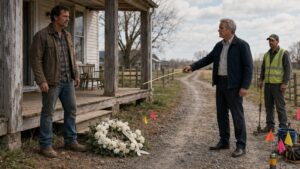
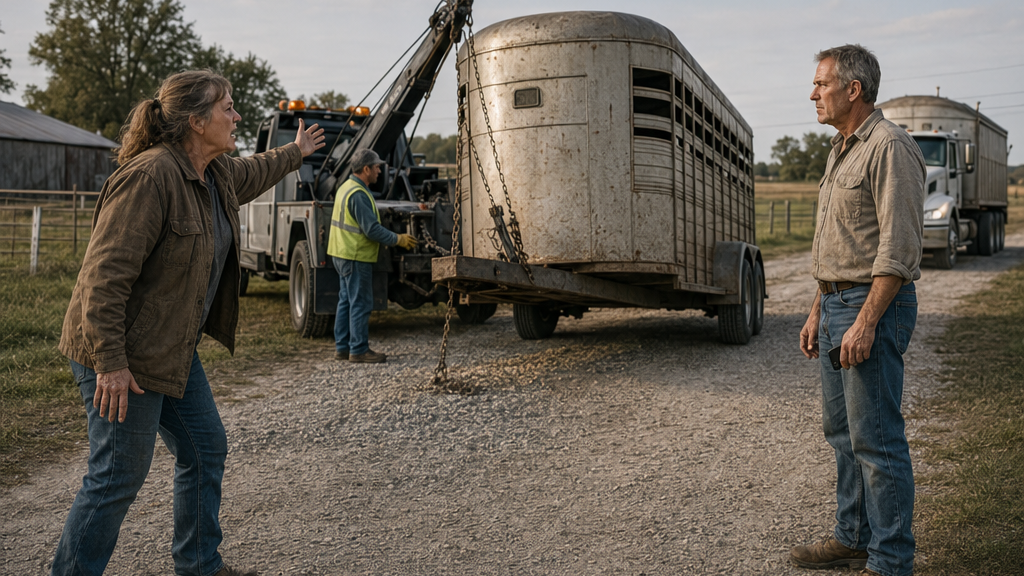
Thirty feet of weathered aluminum livestock trailer sat crosswise across the mouth of his farm lane, its rear wheels planted in the gravel and its hitch angled toward Nancy Lewis’s pasture. From Raymond’s porch, it looked less like something parked than something deliberately laid across the only way in or out.
He stopped with one boot on the bottom step.
Beyond the trailer, on the county road, a bulk feed truck had slowed nearly to a stop.
The driver tapped the horn once.
Raymond looked at his watch. Seven twenty-three.
The truck was supposed to have been at the bins by seven fifteen.
He walked down the lane without hurrying. The gravel beneath his boots was still ridged from the grading he had done two evenings before. Nancy’s trailer tires had cut diagonally through those ridges and flattened them into broad gray tracks.
The feed driver lowered his window.
“Morning, Raymond.”
“Morning.”
The driver nodded toward the trailer. “That yours?”
“No.”
“That what I was hoping you wouldn’t say.”
Raymond looked up and down the road. The shoulder dropped sharply on the south side into a drainage ditch. To the north, the road curved behind a stand of cottonwoods.
“You can back up a little,” Raymond said.
The driver leaned out far enough to study the curve behind him.
“Not with this rig. Not safely. Somebody comes around there, I’ve got nowhere to put forty thousand pounds.”
Raymond pressed his tongue against the back of his teeth.
This was the third time in nine days.
The first time, he had told himself it was careless.
The second time, rude.
By Saturday morning, he had run out of polite words for it.
Nancy’s house sat beyond the adjoining pasture, partly hidden by a windbreak. He could see her pickup near the barn, but no one was by the trailer.
The feed driver killed his engine.
The sudden quiet made the obstruction feel larger.
“I can wait a bit,” the driver said.
“You shouldn’t have to.”
Raymond took out his phone.
The trail camera he had mounted on a fence post three days earlier faced the entrance from chest height. He opened the app and scrolled backward.
At 6:41 that morning, Nancy’s pickup appeared towing the trailer.
At 6:43, she backed it across Raymond’s lane.
At 6:45, she disconnected.
At 6:47, she drove away.
Raymond watched the twenty-second clip twice.
There was no confusion in it. No mechanical problem. No moment where the trailer had slipped or been left during an emergency.
Nancy had positioned it carefully.
He saved the clip.
The feed driver watched him.
“Camera?”
“Yeah.”
“Good idea.”
Raymond almost laughed. He had resisted putting one there for years. His father had disliked cameras around the farm. Said if you needed one to know who was coming up your lane, you probably already knew too many people.
But his father had been gone six years.
And people had gotten comfortable with things Raymond never remembered agreeing to.
He called Nancy.
She answered on the fifth ring.
“What?”
“Your trailer’s across my lane.”
“I know where it is.”
“I’ve got feed sitting on the county road.”
A pause.
Then, “He can wait five minutes.”
Raymond looked at the silent feed truck.
“You said five minutes last time.”
“I’m loading calves.”
“You’re not loading them on my lane.”
“It’s the turnaround.”
“It’s my lane.”
Nancy exhaled sharply. “Raymond, we’ve been doing this longer than you’ve been running that place.”
He glanced toward the pasture separating their properties.
“You were told twice not to block it.”
“I am not blocking your farm. You’re standing right there.”
“The truck isn’t.”
“That’s not my problem.”
Raymond’s hand tightened around the phone.
He kept his voice level.
“It becomes your problem when you leave your trailer across my access.”
“You always make everything sound official.”
“No. I make it sound plain.”
Another pause.
Then Nancy said, “Your father never had a problem with us using that turnaround.”
Something in Raymond changed, though not in the way she probably intended.
Until that moment, he had treated her references to the past as the kind of rural shorthand people used when they wanted a favor without asking for one.
Your dad never minded.
We’ve always done it this way.
Everybody knows that corner is shared.
But she had never said it that directly before.
Raymond looked back up the lane.
The gravel road had been there before he was born. His father had kept it crowned and graveled every spring, hauled rock into the soft spots after storms, trimmed the shoulders, cleared snow before daylight if cattle trucks were expected.
Raymond had done the same after taking over.
He had never once heard his father call it shared.
“Nancy,” he said, “come move the trailer.”
“I’ll get to it.”
“When?”
“I said five minutes.”
“You said that forty minutes ago on Tuesday.”
“That was different.”
“How?”
She didn’t answer.
The feed driver climbed down from his cab and stretched beside the truck.
Raymond lowered his voice.
“You’ve got ten minutes.”
Nancy gave a short laugh.
“What are you going to do, Raymond?”
He looked at the trailer.
“I’m going to keep my lane open.”
She hung up.
For the next eleven minutes, nothing moved.
The feed driver walked to the road edge, studied the ditch, then came back.
“I can take the truck around and come again this afternoon.”
“You’ve got three more stops.”
“Four.”
Raymond nodded.
That made it worse.
This wasn’t just his morning being delayed. The driver’s route was slipping because Nancy had decided Raymond’s access could function as temporary storage.
A pickup approached from the east and slowed behind the feed truck. The driver raised two fingers from the wheel, then backed carefully into a field entrance and turned around.
Raymond felt heat rise in his face.
He checked his phone.
No call from Nancy.
At 7:51, she finally appeared across the pasture in her pickup.
She stopped on her side of the fence, got out, and walked toward the lane with the irritated stride of someone responding to a nuisance she had not caused.
“What is this?” she asked, looking at the feed truck.
“You know what it is.”
“You could have called me once.”
“I did.”
“Well, I was busy.”
“So am I.”
Nancy looked at the trailer, then at Raymond.
“I need that space for loading.”
“You need your space for loading.”
She folded her arms. “That turnaround has been used by both farms for years.”
“No.”
“Yes.”
“My lane comes off my deeded parcel.”
“That’s not what I said.”
Raymond stared at her.
Nancy continued, more quietly now.
“Your father let us use it.”
“For what?”
“For loading. Turning. Whatever we needed when our side was wet.”
“Whenever you wanted?”
“He never stood down here counting minutes.”
“That doesn’t answer me.”
Nancy’s jaw tightened.
“You think because he’s gone you get to rewrite everything?”
The words struck harder than Raymond expected.
Behind them, the feed truck’s engine started again.
The driver leaned out his window.
“I have to go, Raymond. I’ll call dispatch and see when I can swing back.”
Raymond stepped toward him.
“That’s on me.”
“No, it isn’t.”
But the truck pulled away anyway.
Raymond watched it disappear beyond the cottonwoods.
When he turned back, Nancy was already reaching for the trailer jack.
“Move it all the way onto your side,” he said.
She looked at him.
“I’m moving it.”
“Onto your property.”
“Don’t start.”
“I’m not starting anything.”
Nancy gave him a long look, then turned the jack handle.
The trailer tongue rose with a metallic clicking sound.
Raymond watched without helping.
That bothered him more than he expected.
His father would have stepped in automatically. Grabbed the coupler, guided the truck, probably made some dry remark to keep the argument from hardening.
Raymond stood with his hands at his sides.
Nancy backed her pickup under the hitch.
Before she climbed into the cab, she looked at him over the roof.
“You want to pretend this was never shared, fine.”
Raymond said nothing.
She opened the driver’s door.
Then she stopped.
“Ask anyone who knew your father.”
Chapter 2: Two Warnings and One Quiet Camera
Nine days earlier, Raymond had nearly missed a veterinarian appointment because Nancy’s trailer was parked in the same place.
That first morning, he had come out of the machine shed carrying a halter and found the trailer angled across the lane, one axle on his gravel and the other sitting in the grass beside the fence.
He had a yearling heifer separated in the small lot behind the barn, and the veterinarian was due in twenty minutes.
At first Raymond assumed Nancy was still attached to the trailer.
Then he saw the empty hitch.
Her pickup was gone.
He stood beside the coupler and called her.
“Morning,” Nancy said.
“Where are you?”
“Home.”
“Your trailer isn’t.”
A silence.
Then, as if she had just remembered it, “Oh. Right. I’ll move it.”
“I need the lane.”
“I’ll be there in five minutes.”
Raymond looked toward the county road.
“Nancy.”
“What?”
“Five minutes.”
“I heard you.”
She arrived forty-seven minutes later.
By then, the veterinarian’s truck had been forced to stop on the roadside while Raymond moved the heifer to another pen so they could work closer to the entrance.
Nancy climbed out of her pickup carrying a travel mug.
“Sorry,” she said, though she sounded more annoyed than apologetic. “Phone call ran long.”
Raymond pointed toward the trailer.
“That can’t happen again.”
“It won’t.”
“You blocked the only entrance.”
“I said I’m sorry.”
The veterinarian pretended to be checking something in the truck bed.
Raymond knew the performance. In a small county, people learned how to hear an argument without looking like they were listening.
Nancy hitched up and pulled the trailer away.
Raymond let the matter end there.
That was his mistake.
Not because he should have shouted or threatened her.
Because he should have asked the question he kept avoiding.
Why had she believed she could leave it there in the first place?
Instead, he went back to work.
Three days later, the trailer returned.
This time Raymond was greasing the mower in the machine shed when he heard diesel idle outside. By the time he stepped through the open door, Nancy’s pickup was already backing toward the turnaround.
He wiped his hands on a rag and walked down.
She saw him in her mirror.
The trailer kept coming.
“Nancy.”
She lowered the window.
“I’m just turning around.”
“Fine.”
She swung the trailer wide, using the gravel apron.
Raymond waited.
Then she stopped.
“What are you doing?”
“Leaving it here for a little while.”
“No.”
Nancy looked at him through the open window. “I’ve got groceries in the truck. I need to unload before I take the trailer down to the pasture.”
“Then take the trailer home first.”
“That makes no sense.”
“It makes more sense than blocking me.”
“You’re not going anywhere.”
Raymond stared at her.
Nancy gestured toward the machine shed.
“You’re working on the mower.”
“That doesn’t make the lane available.”
“I’m talking about twenty minutes.”
“The other day you said five.”
“That was one time.”
“And this is the second.”
Her expression changed slightly.
Not guilt.
Offense.
“You’re getting pretty particular about a piece of gravel.”
Raymond looked down at the lane.
The gravel had come from two quarry loads he had paid for that spring. Before spreading it, he had spent half a day cutting out the soft shoulder and rebuilding the crown so loaded trucks would stop washing the edges into the ditch.
“A piece of gravel keeps my farm accessible.”
“Your father never acted like this.”
There it was.
The first reference.
At the time, Raymond had dismissed it.
“My father isn’t standing here.”
“No. He isn’t.”
The way she said it made Raymond immediately regret his tone.
But he did not back away from the point.
“Move the trailer.”
Nancy shifted into drive.
“All right.”
She pulled ahead, then stopped again.
Raymond waited.
She looked back through the window.
“People around here used to help each other.”
Then she drove off.
The sentence stayed with him longer than he wanted.
By afternoon, Raymond had almost convinced himself that he had overreacted.
Almost.
Then the feed supplier called to confirm Saturday’s delivery.
Seven fifteen.
The driver would bring a large tandem-axle truck because Raymond had ordered enough feed to refill both bins before a run of hot weather.
Raymond pictured the trailer across the entrance again.
At four o’clock, he drove into town.
The farm supply store sold trail cameras in a locked glass case near the hunting section.
He bought a plain cellular model and a steel mounting bracket.
The clerk asked what he was watching.
“Gate.”
“Deer?”
“People.”
The clerk gave him a look that suggested people were generally the more troublesome species.
Raymond mounted the camera that evening on a fence post overlooking the lane.
He hated doing it.
Not because he thought Nancy had a right to privacy while using his property.
Because the camera felt like an admission that conversation had failed.
He adjusted the angle until the entire turnaround was visible.
Then he walked the lane before supper.
Fresh trailer tracks curved from Nancy’s side across his gravel and back again.
They were broad enough to erase the finer tread marks from his tractor.
He stood studying them.
His father had always said gravel told you who had been around.
Not poetically.
Practically.
A heavy axle pressed deeper.
A truck with low tire pressure rolled its shoulders.
A trailer under load cut harder on the outside wheel.
Raymond could look at the lane and know what had passed.
Now he wanted timestamps.
That bothered him too.
The following morning, he called the county recorder’s office.
He did not accuse Nancy of anything. He simply asked whether any recorded easement crossed his parcel near the entrance.
The clerk told him property research took time and that old access agreements were not always indexed the way people expected.
Raymond gave the parcel number.
Two hours later, someone called back.
No obvious easement appeared.
The answer gave him satisfaction for roughly thirty seconds.
Then he remembered Nancy saying, Your father never acted like this.
Recorded rights and old habits were not always the same thing.
He should have driven to Nancy’s house that evening.
He should have asked directly whether she believed some agreement existed.
Instead, he told himself he had already asked enough.
The lane was his.
The trailer was hers.
The solution seemed obvious.
Friday evening, Raymond stopped at the local fuel station on his way home. Two farmers were talking near the coffee counter.
One nodded toward Raymond.
“Heard Nancy’s running calves tomorrow.”
Raymond poured coffee into a paper cup.
“Looks that way.”
“She using the shared turnaround?”
Raymond stopped pouring.
“The what?”
The man glanced at him.
“Your entrance there. The wide spot.”
“Who calls it shared?”
A shrug.
“Nancy does.”
The second farmer looked suddenly interested in his coffee.
Raymond put the lid on his cup.
“What exactly has she said?”
“Nothing big. Just that her folks always had use of it.”
“Use isn’t ownership.”
“I didn’t say it was.”
Raymond carried the coffee to the counter without drinking it.
On the drive home, anger replaced doubt.
Not because somebody had called the turnaround shared.
Because Nancy had apparently been saying it when Raymond was not there to correct her.
He decided that if the trailer appeared again, he would not argue.
He had already spoken to a heavy-recovery operator he had used years earlier when a loaded grain wagon broke an axle. Michael Scott had been careful when Raymond explained the situation.
“Make sure it’s fully on your property,” Michael had said.
“It will be.”
“You have proof?”
“I will.”
“And make sure nobody’s inside it, no livestock aboard.”
“It’ll be empty.”
“Then call me if it happens. I’m not getting into a property feud, Raymond. I’ll move equipment if you can show me I’m authorized.”
That suited Raymond.
He did not want a feud.
He wanted the lane clear.
Before bed Friday, he checked the camera battery.
Full.
Signal good.
At 6:41 Saturday morning, his phone vibrated on the kitchen counter.
Motion detected.
Raymond opened the image.
Nancy’s livestock trailer filled the screen.
Chapter 3: When the Trailer Started Moving
Michael Scott’s recovery truck came around the cottonwoods at eight eighteen, amber lights flashing against the trees.
Nancy was nowhere in sight.
Raymond stood at the edge of the gravel lane holding his phone while Michael eased the truck through the entrance as far as the trailer would allow.
The feed truck had left twenty minutes earlier.
That was the part Raymond could not shake.
The blocked lane was no longer an argument between neighbors. A delivery route had been disrupted. The feed would have to come back when dispatch could fit him in, which might be that afternoon or Monday.
Michael shut off the truck and climbed down.
He was a compact man with gray beginning at his temples and the unhurried manner of someone who had spent years around machinery that punished haste.
“Show me where your line is.”
Raymond pointed to the fence corner and the survey pin set several feet inside the ditch.
“The whole gravel apron is mine.”
Michael looked at the trailer.
“And you’re certain she doesn’t have a recorded easement?”
“I called the county yesterday. They found nothing obvious tied to my parcel.”
“Nothing obvious isn’t the same as nothing.”
“I know.”
Michael studied Raymond for a second.
“You sure you want it moved?”
“Yes.”
That answer came quickly.
Too quickly, Raymond realized.
But he did not change it.
He showed Michael the trail-camera recording.
Michael watched Nancy back the trailer into place, disconnect, and leave.
“No livestock?”
“Empty.”
“Any keys?”
“No.”
Michael handed the phone back.
“All right.”
He positioned the recovery truck at an angle, extended the wheel-lift assembly, then began rigging the trailer tongue.
The metallic clank of chain against steel carried across the pasture.
Raymond felt a strange calm settle over him.
For nine days, the lane had been something Nancy could occupy and Raymond had to react to.
Now the machinery was changing the facts.
The trailer jack came off the gravel.
For the first time that morning, Raymond could see the crushed stone beneath it.
A strip of ordinary gray lane.
Nothing dramatic.
Yet the sight gave him more satisfaction than he expected.
Michael stopped the lift halfway.
“We’re going to pull it straight enough to clear your entrance, then I’ll take it to my secured lot until she sorts it out.”
Raymond nodded.
An engine sounded from Nancy’s side.
Her pickup crossed the pasture road fast enough to throw dust behind it.
Michael looked over.
“That her?”
“Yes.”
“Then you talk to her. I’m staying with the equipment.”
Nancy braked near the fence, climbed out, and left the driver’s door open.
“What are you doing?”
Raymond did not move.
“Clearing my lane.”
“You called a recovery truck?”
“I told you to move it.”
“I was moving cattle.”
“You left.”
“For half an hour.”
“The feed truck had to leave.”
Nancy looked past him at Michael.
“Put that down.”
Michael stayed beside the controls.
“You’ll need to talk to the property owner.”
“I’m talking to the property owner.”
Her face flushed.
“This trailer does not leave.”
Raymond said, “Then it shouldn’t have been left across my entrance.”
“You don’t get to steal my equipment because you’re mad.”
“Nobody’s stealing anything.”
“You called somebody to haul it away.”
“After two warnings.”
Nancy stepped toward him.
“This is ridiculous.”
“No. The ridiculous part was telling me five minutes and leaving it here long enough to cost another driver part of his route.”
“I told you why I needed the turnaround.”
“You told me you needed it. You never told me why you think you have a right to it.”
Nancy’s expression hardened.
“Because your father gave us the use of it.”
A pickup slowed on the county road.
Then another.
The first driver continued. The second pulled onto the shoulder farther down, someone inside apparently watching.
Raymond noticed and disliked it immediately.
He had not called anyone.
He did not want an audience.
Nancy noticed too.
Her voice dropped.
“You want to make a show out of this?”
“I want the lane open.”
“Then tell him to lower my trailer.”
“No.”
For a moment they stood facing each other with Michael behind them and the trailer tongue suspended waist-high.
Nancy looked older than she had a week before.
Not weaker.
Just tired in a way Raymond had not noticed when they were arguing.
Then she said, “Your father would be ashamed of this.”
Raymond felt the words land.
He answered slowly.
“My father would have moved the trailer himself.”
“He wouldn’t have needed to.”
“Why?”
“Because he understood the agreement.”
“What agreement?”
Nancy stared at him.
“The one you keep pretending never existed.”
“If there was an agreement, show it to me.”
“I shouldn’t have to.”
“That’s convenient.”
Her eyes narrowed.
“You think I invented thirty years because you got irritated over one trailer?”
“Three times.”
“You keep counting incidents. I’m talking about history.”
“And history doesn’t block a feed truck.”
Michael shifted his weight beside the controls but said nothing.
Raymond appreciated that.
He wanted no referee.
Nancy pointed down at the lane.
“This turnaround was used by both places before you ever took over.”
“Used doesn’t mean owned.”
“I never said owned.”
“You’re telling people it’s shared.”
Something flickered across her face.
Raymond saw it.
“So you did say it.”
Nancy looked toward the road.
“I said we’ve always had use of it.”
“That’s not the same thing.”
“No, Raymond, it isn’t. But you don’t seem interested in the difference.”
That stopped him.
Until then, he had assumed Nancy’s language was becoming more aggressive because she wanted to establish a claim.
But the way she said it suggested something else.
Not ownership.
Expectation.
Maybe even obligation.
Raymond looked toward the gravel turnaround.
He tried to remember his father ever mentioning the Lewis place in connection with access.
Nothing came immediately.
There had been neighbors borrowing gates, tractors, loaders, stock trailers, chains, pasture during dry spells. Rural life had been full of agreements nobody wrote down because nobody expected to need proof.
That was exactly what bothered him.
Michael cleared his throat.
“Raymond.”
He turned.
“If I’m moving this, I need the go-ahead now.”
Raymond looked at Nancy.
She did not plead.
That made it harder.
She stood with her arms at her sides, furious but composed.
He could stop it.
Tell Michael to drop the trailer.
Ask questions first.
It would cost nothing except another round of uncertainty.
Raymond pictured the feed truck disappearing down the county road.
He thought of Tuesday.
Friday.
Saturday.
His father’s name being used each time Raymond tried to set a boundary.
“Move it,” he said.
Nancy looked away.
Michael operated the controls.
The trailer rose another few inches, then shifted as the recovery truck pulled forward.
Its rear tires rolled over the gravel, exposing the flattened tracks beneath them.
The entrance opened foot by foot.
The sight should have felt like victory.
Instead, Raymond watched Nancy.
She stood very still.
Once the trailer was aligned behind the recovery truck, Michael secured the remaining chains.
A few minutes later, the rig eased onto the county road.
Nancy did not yell after it.
She watched until it disappeared around the curve.
The feed truck returned just before ten.
The driver leaned on the horn twice as he turned cleanly into the lane.
Raymond guided him toward the bins.
For twenty minutes there was only work: hoses connected, auger running, feed rattling into steel bins.
That sound steadied him.
This was what the lane was for.
Work.
Access.
Movement.
When the driver finished, he handed Raymond the delivery slip.
“Glad you got it sorted.”
Raymond looked toward the road.
“Not sure I did.”
The driver followed his gaze but did not ask.
After the truck left, Nancy was still standing near the fence.
Raymond walked toward her.
“You’ll have to call Michael about the trailer.”
“I know.”
“The recovery charge—”
“I know how towing works.”
Neither of them spoke for a moment.
Then Raymond said, “If you have proof of an agreement, bring it.”
Nancy looked at him.
“You already called the county, didn’t you?”
“Yes.”
“And they told you there’s no easement.”
“They didn’t find one.”
A bitter smile touched her mouth.
“So that was enough for you.”
“It’s my parcel.”
“I know whose parcel it is.”
“Then why are we doing this?”
Nancy looked down at the newly visible gravel.
“Because you think ownership answers every question.”
“And you think my father answers every question.”
“No.”
Her reply came quickly.
For the first time all morning, some of the anger left her face.
“I think your father answered one question a long time ago, and you never knew he did.”
Raymond said nothing.
Nancy walked back toward her pickup.
At the open door, she stopped.
“I still have what he wrote.”
Raymond felt the morning shift under him again.
Not legally.
Not physically.
Something less comfortable.
“You have a document?”
Nancy looked back.
“A note.”
“What does it say?”
She climbed into the truck.
“You wanted proof.”
The engine started.
“Come by Monday,” she said through the open window. “I’ll show you.”
Chapter 4: The Permission His Father Never Explained
“No recorded easement.”
Katherine Davis said it twice, the second time more slowly, as if Raymond might otherwise mistake the answer for something broader than it was.
He sat across from her desk in the county records office Monday morning with his parcel number written on the back of an old feed receipt. A monitor between them displayed a scanned plat of his farm and the Lewis property beside it.
Katherine tapped the screen.
“I checked the current deed, the prior deed, the transfer before that, and the easement index. Nothing recorded across this part of your parcel.”
Raymond leaned closer.
The farm looked strangely clean on a county map. Black boundary lines. Acreage figures. Road frontage. None of the mud, gates, broken fence staples, shallow drainage cuts, or years of maintenance that made those lines real.
He pointed to the widening just inside his entrance.
“That’s the turnaround.”
“I see it.”
“And nothing gives the Lewis property permanent use?”
“Nothing recorded that I found.”
Raymond sat back.
He had expected relief.
Instead he heard Nancy again.
I still have what he wrote.
Katherine watched him.
“You’re asking two different questions.”
“What two?”
“One is whether there’s a recorded property right. I can help you with that.” She moved the mouse and closed one file. “The other is whether your father gave somebody permission privately.”
Raymond folded the feed receipt.
“If he did, wouldn’t that be here?”
“Not necessarily.”
“That seems useful.”
She smiled faintly. “People don’t come to county offices because everything was documented perfectly.”
Raymond looked through the glass wall toward shelves of old record books.
“My father wasn’t careless.”
“I didn’t say he was.”
“No.”
Katherine waited.
Raymond realized he had answered too sharply.
He rubbed his thumb along the fold in the receipt.
“Sorry.”
She nodded once.
“If someone shows you a handwritten note, don’t assume it creates an easement just because it exists. And don’t assume it means nothing because it wasn’t recorded.”
“That sounds like a very county answer.”
“It is.”
By Tuesday afternoon, Nancy had not called.
Raymond nearly let himself believe she had changed her mind about showing him the note.
Then at four thirty her pickup came slowly up the county road and stopped outside his gate.
She did not pull into the lane.
That detail registered immediately.
Raymond was tightening a loose hinge on the gate when she got out carrying a clear plastic sleeve.
“You said bring proof.”
“I did.”
She held the sleeve out.
Raymond wiped his hand on his jeans before taking it.
Inside was a yellowed half sheet of paper folded twice. The handwriting on the front hit him before he understood the words.
His father’s.
The capital R leaned backward. The lower loops on the g’s were narrow and tall. Raymond had seen that hand on seed orders, repair lists, veterinary notes, and scraps left on the kitchen counter.
He slid the page carefully from the sleeve.
Nancy stayed near the road.
The note was brief.
It gave the Lewis family permission to use the east turnaround and lower farm entrance when needed for trailer turning and loading during harvest periods when their own approach was too wet or unsafe.
Raymond read it again.
There was no date of expiration.
There was also no word like permanent.
No statement that the lane was shared.
No right to leave equipment unattended.
He turned the page sideways, then back.
“This is real.”
Nancy gave him a tired look.
“You thought I forged it?”
“I didn’t know what you had.”
“You thought I had nothing.”
“That’s different.”
“Not from where I was standing Saturday.”
Raymond looked down at the note.
“Harvest periods.”
“Yes.”
“Not year-round.”
“We move cattle when we need to move cattle.”
“That isn’t what this says.”
“It says when our entrance was unsafe.”
“It says during harvest periods when your approach was too wet or unsafe.”
Nancy stepped closer.
“You want to argue over commas now?”
“I want to understand what was agreed.”
“No, Raymond. You want the paper to tell you exactly what you already decided.”
That landed too close to the truth.
He looked toward the lane.
Monday’s feed delivery had left fresh dual-wheel tracks running straight from the road toward his bins. The entrance was open now. Clear. Exactly what he had wanted.
But the note in his hand had made the gravel look different.
Not shared.
Not surrendered.
Used.
Allowed.
There was a difference, and Raymond was beginning to see that he had avoided learning it because uncertainty annoyed him more than conflict did.
“Why didn’t you show me this the first time?” he asked.
Nancy crossed her arms.
“Why didn’t you ask?”
“I did ask why you thought you could use the turnaround.”
“No. You told me to move.”
“That’s because you were blocking me.”
“And I was wrong to leave it there that long.”
Raymond looked at her.
It was the first clear admission she had made.
Nancy’s jaw tightened as though even that much had cost her.
“But you already knew what you wanted the answer to be,” she continued. “You wanted me to say I had no right at all.”
“You don’t have a right to block the lane.”
“That’s not what I said.”
He looked at the note again.
“I called the county.”
“I figured.”
“There’s no recorded easement.”
“I never said there was.”
“You told people the turnaround was shared.”
“I said we’ve always had use of it.”
“That sounds shared when you say it to somebody else.”
Nancy’s face hardened.
“Then maybe I said it badly.”
Raymond did not answer.
The concession surprised him more than her anger had.
He carried the note toward the porch, and Nancy followed as far as the bottom step.
Under better light, Raymond saw faint pencil marks on the paper. His father had sketched the two entrances: Raymond’s lane as a straight line from the county road, the Lewis entrance farther east, and a rough curved arrow showing how a trailer could swing through the widened gravel area.
The drawing made the arrangement practical rather than abstract.
A trailer entered.
Turned.
Left.
Nothing in the sketch suggested parking.
Raymond pointed.
“This is a turnaround.”
“I know.”
“Not a staging area.”
Nancy said nothing.
“You knew that.”
“Yes.”
The answer was quiet.
Raymond lowered the page.
“Then why leave the trailer there?”
“I told you. I was loading.”
“For nearly an hour the first time.”
“I made a mistake.”
“Three times?”
Nancy looked toward her property.
“What do you want me to say?”
“The truth would be useful.”
She turned back.
“I used more than the agreement allowed.”
Raymond waited.
“But the agreement existed,” she said.
“Yes.”
The word came harder than he expected.
“Yes, it did.”
Some of the fight left Nancy’s shoulders.
Raymond felt no victory in giving her that.
Only correction.
He turned the note over.
There, in his father’s handwriting, was a shorter line he had not noticed through the plastic sleeve.
Continue access after the barn fire. Same understanding until lower approach is repaired.
Raymond stared at it.
The words were darker than the writing on the front, as though added later with a different pen.
“What barn fire?”
Nancy looked at the paper.
For several seconds she said nothing.
Then she reached for the sleeve.
“Keep it tonight if you want.”
Raymond did not hand it back.
“What barn fire, Nancy?”
Her eyes met his.
“You really don’t know.”
“No.”
She looked past him toward the old barns.
One of them had been rebuilt before Raymond took over full-time. He remembered new rafters going in when he was young, remembered sheets of blackened metal stacked behind the machine shed, but he had never connected them to the Lewis family.
Nancy stepped back toward her pickup.
“Ask your father’s old papers before you ask me.”
“Why?”
“Because you’ll believe his version.”
She opened the truck door.
Raymond held up the note.
“What happened?”
Nancy paused with one hand on the door.
“Your father didn’t give us that turnaround because he was careless with his land.”
Then she got into the truck.
Raymond turned the note over again.
After the barn fire.
Three words had changed the question completely.
Chapter 5: The Debt Hidden Behind the Turnaround
The photograph was stuck to the bottom of an old file box.
Raymond found it Wednesday morning beneath canceled checks, seed invoices, and a stack of insurance papers brittle at the edges. When he pulled it free, a strip of brown cardboard came with it.
The picture showed the old north barn with half its roof gone.
Black rafters pointed into a pale sky. Two men stood near the doorway beside a tractor, their clothes dark with soot.
One was Raymond’s father.
The other was Nancy’s husband.
Raymond sat down on the basement step.
He remembered the barn after the fire, but not the fire itself. He had been away working equipment for another farm that summer, coming home mostly on Sundays. By the time he returned for good, repairs had already begun.
On the back of the photograph his father had written only a date and six words.
Got twenty-eight head out in time.
Raymond turned it over again.
Twenty-eight.
He knew the old barn layout. In a fast fire, cattle packed behind a closed interior gate could have been lost before anyone got a tractor close enough to pull panels loose.
He went through the box more carefully.
An insurance statement mentioned electrical damage.
A hardware receipt listed new gate hinges.
Then, folded inside a farm notebook, Raymond found another line in his father’s handwriting.
Lewis came before fire crew. Opened west pen. Saved cows and tractor.
Raymond leaned back against the basement wall.
For several minutes he listened to the furnace fan turn on and off.
The access note lay on the step beside him.
Until then, he had thought of it as evidence.
Now it looked more like repayment.
That afternoon he walked to the old barn site.
The structure there now was newer than the other buildings, though twenty-five years of weather had softened the difference. Near the west wall, two old hinge scars remained in a post his father had reused.
Raymond put his fingers against them.
He could imagine the gate there.
Smoke.
Cattle crowding.
Men working without time to negotiate who owed whom what.
He did not like where the thought led.
Not because Nancy was right about the trailer.
She wasn’t.
But because Raymond had spent nine days treating the conflict as if every inch of history began when the property came fully into his hands.
A truck door closed behind him.
Nancy stood near the fence.
“I saw you walking over.”
Raymond held up the photograph.
Her face changed.
Not dramatically.
Just enough.
“You found it.”
“I found some things.”
She came through the gate but stopped several feet away.
Raymond handed her the photograph.
Nancy looked at her husband for a long time.
“He ruined that shirt,” she said.
Raymond waited.
“He liked that shirt.”
Her thumb moved across the edge of the photograph.
“My father wrote that he got twenty-eight head out.”
Nancy nodded.
“He was first one here.”
“How?”
“Saw smoke from our place.”
Raymond glanced toward her house. From the upper pasture, the old barn roof would have been visible.
“He came alone?”
“At first. Your father was inside trying to get the main pen open.”
Raymond looked at the reused hinge post.
Nancy continued.
“The power had gone. Gate latch was hot. My husband backed your tractor through a panel and opened the west side.”
Raymond pictured the tractor in the photograph.
“He could’ve been hurt.”
“Yes.”
The word was flat, almost impatient.
“He was good at doing things before thinking about that.”
Raymond looked at her.
“He never talked about it?”
“Not much.”
“Neither did my father.”
“Maybe that’s why they got along.”
Despite himself, Raymond smiled.
Nancy handed the photograph back.
“The access came after?”
“Not right away.”
Raymond waited.
“The flood came two years later.”
She pointed toward her lower entrance.
“Creek backed through the ditch. Washed the approach down to the pipe. We couldn’t get a loaded trailer across it.”
“And my father gave you the turnaround.”
“He told us to use yours until we fixed ours.”
“During harvest.”
“At first.”
Raymond looked at the note in his hand.
“Then why the line about after the barn fire?”
Nancy’s expression tightened.
“Because when my husband tried to thank him for letting us use the lane, your father told him not to. Said he still owed him for the barn.”
There it was.
Not a legal right.
A debt between two men.
Raymond felt something uncomfortable loosen inside him.
His father had not surrendered the lane.
He had chosen to share it because somebody had once run toward smoke when he could have stayed home.
That mattered.
But so did what Nancy had done with the memory.
Raymond looked at her.
“Did your husband think this was permanent?”
Nancy studied the ground.
The pause told him before she did.
“No.”
Raymond said nothing.
“He thought we should ask if we needed it after our entrance was repaired.”
“So why didn’t you?”
“Because your father never made us.”
“That isn’t an answer.”
“It is. You just don’t like it.”
Raymond’s sympathy cooled.
“Nancy.”
She looked at him.
“You knew.”
“I knew what?”
“You knew your husband didn’t consider that note permission to use my lane whenever you wanted.”
Her mouth tightened.
“Yes.”
“And you still told me it had always been shared.”
“I told you we had always used it.”
“You knew what I heard.”
“You hear what you want when you’re angry.”
“And you say what helps you when you’re cornered.”
The words landed between them.
Nancy looked toward the county road.
Raymond regretted the sharpness but not the truth.
After a moment she said, “Maybe.”
It was not much of an apology.
It was enough to keep him listening.
Raymond folded the photograph into the notebook.
“I’m not pretending the history didn’t happen.”
“Good.”
“But the trailer stays off my lane.”
Nancy’s head turned.
“Raymond—”
“No unattended equipment. No blocking. No using the turnaround without asking.”
Her face closed again.
“You know I need it.”
“You haven’t told me why.”
“I told you how it started.”
“That was years ago. Your entrance has been repaired since.”
“It isn’t always usable.”
“Then fix it.”
Nancy gave a short, humorless laugh.
“You think I haven’t thought of that?”
“I think you’ve decided my lane is easier.”
“You don’t know what I’ve decided.”
“Because you don’t say it.”
She stepped back.
“And you don’t ask until after you call a recovery truck.”
That one was fair.
Raymond knew it immediately.
His own pride rose anyway.
“I warned you twice.”
“Yes.”
“And you blocked me a third time.”
“Yes.”
“Then don’t turn this into something I caused.”
“I’m not.”
“You are.”
Nancy stared at him.
Then she said, “Fine. No more use.”
Raymond had expected argument.
The quick surrender felt wrong.
“Nancy.”
“You wanted a line. There it is.”
“That isn’t what I said.”
“It’s what you meant.”
She started toward the gate.
Raymond followed a few steps.
“If you have an actual access problem, tell me.”
She turned.
“I just did.”
“No. You told me an old story.”
Her expression hardened.
“That story is the reason you have twenty-eight more cattle in a photograph instead of twenty-eight dead ones.”
Raymond stopped.
Nancy immediately looked as if she wished she could take the sentence back.
But she didn’t.
She went through the gate and closed it behind her.
Raymond stayed beside the barn.
For the rest of the afternoon he worked alone.
Near six, he drove the tractor down to check a section of fence by the road. From the higher ground, he could see Nancy’s entrance clearly.
Her gravel approach looked normal from a distance.
Then the low sun caught a raw strip of soil beside the culvert.
Raymond slowed.
A section of the shoulder had collapsed.
Fresh erosion ran down the edge where the culvert pipe disappeared beneath the drive.
He shut off the tractor.
From where he sat, he could see two new tire marks bending away from the soft edge.
One of them had slid several inches toward the ditch.
Raymond looked from Nancy’s damaged approach to his own wide, firm gravel turnaround.
For the first time, her insistence stopped looking merely convenient.
Chapter 6: What Nancy Would Not Admit About Her Gate
The trailer wheel dropped six inches with a sound like a shovel striking an empty drum.
Raymond heard Nancy shout from across the fence.
He was halfway through checking a water trough Thursday morning when he looked toward the road and saw a livestock trailer tilted sharply at Nancy’s entrance.
One rear tire had broken through the crumbling edge of the approach.
The pickup pulling it stopped immediately.
For several seconds nothing moved.
Then Raymond climbed the fence.
Nancy was already crouched near the wheel when he reached her.
“Don’t come any closer,” she said.
“I’m looking.”
“I know what happened.”
The edge of the culvert had collapsed beneath the trailer tire. The wheel had not fallen into the ditch, but another foot of movement could put the axle against the bank.
Raymond studied the load.
“Cattle?”
“Four.”
He could hear them shifting inside.
“Don’t move the truck.”
“I wasn’t planning to.”
Nancy stood.
Her face was pale with anger, though Raymond could not tell whether it was directed at him, herself, or the ground.
“This is why,” he said.
She looked away.
“This is why you’ve been using my lane.”
“I told you my entrance wasn’t always safe.”
“You never said this.”
“You never needed to know.”
“My feed truck got turned away because of this.”
Nancy’s eyes flashed.
“I know.”
“Michael hauled your trailer because of this.”
“I know.”
“You could’ve told me.”
“And said what?”
“The truth.”
She laughed once.
“Easy word when it isn’t your bill.”
Raymond looked down at the broken approach.
The culvert pipe itself was old but intact. The fill around it had washed away along one side. Stone had settled. The outer edge no longer had enough support for a loaded trailer.
“How long?”
Nancy said nothing.
“How long has it been like this?”
“A while.”
“How long?”
“Spring.”
Raymond stared at her.
“This spring?”
“Yes.”
“You’ve known for months?”
“I’ve been watching it.”
“That isn’t fixing it.”
“I know that.”
The sharpness in her voice silenced him.
Nancy rubbed both hands over her face.
“I had somebody price it.”
Raymond waited.
“Pipe, excavation, stone, widening the approach. More if they find the base washed out.”
“And?”
“And I don’t have it.”
The admission came almost under her breath.
Raymond looked toward her pasture.
He knew cattle prices. Hay costs. Fuel. Vet bills. He also knew the way people in the county could own land worth more than they would ever see in cash and still hesitate over a repair that required five figures at once.
“You could’ve asked me for temporary access.”
Nancy’s mouth tightened.
“I had temporary access.”
“You had an old note.”
“I had thirty years of nobody objecting.”
“My father objected to leaving trailers there.”
“Sometimes.”
“So you knew.”
“Yes.”
Raymond shook his head.
“Why make this harder than it had to be?”
Nancy looked at him then.
“Because I did not want to come to you and say I couldn’t afford my own gate.”
The answer was so plain that Raymond had nothing ready for it.
Nancy continued before he could speak.
“My husband handled things like that. Culverts. Fences. Equipment deals. If something broke, he found a way.”
Her eyes moved toward the pasture.
“He’s not here.”
Raymond said nothing.
“I’ve sold six cows already this year. Feed went up. The vet bill in March was worse than I expected. Then the contractor gave me the estimate.”
“You could’ve told me.”
“And listen to you explain property lines?”
“That’s unfair.”
“Yes.”
She looked at him.
“So was what I did.”
The cattle shifted again inside the trailer.
One hoof struck the floor.
The practical problem returned.
Raymond walked around the pickup.
“You have another tractor?”
“Not heavy enough.”
“We need to unload the pressure on that wheel.”
Nancy glanced at him.
“You helping me?”
“I’m helping the cattle.”
“Of course.”
“Don’t start.”
Something almost like a smile appeared and disappeared.
Raymond went back for his tractor and a length of chain. They worked without much conversation. He pulled lightly from solid ground while the pickup eased forward. The trapped wheel climbed out of the broken edge and returned to the center of the approach.
Once the trailer was stable, Nancy shut off her truck.
Neither of them spoke for a moment.
Raymond looked at the culvert.
Then across the fence at his own lane.
The contrast was almost irritating in its simplicity.
His entrance was wide, crowned, graveled, maintained.
Hers was failing.
That explained the pressure.
It did not excuse what she had done with it.
“You still owe Michael,” Raymond said.
Nancy’s face tightened.
“I know.”
“And the feed delivery delay.”
“I know.”
“I’m not pretending those didn’t happen because your culvert’s bad.”
“I didn’t ask you to.”
“No. You didn’t ask me anything.”
She looked at him.
Raymond heard his own words.
The accusation applied in both directions.
He had not asked either.
He had waited until resentment became certainty, then treated certainty as information.
He rubbed the back of his neck.
“When’s the next pickup?”
Nancy hesitated.
“Saturday week.”
“Loaded?”
“Yes.”
“How many?”
“Probably seven.”
“That approach won’t hold it.”
“I know.”
Raymond looked at the broken stone.
“You have an estimate?”
“At the house.”
“Bring it over tonight.”
Her expression changed immediately.
“I’m not asking you to pay for it.”
“I didn’t say I would.”
“Then why do you need the estimate?”
“I want to see what actually needs doing.”
“I know what needs doing.”
“So do I. Your entrance needs repaired.”
Nancy folded her arms.
“And until then?”
Raymond looked across at his lane.
The answer he would have given three days earlier was simple.
Not my problem.
It still tempted him.
The recovery truck had been justified. Nancy had ignored two warnings. She had exaggerated the old arrangement and allowed people to believe the turnaround was shared.
Nothing Raymond had learned erased that.
But the same history that did not give Nancy ownership also made complete refusal feel smaller than he wanted to be.
“I’ll think about it.”
Nancy gave him a skeptical look.
“That sounds dangerous.”
“Bring the estimate.”
That evening she left a folded contractor quote on Raymond’s porch.
No conversation.
No note.
Raymond carried it to the kitchen table.
He read the scope twice.
New culvert.
Excavation.
Stone base.
Widened entrance.
Drainage shaping.
The number at the bottom was high enough to explain Nancy’s silence without making that silence right.
Raymond set the quote beside his father’s old permission note.
For a while he looked at both pieces of paper.
One represented a favor nobody had clearly ended.
The other represented a problem nobody had clearly admitted.
He opened a drawer and took out a blank sheet.
At the top he wrote Temporary Farm Access Agreement.
Then he stopped.
The old version of himself wanted one sentence.
No use permitted.
The man his father had been might have written something entirely different and trusted a handshake to carry the rest.
Raymond no longer trusted either extreme.
He began again.
Access by prior arrangement only.
No unattended trailers.
No obstruction of deliveries, livestock movement, or emergency access.
Temporary permission ending upon repair of the Lewis entrance.
He left space beneath it.
Not because he was giving the lane away.
Because for the first time, he understood that saying yes carefully could protect a boundary just as surely as saying no.
On the other side of the dark kitchen window, the lane disappeared toward the county road.
Raymond laid his pen beside the unfinished agreement.
Saturday week was coming.
Chapter 7: A Clear Lane and Terms Both Could Keep
Nancy’s trailer was waiting beside her own gate when Raymond came down the lane Saturday morning.
It was not touching his gravel.
The pickup and trailer sat entirely on the Lewis property, straight and motionless, with seven cattle shifting behind the aluminum slats. Nancy stood by the driver’s door with a paper cup in one hand.
She had arrived early.
More importantly, she had not assumed anything.
Raymond slowed his tractor and looked from the trailer to his entrance.
Two weeks earlier, he would have expected to find the rig crosswise over the turnaround before sunrise.
Today the lane was empty from the county road to the machine shed.
Nancy raised one hand.
Raymond shut off the tractor.
“You waiting on me?” he asked.
“You said you were thinking.”
“I was.”
“The buyer’s truck will be here at eight.”
Raymond checked his watch.
Seven twenty-six.
“And if I say no?”
Nancy looked toward her damaged culvert.
“Then we figure out another way.”
No accusation followed.
No mention of his father.
That mattered.
Raymond climbed down.
“I have something in the house.”
Nancy gave him a cautious look.
“That usually isn’t how good conversations start.”
“It’s paper.”
“That makes it worse.”
He almost smiled.
“Come on.”
They sat at opposite ends of Raymond’s kitchen table.
Between them lay three things: the contractor’s estimate for Nancy’s culvert, his father’s old handwritten permission, and the agreement Raymond had rewritten six times.
He pushed the new document toward her.
Nancy did not touch it immediately.
“What is it?”
“Temporary access.”
Her eyes lifted.
“Read it.”
She did.
Raymond watched her move down the page.
Permission to use the east turnaround for scheduled livestock movements while the Lewis entrance remained unsafe.
Advance notice whenever reasonably possible.
No unattended trailers.
No parking or staging across Raymond’s lane.
No interference with feed deliveries, livestock movement, equipment access, or emergency vehicles.
Permission could be suspended if those conditions were ignored.
The arrangement would end when Nancy’s culvert and entrance were repaired.
At the bottom Raymond had added one final sentence.
Temporary permission does not create permanent access or ownership rights.
Nancy tapped that line.
“You really wanted that one in there.”
“Yes.”
“At least you’re consistent.”
“I’m trying to be clear.”
She read the page again.
“And if I need through unexpectedly?”
“Call.”
“What if you don’t answer?”
“If it’s genuinely urgent, use it and tell me as soon as you can.”
Nancy looked up.
Raymond continued before she could misunderstand.
“Urgent means an animal problem, equipment trouble, something like that. It doesn’t mean you don’t feel like making the turn at your place.”
“I know what urgent means.”
“Good.”
She leaned back.
“What do you want for it?”
“Nothing.”
Nancy’s eyes narrowed.
“Raymond.”
“The lane isn’t for rent.”
“I’m not taking charity.”
“It’s not charity.”
“What would you call it?”
He looked at his father’s note.
“A temporary solution.”
“That sounds suspiciously like charity with paperwork.”
Raymond folded his hands.
“Your husband helped my father when the barn burned.”
Her expression changed.
“I’m not paying a debt that belongs to two dead men,” he said. “And you don’t get permanent rights because of it.”
Nancy said nothing.
“But pretending it meant nothing would be just as dishonest.”
He tapped the new agreement.
“This is what I can live with.”
Nancy looked toward the window.
Outside, the lane curved past the barn, fresh gravel catching the morning light.
“You know,” she said, “your father never made us sign anything.”
“That was his mistake.”
Her eyes came back to him.
Raymond expected anger.
Instead Nancy laughed.
Only once.
“You’d have hated hearing yourself say that ten years ago.”
“Probably.”
“And he would’ve argued with you.”
“Definitely.”
The amusement faded.
Nancy reached into her jacket pocket and placed an envelope on the table.
“What’s that?”
“Michael’s recovery charge.”
Raymond did not touch it.
“You paid him?”
“I paid him when I got the trailer.”
“Then what’s this?”
“Your feed supplier charged for the failed delivery.”
Raymond looked at the envelope.
“They rolled part of it into the next invoice.”
“I called.”
He frowned.
“You called my feed company?”
“I asked what the wasted trip cost. I didn’t ask about your account.”
“That’s still my bill.”
“It became my bill when my trailer sent him away.”
Raymond opened the envelope.
The amount matched the added delivery charge exactly.
He slid it halfway back.
Nancy stopped it with two fingers.
“No.”
“You don’t have money for a culvert.”
“I have enough to pay for something I caused.”
“That repair is more important.”
“So is this.”
There was pride in her voice, but not the kind that had made her hide the failing entrance.
This time it was attached to responsibility.
Raymond took his hand off the envelope.
“All right.”
Nancy picked up the access agreement.
“I want one change.”
“What?”
“If the repair contractor needs to cross your corner while they’re working, I need to be able to ask.”
“That’s asking, not assuming.”
“So yes?”
“If it prevents them tearing up more of your ditch, yes.”
She nodded.
Raymond wrote the addition in the margin. They both initialed it.
Then Nancy signed.
Raymond signed beneath her.
For a moment the scratching of the pen was the only sound in the kitchen.
Nancy studied his signature.
“Your handwriting’s worse than your father’s.”
“That isn’t legally relevant.”
“Ask Katherine.”
Raymond smiled despite himself.
They went outside together.
The livestock buyer’s truck appeared at eight exactly.
Nancy opened her gate, then walked to Raymond’s entrance rather than pulling forward.
“You ready?”
Raymond looked down the lane.
No feed truck was scheduled. No equipment stood near the entrance. The cattle in Nancy’s trailer were calm.
He opened the gate wider.
“Bring it through.”
Nancy climbed into her pickup.
The trailer rolled onto Raymond’s gravel.
Its tires followed almost the same arc the trail camera had recorded weeks before, but this time nothing about the movement felt stolen.
Nancy turned carefully in the widened area, straightened the rig, and continued toward the loading point.
She never stopped across the lane.
The buyer’s truck entered behind her without waiting on the county road.
Raymond stood beside the gate and watched both vehicles pass.
The gravel still belonged to him.
That fact had not changed.
What had changed was that permission had become a choice again.
Later, after the cattle were transferred, Nancy walked back carrying her copy of the agreement in a clear plastic sleeve.
“Contractor says three weeks if the weather holds,” she said.
“For the culvert?”
“Yes. I’m selling another pair of cows to cover the difference.”
Raymond nodded.
He knew better than to tell her whether that was the right decision.
“You’ll have your own entrance back.”
“I already have my own entrance.”
“You know what I mean.”
“I do.”
She looked toward the trail camera on the fence post.
“You keeping that?”
“Yes.”
“Figured.”
Raymond had once attached a small temporary marker beneath it to make the camera impossible to miss. After Nancy left, he walked over with a screwdriver.
He removed the marker.
The camera stayed.
Not because he expected Nancy to block him again.
Because clear boundaries did not require forgetting what had happened.
He put the screwdriver in his pocket and looked down at the lane.
Fresh tire tracks crossed the gravel where Nancy’s trailer had turned that morning. Unlike the old tracks, they did not end beneath abandoned equipment. They curved through the turnaround and continued on.
His father had once allowed the same movement without needing a contract.
Raymond understood now why.
He also understood why he could not simply copy him.
Different people. Different years. Different pressures.
The lesson was not that his father had always said yes.
It was that the lane had remained his father’s to say yes to.
Raymond closed the gate until the latch caught.
Across the fence, Nancy’s pickup moved slowly toward home with the empty trailer behind it.
When she reached her damaged entrance, she did not attempt to cross it. She continued to the temporary route they had agreed on, raised a hand through the window, and waited.
Raymond raised his hand back.
Then he opened the gate.
The story has ended.