Eleven Days After His Father’s Funeral, They Ordered Him to Tear Up the Road His Family Built
Chapter 1: Eleven Days After the Funeral, Survey Flags Appeared
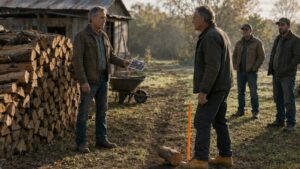
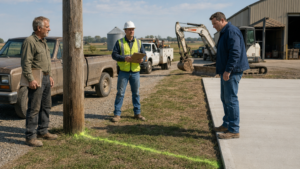
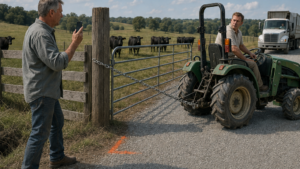
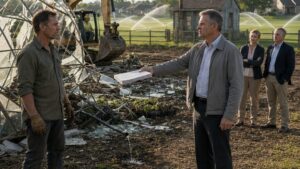
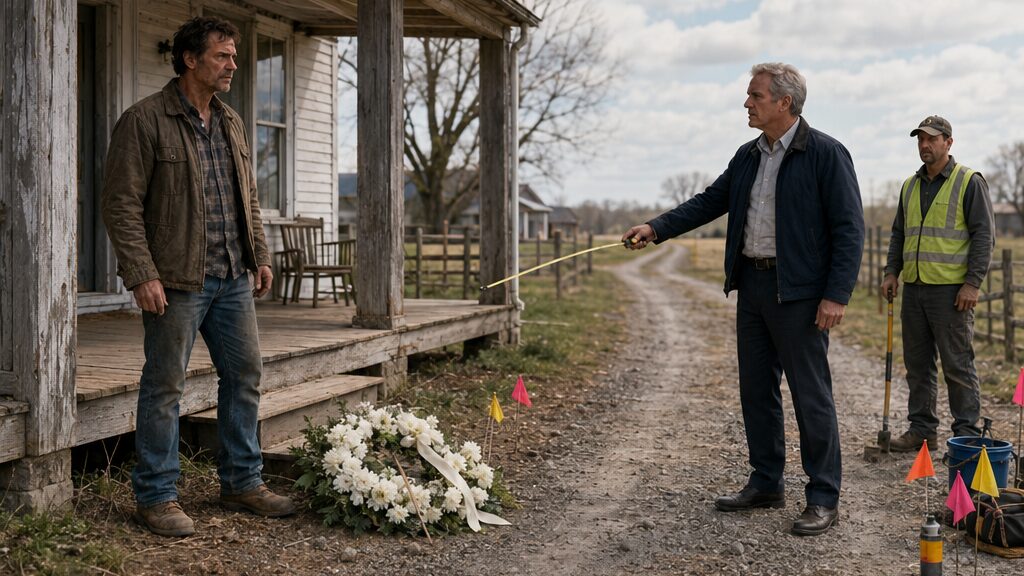
The first orange flag was six feet from Mark Hall’s front step.
He stopped with one boot on the porch and stared at it, then at the second flag farther down the gravel lane, then at the man kneeling beside it with a measuring wheel.
Beyond him stood Gregory White.
Gregory wore a white polo, pale trousers, and shoes that had somehow stayed clean despite the dust. His dark SUV sat half on the shoulder where Daniel Hall used to park the hay wagon during repairs.
Mark looked at the measuring wheel again.
“What are you doing?”
The contractor straightened but did not answer.
Gregory did.
“Mark. I was hoping we could get this handled without another argument.”
“Another argument?”
“With your father.”
Mark felt the words land harder than Gregory seemed to intend.
Daniel had been dead eleven days.
The casseroles from the funeral were still stacked in foil pans inside the refrigerator. Three sympathy cards stood unopened on the kitchen counter. On the porch, a white wreath from the funeral home hung crookedly from a nail because Mark had not decided what a person was supposed to do with a funeral wreath when the funeral was over but the death wasn’t.
Gregory pointed toward the lane.
“We’re marking the proposed relocation.”
“You’re marking my driveway.”
“The portion that crosses toward our entrance.”
Mark stepped off the porch.
The gravel had looked bad even when he was a boy. In spring it turned gray-brown and soft at the edges. In August it powdered passing trucks. Daniel patched potholes with whatever stone the quarry had cheapest and never seemed concerned that the surface changed color every hundred feet.
Mark had spent years being embarrassed by it.
Now someone else calling it a problem irritated him.
“When did I agree to relocate anything?”
“You didn’t. Your father wouldn’t either.”
Gregory said it with the exhausted certainty of a man who had repeated the sentence many times.
The contractor looked between them.
Gregory continued. “I sent Daniel proposals. I offered to discuss paving. I offered to split the work. Every conversation ended the same way.”
Mark folded his arms.
“He’s not here.”
“I’m aware.”
Something in the flatness of Gregory’s reply sharpened the air.
Mark said, “Then you should also be aware that this is a bad week to show up with stakes.”
“It has been a bad week for years.”
The contractor lowered his eyes.
Gregory exhaled through his nose and pointed uphill, where his own driveway branched toward the newer house beyond the trees.
“That road drains badly. It looks neglected. It affects our entrance, and we’ve been dealing with it since before you started coming back for holidays.”
“I grew up here.”
“And then you left.”
Mark took another step.
Gregory did not retreat.
There it was—the thing beneath the road.
Mark had left. Daniel had stayed. Gregory knew it. Everybody within five miles probably knew it.
Mark looked toward the first orange flag.
“What happens if I pull these out?”
“They get put back.”
“What happens if I tell him to leave?”
Gregory glanced at the contractor.
“He leaves today.”
“Good.”
“But the issue doesn’t.”
The contractor began gathering his wheel.
Gregory walked toward the porch, studying the line between the porch rail and the edge of the lane.
“One measurement is still off.”
He reached toward the white wreath.
Mark’s voice changed.
“Don’t.”
Gregory paused, hand on the wire frame.
“It’s blocking the sight line.”
“That was on my father’s casket.”
Gregory’s expression shifted, but only slightly.
Then he lifted the wreath from the nail anyway.
Perhaps he meant only to set it aside. Perhaps he was annoyed that Mark had turned an object into a boundary neither of them could cross.
The bottom of the wreath caught the porch rail.
The wire twisted.
It slipped from Gregory’s hand and dropped into the gravel.
White artificial lilies bent against the stones.
Nobody moved.
The contractor stopped beside his truck.
Mark stared down at the wreath.
For one bright second he imagined shoving Gregory backward.
He could almost feel it: both hands against the white polo, Gregory stumbling into the road, the clean trousers finally covered in the same dust he hated.
Instead Mark bent down.
He lifted the wreath carefully. Gravel spilled from the plastic greenery.
He straightened the bent lilies with his thumb.
Then he hung it back on the nail.
Gregory said, quieter, “That wasn’t intentional.”
Mark turned toward the contractor.
“No work starts on this property until I know exactly who owns what and who has what right.”
The contractor nodded once.
Gregory’s jaw tightened.
“We know who has what right.”
“You know what you believe.”
“My attorney has reviewed the parcels.”
“Good.”
Mark looked at the orange flags.
“Then mine can too.”
It was a bluff. Mark did not have an attorney. He barely had a plan for what to do with Daniel’s tractor, much less the property.
Gregory seemed to know it.
“You told the funeral-home driver you were probably selling.”
Mark’s face hardened.
“That’s none of your business.”
“It becomes my business when the condition of this place affects mine.”
Mark took in the clipped lawn rising toward Gregory’s house, the stone entrance columns, the dark SUV, the immaculate polo.
Then he looked at Daniel’s shed with its sagging door and coffee can full of rusty bolts.
For years Mark had seen the same difference Gregory saw.
That was what made the insult difficult to reject completely.
The place did need work.
The lane did wash out.
Daniel had refused help simply because the wrong person offered it more than once.
But none of that gave Gregory the right to stand beside Daniel’s funeral wreath and behave as if eleven days were enough time for ownership to become obedience.
Gregory stepped toward his vehicle.
“You’ll hear from my attorney.”
“Then I’ll read whatever he sends.”
“You have thirty days before this gets expensive.”
Mark said nothing.
Gregory drove away first. The contractor followed.
The orange flags remained.
Mark stood alone beside the road.
A pair of old tire grooves curved along the gravel, passing the shed before climbing toward the fork between the two properties. He remembered Daniel driving that route with one elbow hanging out the truck window, never slowing for potholes because he knew where every one of them was.
Mark had hated that truck.
He had hated this road.
He had hated arguing with his father about why a man pushing seventy should keep fighting to maintain land no son seemed interested in farming.
Three months earlier, their last real conversation had ended with Mark saying, “You’re protecting dirt like it cares whether you’re alive.”
Daniel had hung up.
They had spoken twice afterward, briefly.
Neither mentioned it.
That afternoon Mark pulled none of the flags.
At four thirty, a delivery vehicle stopped beside the mailbox.
The driver walked a large envelope to the porch and asked Mark to sign.
The return address belonged to a law office.
Inside was a formal demand on behalf of Gregory and Debra White.
Mark read it standing beside the wreath.
The document described the gravel lane as deteriorated, visually detrimental, inadequately maintained, and subject to removal or relocation. It demanded written compliance within thirty days.
Attached behind it was another document.
A release.
There was a signature line for Mark Hall.
If he signed, the dispute could apparently end without court.
Mark looked from the empty line to the orange flags marching down his father’s road.
For the first time, he wondered whether Gregory had arrived so quickly because he believed Mark would sign before learning what Daniel had refused to give up.
Chapter 2: The Road His Father Refused to Explain
The unsigned road proposal was underneath a box of funeral receipts.
Mark found it the next morning while searching Daniel’s desk for the deed.
It was four years old.
The paper showed a neat curved line abandoning the existing gravel lane near the shed and cutting across the lower edge of the field before climbing toward the White property.
At the bottom was a blank signature line.
Daniel Hall had never signed it.
Mark placed Gregory’s new release beside the older proposal.
The legal language differed, but the shape of the road was nearly identical.
He sat back in Daniel’s chair.
On the wall above the desk hung a calendar still turned to the month Daniel died. A hardware-store receipt had been tucked beneath one corner. Mark pulled it free without thinking.
Culvert pipe.
Three bags of cold patch.
Two tons crushed limestone.
Bought seven months earlier.
He looked toward the window.
From the desk he could see the lane.
Daniel had spent money on the road even near the end.
Just apparently not enough to satisfy Gregory.
Mark carried both documents outside.
The orange survey flags had begun to bother him more than the potholes.
They suggested somebody had already made a decision.
He walked the lane slowly, following the proposed reroute with his eyes.
It would leave the existing road just beyond the shed, pass through a low strip of field, and reconnect farther uphill.
Mark remembered that low ground.
As a boy he had lost one boot there during spring thaw and walked home with mud to his knee. Daniel had laughed until he saw Mark’s face, then carried him the last hundred yards.
Near the fork, Mark crouched and touched the gravel.
Some sections were pale limestone. Others were reddish quarry rock. A darker patch contained small black chips from old asphalt.
Forty years of repairs layered over one another.
A pickup slowed on the county road.
The driver, a neighboring farmer Mark recognized but could not immediately place, leaned out his window.
“You selling?”
“Everybody know that already?”
“Your dad told everybody you weren’t.”
Mark nearly laughed.
“That sounds like him.”
The farmer nodded toward the flags.
“White finally getting his new road?”
“He thinks so.”
“That argument still going?”
Mark straightened.
“How long was it going?”
The farmer gave him a puzzled look.
“Long as White’s been up there.”
“He says this is basically his entrance.”
The farmer looked at the lane, then back at Mark.
“Well, it’s his entrance. It ain’t only his road.”
Mark said nothing.
The farmer pointed toward the fork.
“Before that big house was there, the old place uphill used this same track. Milk truck used it. Feed truck. Your granddad let them through. White bought the parcel with access already coming this way.”
“You know that for sure?”
“I know what wheels I followed.”
“That’s not the same as what’s recorded.”
“Nope.”
The farmer tapped the side of his door.
“That’s what the courthouse is for.”
He drove on.
Mark remained beside the fork.
For the first time, he noticed how the deepest tire tracks did not end at Daniel’s shed or fields. They continued uphill.
Gregory’s vehicles had been using the same gravel he wanted changed.
Back in the house, Mark read the new release more carefully.
He had skimmed it the night before with the tired assumption that a lawyer’s document must describe something already established.
Now certain phrases looked different.
Relinquish.
Waive.
Future claims.
Access rights.
He read the paragraph twice.
The document did not merely ask permission to move gravel.
It asked Mark to release any rights the Hall parcel might have in the existing route.
His stomach tightened.
Yesterday, before Gregory dropped the wreath, Mark might have signed it.
That truth embarrassed him more than Gregory’s insult.
He had come to the farm intending to close accounts, sell machinery, call an agent, and leave. Every old object seemed like another task Daniel had handed him by dying.
The broken fence latch.
The stained ceiling.
The tractor with a slow hydraulic leak.
The road.
Mark had mistaken wanting to escape responsibility for knowing what responsibility actually was.
He went to the shed.
Daniel had organized almost nothing except fasteners. Coffee cans were labeled by size in thick black marker. Everything else existed in piles.
Mark searched a metal cabinet near the workbench.
He found tax receipts, seed invoices, and two more copies of road proposals.
One contained a handwritten note in Daniel’s blocky printing.
NO.
Nothing else.
Mark stared at it.
“Helpful as always.”
His voice sounded strange in the empty shed.
For a moment, anger returned with surprising force.
Daniel could have explained.
He could have left a folder marked ROAD.
He could have told Mark why Gregory’s proposals mattered instead of treating every question as a challenge.
Years earlier Mark had asked why he would not just pave the entrance.
Daniel had answered, “Because it isn’t that simple.”
That had been the whole explanation.
Not that simple.
Daniel’s favorite shield.
Mark took the papers outside.
The wreath was visible from the shed door.
One side sagged where the wire had bent.
Mark went to straighten it again but stopped halfway.
He was tired of tending symbols while ignoring facts.
Instead, he called the phone number on the legal demand.
Gregory answered.
“You get the papers?”
“I did.”
“Then you understand we’re serious.”
“I understand you want me to sign away rights you haven’t explained.”
Silence.
Then Gregory said, “Your father understood the issue.”
“I’m asking you.”
“The current lane doesn’t meet what we need.”
“That’s not what I asked.”
Another silence.
Gregory’s voice cooled.
“If you want legal interpretation, hire counsel.”
Mark looked uphill.
“I think I’ll start with the county.”
“You can waste time wherever you want.”
Mark almost answered.
Then Gregory added, “Your father did.”
The line went dead.
Mark lowered the phone.
The old anger toward Daniel returned, but now it had company.
Suspicion.
By noon he had the deed, the unsigned release, and every road proposal he could find stacked on the passenger seat of Daniel’s truck.
He hesitated before starting the engine.
Daniel’s keys still carried the small brass tag from the farm co-op. Mark had used them only once since the funeral.
The engine coughed twice, then caught.
He backed down the gravel lane slowly.
The orange flags passed his window one by one.
At the fork he stopped and looked at the tire grooves continuing uphill toward the White property.
If Gregory was right, the county records would show it.
If Daniel was right, Mark wanted to know something his father had apparently never figured out how to say.
He turned onto the county road and drove toward the courthouse with the unsigned release on the seat beside him.
Chapter 3: A Faded Line Across the 1962 Plat
Kathleen Rivera laid the 1962 plat on the counter and said, “That line shouldn’t disappear.”
Mark leaned closer.
The map was yellowed at the folds and smelled faintly of paper dust. Parcel boundaries had been drawn in black ink, with measurements written at angles that forced him to turn his head.
A faint dashed line crossed the Hall property.
Then it continued toward the land now owned by Gregory and Debra White.
Mark pointed.
“That’s the road?”
Kathleen adjusted her glasses.
“It may represent access. It may represent an old drive. It may represent something else. A plat tells us where to look. It doesn’t tell us what a court would decide.”
She had been telling him versions of that for nearly an hour.
Mark appreciated it less each time.
“You work in land records.”
“I keep land records. I don’t practice law.”
“Right.”
Kathleen glanced at him.
“You’d be surprised how many people come in here wanting one old piece of paper to make somebody else wrong.”
Mark thought of Gregory standing over the funeral wreath.
“That’s not why I’m here.”
Kathleen’s expression suggested she had heard that too.
She returned to the map.
“You said the current drive follows this route?”
“Near as I can tell.”
“Has it been moved?”
“Not in my lifetime.”
“And you’re how old?”
“Forty-seven.”
“That helps.”
She walked to a computer terminal and entered a reference number from the corner of the plat.
Mark watched rows of index entries appear.
The county office was quieter than he remembered from childhood trips with Daniel. No high wooden counter, no cigarette smell, no men in seed caps arguing over tax assessments. Just fluorescent lights, rolling file shelves, computers, and a printer that seemed determined to grind itself apart.
Kathleen clicked through several records.
“Here.”
Mark moved beside her.
A deed from decades earlier referenced an easement.
Kathleen enlarged the scanned page.
The legal description meant almost nothing to Mark at first. Bearings. Distances. Corners. References to monuments that probably no longer existed.
Then he saw a phrase he understood.
Ingress and egress.
“Access,” he said.
“Yes.”
“For whose benefit?”
“That is what we’re establishing.”
She pulled another deed.
Then another.
The property names changed over time. Owners died, sold, inherited, subdivided.
The easement reference remained.
Mark felt something loosen in his chest.
“So Gregory can’t just tear up the road.”
Kathleen held up one finger.
“I did not say that.”
“But if there’s a recorded easement—”
“We have evidence of an easement. We need the creating instrument, not just later references to it.”
“You’re good at ruining a moment.”
“It’s cheaper here than in court.”
That almost made him smile.
They searched backward through the index.
The trail ended at an older volume that had never been fully digitized.
Kathleen disappeared into the records room.
Mark remained at the counter with the modern parcel map beside the 1962 plat.
That was when he noticed the difference.
The current tax map showed a clean boundary between Hall land and White land.
The old plat showed the dashed access line cutting through both as if the ownership line mattered less than the route.
Mark photographed nothing. Kathleen had already warned him that phone pictures of partial records caused more arguments than they settled.
He waited.
His phone buzzed.
A message from Gregory.
Have you reviewed the release?
Mark typed, At county records now.
He stared at the words before sending them.
Then he did.
The reply came almost immediately.
Waste of time.
Mark put the phone facedown.
Five minutes later Kathleen returned carrying a heavy bound volume and a folder.
“This is closer.”
She placed the folder on the counter.
Inside was a recorded instrument tied to the 1962 transfer.
Mark read the first page too quickly.
“Slow down,” Kathleen said.
“I’m trying.”
“No, you’re hunting for one sentence.”
She was right.
He forced himself to begin again.
The document established a defined route for passage between the road and the uphill parcel. It referenced the same measurements on the plat. The language was old but clear enough.
The existing gravel corridor was not an accidental convenience.
It had been created as a recorded access easement.
Mark looked at Kathleen.
“So he can’t make me erase it because he doesn’t like looking at it.”
“I would take this to an attorney before making statements like that.”
“But it exists.”
“Yes.”
“And it follows the lane.”
“Based on what we have, it appears to.”
Mark leaned both hands against the counter.
For twenty-four hours he had imagined the best possible discovery as proof that Gregory was lying.
This was better.
Gregory might have threatened the one road he could not afford to lose.
Mark pictured walking uphill with a copy of the document.
He pictured placing it on the hood of Gregory’s spotless SUV.
He pictured saying nothing while Gregory read.
For the first time since the funeral, the thought of the road felt almost good.
Not beautiful.
Not sentimental.
Useful.
Daniel had been right to refuse.
Mark felt a quick, fierce satisfaction.
Kathleen was still turning pages.
“What?”
She did not answer.
She pulled the original instrument closer.
Her finger moved down the text.
Then stopped.
Mark recognized the change in her expression.
It was the same look she had worn when the old plat first appeared.
“What is it?”
“There’s another reference.”
“To what?”
“Maintenance.”
The satisfaction drained slightly.
Kathleen read several lines in silence.
Mark said, “Whose maintenance?”
“That is exactly the question you should be asking.”
She moved to the index again.
“This easement was amended later. Looks like there may be a separate recorded agreement governing repair, drainage, and cost.”
“Which side pays?”
“I haven’t found it yet.”
Mark looked down at the faded line running across the 1962 plat.
Ten minutes earlier it had looked like rescue.
Now it looked like a rope tied to something he could not yet see.
Kathleen wrote an instrument number on a slip of paper.
“This one is in an older book. We’ll have to request it from storage.”
“How long?”
“Probably two days.”
Mark stared at the number.
“So I came in here to find out whether Gregory can force me to move the road, and I find out he probably can’t.”
“That’s fair as a preliminary reading.”
“But now there’s another document.”
“Yes.”
“That could say what?”
Kathleen closed the folder.
“That the right to use a road and the duty to maintain one are often two different parts of the same problem.”
Mark looked again at Daniel’s name in the chain of title.
For years, he had thought his father’s favorite mistake was refusing to let anything go.
Now Mark was beginning to wonder what, exactly, Daniel had agreed to carry.
Chapter 4: The Right That Came With a Bill
Daniel Hall’s signature sat at the bottom of the maintenance agreement in blue ink.
Mark recognized the shape immediately—the hard downward slash on the H, the cramped double l, the way Daniel always pressed too hard with a pen.
For several seconds, that mattered more than the words above it.
Kathleen Rivera waited across the counter.
“You found it,” Mark said.
“It came up from storage this morning.”
He touched the edge of the page without moving it.
The agreement had been recorded twenty-three years earlier. The language was more modern than the 1962 instrument, but not friendlier. Maintenance. Drainage. Necessary repairs. Reasonable allocation according to use.
Mark read the relevant paragraph twice.
Then a third time.
“This doesn’t say Gregory pays.”
“No.”
“It doesn’t say we pay either.”
“No.”
“It says both.”
Kathleen nodded.
“Proportionally.”
Mark leaned back.
Two days earlier, he had driven home believing the old easement had changed everything. He had even rehearsed what he might say if Gregory came down the lane again.
You threatened the wrong road.
It had sounded good in the truck.
Now Kathleen pushed another sheet toward him.
“This amendment says costs should reflect actual use and any condition created by either parcel.”
“Meaning?”
“Meaning I’m not interpreting it for you.”
Mark closed his eyes briefly.
“You enjoy that sentence.”
“I enjoy not losing my job.”
He looked again.
The easement still protected the route. Gregory could not simply redraw it because the gravel offended him.
But the road was not a shield Mark could hold without weight.
It came with obligations.
Kathleen tapped a notation in the margin.
“There’s one more thing. The drainage language appears to have been added because of prior washouts.”
“Can we tell where?”
“Not from this.”
A county survey technician could.
By early afternoon, Mark stood with the technician near the lower ditch while a measuring rod rested against the edge of the gravel.
The orange flags Gregory’s contractor had placed were still visible uphill.
The technician walked the shoulder, stopped at the culvert, then crouched beside a channel cut through the dirt.
“You see this?”
Mark did.
Water had carved a shallow groove from the road toward his field.
“It’s not terrible now,” the technician said. “But enough rain, this shoulder gives way.”
“Whose side is it on?”
The technician glanced at him.
“Yours.”
The answer irritated Mark more than it should have.
“So Gregory’s right?”
“I didn’t say that.”
“You said the failure is on my side.”
“The failure is on your side. That doesn’t tell me who caused it, who benefits from fixing it, or how your agreement allocates cost.”
Mark looked uphill.
Gregory’s estate entrance was barely visible through the trees.
The technician pointed toward the crown of the lane.
“Road’s flattened over time. Water isn’t shedding where it used to. You’ve also got sediment at the culvert inlet.”
“How long?”
“Years.”
Mark knew what came next before he asked.
“Would Daniel have known?”
“If he maintained this road, probably.”
That stayed with him.
Inside the shed that evening, Mark found three invoices for crushed stone and one for a culvert cleaning service. The dates were scattered across the last five years.
Daniel had done something.
Just not enough.
Mark sat on the workbench and opened Gregory’s legal demand again.
The language about drainage no longer looked invented.
That did not excuse the funeral wreath.
It did not excuse arriving with a contractor before Mark had agreed to anything.
But the facts had changed.
Mark had wanted Gregory to be wrong in every possible direction. It would have made the choice easy.
His phone rang.
Gregory.
Mark almost let it go to voicemail.
Instead he answered.
“I know about the easement.”
There was a pause.
“So you went digging.”
“I also know about the maintenance agreement.”
Another pause, longer this time.
Gregory said, “Then maybe now you understand why I’ve been asking for something to be done.”
“You’ve been asking for the road to be moved.”
“Because patching the same problem every year is foolish.”
“According to who?”
“According to the engineer I paid.”
Mark stood.
“What engineer?”
Gregory gave a dry laugh.
“Your father never told you that either?”
“No.”
“Of course he didn’t.”
Mark tightened his grip on the phone.
“Careful.”
“I paid for a drainage and access plan six years ago. Not a sketch from a contractor. An actual engineering review.”
“And Daniel refused it.”
“He refused to discuss it after the second meeting.”
Mark looked through the shed door toward the lane.
“Do you still have it?”
“Yes.”
“Bring it.”
Gregory was silent.
Then he said, “Now?”
“Now.”
Twenty minutes later, the dark SUV rolled down the lane.
Gregory climbed out carrying a thick folder.
He did not come near the porch.
He placed the folder on the hood of Daniel’s old pickup and opened it.
“These were the estimates.”
Mark saw drainage diagrams, grading notes, cost columns, a proposed reroute.
The numbers were not small.
Gregory pointed to one column.
“I offered to pay most of this.”
“Most.”
“Seventy percent.”
“Why?”
“Because we use the upper section more.”
That matched the maintenance agreement almost exactly.
Mark flipped through the pages.
“You wanted the road moved through the lower field.”
“Yes.”
“Why there?”
“It gives a straighter approach and lets us install proper drainage.”
“On my father’s ground.”
“On ground that floods already.”
Mark stared at him.
Gregory’s mouth tightened.
“That was his argument too.”
“What?”
“That it wasn’t useless ground.”
Mark looked at the plan again.
“You called the existing road an eyesore.”
“It is.”
“That’s not the same as a drainage problem.”
“No.”
Gregory’s answer came without hesitation.
The honesty caught Mark off guard.
Gregory rested a hand against the hood.
“I’m not pretending aesthetics don’t matter to me. They do. We spent a lot of money on our property. We expected to protect its value.”
“And that gave you the right to show up eleven days after a funeral?”
Gregory looked away.
“No.”
It was the first clean concession Mark had heard from him.
But it was not an apology.
Gregory closed the folder halfway.
“Your father let this drag on until everything became personal.”
“You helped.”
“Yes.”
Another unexpected answer.
Then Gregory pushed the folder toward Mark.
“Keep it overnight.”
Mark did not take his eyes off him.
“Why?”
“Because you need to see what he refused before you decide he was protecting you from me.”
Gregory drove away.
Mark carried the folder into the house.
Near midnight, he sat at Daniel’s kitchen table comparing the engineering estimate with the old maintenance agreement.
The proposed work was real.
The drainage problem was real.
The cost sharing was reasonable on its face.
For the first time since finding the easement, Mark felt something close to defeat.
Maybe Daniel had not preserved the road.
Maybe he had simply refused to cooperate until the problem became Mark’s.
Then Mark turned the engineering plan sideways.
A note in the lower corner referenced soil drainage across the proposed new route.
He read it twice.
Potential seasonal saturation.
Mark looked toward the dark window.
The low field.
The place where he had lost his boot as a child.
Gregory had produced evidence that Daniel had rejected a legitimate repair.
But the same evidence suggested Daniel might have had a legitimate reason.
Chapter 5: What Gregory Never Said About the Road
“Your father was right about one thing.”
Gregory White said it beside the culvert as if the sentence cost him money.
Mark had asked him to meet at the boundary the next morning. He expected argument. Instead Gregory arrived carrying the engineering folder and wearing old boots rather than polished shoes.
Mark pointed toward the low field.
“The reroute crosses there.”
“I know.”
“The report says seasonal saturation.”
“I know that too.”
“Then why did you tell me Daniel refused a reasonable repair without mentioning that?”
Gregory looked toward the grass.
“Because the engineer also said it could be built.”
“At what cost to the field?”
“That depends on what you consider the field worth.”
There it was.
Mark felt his jaw tighten.
“To you, apparently not much.”
“To me, it is wet ground that produces poorly.”
“It produced hay.”
“Some years.”
“You kept track?”
“Your father told me every time we argued.”
Gregory stepped over the shallow ditch and pointed to a spot where the existing lane curved around the low ground.
“The new route would have required underdrain, base material, and a raised section. Expensive, yes. But stable.”
“And the water?”
“Moved south.”
“Onto Hall land.”
Gregory hesitated.
“Yes.”
Mark let out a short breath.
“So you wanted the road problem solved by moving the water onto us.”
“I wanted access fixed.”
“You wanted your access fixed.”
Gregory looked directly at him.
“That is not the same thing.”
For once Mark had no quick answer.
Gregory continued.
“Your father’s objection was that once the new road existed, your farm would carry nearly all the drainage burden.”
“That sounds fairly important.”
“It was.”
Mark stared at him.
“Then why are we here?”
“Because he was also wrong.”
Gregory walked toward the culvert.
“He treated every compromise like surrender. I offered different drainage. He rejected it. I offered to raise our contribution. He rejected that. I suggested keeping the route and rebuilding the existing road. By then he wouldn’t return my calls.”
Mark thought of Daniel saying, Because it isn’t that simple.
“How much did you spend?”
“On engineering?”
“Yes.”
“Just under twelve thousand.”
Mark looked at him.
Gregory gave a humorless shrug.
“I know. Rich man wastes money, tragic story.”
“I didn’t say that.”
“You were thinking it.”
“Probably.”
Gregory almost smiled.
Almost.
Then the expression vanished.
“I was angry. I still am.”
“So you hired an attorney.”
“I did.”
“And decided I’d be easier than Daniel.”
Gregory did not answer quickly enough.
That was answer enough.
Mark stepped closer.
“That’s why you came so soon.”
“I knew you planned to sell.”
“You knew I’d buried my father eleven days earlier.”
Gregory looked at the culvert.
“Yes.”
“You thought grief would make me convenient.”
“No.”
Mark waited.
Gregory rubbed one thumb against the edge of his watch.
“I thought you’d want it over.”
That was worse because Mark understood it.
He had wanted exactly that.
A vehicle approached from uphill.
Debra White was driving.
She stopped near them and lowered the window.
“Gregory, are you coming back?”
“In a minute.”
Her eyes moved to Mark.
She looked tired rather than hostile.
Mark had seen her at a distance but never spoken to her.
She shut off the engine and climbed out.
“Did he give you the old plans?”
“Yes.”
“Good.”
Gregory’s shoulders tightened.
“Debra.”
“What?”
“We’re handling it.”
“No. You’ve been handling it for six years.”
There was no sharpness in her voice. That somehow made Gregory look more uncomfortable.
Debra turned toward Mark.
“We’re trying to get the property ready to sell.”
Mark glanced at Gregory.
He had never mentioned selling.
Debra continued.
“Our daughter needs help with her children. We’ve been talking about moving closer.”
Gregory said, “That isn’t relevant.”
“It is to why you’re behaving like every month is an emergency.”
His face reddened.
Mark watched the dynamic between them change the shape of the dispute.
Gregory’s house had always looked permanent from below—stone, clipped lawn, wide windows, the sort of place built to announce that somebody had arrived.
Now Mark imagined it with a FOR SALE sign.
“What does the road have to do with selling?” he asked.
Debra answered before Gregory could.
“Unresolved access issues scare buyers.”
Gregory said, “Especially one with drainage problems and no clear maintenance schedule.”
“So this isn’t just about how it looks.”
“It was never just about how it looks.”
Mark remembered the legal demand.
Deteriorated.
Visually detrimental.
Inadequately maintained.
The uglier language had been the easiest part to hate, so he had let it stand in for everything else.
Debra looked uphill.
“I told him to stop talking about property value like that was the only thing that mattered.”
Gregory said nothing.
“But,” she added, “I also told him I’m not spending another five years wondering if the road will wash out every spring.”
There was the pressure Mark had not seen.
Not an excuse.
A reason.
Debra returned to the vehicle.
Before getting in, she said to Mark, “What he did at your porch was wrong.”
Gregory stiffened.
Mark glanced at him.
Debra closed the door and drove uphill.
For several seconds neither man spoke.
Finally Gregory said, “She wasn’t there.”
“She didn’t need to be.”
“No.”
Mark studied the culvert.
“You still withdrawing the demand?”
“No.”
The answer came immediately.
Mark looked up.
“You just admitted the reroute creates a problem for my land.”
“And I admitted the existing road has problems too. I need something enforceable, Mark. Not another handshake. Not another conversation that ends because somebody gets angry.”
“You mean my father.”
“I mean both of us.”
That honesty was becoming inconvenient.
Gregory pointed toward the eroded shoulder.
“You want to keep the easement? Fine. Then show me what happens next.”
He walked uphill without another word.
Mark remained beside the road.
He had come down expecting to prove Gregory dishonest.
Instead, he had learned that Gregory was frightened of losing time and money, Debra wanted certainty, Daniel had rejected a flawed solution for a valid reason, and none of that fixed the washed shoulder under Mark’s boots.
That afternoon he returned to the shed.
He was searching for old drainage receipts when a metal box slid from the top shelf and struck the floor.
The latch popped open.
Inside were grease pencils, survey string, a rusted pocketknife, and a black field notebook swollen at the edges from years of damp hands.
Mark opened it.
The first pages listed dates.
Rainfall.
Culvert clearing.
Gravel loads.
Water depth beside the south fence.
He turned another page.
Then another.
The entries continued backward through years.
Daniel had measured the spring floods.
Not once.
Not during one dispute.
For two decades.
Chapter 6: His Father Had Measured Every Spring Flood
The oldest entry in Daniel’s notebook was twenty-one years old.
APRIL 7. WATER 4 IN. BELOW POST NOTCH. SOUTH DITCH SLOW.
Mark read it sitting on an overturned bucket inside the shed.
The next spring had another measurement.
Then another.
Some years filled half a page. Others got one line.
MARCH 29. CULVERT CLEAR. LOWER GROUND HOLDING.
APRIL 18. WHITE PLACE RUNOFF HEAVIER SINCE DRIVE WORK.
Mark stopped.
White place.
Gregory had not owned the property that long.
The reference must have meant the older parcel, not Gregory himself.
Mark turned forward.
By the time Gregory’s name appeared, Daniel’s notes had become more detailed.
Costs.
Truckloads of stone.
Places where water crossed after storms.
A sketch of the road shoulder.
Then, six years earlier, the same year as Gregory’s engineering proposal, Daniel had drawn two routes.
The existing lane curved around the low field.
The proposed road cut through it.
Beside the new route, Daniel had written:
RAISE ROAD = DAM.
Mark read the words again.
Below them:
WATER HAS TO GO SOMEWHERE.
He carried the notebook outside.
The field sloped so gently that from the porch it looked flat. Standing at the edge, however, Mark could see the shallow fall toward the south drainage.
The existing gravel lane curved along slightly higher ground.
The proposed route crossed the natural flow.
Daniel had seen it.
Probably Gregory’s engineer had too. The report mentioned underdrain and raised base, but on paper those were construction details.
Standing in the field, Mark saw what Daniel had meant.
A raised road there would become a barrier unless maintained perfectly.
Water has to go somewhere.
He remembered hearing those exact words.
Years earlier, during one of their arguments, Daniel had been sitting at the kitchen table with a calculator and a yellow pad.
Mark had come home for a weekend and found papers everywhere.
“What now?” he had asked.
“White wants to move the road.”
“So move it.”
Daniel had stared at him.
“You didn’t even look.”
“It’s a driveway.”
“It’s drainage.”
“It’s always something.”
Daniel had tapped the calculator.
“Water has to go somewhere.”
Mark, already irritated by another weekend disappearing into farm problems, had said, “Then let it go somewhere.”
He had forgotten the conversation until now.
Forgotten his own answer.
Mark shut the notebook.
Understanding did not feel like forgiveness.
Daniel could have explained more.
He could have said the new road would push water into the hay ground. He could have shown Mark the measurements instead of using four words as if they should be enough.
But Mark also had not asked a second question.
He had been too committed to the belief that every complication on the farm was evidence Daniel should finally sell it.
The notebook contained another change.
Three years ago, the careful monthly notes became sparse.
One year later, several entries were unfinished.
A gravel total had been written without a date.
Beside a culvert note, Daniel’s handwriting wandered downward across the line.
Mark knew when that was.
The first hospitalization.
Daniel had called it dehydration.
Later it became blood pressure.
Later still, a heart problem nobody discussed directly.
Mark turned to the final pages.
The maintenance numbers dropped.
One spring had no gravel delivery at all.
The next had a single note:
TOO MUCH THIS YEAR. GET THROUGH FALL.
Mark closed his eyes.
There was no noble secret.
No hidden pile of money.
No perfect plan Daniel had left behind.
The road had deteriorated because near the end he could not afford or physically manage what it needed.
Gregory had been right about that too.
Mark set the notebook on the hood of the pickup and walked the ditch.
He cleared leaves from the culvert mouth with a rake. Mud sucked at his boots.
After twenty minutes, water trapped in a shallow pool began moving.
Not much.
Enough.
He stood breathing hard, staring at the thin stream.
The gravel road had stopped looking like an object Daniel had defended.
It was a system.
A raised crown.
A ditch.
A culvert.
A curve around wet ground.
A route two properties depended on.
Neglect one part and another suffered.
Mark returned to the notebook.
Near the back he found a page folded in half.
Inside were rough cost calculations.
Existing route repair.
Culvert replacement.
Stone.
Grading.
Daniel had compared them with Gregory’s reroute.
At the bottom was one sentence.
FIX WHAT’S THERE. DON’T MOVE PROBLEM.
Mark sat down on the pickup bumper.
For a long time he listened to water ticking through the culvert.
His phone was in his pocket.
He could call an attorney and use the easement to stall Gregory for months. Maybe years.
The recorded right was strong enough to make Gregory nervous.
Mark could insist on access exactly as it stood and force every disagreement through lawyers.
Part of him wanted to.
That part still saw the wreath lying in the gravel.
But if Mark did that, he would be repeating Daniel’s worst habit rather than preserving his best judgment.
Daniel had been right about the route.
He had also stopped talking.
Stopped negotiating.
Stopped repairing enough.
Pride had turned a practical disagreement into inheritance.
Mark opened Gregory’s engineering folder on the hood beside Daniel’s notebook.
Two men’s versions of the same road.
Gregory’s pages were clean, printed, professional.
Daniel’s were smeared with dirt and rain.
Neither was entirely wrong.
Mark took out a blank sheet.
He wrote three headings.
Existing route.
Drainage repair.
Shared maintenance.
Under the first, he wrote: stays.
Under the second: culvert, crown, south shoulder.
Under the third he stopped.
That was the difficult part.
If Mark demanded Gregory pay for everything, Gregory would refuse.
If Mark accepted the responsibility attached to Daniel’s signature, then keeping the easement meant spending money on a farm Mark had not even decided to keep.
He looked toward the farmhouse.
Eleven days after the funeral, he had wanted only to escape.
Now staying long enough to repair the road felt less frightening than signing something simply because leaving was easier.
He called a gravel contractor and asked for an estimate on repairing the existing route rather than relocating it.
Then he called Gregory.
Gregory answered on the fourth ring.
“What is it?”
“I found my father’s drainage notes.”
Silence.
“I didn’t know he kept notes.”
“Neither did I.”
“What do they say?”
“That he was right about the low field.”
Gregory exhaled.
“And?”
Mark looked at the washed shoulder.
“And you were right that he let the existing road get worse.”
Gregory said nothing.
Mark continued.
“I want to meet Monday morning.”
“With counsel?”
“No.”
“I’m not agreeing to anything without review.”
“I didn’t ask you to.”
“What are we meeting about?”
Mark watched water move steadily through the cleared culvert.
“The road.”
“We’ve been meeting about the road for years.”
“You’ve been meeting with my father.”
A pause.
“This time you’re meeting with me.”
Gregory’s voice hardened slightly.
“What are you proposing?”
“I’ll show you Monday.”
“Mark—”
“No attorney at the lane. No contractor. Just you.”
Gregory was quiet long enough that Mark thought he might refuse.
Then he said, “Eight?”
“Eight.”
Mark ended the call.
He picked up Daniel’s notebook and looked at the dirt pressed permanently into its cover.
For years he had believed his father’s great flaw was refusing to let go.
Now Mark understood something harder.
Sometimes holding on was the right decision.
The mistake was believing that holding on meant nothing had to change.
Chapter 7: The Agreement Neither Father Would Have Signed
At eight Monday morning, Mark laid two folders on the hood of Daniel’s pickup.
Gregory White looked at them, then at Mark.
“Which one is the lawsuit?”
“Neither.”
Gregory’s eyes narrowed.
Mark opened the first folder.
“This is the existing easement, the maintenance agreement, the county notes, and the estimate I got Friday.”
Gregory glanced toward the lane.
Fresh wooden stakes marked the washed shoulder and the culvert, replacing some of the orange flags his contractor had planted nearly two weeks earlier.
“And the second folder?”
“A proposed maintenance agreement.”
Gregory did not touch it.
“You had an attorney draft that?”
“I had one review the language. The proposal is mine.”
“That makes me feel much better.”
“It shouldn’t.”
Mark handed him the first page.
“The road stays where it is.”
Gregory looked up immediately.
“Then we’re done.”
“No. We’re finally starting.”
Gregory folded the page once against his palm.
“I told you what I need.”
“And I listened.”
“No, you found an easement and decided you won.”
Mark felt the old response rise in him.
He could have opened the recorded instrument and pointed to every clause that made Gregory’s position weaker.
Instead he reached into Daniel’s truck and took out the black field notebook.
Gregory recognized it before Mark said anything.
“He kept those?”
“For twenty years.”
Gregory looked away.
Mark set the notebook beside the proposal.
“He was right about moving the road through the low field.”
“I know.”
“You knew then.”
“I knew it was a problem. I didn’t think it was an impossible one.”
“You also knew the reroute shifted more of the drainage burden onto this parcel.”
“Yes.”
“And you pushed it anyway.”
“Yes.”
Mark waited.
Gregory’s face tightened.
“But he was wrong to let the existing road deteriorate.”
“I know.”
That answer changed the silence between them.
Gregory studied him.
Mark continued.
“I’m not asking you to pay for all of it.”
Gregory looked down at the proposal.
Mark pointed to a table.
“Culvert replacement is shared. Stone on the upper section is weighted toward your use. The lower shoulder and ditch on my side are weighted toward mine. Any future change to the route requires written consent from both owners.”
Gregory read without speaking.
“And this?”
“Annual inspection after spring runoff.”
“You expect us to walk the road together every year?”
“I expect somebody to look at it before it turns into another six-year argument.”
Gregory almost smiled, but stopped himself.
He flipped the page.
“What is this section?”
“Drainage work.”
“You’re proposing a deeper south ditch.”
“Not deeper everywhere. Just enough to carry the flow without cutting into the field.”
Gregory looked toward the stakes.
“You had somebody out here already?”
“A contractor.”
“You told mine to leave.”
“Mine wasn’t marking a new road.”
Gregory handed the proposal back.
“I can still litigate.”
“I know.”
“You could too.”
“I know.”
“You have the easement.”
“Yes.”
Gregory waited, apparently expecting Mark to say more.
Mark did not.
The restraint seemed to irritate him.
“You could make this extremely difficult for us.”
“I could.”
“Then why aren’t you?”
Mark looked toward the porch.
The funeral wreath was still there.
Its white flowers had begun to dull from dust and sun.
“Because difficult isn’t the same as right.”
Gregory followed his gaze.
Mark continued.
“You were wrong to come here when you did. You were wrong to assume I’d sign whatever got put in front of me because I wanted to leave. You were wrong about the reroute.”
Gregory’s mouth hardened.
Mark tapped Daniel’s notebook.
“And my father was wrong to stop answering your calls. He was wrong to let this road get worse when he knew what the agreement required.”
Gregory stared at him.
Mark could feel how strange the words were in his own mouth.
A week earlier, he would have defended Daniel simply because Gregory had attacked him.
Now defending him required something harder: telling the truth about him.
Gregory opened the proposal again.
“What happens to the legal demand?”
“You withdraw it.”
“And if I don’t?”
“Then we spend money proving things we already know.”
Gregory looked at the road.
The old gravel showed every repair as a different shade.
“You really intend to keep this place?”
Mark had not planned to answer that question today.
“I’m keeping it through harvest.”
“That wasn’t what I asked.”
“It’s what I know.”
A second vehicle came slowly down from the White property.
Debra stopped near the fork but did not get out immediately.
Gregory glanced at her.
“You invited her?”
“No.”
“She lives there too.”
Debra approached.
Gregory handed her the proposal.
She read the first page standing beside him.
Then the second.
“How much?”
Gregory pointed to the cost table.
Debra looked at Mark.
“This is your share?”
“Yes.”
“You’re agreeing to pay that?”
“Yes.”
Gregory said, “He’s also refusing the reroute.”
Debra continued reading.
Finally she said, “How much would court cost?”
Gregory frowned.
“That’s not the point.”
“It is one of them.”
“He has us pinned by the easement.”
Mark shook his head.
“No.”
Gregory turned.
“If I wanted to pin you, this proposal would look very different.”
Debra looked between them.
“What does that mean?”
Mark answered before Gregory could.
“It means the existing documents give me leverage. I’m choosing not to use them as punishment.”
Gregory’s expression changed.
Not gratitude.
Something more uncomfortable.
Recognition.
Debra handed the papers back to him.
“We wanted certainty.”
Gregory said nothing.
“This gives us certainty.”
“It gives Hall control over the route.”
“It gives both properties control over changes.”
“That’s not the same thing.”
“No,” Debra said. “It’s better.”
Gregory stared at the page again.
Then at Daniel’s notebook.
Finally he said, “The easement boundary needs to be clearly documented with the agreement.”
Mark nodded.
“Agreed.”
“And the upper gravel allocation changes if traffic changes.”
“Agreed.”
“And neither owner can block access while there’s a dispute over maintenance.”
“Agreed.”
Gregory looked almost disappointed to have run out of objections.
He signed nothing that morning.
Mark had not expected him to.
The attorneys exchanged revisions over the next several days. The county survey technician confirmed the historical route. The drainage work was adjusted slightly to preserve the south field. The cost percentages changed twice.
Mark disliked writing the first deposit check.
That was part of the point.
He had spent the first days of the dispute thinking responsibility belonged entirely to the man uphill.
Now a gravel contractor spread fresh stone over the worst section while Mark watched his own money disappear beneath the truck tires.
Gregory paid his share.
Neither man commented on it.
On Friday afternoon, they met at the county recording office.
Kathleen Rivera read the title of the new instrument, then looked at Mark.
“You understand this becomes part of the property record.”
“Yes.”
“And future owners may be bound by it.”
“That’s the idea.”
Gregory stood beside him.
Kathleen looked at him too.
“You?”
“Yes.”
She slid the document forward.
Gregory signed first.
Then Mark.
Kathleen gathered the pages for recording.
Through the office window, Mark could see a maintenance truck in the parking lot with dust on its tires.
He thought of Daniel’s one-word note.
NO.
Daniel would probably have hated this agreement.
Gregory might have hated it too, six years earlier.
That was why Mark signed.
Outside, Gregory stopped before getting into his SUV.
“The original lane stays on the recorded exhibit.”
“It does.”
“I want that clear.”
“It is.”
Gregory nodded.
Then he said, “Your father would have argued another month.”
Mark looked toward the road home.
“Probably.”
“And mine would’ve sued.”
Mark glanced at him.
Gregory gave the faintest shrug.
For the first time, neither man seemed proud of the comparison.
Chapter 8: The Same Gravel, But No Longer His Father’s Burden
The first hard rain arrived at two in the morning.
Mark woke to water striking the bedroom window and knew exactly where he needed to go.
He pulled on jeans, boots, and Daniel’s old rain jacket, then drove the pickup down toward the culvert with the headlights cutting through sheets of rain.
For twenty-one years Daniel had measured storms like this.
Tonight Mark was doing the same thing.
That thought irritated him enough to make him smile.
He parked above the low field and stepped out.
Water rushed along the rebuilt shoulder.
For a moment he could not tell whether the new ditch was holding.
Then the headlights caught the flow.
It moved south through the graded channel, entered the new culvert, and emerged on the other side without spilling into the field.
Mark stood in the rain until his shoulders were soaked.
A dark vehicle approached slowly from uphill.
Gregory’s SUV stopped twenty yards away.
The window lowered.
“Couldn’t sleep either?”
Mark walked closer.
“You checking my work?”
“Our work.”
Mark looked at him.
Gregory nodded toward the culvert.
“Looks like it’s holding.”
“So far.”
“That lower section?”
“Dry.”
Gregory remained in the vehicle.
Rain tapped against the roof between them.
Finally he said, “Good.”
That was all.
No apology.
No handshake.
No declaration that the fight had somehow made them friends.
Gregory drove back uphill.
Mark preferred it that way.
By daylight the storm had passed.
The road looked almost disappointingly ordinary.
Fresh gravel lay darker where it was wet. Tire tracks crossed it toward the White property, then another set turned into the Hall farm.
No water had cut through the hay ground.
The road simply worked.
Mark walked it from the county road to the fork.
The orange survey flags were gone.
Only the new drainage stakes remained, and the contractor would remove those when the final grading settled.
For weeks Mark had experienced the road as an argument.
Standing on it now, he could see what Daniel had probably seen most days.
A way in.
A way out.
Nothing more dramatic than that.
The property itself still demanded decisions.
A fence line needed resetting before winter. The shed roof leaked near the back wall. Daniel’s tractor needed hydraulic seals. The farmhouse carried forty years of deferred choices in every room.
Mark had not suddenly become a farmer because he won a property dispute.
He still disliked mornings that began before sunrise.
He still had work waiting for him in the city.
He still did not know whether the Hall farm would be his home five years from now.
But he had called the neighboring farmer about helping with the first harvest.
He had postponed the real-estate agent.
For now, that was enough.
Later that week, Mark found Gregory standing near the fork while a delivery truck climbed toward the White house.
The driver slowed over the fresh gravel.
Gregory watched it pass.
“You’re going to need more stone there by winter.”
Mark looked at the tire marks.
“Probably.”
“I have a supplier who’s cheaper.”
Mark raised an eyebrow.
Gregory shook his head.
“I’m not trying to take over.”
“I didn’t say anything.”
“You were thinking it.”
“Probably.”
Gregory looked toward the Hall field.
“Debra says we should stay another year before listing.”
Mark nodded.
“Road issue?”
“Partly.”
“And the rest?”
Gregory slid his hands into his pockets.
“She thinks I’ve spent so long trying to make the property ready to leave that I stopped living there.”
Mark said nothing.
Gregory gave a short laugh.
“That sound familiar?”
Too familiar.
Mark looked toward the farmhouse.
“Maybe.”
Gregory began walking uphill, then stopped.
“About the porch.”
Mark waited.
“I shouldn’t have touched the wreath.”
“No.”
“I knew what it was.”
That mattered.
Gregory did not hide behind an accident.
“I was angry,” he said. “Your father had stopped answering me, and then he died, and suddenly I thought I’d spend another year starting over.”
Mark looked at him.
“That doesn’t make it better.”
“I know.”
Gregory nodded once and continued uphill.
It was not forgiveness.
But it was finally an apology.
Mark let it stand.
That afternoon he carried Daniel’s field notebook into the kitchen.
He spread it beside the farm ledger and opened to the pages covering the last three years.
The handwriting deteriorated gradually.
Not enough for Mark to have noticed in a single note.
Across dozens of pages, it was obvious.
Shorter entries.
Missing measurements.
Numbers corrected twice.
One spring, Daniel had written the same culvert depth on two consecutive dates even though rain records showed a storm between them.
Mark sat down.
For most of his adult life, he had framed their conflict in clean terms.
Daniel refused to change.
Mark wanted him to.
Daniel chose the farm.
Mark chose everything outside it.
But the last years had not been clean.
Daniel had been sick.
Proud.
Short of money.
Afraid, probably, though he would never have used the word.
And Mark had found it easier to call him stubborn than to ask whether he needed help.
That knowledge hurt in a way the funeral had not.
Funerals gave grief tasks.
Choose the casket.
Call relatives.
Sign papers.
Take food from neighbors.
This had no task attached.
Understanding did not let Mark redo the last phone call.
It did not turn Daniel into a patient father or Mark into a patient son.
It did not erase the sentence Mark had said three months before his death.
You’re protecting dirt like it cares whether you’re alive.
Mark looked through the kitchen window.
The gravel road was pale again in the afternoon sun.
A farm truck came up from the county road, tires cracking over the stone.
It passed the shed and continued toward the field.
The road cared about nothing.
That had never been the point.
Near sunset, Mark stepped onto the porch.
The funeral wreath still hung from the nail.
Its flowers had dulled. Dust had collected along the white ribbon. One of the lilies Gregory had bent would not sit straight no matter how many times Mark adjusted it.
Eleven days after Daniel died, Mark had treated taking it down as some kind of betrayal.
Now almost a month had passed.
He lifted the wreath from the nail.
For a moment he held it against his chest.
Then he carried it inside and placed it with the other funeral things waiting to be put away.
When he returned to the porch, the empty nail looked smaller than he expected.
Mark went back to the kitchen.
He picked up Daniel’s field notebook.
He considered putting it into the desk drawer with the old deeds.
Instead he laid it beside the farm ledger.
Not on top.
Beside it.
One book belonged to the man who had kept the road alive as long as he could.
The other belonged to whoever decided what happened next.
Outside, tires moved over the repaired gravel.
Mark did not turn to see whose they were.
For the first time, the sound did not feel like someone entering his father’s property.
It sounded like a road being used.
The story has ended.