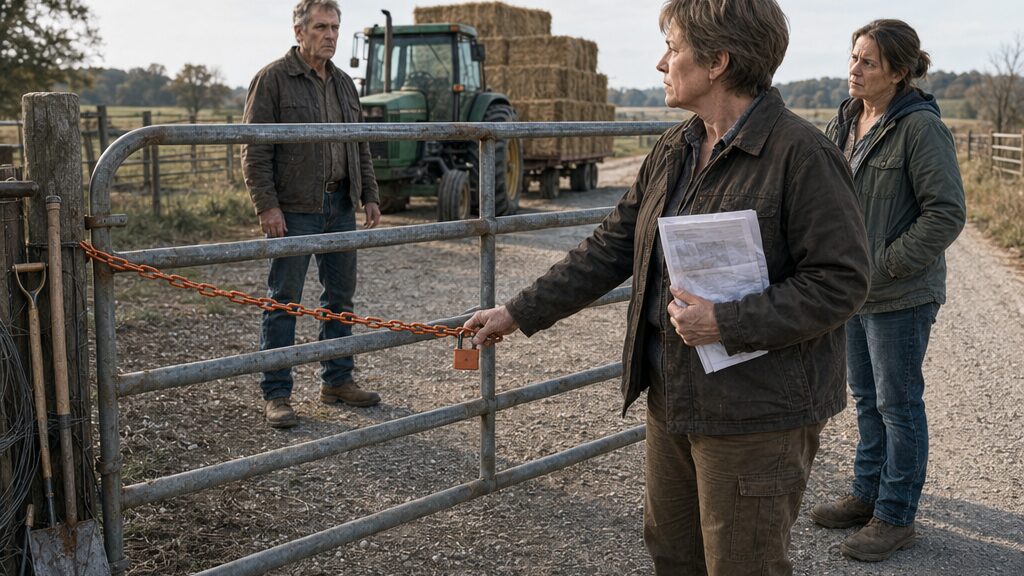
She Chained His Farm Gate Over a Nine-Hundred-Dollar Assessment, So He Followed the Money Instead
Chapter 1: The Orange Chain Across Raymond’s Gate
Raymond Hall saw the orange chain before he saw Nancy Roberts.
It ran through the bars of his cattle gate in two bright loops, too clean and too new against the weathered gray steel. A heavy orange-coated padlock hung at the center. Twenty yards behind Raymond, his tractor idled with a flat hay wagon loaded high enough that he could see the top bales in the side mirror.
On the other side of the gate, Nancy stood beside her pickup with a folder tucked under one arm.
Raymond killed the tractor engine.
The sudden quiet made the chain seem louder than it was.
He climbed down, crossed the gravel, and stopped three feet from the gate.
“What is this?”
Nancy adjusted her glasses. “You received the notice.”
“I received a bill.”
“An assessment.”
“For nine hundred dollars.”
“Yes.”
Raymond looked at the lock again. “And that gives you the right to close my gate?”
Nancy opened the folder and removed a sheet of paper. “The association approved emergency collection authority for the road and drainage work.”
“That’s not what I asked.”
“The assessment was due Friday.”
“It’s Monday.”
“It was due three days ago.”
Raymond put both hands on the top rail of the gate. Beyond Nancy, the shared gravel lane curved downhill toward the county road. Every load of hay, every cattle trailer, every feed truck that came to his place had to use that lane.
“You chained a working farm shut over nine hundred dollars.”
“I restricted association access until the account is current.”
“This gate is on my property.”
“The lane serves multiple parcels.”
“That doesn’t make the gate yours.”
Nancy’s mouth tightened. “Raymond, I’m not doing this argument again.”
He almost laughed at that. They had not had the argument once.
Two weeks earlier, Nancy had handed him an emergency assessment notice after a roadside meeting he had nearly skipped. The association wanted nine hundred dollars from every member for a failing culvert, fresh gravel, ditch work, and equipment costs. Raymond had asked for the contractor estimate.
Nancy had told him it would be circulated.
Nothing had arrived.
He had not paid.
Now the answer was hanging from his gate.
Raymond pointed at her folder. “Show me the quote.”
Nancy glanced down. “The board approved the expenditure.”
“The quote.”
“The contractor has already mobilized.”
“Then there ought to be a piece of paper with a number on it.”
A pickup slowed behind Nancy. Sarah Mitchell was driving. She pulled onto the grass shoulder and got out, leaving the engine running.
“Everything all right?”
Nancy answered first. “Raymond is refusing the emergency assessment.”
Raymond kept his eyes on Nancy. “I’m refusing to pay a number nobody will explain.”
Sarah looked at the chain. “You actually locked it?”
“Temporary access enforcement,” Nancy said.
Sarah’s expression changed, but only for a second.
Raymond noticed.
He pointed through the gate toward the tractor. “I’ve got twelve tons of hay sitting there. I’m moving it to the upper barn before noon.”
“You can move it when the assessment is paid.”
“Where is the contractor quote?”
Nancy tapped the folder against her thigh. “We have minutes from the vote.”
“That isn’t a quote.”
“We have invoices.”
“Then show me those.”
“They aren’t with me.”
“What is with you?”
“The assessment notice and the enforcement provision.”
“Show me the part that says you can block agricultural access.”
Nancy held the paper out through the gate.
Raymond read the highlighted paragraph. It referred to suspension of association privileges for delinquent accounts. Parking privileges, meeting-room use, common equipment. Nothing about a private farm gate. Nothing about blocking a working lane.
He handed it back.
“This doesn’t say what you say it says.”
“It gives the board enforcement authority.”
“It gives you authority over common privileges.”
“The road is common.”
“The gate isn’t.”
Nancy’s face reddened slightly.
Sarah stepped closer. “Maybe we should take the lock off until the board meets.”
Nancy turned. “And teach everybody that deadlines are optional?”
“No. I’m saying—”
“You signed the assessment resolution too.”
Sarah stopped.
Raymond looked from one woman to the other.
That was useful.
Not proof of anything, but useful.
The rumble of a diesel engine came from downhill.
A feed truck appeared around the bend and slowed behind Nancy’s pickup. The driver lowered his window.
“Hall farm?”
Raymond lifted a hand. “Yeah.”
The driver looked at the chained gate.
“I’ve got four tons for you. Where do you want me?”
“Right where you’re headed.”
Nancy stepped toward the truck. “Access is temporarily restricted.”
The driver stared at her, then at Raymond.
Raymond felt heat rise into his face.
“Can you wait ten minutes?” he asked.
The driver shook his head. “I’ve got two more stops and I can’t block this lane.”
Raymond looked at Nancy.
She did not move.
The truck backed slowly until it found enough shoulder to turn.
Raymond stood there while six hundred dollars of feed disappeared down the road.
His bolt cutters were hanging in the machine shed less than fifty yards away.
He thought about them.
Nancy probably knew he was thinking about them.
“If I cut that chain,” he said, “you’ll tell everybody I damaged association property.”
“If you destroy board property, I’ll record it accurately.”
Raymond nodded.
Then he stepped back from the gate.
Nancy seemed almost disappointed.
He pulled out his phone, took photographs of the lock, the chain, the gateposts, and the paper Nancy still held.
Then he photographed his loaded hay wagon behind the gate.
“What are you doing?” Nancy asked.
“Recording it accurately.”
Sarah looked down.
Raymond slipped the phone into his pocket.
“I’ll ask one more time. Who is the contractor?”
Nancy hesitated just long enough for Sarah to look at her.
“Gonzalez Grading and Drainage.”
“How much was the quote?”
“The final scope changed.”
“That isn’t a number.”
“We had washout damage.”
“What was the original number?”
Nancy pressed her lips together. “You can raise questions at the next meeting.”
“When?”
“We’ll announce it.”
Raymond stared at her.
For years he had hated association meetings. People sat under fluorescent lights and spent forty minutes discussing gravel depth, roadside mowing, and whose truck had damaged which culvert edge. Raymond had missed more meetings than he had attended, and Nancy had reminded him of that every time he objected to something afterward.
He had always figured the road got graded, the ditches got cut, and somebody collected the checks.
Maybe that had been the mistake.
Nancy turned toward her truck.
Sarah did not.
She was still looking at the folder in Nancy’s hand.
Not the assessment notice.
The empty place behind it where a contractor quote should have been.
Raymond rested his hands on the gate.
“Sarah.”
She looked up.
“You’re the treasurer, right?”
“Yes.”
“You saw the bid?”
Her mouth opened.
Nancy stopped beside her pickup.
Sarah looked at Nancy.
Then back at Raymond.
“I saw the amount we voted on.”
Raymond felt his anger settle into something colder.
“That wasn’t my question.”
Sarah did not answer.
And for the first time that morning, the orange chain stopped being the thing Raymond most wanted removed.
Chapter 2: The Rules Began Reaching Past the Road
The next orange paper appeared before sunrise.
Raymond found it nailed to the outside of his equipment shed, bright enough to catch the beam of his flashlight from across the yard.
He pulled it free.
The notice accused him of storing machinery inside the association’s roadside drainage easement.
Raymond looked over his shoulder at the disc mower parked beside the shed.
It had been sitting in the same place for seven years.
By breakfast, he had three notices spread across the kitchen table.
The first concerned the mower.
The second, delivered two days after the gate incident, claimed his hay wagon had obstructed emergency access.
The third warned that grass along his ditch line exceeded the association’s maintenance standard.
He read them twice.
Then he drove the lane slowly with a tape measure, a survey copy, and a can of marking paint.
The mower sat four feet inside his recorded property line and nearly eleven feet beyond the road easement.
He measured it again.
Nancy arrived while he was driving a small stake into the ground.
“What are you doing?”
“Checking your numbers.”
“They aren’t my numbers.”
Raymond straightened. “Then whose are they?”
“The association’s.”
He pointed to the mower. “Your notice says that machine is inside the easement.”
“It interferes with drainage access.”
“That’s different.”
“The practical effect is the same.”
“No, Nancy. One is a rule. The other is something you decided this morning.”
She folded her arms.
Raymond held out the survey copy. “Recorded easement ends there.”
She barely looked at it.
“We have maintenance discretion.”
“You have discretion to move my property line?”
“Don’t start.”
“That seems to be the phrase you use whenever somebody asks for the paper behind the rule.”
Nancy’s expression hardened.
“You skipped five meetings last year.”
“Six.”
“That’s not something to brag about.”
“I’m not.”
“You ignore what this association does until you get a bill you don’t like.”
That landed harder than Raymond wanted it to.
He folded the survey.
Nancy was not entirely wrong.
The association had mailed agendas. Sarah had called him once about a ditch-cleaning vote. He had told her he had calves to work and didn’t have time to sit around discussing gravel.
He had made a habit of treating the board like an inconvenience.
Now the board was treating him like one.
Nancy took his silence for surrender.
“The road doesn’t maintain itself.”
“I know.”
“Then act like it.”
She walked back toward her truck.
Raymond looked at the orange notice in his hand.
By noon he had drafted a written response, attached a copy of the survey, and delivered it to Sarah’s mailbox.
The notice disappeared from his record two days later.
No apology came with it.
That small victory should have satisfied him.
Instead, it bothered him more.
If one violation could vanish the moment he produced a measurement, how many others had been written because nobody bothered to challenge them?
The older cattle farmer down the lane gave him part of the answer.
Raymond caught him repairing a hinge on a pasture gate and asked whether he had seen the culvert bid.
The man snorted.
“I wrote the check.”
“That wasn’t the question.”
“I know.”
“You see a detailed estimate?”
“Nope.”
“Invoice?”
“Nope.”
“Then why’d you pay?”
The older farmer tightened the hinge bolt. “Because nine hundred was cheaper than spending three evenings listening to Nancy explain why it wasn’t.”
Raymond said nothing.
The man wiped his hands on his jeans.
“Road does need work, though.”
“You seen it?”
“Bottom crossing’s soft. Bad soft.”
“Did Nancy tell you what company got the job?”
“Something Gonzalez.”
“How much?”
The man shrugged. “Enough that she said we needed everybody paid up immediately.”
Raymond walked back toward his truck.
That afternoon he drove down to the chained gate.
The lock had been removed after Sarah convinced two board members that blocking commercial deliveries created more liability than leverage. But the orange chain remained looped around one gatepost like a warning.
Raymond had left it there.
Nancy had expected him to cut it.
He wanted it visible.
Across the road, fresh orange paint marked a drainage line through the grass. Farther downhill, a shallow trench had been scraped beside the lane, but no crew was working.
The young orchard owner pulled up and stopped beside him.
“You going to the meeting?”
“What meeting?”
“Saturday.”
Raymond turned.
“What Saturday meeting?”
The orchard owner frowned. “Special board session. Nancy came by this morning.”
“For what?”
“More authority on the repair contract, I think. Something about changing the scope before the insurance review.”
Raymond looked downhill.
The first emergency assessment had not yet produced a finished ditch, a new culvert, or even a visible pile of pipe.
Now Nancy wanted authority to expand it.
“When did you get notice?”
“This morning.”
Raymond checked his mailbox.
Nothing.
By dusk, a printed meeting notice had appeared under the windshield wiper of his farm truck.
He read it in the cab.
Emergency infrastructure authorization. Contractor scope modifications. Collection enforcement.
No detailed costs.
No invoices.
No bid attachment.
Raymond drove to Sarah Mitchell’s place before he could talk himself out of it.
Her farmhouse sat on twenty acres of pasture and garden ground, modest and tidy, with a small barn behind it. She answered the door wearing work gloves.
“I know why you’re here.”
“Good. Saves time.”
“Raymond—”
“I want the records.”
“We give annual summaries.”
“I don’t want a summary.”
“Members don’t normally ask for every invoice.”
“I’m asking.”
Sarah removed one glove finger by finger.
“You’re making this personal.”
“No. Nancy made it personal when she chained my gate. I’m trying to make it numbers.”
Sarah looked tired.
Raymond softened his voice.
“You signed the assessment. You’re treasurer. Tell me what nine hundred dollars times all these properties is paying for.”
“The culvert, ditch work, gravel, equipment mobilization.”
“How much for each?”
“I’d have to pull the file.”
“Pull it.”
She looked past him toward the lane.
“You really think Nancy stole the money?”
“I didn’t say that.”
“You’re implying it.”
“I’m saying I asked for a contractor quote ten days ago and still haven’t seen one.”
Sarah was quiet.
Raymond took a folded letter from his jacket.
“I’m requesting the bank statements, invoices, canceled checks, contractor agreements, meeting minutes, and any account records connected to the emergency assessment.”
Her eyes moved across the first paragraph.
“That’s a lot.”
“It’s the association’s money.”
“It’ll take time.”
“You have until the meeting if you want me asking questions from memory instead.”
Sarah looked up sharply.
Raymond regretted the edge in his voice but did not take it back.
She took the letter.
“I’ll give this to Nancy.”
“No.”
Sarah frowned.
“It’s addressed to the treasurer.”
He let that sit between them.
At last she folded the letter once and held it against her side.
“I’ll see what I can provide.”
Raymond nodded.
As he walked back to his truck, he heard the screen door close behind him.
For the first time since the orange chain went across his gate, he had stopped arguing about what Nancy was allowed to do.
Now he wanted to know what she had already done.
Chapter 3: The Repair Was Real but the Numbers Were Wrong
Raymond climbed down into the drainage ditch expecting to prove Nancy a liar.
Instead, the ground gave way under his boot.
He caught himself on the concrete headwall and stared into the dark space beneath the culvert.
Water had eaten a channel under the roadbed wide enough for him to slide his arm into. Gravel hung above it in a packed shelf, unsupported for nearly two feet. Another hard storm—or a loaded cattle trailer hitting the wrong edge—could collapse part of the crossing.
Raymond crouched and shone his flashlight deeper.
“Damn.”
He sat back on his heels.
For nearly three weeks he had told himself the emergency was a pretext. Nancy needed a reason to collect money, a reason to pressure people, a reason to justify that orange chain.
But the road was failing.
That changed something.
Not the missing quote.
Not the notices.
Not the gate.
But enough.
Raymond climbed out and walked the ditch line.
Someone had scraped vegetation from roughly eighty yards of bank. A few truckloads of stone had been spread near the crossing. Fresh equipment tracks ran into a soft patch and stopped.
There was real work here.
Just not much of it.
At home he cleared one end of the kitchen table.
Sarah had delivered what she called the association’s financial package that morning.
It was twelve pages.
Raymond expected invoices.
Instead he found summaries.
Emergency assessment collections.
Road repair allocation.
Drainage allocation.
Administrative reserve.
Contractor advance.
The figures were neat, typed, and almost useless.
He created two piles.
On the left he placed documents showing what the association claimed had been approved.
On the right he placed anything proving what had actually happened.
The left stack grew quickly.
The right remained thin.
Raymond called Sarah.
“This isn’t what I requested.”
“It’s what I could release.”
“Could?”
“Nancy says bank statements contain private information.”
Raymond looked at the phone.
“Private information belonging to who?”
“The association.”
“I am in the association.”
“There are account numbers.”
“Black them out.”
“She doesn’t want copies circulating.”
Raymond leaned back in his chair.
“Did you see the original Gonzalez bid?”
A pause.
“I saw the amount presented to the board.”
“That means no.”
“I didn’t say that.”
“You didn’t have to.”
Sarah exhaled.
“Raymond, the culvert is bad.”
“I know.”
That stopped her.
“You went down there?”
“This morning.”
“And?”
“And Nancy was right about the road.”
Sarah said nothing.
Raymond continued.
“That doesn’t make her right about the money.”
His own words sounded different now.
Less satisfying.
More useful.
He took the summary sheet and compared it with his list of properties on the lane. The exact collection total depended on which parcels were assessed and whether several vacant tracts paid a reduced share, but the amount was substantial.
Far more substantial than the visible work.
The summary showed a major contractor advance.
Raymond stared at it.
He called two local suppliers without asking for confidential pricing. He simply described the work: replace one failing culvert, rebuild shoulders, clean ditches, add gravel over a defined section.
Both told him the amount depended on pipe size, hauling distance, excavation, and weather.
Neither estimate made the association’s figures impossible.
But neither explained why so little had happened after such a large advance.
That afternoon he drove to the county offices.
The records clerk directed him to a public terminal.
“Company name?”
“Gonzalez Grading and Drainage.”
He searched.
The business existed.
That was the first disappointment.
Raymond had expected perhaps a shell company, a mailbox, something so obviously wrong he could carry it straight into Saturday’s meeting.
Instead, the filing showed an active limited-liability company with a registered owner: Eric Gonzalez.
Raymond wrote the name down.
The registration date caught his eye.
He checked it again.
The company had been organized eleven days before the association voted on the emergency assessment.
Raymond sat back.
That was not proof of wrongdoing either.
People started companies every day.
But people did not usually receive substantial advances from neighborhood associations within weeks of doing so.
He requested the public filing details.
The clerk printed them.
Raymond folded the pages and drove home.
On the way he stopped at the culvert once more.
This time he did not look at the hole beneath the road.
He looked at the work around it.
Fresh scrape marks.
Three loads of gravel, maybe four.
A section of ditch opened.
No new pipe.
No headwall repair.
No erosion fabric.
No crew.
At the kitchen table that evening, the two document stacks sat under the hanging light.
What the board said.
What Raymond could prove.
He moved the company filing to the right-hand stack.
Then he found the special meeting minutes Sarah had included.
The emergency vote had authorized contractor mobilization immediately after collection.
The company registration came eleven days earlier.
Raymond read both dates again.
He could feel his old certainty trying to return—the clean certainty that Nancy had invented everything.
He pushed it away.
The culvert was real.
The road could fail.
If he walked into the meeting pretending otherwise, Nancy would bury every legitimate question beneath that one mistake.
He needed facts, not anger.
Raymond unfolded the company filing.
At the bottom was the registered business address.
He read it once.
Then a second time.
The road name was familiar.
He had hauled hay past that property for years.
A white farmhouse sat there with a long equipment shed behind it and an old windbreak along the north side.
Raymond had never known who technically owned the parcel.
But he knew who had grown up there.
He reached for the association directory and flipped through until he found Nancy Roberts.
Her mailing address was different.
He checked an older county parcel map online.
The property listed in Eric Gonzalez’s business filing belonged to a Roberts family trust.
Raymond stared at the screen.
The phone rang before he could decide what the connection meant.
Sarah.
He answered.
“Raymond?”
“Yeah.”
Her voice was lower than usual.
“Nancy found out you went to the county office.”
Raymond looked at the two stacks.
“How?”
“I don’t know.”
“What does she want?”
“She says if you make accusations at Saturday’s meeting without proof, she’ll move to have you removed.”
“Removed from what?”
“The meeting.”
Raymond almost smiled.
Then Sarah said, “There’s something else.”
He stopped.
“What?”
“The address on that contractor filing.”
Raymond said nothing.
Sarah drew a slow breath.
“I think you need to find out exactly who Eric Gonzalez is before Saturday.”
Chapter 4: The Contractor’s Address Changed the Story
The Roberts family property was six miles from Raymond’s farm, and the sign for Gonzalez Grading and Drainage was bolted to the side of its equipment shed.
Raymond slowed his truck but did not pull in.
A compact excavator sat near the building with mud dried across its tracks. Beside it were two pallets of corrugated pipe and a rust-streaked dump trailer. Nothing about the place looked imaginary.
That bothered him.
He had spent the drive expecting the business address to expose something simple.
Instead, it looked like a contractor trying to become a contractor.
Raymond continued to the county office.
The clerk confirmed what the public filing already showed. The property belonged to a Roberts family trust. Eric Gonzalez had registered his company there because he leased the equipment shed and part of the yard.
“Any relation between the names?” Raymond asked.
The clerk glanced at him over the monitor.
“That’s not in this filing.”
He knew better than to push.
At a diner near the highway, Raymond spread photocopies across a corner table while his coffee went cold.
Nancy Roberts.
Eric Gonzalez.
Same property.
Company created eleven days before the assessment vote.
Large contractor advance shortly afterward.
It looked bad.
Looking bad was not enough.
Raymond took out his phone and called the number listed on the company filing.
A man answered on the fourth ring.
“Gonzalez Grading.”
“This Eric?”
“Yes.”
“My name is Raymond Hall. You’re doing the road work for our association.”
There was a pause.
“I know who you are.”
That surprised Raymond.
“Then you know why I’m calling.”
“I’ve got an idea.”
“I’d rather hear it from you.”
Eric exhaled. “You think I got paid for work I didn’t do.”
“I think I don’t know what you got paid for.”
Another pause.
Then Eric said, “I’m at the lower crossing in half an hour.”
When Raymond arrived, Eric was standing beside the ditch with a clipboard under one arm. He was younger than Raymond expected, maybe late thirties, with work boots coated in clay and a faded cap pulled low.
“You brought paperwork,” Raymond said.
Eric looked at the folder in Raymond’s hand. “So did you.”
Neither man smiled.
Eric led him toward the culvert.
“You saw the undermining?”
“Yes.”
“Then you know it’s real.”
“I know the hole is real.”
Eric crouched near the headwall.
“The pipe needs replacing. Shoulders need rebuilt. Ditch line needs opened farther uphill or the same water comes back.”
“Why isn’t it done?”
Eric stood.
“Because I don’t own enough equipment yet.”
Raymond stared at him.
Eric met his eyes.
“There. That’s the answer you wanted.”
“You took the contract without having the equipment?”
“I had access to it.”
“Meaning?”
“Rental agreement.”
“Then what happened?”
“Supplier changed terms after I formed the company. Wanted more cash up front.”
Raymond’s voice hardened. “You already got an advance from us.”
“Yes.”
“How much?”
Eric’s jaw shifted. “Ask your association.”
“I did.”
“And?”
“They gave me summaries.”
Eric looked away.
That reaction told Raymond more than a refusal would have.
“You know what they showed us?”
“No.”
“Then show me what you submitted.”
Eric hesitated.
Raymond almost pushed.
Instead he waited.
Finally Eric walked to his truck and came back with a thick envelope.
Inside were purchase orders for pipe, stone, erosion fabric, equipment rental deposits, fuel projections, and labor estimates.
Raymond went through them slowly.
The numbers were messy, but they were real.
“So you intended to do the job.”
“I still intend to.”
“Why start a company eleven days before the board vote?”
Eric rubbed the back of his neck.
“Because I’d been working under other outfits for twelve years. Nancy said if I was ever going to go on my own, this was the kind of contract that could get me started.”
Raymond stopped turning pages.
“Nancy said that.”
Eric looked at him.
“You don’t know?”
“Know what?”
Eric’s face changed.
Not guilt exactly.
Recognition.
“She’s my aunt.”
Raymond closed the envelope.
There it was.
Not a fake contractor.
Not a phantom business.
Family.
“You bid against anybody?”
Eric looked toward the road.
“I gave her a number.”
“That wasn’t what I asked.”
“I don’t know what other bids they had.”
“Did Nancy tell the board you were her nephew?”
“I assumed they knew.”
“You assumed.”
“She said everybody around here knows everybody.”
Raymond almost laughed, but the sound would have been ugly.
“I didn’t.”
Eric’s shoulders stiffened.
“I’m not stealing from you.”
“I didn’t say you were.”
“You’re thinking it.”
“I’m thinking you took a large advance on a job you weren’t equipped to finish.”
Eric looked down at the ditch.
“That part is fair.”
For several seconds there was only the sound of water moving under the damaged pipe.
Then Eric said, “I ordered the material. I paid deposits. I hired two men. It got ahead of me.”
“Why didn’t the board know?”
“I told Nancy.”
“Nancy isn’t the whole board.”
“She said she’d handle it.”
Raymond folded his arms.
Eric seemed to understand the implication at the same moment he did.
“What happened to the rest of the advance?” Raymond asked.
“It didn’t all come to me.”
Raymond stared at him.
“What does that mean?”
Eric frowned. “There were two payments.”
“From the association?”
“One from the operating account. One from the reserve.”
“What reserve?”
“The emergency reserve.”
Raymond felt the air go still around him.
“There’s a separate account?”
“That’s what Nancy called it.”
“Who told you the board authorized it?”
“Nancy.”
“Did you see anything showing that?”
“No.”
Raymond reached for his phone.
He did not call Nancy.
He called Sarah.
She answered quickly.
“Did the association open an emergency reserve account?”
Silence.
“Sarah.”
“What are you talking about?”
“Eric says one of his payments came from a separate reserve account.”
“I’ve never signed anything for a separate account.”
“You’re treasurer.”
“I know what I am.”
“Then who opened it?”
“I don’t know.”
Eric watched Raymond from beside the culvert.
Sarah’s voice dropped.
“Raymond, don’t say anything at the meeting yet.”
“Why?”
“Because if there is another account, I need to see everything before Nancy knows I’m asking.”
Raymond looked at Eric’s purchase orders.
For the first time, the two stacks in his kitchen no longer represented truth and lies.
They represented something worse.
Partial truths held by different people.
And somewhere between them sat an account the treasurer herself had never seen.
Chapter 5: Sarah Finally Asked to See Everything
Sarah arrived at Raymond’s farmhouse two mornings later carrying a ledger she had once told him he could not have.
She held it against her chest as though it weighed more than paper.
“You were right about the second account.”
Raymond stepped aside.
She entered without waiting for an invitation.
On the kitchen table, Raymond had cleared two spaces again. One stack held association summaries and meeting minutes. The other held county filings, Eric’s purchase orders, and his own notes from the culvert.
Sarah placed the ledger between them.
“That’s not all,” she said.
Raymond looked at her.
Her face was pale.
“What else?”
“I signed transfers.”
He pulled out a chair.
Sarah remained standing.
“I didn’t know where they were going.”
“You signed them.”
“I signed authorization sheets Nancy brought me.”
Raymond said nothing.
Sarah finally sat.
“She’d have the totals already filled in. Contractor advance. Materials. Emergency work. I checked that the amounts matched what we’d voted.”
“But you didn’t see the bank destination.”
“No.”
Raymond leaned back.
“You’re the treasurer.”
“I know.”
“You keep saying that.”
“Because I know exactly how bad it sounds.”
He wanted to tell her it sounded worse than bad.
Instead he opened the ledger.
The entries were orderly enough at first.
Assessment collections.
Routine grading expenses.
Insurance payment.
Then larger transfers began.
Several were marked as emergency reserve movements.
Sarah tapped one line.
“I thought that meant we were moving money internally so Nancy could keep the repair funds separate from normal road expenses.”
“Did you ever see a statement?”
“No.”
“Did you ask?”
She looked at him.
“No.”
That answer carried more shame than any excuse could have.
Raymond turned another page.
“Why not?”
Sarah rubbed her thumb along the ledger’s edge.
“Last winter an ambulance came up this lane for the older cattle farmer. It rained for two days straight. The driver almost put the rear wheels into the ditch at the bottom crossing.”
Raymond remembered.
Everybody did.
Sarah continued.
“Nancy said if that culvert went completely, emergency vehicles could lose access to four properties. She said the insurer was already asking about maintenance records.”
“So you stopped questioning her.”
“I trusted her.”
“That’s not the same thing.”
“I know that now.”
Raymond closed the ledger.
Sarah looked toward the window.
“I also didn’t want to be the person who slowed everything down. What if we argued for a month and somebody got hurt? What if a cattle trailer rolled that shoulder? Everybody would ask why the board knew and did nothing.”
Raymond thought about the hole under the culvert.
That was the part he wished were false.
It would have made everything easier.
He opened the ledger again.
“Where are the statements?”
“Bank.”
“Can we get them?”
Sarah lifted a folder from her bag.
“I already did.”
Raymond stared at her.
“You went without Nancy?”
“Yes.”
It was the first time he had seen Sarah look frightened and relieved at once.
They drove to the local branch together because Sarah wanted confirmation of what the documents meant.
The bank representative would not discuss anything beyond Sarah’s authority, but as treasurer she could obtain records for the primary association account.
The second account was harder.
Sarah placed an old authorization form on the desk.
“I need to know whether this account is connected to our association.”
The representative examined it, checked the system, and asked Sarah for identification.
After several minutes, a printed account summary appeared.
Sarah read the first page.
Then the second.
Her hand stopped.
Raymond did not touch it.
“What?”
She turned the page toward him.
The account name included the association’s abbreviated title followed by “Emergency Reserve.”
Nancy Roberts was listed as authorized signer.
Sarah was not.
“How can that happen?” Raymond asked.
Sarah shook her head.
“I don’t know.”
The bank representative chose words carefully.
“Account-opening documentation would determine the authorization presented at the time.”
“Can she get that?” Raymond asked.
“If her association status permits access, we can process a records request.”
Sarah signed it.
Back at Raymond’s kitchen table, the two stacks finally began to make sense.
The association had collected substantial emergency assessments.
Part of the money went directly to Eric’s company.
Part moved into the second account.
From there came equipment deposits, some material expenses, and several payments Raymond could not immediately connect to the road.
Not proof of theft.
But certainly not the transparent emergency repair Nancy had described.
Sarah sat with both hands around a coffee mug.
“I signed the transfers into that account.”
“You didn’t control it.”
“No.”
“Did the board vote to create it?”
“Not at any meeting I attended.”
Raymond looked at the minutes.
“Could there have been an executive session?”
“Not without me knowing.”
The answer came faster this time.
She was done protecting the process.
Her phone buzzed on the table.
Sarah read the message.
Her shoulders dropped.
“What?”
“Nancy.”
Raymond waited.
“She’s calling a membership meeting Saturday.”
“That was already scheduled.”
“This is different.”
Sarah handed him the phone.
The message announced a vote on an additional emergency assessment to cover increased contractor and material costs.
Raymond read it twice.
“She wants more money before reconciling the first assessment.”
Sarah nodded.
“She says delay could close the road.”
Raymond pushed his chair back.
For three weeks he had wanted a clean confrontation.
Now that he had enough evidence to create one, it felt less satisfying than he had imagined.
The road really could fail.
Eric had genuinely bought materials.
Sarah had genuinely failed in her duty.
Nancy had genuinely hidden the family relationship and used an account the treasurer did not control.
Nobody fit neatly into the role Raymond had assigned them.
Including him.
He looked toward the counter where several unopened association envelopes from earlier in the year still sat beneath a seed catalog.
Sarah followed his gaze.
“You really didn’t read those?”
“Most of them.”
“That’s part of why she thinks she can say you never participate.”
“I know.”
Sarah gave him a tired look.
“You going to tell everybody that too?”
Raymond did not answer immediately.
He pulled a blank sheet of paper toward him.
“What are you doing?”
“Working out what the road actually needs.”
“For the meeting?”
“If I stand up there and say no more money, Nancy points at the culvert and wins.”
Sarah watched him write.
“Then what are you proposing?”
“Freeze the second assessment. Open the accounts. Price the unfinished work. Rebid whatever Eric can’t complete. Keep emergency access open.”
“You think people will listen?”
“I think they’ll listen longer if I give them something besides somebody to blame.”
Sarah looked at the two document stacks.
“Are you going to put my signatures in front of them?”
“Yes.”
She flinched, almost imperceptibly.
Raymond set down his pencil.
“But I’m not going to pretend you knew everything.”
Sarah looked at him.
“You’ll have to tell them what you did know.”
“And what I didn’t.”
“Yes.”
She nodded once.
That agreement changed the room more than any bank statement had.
Raymond began making a third list.
Not evidence.
Repairs.
By Saturday, he intended to walk into the equipment shed with proof of what had gone wrong and a way to keep the road from failing while they fixed it.
For the first time, exposing Nancy was no longer the whole plan.
Chapter 6: The Meeting Where Privacy Stopped Working
Nancy Roberts began the Saturday meeting with a demand for more money.
“We cannot wait another month,” she said.
The cooperative equipment shed had been cleared enough for three rows of folding chairs and a long scarred table. Farmers, small-acreage owners, and two board members filled nearly every seat.
Raymond stood at the back with two stacks of records in a cardboard box.
The orange chain lay across the top.
Nancy held a clipboard.
“The lower crossing has deteriorated beyond the original scope. Material costs increased, equipment availability changed, and the insurer has asked for a completion schedule. I’m asking the membership to approve a second emergency assessment tonight.”
A murmur moved through the room.
Raymond saw Sarah seated at the end of the board table.
She looked at him once.
Then down.
Nancy continued.
“We moved quickly because waiting would have endangered every property beyond that crossing.”
“That part is true.”
The room turned.
Raymond walked forward carrying the box.
Nancy’s expression tightened.
“This is a scheduled presentation.”
“I’ll keep it short.”
“You can speak during member comment.”
“I’m commenting on the assessment you just asked us to vote on.”
One board member shifted uncomfortably.
Nancy looked toward him, then back at Raymond.
“Five minutes.”
Raymond set the box on the table.
He removed the orange chain first.
Metal struck wood with a hard clatter.
Several people recognized it.
Nancy stared at it.
Raymond placed one stack of records on the left.
Then another on the right.
“I was wrong about something,” he said.
That caught the room more effectively than an accusation.
“I thought the road emergency was exaggerated.”
Nancy folded her arms.
Raymond continued.
“It isn’t. I crawled under the lower culvert myself. The shoulder is undermined. The pipe needs replacement. If we ignore it, somebody could lose access.”
The tension in Nancy’s face shifted.
For a moment she looked almost vindicated.
Raymond let her have it.
Then he placed a photograph of the damaged crossing on the table.
“So the question isn’t whether the road needs money.”
He touched the first stack.
“The question is what happened to the money we already collected.”
Nancy stepped forward.
“We have provided financial summaries.”
“Summaries.”
“That is standard practice.”
“Not anymore.”
He opened the first folder.
“Assessment collections went into the operating account. Large transfers then left that account for contractor expenses and something labeled emergency reserve.”
Nancy’s jaw tightened.
“That reserve was established to isolate project funds.”
“By what vote?”
“The board authorized emergency spending.”
“That wasn’t my question.”
A few heads turned toward Sarah.
Raymond did not.
Not yet.
He placed the company filing on the table.
“Gonzalez Grading and Drainage was formed eleven days before the emergency assessment vote.”
Nancy’s voice sharpened.
“New businesses are not prohibited from contracting.”
“No.”
Raymond slid another document beside it.
“And Eric Gonzalez appears to have purchased materials and planned real work.”
The room shifted again.
Nobody had expected Raymond to defend the contractor.
Nancy certainly had not.
He saw it in her face.
“I’m not saying the company is fake,” Raymond said. “I’m saying the board was not told everything it should have been told.”
Nancy spoke over him.
“This is private contractor information.”
Raymond looked at her.
“The family relationship is private?”
Silence settled across the shed.
Nancy’s fingers tightened around her clipboard.
“Eric is my nephew,” she said. “That does not invalidate his work.”
“No. It doesn’t.”
A neighbor spoke from the second row.
“You told us that before the vote?”
Nancy turned toward the voice.
“The board knew the contractor was local.”
“That wasn’t what he asked.”
Raymond saw Sarah close her eyes briefly.
Then she stood.
“I didn’t know.”
Every face turned toward her.
Sarah’s hands trembled slightly as she placed them on the table.
“I’m the treasurer. I approved transfer sheets Nancy brought me. I knew the totals. I knew they were being described as emergency project expenses.”
She swallowed.
“I did not know Eric was Nancy’s nephew when I signed them.”
Nancy stared at her.
“Sarah.”
“I’m not finished.”
The room went quiet.
Sarah looked toward the membership.
“I also did not review destination records before approving those transfers. I should have.”
Nancy shook her head.
“You knew we had deadlines.”
“I knew we had pressure. That isn’t the same as knowing what I signed.”
Raymond watched the room absorb that.
There was no cheer.
No triumphant reaction.
Only people recalculating what they thought they understood.
Nancy put down the clipboard.
“You all wanted the road fixed. Every time I asked for volunteers, nobody had time. Every time we needed someone to meet contractors or talk to the insurer or chase late payments, who did it?”
No one answered.
Her voice was controlled but strained now.
“I did.”
Raymond believed her.
That was what made the next part harder.
Nancy continued.
“When the lower crossing started failing, I acted because waiting for six meetings and three competing opinions would have left us with no road.”
The older cattle farmer leaned forward.
“That still doesn’t explain the second account.”
Nancy froze.
Raymond took the account summary from the right-hand stack.
“There it is.”
He laid it flat.
“Emergency reserve. Association name. Nancy Roberts as authorized signer.”
Nancy’s face lost color.
“That document contains private banking information.”
Raymond heard the line and almost felt the whole story turn.
He looked at the orange chain.
Then at Nancy.
“You chained my gate because association rules applied to my property.”
His voice stayed low.
“You fined me because association rules applied to my equipment.”
He touched the account statement.
“But when the association money reaches an account the treasurer didn’t control, now it’s private?”
Nancy looked around the room.
Nobody rescued her.
Raymond continued before anger could carry him too far.
“I’m not asking anyone here to vote on guilt tonight.”
Nancy looked back at him.
“I’m asking you not to approve another assessment until every account is reconciled.”
He pulled out a single-page repair proposal.
“Keep the crossing open with temporary stone and weight limits. Get two independent prices for the remaining culvert work. Credit verified materials Eric already purchased. Rebid anything he cannot complete. No gate restrictions for unpaid assessments without an actual rule authorizing them.”
One board member reached for the page.
“This could work?”
“It keeps access open while we sort out the books.”
Nancy shook her head.
“We don’t have time to restart contracting.”
A voice came from near the door.
“Yes, you do.”
Eric Gonzalez stood there.
Raymond had not invited him.
Nancy’s face tightened further.
Eric removed his cap.
“I can finish the ditch work I’m equipped for. I can’t complete the whole culvert job on the schedule Nancy promised.”
“You don’t need to do this,” Nancy said.
“Yes, I do.”
He looked toward the members.
“I took an advance too early. I thought I could line up the equipment after I had the contract. I couldn’t. Some of the money went to materials. Some went to deposits. I can document that.”
A board member asked, “Did you disclose to us that Nancy was your aunt?”
Eric looked down.
“Nancy told me it wasn’t necessary because she wasn’t personally getting paid.”
Nancy stood very still.
That was the moment Raymond saw her authority break.
Not because anyone shouted.
Because the explanation she had controlled for weeks had escaped her control.
She looked at Eric.
“I was trying to get you established.”
“I know.”
“And get the road fixed.”
“I know that too.”
Neither statement cleared her.
Neither made her a monster.
Sarah placed both palms on the table.
“We need a motion.”
The board member beside her nodded.
The motion came in pieces, argued over for nearly twenty minutes: suspend any new assessment; preserve emergency road access; require complete statements for all association-linked accounts; obtain independent repair bids; temporarily remove Nancy’s authority to transfer association funds.
Nancy objected twice.
Then stopped.
When the vote was finally called, the room stayed painfully quiet.
Hands rose.
Not every hand.
Enough.
Nancy looked at the count and sat down.
Sarah gathered the account papers.
Raymond picked up the orange chain.
He had imagined this moment many times since the morning he found it across his gate.
In those versions he had felt victorious.
Instead, he looked at Nancy sitting behind the scarred table and understood that exposing a broken system did not repair a culvert, recover a dollar, or teach people how to govern themselves.
The older cattle farmer spoke from the second row.
“So who handles the road Monday morning?”
Nobody answered immediately.
Every face seemed to turn toward the same table they had spent weeks blaming.
The association had taken authority away from Nancy.
Now it had to discover whether anyone else was willing to carry the weight she had been carrying badly.
Chapter 7: The Gate Opened Before Trust Did
Raymond drove through the farm entrance without touching the brake.
For nearly a month, he had slowed there automatically, half expecting to find orange-coated steel stretched across the gate again. That morning the metal gate stood wide against the fence, and the only chain in sight hung loosely from a nearby equipment gate where it kept calves away from stacked pipe.
The old orange chain.
Someone had moved it.
Raymond recognized the scrape on one link where Nancy’s padlock had rubbed through the coating.
He looked at it for a second, then continued downhill.
The lower crossing no longer sagged at the shoulder.
Fresh stone had been packed around a new culvert. Erosion fabric showed through the unfinished ditch bank, waiting for seed. Temporary stakes marked the edge where the final gravel lift would go after settlement.
The work was not elegant.
It was solid.
More importantly, Raymond knew what it cost.
Every invoice was now copied into a binder Sarah kept at the association office. The two independent bids had been circulated before the unfinished work was awarded. Eric had completed the ditch excavation and material hauling his equipment could handle, then surrendered the remaining portion of his original contract.
A second contractor finished the culvert.
Nobody called it a victory.
There had been too many uncomfortable numbers for that.
The audit of the accounts had taken three weeks. Most of the disputed money could be traced—not to one dramatic theft, but to rushed contractor advances, equipment deposits, material purchases, reserve transfers, and expenses Nancy had authorized without complete board approval.
A handful of charges remained unresolved.
Nancy had agreed to repay two expenses herself while documentation for several others was reviewed.
Raymond had expected that discovery to satisfy him.
It did not.
A missing ten thousand dollars would have been easier to hate than a hundred smaller decisions made by people who had convinced themselves they were saving time.
Raymond stopped his truck beside the new culvert.
Sarah was standing near the headwall with a measuring wheel and a clipboard.
“You’re early,” she said.
“You’re measuring it again?”
“Trust is expensive now.”
Raymond got out.
Sarah rolled the wheel along the shoulder.
The association had changed more in three weeks than it had in ten years.
No payment could leave an account without two authorized people seeing the destination. Contractor relationships had to be disclosed before bids were considered. Members received copies of account summaries quarterly, with supporting records available on request.
Nobody had designed the rules to sound impressive.
They had designed them because everybody now knew exactly what happened when people assumed somebody else was paying attention.
Sarah stopped the wheel.
“Twenty-two feet.”
“That’s what it was yesterday.”
“I like consistency.”
Raymond looked toward the road.
“You always this particular?”
“I used to think Nancy was particular enough for all of us.”
There was no bitterness in the sentence.
That made it worse.
A pickup appeared at the top of the lane.
Nancy’s.
Raymond had not seen her since the second accounting meeting.
She drove slowly to the crossing and parked.
Sarah looked at Raymond.
“I asked her to come.”
“Why?”
“She still has association property.”
Nancy stepped out carrying a small metal cash box and a ring of keys.
Without the clipboard she had carried everywhere for years, she looked unfamiliar.
She set the box on Raymond’s tailgate.
“Fuel-card receipts. Old meeting-room key. Storage shed. Mailbox.”
Sarah checked the items.
Nancy placed one last key beside them.
“Bank box.”
Sarah nodded.
“Thank you.”
Nancy looked at the repaired crossing.
“They raised the outlet three inches.”
Raymond followed her gaze.
“Had to. The old grade was sending water back toward the shoulder.”
“It’ll collect sediment there.”
“Contractor says they’ll clean it after the first heavy rain.”
Nancy frowned.
“He should have extended the apron.”
Raymond almost smiled.
There she was.
Not chair.
Not authorized signer.
Still Nancy.
Sarah closed the cash box.
“We can note it for inspection.”
Nancy looked as if she wanted to argue.
Instead she nodded.
Sarah carried the box to her truck, leaving Raymond and Nancy beside the culvert.
Neither spoke for a while.
Finally Nancy said, “You got what you wanted.”
Raymond looked at her.
“No.”
She glanced at him.
“I wanted you to be completely wrong.”
Nancy gave a short, humorless laugh.
“So did I.”
Raymond rested one boot on the new gravel shoulder.
“The road did need fixing.”
“I told you that.”
“You also chained my gate.”
Her face hardened slightly.
“I shouldn’t have done that.”
It was not an apology shaped for a meeting room.
Just a statement.
Raymond accepted it as far as it went.
Nancy looked toward Sarah’s truck.
“You know what happened after the vote?”
“Which vote?”
“The first assessment.”
Raymond waited.
“I had forty-three calls in six days. People wanted the road fixed immediately. They wanted the assessment lower. They wanted their parcel exempt. They wanted me to guarantee the crossing would survive fall hauling.”
Her fingers tightened around the empty key ring.
“Two board members stopped answering their phones. Sarah would sign what I brought her, but she didn’t want to argue with anybody.”
“That doesn’t explain the reserve account.”
“No.”
Nancy’s answer came quickly.
“I opened it because I thought keeping project money separate was cleaner.”
“Without telling the treasurer.”
“I meant to.”
Raymond said nothing.
Nancy stared at the culvert.
“Then Eric ran into trouble.”
There it was.
The part beneath the accounting.
“He’d been working for other contractors since he was nineteen. Every time he talked about starting his own outfit, somebody told him he needed a contract before anybody would finance him.”
“So you gave him one.”
“I gave him a chance.”
“You gave your nephew association money.”
“I gave a contractor a job the road needed.”
“And decided the family relationship didn’t matter.”
Nancy looked at him.
“At first, yes.”
“At first?”
Her mouth tightened.
“By the time I knew it mattered, admitting it would have made everything look exactly like what you accused me of.”
Raymond understood.
That did not excuse it.
But he understood.
“So you hid more.”
“I kept thinking if we finished the road, everybody would see the outcome and stop caring how we got there.”
“And when the job fell behind?”
“I pushed harder.”
“The notices.”
“Yes.”
“My gate.”
Nancy looked away.
“Yes.”
The quiet between them held no forgiveness.
Only shape.
Raymond had spent weeks asking where the money went.
The deeper answer was less satisfying.
Nancy had begun by deciding that urgency gave her permission to skip one step.
Then another.
By the time she realized she had crossed the line, protecting the work had become indistinguishable from protecting herself.
Sarah returned.
“We need to talk about the temporary committee.”
Raymond groaned.
Nancy looked at him.
Sarah ignored both reactions.
“We need three people until the annual election.”
“I nominate Raymond,” Nancy said.
Raymond turned toward her.
“That’s not funny.”
“I’m not joking.”
“You spent years telling me I never showed up.”
“You didn’t.”
Sarah tried not to smile.
Raymond looked from one woman to the other.
“I have a farm.”
“So does everybody here,” Sarah said.
“I have cattle.”
“So does half the lane.”
“I hate meetings.”
Nancy gave the smallest shrug.
“That may improve them.”
Raymond shook his head.
Then he remembered the unopened envelopes on his kitchen counter.
For years he had treated the association as something other people should handle correctly without bothering him.
He had wanted independence without administration.
A clear lane without meetings.
A maintained ditch without budgets.
He had left the dull parts to whoever had the patience to do them.
Nancy had filled that space.
Badly, eventually.
But she had not created the empty space alone.
“How temporary?”
Sarah answered immediately.
“Until the annual election.”
“How many meetings?”
“Two scheduled. More if something breaks.”
Raymond pointed at the new culvert.
“If that breaks this month, I’m moving.”
Sarah laughed.
Nancy did not.
Raymond looked at the repaired road.
“I’ll do it.”
Sarah nodded as though she had expected nothing else.
Nancy picked up her empty key ring.
Before she left, she stopped beside Raymond.
“The orange chain is still yours to complain about.”
“It was yours.”
“I bought it with association money.”
Raymond stared at her.
For one alarming second, neither knew whether that was a joke.
Then Nancy almost smiled.
“Put it somewhere useful.”
She drove away.
Later that afternoon, Raymond returned to his entrance after checking cattle in the upper pasture.
The main gate was still open.
He walked to the smaller equipment gate and examined the orange chain looped through it.
It had been fastened too tightly.
Raymond unhooked it, fed it through one lower rail, and left enough slack that the gate could move without binding.
Then he stood with the chain in his hands.
A month earlier, he had wanted to cut it apart.
Now it was only hardware.
That felt better than making it a trophy.
Sarah’s truck appeared down the lane.
She stopped beside him and lowered the window.
“Committee meeting Thursday. Seven.”
Raymond sighed.
“About what?”
“Gravel invoices.”
He looked toward his barn.
Then at the open road.
“I’ll be there.”
Sarah nodded and drove on.
Raymond removed the last loop of orange chain from the main gatepost, where it had hung since the morning Nancy locked him in.
He carried it to the equipment gate and hooked it loosely into place.
Then he opened the main gate all the way until metal touched fence.
No lock.
No warning.
Nothing between the farm and the road except the work required to keep both of them open.
The story has ended.