He Blocked the Only Farm Road Every Weekend Until the Easement Cost Him More Than Pride
Chapter 1: The Trailer Across the Only Farm Road
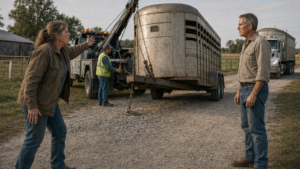
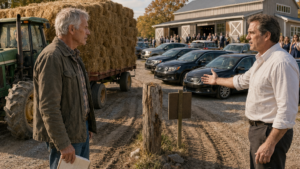
Mark Hall came around the equipment barn with a thermos in one hand and stopped so hard that coffee splashed across the lid.
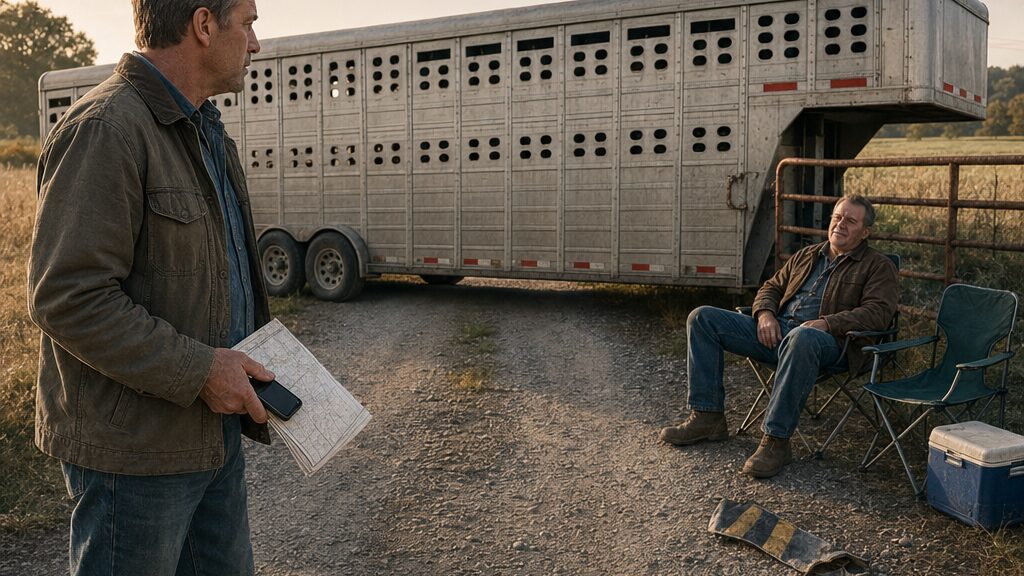
Forty feet of livestock trailer sat sideways across the gravel lane.
Its rear wheels were sunk near the ditch. The pickup attached to it rested on Richard Walker’s side of the fence, but the trailer itself stretched almost gatepost to gatepost, sealing the only usable road to Mark’s rear pasture.
Beyond it, Mark’s white service truck waited beside the barn with ladders strapped to the rack and two cases of electrical gear already loaded.
At seven-thirty he was supposed to be twelve miles east repairing a failed milk-house panel.
At eight, a livestock buyer was coming to look at six calves in Mark’s back lot.
Neither was getting through that trailer.
Mark set the thermos on the fence post.
“Richard.”
Richard appeared from behind the trailer carrying a folding chair.
He wore an old cap and work boots with the laces loose. He looked at Mark, looked at the blocked road, and opened the chair as though none of it required explanation.
“You need to move that.”
Richard lowered himself into the chair.
“I’m unloading later.”
“You’re blocking my access.”
“I’m on my property.”
“The truck is. The trailer isn’t.”
Richard reached into a cooler beside his boot.
Mark felt the answer rising in him before Richard even spoke. He had heard variations of it twice already that month—when the trailer had narrowed the lane, when a stack of round-bale feeders had been left near the gate, when Richard’s pickup had sat half on the gravel while he talked to a neighbor for forty minutes.
“There’s room,” Richard said.
“For what?”
Richard gestured vaguely toward the ditch.
Mark looked at the service truck. Even if he folded both mirrors, there was no way past without putting two wheels down the bank.
“I have work.”
“So do I.”
“Then move it ten feet.”
Richard cracked open a soda.
The rusted iron gate beside him gave a faint metallic squeal in the breeze. Mark’s father had rehung that gate twice over the years, never replacing it because he claimed good iron outlived good men if you kept oil on the hinges.
Now one half of it could barely swing because the trailer blocked its arc.
Mark walked to his truck and pulled a folded county plat from behind the seat.
When he returned, Richard was drinking from the can.
Mark opened the paper across the hood of Richard’s pickup.
“This strip right here. Sixteen feet. Recorded access from the county road to the rear parcel.”
Richard did not look down.
“I know what your paper says.”
“Then why are we doing this?”
That finally made Richard smile.
Not broadly. Just enough to make Mark feel foolish for asking.
“Because you act like a line on a map created that road.”
“It defines who can use it.”
“No. It defines what somebody got talked into signing.”
Mark held Richard’s gaze.
He had known the Walkers all his life without knowing them well. Richard had been three grades ahead of him. Their fathers had traded equipment sometimes. During hay season, men crossed property lines without asking because rain did not care whose field you were in.
But the farms had changed. Parcels had been sold. Fences had moved. Mark had mortgages, insurance inspections, customer schedules and a rear pasture with no other dependable vehicle access.
He folded the plat.
“I’m asking you once more. Move the trailer.”
Richard leaned back.
“Ask nicer.”
Mark almost laughed.
Instead he walked to the gatepost, where two days earlier he had wired a temporary yellow warning marker at eye level. It read that the access lane had to remain clear.
The marker hung crooked now.
Richard had apparently caught it with something while backing in.
Mark straightened it.
Behind him the chair creaked.
“You planning to police the road now?”
“I’m planning to use it.”
“You bought seventy acres and suddenly think you bought everybody around it.”
Mark turned.
“That isn’t what I said.”
“You don’t have to.”
The phone in Mark’s shirt pocket buzzed.
The dairy owner.
Mark answered and looked at his trapped service truck while he explained that he would be late.
“How late?” the man asked.
Mark looked at Richard.
“I don’t know yet.”
When the call ended, Richard was staring across the pasture.
Mark could have told him the truth—that this customer had called him first for nearly nine years, that farmers remembered who showed up during a breakdown, and that being late often meant not being called the next time.
He could have told him how close the farm loan had come to taking the rear acreage after his father died.
Instead Mark said, “You’re costing me work.”
Richard shrugged.
“There’s always another job.”
Something in Mark hardened.
He walked back to the temporary warning marker.
“This stays here.”
Richard stood.
For the first time that morning, the lazy humor left his face.
He crossed the gravel, took the marker between two fingers, pulled it free from the wire, and dropped it.
Then he stepped on it.
The thin plastic cracked beneath his boot.
Neither man spoke.
Mark looked down at the broken yellow rectangle pressed into the stones.
Then he looked at Richard.
He did not threaten him.
He did not touch the trailer.
He took out his phone and photographed the crushed marker, the trailer, the pickup and the blocked gate.
Richard watched him.
“What’s that supposed to do?”
Mark took one more photograph from the road.
“I don’t know yet.”
The livestock buyer eventually came around by the north field on foot. Mark missed the dairy call entirely; another electrician took it.
By late morning Richard moved the trailer without saying anything.
The lane opened.
Mark drove through the rusted gate and stopped for a moment on the other side.
He should have felt relieved.
Instead he found himself looking back at the gravel where the yellow plastic lay broken.
Richard was winding the trailer jack.
Mark unfolded the plat once more.
“Richard.”
Richard glanced over.
“You said somebody got talked into signing this.”
Richard’s hands stopped.
For several seconds the only sound was the chain on the gate tapping the post.
Then Richard said, “That was Walker ground before your deed ever existed.”
Chapter 2: Mark Stops Asking and Starts Measuring
The county clerk had already closed Mark’s parcel file when she noticed the second document number.
“Hold on.”
Mark was halfway out of the chair.
She turned back to her monitor and typed again.
“There’s an attachment.”
“What kind?”
“Older filing.”
The printer behind her started.
Mark sat down again.
Three days had passed since Richard blocked the road. Mark had spent most of them telling himself the argument no longer mattered because the lane was open.
Then he had driven past Richard’s place Monday evening and seen the livestock trailer positioned beside the fence, ready to move.
The clerk brought over four pages.
The first was a legal description written decades before Mark bought the farm. The second contained a crude survey drawing. The third and fourth recorded an easement granting access from the county road to what was now Mark’s rear acreage.
Mark traced the language with his finger.
Agricultural equipment.
Livestock transport.
Service vehicles.
Maintenance access.
“It’s not vague,” he said.
“No.”
“And it runs with the parcel?”
“Yes.”
“So he can’t block it.”
The clerk gave him the careful expression county employees learned after enough property disputes.
“I can tell you what’s recorded. I can’t tell you what enforcement action you should take.”
Mark nodded.
He had expected that.
Outside, he found Jonathan Moore sitting on a bench near the courthouse entrance, eating crackers from a paper sleeve.
Jonathan had retired from county road and records work five years earlier. Mark had called him because Jonathan had known both families and, more importantly, because he understood the difference between what people believed about land and what the courthouse actually had on paper.
Mark handed him the copies.
Jonathan read in silence.
“Well?”
“The easement’s real.”
“That’s what I thought.”
Jonathan kept reading.
“And broad enough for what you’re doing.”
“Then that’s it.”
Jonathan looked up.
“No. That answers what you can do. It doesn’t answer why a Walker is angry enough to park forty feet of steel across it.”
Mark leaned against the brick wall.
“Maybe because Richard likes being a pain.”
“That could be part of it.”
“Helpful.”
Jonathan tapped the oldest page.
“This was filed when those farms were split.”
“I know.”
“Do you know why they were split?”
Mark hesitated.
His father had never spoken much about it. Acreage changed hands. That happened.
“No.”
Jonathan folded the copies.
“Then don’t confuse having the legal answer with having the whole answer.”
Mark took the papers back.
“I need the legal answer today.”
“That I believe.”
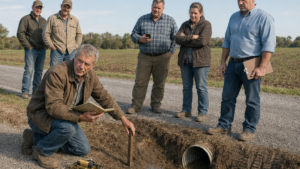
That afternoon he returned to the farm with a measuring tape, marking paint, a steel post and a small metal warning sign.
He started at the county-road edge.
Sixteen feet.
He measured again.
The old iron gate was set slightly crooked, but the opening itself sat comfortably within the recorded corridor.
Mark photographed the tape stretched across the gravel.
Then he measured from the fence line.
Then from the ditch.
Then from the gate to the point where Richard had parked the trailer.
He worked quietly, recording every angle.
At the feed store, he had asked the owner which towing company handled unauthorized equipment on private agricultural access. That led to a phone call, which led to another call, which led to a plain explanation: notice had to be clear, the obstruction had to be documented, and ownership of the vehicle had to be verifiable.
No one promised Mark anything.
That suited him.
He did not want favors.
He wanted a process.
By four o’clock he had dug a posthole beside the rusted gate.
He mixed concrete in a five-gallon bucket, set the steel post and checked it with a level.
When he lifted the sign into place, he heard an engine.
Richard’s pickup rolled slowly along the neighboring field.
It stopped near the fence.
Richard rested one arm through the window.
“What are you building?”
“Nothing.”
“Looks like something.”
Mark tightened the bottom bolt.
Richard read the sign from his truck.
His expression did not change.
“So this is what we’re doing now.”
Mark stood.
“I asked you to keep the lane clear.”
“You showed me your paper.”
“And you broke the warning.”
Richard looked toward the gate.
“That gate was there before you were.”
“So was the road.”
“That’s my point.”
Mark almost answered.
Instead he picked up the shovel and filled the edge of the hole.
Richard waited as though silence itself were an insult.
Finally he said, “You ever wonder why that easement exists in the first place?”
Mark tamped the soil.
“It exists because it’s recorded.”
Richard laughed once.
“That’s exactly your problem.”
He drove away.
Mark stared after him.
Jonathan’s warning returned to him: the legal answer was not the whole answer.
But Richard had just watched him set the post. He had seen the sign. He could no longer claim confusion.
Mark took photographs from the county road, from the gate, and from halfway down the lane.
He saved copies to a folder on his computer.
Then he put the modern plat and the older filing together in the desk drawer.
For the first time since the argument began, he felt that the problem had shape.
Not resolution.
Shape.
There was a line.
There was a record.
There was notice.
If Richard crossed all three, the consequence would belong to Richard.
For four days nothing happened.
Friday evening, Mark hauled hay through the lane without trouble. The iron gate swung wide, scraping faintly at the hinge.
He stopped and worked oil into the joint until the squeal softened.
Saturday morning, before sunrise had burned the gray from the eastern sky, Mark carried his coffee toward the barn.
He heard a diesel engine idling.
Then he rounded the corner.
Richard’s livestock trailer was parked in exactly the same place as before.
Two folding chairs sat beside it.
A cooler rested between them.
And Richard Walker was already there.
Chapter 3: The First Tow Changes Nothing
The tow truck reversed down the gravel lane with its warning lights flashing against the side of Richard Walker’s unattended livestock trailer.
Mark stood beside the rusted gate holding his phone.
He had already taken nineteen photographs.
Wide shots.
Close shots.
The trailer wheels.
The steel warning post.
The blocked gate.
The license plate.
The distance between the trailer and the ditch.
He had also recorded one slow video from the county road to the barn, showing that no truck, wagon or livestock trailer of his own could pass.
The tow operator climbed down.
“You’re Hall?”
“Yes.”
“Your property?”
“The access is recorded to my parcel.”
Mark handed over the county copy and the photographs.
The operator studied them, then looked at the sign.
“You gave notice?”
“He saw me install it.”
“That isn’t what I asked.”
Mark appreciated the bluntness.
“Yes. Written notice yesterday. Copy was delivered.”
The operator nodded.
“Good.”
He began working.
Mark stayed out of the way.
That was the strangest part.
For weeks Richard’s trailer had seemed enormous. It had dominated every conversation, every glance toward the road, every morning schedule.
Once the operator attached the chains and started lifting, it became only a machine being removed from a place where it should not have been.
The first movement of the trailer wheels sent a small wave of gravel outward.
Mark watched the gap appear.
Then another foot.
Then six.
The rusted gate was free.
He opened it.
The hinge gave its familiar rough groan.
By the time the tow truck reached the county road, Mark could see straight from the barn to the rear pasture.
He stood there longer than necessary.
No shouting.
No victory.
Just open gravel.
He drove his service truck through, turned around behind the barn and came back without touching the grass on either side.
That small fact satisfied him more than he expected.
The lane worked exactly as it was supposed to.
At eleven, Mark hauled mineral tubs to the cattle.
At noon, he brought a hay wagon through.
For the first time in weeks, he did not have to calculate whether Richard might be in the way.
At twelve-thirty, tires tore into the gravel near the house.
Richard’s pickup stopped so abruptly the suspension rocked.
He was out before the engine quit.
“Where is it?”
Mark was washing grease from his hands at the outdoor faucet.
“You know where.”
“You had my trailer taken?”
“I had the obstruction removed.”
Richard came across the yard.
The smugness from the folding chair was gone.
“You think that wording makes you clever?”
“No.”
“You had no right.”
Mark dried his hands.
“I documented the lane, the notice and the obstruction. The towing company made its own decision.”
“Don’t hide behind them.”
“I’m not hiding.”
Richard stopped a few feet away.
For a moment Mark thought the argument might finally become physical.
Richard’s hands were closed, but he kept them at his sides.
“You know what they want?”
“No.”
“Eight hundred and change before storage.”
Mark said nothing.
“Almost nine hundred dollars for a trailer that was sitting on ground my family has used since before you were born.”
“It was blocking my road.”
“Your road.”
“My access.”
“That’s what you call it now.”
Mark felt his temper move.
“You watched me set the sign.”
“I watched you plant a piece of metal like you’d conquered something.”
“I asked you twice.”
“And I told you that road isn’t what you think.”
“I think I need to get to my barn.”
“You always make it sound that simple.”
“It is simple when you park across it.”
Richard looked past him toward the gate.
Mark could see something beneath the anger now, something he had missed while Richard was smiling.
Not uncertainty.
Injury.
That did not make the obstruction acceptable.
But it changed its shape.
Richard pointed toward the gravel.
“My dad graded that lane.”
Mark said nothing.
“My grandfather hauled cattle through there. We fixed that ditch. We set that gate.”
“And?”
“And then your father gets a piece of paper and suddenly everybody acts like we handed it over.”
Mark stiffened at the mention of his father.
“My father didn’t write county law.”
“No. He just knew when to use it.”
The words landed harder than Mark expected.
“What’s that supposed to mean?”
Richard looked at him for several seconds.
Then he shook his head.
“Of course you don’t know.”
He walked back toward his pickup.
Mark followed two steps.
“Know what?”
Richard opened the door.
“You want everything handled through paperwork? Fine. Read more paperwork.”
He drove off.
Mark stood in the yard with the towel still in his hand.
The first tow had been supposed to settle the question.
Instead it had created a larger one.
That afternoon the towing company emailed Mark confirmation of the removal. He printed it and placed it beside his photographs.
He should have felt vindicated.
The trailer was gone.
The lane was clear.
Richard had finally paid for ignoring him.
But the sentence about Mark’s father would not leave.
He opened the desk drawer and removed the old filing the county clerk had found.
He read every line.
Nothing in it suggested coercion.
Nothing explained why Richard spoke as though the easement had been taken rather than granted.
Near dusk, a vehicle slowed at the end of Mark’s driveway.
Linda Baker got out.
Mark knew her well enough to wave at the feed store and not well enough to expect her at his house.
She carried no folder.
No envelope.
She looked toward the newly cleared lane before coming up the steps.
“I heard about the trailer.”
“Richard tell you?”
“He didn’t need to.”
Mark waited.
Linda glanced through the screen door toward the desk where the plat lay open.
“You’ve been checking records.”
“Yes.”
“The current ones?”
“And the easement filing.”
She nodded slowly.
“That’s not the one I mean.”
Mark leaned against the doorframe.
“Richard told me to read more paperwork.”
Linda looked tired.
“He’s angry. That doesn’t mean everything he says is wrong.”
“He blocked the road after written notice.”
“I know.”
“And broke my warning.”
“I know that too.”
“Then what are you here for?”
Linda did not answer immediately.
Instead she looked past him toward the rusted gate.
“When we were kids, that gate wasn’t a boundary.”
Mark followed her gaze.
“What was it?”
“Just a gate.”
She turned back to him.
“Have you ever seen the parcel map from before our farms were divided?”
Chapter 4: The Map Before the Fence Line
Linda Baker’s map did not match Mark’s.
She spread it across her kitchen table beside the modern county plat, weighted both corners with a sugar bowl and an old ceramic mug, then tapped a faded pencil line with one finger.
“Your road is here now,” she said.
Mark looked at the modern survey.
Then at hers.
On Linda’s map, the lane did not appear to belong to either farm because, at the time it was drawn, there had not been two farms.
One long parcel ran from the county road over the rise, through what was now Richard’s pasture, past the rusted gate, and into the acreage Mark owned today.
Mark leaned closer.
“How old is this?”
“Older than either of us.”
“And this was all Walker property?”
“At one time.”
Linda pulled a photograph from beneath the map.
The picture had gone brown around the edges. Two boys stood beside a tractor near the same iron gate that now divided the properties. The gate was open. No fence continued from either side of it.
Mark recognized his father as one of the boys only after Linda pointed him out.
The other was Richard’s father.
“They worked together?”
“Everybody worked together then.”
“That isn’t what Richard says.”
“Richard remembers what happened later.”
Mark straightened.
“You told me there was an older parcel map. You didn’t say my father was part of this.”
Linda’s mouth tightened.
“I said you hadn’t seen all of it.”
She slid another paper across the table.
It was a copy of a transfer document from the years when part of the Walker land had been sold. Mark read the legal description once, then again.
The acreage that became the Hall farm had been separated from the larger Walker tract during a period when several liens were listed against the property.
At the bottom of one negotiation page was his father’s signature.
Mark stopped.
“What was he doing in this?”
Linda looked toward the window.
“I don’t know every conversation.”
“That’s his signature.”
“I know.”
“Was he buying the land?”
“Not then.”
Mark pushed his chair back.
The kitchen suddenly felt too small.
His father had always described the rear acreage as something acquired later, after years of renting neighboring ground. He had never mentioned being involved while the Walkers were selling pieces of their farm.
“What happened?”
Linda folded her hands.
“The Walkers were behind. Feed bills. Equipment. Taxes. There’d been a bad year, then another bad year.”
“And my father?”
“He was renting pasture from them.”
Mark looked again at the signatures.
“He pressured them?”
“I didn’t say that.”
“Richard did.”
“Richard was young.”
“So was I.”
“That doesn’t make either of you accurate.”
Mark exhaled sharply.
Linda took the old photograph and turned it toward him.
“Before the parcel sale, nobody needed an easement. That lane was inside one property. Your father used it because our father let him.”
“As a favor.”
“At first.”
The words bothered Mark more than they should have.
He had spent weeks telling Richard that recorded rights mattered. Now every older piece of paper seemed to say those rights had been built on something less formal first.
Linda continued.
“When land got divided, access to the rear acreage had to be dealt with. That’s when it stopped being a handshake.”
“And became permanent.”
“Yes.”
“Richard thinks my father used their debt to get it.”
Linda did not answer.
That silence followed Mark to the county archive.
The records clerk brought out the transaction packet later that afternoon. Mark sat beneath fluorescent lights turning brittle pages while the room’s ventilation system hummed overhead.
Purchase option.
Parcel division.
Loan correspondence.
Access language.
Then he found another page with his father’s signature.
Not on the easement itself.
On a letter connected to negotiations.
The wording was plain enough: without reliable access to the rear fields, his father would not proceed with a later purchase agreement.
Mark read it three times.
Jonathan Moore stood beside the cabinet, spectacles low on his nose.
“That bothering you?”
“My father made access a condition.”
“That seems reasonable.”
“Does it?”
Jonathan looked at him.
“You wanted him to buy land he couldn’t reach?”
“That isn’t what I mean.”
“I know.”
Mark pushed the paper away.
“If the Walkers were desperate for money, and he knew it—”
“Then you’re trying to decide whether leverage is the same thing as coercion.”
Mark said nothing.
Jonathan took the chair opposite him.
“Property records tell you what happened on paper. They don’t tell you how somebody felt when they signed.”
“So Richard could be right.”
“About being angry? Certainly.”
“About my father taking advantage?”
Jonathan glanced at the file.
“I don’t know.”
Mark hated the answer because it was honest.
For the first time since the trailer appeared, he could see a version of the story in which Richard had inherited more than stubbornness.
He had inherited a grievance.
That still did not justify blocking a road.
But it explained why a nine-hundred-dollar tow had felt to Richard like something older than a towing bill.
When Mark returned home near sunset, the rusted gate was closed.
He slowed.
Richard’s pickup sat sideways across the gravel lane.
Not near it.
Across it.
The nose was almost against the ditch, the tail nearly touching the fence.
There was no trailer this time.
No chairs.
No cooler.
Just the truck.
Richard stood on the opposite side of the gate with his arms folded.
Mark got out.
“What is this?”
Richard nodded toward the folded papers under Mark’s arm.
“Find anything interesting?”
“Move your truck.”
“You find my dad’s debts?”
Mark said nothing.
Richard’s expression changed slightly.
“So you did.”
“I found records.”
“And?”
“And I’m still reading them.”
Richard walked closer to the gate.
“That’s new.”
“What is?”
“You admitting paper might not tell you everything.”
Mark looked at the truck.
“Move it.”
“Talk to me about the road.”
“We can talk after you move it.”
“No.”
Mark felt heat rise into his face.
“This is exactly the problem.”
Richard shook his head.
“No, Mark. The problem is that you want the lane settled before the history gets discussed.”
“The history doesn’t give you the right to block me.”
“And the easement doesn’t erase how it happened.”
Mark stepped closer.
“You want to challenge it, challenge it legally.”
Richard gave a humorless smile.
“That what your dad told mine?”
Mark went still.
Richard opened his truck door but did not get in.
“Tomorrow,” he said. “You want the road open, come talk about the road.”
Then he walked back toward his house, leaving the pickup broadside across the lane.
Chapter 5: The Day Richard Blocks the Ambulance Route
Mark’s phone rang while he was staring at Richard’s pickup.
He nearly ignored it.
Then he saw the call was coming from the rear pasture.
He answered.
“Mark?”
The voice on the other end was strained.
“One of the hands got hurt by the hay wagon.”
Mark was already moving.
“How bad?”
“Leg. Maybe hip. He’s down and can’t put weight on it.”
“Call emergency services.”
“Already did.”
Mark looked through the rusted gate at the pickup blocking the lane.
His stomach dropped.
“Tell them the main farm access is off County Twelve. I’ll open it.”
He ended the call and walked fast toward Richard’s house.
Richard came out before Mark reached the porch.
“What?”
“There’s an injured man in my rear field. Move the truck.”
Richard’s face changed, but only for a second.
“Use the upper cut.”
“It’s too narrow for an ambulance.”
“You get tractors through.”
“Not an ambulance.”
Mark pointed toward the lane.
“Move it now.”
Richard looked past him at the road.
“You wanted me to settle this through proper channels.”
“This is not the time.”
“It’s exactly the time.”
Mark stared at him.
Richard crossed his arms.
“We settle the road. You agree this isn’t some unlimited corridor through my property, and I move the truck.”
Mark could not believe what he was hearing.
“Someone is hurt.”
“And I’m not stopping you from helping him.”
“You are blocking the route.”
“There’s another way.”
“For a pickup. Maybe.”
Richard’s jaw worked.
Mark understood suddenly that Richard had convinced himself this was leverage, not danger.
That somehow made it worse.
“You think this is about winning an argument?”
“I think if I move that truck, you go right back to pretending there’s nothing to discuss.”
A siren sounded faintly from the county road.
Mark turned.
For years he had told himself that staying calm made him reasonable.
He had been calm when Richard laughed.
Calm when the warning was crushed.
Calm when the trailer returned.
Calm while he photographed everything.
Now calm felt dangerously close to silence.
“You want to know what this road costs me?” Mark said.
Richard frowned.
“I lost a dairy account because you blocked me the first weekend.”
Richard’s arms dropped slightly.
“I had to send a livestock buyer around through mud on foot. I’ve rescheduled service calls. I’ve turned around loaded wagons because I didn’t know if I could get back through.”
“You never said that.”
“I shouldn’t have to give you my books before you stop parking across a legal access.”
“That’s not what I meant.”
“No. You decided it wasn’t hurting anything because I kept it to myself.”
The siren grew louder.
Mark stepped closer.
“And now there’s a man on the ground behind my barn.”
Richard looked toward his pickup.
For one second Mark thought he was going to move.
Then Richard said, “If they need through, I’ll move when they get here.”
Mark stared at him.
That was the moment something broke—not between them, because that had happened earlier, but inside Mark’s belief that procedure alone could contain the dispute.
He pulled out his phone.
“I’m documenting this.”
Richard’s eyes narrowed.
“Go ahead.”
Mark photographed the truck across the lane.
Then he called the emergency dispatcher and explained the obstruction.
The ambulance reached the county-road entrance minutes later and stopped.
Its driver got out, looked down the lane, then at Richard’s truck.
“That can’t stay there.”
Richard walked toward them.
“I can move it.”
But the driver was already looking at the upper pasture entrance.
Mark pointed.
“We can get a utility vehicle through from the north side. It’s rough.”
The ambulance crew made the decision quickly. One of them transferred equipment into Mark’s farm utility vehicle while the ambulance remained near the road.
Mark drove.
The upper route cut across a shallow drainage swale, through a narrow pasture opening, and along the back fence.
Every bounce felt like wasted time.
They reached the injured worker lying beside the hay wagon.
His face was gray with pain, but he was conscious.
That was the first relief Mark had felt all afternoon.
The crew stabilized him and arranged to bring him back out through the alternate opening.
It worked.
But it worked badly.
Slowly.
Carefully.
With equipment carried farther than it should have been.
When Mark returned to the main lane, a sheriff’s deputy was standing beside Richard’s pickup.
Richard had finally moved it onto his own side.
The deputy was writing.
Richard looked furious.
Mark felt nothing triumphant.
The deputy asked him what had happened.
Mark gave the facts.
No speeches.
No history.
He explained the call, the blocked lane, the request to move, the refusal, the alternate route.
Richard interrupted once.
“I told him I’d move when they arrived.”
The deputy looked at him.
“Why wasn’t it moved before they arrived?”
Richard said nothing.
The deputy returned to his notes.
Mark watched the rusted gate.
A chain had been looped through it sometime during the confusion, probably by Richard when he shifted the truck. The gate itself was no longer physically blocked, but the chain made the whole thing look locked down, contested.
The injured worker was transported.
The immediate danger passed.
Only then did Mark realize his hands were shaking.
Linda’s pickup arrived before the deputy left.
She got out and walked toward Richard.
“What happened?”
Richard glanced at Mark.
“Ask him.”
“I already heard an ambulance came.”
“It’s handled.”
Linda looked from Richard to the lane, then to the deputy.
“You blocked it?”
Richard’s face hardened.
“I was trying to get him to sit down and settle the access.”
“With a truck across the road?”
“He had another way.”
Linda stared at him.
For the first time, Mark saw Richard look younger—not physically, but defensively, like a son waiting for someone to agree with the version of the family story he had carried for years.
“He keeps acting like Dad gave that road away,” Richard said.
Linda’s expression changed.
“He did give access.”
“He was pressured.”
“Richard.”
“You know he was.”
Linda closed her eyes briefly.
Mark said nothing.
This was their argument now.
Richard pointed toward Mark.
“His father knew we needed money.”
Linda looked at her brother.
“Yes.”
Richard’s face tightened as though agreement proved everything.
Then Linda continued.
“But Dad signed that road for a reason you never asked about.”
Richard went still.
“What reason?”
Linda looked at Mark, then back at Richard.
“Not here.”
Richard laughed once.
“No. You brought it up. Say it.”
Linda shook her head.
“You’ve spent years telling this story as if Dad was too weak to say no.”
“He was cornered.”
“You don’t know that.”
“I was there.”
“You were sixteen.”
Richard’s face reddened.
“And you were what, twenty? That makes you the expert?”
“No.”
Linda’s voice stayed low.
“It makes me the one he talked to afterward.”
Richard stared at her.
The deputy stopped writing.
Even Mark forgot the paperwork in his hand.
Linda looked toward the gate.
“Dad signed that road for a reason you never asked about.”
This time Richard did not answer.
Chapter 6: What Their Fathers Actually Agreed To
Linda put the note on the Walker farmhouse table and kept her fingers on it.
Richard stood on the other side.
Mark had not wanted to come inside.
He had said as much.
Linda had replied that if the two men were going to keep fighting over what their fathers had done, they should at least know what their fathers had actually done.
So Mark came.
The note was one sheet of yellowed paper folded twice.
Richard looked at it without touching it.
“What is that?”
“Dad’s.”
“I can see that.”
“He wrote it after the parcel sale.”
Richard looked at Linda.
“You had this?”
“Yes.”
“For how long?”
“A long time.”
His anger shifted direction immediately.
“You let me believe—”
“I let you believe what you wanted to believe.”
Mark glanced toward the door.
Linda noticed.
“Stay.”
Richard gave Mark a hard look.
“He doesn’t need to hear this.”
“He’s been paying for it too.”
That silenced the room.
Linda opened the note.
She did not hand it over immediately.
Instead she read one section herself, as though checking whether the years had changed the words.
Then she slid it toward Richard.
Mark stayed where he was.
Richard read.
At first his face remained hard.
Then his shoulders lowered.
He read again.
“What does it say?” Mark asked.
Richard did not answer.
Linda did.
“It says Dad knew selling the rear acreage without guaranteed access would make it nearly useless.”
Mark looked at the note.
Linda continued.
“He also knew your father was the only buyer willing to keep using it as farm ground instead of carving it up again.”
Richard shook his head.
“That’s not what he told us.”
“He didn’t tell us much.”
“He said they pushed him.”
“He said he hated signing.”
“Same thing.”
“No.”
Linda’s voice sharpened.
“It isn’t.”
She finally took the note and handed it to Mark.
The handwriting was uneven but readable.
Richard’s father had written that he resented losing acreage, but selling part of the farm would pay overdue obligations and keep the remaining Walker property intact.
He had also written that the Hall family needed permanent access if the rear fields were ever to remain productive.
One sentence made Mark pause.
Better one road kept open than two farms shut down.
He read it again.
His father’s name appeared later.
Not as a hero.
Not as a villain.
As a man negotiating hard over land he intended to work.
There was more.
Richard’s father admitted he had insisted on compensation in the parcel price for granting permanent access.
Mark looked up.
“He was paid for the easement.”
Linda nodded.
Richard frowned.
“For part of it.”
“Yes.”
“You never told me.”
“You never asked.”
“I asked plenty.”
“You accused. That’s different.”
Richard pushed away from the table.
“So Dad was happy about it?”
“I didn’t say that.”
Linda’s tone softened.
“He hated selling ground. He hated needing the money. He hated that another family would have a permanent right across land that had been Walker land.”
Richard turned toward the window.
“But he chose it.”
“Yes.”
The words seemed to take something out of him.
Mark understood why.
For weeks Richard had behaved as if accepting the easement meant admitting his father had been beaten.
Now the truth was more difficult.
His father had made a choice.
A painful one.
A practical one.
And Richard had spent years turning that choice into an injury because anger was easier to inherit than compromise.
Mark looked back at the note.
His own discomfort had not disappeared.
There were records showing his father knew the Walkers were under financial pressure.
He had negotiated firmly.
Possibly coldly.
Mark said, “My father still benefited.”
Linda nodded.
“So did ours.”
“That doesn’t make it equal.”
“No.”
Richard turned.
For the first time all evening, the anger in his face looked exhausted rather than aggressive.
“You think this clears him?”
Mark knew Richard meant Mark’s father.
“No.”
Richard seemed surprised.
Mark placed the note on the table.
“I think my father knew your family needed money and used that fact to make sure he got access before he bought anything.”
Linda watched him.
Mark continued.
“That was good business for him.”
Richard’s mouth tightened.
“And bad for us.”
“Maybe.”
Mark looked at the old paper.
“But your father wasn’t tricked into signing.”
Richard did not respond.
“And none of it gives you the right to park across the lane now.”
There it was again.
The legal sentence.
The old shield.
Mark heard how quickly he reached for it.
He forced himself to continue.
“I should have told you what the blockages were costing me.”
Richard gave him a skeptical look.
“That wouldn’t have changed the deed.”
“No.”
“Wouldn’t have changed what your dad did.”
“No.”
“But you think it changes this?”
Mark looked toward the dark window where the lane lay beyond the pasture.
“I think I kept saying ‘legal access’ because it was easier than saying I’m scared of losing the farm.”
Neither Linda nor Richard spoke.
Mark had never said it aloud.
Not to Jonathan.
Not to customers.
Not even to himself in those words.
“My father left debt with the land,” Mark said. “I told him before he died I’d keep the rear acreage working. Every service job matters. Every cattle sale matters. When you block that road, I don’t see Walker history. I see the bank taking another piece because I couldn’t keep things moving.”
Richard looked down.
Mark rubbed a thumb across the edge of the table.
“That doesn’t excuse how your family got squeezed.”
“No,” Richard said.
It was the first quiet word he had given Mark in weeks.
Linda sat back.
For a moment Mark thought the conflict had finally reached the place where it could end.
Then Richard asked, “What are you claiming from me?”
Mark understood immediately.
“Towing. Lost work. Damage to the warning. Costs tied to the emergency access issue.”
“How much?”
“I haven’t totaled it.”
“You’re going to.”
“Yes.”
Richard gave a bitter smile.
“So we’re back to money.”
“We were never away from it.”
Richard folded the note and pushed it back toward Linda.
“I’m not paying for every job you say you lost.”
“I didn’t ask you to.”
“You will.”
“I’ll document what I can prove.”
Richard nodded slowly, as though Mark had confirmed something.
“And I’ll challenge the easement.”
Linda stared at him.
“After reading that?”
“Dad agreeing to it doesn’t mean the modern use is unlimited.”
“It specifically covers agricultural and service access,” Mark said.
“Then a judge can tell me that.”
The fragile understanding vanished.
Not completely.
But enough.
Mark stood.
“I’m not stopping you.”
Richard looked at him.
“No more towing?”
“If you block it again, I’ll enforce it again.”
Richard almost smiled.
Not the old smug smile.
Something tired.
“There you are.”
Mark left before he answered.
The next morning, the rusted gate stood open.
Richard’s pickup was gone.
For several hours Mark allowed himself to think the argument had moved into a colder but safer phase.
Then the mail carrier brought a certified envelope.
Inside was formal notice that Richard Walker intended to challenge the scope and continued use of the easement.
Mark read the first page at his kitchen table.
The modern county plat lay beside it.
Linda’s old map sat underneath.
For the first time, he had both versions of the road in front of him.
And he had to decide which kind of victory he was willing to pay for.
Chapter 7: The Gate Stays Open, but Not for Free
Mark carried two maps into the county mediation room.
The modern plat was folded neatly inside a clear sleeve. Linda’s older map was soft at the creases and had to be supported with both hands when he unfolded it.
Richard Walker was already seated across the table.
He looked at the maps before he looked at Mark.
Between them sat a stack of invoices, photographs of the blocked lane, the towing record, the deputy’s report from the ambulance incident, and Richard’s formal challenge to the easement.
Mark had spent two weeks calculating what he could demand.
Lost electrical work.
The damaged warning.
Towing-related expenses.
Time spent documenting the obstructions.
Costs associated with the formal dispute.
On paper, the number had grown large enough to hurt.
That had once seemed satisfying.
Now it simply looked expensive.
The mediator reviewed the easement language first.
Richard’s argument was narrower than before. He no longer claimed the road belonged exclusively to his family. Instead, he argued that the easement had been stretched beyond what his father intended.
Mark listened without interrupting.
When Richard finished, the mediator looked at the recorded language.
“Agricultural equipment, livestock transport, service vehicles and maintenance access.”
“Yes,” Richard said.
“That is fairly broad.”
“It doesn’t say he gets to treat the whole strip like his private road.”
Mark started to answer, then stopped.
Two weeks earlier he would have pointed at the document.
He would have said the language was obvious.
Instead he asked, “What use are you worried about?”
Richard glanced at him.
“What?”
“You keep saying I’m taking more than the easement gives me. What exactly do you think I’m going to do?”
Richard leaned back.
For a moment he seemed almost annoyed that Mark had asked.
Then he said, “It starts with trucks. Then somebody widens it. Then there’s gravel on another three feet. Then a fence moves because a trailer needs turning room. Ten years later everybody says it’s always been that way.”
Mark looked at the old map.
That was not an imaginary fear.
It was exactly how rural boundaries sometimes changed in people’s memories long before they changed anywhere else.
“I don’t need it wider,” Mark said.
Richard watched him carefully.
“I need sixteen feet clear. That’s what’s recorded.”
“And the ditch?”
“Stays where it is.”
“The fence?”
“Stays where it is unless we both agree otherwise.”
Richard looked toward the mediator.
Mark reached into his folder.
“I wrote something.”
He slid a single page across the table.
Richard did not pick it up.
“What is it?”
“An offer.”
The mediator read first.
Mark had proposed permanent lane markers set within the recorded easement, shared gravel maintenance where the road crossed Richard’s property, no widening without written agreement, and no parking or storage within the access corridor.
The towing charges already incurred would remain Richard’s responsibility.
Mark would withdraw part of his claim for lost work and additional damages.
Richard finally picked up the page.
“You’re dropping money?”
“Some of it.”
“Why?”
Mark looked at him.
“Because I want the road.”
“You already have the road.”
“I have a legal fight about the road.”
Richard’s mouth tightened.
Mark continued.
“I don’t want to spend the next two years proving something that’s already written down while both farms pay lawyers to argue over what our fathers meant.”
The room went quiet.
Richard read the proposal again.
“And if I say no?”
Mark looked at the photographs.
The trailer.
The crushed warning.
The pickup across the lane.
The ambulance stopped at the county road.
“If you say no, I defend the easement. All of it.”
“You think you’d win.”
“I think your challenge is weak.”
The mediator did not contradict him.
Richard noticed.
His fingers tightened around the page.
“And then you’d come after the rest of this?”
Mark looked at the invoices.
“Yes.”
There was no satisfaction in saying it.
Richard stared at him for several seconds.
“You could make this cost me.”
“It already has.”
Richard gave a short, humorless breath.
“That trailer bill alone was ridiculous.”
“You parked it there after notice.”
“I know.”
It was the first time Richard had said those words without attaching an argument.
Mark looked down at the two maps.
“When I first brought the plat to you, I thought that should end the conversation.”
“It didn’t.”
“No.”
Mark touched the older map.
“And when Linda showed me this one, I thought maybe it meant my father had done something wrong enough to change everything.”
Richard’s expression shifted.
“Did he?”
“He negotiated hard.”
“So did mine.”
“Yes.”
Neither man spoke for a moment.
Mark thought of the handwritten line from Richard’s father.
Better one road kept open than two farms shut down.
Their fathers had not left them a clean story.
They had left them functioning land.
And resentment.
Both had survived.
Richard tapped the proposal.
“You want me to pay the towing costs.”
“Yes.”
“Both removals.”
“Yes.”
“And the damaged sign.”
“Yes.”
“But you drop the lost-income claim.”
“The part I can’t prove cleanly.”
Richard looked almost surprised.
“You probably lost the dairy account.”
“I did.”
“That was because of me.”
“In part.”
Richard rubbed a hand over his face.
Mark had imagined this meeting dozens of times.
In most versions, Richard finally admitted everything, apologized, and accepted the consequences.
Reality was quieter.
Richard looked tired.
So was Mark.
“What about the gate?” Richard asked.
Mark glanced at the proposal.
“It gets rehung two feet inside the Walker side so the swing doesn’t narrow the corridor.”
“My side.”
“Yes.”
“And it stays ours.”
“The gate does.”
Richard nodded slowly.
“The access doesn’t.”
“No.”
Richard looked at the old map one last time.
Then he signed.
Mark did not feel victorious.
He felt something unclench.
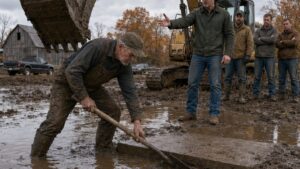
A week later they reset the boundary markers.
The work was simple enough that neither man needed help.
Richard held the post while Mark checked the measurement.
“Sixteen?”
“Sixteen.”
“You measured twice?”
Mark looked at him.
Richard almost smiled.
“Just asking.”
Mark measured again.
“Sixteen.”
They rehung the rusted iron gate on new hinges inside Richard’s line.
When Mark pushed it open, it moved without scraping the gravel.
No squeal.
No chain catching.
Just the heavy iron swinging cleanly until it rested against the fence.
Richard stood beside it with his hands on his hips.
“My dad would’ve replaced that thing twenty years ago.”
“My dad refused.”
“He said old iron was better.”
Mark glanced at him.
“You heard that too?”
“Everybody heard that.”
For a second, both men smiled.
It did not erase the tow bills.
Richard still had to pay them.
It did not erase the ambulance delay, the crushed warning, or the weeks when each man had assumed the worst motive in the other.
They did not become friends.
Some mornings Richard passed through the lane on foot without looking toward Mark’s barn.
Some afternoons Mark drove his service truck through while Richard worked the adjoining pasture, and neither raised a hand.
But the lane stayed clear.
The new markers remained where they had been set.
No trailer appeared across the gravel.
No pickup sat sideways at the entrance.
And Mark stopped keeping the modern plat behind the seat of his truck.
He returned it to the house.
The old map went into the same drawer.
Late that fall, Mark hauled a wagon of hay toward the rear pasture.
At the gate he saw Richard approaching from the opposite direction with his pickup.
Mark slowed.
So did Richard.
For one old, instinctive second, both seemed to calculate who had the stronger claim to the narrow place.
Then Richard backed up into his own turnout.
Mark drove through.
He stopped beyond the gate and looked in the mirror.
Richard waited until the wagon cleared, then pulled forward.
No wave.
No apology.
No contest.
Mark climbed down and pushed the rusted gate fully open before continuing toward the pasture.
Behind him, Richard used the same lane in the other direction.
The gate remained open between the two farms.
The story has ended.