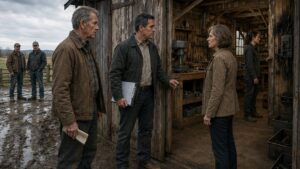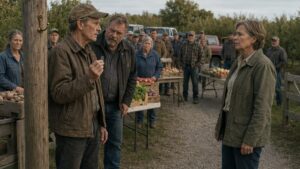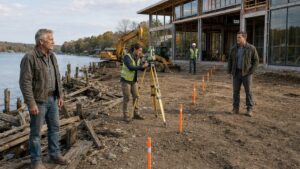
They Cleared Her Mother’s Christmas Basket From the Farm Gate—Then She Read the Easement They Never Expected Her to Find
Chapter 1: The Crates Beside the Cedar Gate
Christine Carter knew the basket before she could make out the man carrying it.
Even in the gray light before sunrise, she recognized the crooked handle her mother had wrapped with green ribbon years ago, the shallow wicker sides, the pinecones wired together so carefully that none had ever fallen loose.
A stranger was walking away with it.
Christine stopped halfway down the porch steps.
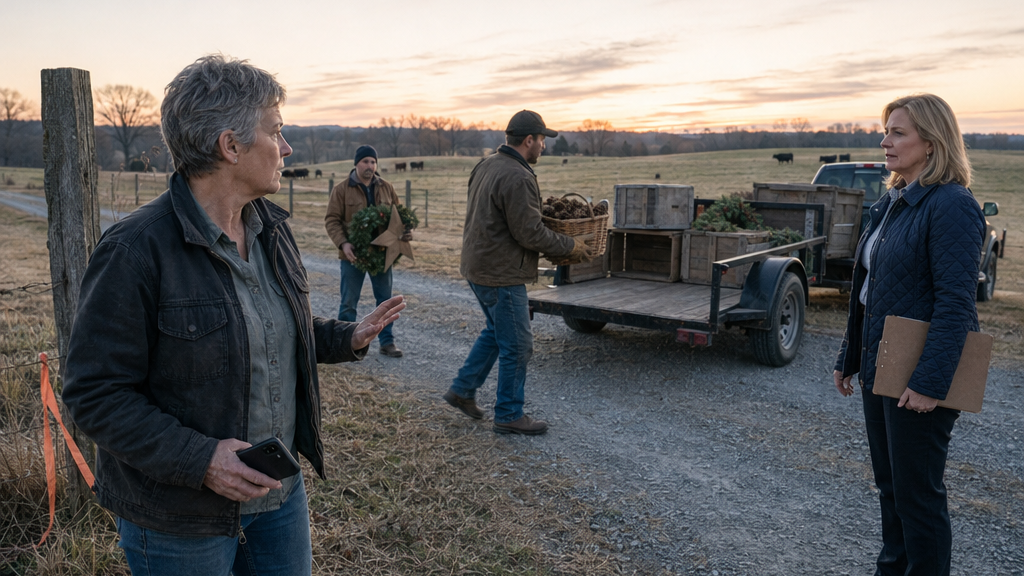
At the end of her driveway, beside the cedar gateposts, two men were loading wooden crates onto a small utility trailer. Garland, battery candles, painted wooden stars, two red bows, and the little tin lanterns Christine put out every December were already stacked inside.
Her mother’s basket sat on top.
“Hold on.”
Her voice carried farther than she intended.
One worker froze. The other looked toward the woman standing near the gravel lane.
Jennifer Wilson turned slowly.
She wore a quilted jacket over clean clothes and held a clipboard against her chest. Even from thirty yards away, Christine could see that Jennifer did not look surprised to see her.
Christine walked toward them, boots crunching over the frozen grass.
“What are you doing?”
Jennifer glanced toward the crates.
“Clearing the access area.”
“That’s my property.”
“It’s inside the lane clearance.”
Christine looked from Jennifer to the trailer.
There were twenty-two pieces if she counted the garland sections separately. She knew because she had carried them out herself three days earlier.
“What lane clearance?”
Jennifer exhaled through her nose.
“The association discussed this. We can’t keep having things along the access road.”
“These aren’t along the road.”
“They’re inside the maintenance area.”
One worker had reached for the basket again.
Christine lifted one hand.
“Please don’t touch that.”
He stopped.
Jennifer said, “They’ve already been instructed to remove everything.”
Christine stepped closer to the crate. The basket smelled faintly of cedar even after all these years. Her mother had made it the winter Christine’s husband was still alive, back when the two of them sold wreaths from a folding table beside the gate.
Christine touched the handle once.
“My mother made this.”
Jennifer’s expression changed, but only slightly.
“I understand things have sentimental value.”
“No,” Christine said. “I don’t think you do.”
The worker looked down.
Jennifer tightened her grip on the clipboard. “Christine, this isn’t personal.”
Christine almost laughed.
Instead, she took out her phone.
Jennifer frowned. “What are you doing?”
“Taking pictures.”
She photographed the basket in the crate.
Then the crates.
Then the trailer.
Then Jennifer.
Then she turned her camera toward the ground.
A faded orange survey ribbon had been tied years ago to a short metal stake near the cedar post. Most people would have missed it beneath the winter grass.
Christine had barely thought about it herself in years.
She photographed that too.
Jennifer shifted her weight.
“You don’t need to make this into something bigger than it is.”
Christine looked up. “Where does the recorded right-of-way end?”
Jennifer blinked.
“The what?”
“The recorded right-of-way. Where does it end?”
“The association maintains this entire entrance.”
“That wasn’t my question.”
Jennifer’s mouth tightened.
“Everybody who lives back here knows we keep this area clear.”
Christine looked at the gravel.
The lane itself was only wide enough for two pickups to pass carefully. Beyond it lay a shallow drainage edge, then grass leading toward Christine’s gate.
Her decorations had been arranged against the cedar posts and fence, nowhere near the wheel tracks.
Jennifer reached under the clipboard and pulled out a sheet of paper.
She placed it against the gatepost and set a stone over the top.
“There’s your notice.”
Christine stared at it.
A violation notice.
Not a warning.
Not a request.
A violation.
“You came onto my land before daylight,” Christine said, “took my things, and left me paperwork?”
“We removed obstructions from the association clearance zone.”
“Show me the clearance zone.”
Jennifer’s eyes sharpened.
“Christine, I’m not standing out here arguing measurements at six-thirty in the morning.”
“You were willing to remove twenty-two things at six-thirty.”
Neither worker moved.
For a moment, Christine heard only cattle shifting somewhere beyond the barn and the low idle of the pickup attached to the trailer.
Jennifer finally said, “You can claim the items from association storage after you acknowledge the violation.”
“And if I don’t?”
Jennifer hesitated.
“Unclaimed items may be disposed of.”
Christine’s gaze went to the basket.
Something cold settled beneath her ribs.
She had spent years telling herself that disputes among neighbors were rarely worth the damage they caused.
When the road crew asked to park a mower beside her fence, she let them.
When Jennifer asked whether workers could trim brush a few feet past the gravel, Christine said fine.
When a load of crushed stone spilled farther into her entrance than expected, she swept what she could and said nothing.
There had always been another hay cutting, another calf to check, another reason not to turn an inconvenience into a feud.
Jennifer had apparently been keeping a different account.
Christine stepped aside.
“Finish what you were told to finish,” she said to the workers.
Jennifer looked almost relieved.
Then Christine added, “But I’m documenting every foot of it.”
The relief vanished.
One worker lifted the basket carefully into the trailer.
Christine photographed where his boots stood.
She photographed the tire tracks.
She photographed the edge of the gravel and the orange ribbon.
Jennifer shook her head.
“This is exactly why we needed a uniform policy. Everybody thinks their property is the exception.”
Christine lowered her phone.
“My property doesn’t need to be an exception.”
She looked at the notice beneath the stone.
“It just needs to be mine.”
Jennifer said nothing.
The men secured the crates. The trailer rolled slowly away, carrying the basket down the lane.
Christine watched until it passed the curve by David Clark’s pasture.
Only then did she walk back toward the gate.
She picked up the violation notice but did not read it yet.
Instead she crouched beside the edge of the road.
One set of fresh tire tracks cut across the grass.
Not partly.
Not with one wheel brushing the shoulder.
Both passenger-side tires of the maintenance pickup had been entirely off the gravel, several feet inside the grassy strip beside her gate.
Christine took another photograph.
Then she looked from the tracks to the faded orange ribbon.
For the first time in years, she wondered exactly what that ribbon had once been marking.
Chapter 2: What the Camera Saw Before Sunrise
At 7:14 that morning, Christine watched Jennifer point directly past the gravel edge on her security camera.
She replayed the clip.
Jennifer appeared in black-and-white infrared near the gate, one hand holding the clipboard and the other extended toward the cedar post.
The two workers followed her gesture.
One crossed the grass.
Then the other.
Christine paused the recording.
The timestamp showed 5:48 a.m.
She had still been asleep.
She dragged the video backward.
At 5:43, the pickup arrived.
At 5:45, Jennifer walked the gate line alone.
At 5:47, she motioned the men forward.
There was no hesitation suggesting they had misunderstood her.
Christine sat at the kitchen table with a mug of coffee growing cold beside her.
On the wall near the mudroom hung the empty hook where she normally stored the basket after Christmas.
She looked away from it.
The camera did not show the entire frontage, but it showed enough.
The men did not simply remove something leaning into the roadway.
They stepped behind the cedar post.
One of them carried the small wooden sled Christine had placed against the fence. The other returned for the pinecone basket.
Jennifer watched every trip.
Christine saved the clips to her phone and then emailed copies to herself. She was not particularly comfortable with technology, and years earlier she would have trusted the original recording to remain where it was.
That morning, she made three copies.
At 8:06, Jennifer called.
Christine let it ring twice before answering.
“I assume you’ve seen the notice,” Jennifer said.
“I’ve seen the notice and the camera footage.”
A pause.
“We documented the removal too.”
“That’s good.”
Jennifer sounded thrown by the answer.
Christine continued, “What rule did I violate?”
“The roadside clearance policy.”
“When was it adopted?”
Another pause.
“Christine, we discussed this at the fall meeting.”
“That’s not what I asked.”
“The association has responsibility for keeping the road open.”
“I know.”
“We had a feed truck nearly scrape equipment this fall. We’ve had trailers sticking out. Trash cans. Landscaping rocks. People keep putting things where trucks need turning room.”
Christine looked through the kitchen window toward the gate.
“My basket wasn’t in the road.”
“It applies to everybody.”
“What applies to everybody?”
“The clearance rule.”
“Send it to me.”
Jennifer’s voice became flatter.
“I’m not going to litigate this by phone.”
“I didn’t ask you to.”
Christine ended the call before she could say something she would regret.
Ten minutes later she walked to the gate with a measuring tape.
She measured from the visible gravel edge to the cedar post.
Then from the post to the orange ribbon.
She wrote both numbers on the back of an old feed invoice.
The violation notice claimed the decorations interfered with “association-maintained access and safety clearance.” It did not specify a number of feet.
It did not identify a recorded boundary.
It did not state where the rule could be found.
Christine checked her mailbox.
Nothing.
She searched the stack of mail on the counter.
Nothing there either.
Then she opened her email and searched the association messages from the previous month.
Road grading.
Annual dues.
A reminder about drainage ditches.
A notice about hunters using neighboring property.
No clearance notice.
At eleven, David Clark pulled into the lane in his farm truck.
Christine was already at the gate.
He slowed when he saw her.
“You all right?”
“They took my Christmas things.”
His face tightened.
“I heard.”
“From Jennifer?”
He nodded once.
“Did you vote on a clearance rule?”
David rested his forearm on the open window.
“We talked about keeping the road open.”
“That’s not the question.”
David looked toward the grass.
Christine understood the look. It was the same one people used before telling her they did not want to get in the middle.
She had used it herself often enough.
“There’s been trouble with trucks,” he said.
“What kind of trouble?”
“Back in October, the feed truck had to swing wide by the lower bend. Somebody had a piece of equipment sitting too close. Driver nearly caught the mirror.”
“That wasn’t here.”
“No.”
“Did the board vote that anything near the lane could be removed?”
David rubbed his jaw.
“I don’t remember the exact wording.”
“Do you remember voting?”
He did not answer immediately.
That was answer enough to make Christine’s stomach tighten.
Finally he said, “Jennifer was supposed to deal with the hazards.”
“Hazards on the road?”
“Mostly.”
“Mostly isn’t a boundary.”
David looked uncomfortable.
“Christine, nobody was trying to steal from you.”
“I didn’t say anybody was.”
But the basket was gone.
The difference felt increasingly technical.
David glanced toward the empty cedar post.
“She may have taken it farther than I expected.”
Christine folded the notice once.
“Then I need the meeting minutes.”
David looked at her.
“You can ask the secretary.”
“I’m asking you because you were there.”
He tapped the steering wheel with one finger.
The silence lasted three seconds too long.
“I’ll see what I can find,” he said.
Christine stepped closer to the truck.
“Were minutes taken?”
“Yes.”
“Was there a vote?”
David looked down the lane.
A tractor engine sounded faintly beyond his pasture.
When he looked back, his expression had changed from guarded to worried.
“There was discussion,” he said.
“That’s still not what I asked.”
“No.”
He put the truck into gear.
Christine remained beside the lane.
“David.”
He stopped.
She held up the violation notice.
“If Jennifer is enforcing something the board actually passed, I need to see it.”
He nodded.
“And if she isn’t?”
David did not answer.
He drove away.
Christine watched his taillights disappear around the curve.
For the first time since dawn, the missing basket was no longer the question troubling her most.
The question was what Jennifer believed the board had given her permission to do—and why David seemed afraid of the answer.
Chapter 3: The Easement Was Narrower Than Memory
The line on the recorded plat put Christine’s cedar gatepost several feet outside the easement Jennifer had described.
Christine checked the scale twice.
Then she asked Mark Thomas to check it.
He leaned over the county records counter, adjusted his glasses, and placed a clear plastic ruler against the copy.
“This is the recorded plat associated with the parcel,” he said.
“And that’s the access easement?”
“That appears to be the easement depicted here.”
“How wide?”
Mark pointed to the notation.
Christine read it herself.
Her pulse quickened.
“That doesn’t reach my gate.”
“Based on this drawing, no.”
She took out her phone and showed him the photograph of the orange ribbon.
“And this?”
Mark studied it.
“I can’t tell you what a field marker represents from a photograph.”
“But if it lines up with this measurement?”
“It might be relevant.”
Christine frowned.
“You’re being careful.”
“I work at the county records office. Careful is most of the job.”
That irritated her more than it should have.
She had driven forty minutes with a folder full of photographs expecting a clean answer.
Jennifer was wrong.
Christine wanted someone official to say it.
Instead Mark slid the plat back toward her.
“This tells you what was recorded. It doesn’t automatically resolve every question about maintenance rights, historic use, permission, or private agreements.”
“The document says access and maintenance.”
“Yes.”
“It doesn’t say they can remove my property.”
“I’m not telling you they can.”
“You’re not telling me they can’t.”
“No.”
Christine sat back.
Mark’s tone remained patient.
“If you’re asking what the county record shows, I can help you with that. If you’re asking me to interpret a private easement dispute, that’s beyond what I should do.”
Christine looked down at the plat again.
The road had existed before she was born. Her father had called it “the back lane.” Her mother called it “everybody’s road,” even though technically it belonged to parcels under different arrangements.
No one in Christine’s family had stood at the kitchen table discussing exact feet.
They moved tractors for one another.
They cut branches when trucks needed room.
They left gates unlocked when someone was expecting a delivery.
It had seemed simpler because people knew one another.
Or perhaps it had only seemed simpler because nobody had yet tested the edges.
Mark brought out an older document.
“This is the easement language attached to the record.”
Christine read slowly.
Ingress.
Egress.
Maintenance.
Reasonable access for benefiting parcels.
Nothing about aesthetic control.
Nothing about seasonal decorations.
Nothing resembling Jennifer’s broad clearance zone.
Christine felt the first clean surge of vindication since the basket disappeared.
“There.”
Mark did not react.
“There what?”
“It says what they can do.”
“It says what rights are recorded.”
“That’s the same thing.”
“Not always.”
The satisfaction drained slightly.
Mark tapped the papers.
“You mentioned crews have worked beside the lane before.”
Christine hesitated.
“Yes.”
“How far beside it?”
“Depends.”
“Did you object?”
“No.”
“Did you give permission?”
“Sometimes.”
That answer sat differently once spoken aloud.
She remembered a road mower parked beside the cedar post two summers earlier.
Jennifer had called beforehand.
Would Christine mind if they left it there until morning?
Christine had said of course not.
Another year, workers cut brush past the gravel edge because a limb was blocking sight distance.
Christine had brought them water.
Once, after a storm, she had allowed gravel to be pushed temporarily across part of her entrance while the ditch was repaired.
None of those things had felt like surrendering anything.
But she had never written down where permission began or ended.
Mark folded his hands.
“Past cooperation doesn’t necessarily answer the current question. But it may explain why people developed expectations.”
Christine stared at the plat.
She had wanted a story with clean sides.
Jennifer crosses line.
Christine proves line.
Problem solved.
Instead the papers showed something less comfortable: Jennifer might have crossed the recorded boundary, but Christine herself had spent years treating boundaries as something decent neighbors did not need to mention.
“Can I get certified copies?”
“Absolutely.”
She paid the fee.
The county clerk stamped the documents, and Christine placed them carefully into a fresh folder.
By the time she drove home, the orange ribbon had taken on a new significance.
She stopped at the gate before going to the house.
With the plat in hand, she measured from the approximate centerline of the gravel lane.
The numbers brought her close to the old ribbon.
Not exactly enough to call it a survey.
Close enough to make her stop.
The ribbon had faded almost pale yellow on the sun-facing side.
She touched it with one finger.
Her father might have tied it there.
A surveyor might have.
She could not remember.
That uncertainty bothered her almost as much as Jennifer’s certainty had.
Inside the farmhouse, an envelope from the association waited beneath her door mat.
Meeting records.
David had followed through.
Christine took the packet to the kitchen table.
The first pages were ordinary.
Treasurer’s balance.
Gravel expenses.
Drainage repairs.
A complaint about speeding.
Then she found the October meeting.
Under road safety, the minutes summarized a discussion about large vehicles needing adequate passage. David had raised the feed-truck incident. Another owner had mentioned trailers parked near a bend.
Jennifer had proposed a “consistent clearance standard.”
Christine read the next line twice.
Further review recommended.
No motion.
No second.
No vote.
She turned the page.
November contained a reference to Jennifer obtaining estimates for maintenance signage.
Still no rule.
Still no vote.
Christine searched the whole packet.
Nothing authorized seizure of personal property.
Nothing defined a clearance zone.
Nothing granted Jennifer discretion to remove objects from private frontage.
She leaned back.
The room was quiet except for the refrigerator motor.
On the table lay the certified plat, the easement language, her photographs, and the association minutes.
For several minutes she let herself feel vindicated.
Then she noticed a loose page at the back of the packet.
It was a draft marked for discussion.
Across the top was a proposed roadside-clearance policy.
Christine read the first paragraph.
Then the second.
Jennifer’s language from the gate was there almost word for word.
The draft existed.
The board had considered it.
But nowhere in the minutes had they adopted it.
Christine turned back to the October record and placed the pages side by side.
That changed the question again.
Jennifer had not invented the idea out of nothing.
She had enforced a proposal as though discussion had already made it law.
And if she knew the difference, Christine needed to understand why she had crossed it.
Chapter 4: The Rule Everyone Thought Had Passed
Christine found the words “DISCUSSION COPY” in small type at the bottom of the draft policy.
She had almost missed them.
The proposed clearance rule covered two pages and sounded official enough to fool anyone who skimmed it. It referred to safety, agricultural access, delivery vehicles, emergency response, roadside obstructions, and the association’s duty to maintain the private lane.
But the document had no adoption date.
No vote count.
No signatures.
No effective date.
Christine laid it beside the October minutes and circled the words with a pencil.
Further review recommended.
That was what the minutes said.
Not approved.
Not adopted.
Not effective immediately.
She heard a truck slow outside.
For a moment she thought Jennifer had come back, but the engine continued toward the lower pasture.
Christine reached for the phone.
She called David.
He answered on the fourth ring.
“I’ve got the minutes,” she said.
“I figured you would.”
“And the draft.”
Silence.
“David, did the board ever pass this thing?”
“We talked about it.”
“That’s not passing it.”
“No.”
Christine leaned against the kitchen counter.
It was the first unqualified answer anyone had given her.
“No what?”
“No, we didn’t take a formal vote.”
“Then why was Jennifer enforcing it?”
David exhaled.
“That part is complicated.”
“It became less complicated when she took my mother’s basket.”
“I know.”
“Do you?”
He did not answer.
Christine closed her eyes.
She had known David for more than twenty years. He was the sort of man who would drive a tractor across three fields to help pull a neighbor from mud, then spend six months avoiding a ten-minute disagreement over a fence post.
“Come by,” she said.
“I’m working.”
“After.”
There was another pause.
“All right.”
He arrived just before dark.
Christine had the papers spread across the kitchen table.
The certified plat sat on one side. The October minutes and draft policy sat on the other.
Between them, she had placed a single pinecone.
It had fallen from the gate decoration before the workers removed everything. She had found it in the grass that morning.
David noticed it immediately.
“You get the basket back?”
“No.”
He took off his cap and sat down.
Christine pushed the draft toward him.
“Tell me what happened.”
David read the first page without needing to.
“We had complaints,” he said.
“About my decorations?”
“Not yours.”
“Then whose?”
“Mostly road hazards. The feed truck incident. A trailer that sat half into the turning area for three days. Somebody left landscape stone along the shoulder. People were getting loose about it.”
“So you wanted a rule.”
“I wanted the lane clear.”
“That’s not the same thing.”
David rubbed the edge of the paper between two fingers.
“No.”
Christine waited.
He looked at the pinecone.
“I brought it up.”
Her anger shifted.
“You?”
“The feed truck scared me.”
“What happened?”
“He was coming through before daylight. Had to swing around equipment near the bend. Nearly caught the mirror on a tree. If he’d backed up much farther, he could’ve gone into the ditch.”
Christine said nothing.
“I told Jennifer we needed something consistent. Not just calling people every time somebody got careless.”
“That sounds reasonable.”
“It was supposed to.”
“What did you vote for?”
“We didn’t.”
Christine tapped the draft.
“So this was never more than a proposal.”
“Correct.”
“Did you authorize Jennifer to remove property?”
“No.”
The answer came fast enough that Christine believed it.
David continued, “We told her to deal with immediate hazards. Things actually blocking the travel surface. Branches. Equipment. Trash cans sitting in the road. That kind of thing.”
“My basket was behind the gatepost.”
“I know.”
“My wooden sled was against the fence.”
“I know.”
“My garland was tied to my post.”
“I know.”
She looked at him.
“So why didn’t you say anything when I asked you yesterday?”
David stared at the table.
Because he hated conflict, she thought.
But there was more.
“I didn’t know how far she’d gone,” he said.
“You saw the trailer.”
“I heard afterward.”
“You knew she was enforcing something.”
He looked up.
“I knew she’d started telling people the clearance policy was in effect.”
“And you let her?”
David’s mouth tightened.
“That’s fair.”
“Why?”
“Because most of what she was doing needed doing.”
Christine laughed once, without humor.
“So if eighty percent of it was reasonable, nobody wanted to ask about the other twenty.”
“That’s about right.”
The honesty stopped her.
David leaned back.
“Jennifer handles everything nobody else wants. Calls about potholes. Gravel invoices. People mad about culverts. People mad because somebody else won’t pay dues. She gets tired of waiting for meetings.”
“That doesn’t give her my land.”
“I didn’t say it did.”
“No. You just didn’t stop her from acting like it did.”
David absorbed that.
Then he said quietly, “Neither did you.”
Christine stiffened.
“What does that mean?”
He looked toward the back door.
“You’ve let crews work off the road before.”
“With permission.”
“I know that.”
“Does Jennifer?”
“Yes.”
“Then she knows permission isn’t ownership.”
David hesitated again.
“She said you’d never objected before.”
Christine stared at him.
He went on carefully.
“She said everybody understood the association maintained the whole entrance. That you’d always been cooperative.”
The word cooperative suddenly felt ugly.
Christine picked up the pinecone.
“I was cooperative because people asked.”
“I know.”
“Jennifer didn’t ask.”
“I know that too.”
The room went still.
Christine saw her own part clearly now, and she disliked it.
She had believed refusing small requests would make her petty.
She had believed written boundaries were for people who did not trust each other.
So she had kept saying yes without saying what the yes meant.
Jennifer had taken those years of unspoken accommodation and treated them as precedent.
That did not excuse the removal.
But it explained how the line had blurred before anyone crossed it.
David put his cap back on.
“I’ll say what I know if there’s a meeting.”
Christine looked at him.
“Why now?”
“Because I should’ve said it sooner.”
The next afternoon Jennifer called.
Her voice was businesslike.
“We’ve inventoried what was removed.”
Christine stood beside the barn, watching cattle move toward the feeder.
“All twenty-two pieces?”
“Most.”
“Most isn’t twenty-two.”
“There were items in poor condition.”
Christine’s grip tightened on the phone.
“What happened to them?”
“Some may already have been disposed of.”
The world narrowed.
“The basket?”
“It’s still here.”
Christine closed her eyes.
Jennifer continued, “I’m willing to release the remaining items today.”
“What do I need to do?”
“Sign an acknowledgment that the association has authority to maintain the roadside clearance zone and that future objects placed there may be removed.”
Christine opened her eyes.
There it was.
The return of her mother’s basket attached to the very claim she was disputing.
“You’re asking me to sign that your version of the boundary is correct.”
“I’m asking you to acknowledge the association’s maintenance authority.”
“Those aren’t the same words.”
“They mean the same thing in practice.”
“No,” Christine said. “That seems to be the whole problem.”
Jennifer’s voice cooled.
“If you want your property back, Christine, I’m trying to give you a path.”
Christine looked toward the gate.
The cedar posts were bare.
The place where the basket normally hung looked larger empty than it ever had decorated.
For one terrible second, she wanted to say yes.
Sign whatever Jennifer put in front of her.
Bring the basket home.
Fix the rest later.
Then she thought of the orange ribbon.
The certified plat.
The unsigned draft.
And all the years she had let other people decide what her silence meant.
“What time does the storage shed close?” she asked.
“Five.”
“I’ll come look at what’s there.”
“And sign the acknowledgment?”
Christine picked up the pinecone from her jacket pocket.
“No,” she said. “Not unless the paper shows exactly where your authority ends.”
Chapter 5: The Basket Came Back With Damage
Christine saw the basket before Jennifer finished unlocking the storage shed.
It was shoved beneath three orange road cones on a metal shelf.
One side of the wicker had split.
The green ribbon around the handle hung loose.
Christine did not move at first.
Jennifer followed her gaze.
“I told them to be careful with it.”
Christine walked inside.
The shed smelled of fuel, damp cardboard, and cold metal.
Several plastic totes held the rest of her decorations. A wooden star had lost one point. Two lanterns were dented. The little sled was scratched along one runner.
But the basket was there.
Christine reached for it.
Jennifer stepped between her and the shelf.
“We need to deal with the acknowledgment first.”
Christine looked at her.
“Move.”
“I’m not withholding your property.”
“You are standing between me and it.”
Jennifer’s jaw tightened.
“I’m trying to keep this from getting worse.”
“It got worse when you put my mother’s basket under road cones.”
Jennifer glanced toward the shelf.
For the first time, embarrassment crossed her face.
“I didn’t put it there.”
“You supervised the removal.”
“Yes.”
“Then where it ended up was your responsibility.”
Jennifer stepped aside.
Christine lifted the basket carefully.
The crack ran from the rim almost halfway down one side. It could probably be repaired, but the shape had changed. One corner sagged inward.
She turned it over.
A pinecone was missing.
She had no way of knowing whether it had been lost that morning or years earlier.
That uncertainty hurt more than she expected.
“How many pieces are gone?” she asked.
Jennifer checked an inventory sheet.
“Three were determined to be damaged beyond storage.”
“Which three?”
“A section of garland. One decorative box. And a small wooden sign.”
Christine looked up.
“The sign my mother painted?”
Jennifer scanned the page.
“If that’s the wooden sign that was by the east post, yes.”
Christine stared at her.
“You threw it away.”
“The workers disposed of items they believed were deteriorated.”
“They believed.”
Jennifer set the clipboard down.
“Christine, I’m not going to pretend this was handled perfectly.”
“Perfectly?”
“No.”
“Was it handled legally?”
Jennifer’s eyes flashed.
“I’m not a lawyer.”
“Neither am I.”
“Then maybe neither of us should be using that word.”
Christine set the basket on a workbench.
“Why did you take things beyond the gravel?”
Jennifer crossed her arms.
“Because the complaints weren’t only about the gravel.”
“What complaints?”
“Turning clearance. Visibility. Delivery access. People treating the roadside like an extension of their yards.”
“My gate is an extension of my yard.”
“It also sits beside a road used by six properties.”
“That doesn’t make it theirs.”
Jennifer looked tired now rather than angry.
“I have spent five years getting calls every time that lane washes out, freezes, gets blocked, or needs stone. I call contractors. I chase dues. I arrange grading. I get blamed when a truck can’t turn.”
Christine said nothing.
Jennifer continued.
“You know how many people show up when I ask for help? Almost nobody.”
“That sounds frustrating.”
“It is.”
“It still doesn’t move the boundary.”
Jennifer looked away.
Christine saw the moment clearly: Jennifer understood that.
Not agreed.
Understood.
“David told me what the board authorized,” Christine said.
Jennifer’s expression changed.
“What did he tell you?”
“That the board wanted actual hazards removed from the traveled area. He said there was never a vote allowing you to clear private frontage.”
Jennifer exhaled sharply.
“David wanted me to fix the problem.”
“That’s not the same thing.”
“He wanted consistency.”
“So you created your own.”
“I applied the draft.”
“The draft wasn’t adopted.”
“No,” Jennifer said.
The direct answer startled Christine.
Jennifer picked up the clipboard again.
“I thought it should have been.”
Christine waited.
“Every meeting,” Jennifer continued, “somebody says we need clearer rules. Then we discuss it for an hour, everybody goes home, and I still have to deal with the next truck.”
“So you decided discussion counted as permission.”
“I decided the road couldn’t wait for six people to agree on every foot.”
Christine looked at the damaged basket.
“And you assumed I wouldn’t object.”
Jennifer did not answer.
“David said you told him that.”
Jennifer’s silence was enough.
Christine felt anger, but beneath it was something worse: recognition.
Jennifer had not singled her out because she thought Christine weak.
She had chosen the path of least resistance because Christine had trained everyone to expect it.
“Every time you asked to trim brush,” Christine said, “I said yes.”
Jennifer nodded.
“Every time you asked to park equipment, I said yes.”
“Yes.”
“That was permission.”
“I know.”
“Then why did you turn permission into authority?”
Jennifer looked toward the open shed door.
“Because I thought you understood what we were trying to do.”
“I understood until nobody asked.”
For a moment, neither woman spoke.
Then Jennifer pulled the acknowledgment form from her folder.
“If you won’t sign this, the board will take up a formal clearance rule next week.”
Christine looked at the paper.
“You’re going to pass now what you acted like you already had?”
“We need a rule.”
“You may.”
Jennifer’s eyes narrowed slightly.
Christine continued, “But if you’re going to make one, put the feet in it.”
“What?”
“The exact surveyed limits.”
“That’s not practical everywhere.”
“Then define where it applies.”
“Road conditions change.”
“Ownership doesn’t move because a truck is inconvenient.”
Jennifer pressed her lips together.
Christine lifted the basket.
“I’m taking my property.”
“I haven’t released it.”
“You just told me you’re not withholding it.”
Jennifer seemed to realize the trap in her own words.
“You need to sign receipt of inventory.”
“I’ll sign that I received whatever is here.”
“Not the acknowledgment?”
“No.”
Jennifer stood very still.
Then she handed Christine the inventory page.
Christine crossed out the line referring to the broad clearance zone.
Beside it, she wrote that she was accepting returned items without agreeing to the association’s claimed boundary.
She signed.
Jennifer read it.
“You always were stubborn.”
Christine picked up the damaged wooden star.
“No. That’s part of the problem.”
Jennifer looked at her.
“I wasn’t stubborn enough.”
Christine loaded the surviving decorations into her truck.
She placed the basket on the passenger seat rather than in the bed.
At home, she set it on the kitchen table.
The split wicker looked worse under the light.
She found thin wire, wood glue, and the small pliers her mother used to keep in a drawer with floral supplies.
The repair would show.
Christine decided not to hide it.
Before sunset, she emailed the association secretary.
She attached the plat, the certified easement language, the minutes, and her photographs.
Then she wrote one request:
Any proposed clearance rule should identify exact limits and a process for obtaining owner consent before entering private frontage.
She read it twice before sending.
No apology.
No softened ending.
No sentence assuring everyone she did not want trouble.
She clicked send.
Twenty minutes later an association email arrived announcing a special meeting.
The subject was simple.
Proposed Roadside Clearance Standard.
Christine looked at the cracked basket on the table.
Jennifer was no longer pretending the rule had already passed.
Now she intended to make it real.
Chapter 6: The Meeting Where Silence Stopped Helping
The proposed rule used the same phrase Jennifer had spoken beside the gate.
“Association clearance zone.”
Christine read it again under the fluorescent lights of the volunteer fire hall.
Nowhere on the two-page proposal did the phrase contain a measurement.
No distance from the road centerline.
No reference to recorded easements.
No distinction between the gravel surface and private frontage.
Just a zone.
Jennifer sat at the folding table in front with the association secretary and David.
Christine had chosen a chair halfway back.
The repaired basket sat on the floor beside her boots.
She had not intended to bring it.
Then, before leaving the farmhouse, she had looked at the visible crack and changed her mind.
Jennifer called the meeting to order.
The first ten minutes were ordinary enough to make Christine restless.
Minutes.
Treasurer’s report.
Gravel expenses.
Then Jennifer lifted the proposed policy.
“We all know why we’re here.”
Several people shifted in their chairs.
Jennifer continued.
“The lane serves working farms, residences, deliveries, emergency access, and service vehicles. We have had repeated obstruction and clearance issues. This proposal gives the association authority to keep the corridor safe.”
Christine raised her hand.
Jennifer looked at her but continued speaking.
“We need something practical. We cannot call a full meeting every time somebody leaves something too close to the road.”
Christine kept her hand up.
Finally Jennifer said, “Christine.”
“What is the corridor?”
“It’s the safe operating area adjacent to the lane.”
“How many feet?”
“That depends on the location.”
“Who decides?”
“The association.”
“Which person?”
A murmur moved through the room.
Jennifer’s shoulders stiffened.
“The board, or its designated representative.”
“So if this had already been the rule two weeks ago, you could decide my gatepost was inside it?”
Jennifer looked directly at her.
“Yes, if it created an access issue.”
“Was my gatepost an access issue?”
Jennifer did not answer immediately.
David stared at the table.
Christine’s heart was beating harder than she wanted anyone to see.
Public confrontation was exactly what she usually avoided.
She had always believed there was dignity in not making a scene.
Now she wondered how often that belief had simply made other people’s decisions easier.
Jennifer said, “This meeting is about the future policy, not relitigating one incident.”
Christine stood.
“No. It’s about both.”
The room became quiet.
She carried the basket to the table.
She did not set it dramatically in front of Jennifer.
She placed it beside the certified plat.
Then she unfolded the map.
“This is the recorded easement at my entrance.”
A landowner in the front row leaned forward.
Christine traced the dimension with one finger.
“This is the gravel lane. This is the easement shown on the county record. This is where my cedar post sits.”
She pointed farther out.
“And this is where the association workers were standing when they took that basket.”
Jennifer said, “We’ve already discussed that the recorded line may not define every practical maintenance need.”
“Correct.”
The agreement surprised several people.
Christine continued.
“That’s why I’m not asking anybody to pretend a paper line solves every safety problem.”
Jennifer’s expression changed slightly.
Christine looked toward David.
“But I am asking what the board actually authorized.”
David’s face tightened.
He knew what was coming.
Jennifer said, “We discussed lane clearance in October.”
“Yes,” Christine said. “You did.”
She placed the minutes beside the map.
“There was no vote.”
A man near the back said, “I thought there was.”
Another owner nodded.
“So did I.”
Jennifer looked toward them.
“The intent was clear.”
David spoke before Christine could.
“No.”
Every head turned.
Jennifer stared at him.
David shifted in his chair.
“The intent wasn’t as broad as what happened.”
Jennifer’s voice hardened.
“David.”
He raised a hand.
“I brought up the feed truck.”
Christine remained silent.
David continued.
“That was me. I wanted us to deal with hazards in the traveled area. Equipment near the bend. Stuff sticking into turning space. I wanted Jennifer to be able to get those things moved without chasing everybody for a week.”
Jennifer said, “Exactly.”
“But I never voted to remove decorations from private frontage.”
The room went still.
Jennifer’s face reddened.
“You told me to handle the problem.”
“I did.”
“And now you’re acting like I invented it.”
“I’m saying I was vague.”
That sentence changed the room more than any accusation could have.
David looked at Christine.
“And Christine was right to ask me before. I should’ve answered then.”
Christine felt no triumph.
Only relief.
The problem had finally acquired its real shape.
Not one bad woman against one innocent woman.
A board that spoke loosely.
A president who turned loose language into broad authority.
Owners who assumed somebody else had approved things.
And Christine, who had spent years letting informal permission stand in place of clear limits.
Jennifer folded her arms.
“So what do you suggest? We do nothing until someone blocks an ambulance?”
“No,” Christine said.
“Because that’s what this sounds like.”
“No.”
Christine looked at the map.
“There’s a choke point by the lower bend.”
David nodded.
“Yes.”
“A truck needs extra swing there.”
“Yes.”
“Then mark it.”
Jennifer frowned.
Christine pointed at the proposed policy.
“Measure the places where extra clearance is actually needed. Record them. Put stakes or markers where necessary. If maintenance requires access outside the easement, ask the owner in writing unless it’s an actual emergency.”
One of the landowners said, “That sounds like a lot of trouble.”
Christine looked at him.
“It is more trouble than saying ‘clearance zone.’”
A few people smiled, but nobody laughed.
She continued.
“But then everybody knows where it is.”
Jennifer shook her head.
“Road conditions change.”
“Then the rule can have a process for changing them.”
“What happens when a tree comes down?”
“Emergency access is different.”
“What happens when somebody parks a trailer where a feed truck can’t turn?”
“Call them. Give them a deadline. If it’s on association-controlled space, move it under an adopted rule.”
“And if it’s private land?”
“Ask.”
Jennifer stared at her.
Christine could feel the old instinct rising—to soften what she had said, to add something friendly, to make it easier for Jennifer to accept.
She resisted it.
Then she did something she had not planned.
She touched the crack in the basket.
“I also need to say something about my part.”
Jennifer looked surprised.
Christine kept her eyes on the room.
“For years, crews asked whether they could park equipment by my gate. I said yes. They asked whether they could trim beyond the road edge. I said yes. I never wrote down that permission was temporary because I thought doing that would be unfriendly.”
She looked at Jennifer.
“That was a mistake.”
Jennifer’s posture loosened slightly.
“But permission should not have been treated as permanent authority.”
David nodded.
Several others did too.
Christine folded the map once.
“I don’t want a rule that makes maintaining this road impossible. I use the road too. So do my cattle trucks. So does the hay equipment.”
She slid the proposal toward Jennifer.
“I want one that tells me where your responsibility stops and mine starts.”
The argument that followed lasted almost an hour.
One owner objected to survey costs.
Another worried about drainage access.
The association secretary suggested distinguishing the existing recorded easement from additional owner-approved maintenance areas.
David proposed identifying only the known choke points instead of inventing one broad zone for the whole lane.
Jennifer fought hardest over emergency discretion.
On that point, Christine agreed she needed some.
“Real emergency,” Christine said. “Not convenience.”
Jennifer gave her a tired look.
“That distinction will start another argument someday.”
“Probably.”
For the first time that evening, Jennifer almost smiled.
When the discussion finally slowed, the secretary read back what had emerged.
A defined maintenance corridor based on recorded access rights.
Specific expanded clearance at documented problem locations.
Written notice before nonemergency work extended onto private frontage.
Owner consent for routine access beyond the defined corridor.
A separate process for immediate safety hazards.
Reimbursement procedures if property was removed or damaged without authorization.
No one applauded.
Christine was grateful for that.
This was not a courtroom victory.
It was six tired landowners trying to build a rule they should have built before Jennifer ever stood beside Christine’s gate.
Jennifer looked at the basket.
“The damage to that needs to be dealt with separately.”
“Yes,” Christine said.
“And the items that were discarded.”
“Yes.”
Jennifer nodded once.
Not apology.
Not yet.
But acknowledgment.
The secretary asked whether the revised policy should return for a formal vote after measurements were completed.
David said yes.
Another board member agreed.
Jennifer looked toward Christine.
“You want exact surveyed limits.”
“I want something a person can stand beside and point to.”
Jennifer glanced at the plat.
“That may cost money.”
“So did removing my property.”
The room went quiet again.
Jennifer looked down.
Then she nodded.
The motion passed to obtain measurements for the disputed areas and return with a revised rule.
People began folding papers and pushing back chairs.
Christine picked up her basket.
David approached.
“You did better than I would’ve.”
Christine looked at him.
“You had your chance.”
He winced.
“That’s fair.”
She tucked the plat beneath her arm.
At the door, Jennifer called her name.
Christine turned.
Jennifer was still standing behind the folding table with the proposed rule in her hand.
“If the survey shows we need more room at the lower bend, I’m going to argue for it.”
“You should.”
Jennifer seemed surprised again.
Christine adjusted the basket against her hip.
“And if it shows my gate is outside your corridor, I’m going to expect you to stay outside it.”
Jennifer met her eyes.
“That seems to be where we are.”
“No,” Christine said.
She looked at the draft in Jennifer’s hand.
“It’s where we should’ve been before anybody moved anything.”
Outside, Christine placed the basket carefully on the passenger seat.
For once, she did not leave the fire hall hoping everyone still thought she was easy to get along with.
She left knowing the next conversation would have lines on a map, marks on the ground, and words in writing.
And that meant Jennifer’s authority, Christine’s cooperation, and everybody else’s assumptions would finally have to fit inside something measurable.
Chapter 7: The Line They Finally Put in Writing
The survey stakes appeared before Christine had finished her first cup of coffee.
Three bright markers stood along the lane beyond the cedar gate, their tops visible through the kitchen window. One sat near the drainage edge. Another marked the approach to the lower bend. The third stood several feet away from the place Jennifer had called the association clearance zone.
Christine set down her mug and went outside.
A survey crew had already moved farther down the road, leaving measured points behind them. The old orange ribbon still clung to its short stake near the gate, faded almost white on one side.
Christine crouched beside the new marker.
It was close to where the old ribbon had been.
Not exact.
Close enough to explain why someone had once tied the ribbon there, and close enough to make the difference visible now.
The cedar gatepost stood beyond the marked maintenance corridor.
So did the place where her mother’s basket had hung.
Christine remained there until the cold began working through her jeans.
For weeks she had wanted this moment.
A mark in the ground.
Something nobody could describe away with phrases like everybody knows or practical clearance.
Now that she had it, the satisfaction was quieter than she expected.
The basket was still cracked.
The wooden sign was still gone.
A line could clarify what should happen next. It could not undo what had already happened.
Two days later, the association met again at the volunteer fire hall.
This time the revised policy contained measurements.
Christine read every page before the meeting began.
The road-maintenance corridor followed the recorded easement except at two documented locations where additional turning clearance was necessary. One was the lower bend David had described. The other was near a drainage crossing where large trucks needed room during wet conditions.
Those extra areas required written agreements from the affected owners.
Routine work beyond the corridor required advance consent.
Immediate hazards could be addressed without waiting, but the policy defined an immediate hazard as something actually blocking or endangering passage—not simply something the association president preferred moved.
There was also a notice process.
And a reimbursement provision.
Christine read that section twice.
Property damaged or removed outside authorized maintenance work would be documented and reimbursed.
Jennifer entered carrying a folder.
Their eyes met.
Neither woman smiled.
Jennifer sat at the front table and began arranging papers with the same precision she had used the morning Christine’s decorations disappeared.
The difference was that this time the authority in those papers had been debated, measured, and written before anyone acted.
The secretary read the revised policy aloud.
Questions followed.
One owner wanted to know who would maintain the permanent markers.
Another asked whether the expanded turn area at the lower bend would interfere with fencing.
David explained the measurement.
Jennifer answered questions about emergency access without trying to broaden the language.
Christine noticed that.
When the secretary reached the owner-consent provision, Jennifer glanced at Christine.
“We also have individual acknowledgments for the locations where maintenance access touches private frontage,” she said.
She took several documents from the folder.
One was Christine’s.
Jennifer brought it across the room herself.
Christine read it.
The document identified the recorded corridor, the cedar gate location, and the limits of any future routine access. It stated that temporary permission for work outside the corridor would not create permanent authority.
Christine looked up.
“That sentence wasn’t in the earlier draft.”
“No,” Jennifer said.
“Who added it?”
“I did.”
Christine studied her face.
Jennifer did not look pleased with herself or ashamed.
Mostly she looked tired.
Christine signed.
Then she slid the document back.
Jennifer signed beneath her name.
The movement stopped Christine for half a second.
Weeks earlier Jennifer had asked Christine to sign a paper acknowledging a broad, undefined clearance zone before she could recover her belongings.
Now Jennifer was signing a document that acknowledged exactly where that authority ended.
Neither of them mentioned the symmetry.
They did not need to.
The revised policy passed.
Not unanimously.
One owner voted against it because he still thought the measurements and written notices were too cumbersome.
Nobody cheered.
The secretary gathered the documents.
David helped stack chairs.
Jennifer remained at the table.
“There’s another matter,” she said.
Christine stopped near the door.
Jennifer opened the folder again.
“The association’s insurer reviewed the property claim.”
Christine came back.
Jennifer handed her a breakdown.
The surviving decorations had been returned. Repair costs for the basket and wooden star were included. The association would reimburse the value of the discarded garland and decorative box.
The final line concerned the hand-painted wooden sign.
Christine looked at the amount.
It was reasonable as a replacement value.
That was almost insulting in its inadequacy.
Her mother had painted the sign at the kitchen table while complaining that green paint never dried the color it looked in the can.
There was no amount that bought that afternoon back.
Jennifer seemed to understand what Christine was thinking.
“I know that doesn’t replace it.”
“No.”
“The workers shouldn’t have thrown it away.”
“No.”
Jennifer looked down.
“I shouldn’t have told them to clear that area.”
The words were plain.
No excuse attached to them.
Christine folded the reimbursement sheet.
“I shouldn’t have spent fifteen years assuming everybody knew what I meant when I said yes.”
Jennifer looked at her.
“That didn’t give me permission to do what I did.”
“No.”
“But it probably made it easier for me to tell myself you wouldn’t mind.”
Christine considered that.
“Yes.”
Neither woman offered more.
There was no hug.
No sudden restoration of the cordial friendship they had once had.
When they left the fire hall, Jennifer walked toward her truck and Christine toward hers.
At the edge of the parking lot, Jennifer called after her.
“The survey company is installing the permanent markers Friday.”
Christine turned.
“I know.”
Jennifer nodded.
“That should make things simpler.”
Christine thought of how often people called something simple when they meant finally defined.
“It should,” she said.
On Friday morning a low metal boundary marker replaced the temporary stake beside Christine’s entrance.
It was not decorative.
It did not call attention to itself.
Anyone driving the lane would probably miss it unless they knew to look.
Christine knew.
She spent that afternoon repairing the basket.
She reinforced the cracked wicker from inside with thin wire and worked glue carefully into the split. She retied the faded green ribbon around the handle.
The repair remained visible.
She could have covered it with fresh ribbon.
She chose not to.
Before carrying the basket outside, she opened the drawer where she kept farm records.
The certified plat was there.
So was the revised association policy, the signed boundary acknowledgment, the reimbursement record, and copies of the photographs from the morning the decorations were removed.
Christine took out a blank sheet.
At the top she wrote the date.
Beneath it she recorded the maintenance corridor dimensions at the gate and the process required for future access beyond it.
Then she wrote one more sentence.
Temporary permission does not change the boundary.
She signed her name.
For years, Christine would have considered such a note unnecessarily formal.
Now it felt like kindness of a different sort.
Not kindness that expected people to guess.
Kindness that left less room for resentment later.
She put the paper into the folder and closed the drawer.
At the gate, the permanent marker sat several feet inside the cedar post.
Christine hung the repaired pinecone basket on the private side of that line.
The wooden sign was missing.
Two of the old decorations would never return.
The entrance looked slightly emptier than it had before.
She adjusted the basket until the handle rested straight.
A truck approached along the gravel lane.
Jennifer was driving.
She slowed as she passed.
Her eyes moved from the marker to the basket.
For a moment Christine expected her to stop.
She did not.
Jennifer lifted one hand from the steering wheel.
Christine returned the gesture.
Then the truck continued toward the bend.
The basket remained where Christine had hung it, behind the line everyone could finally point to.
The story has ended.