When the Seed Exchange Vanished, the Farmer Everyone Blamed Refused to Show the Camera Footage
Chapter 1: The Empty Post Beside the Orchard Road
The seed cabinet was gone, and whoever had taken it had cut through both mounting bolts cleanly.
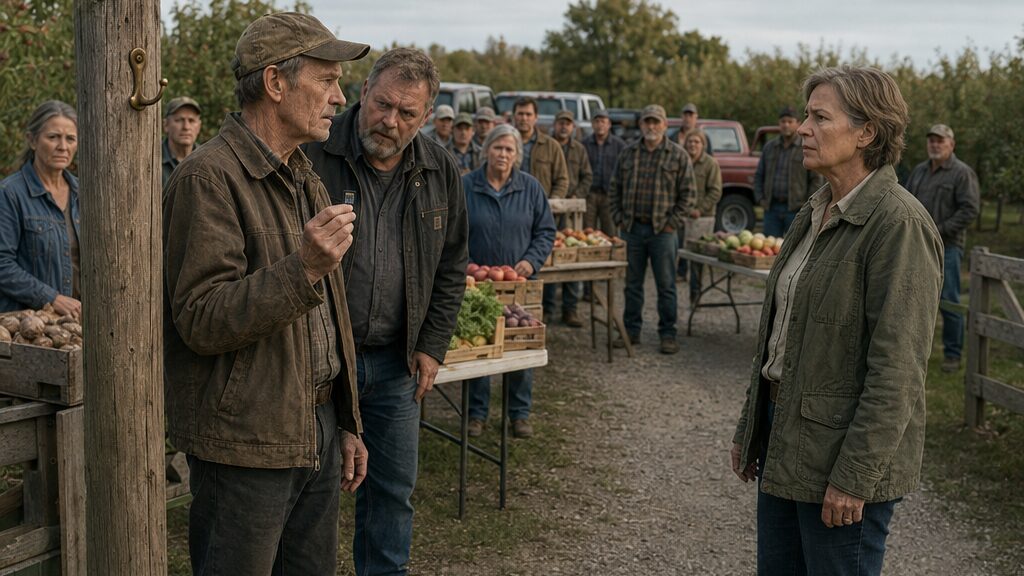
Benjamin Hall stood at the orchard entrance with one hand resting on the empty cedar post. The cut metal was bright beneath the gray morning, untouched by rust. Two washers lay in the flattened grass. The brass hook where he had always hung the cabinet key swung gently against the wood.
He caught it between his fingers.
The road beyond the post curved between his pear rows and the Moore farm’s lower field. Nothing moved except a crow lifting from the drainage ditch. The auction grounds half a mile away would open in less than an hour. By then, trucks would be passing this spot, and everyone would see what was missing.
Benjamin stepped off the gravel and studied the ground.
The cabinet had been built from an old kitchen cupboard Donna used for storing jars. He had added a sloped tin roof, glass doors, and shallow drawers for seed envelopes. Three years of rain had darkened the oak around the hinges. It weighed more than one person could lift comfortably.
The grass held two sets of boot marks and the paired impressions of narrow tires. A vehicle had backed in from the lane, stopped close to the ditch, then pulled forward toward the Moore property.
He followed the tracks until they disappeared on the hard-packed road.
Kimberly Moore had stood beside that same post the previous afternoon, arms folded over her white work shirt.
“You’re turning a farm lane into a public parking lot,” she had said.
“Three trucks in a day isn’t a parking lot.”
“It only takes one insurance claim.”
Benjamin had kept tightening the loose roof screw while she spoke. Refusing to look at her had been easier than admitting the lane question was still unresolved.
She had pointed at the cabinet. “It needs to go.”
He had answered without raising his voice. “People use it.”
“That doesn’t make it yours to put wherever you please.”
Now the cabinet was gone.
Benjamin looked toward the fence line separating the two farms. Kimberly’s grain bins stood beyond the rise, pale cylinders against the morning sky. Her house was hidden behind them.
He could call the sheriff. He could drive over and ask her directly. He could wait until the auction and let everyone see the tire marks for themselves.
Instead, he crossed the ditch and walked twenty yards into the first row of pear trees.
A trail camera was strapped to a trunk at shoulder height, angled toward the lane. He had installed it after deer began stripping bark from the young trees. Donna used to complain that he bought equipment only after damage had already been done.
The camera’s latch clicked loudly in the stillness.
Benjamin removed the memory card and slipped it into his shirt pocket before checking the screen. He did not need to watch the footage beneath the tree. Not yet.
A pickup turned onto the road.
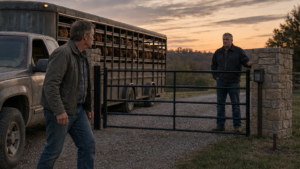
Samuel Wright leaned out the driver’s window before the truck had fully stopped. “You move it?”
Benjamin returned to the post.
Samuel climbed down, his heavy work boots scattering gravel. He was broad through the shoulders, with grease embedded permanently around his fingernails from forty years of repairing tractors and fire engines. His eyes moved from the cut bolts to the tire marks.
“Who did this?”
“I don’t know.”
Samuel looked at him. “You know where those tracks point.”
“They point down the lane.”
“They point toward Moore’s.”
Benjamin picked up one of the washers and rubbed dirt from its edge.
Samuel crouched beside the post. “They used a cordless saw. Took their time, too.”
A second vehicle slowed. Susan Clark’s faded farm truck stopped beside Samuel’s. Wooden produce crates filled the bed.
She stepped out without closing the door. “Where is it?”
Benjamin did not answer.
Susan walked past him and put both hands on the empty post, as though the cabinet might have become invisible instead of absent. “The Cherokee beans were in there.”
“And the Glass Gem corn,” Samuel said.
Susan turned sharply. “How much?”
“Most of what was left,” Benjamin said.
Her face changed. She grew vegetables on twelve rented acres and sold nearly everything through two roadside stands. The Cherokee beans had come from a line Donna saved for sixteen years. Susan had planned her spring rows around them.
“You kept backups?” she asked.
“Some.”
“Some isn’t the same as enough.”
Benjamin heard the accusation beneath her worry. The cabinet had looked like a place where people exchanged spare packets. Few knew how many growers had begun relying on it.
A teenager’s bicycle appeared at the bend. The rider slowed when he saw the empty post, then continued toward the auction without speaking.
That was how the news would travel. Not through an announcement. Through one person seeing the bare wood, then telling another.
Samuel stood. “You have a camera on that row.”
Benjamin kept his gaze on the washer.
“I helped you mount it,” Samuel said. “It faces the road.”
Susan looked from Samuel to Benjamin. “Did it record last night?”
“It may have.”
“Then check it.”
A dark SUV came along the lane from the direction of the Moore farm.
Kimberly drove with both hands on the wheel. She slowed as she passed the three of them. Her eyes moved toward the empty post, then to Benjamin. She did not stop.
Susan watched the vehicle until it vanished around the bend. “She knew.”
“That proves nothing,” Benjamin said.
“She demanded you take it down yesterday.”
“She said it should be moved.”
Samuel gave a humorless laugh. “You correcting the wording for her now?”
Benjamin pressed the washer into his palm.
More trucks began appearing, carrying eggs, greens, honey, and early apples toward the auction. Drivers slowed. Some raised a hand. Others stared openly at the cut bolts.
By eight o’clock, half the county would have an opinion.
Susan stepped closer. “Benjamin, people gave you those seeds because they trusted you to keep them available.”
“They trusted the cabinet.”
“You built it.”
“That doesn’t mean I can replace everything in it.”
“No,” she said. “It means you need to find out who took it.”
Her anger struck harder than Kimberly’s had. Susan had sat with Donna through the last winter, labeling seed envelopes at the kitchen table while Benjamin worked outside because he could not bear the quiet in the house.
He touched the memory card through his pocket.
Samuel noticed.
“You already pulled it,” he said.
Benjamin said nothing.
Samuel’s expression tightened. “You know who was here.”
“I know the camera may have recorded the road.”
“Same thing.”
“No.”
Susan glanced toward the auction grounds, where the first loudspeaker test carried faintly across the fields. “Then what are you waiting for?”
Benjamin looked again at the empty post. The brass hook tapped against the cedar, a thin, repetitive sound.
He had expected anger when he found the cabinet gone. What came instead was something colder: the knowledge that the truth, once shown, would not stop at the person in the footage.
Samuel held out his hand.
“Give me the card.”
Benjamin closed his fist around it.
Chapter 2: Everyone Wanted the Footage Except Benjamin
“Benjamin removed it himself,” Kimberly Moore said loudly enough for three produce rows to hear.
The Saturday auction had barely begun. Farmers were still unfolding tables and chalking prices onto boards when her accusation crossed the gravel lot.
Benjamin stood beside the empty cabinet post at the edge of the grounds. Samuel was on his right. Susan had stopped unloading squash and was watching from ten yards away.
Kimberly faced a loose semicircle of growers, buyers, and seasonal workers. She wore clean jeans and the white collared shirt she used for committee meetings. Her dark SUV was parked behind her.
“He knows the county is reviewing the access lane,” she continued. “Now the cabinet disappears the night after I object, and suddenly everyone is supposed to blame my farm.”
No one had said her name aloud.
That was what made the statement land.
Samuel stepped forward. “Funny how quick you knew where the blame was headed.”
Kimberly’s eyes narrowed. “Because you’ve been staring at my truck since I arrived.”
Susan came around her table. “Did you take it?”
“No.”
The answer came cleanly, without hesitation.
Benjamin watched her hands. They were clasped in front of her, one thumb pressing hard into the other.
“Then why accuse him?” Susan asked.
“Because this isn’t about seeds.” Kimberly pointed past Benjamin toward the lane. “It is about making that road look public before the county decides who controls it.”
Several heads turned toward Benjamin.
The auction occupied a widened patch of gravel where the orchard road met the state route. For decades, nearby farmers had used it informally to exchange produce. The seed cabinet stood farther down, beside a narrow strip that both Benjamin’s deed and the Moore survey described differently.
Until that moment, most people had treated the dispute as another boundary argument between neighbors.
Kimberly had just given it a motive.
Samuel extended his hand again. “Show them the card.”
Benjamin did not move.
A feed-store owner near the apple tables frowned. “What card?”
“Trail camera,” Samuel said. “Covers the lane.”
Conversation thinned across the lot. Even the auction clerk lowered his clipboard.
Kimberly looked at Benjamin. For the first time that morning, uncertainty broke through her composure.
“You have footage?” Susan asked.
Benjamin felt the small rectangle in his pocket, lighter than the brass key and heavier than anything else he carried.
“The camera recorded the road,” he said.
Samuel nodded toward the crowd. “There. Put it on my phone.”
“No.”
The word seemed to create its own silence.
Susan stared at him. “Why not?”
“Because a picture can show who was on the road. It cannot show everything that put them there.”
Samuel’s jaw tightened. “It can show who stole the cabinet.”
Kimberly recovered quickly. “Or it can show nothing. Maybe that’s why he won’t play it.”
A murmur moved through the tables.
Benjamin had known people in the county for most of his life. He had repaired fence after storms with some of them, lent sprayers to others, buried parents alongside their families. Their suspicion did not arrive as shouting. It came through lowered eyes, folded arms, and the sudden distance around him.
Samuel spoke quietly. “You’re letting her do this.”
“I’m stopping you from doing something we can’t take back.”
“She took something we can’t replace.”
Susan stepped between them. “The beans alone represent years of saving. People trusted that box because Donna kept records. After she died, they trusted you.”
At the sound of his wife’s name, Benjamin looked toward the post.
The empty brass hook shone against the cedar. He had kept the only key on it during auction hours. Donna believed a community exchange should never feel guarded. At night, he took the key inside.
Kimberly followed his gaze. “That cabinet was sitting where the county hasn’t established a public right of use. Every person pulling over there strengthens the argument that the lane serves the public.”
“It served farmers,” Susan said.
“It served Benjamin’s position.”
That struck closer than Benjamin wanted anyone to know.
He had placed the cabinet near the disputed strip because the ground was level, visible, and shaded in the afternoon. He had also known that regular use would make the lane harder to close. He had told himself those two facts were unrelated.
Samuel was still holding out his hand.
Benjamin took the memory card from his pocket.
Gasps were too dramatic for people who worked around machinery and livestock. What passed through the group was smaller: a collective lean, bodies shifting half an inch toward the evidence.
The card looked insignificant against Benjamin’s scarred fingertips.
Kimberly’s face lost color.
“Play it,” someone said.
Benjamin held it beside the brass hook.
“No.”
Samuel dropped his hand. “Then don’t expect me to stand here while they call you a liar.”
A county vehicle pulled into the lot before Benjamin could answer. Gregory Perez parked beside the auction shed and emerged carrying a flat document envelope.
Gregory was younger than Benjamin by nearly twenty years, careful in both speech and dress. He had helped growers test soil, apply for conservation grants, and survive three bad seasons without treating any of them like fools.
He looked from the gathered farmers to the empty post.
“I was told there was an incident.”
“An incident,” Samuel said. “That’s one word.”
Gregory approached Benjamin. “The cabinet is missing?”
“Since before dawn.”
“And there may be footage?”
Benjamin returned the card to his pocket. “There is footage of the lane.”
Kimberly stepped closer. “Before this becomes a theft circus, you should tell them why the county contacted him.”
Gregory’s attention shifted to her. “This is not the place.”
“You brought the notice.”
“I brought it to deliver privately.”
Samuel gave a short laugh. “Private seems to be popular today.”
Gregory removed a single sheet from the envelope. A yellow band ran across the top. The county seal was printed below it.
Benjamin recognized the parcel number before Gregory reached him.
“What notice?” Susan asked.
Gregory kept his voice low. “A temporary compliance inquiry. It does not determine ownership.”
Kimberly spoke over him. “It says the cabinet may have been placed inside the access easement without authorization.”
The crowd’s attention returned to Benjamin.
He accepted the paper. The language was cautious, but the effect was not. Pending review. Possible obstruction. Unresolved public-use implications.
The cabinet’s absence suddenly looked less like something taken from him and more like something he had been ordered to remove.
“You got this before today?” Samuel asked.
Benjamin read the date.
It had been issued the previous afternoon.
Kimberly saw the answer in his face. “He knew.”
“I had not received it.”
“But you knew the review was active.”
“Yes.”
Susan’s disappointment was quieter than anger. “You never told us.”
“There was nothing decided.”
“You let people keep using the lane.”
“They needed the seeds.”
Kimberly shook her head. “You needed the traffic.”
Benjamin folded the notice once.
Gregory stepped into the widening gap between them. “The lane question is not settled. Neither farm has an exclusive determination. But regular public use can affect how the board evaluates access, drainage maintenance, and liability.”
Samuel pointed toward the missing cabinet. “So this paper gives somebody permission to cut it loose?”
“No,” Gregory said. “It does not authorize removal.”
“Then play the footage.”
Benjamin looked at Kimberly. She met his eyes now, fear and defiance held together so tightly he could not separate them.
He could place the card in Samuel’s phone. In less than a minute, the county would know whose truck had backed toward the post.
But the notice in his hand would remain. So would the reason he had selected that location. So would Donna’s cabinet, turned from a gift into leverage by both farms.
Gregory touched the edge of the document.
“There is another problem,” he said. “The cabinet may have affected a pending easement decision.”
Chapter 3: The Cabinet Was More Than a Memorial
Gregory spread the aerial map across Benjamin’s kitchen table and placed his finger directly over the place where the seed cabinet had stood.
The red boundary line passed through the post.
Benjamin remained standing.
From above, the disputed lane looked simple: a pale strip between orchard rows and the Moore field, one drainage ditch, one fork toward the county road. Lines made clean claims that the ground itself refused to honor.
“This survey layer came from the Moore filing,” Gregory said. “Your deed map puts the boundary six feet east.”
“My father maintained that ditch for forty years.”
“That establishes history, not necessarily ownership.”
“It establishes who kept the road passable.”
Gregory looked up. “I’m not arguing with you. I’m telling you what the board will see.”
Two days had passed since the auction. The cabinet had not returned. Benjamin had watched the trail-camera footage three times, alone, with the curtains closed though no one could see the laptop from the road.
At 1:17 in the morning, Kimberly’s SUV had reversed beside the post. Kimberly got out. Carolyn Hill appeared from the passenger side. Together, they cut the bolts, tipped the cabinet onto a furniture dolly, and loaded it through the rear hatch.
There was no ambiguity.
There was also no sound.
The women’s faces were pale shapes under the infrared light, their movements abrupt and frightened rather than triumphant. Carolyn dropped something near the ditch. Kimberly stopped twice to look toward Benjamin’s house.
The footage proved removal. It did not explain fear.
Gregory tapped the map. “When did you install it?”
“Three years ago.”
“The access petition was already pending.”
“The original petition had been dormant for seven.”
“That isn’t the same as closed.”
Benjamin turned toward the window. Beyond the yard, his pear trees stood in ordered rows. Donna had hated aerial maps. She said they made farms look as if nobody had ever sweated on them.
Gregory folded his hands. “Did you choose that site because people would pull into the lane?”
“I chose it because the shoulder was level.”
“And visible from the highway.”
“Yes.”
“And regular use could demonstrate that the lane served more than one property.”
Benjamin said nothing.
Gregory’s expression changed slightly. Not accusation. Recognition.
“That is what Kimberly will argue,” he said.
“She argues whatever keeps her gate locked.”
“Her insurer threatened to exclude the lane after a delivery truck slid into the ditch last fall.”
“That truck was hauling feed to her barn.”
“It entered through the public end.”
Benjamin pushed the map away. “You came here about a cabinet.”
“I came because the cabinet connected seeds, land access, drainage, and two farms pretending those things were separate.”
The back door opened without a knock.
Susan entered carrying a ledger wrapped in a dish towel. “You’re both going to want this.”
She set the bundle on the table and uncovered Donna’s old seed catalog.
Benjamin reached for it automatically. Susan kept one hand on the cover.
“I found my copy of last year’s exchange list,” she said. “I compared it with what I planted and what others reserved.”
“Reserved?” Gregory asked.
Susan gave Benjamin a hard look. “That is what it became, whether he wants to call it that or not.”
The catalog’s pages were ruled by hand. Donna had recorded varieties, donors, planting notes, germination rates, and dates. After her death, Benjamin continued the entries, but more sparsely. He wrote quantities, not stories.
Susan opened to the spring section.
“Cherokee Trail of Tears beans,” she said. “Enough for four growers. Glass Gem corn for two. Donna’s striped tomato line. The yellow storage onion Carolyn gave her before they stopped speaking.”
Benjamin glanced at the final entry.
Susan continued. “People planned acreage around what was in that cabinet. Not flowerbeds. Market rows.”
Gregory bent over the ledger. “How many farms?”
“Eleven last season. Maybe fourteen this year.”
Benjamin looked at her. “You never told me fourteen.”
“You never asked. You kept refilling the drawers, so people assumed the supply was secure.”
“It was an exchange. They were supposed to replace what they took.”
“Most did.”
“Most.”
Susan’s mouth tightened. “You wanted it to be Donna’s cabinet. The rest of us needed it to be a seed bank.”
The distinction settled over the table.
Benjamin had believed he was honoring a promise: keep the seeds available. He had never created rules, backups, or shared records because doing so would mean admitting the cabinet no longer belonged only to Donna and him.
Gregory turned pages carefully. “Were duplicate lots stored elsewhere?”
“Some in my shed.”
“How many of these?” Susan asked.
Benjamin did not answer quickly enough.
She closed her eyes. “You don’t know.”
“I know what I have.”
“You know what you put away. You don’t know what people added last month.”
A truck door slammed outside.
Samuel entered the yard, but instead of coming to the house, he walked toward the orchard shed. Benjamin saw him through the window.
“What is he doing?” Gregory asked.
“Helping me check the stored packets.”
They followed.
The shed smelled of dry wood, oil, and old apples. Benjamin unlocked a metal cabinet along the back wall with the brass key from his ring. Inside were labeled jars and paper envelopes arranged by crop.
Samuel stood beside an open storage bin.
“This all you’ve got?”
“It should be enough to restart most lines.”
Susan began comparing labels with the catalog. Her movements grew faster.
“Striped tomatoes?”
“Top shelf.”
“Glass Gem?”
“Two jars.”
“Yellow onions?”
Benjamin checked the lower drawer.
Empty.
Susan turned another page. “Cherokee beans?”
“One jar.”
“You need four.”
“I know.”
She reached the final section and stopped. “Donna’s white runner beans.”
Benjamin searched the cabinet twice, though he already knew.
The last viable envelopes had been in the roadside box.
Samuel leaned against the workbench. “Then the person who took it didn’t steal lumber. They took next season.”
Gregory spoke carefully. “Has anyone contacted Kimberly directly?”
Samuel looked at Benjamin. “Ask the man protecting her.”
“I’m not protecting her.”
“You’re protecting something.”
Benjamin took the memory card from his pocket and placed it on the bench.
Susan stared at it. “You watched it.”
“Yes.”
“And?”
“The camera shows Kimberly’s SUV.”
Samuel straightened. “Kimberly?”
“And Carolyn.”
The shed went silent.
Susan’s anger faltered. Carolyn had once sat at Donna’s kitchen table every winter, folding seed envelopes and drinking coffee after her work at the Moore farm was done.
“Why would Carolyn help her?” she asked.
“I don’t know.”
Samuel reached for the card.
Benjamin covered it with his palm.
“You still won’t release it?” Samuel said.
“Not yet.”
“You just confirmed they took it.”
“I confirmed what the camera shows.”
“What else do you need?”
Benjamin looked at Donna’s catalog, at the missing lines and the empty spaces in his backup cabinet.
“The reason.”
Samuel stepped back in disgust. “A reason doesn’t put seed in the ground.”
“No,” Benjamin said. “But public shame won’t either.”
A vehicle rolled into the yard.
Carolyn Hill climbed out alone.
She did not approach the shed at first. She stood near the open doorway with both hands in the pockets of her canvas coat, looking older than Benjamin remembered.
When she finally came inside, her eyes went straight to the memory card under his hand.
“So you saw us,” she said.
Susan whispered, “Carolyn.”
Carolyn did not look at her. “Have you posted it?”
“No.”
Her shoulders lowered by a fraction.
Samuel noticed. “That relief tells us plenty.”
Carolyn ignored him. “Benjamin, I need until tomorrow.”
“For what?”
“To speak to Kimberly.”
“You had two days.”
“She isn’t listening to me.”
“And the seeds are missing.”
Carolyn’s face tightened. “I know where the cabinet is.”
Susan moved toward her. “Are the envelopes dry?”
Carolyn hesitated.
That hesitation answered more than words.
Benjamin removed his hand from the memory card. “Where is it?”
“I can’t tell you yet.”
Samuel swore under his breath.
Carolyn finally met Benjamin’s eyes. “If you release that footage tonight, she will deny everything and take the farm-access case down with her. Give me until tomorrow morning.”
“What is she afraid of losing?” Benjamin asked.
Carolyn glanced toward the red boundary line still visible through the kitchen window.
“More than the lane,” she said. “And if you expose her before I make her understand what she’s done, you may lose those seeds for good.”
Chapter 4: The Shed Behind the Moore Farm
Moisture had reached the bottom drawer.
Kimberly Moore saw it in the dark crescent spreading through the paper envelopes, turning clean labels soft at the edges. She dragged the seed cabinet farther from the machinery shed wall, but the damage had already begun.
The shed roof leaked above the old cultivator. Water had run along a beam, down a length of baling wire, and onto the cabinet’s tin top. She had covered it with a tarp after the first night. The tarp had trapped the damp inside.
Carolyn stood in the open doorway with a flashlight and said, “You told me it would be here for a few hours.”
Kimberly pulled open the lowest drawer.
A packet split against her fingers. Pale bean seeds rolled across the warped wood and dropped into the dust.
Neither woman moved.
Carolyn aimed the flashlight downward. “Those are Donna’s.”
“They’re beans.”
“You know what I mean.”
Kimberly crouched and collected them one by one. Some were dry. Others had swollen, their skins wrinkled and loose.
She placed them on the cabinet roof.
“We can dry them,” she said.
“You don’t know that.”
“I said we can try.”
Carolyn came inside and shut the shed door behind her. The flashlight beam crossed the grain drill, a stack of worn tires, and the pale cabinet hidden between machinery no one had used in years.
It looked smaller here.
At the roadside, it had drawn trucks, children, growers, and arguments. Inside the shed, it was only a damaged cupboard with saw marks beneath its base.
Carolyn set the flashlight on a workbench. “Benjamin has the footage.”
Kimberly’s hand stopped over the drawer.
“He watched it,” Carolyn continued. “He told Samuel and Susan the camera shows both of us.”
“Then why hasn’t it been posted?”
“He won’t release it.”
Kimberly looked toward the closed door, as if the answer might be waiting outside.
Carolyn crossed her arms. “He’s protecting you.”
“He’s protecting himself.”
“From what?”
“The lane review. The cabinet placement. The fact that he used people stopping there to strengthen his claim.”
“That doesn’t explain why he kept our names out of it.”
Kimberly pushed the drawer closed too hard. The swollen wood caught before it seated.
“He wants leverage.”
Carolyn shook her head. “You always call it leverage when somebody gives you time.”
“Time for what?”
“To fix what you did.”
Kimberly turned away.
On a shelf beside the cabinet sat a bundle of county envelopes tied with twine. Insurance notices. Loan statements. Drainage estimates. The paperwork had multiplied through two wet seasons while the hay yield fell and equipment repairs climbed.
The lane was the one part of the farm the lender had asked about twice.
If the county treated it as public access, the Moore operation would bear maintenance obligations it could not afford. If the drainage board widened the ditch, they would lose a strip of their best lower field. If the insurer excluded the road, delivery trucks might refuse to enter.
Benjamin’s cabinet had brought regular traffic onto the disputed section. He knew that.
Kimberly had watched vehicles pull over, doors open, people carry seed packets back to their trucks. Every visit became another small fact someone could point to at a hearing.
She had told herself she was removing an obstruction before the county notice arrived.
She had told herself Benjamin would retrieve it the next morning.
She had told herself the seeds would be safe.
Carolyn picked up one of the wet envelopes. The ink had feathered until the variety name was barely readable.
“You could have moved it to his barn,” she said.
“He would have put it back.”
“You could have called Gregory.”
“Gregory would have scheduled a meeting.”
“You could have waited.”
“The board meets Monday.”
Carolyn looked at her. “So you stole it.”
Kimberly’s face hardened. “I removed property placed on disputed ground.”
“At one in the morning.”
“He refused every other conversation.”
“You cut the bolts.”
“He refused.”
“That isn’t permission.”
Kimberly stepped closer. “Do you want to lose the lower field?”
Carolyn did not answer.
Their father had divided the property badly and died before correcting the deeds. Kimberly had taken over the daily operation. Carolyn had signed papers, covered taxes when she could, and trusted Kimberly to keep the farm whole.
That trust had become another debt.
Kimberly lowered her voice. “If the lane goes against us, the lender can call for a new valuation. You know what happens after that.”
“I know.”
“Then stop acting as though this is about a painted cupboard.”
Carolyn glanced at the wet bean seeds on the roof. “It stopped being only a cupboard when people planned their planting around it.”
“They should not have.”
“But they did.”
A vehicle passed on the county road beyond the shed. Its tires made a distant rush over gravel.
Kimberly pictured Benjamin at the auction, holding the memory card in plain sight and refusing to play it. She had expected exposure. She had prepared to deny the image, challenge the angle, argue that the lane was hers to protect.
Instead, he had left the decision suspended over her.
That was worse.
Carolyn opened another drawer. Envelopes were stacked in rows, some labeled in Donna’s handwriting, others in Susan’s or Benjamin’s. A few bore only crop names and dates.
“These need air tonight,” she said. “We should take them to the house.”
“No.”
“They’ll mold.”
“If anyone sees them—”
“Who is coming into the kitchen at midnight?”
Kimberly looked at the cabinet again. “Separate the dry packets.”
Carolyn did not move.
“Please,” Kimberly said.
It was the first time she had used the word since they entered the shed.
They worked in silence.
Dry seed went into shallow feed trays. Damp envelopes were opened carefully and spread across old window screens. Several packets had already failed. A jar of white runner beans had broken when the cabinet tipped during loading; glass fragments remained lodged in the rear corner.
Carolyn held up three soft seeds between her fingers. “These are gone.”
Kimberly stared at them.
Donna had once brought those beans to the Moore kitchen during a winter when Kimberly’s mother could barely leave her chair. She had simmered them with onions and ham and filled the freezer without being asked.
Kimberly had forgotten that until now.
“Benjamin knew we took it,” Carolyn said. “And he still gave us a day.”
“He gave you a day.”
“He gave both of us one.”
Kimberly swept the broken seeds from the screen into her palm. “What did you tell him?”
“That I would speak to you.”
“You had no right.”
Carolyn let out a tired breath. “You stopped having the right to complain about that when you asked me to hold the flashlight while you cut his bolts.”
The words struck cleanly.
Kimberly turned toward the bundle of county notices. “If I return it, he releases the footage anyway.”
“Maybe.”
“Then nothing changes.”
“The seeds stop getting ruined.”
“And the whole county sees me back down before the hearing.”
Carolyn came around the cabinet. “That is what you are worried about?”
“I chair the access committee.”
“You used the committee to speak like you had authority you did not have.”
“I was protecting our farm.”
“You were protecting your position.”
Kimberly’s head snapped toward her.
Carolyn did not retreat. “Those are not always the same thing.”
For several seconds, the only sound was water ticking from the roof into a rusted pan.
Kimberly looked at the cabinet’s glass doors. In the reflection, she saw herself in pieces between the machinery behind her.
She had imagined returning the cabinet only after Benjamin agreed to move it. She had imagined bargaining from control.
Now the warped drawers and ruined envelopes had taken that option away.
“Help me load it,” she said.
Carolyn watched her carefully. “Where are we taking it?”
“Back.”
“With an apology?”
Kimberly reached for the dolly.
“I’m returning his property.”
“That is not what I asked.”
Kimberly slid the dolly beneath the cabinet. “It is what I can do tonight.”
Carolyn stood still for a moment, then picked up the flashlight.
Before dawn, they carried the damaged cabinet out of the shed and rolled it toward Kimberly’s truck.
Chapter 5: A Returned Cabinet Without an Apology
Benjamin heard the truck before he saw the cabinet.
Its engine idled at the orchard entrance, low and uneven, then faded down the lane without headlights. By the time he reached the porch, only red taillights remained beyond the pear rows.
The cabinet leaned against the empty post.
One glass door hung lower than the other. Mud streaked the oak. The tin roof was bent along the front edge, and the lowest drawer would not close.
Benjamin crossed the yard without putting on his coat.
The brass hook still hung from the post. He removed the key from his pocket and tried it in the cabinet lock.
The key turned halfway, then stopped.
Rust had formed inside the mechanism.
He pulled the door open by its lower corner.
The smell reached him first: wet paper, swollen wood, and something faintly sour beneath it. Envelopes had been stacked back into the drawers, but many were limp. Ink had bled across labels. A broken jar lay wrapped in a feed sack on the bottom shelf.
Benjamin lifted one packet.
WHITE RUNNER — DONNA, 2011.
The paper came apart along the fold.
He stood in the gray light with half the label in each hand.
For three days, he had imagined the cabinet’s return as relief. He had pictured carrying it into the packing barn, sorting the seeds, bolting it somewhere Kimberly could not touch.
What returned was not the object he had lost.
It was evidence of time, damp, and decisions no one could reverse.
A vehicle door closed behind him.
Carolyn approached carrying a shallow cardboard box against her chest. Her coat was unbuttoned, and strands of hair clung to her face.
“Kimberly brought it back,” Benjamin said.
Carolyn looked toward the road. “She drove.”
“That wasn’t the question.”
“No.”
He placed the ruined envelope on the cabinet roof. “Did she send you to explain?”
“She doesn’t know I came.”
Carolyn set the box on the grass. Inside, seed envelopes lay between sheets of newspaper. Several glass jars were wrapped in towels.
“We separated what was dry,” she said. “These were in better shape.”
Benjamin picked up a packet of yellow onion seed.
“You hid it in the machinery shed.”
Carolyn nodded.
“For three days.”
“Yes.”
“Why?”
Her eyes moved to the disputed lane. “Kimberly thought the cabinet would help prove public use before Monday’s hearing.”
“And you?”
“I thought helping her move it would stop her from doing something worse.”
Benjamin gave a brief, empty laugh. “That is usually how worse things begin.”
Carolyn accepted it.
He lifted another packet. “Donna’s white runners are gone.”
“There may be some viable seed in the broken jar.”
“May be.”
“We dried what we could.”
“You cut the cabinet loose.”
“Kimberly cut it. I held the light.”
“That distinction matters to you?”
“No.”
The honesty left him with nowhere easy to put his anger.
Carolyn crouched beside the box and removed a small jar. Inside were fewer than thirty pale beans, several marked by dark spots.
“She was afraid,” Carolyn said.
“So was I.”
“She thinks if the county recognizes public use, the lender will force a new valuation. We are behind after the drainage repairs and last year’s hay loss.”
“Then she could have said that.”
“She doesn’t say things that make her look weak.”
Benjamin looked at the cabinet.
“Neither do you,” Carolyn added.
His head turned slowly.
She kept her eyes on the seed box. “You had the footage. You could have ended the rumor at the auction.”
“I could have started another one.”
“You also didn’t want anyone asking why the cabinet stood there.”
Benjamin said nothing.
Carolyn rose. “That does not excuse us.”
“No.”
“But it is part of what happened.”
The orchard packing barn stood open behind him. Inside, empty bins waited for the coming harvest. He carried the cardboard box there, then returned for the cabinet.
Carolyn took one side without asking.
Together they lifted it from the grass.
The cabinet was heavier with wet wood. The damaged door swung outward as they crossed the yard, tapping Benjamin’s knee with each step. He could hear loose seeds shifting in the drawers.
They set it on a worktable beneath the barn lights.
The damage looked worse indoors.
Donna’s handwritten labels had once made the shelves feel ordered even when the varieties came from different farms. Now the ink ran down the paper like thin roots.
Carolyn touched the edge of the warped door. “Kimberly will say she found it abandoned.”
“Will she?”
“I don’t know.”
“She denied taking it.”
“I know.”
“She let people accuse me.”
Carolyn’s face tightened. “I know that too.”
Benjamin removed the brass key and set it beside the lock. Rust stained its teeth.
“Returning it without admitting anything is not returning the truth,” he said.
“No.”
“Then why did she do it?”
“Because she saw the damage. Because you did not release the footage. Because she is ashamed.” Carolyn paused. “Pick whichever answer lets you sleep.”
None would.
A pickup entered the yard fast enough to throw gravel against the barn wall.
Samuel stepped out holding his phone.
“I heard it was back.”
His anger dimmed when he saw the cabinet. He walked around it once, taking in the swollen drawers and wet envelopes.
“What happened?”
Carolyn faced him. “We kept it in the Moore shed.”
Samuel stared at her. “We?”
“I helped Kimberly move it.”
He looked toward Benjamin. “You knew this.”
“I knew what the camera showed.”
Samuel held up his phone. “Then we are done waiting.”
Benjamin saw the paused image on the screen. Black-and-white footage. Kimberly beside the SUV, Carolyn bent over the cabinet.
“How did you get that?”
“I copied the card Monday when you left it beside the computer.”
Carolyn took a step back.
Benjamin’s voice remained quiet. “Delete it.”
“No.”
“It was not yours to copy.”
“Neither was the cabinet theirs to take.”
“Delete it.”
Samuel’s face reddened. “You stood there while half the county thought you staged this. Now the seeds are ruined, and you still want to protect them?”
“I want the hearing to have facts, not a mob.”
“This is a fact.”
“It is one fact.”
Samuel opened the sharing screen. “I can send it to the auction group now.”
Benjamin moved between Samuel and the cabinet.
“You do that,” he said, “and you turn Donna’s work into entertainment for people who will forget it by supper.”
Samuel’s thumb hovered over the screen.
Carolyn said, “He’s right.”
Samuel looked at her in disbelief. “You do not get a vote.”
“No,” she said. “But if you release it tonight, Kimberly will deny why she did it. Benjamin will deny why he placed the cabinet there. Everyone will choose the half they already like.”
Benjamin looked at Carolyn.
She had finally said aloud what he had been avoiding.
Samuel lowered the phone slightly. “So what? We let Monday come and hope people grow honest?”
“No,” Benjamin said.
He picked up the rusted key and placed it beside Samuel’s phone.
“The footage will be shown.”
Carolyn’s breath caught.
Samuel studied him. “When?”
“At the hearing.”
“All of it?”
“All of it.”
“And Kimberly?”
“She will answer for what she did.”
Samuel’s eyes narrowed. “What else is there?”
Benjamin looked at the wet cabinet, Donna’s broken labels, and the memory card still locked in the desk inside his house.
“The whole record,” he said. “Including mine.”
Chapter 6: The Hearing Where Both Farms Were Exposed
Benjamin asked to speak before Samuel played the footage.
The county meeting room held fewer than fifty chairs, but every one was occupied. Farmers stood along the rear wall. Susan sat in the second row with Donna’s seed catalog on her lap. Carolyn had chosen a seat near the aisle, three places from Kimberly.
At the front, two agricultural board members waited behind folding tables. Gregory Perez sat beside a projector and a stack of maps.
Samuel stood near the laptop, his hand resting on the lid.
Kimberly faced the board from the opposite table. She wore the same white collared shirt she had worn at the auction, but the sleeves were rolled unevenly. A folder of insurance letters and drainage estimates lay open before her.
Benjamin carried only three things: the brass cabinet key, the trail-camera memory card, and a copy of his installation notes.
He placed the key beside the card.
The room quieted.
One board member glanced at Samuel. “Mr. Wright was prepared to present video related to the removal.”
“He can,” Benjamin said. “But first I need to explain why the cabinet was where it was.”
Kimberly looked at him sharply.
Samuel’s hand left the laptop.
Benjamin unfolded his notes. The page showed measurements in his handwriting: distance from ditch, shoulder width, sight line from the highway, bolt spacing.
He had written them three years earlier.
“When I installed the cabinet,” he said, “the boundary along the orchard lane was disputed.”
A chair creaked in the rear.
Benjamin continued before anyone could interrupt.
“My deed map placed the post on my side. The Moore survey placed it inside the access strip. The county had not ruled.”
The board member asked, “Were you aware that regular public use might influence an easement review?”
“Yes.”
The answer moved through the room more strongly than denial would have.
Kimberly’s expression changed from caution to disbelief.
Benjamin looked at Susan. She held the seed catalog closed now, both hands resting over Donna’s name.
“I chose the site because it was level and visible,” he said. “I also knew people stopping there would make the lane look established as shared access.”
Samuel exhaled behind him.
A farmer at the back said, “So Kimberly was right.”
“She was right about that part.”
Kimberly leaned toward her microphone. “He has been using the cabinet to build a public-use claim against our farm.”
Benjamin turned toward her. “I let it serve two purposes and spoke about only one.”
“You hid that from everyone.”
“Yes.”
The word cost less the second time, though not much.
One board member looked at Gregory. “Does cabinet traffic establish a public easement?”
“No,” Gregory said. “Not by itself. The lane’s status remains unresolved. Use history, maintenance, deed language, drainage responsibility, and access patterns all matter.”
“So neither party had authority to act as if the issue were settled?”
“That is correct.”
Kimberly closed one hand over the edge of her folder.
Benjamin returned to the table.
“Donna built the seed records before she died,” he said. “I built the cabinet from her cupboard and kept the only key. I called it a community exchange, but I made every decision myself. I did not tell growers the site was disputed. I did not create backups or shared records. When the cabinet disappeared, I had footage that could clear me, and I kept it because I did not want the rest examined.”
Susan’s eyes lowered.
Benjamin placed his installation notes beside the key.
“That silence harmed people. It let suspicion spread. It also left the seeds dependent on one box and one person.”
Samuel shifted his weight.
The second board member asked, “Are you saying the removal was justified?”
“No.”
Benjamin turned to Samuel.
“Play it.”
The projector came alive.
Black-and-white orchard rows appeared on the wall. A time stamp glowed in one corner. The room watched Kimberly’s SUV reverse beside the post.
No one spoke.
Kimberly stepped from the driver’s side. Carolyn emerged with a flashlight. Samuel advanced the clip. The cordless saw touched the first bolt. The cabinet tipped onto the dolly. Both women struggled to lift it through the rear hatch.
The footage ended with Kimberly standing alone beside the empty post, looking toward Benjamin’s house.
Samuel closed the file.
The room remained silent.
There was no cheering. No burst of outrage. Only the small sounds of people adjusting in their chairs and avoiding one another’s eyes.
One board member addressed Kimberly. “Did you remove the cabinet?”
Kimberly’s hands were flat on the table. “The footage shows what happened.”
“That was not the question.”
Her gaze moved to Benjamin. “He had no authority to place it there.”
“Did you have authority to remove it?”
“No.”
Carolyn closed her eyes.
Kimberly looked down at the insurance letters. “I believed the cabinet was being used to establish public access. Our insurer had already warned us about the lane. The bank requested another review. If the county widened the drainage ditch or assigned maintenance to us, we could lose the lower field.”
Gregory said, “Those concerns are legitimate. The removal was not.”
“I know that now.”
Samuel muttered, “Convenient.”
Benjamin looked back at him, and Samuel fell silent.
The board member asked, “Where was the cabinet kept?”
Kimberly hesitated.
“In the machinery shed,” Carolyn said.
Every face turned toward her.
Carolyn rose from her chair. Her hands trembled, but her voice did not.
“I helped move it. I held the light while Kimberly cut the bolts. I helped hide it behind unused equipment.”
Kimberly turned. “Carolyn.”
“She asked for the truth.”
“You did not have to—”
“Yes,” Carolyn said. “I did.”
The room changed then. Not because of evidence, but because Kimberly’s sister had stepped out from behind the excuse they shared.
Carolyn faced the board. “We intended to keep it until after the hearing. The shed roof leaked. Some seed was damaged. We returned the cabinet before Benjamin released the video, but we did not admit what we had done.”
Susan gripped the catalog more tightly. “How much was lost?”
Carolyn looked at her. “The white runners. Most of the yellow onions. Some Cherokee beans. We salvaged what we could.”
Kimberly remained seated.
The board member asked her, “Is that accurate?”
For several seconds, she said nothing.
Benjamin understood the temptation in her silence. He had lived inside the same defense: speak less, reveal less, preserve control.
Kimberly looked at the projection screen, now blank except for a pale rectangle of light.
“Yes,” she said. “I took it. Carolyn helped me hide it.”
A low murmur moved through the room.
Kimberly lifted her head. “I believed Benjamin would use the cabinet and the traffic to take control of the lane. I still believe he intended that.”
“I did,” Benjamin said.
She looked at him.
“But you destroyed seed to stop me.”
“I did not intend to.”
“No. You intended only the part before the damage.”
Her mouth tightened.
He recognized that too.
Gregory stood and placed a larger map on the table between them.
“There is a possible temporary solution,” he said. “The county owns a narrow triangle where the lane meets the state route. It could hold a designated pull-off outside the disputed strip. The cabinet could be relocated there under a cooperative agreement.”
Kimberly glanced at the map. “Who maintains it?”
“That would have to be shared.”
“Liability?”
“Covered under the cooperative if structured correctly.”
“And the drainage decision?”
“Separate. It remains unresolved.”
Samuel frowned. “So after all this, nobody decides the lane?”
“Not tonight,” Gregory said.
The answer frustrated the room because it sounded like bureaucracy. Benjamin saw something else in it: no document would erase what had happened. They would still have to work beside one another.
The first board member folded her hands. “The county can issue removal citations and refer the property matter to the sheriff. It can also condition any cooperative approval on restitution for damaged stock and full disclosure of access rules.”
Susan raised the catalog. “The lost seed cannot simply be bought.”
“No,” Benjamin said. “But some lines may exist on other farms.”
She looked at him. “If people share them.”
He touched the brass key.
For three years, it had opened Donna’s cabinet. He had treated that duty as proof that he alone was keeping her promise.
Now the key lay in public view beside the memory card and his own measurements.
Kimberly looked toward Carolyn, then at the damaged-seed inventory Gregory had placed before her.
“If the cooperative is formed,” the board member said, “would the Moore farm participate in replacing the lost stock?”
Kimberly’s first response appeared in her face: refusal, pride, calculation.
Then Carolyn sat down without looking at her.
Kimberly’s shoulders lowered.
“Yes,” she said. “We will contribute what we have.”
Susan asked, “And the yellow onion line?”
Carolyn answered. “There may be a jar in our cellar from Donna’s last exchange.”
Kimberly turned toward her sister. “You said those were gone.”
“I said I had not checked.”
The board member made a note. “Then check.”
A few people almost laughed, but the sound died before it formed.
Benjamin picked up the memory card.
He could feel the room waiting for a final statement, an accusation, perhaps forgiveness. He had none to offer.
“The footage should remain with the county record,” he said. “Not the auction group.”
Samuel looked away, but nodded once.
Benjamin set the card beside Gregory’s file.
Then he placed the brass key next to it.
“I will not reopen the cabinet alone,” he said.
Susan’s eyes moved from the key to him.
The board member asked, “Are you proposing shared stewardship?”
“I am saying that if it comes back, it cannot belong only to me.”
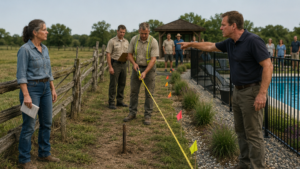
The hearing ended without a ruling on the lane. The board scheduled a site review and gave Gregory ten days to draft a cooperative plan.
People left in small groups, speaking quietly.
Kimberly remained at her table until most of the room had emptied.
Benjamin gathered his notes.
“Benjamin,” she said.
He stopped.
She looked at the brass key still lying beside the memory card.
“I took the cabinet,” she said, louder now, though only Carolyn, Susan, Samuel, and the board remained. “Carolyn helped me hide it. The damage happened because I would not return it when she asked.”
Carolyn looked at her sister for the first time since the confession began.
Kimberly did not ask to be forgiven.
Benjamin did not offer it.
But the truth no longer belonged to either farm alone.
Chapter 7: The Key No Longer Belonged to One Farmer
The restored cabinet arrived on the back of Samuel’s flatbed with its doors tied shut by a length of clean rope.
Benjamin stood beside the new concrete pull-off while the truck reversed toward him. Six weeks earlier, the same cabinet had leaned against the old cedar post with swollen drawers and rain-softened labels. Now its oak had been planed smooth, the bent tin roof replaced, and the glass reset in square frames.
The repair marks remained visible.
Samuel had wanted to stain over them. Benjamin had stopped him.
“People ought to see where it split,” he had said.
The county triangle sat beyond the disputed lane, where the orchard road met the state route. Gregory had arranged for a shallow gravel entrance, two parking spaces, and a drainage channel that sent runoff away from both farms. A small metal sign named the seed cooperative and listed no owner.
That last part had taken Benjamin three drafts to accept.
Samuel lowered the flatbed. “You planning to help, or just supervise?”
Benjamin took the left side.
Together they eased the cabinet down the ramp. It was lighter without the old warped base, though Benjamin still felt its weight in his shoulders. Susan guided them toward four anchor bolts already set in the concrete.
“Two inches right,” she said.
Samuel shifted his end. “Your right or mine?”
“The useful one.”
They set the cabinet onto the bolts.
Around them, the pull-off had begun filling with trucks. Farmers carried jars, envelopes, and small wooden boxes toward a folding table where Gregory checked donations against the cooperative inventory. Two teenagers arranged labels beneath clear plastic covers. A seasonal worker from the vegetable farms brought three paper sacks of bean seed and refused to put his name beside them.
Benjamin recognized varieties he thought had been lost.
Cherokee beans came from four farms. The yellow storage onion line had survived in jars at the Moore cellar and in Susan’s seed room. A grower from the next county had produced a small packet of white runner beans descended from seed Donna had shared eight years earlier.
Not everything had returned.
But enough had.
Susan opened Donna’s catalog on the folding table. Beside it lay a new ledger with columns for donor, quantity, germination test, withdrawals, and replacement commitments.
“You need to sign the first page,” she told Benjamin.
“I already signed the agreement.”
“This is the inventory record.”
“You are the record keeper.”
“And you are the reason half these people came.”
Benjamin looked at the blank line.
For years, he had written every entry alone after dark, when the cabinet was locked and the orchard quiet. The new ledger would remain in a metal drawer accessible to four stewards. Copies would be stored at the extension office.
He signed beneath Susan’s name rather than above it.
She noticed but said nothing.
Gregory approached holding a small lockbox. “This mounts on the inside wall. Four numbered keys, one emergency copy at the county office.”
Benjamin reached into his pocket.
The original brass key lay warm against his palm. Samuel had cleaned the rust from its teeth, but it no longer worked in the replacement lock. Gregory had suggested putting it in a display frame with Donna’s name.
Benjamin had refused that too.
A key that opened nothing did not need to become a shrine.
“Keep it in the box,” he said.
Gregory examined it. “As what?”
Benjamin looked toward the cabinet. “A reminder.”
“Of the old lock?”
“Of what happens when one person has the only one.”
Gregory placed the brass key inside the lockbox but did not close the lid.
A truck entered the pull-off and stopped near the gravel edge.
Conversation softened without ending.
Kimberly stepped out carrying a wooden crate. Carolyn came around the passenger side with two glass jars wrapped in towels.
Kimberly wore work clothes, not her committee shirt. Mud dried along the knees of her jeans. She looked first at the cabinet, then at the people gathered near it.
No one welcomed her.
No one told her to leave.
Carolyn carried the jars to Susan. “Yellow onions,” she said. “One full jar from the cellar, one partial.”
Susan checked the labels. Donna’s handwriting was visible beneath Carolyn’s later notes.
“Germination?”
“Seventy-eight percent on the older jar. Eighty-four on the other.”
Susan wrote the figures into the ledger.
Kimberly remained beside the truck with the crate.
Benjamin walked toward her.
Inside were seed packets arranged between layers of newspaper. Some had been dried in the Moore kitchen after the cabinet was returned. Others came from their own farm stores: field peas, dent corn, hay vetch, and two varieties of winter squash.
“We found more in the upstairs pantry,” Kimberly said.
Benjamin lifted one packet. The paper was new, but the label had been copied exactly from Donna’s ruined envelope.
WHITE RUNNER — DONNA LINE.
“How many?” he asked.
“Twenty-six viable seeds.”
“That is not enough to distribute.”
“No.” Kimberly looked toward the cooperative table. “It is enough to grow out.”
He returned the packet to the crate.
She had no prepared apology. He could see that in the way she held the box—with both hands occupied, as if work might substitute for language.
“The board sent the stewardship schedule,” she said.
“I saw it.”
“My name is on the third Saturday.”
“It is.”
“I assumed you would object.”
“I did.”
Her eyes met his.
Benjamin let the silence hold.
Then he said, “Gregory asked whether the cooperative could trust you to keep records and return the key.”
“And what did you tell him?”
“That trust is not the same thing as forgetting.”
Kimberly’s mouth tightened, but she nodded.
He continued. “I also told him a rota that includes only people who never failed would be a short list.”
Behind them, Samuel tested the cabinet doors. The hinges opened without scraping. Susan placed the first jars inside, leaving space between varieties for air.
Kimberly glanced toward the old brass key in the open lockbox.
“You kept it.”
“For now.”
“Does it work?”
“No.”
Something passed across her face—understanding, perhaps, or discomfort.
Carolyn joined them. “The crate should stay out of direct sun.”
Kimberly lifted it again. “Where do you want it?”
Benjamin almost answered automatically: second shelf, left side, dry packets above jars. The old cabinet had lived in his head as a system only he understood.
He looked toward Susan instead.
“She is managing intake today.”
Kimberly carried the crate to the table.
The decision felt small. It was not.
By noon, the cabinet held more seed than it had before the removal, though the collection was different. Some old lines were represented by only a handful of seeds marked for careful increase. New varieties had arrived from farms that had never used the exchange before.
Gregory called the stewards together.
He read the operating rules without ceremony: the pull-off remained public during daylight hours; no vehicle could enter the disputed lane from the site; records would be shared; no single farm could relocate, lock, or claim the cabinet; damaged or depleted stock had to be reported.
When he finished, he placed four numbered keys on the table.
Susan took the first.
Samuel took the second.
Kimberly hesitated before accepting the third.
The fourth remained in front of Benjamin.
He picked it up.
It was bright steel, machine-cut, without wear or history. He turned it once between his fingers, then opened the lockbox mounted inside the cabinet.
The old brass key lay at the bottom.
Benjamin placed the new key beside it.
Susan frowned. “You are on next week’s rota.”
“There is an emergency copy.”
“That is not the point.”
“No,” he said. “It isn’t.”
He closed the box but did not lock it.
The first visitor was a young grower Benjamin barely knew. She brought two envelopes of tomato seed and took one packet of beans after signing the ledger. No one instructed her beyond pointing to the rules.
Then a teenager opened the cabinet for an older farmer whose hands shook too badly to manage the latch.
The exchange began without Benjamin.
Kimberly stood at the far end of the pull-off, explaining the drainage edge to a truck driver so his rear tire would not crush the new gravel channel. Samuel watched her for a moment, then handed her a shovel and pointed toward a soft spot near the entrance.
She took it without argument.
Benjamin walked to the road.
From there, the cabinet looked almost as it once had: glass doors catching the afternoon light, seed jars visible inside, trucks slowing as they approached.
But it no longer stood on the orchard lane. It no longer strengthened his claim or threatened Kimberly’s. It stood on county ground, held by an agreement neither of them controlled.
Susan came beside him.
“Donna would have hated the metal sign,” she said.
“She hated every sign.”
“She would have liked the ledger.”
“She would have corrected your columns.”
Susan smiled faintly. “Probably.”
Benjamin looked through the cabinet glass. The repaired split ran down one side, thin but unmistakable.
For years, he had believed keeping Donna’s promise meant guarding what she left. He understood now that he had guarded it so closely the community could use it only on his terms.
Behind him, the lockbox door clicked open.
Benjamin did not turn to see who had taken the first shift.
He left the brass key where anyone responsible for the cabinet could find it and walked back toward the orchard with both hands empty.
The story has ended.