They Called His Orchard Lights Wasteful Until the Dark Took More Than Mailboxes
Chapter 1: The Complaint Beneath the Colored Orchard Lights
The county officer reached for the cutoff switch while David Hall still had his hand on it.
Neither man moved.
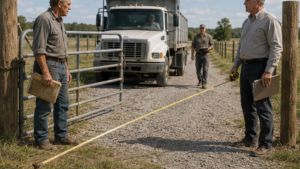
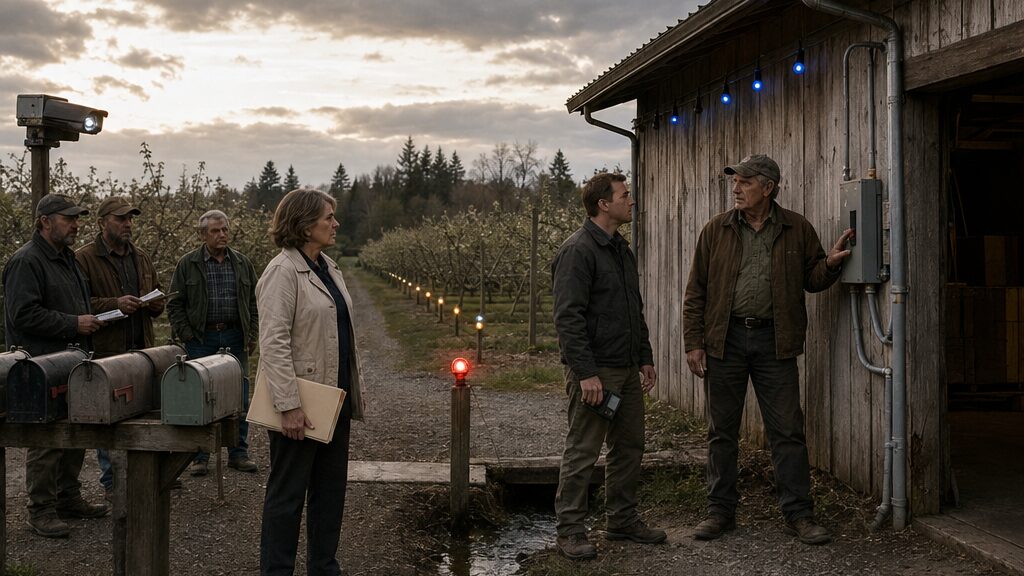
The gray metal box was fixed to the outer wall of the packing shed, just beyond the gravel pullout where eight rural mailboxes stood in a row. Above them, colored bulbs ran beneath the eaves and continued along cedar posts toward the orchard entrance—red, amber, green, and blue points against a cold March afternoon.
“Let go of the panel, Mr. Hall,” the officer said.
David looked past him at Patricia Brown. She stood beside her pickup with a folder pressed against her coat. Two neighboring growers had stopped at the mailboxes. The mail carrier remained inside her vehicle, pretending to organize envelopes.
Patricia nodded toward the lights. “This didn’t have to become a county matter.”
“No,” David said. “It didn’t.”
The officer glanced between them. “I’m here to determine what’s installed, whether it falls under agricultural lighting exemptions, and whether it’s safe. Nobody is disconnecting anything until I finish looking.”
Patricia’s mouth tightened. She had chaired the agricultural road association for four years, long enough to learn that authority worked best when it appeared procedural.
“The complaint is not only mine,” she said. “Those bulbs have been up since December.”
“They were up before December.”
“That doesn’t improve the situation.”
David released the panel and stepped back. At sixty-five, he had learned that stillness unsettled people who arrived expecting an argument. His canvas jacket was patched at one elbow, and dried mud marked his boots. He looked less like a man defending a system than one interrupted halfway through repairing a gate.
The officer opened the metal cover.
Inside, four labeled switches sat above a row of older wiring. The labels were not festive.
MAILBOX.
DITCH.
SHED.
BLUE.
Patricia leaned closer. “Anybody can write labels.”
David turned toward the road. “Watch the red line.”
He switched off the first circuit.
Every third bulb along the fence went dark. The red bulb nearest the mailboxes vanished, as did two others tracing the edge of the irrigation ditch. Without them, the shallow crossing beside the pullout became difficult to distinguish from the grass.
“That pipe washed out last fall,” David said. “The red bulbs mark the crossings until I can replace the culvert.”
One of the growers shifted his weight. He had nearly put a tractor wheel into that ditch in January.
David switched the red circuit back on and killed the amber one. The bulbs beneath the packing-shed eaves went dark. A small camera above the loading door remained, but its view now pointed into shadow.
“Amber gives the shed cameras enough light to catch faces instead of headlights,” David said.
Patricia folded her arms. “Then install proper security fixtures.”
“They blind drivers coming around the bend.”
“Then hire someone who knows how to position them.”
The words landed harder than her tone suggested. Thomas Rivera had helped David angle those cameras, but Thomas was not present. David wondered whether that absence was caution or agreement.
He turned off the green circuit. A string of bulbs along the orchard entrance disappeared, leaving the gatepost and the first row of trees in dull gray light.
“Green marks the walk from the road to the worker lot,” David said. “During harvest, crews arrive before sunrise.”
The officer looked along the lines, following the system rather than the colors now.
Patricia noticed the change in his expression. “The association was never given any of this information.”
“You never asked.”
“I asked what the lights were for.”
“You asked why I still had Christmas decorations up.”
A mailbox door clicked shut. The grower who had been listening lowered his eyes.
Patricia’s face colored, but she kept her voice controlled. “You told me they were for security. That is not a plan, a permit, or an inspection report.”
David had no answer that would help him.
The officer pointed to the final switch. “What does the blue circuit cover?”
David’s hand stopped above it.
The blue bulbs began at the packing shed and ran in a narrow line toward the farmhouse, crossing behind the equipment bay rather than following the public road. One blue bulb hung above a side door that had not been used regularly in years.
“Private ground,” David said.
“That wasn’t the question.”
“It marks a route.”
“For whom?”
David closed the panel.
The officer’s gaze sharpened. Patricia looked from the blue bulbs to David, and for the first time her irritation gave way to curiosity.
“If this is an integrated safety system,” the officer said, “I need to understand all of it.”
“You need to know whether it’s dangerous.”
“That requires knowing where it goes.”
“It ends at my house.”
Patricia opened her folder. “This is exactly the problem. He expects everyone to trust whatever he decides to build.”
David looked at her. “And you expect everyone to trust whatever you decide to remove.”
For a few seconds, only the ticking engine of the mail carrier’s vehicle disturbed the pullout.
The officer crouched beside the panel and traced a conduit downward. Most of the wiring was protected in weatherproof pipe. Near the foundation, however, one newer section entered through a patched opening behind the shed siding.
“Who installed this branch?” he asked.
“I did.”
“Licensed electrician?”
“No.”
“Permit?”
David did not answer.
Patricia exhaled through her nose. Not triumphantly. Almost with relief, as though the officer had finally found something solid enough to justify the trouble she had started.
The officer stood. “The agricultural exemption covers low-voltage field markers under certain conditions. It does not automatically cover modified building circuits, camera support, and unidentified branches.”
“They’re twelve-volt fixtures past the transformer,” David said.
“Past which transformer?”
David pointed inside the shed.
The officer walked toward the loading door. David moved first and blocked the entrance without appearing to.
“Not until Rachel gets here.”
Patricia caught the name. “What does your daughter have to do with an electrical inspection?”
“Nothing you need to concern yourself with.”
“That answer has carried this far enough.”
The officer raised a hand. “I don’t need a family dispute. I need access to the equipment feeding these lines.”
David could have opened the door. The transformer was mounted twenty feet inside, behind an old sorting table. Nothing illegal waited there beyond rough records and modifications that had accumulated over several seasons.
But the blue route map was locked in the records cabinet.
So was the incident report Rachel had once refused to file.
He had promised her that nobody would turn what happened into road gossip. Over the years, the promise had hardened into something he no longer examined. He had built lights instead.
The county officer watched him make the decision.
“I can come back tomorrow with access authority,” he said quietly. “Or you can show me now.”
David glanced at Patricia. She had stopped looking victorious. Her eyes rested on the blue bulb above the side door.
“No,” David said.
The officer removed a red tag from his case.
Patricia stepped forward. “Couldn’t the system remain on until a full inspection?”
David looked at her, surprised by the question.
The officer shook his head. “Not after the owner has denied access to the supply equipment. I can isolate the unidentified branch, but the circuits share a modified transformer. Until I verify it, the whole installation is out of service.”
He wrote the date and time on the tag.
David’s calm did not break, but something inside him shifted from resistance to alarm. The lights had never all been dark at once—not since he installed the first blue bulbs.
The officer fixed the tag across the panel door.
“Disconnect by sunset,” he said. “No reconnection until inspection and approval.”
Patricia closed her folder. The growers returned to their trucks without speaking. The mail carrier drove away.
David remained beside the box as the late light faded across the orchard rows. One by one, the colored bulbs began to glow brighter against the coming dusk.
He had less than an hour before he would have to turn them all off.
Chapter 2: Three Dark Nights Along the Orchard Road
Rachel Green found the tire tracks before she found her father.
They cut through the damp gravel behind the packing shed, two fresh bands pressed deep enough to expose pale stone beneath the mud. The tracks approached the loading bay, stopped near the side door, then backed toward the orchard road.
No delivery was scheduled.
Rachel crouched beside one tread mark and touched its edge. Still sharp. Recent.
Above her, the empty sockets under the shed eaves looked like missing teeth.
“Dad?”
A metallic scrape came from inside.
She entered through the loading door and found David on a ladder with a coil of wire over one shoulder. The county tag remained across the exterior panel, but he had removed the inner cover from the transformer box.
“Get down,” she said.
“I’m tracing a fault.”
“You’re preparing a bypass.”
“I didn’t say that.”
“You brought the old battery bank out.”
On the floor beneath him sat two deep-cycle batteries once used for an irrigation monitor. A temporary cable ran halfway toward the camera junction.
David descended slowly. “The tag covers the building feed. It doesn’t cover an independent low-voltage source.”
“It covers reconnection.”
“It covers their interpretation of reconnection.”
Rachel stared at him. “That sentence is why Patricia had enough support to file the complaint.”
He set the wire on the sorting table. “There were tracks outside.”
“I saw them.”
“Then you understand.”
“I understand somebody drove behind the shed. I also understand that if you power those lights tonight, the county can fine us or shut down the entire electrical service.”
“They won’t know.”
She gave a short, humorless laugh. “You put colored bulbs along half a mile of road.”
David looked toward the door. Daylight was already thinning.
Rachel had returned to the orchard fourteen months earlier after years coordinating agricultural freight. She had come with spreadsheets, vendor agreements, and the belief that practical problems yielded to visible facts. Her father treated documentation as something requested by people who had never repaired a frozen pump at two in the morning.
She pointed to the temporary cable. “We do this correctly or not at all.”
“We may not get three weeks to do it correctly.”
“Then we use motion lights on independent batteries. Approved units.”
“Too bright.”
“Adjustable.”
“Too narrow.”
“Better than violating the order.”
David’s jaw worked once. He began coiling the cable.
That was not agreement. It was postponement.
The first night passed without incident, though Rachel barely slept. She installed two battery motion lights, one above the worker lot and one facing the mailboxes. Wind moved branches across the sensors, switching the lights on and off until David finally covered half of each detector with black tape.
The mailbox camera recorded pale bursts and darkness.
On the second morning, Patricia’s pickup slowed at the orchard entrance but did not turn in. She looked toward the dead bulbs and continued down the road.
By the second night, the darkness had acquired shape.
Without the red markers, the ditch crossing vanished beyond the mailbox pullout. Without amber light beneath the eaves, the packing shed seemed farther from the farmhouse than it was. The blue route remained visible only as a line of dark sockets leading through the yard.
Rachel reviewed the camera feeds at the kitchen table. The mailbox view showed a white oval whenever a vehicle passed, then dissolved into grain. At 11:43 p.m., a shape moved beside the mailboxes.
She froze the image.
A shoulder, perhaps. Or a branch.
David stood behind her, holding a mug gone cold.
“Play it.”
She advanced three frames. The shape crossed the lower corner. A brief reflection flashed near the road.
“Plate?” he asked.
“Glare.”
“Height?”
“Unclear.”
“Go to the shed camera.”
The shed view showed darkness and the faint edge of a vehicle turning somewhere beyond the gate.
“There,” David said.
“It could be any truck.”
“It came in.”
“We can’t prove that.”
“I don’t need proof to lock my own gate.”
He took his jacket from the chair.
Rachel caught his sleeve. The movement surprised them both.
“You are not walking out there alone because of six gray pixels.”
His eyes dropped to her hand.
For a moment she was twenty-eight again, standing beneath that same kitchen light while a deputy asked whether she recognized either man. She had said no. David had stood behind her, silent and rigid, already designing something in his head.
Rachel released him. “We call the sheriff if anyone enters.”
“And tell them what?”
“The truth available to us.”
“That something moved?”
“Yes.”
He stayed inside, but not because she had convinced him. He sat by the window until dawn.
The third night, the mailboxes came apart.
The sound reached the farmhouse shortly after two—a wooden crack, then metal striking gravel. David was out the door before Rachel reached the hallway. She followed with a flashlight and called the sheriff’s office while running.
At the pullout, three mailbox posts lay across the road. Doors had been torn loose. Letters and farm invoices scattered through the ditch. One box had been crushed under a tire, its flag bent flat against the gravel.
David stood beneath the dead red bulb, staring.
The battery light above the pullout had been twisted toward the field.
“Don’t touch anything,” Rachel said.
He pointed to the road. “Truck came through here.”
She saw the marks: a wide tread cutting beside the broken posts, then continuing toward the orchard entrance.
A neighbor arrived in a bathrobe under a work coat. Another truck stopped behind him. Questions began before anyone had answers.
“Did the cameras get it?”
“Where were the lights?”
“Was this aimed at David?”
Patricia arrived ten minutes later. She stepped from her pickup and stopped when she saw the mailboxes.
Nobody greeted her.
She moved carefully around the debris, her face drained of its usual certainty. “The motion light?”
“Turned,” Rachel said.
“And the camera?”
David looked at Patricia. “You wanted the lights off.”
Patricia absorbed the accusation without answering. Her eyes moved to the dark bulbs overhead.
The sheriff’s deputy took statements and photographed the tire marks. He would not say whether the damage was random. Mailbox vandalism happened. So did trespass. Without a clear plate or face, the camera footage offered little.
By daylight, the scene looked less frightening and more humiliating. Splintered cedar, bent metal, wet envelopes, neighbors sorting through what belonged to whom.
Patricia offered to call the insurer.
David walked away.
Rachel found him behind the packing shed, studying the tracks she had discovered that first morning. Newer marks crossed them now.
“You knew somebody had been back here,” he said.
“I told you.”
“You didn’t tell the others.”
“Neither did you.”
“That’s different.”
“No. That is the problem.”
He looked toward the dead blue line.
Rachel followed the tire marks to the side door. Something pale lay in the mud near the foundation. At first she thought it was broken plastic.
She bent and lifted it by the metal base.
A blue bulb.
Unlike the smashed mailboxes, it was intact. Someone had unscrewed it rather than broken it.
Beside the socket, pressed into damp soil, was a boot print too large to be hers and too narrow to be David’s.
The print pointed toward the locked records door.
Chapter 3: The Meeting Where Nobody Was Entirely Right
The neighboring pear grower placed a shattered mailbox door on the table in front of Patricia Brown.
It landed with a flat metal slap that silenced the grange hall.
“This belonged to my wife’s box,” he said. “Her medication was in the ditch.”
Patricia looked at the bent aluminum door, then at the thirty people seated in folding chairs. She had arranged the tables, printed the agenda, and placed a pitcher of water beside the association minutes. None of it gave her control of the room.
“We will address the damage first,” she said.
“You addressed the lights first,” someone called.
Another voice followed. “Now we’ve got no lights and no mailboxes.”
Patricia kept her hands flat on the table. “The county ordered the disconnection after finding an uninspected system.”
“You brought the county.”
“Yes. Because the association has liability obligations.”
David sat in the second row beside Rachel. He had not spoken since entering. A single colored bulb rested on the table before him—the blue one Rachel had found in the mud, sealed now inside a clear evidence bag at the deputy’s suggestion.
The county electrical inspector sat near the wall. Thomas Rivera occupied a chair between the association board and the residents, looking unhappy with everyone.
Patricia turned to the inspector. “Please explain why the system was shut down.”
He did. Modified transformer. Undocumented branch circuits. Denied access. Potential code violations. He spoke without blame, which made the facts sound worse.
When he finished, the room shifted toward David.
Patricia felt the pressure ease by a fraction.
Then the pear grower pointed to the broken mailbox door. “Would those lights have stopped this?”
The inspector hesitated. “I can’t say they would have prevented it.”
“Would the cameras have shown more?”
“Likely.”
“Would the pullout have been better lit?”
“Yes.”
The pressure returned.
Patricia reached for her folder. “The board offered Mr. Hall an inspection pathway.”
David finally spoke. “You requested immediate removal.”
“I requested compliance.”
“You rejected a temporary inspection.”
“Because your system was connected before approval.”
Thomas leaned forward. “That’s enough.”
He was seventy, broad-shouldered despite a slight stoop, with hands permanently marked by wire, oil, and orchard work. He had retired from the regional utility but still repaired pumps for neighbors who paid him in cash, pears, or promises.
“You all want one person to be completely wrong,” he said. “That would be convenient.”
Nobody interrupted him.
Thomas pointed toward David. “Those lights were useful. I helped aim two of the cameras, and the colored markers reduced glare at the curve. The red bulbs showed the ditch crossings. Amber carried enough light for the camera sensors. Green marked the worker approach.”
Patricia heard murmurs spreading through the chairs.
Then Thomas turned to David.
“But you added circuits after I last looked at it. You tied a building transformer into field markers without a revised load calculation. You ran a branch through patched siding. You kept no inspection record.”
David’s expression did not change, but Rachel looked at him.
Thomas faced the room again. “Disconnecting everything at once was reckless. Building it without documentation was also reckless. Both can be true.”
The words settled heavily because no one could use them as a weapon without being cut by the other edge.
Patricia lifted the water glass and found her hand unsteady.
An association board member cleared his throat. “What happens now?”
The insurance adjuster, attending by speakerphone, answered from the center of the table. “Until a compliant lighting and camera-support plan is submitted, the shared road’s liability coverage may exclude losses associated with unapproved electrical infrastructure or known visibility hazards.”
Patricia stared at the phone.
“Exclude the entire road?” she asked.
“Potentially. The underwriter needs a remediation plan within ten business days.”
A grower near the back stood. “You told us reporting the lights would protect the policy.”
“I said unreported wiring threatened it.”
“And now removing it threatens it too.”
Patricia closed her folder before anyone could see the insurer’s earlier letter inside. The letter had warned that another unresolved claim involving Nicholas’s equipment company could increase premiums across both their properties. She had read that sentence three weeks ago and begun treating every uncertain condition as a threat requiring immediate elimination.
David watched her close the folder.
His gaze was not triumphant. That made it harder to meet.
Rachel stood. “We can submit a temporary plan. Battery fixtures at the mailboxes. Separate approved units at the ditch crossings. Cameras on independent low-voltage power.”
The inspector nodded. “That could work while a permanent system is reviewed.”
Patricia should have welcomed the proposal. Instead she heard the cost in every item.
“Who pays?” she asked.
Silence answered.
“The association reserve cannot absorb a complete replacement,” she continued. “We have culvert work due this spring.”
David said, “I’ll provide the fixtures.”
“And retain control?”
“No.”
The single word drew Patricia’s attention.
David looked at Rachel rather than the board. “Not if shared control is the condition.”
Rachel’s face softened slightly, but suspicion remained.
Thomas picked up the evidence bag containing the blue bulb. “This line still hasn’t been explained.”
David’s shoulders tightened.
Patricia saw the change. So did the inspector.
“What does it mark?” she asked.
David looked toward the grange hall windows, where the parking lot had gone black beyond the glass.
“Private access.”
“That answer stopped being enough when the wiring affected shared coverage.”
Rachel rose so abruptly her chair scraped the floor. “It does not belong in this meeting.”
The room went still.
Patricia looked from Rachel to David. The tension between them was older than the complaint. She understood that much, though nothing else.
The inspector spoke carefully. “I don’t need personal history. I need circuit purpose and load.”
“Then ask for that,” Rachel said. “Not the story behind it.”
David lowered his eyes.
Patricia felt something inside her certainty give way. She had assumed secrecy meant arrogance. Now she saw that it might also mean fear, though she could not tell whose.
She turned the agenda page. “We will limit discussion to technical function.”
Rachel sat, but she did not thank her.
The meeting moved to temporary repairs. Residents argued over cost shares, camera angles, and whether the damaged mailboxes should be replaced with steel units. The outrage thinned into the duller hostility of numbers.
By the time the hall emptied, Patricia’s head ached.
She gathered papers while David and Rachel left without speaking to her. Thomas paused beside the table.
“You pushed too fast,” he said.
“So did he.”
Thomas nodded. “That doesn’t make your part smaller.”
He left her with the broken mailbox door and the sealed blue bulb.
Nicholas waited outside beside her pickup.
He kept his hands in his jacket pockets. At thirty-six, he still wore guilt the way he had as a boy—not by avoiding her eyes, but by holding them too steadily.
“What are you doing here?” Patricia asked.
“I heard about the insurance deadline.”
“You should have stayed home.”
“I need to tell you something before the deputy asks for commercial vehicle records.”
Cold moved through her before he finished.
Nicholas glanced toward the emptying lot. “My truck was on the orchard road that night.”
Patricia gripped the folder against her chest.
“How late?”
“After midnight.”
“What were you carrying?”
He looked away then.
Behind them, through the grange hall window, the blue bulb lay under fluorescent light beside the shattered mailbox door.
Patricia lowered her voice. “Nicholas, what did you do?”
Chapter 4: What the Blue Circuit Was Built to Remember
Rachel had the locked records cabinet open before David reached the packing shed office.
The key lay beside her on the desk. He recognized it immediately—the small brass spare he kept taped beneath the bottom drawer, a precaution he had once considered clever.
She held a folded sheet of graph paper under the lamp.
Blue pencil lines crossed a rough map of the shed, worker lot, farmhouse path, and equipment bay. Circles marked the original bulb positions. In the lower corner, David’s handwriting read: CLEAR ROUTE. HOUSE TO SHED. NO BLIND POINTS.
“You went through my files,” he said.
Rachel did not look up. “You hid my files in your cabinet.”
“They’re system records.”
“My statement is clipped to the back.”
David closed the office door. Beyond the thin wall, the idle sorting machinery ticked as its metal cooled.
Rachel turned the page.
The unsigned incident form was still there, yellowed at the edges. Most of it was blank. Date, location, description. A deputy had written two sentences before Rachel asked him to stop.
Two unknown men entered the packing-shed area after dark. Reporting party unable to identify vehicle or individuals.
David had kept the paper because throwing it away had felt like admitting he could do nothing.
“You said you didn’t want a report,” he said.
“I said I didn’t want every neighbor asking me what they did.”
“I respected that.”
“You built half the orchard around it.”
He remained near the door.
Rachel laid the map flat. “When did you draw this?”
“The week after.”
“I was living here.”
“You weren’t sleeping.”
“Neither were you.”
The blue circuit had begun with six bulbs. One over the shed door. Two along the path. One at the fuel tank. One where the route crossed behind the equipment bay. One outside the farmhouse mudroom.
David had chosen blue because it was visible without washing the yard in white glare. Later, he added a switch beside Rachel’s bedroom and another in the shed office. If either was pressed, every blue bulb flashed and the house alarm sounded.
He had never explained the full design to anyone beyond Thomas.
Rachel held up the map. “You told the officer it marked private access.”
“It does.”
“That is not why you built it.”
“He didn’t need why.”
“He needed enough truth to inspect it.”
David moved toward the desk. “He needed load ratings and conduit routes. Not your history.”
“You denied him the shed.”
“Because this was here.”
“You could have removed it.”
“I wasn’t going to hide records before an inspection.”
“You were already hiding them.”
The words stopped him.
Rachel turned to the last page. It contained newer notes in David’s handwriting: camera angles, replacement dates, voltage readings, and a list of times when vehicles had entered after dark. He had recorded every unexplained headlight, every open gate, every worker who forgot to sign out.
She tapped the list. “You kept tracking it.”
“I kept the orchard safe.”
“You kept waiting for them to come back.”
David looked through the office window toward the darkened shed. “People return when they learn nobody is watching.”
Rachel’s expression changed—not softer, but more tired.
“They didn’t come back, Dad.”
“You don’t know that.”
“Neither do you.”
He reached for the map. She pulled it away.
The movement was small, but it exposed the distance between them more clearly than shouting would have.
“You made me the reason for every wire you didn’t permit,” she said. “Every camera you didn’t document. Every time someone asked a question and you decided they had no right to an answer.”
“That system let you walk from the shed to the house.”
“I stopped walking that route.”
“Because it wasn’t safe.”
“Because you watched me every time I did.”
David opened his mouth, then closed it.
Rachel’s voice lowered. “You never asked whether the lights helped me.”
He looked at the blue map again. He remembered finishing the first circuit before dawn, his hands numb from cold, then standing in the yard while the bulbs came on one by one. He had believed he had repaired something.
“Didn’t they?” he asked.
“For a while.”
The answer gave him less comfort than no.
Rachel sat down. “Then they became a reminder that you thought danger was still standing behind the shed. Every night.”
David took the chair across from her.
Outside, wind pushed a loose branch against the metal siding. Both of them glanced toward the sound. Rachel noticed that they did it together.
“I promised you it wouldn’t happen again,” he said.
“You promised yourself.”
He looked at his hands.
The night of the incident, Rachel had come into the kitchen without her coat. Mud covered one knee. She said two men had blocked the path between the shed and the house, asking whether she was alone and whether the fuel tanks were locked. She had slipped through the sorting room and exited by another door.
They had not touched her. They had not taken anything.
That absence of visible harm made the event difficult to explain and impossible for David to forget.
“I should have been outside,” he said.
“You were asleep.”
“I should have heard the truck.”
“You are not supposed to hear every truck.”
He had spent years proving otherwise.
Rachel folded the map carefully. “At the county hearing, you cannot tell them this story.”
“If the blue circuit needs justification—”
“No.”
“They may ban it.”
“Then they ban it.”
His head lifted. “That route protects workers now. Not only you.”
“Then justify it with worker safety. Emergency signaling. Access visibility. Do not put me in front of the room without my consent just because the truth would help your case.”
“I wouldn’t name you.”
“They know I’m your daughter. They know where I worked. They can count backward.”
David pushed away from the desk and stood. “I was trying to protect your privacy.”
“You protected the secret. That isn’t the same thing.”
The office seemed suddenly too small for the cabinet, the map, and everything he had refused to name.
Rachel placed the unsigned report back inside the folder.
“You want Patricia to admit she acted out of fear,” she said. “You want the board to understand her complaint caused damage. But you still think your fear should remain beyond examination.”
“She used rules against us.”
“And you used silence against everyone.”
David flinched as if she had raised her voice.
She had not.
A vehicle entered the yard. Headlights swept across the office window and vanished when the driver turned toward the loading bay.
David moved to the door.
Rachel caught the sound of the engine. “Expected?”
“No.”
They stepped into the shed together. The vehicle stopped outside, but no one entered. After a moment, its reverse lights appeared, and it backed away.
By the time David reached the loading door, the road was empty.
Rachel returned to the office and began sorting the papers that had fallen from the cabinet shelf. Beneath an old pump invoice, she found a recent delivery packet.
The contractor name at the top read PEREZ ORCHARD EQUIPMENT.
Three delivery dates were listed. Two matched daytime repairs David remembered.
The third was stamped 12:18 a.m.—the night the mailboxes were destroyed.
Rachel carried it to the doorway.
“Dad.”
David turned.
She held the invoice where he could see Nicholas’s name and the late delivery time.
The document did not prove who broke the mailboxes.
It proved someone had been using the dark road and had not told them.
Chapter 5: The Road Was Dark for More Than One Reason
Patricia found the missing gate chain under the passenger seat of Nicholas’s truck.
It was coiled beneath a tarp, still carrying flakes of green paint from the Hall Orchard entrance. One end had been cut cleanly through the old repair link.
She straightened with the chain in both hands as Nicholas crossed the equipment yard carrying a fuel filter.
He stopped when he saw it.
“Where did you get this?” she asked.
Nicholas set the filter on the truck bed. “You already know.”
“I know where I found it.”
The yard was bordered by parked sprayers, a disabled forklift, and two orchard tractors waiting for repair. Every machine represented work Nicholas had accepted before receiving payment for the last job.
Patricia lifted the chain. “Why was Hall’s gate hardware in your cab?”
“It came loose.”
“Chains do not come loose and climb under seats.”
“I put it there.”
“When?”
He looked toward the open workshop doors. A mechanic worked inside, far enough away not to hear unless voices rose.
“The night of the delivery,” Nicholas said.
Patricia had slept badly after the meeting, replaying the way he said his truck had been on the road. She had imagined mistakes she could contain: a wrong turn, an emergency repair, a customer who insisted on late service.
The chain made containment less likely.
“What delivery?”
“A used pump assembly.”
“To whom?”
“Buyer east of Hall’s place.”
“You used the orchard road as a shortcut.”
“The county bridge has a weight restriction.”
“So you entered private property.”
“The road joins the service lane.”
“It joins it through David’s gate.”
Nicholas rubbed a hand across his mouth. “The gate was already open.”
“Then why take the chain?”
“It caught on the trailer.”
Patricia stared at the cut link.
He looked away. “I didn’t have bolt cutters long enough to clear it clean. I backed up, cut the repair loop, and moved it so I could get through.”
“You left the gate unsecured.”
“I meant to put it back.”
“But you didn’t.”
“It was after midnight. I was already late.”
Patricia dropped the chain into the truck bed. Metal struck metal.
“Did anyone follow you?”
Nicholas did not answer quickly enough.
Her stomach tightened. “Nicholas.”
“There was a pickup behind me near the highway.”
“Whose?”
“I don’t know.”
“You let an unknown vehicle through Hall’s gate?”
“I didn’t let anybody through. I turned onto the service lane. They kept going.”
“Toward the mailboxes?”
“Maybe.”
“You told the deputy none of this.”
“I told him I didn’t see the damage.”
“That was not the question.”
He faced her. “You want me to say I smashed those boxes because my truck was there?”
“I want you to say what happened before somebody pulls your route records and decides for you.”
Nicholas’s expression hardened. “I delivered a pump. I cut a chain. I left. That is what happened.”
Patricia believed he had not destroyed the mailboxes. Belief was not the same as relief.
“Why hide the delivery?”
“The buyer paid cash.”
“Why?”
“Because he did not want the equipment listed until his financing cleared.”
She closed her eyes briefly. “You moved unrecorded equipment across private land after midnight for a buyer avoiding his lender.”
“It was a pump, not stolen machinery.”
“That distinction will comfort the insurer.”
At the word insurer, Nicholas looked toward the office.
Patricia saw the fear he had been carrying. His company’s last claim involved a worker backing a trailer into a cold-storage wall. The insurer had renewed them with conditions, higher deductibles, and a warning that another undisclosed incident could end the policy.
“You filed the complaint because of me,” he said.
“I filed it because Hall’s wiring was unapproved.”
“You pushed for same-day shutdown because you thought the underwriter might inspect the road.”
Patricia said nothing.
Nicholas laughed once, bitterly. “You told everyone it was about the covenant.”
“It was about keeping this business alive.”
“It was about hiding one risk by pointing at another.”
The accusation felt unfair because it was accurate only in part. Patricia had believed the lights were a liability. She still believed David had installed them badly. But the urgency—the refusal to wait for Thomas, the insistence on county involvement, the language about immediate exposure—had come from the insurance letter in her folder.
Nicholas lowered his voice. “Stop protecting me like I’m twelve.”
“I am trying to keep six people employed.”
“Then tell them the truth before they learn it from a route log.”
A truck entered the yard. David’s old pickup rolled between the parked equipment and stopped beside the office.
Patricia’s first thought was that Rachel had found the invoice.
David stepped out alone.
He looked at the chain in the truck bed, then at Nicholas.
“I came to ask about a delivery,” he said.
Nicholas crossed his arms. “You have the invoice.”
“Rachel found it.”
Patricia moved between them without intending to. “He did not damage the mailboxes.”
David’s eyes stayed on Nicholas. “I didn’t say he did.”
“You came here.”
“I came to ask why his truck entered my orchard after midnight.”
Nicholas answered before Patricia could. “Bridge restriction. I used your service lane.”
“You cut my gate chain.”
“It caught the trailer.”
“You left the gate open.”
“Yes.”
The direct admission changed the scene. David had arrived prepared for evasion. For a moment, he had nowhere to put his anger.
“Was there another vehicle?” he asked.
Nicholas described the pickup. Dark body. One working headlight. It followed him off the highway, slowed near the mailboxes, then disappeared from his mirrors when he turned through the orchard.
“Could you identify it?”
“No.”
“Driver?”
“No.”
“Plate?”
“No.”
David looked toward the chain.
Nicholas said, “I didn’t know they would come through.”
“You didn’t know because you didn’t stop to close the gate.”
“I was working.”
“So was everyone whose mail ended up in the ditch.”
Patricia expected Nicholas to answer sharply. Instead, he nodded once.
“I know.”
The quiet responsibility in those two words unsettled her more than denial would have.
David picked up the chain. “This repair link was weak.”
Patricia stared at him. “That is not an excuse.”
“No. It’s another failure I knew about and postponed.”
Nicholas looked up.
David set the chain down. “The lights being off made the road easier to use unseen. The gate being open made it easier to enter. Neither proves who did the damage.”
Patricia heard the restraint in his voice. He could have accused Nicholas publicly. He could have taken the chain to the board and made her defend her son beneath fluorescent lights.
Instead, he asked, “Will you give the deputy your route record?”
Nicholas hesitated.
Patricia said, “He will.”
Nicholas turned on her. “I can answer.”
“Then answer.”
He looked from Patricia to David. “Yes.”
David nodded. “And the buyer?”
“I’ll identify him.”
“That may cost you the contract.”
“It may.”
Patricia felt her authority slipping into something less comfortable and more honest.
Her phone rang inside her coat.
The insurance adjuster’s number appeared on the screen.
She answered.
The adjuster spoke for less than a minute. A final county hearing had been scheduled for the following week. Until then, no replacement system could be installed except temporary independently powered fixtures approved by the electrical inspector. If no permanent remediation agreement was reached, the shared road exclusion would take effect.
Patricia ended the call.
“They scheduled the hearing,” she said.
David’s face closed again. “When?”
“Next Thursday.”
“That is not enough time for full engineering.”
“They know.”
Nicholas looked at the equipment yard, at the jobs waiting, and at the chain he had cut.
Patricia understood then that the hearing would not be about proving who had been worse. It would be about which truths each of them was willing to place on the table.
David returned to his truck without taking the chain.
That evening, Patricia drove to Hall Orchard alone.
The colored bulbs remained dark. Temporary battery lamps cast narrow white pools near the mailboxes, making everything beyond them appear more hidden.
David was repairing a mailbox post when she pulled in.
She carried the chain across the gravel.
He watched her approach but did not stand.
“I did not come as board chair,” she said.
“Then why are you carrying evidence?”
“Because it belongs to your gate.”
She placed the chain beside him.
David looked toward her pickup. “Where’s Nicholas?”
“Giving his route records to the deputy.”
The hammer in David’s hand lowered.
Patricia drew the insurance letter from her coat, but kept it folded.
“I need to speak to you without the board,” she said. “And without either of us pretending this started for the reasons we gave in that meeting.”
Chapter 6: The Hearing David Could Not Win by Staying Silent
The hearing officer held up David’s blue circuit diagram.
“Did this branch have any lawful agricultural purpose?”
David could feel Rachel seated behind him, though he did not turn around.
The county agricultural services room had no windows. Fluorescent panels flattened every face and made the redesigned color map on the easel look almost childish: red crossings, amber camera zones, green worker paths, blue emergency points.
At the opposite table, Patricia sat beside the insurance adjuster. Nicholas occupied a chair behind her. Thomas had placed a tool case under his seat, as if someone might ask him to repair the room before the hearing ended.
David leaned toward the microphone.
“Yes,” he said.
“Describe it.”
The answer he had once refused was now the first thing the hearing required.
“The blue branch marks a protected route between the packing shed and the farmhouse. It also connects to two manual alert switches.”
“For what emergency?”
“Any situation in which a worker cannot safely cross the yard without drawing attention.”
The officer looked down at the original plan. “This was not listed in your installation notes.”
“My installation notes were incomplete.”
“Why?”
David’s first instinct was to say the details were private. The phrase rose ready-made, smooth from years of use.
He looked at Rachel.
She sat with her hands folded over a closed folder. She had agreed to attend only after he promised not to tell her story. Not indirectly. Not as an unnamed example. Not as a justification she could not control once spoken.
David faced the officer again.
“The circuit was built after a safety incident involving a family member,” he said. “That person has not given permission for the details to be disclosed. The design can be justified without them.”
The insurance adjuster spoke. “Without a documented risk event, the underwriter may view the branch as unnecessary.”
David nodded. “Then view it as unnecessary in its original form.”
Rachel’s head lifted.
He walked to the easel.
“The original blue circuit depends on my private reasoning and my control. That is not acceptable for shared infrastructure. The replacement does not.”
He turned the top page of the map.
Beneath it was a new plan Rachel had helped draft. The blue route no longer ended at the farmhouse. It connected the packing shed, worker lot, mailbox pullout, and three manual emergency switches. Each switch could activate blue flashing markers and send an alert to designated phones. The circuit would remain separate from the cameras and building supply.
The electrical inspector leaned forward.
“Listed low-voltage components?” he asked.
“Yes.”
“Independent transformer?”
“Yes.”
“Accessible disconnect?”
“At the shared cabinet and the shed.”
The hearing officer tapped the original diagram. “Why was none of this done initially?”
David kept one hand on the easel.
“Because I installed the system myself and believed usefulness excused the lack of process.”
Patricia looked at him.
He continued before anyone could soften the admission.
“I added loads without updating the plan. I ran a branch through patched siding. I denied inspection access. Those were my choices. The removal order did not create those violations.”
The room remained quiet.
The admission cost him something more precise than pride. It removed his last clean version of the story—the one in which he had been right, Patricia had been wrong, and the darkness proved it.
The officer asked, “Do you accept penalties associated with the unpermitted work?”
“Yes.”
“Do you accept that the original system cannot be restored as built?”
David looked at the old blue map, then folded it once.
“Yes.”
Behind him, Rachel released a breath.
The insurance adjuster turned to Patricia. “The association chair requested accelerated disconnection. Was the board informed that a temporary inspection had been offered?”
Patricia placed both hands on the table.
“No.”
A murmur moved through the back row.
She did not look toward it.
“Why not?” the hearing officer asked.
Patricia unfolded the insurance letter she had shown David at the orchard.
“Our equipment policy had been placed under conditional renewal after a prior claim. I believed any additional unreported hazard connected to our shared road could affect both the business and association coverage.”
“Was that belief confirmed?”
“No.”
“Did it influence your decision?”
“Yes.”
Nicholas shifted behind her.
Patricia continued. “My son’s company was also using the road for an unauthorized late delivery on the night the mailboxes were damaged. I learned that after the association meeting.”
The adjuster’s expression sharpened. “Was the vehicle involved in the vandalism?”
“No evidence says it was. But he cut a gate chain, left the entrance unsecured, and failed to report the route.”
Nicholas stood halfway, then stopped when Patricia raised a hand.
“He has provided the deputy with his records,” she said. “He will accept responsibility for the gate and part of the mailbox replacement.”
The hearing officer studied her. “Why are you disclosing this now?”
Patricia glanced at David. “Because I accused him of using secrecy as authority while I was doing the same thing.”
No one applauded. No one offered forgiveness. The statement remained in the room with the weight of a tool placed on a workbench.
Thomas cleared his throat.
“With permission,” he said, “I reviewed the replacement plan.”
The officer nodded.
Thomas opened his case and removed a typed inspection checklist. He confirmed that the new design separated field markers, camera illumination, emergency alerts, and building power. Red fixtures would mark irrigation crossings. Amber fixtures would provide shielded camera support. Green fixtures would identify worker access. Blue fixtures would operate only during an emergency or scheduled test.
“All components can be inspected independently,” Thomas said. “No homemade junctions. No shared hidden feed.”
The electrical inspector added, “The technical plan is approvable with revisions.”
David heard the condition before it came.
The hearing officer turned to the association documents. “The road crosses multiple properties and serves shared mail delivery. Any permanent system affecting those areas must not remain under one owner’s exclusive control.”
David looked at the small brass key on the table before him.
He had carried it for years. It opened the exterior cutoff cabinet and the records office where he kept the original map. Even after Rachel returned to manage the orchard, he had never given her a copy.
“What control structure is required?” he asked.
“Two authorized custodians from separate properties, plus emergency access for the association chair or designated safety officer. Maintenance logs available to all affected owners. Annual inspection.”
Patricia said, “I should not be the sole association custodian.”
The hearing officer raised an eyebrow.
“Thomas can serve until the board selects someone,” she said. “I will retain emergency access only.”
Thomas looked displeased by the extra work, which meant he would probably accept it.
David closed his fingers around the key.
The arrangement was sensible. That did not make it easy.
The lights had been his answer to a night when he had failed to hear a truck. The switches, routes, and cameras formed a system in which he alone could make sure no one was surprised again.
Shared control meant accepting that safety could survive his absence.
The hearing officer waited. “Mr. Hall?”
David set the key on the table.
“I accept.”
The clerk passed him the remediation agreement. He read the sections on penalties, inspection deadlines, cost allocation, and shared authority. Patricia would withdraw the removal complaint. David would contribute the original fixtures that met code. The association would fund common-area conduit. Nicholas would pay for the gate and part of the mailbox rebuild.
David signed.
Patricia signed after him.
The officer collected the agreement but left the redesigned map on the easel.
“One issue remains,” she said. “The blue emergency circuit is optional. Approval depends on documented users, testing procedures, and consent from the property owner responsible for its activation policy.”
She looked toward Rachel.
David turned at last.
Rachel did not move.
He understood that the hearing could approve a circuit but could not decide what it meant. Neither could he.
He lifted the blue marker from the table and walked back to her.
“You choose whether it returns,” he said.
Rachel looked at the map, then at the old folded diagram in his hand.
“Not today,” she said.
David nodded.
For once, he did not fill the silence with a decision.
He placed the blue marker beside her folder and walked away without taking it back.
Chapter 7: When the Orchard Lights Returned With Different Meaning
The first restored bulb came on above the rebuilt mailbox posts and exposed a mistake nobody had noticed in daylight.
One of the new steel boxes sat half an inch lower than the others.
Nicholas Perez stared at it from the gravel, then reached for his level without being asked. The red bulb above him cast a narrow, shielded pool across the pullout. It did not shine into the road or wash the orchard in color. It marked the edge of the repaired ditch crossing exactly as the approved plan required.
Rachel Green stood beside the shared control cabinet with the inspection checklist tucked under one arm.
“Leave it,” she said.
Nicholas looked at the crooked box.
“It’ll bother me.”
“It’s supposed to.”
He gave her a tired glance, but he set the level down.
Six weeks had passed since the hearing. Apple blossoms now covered the first rows in pale clusters, and every afternoon brought another vehicle carrying conduit, fixtures, gravel, or someone with an opinion about where the lights belonged.
Nicholas had paid for the mailbox materials and worked most weekends installing them. No one had told him the work settled his part. No one had told him it did not.
David Hall stood near the packing-shed wall while the electrical inspector tested the amber circuit. When the switch was thrown, low fixtures beneath the eaves illuminated the loading bay without throwing light beyond the property line.
The inspector checked the camera monitor.
“Faces are clear at twenty feet,” she said. “No glare from the bend.”
Thomas Rivera marked the item complete on his clipboard.
David watched him do it.
The old system had lived mostly in David’s memory: which socket flickered in hard rain, which wire crossed behind the sorting table, which breaker needed a firm push. The new system existed on paper, in labeled cabinets, and in copies held by people other than him.
That still felt less like safety than exposure.
Rachel noticed his eyes on the cabinet.
“You can check the logs after Thomas finishes.”
“I wasn’t going to touch anything.”
“You were thinking loudly.”
David looked toward the road. “The green line is late.”
“It comes on at four tomorrow morning for the pruning crew test.”
“It should be tested tonight.”
“It was tested yesterday.”
“Under load?”
“With every fixture active.”
He nodded once, conceding the point without enjoying it.
At the mailboxes, Patricia Brown knelt beside the concrete base of the shared cabinet. She read the laminated instructions twice, then stood and brushed dust from her knees.
“Which switch isolates the mailbox camera support?” she asked.
The question was directed toward David.
Weeks earlier, she would have opened the cabinet first and asked afterward.
David stepped beside her but did not take the key from Thomas.
“Amber two,” he said. “The label has the camera symbol.”
Patricia found it. “And if the road floods?”
“Red main stays active on battery backup. Shut down amber and green unless the inspector says otherwise.”
She repeated the sequence quietly.
David pointed to the lower row. “Emergency cutoff is separate. Don’t use it for maintenance.”
Patricia looked at him. “Show me.”
He did.
Their exchange drew no attention. The growers nearby continued tightening bolts and spreading gravel. That absence of audience made the moment easier for both of them.
When Patricia understood the sequence, she closed the cabinet without touching any switches.
“Thank you,” she said.
David glanced toward the repaired mailboxes. “The third box is low.”
“I know.”
“You’re leaving it?”
“Nicholas installed it.”
“That does not answer the question.”
“It answers enough.”
A pickup arrived carrying one of the neighboring growers who had voted against the final maintenance assessment. He stepped out holding the latest invoice.
“I still don’t see why every property pays the same share,” he said before reaching the group. “Hall owns most of the fixtures.”
“The common-road equipment is shared,” Patricia replied.
“My place does not use the worker path.”
“Your mail arrives here.”
“So charge me for the boxes.”
Rachel walked over. “The emergency markers also cover the road entrance you use during harvest.”
“I managed before colored lights.”
“So did we,” David said. “Until we didn’t.”
The grower looked at him, perhaps expecting another argument. David did not offer one.
Patricia opened the cost schedule. “The assessment was approved. You can request a review next quarter.”
“That means no.”
“It means not today.”
He left the invoice folded on the hood of her pickup and walked toward the mailbox line, muttering about committees.
The disagreement did not spoil the inspection. It simply remained, one more imperfect part of a system built by people who still mistrusted one another in specific ways.
Thomas completed the red and amber checks. The green worker-path circuit followed, muted fixtures marking the route from the road to the parking area. Nothing blinked. Nothing hummed. Every junction stayed dry under the inspector’s meter.
Only the blue circuit remained off.
Rachel had delayed her decision until the final week.
She had studied emergency-lighting standards, spoken with seasonal workers, and redrawn the route so many times that blue pencil dust stained the side of her hand. The approved line no longer traced a private path from the shed to the farmhouse. It linked three places where a person might need help without approaching the house: the packing-shed office, the worker lot, and the mailbox pullout.
The switches belonged to the people using those spaces.
Not to David alone.
The inspector turned to Rachel. “Ready to test?”
Rachel looked across the yard.
The blue fixtures were smaller than the old bulbs and enclosed in dark metal guards. In daylight, they nearly disappeared beneath the eaves and posts. They would not remain constantly lit. Pressing any emergency switch would activate the full route for five minutes, alert designated phones, and record which switch had been used.
David stood with his hands at his sides.
He had not asked what she would choose after the hearing. That restraint had been clumsy at first. For three days, he avoided the subject so thoroughly that it became another kind of pressure. Then Rachel placed a draft plan on the kitchen table, and he reviewed it without changing a line.
Now he said, “You don’t have to keep the color.”
“I know.”
“It can be white.”
“I know.”
Thomas held out the cabinet key to her.
Rachel took it.
She unlocked the lower compartment and checked the indicator lights. All three blue switches showed ready. The inspector positioned herself beside the monitor. Patricia stepped back from the cabinet. Nicholas stopped adjusting the mailbox post.
Rachel pressed the test control.
For half a second, nothing happened.
Then blue light appeared above the packing-shed office, followed by another near the worker lot and a third at the mailbox pullout. The fixtures did not create a corridor leading home. They created visible islands where anyone could stop, signal, and be seen.
David’s phone sounded once in his pocket.
Patricia’s sounded a moment later. Thomas’s followed.
The inspector watched the timer count down. “All notifications received?”
They confirmed them.
Rachel walked beneath the nearest blue fixture. The light was clear but not harsh. It showed the office door, the emergency switch, and the open ground around her. It did not point toward the farmhouse.
David joined her but stayed beyond the marked area.
“What made you keep it?” he asked.
Rachel looked up at the blue light.
“I didn’t keep your circuit.”
He absorbed that.
“I kept the part that lets someone ask for help.”
The timer expired. The blue fixtures went dark together.
David nodded toward the cabinet. “Good.”
It was not an apology, but it held room for one.
Later, after the inspector signed the approval and the growers began leaving, Nicholas returned to the low mailbox. He loosened the mounting bolts and raised it half an inch.
Rachel watched from the road.
“I thought I told you to leave it,” she said.
“You did.”
“And?”
“I’m paying for the material. I want it level.”
She let him finish.
Patricia collected the maintenance copies. Thomas placed one in the shared cabinet and handed another to Rachel.
The last copy remained with David.
He carried it to the records office, set it inside the old cabinet, and removed the hand-drawn blue map. For a long moment, he held both plans together—the private route built from fear and the shared route built from consent.
Then he placed the old map beneath the new one instead of destroying it.
When he returned outside, blossom petals had begun collecting along the gravel shoulder. The red bulbs marked the ditch. Amber light held the camera view. Green fixtures traced the worker approach.
The blue line waited, dark and available.
David approached the shared cabinet and opened it with his key. Rachel expected him to check the switches again.
Instead, he removed the key from his ring.
He hung it on the labeled hook inside the cabinet, beside Thomas’s copy and the emergency instructions.
Then he closed the door without locking it from the outside.
Rachel stood at the packing-shed switch.
She pressed it once.
Blue lights rose across the orchard road—not as a path David had chosen for her, but as a signal she had chosen for everyone.
The story has ended.