The Street Parked Motorhome And The Orange Impound Notice Under The Wiper
CHAPTER 1: THE COILED GARDEN HOSE ON THE CONCRETE
The crisp, thin mountain air sweeping down from the granite snowfields of Mount Evans carried the sharp, invigorating scent of ponderosa pine and cold autumn stone, but sixty-three-year-old Marcus Vance was focused entirely on the clarity of clean water. Standing on the wide, reinforced concrete driveway pad of his brick ranch home at the end of the Falcon Crest cul-de-sac, Marcus carefully coiled a heavy-duty fifty-foot commercial rubber garden hose onto its brass wall reel. At his back stood his prized possession: an immaculate, custom-outfitted twenty-four-foot aluminum-bodied expedition camper van. The vehicle’s silver exterior was spotless, water droplets glistening on its ceramic-coated panels in the bright Colorado morning sun, with its dual solar panels angled cleanly toward the southern horizon.
Marcus was a retired aerospace precision machinist who had spent thirty-eight years fabricating high-tolerance titanium rocket engine housings and orbital satellite components for Lockheed Martin’s space propulsion division in Littleton. Before that, he had served six years as a flight-line maintenance crew chief in the United States Air Force, maintaining heavy tactical transport airframes. He understood torque ratings, hydraulic pressure lines, and municipal vehicle codes with the uncompromising rigor of a master engineer. He had lived in Falcon Crest for thirty years, back when the surrounding mesa was cattle range and dirt trails. What he could not stomach was a self-appointed neighborhood bureaucrat using an association title to harass honest working people while openly violating the law herself.
‘Slap the violation on that camper right now, Daniel! Five hundred dollars, maximum commercial vehicle penalty, and call the heavy recovery flatbed to impound that eyesore off our street before noon!’
The shrill, abrasive voice broke the serene mountain morning like an air wrench slipping off a lug nut. Striding down the sidewalk was Karen Sterling-Briggs. At fifty-three, Karen was the permanent director of the Falcon Crest Parking, Traffic, and Architectural Standards Committee. She was married to an executive at a regional commercial auto-salvage firm, and she ruled the eighty-home luxury subdivision with the petty, vindictive hostility of a traffic warden drunk on power. She wore expensive designer athletic fleece, oversized polarized sunglasses, and held her smartphone held high at chest level, recording video of Marcus’s driveway. Her face was locked in a permanent, venomous sneer as her running shoes slapped aggressively against the pavement.
Following two paces behind her was Officer Daniel Ortiz. Daniel was forty-one, dressed in the crisp khaki uniform shirt, dark tactical cargo trousers, and steel-toed field boots of the Arapahoe County Code Enforcement and Parking Compliance Division. Under his left arm, he carried an official municipal code binder and an automated digital license plate scanning terminal. Daniel was a veteran public servant who had spent fifteen years managing municipal right-of-way disputes across the southern Denver suburbs, and his calm, weary posture reflected the exhausted patience of an officer who dealt daily with privileged suburbanites who weaponized municipal resources for personal grudges.
‘Morning, Officer Ortiz,’ Marcus said with a calm, friendly nod, wiping his hands on a clean cotton shop rag. ‘Clean morning. Dew point is sitting at thirty-four degrees. Perfect day for washing road grime off an expedition rig.’
‘Don’t you try to charm county officials, Marcus!’ Karen snapped, stopping at the edge of the driveway and jabbing her finger toward the camper. ‘Look at this monstrosity! It has been sitting on this concrete pad for two full days! Section Seven, Paragraph Three of our covenants explicitly prohibits any recreational vehicle, camper, or utility trailer from being parked on a residential lot! It lowers surrounding property values, it ruins our luxury sightlines, and it is an absolute neighborhood blight! Daniel, you see it parked right here! Write the citation and dispatch the tow truck!’
Officer Ortiz adjusted his spectacles, looking down at his digital clipboard, then looked up at the pristine camper. He walked onto the driveway, examining the vehicle’s tires, registration tags, and position on the concrete pad.
‘Mrs. Sterling-Briggs, we reviewed this exact regulation at the county commissioners’ public workshop last month,’ Officer Ortiz said in an even, measured tone that brooked no argument. ‘Under Arapahoe County Municipal Code Section 12-404, and according to page nineteen of your own association handbook, residents are granted a mandatory, non-waivable forty-eight-hour preparation window to park an RV on a private driveway for the express purposes of loading, unloading, mechanical pre-trip inspection, and exterior washing. Mr. Vance submitted his digital prep notification to our county portal yesterday morning at 9:00 a.m. He has twenty-six hours remaining on his authorized preparation permit. The vehicle is completely on private concrete, it does not overhang the sidewalk by a single inch, and it is fully compliant with all municipal codes.’
Karen’s face flushed an angry, mottled magenta behind her sunglasses. ‘The spirit of the rule is that RVs belong in off-site commercial storage! Civilized people do not stare at campers in an executive neighborhood! He is doing this deliberately to mock my authority, and I demand you take administrative action!’
Marcus let out a quiet, dry chuckle that made Karen’s jaw clench in sudden fury. He stepped forward to the curb, pointing his finger directly across the public cul-de-sac.
‘You know, Karen, since you’re so deeply concerned with neighborhood aesthetics, property values, and parking regulations,’ Marcus said, his voice dropping into a steady, resonant cadence, ‘maybe Officer Ortiz should take a walk across the street and take a look at what’s sitting against your curb.’
Karen froze. Her chin twitched, and her arms dropped to her sides. ‘That… that has nothing to do with this inspection!’
Officer Ortiz turned around, his eyes tracking Marcus’s pointing finger across the asphalt road.
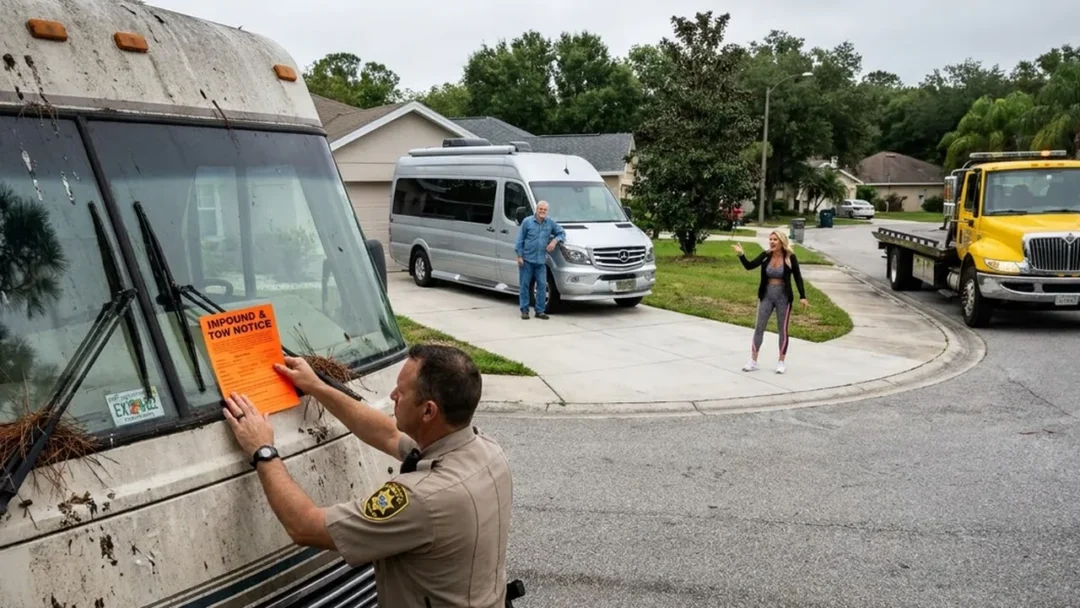
Parked directly against the public street curb, occupying over thirty-five feet of the roadway right-of-way in front of Karen’s luxury residence, was a colossal, dilapidated thirty-foot Class-A motorhome. The vehicle was a faded, chalky off-white, streaked with dark gray mildew and heavy coats of white bird droppings down both fiberglass sidewalls. Piles of rotting brown ponderosa pine needles were accumulated six inches deep across the windshield wipers, and the left-front tire was noticeably sagging, resting on a rusted steel wheel rim that was pressed into the street gutter.
‘While you’ve been checking clocks on my driveway, Karen,’ Marcus said calmly, ‘your thirty-foot commercial motorhome has been abandoned on this public street for sixteen consecutive days without moving an inch.’
‘That is completely different!’ Karen stammered, rushing across the street to physically position herself in front of the front bumper. ‘I am detailing it! I am preparing it for a private family trip! It is temporarily parked on the public street!’
Officer Ortiz walked slowly across the asphalt, his boots echoing in the quiet cul-de-sac. He approached the front bumper of the massive motorhome, pulling out his digital license plate scanning wand. He shone his tactical flashlight directly onto the Colorado license plate mounted beneath the cracked fiberglass grille.
The metal plate was caked in dried road grime. Officer Ortiz reached down with his gloved thumb, scraping away a layer of dried dirt to reveal the colored registration validation sticker in the upper corner.
The rectangular decal was a faded, sun-bleached yellow. Stamped across the center of the decal in bold black numerals was the expiration date: EXP: NOV 2025.
Officer Ortiz looked up, his eyebrows raised in disbelief. ‘Mrs. Sterling-Briggs, this vehicle registration expired nine months ago.’
‘I paid the renewal online!’ Karen cried out, her voice cracking with terror. ‘The DMV had a system backlog! The sticker just hasn’t arrived in the mail yet!’
‘Mrs. Sterling-Briggs, the state DMV does not experience a nine-month backlog,’ Officer Ortiz said coldly. ‘Under Colorado Revised Statutes Section 42-3-103, operating or storing an unregistered motor vehicle on any public highway or street right-of-way is a Class B traffic infraction. Furthermore, under county municipal ordinance, the absolute maximum street parking limit for any vehicle on a public thoroughfare is seventy-two continuous hours.’
Officer Ortiz pulled an oversized, fluorescent orange cardboard citation from his clipboard. He drew a black indelible marker from his pocket and wrote in bold, block letters: NOTICE OF IMMEDIATE IMPOUNDMENT & REMOVAL – UNREGISTERED & INOPERABLE VEHICLE ON PUBLIC RIGHT-OF-WAY.
With a firm, decisive motion, Officer Ortiz slapped the orange impound notice squarely beneath the dirty wiper blade on Karen’s windshield.
Marcus pulled a precision tire tread depth gauge and a digital tire pressure gauge from his work vest, checking the dual rear tires on his camper. ‘These are commercial Michelin Agilis CrossClimate tires rated for ten-ply load capacity, inflated to eighty pounds per square inch on forged aluminum rims,’ Marcus explained to Officer Ortiz, pointing to the technical sidewall markings. ‘Every mechanical component on this vehicle—from the braided stainless steel brake lines to the sealed lithium iron phosphate battery bank—is maintained according to aerospace preventive maintenance schedules. For three decades, our neighborhood was a haven for mountaineers, skiers, and outdoor enthusiasts who respected the wilderness and supported each other. But ever since Karen appointed herself parking director, she has treated every outdoor vehicle as a criminal offense while converting the public street into her private junkyard.’
Officer Ortiz stepped to the driver’s side window of Marcus’s camper, shining his penlight onto the laminated county permit taped to the glass. ‘Preparation Permit Number 4482, validated yesterday at 9:15 AM by the Arapahoe County Transportation Department,’ Ortiz confirmed, taking a photograph with his digital terminal. ‘The permit explicitly authorizes temporary driveway staging for expedition vehicles up to thirty-two feet in length. Mr. Vance followed every single administrative protocol, paid the municipal application fee, and placed his vehicle entirely within the boundaries of his private real property. For Mrs. Sterling-Briggs to demand an immediate impoundment on a permitted vehicle is a clear abuse of municipal process.’
Marcus looked at the clean concrete pad beneath his boots, shaking his head with quiet authority. ‘For twenty-four years, I worked on the flight lines of the United States Air Force, maintaining multi-million-dollar airframes where a single loose fastener or cracked hydraulic line could result in the loss of crew and mission,’ Marcus said to Officer Ortiz. ‘You don’t take a vehicle into the Colorado backcountry without checking every mechanical system from tire pressure to emergency fuel shutoffs. To have someone stand on a public sidewalk and demand a tow truck simply because an honest working man takes pride in maintaining his equipment is an insult to every tradesperson and veteran in this state.’
Marcus walked across the street, standing five feet away on the asphalt, his sharp nostrils suddenly flaring as a cool morning gust swept beneath the motorhome chassis. ‘Officer Ortiz, before you call the dispatcher, take a step toward this front wheel well,’ Marcus warned, his voice turning dead serious. ‘Because that isn’t old engine oil you’re smelling. That’s pure mercaptan odorant leaking from a compromised high-pressure propane tank.’