The Farmer Marked His Own Gate, Then Followed the Glowing Hoofprints to the Man Who Denied Everything
Chapter 1: The Crushed Rows Before the Morning Delivery
At 5:37 in the morning, Eric Campbell found twelve yards of lettuce pressed flat as if someone had dragged a soaked mattress through the field.
The rows had been standing at midnight. He knew because he had walked them with a headlamp after repairing the wash-table pump, touching the outer leaves with the back of his hand to check for grit. By eight, a produce buyer was due to inspect the crop for a new weekly order.
Now pale green heads lay split in the mud.
Eric stopped at the edge of the damage and listened.
The irrigation pump clicked steadily behind the packing shed. A mourning dove called from the power line. Across the narrow county road, Gary Brown’s cattle stood as dark shapes behind the pasture fence, chewing without concern.
Eric stepped between the rows.
The first print filled most of his palm.
Its two rounded halves were sunk deep in the wet soil, with the smaller marks of the dewclaws behind them. Another print crushed a drip line. Water hissed from a split in the black tubing, cutting a narrow channel through the bed.
Not deer.
He followed the tracks toward the northern boundary. The animal had walked through lettuce, crossed a strip of peppers, then turned beside the irrigation header. A second set overlapped the first.
Two cattle, maybe three.
At the field edge, the prints angled toward the shared side gate. Beyond it lay a short gravel lane connecting Gary’s lower pasture to the road. The tracks disappeared there among tire marks and pale stone.
Eric crouched beside the gate.
The lower hinge sagged. The chain hung loose. The steel latch sat crooked against a bent catch plate, though it had not looked that way two days earlier.
He reached for it, then stopped.
His glove hovered over the metal.
Behind him, water continued escaping from the ruptured line.
He took out his phone and photographed the latch before touching anything. Then he photographed the prints, the damaged beds, the broken tubing, and the direction of travel. His camera roll already held ten similar groups from the past six weeks.
This would make eleven.
He had called Gary after the fourth.
He had walked to Gary’s porch after the seventh.
After the ninth, he had stood beside the road while Gary leaned against his truck and said, “You’ve got deer back there. Everybody does.”
“Deer don’t leave cattle prints.”
“Then show me cattle.”
Eric had pointed toward the crushed squash vines.
Gary had glanced at them and shrugged. “Show me mine.”
The words returned now with the same flat weight.
Show me mine.
Eric shut off the irrigation zone and cut out the damaged section of tubing. He could salvage some of the lettuce if the roots had not torn loose, but the outer leaves were muddy and bruised. The buyer would see the gaps even if Eric harvested around them.
He began lifting the least damaged heads into black crates.
At six twenty, Kathleen’s pickup came down the drive.
She parked beside the packing shed and got out carrying two paper cups of coffee. She took three steps toward him, saw the field, and stopped.
“Again?”
Eric kept trimming leaves.
“How much?”
“Not much.”
Kathleen looked across the flattened rows. “That isn’t an answer.”
“I can fill the order from the east beds.”
“The east beds are for Saturday market.”
“We’ll adjust.”
She set his coffee on the tailgate. “Did you call him?”
“Not yet.”
“You need to.”
“He’ll deny it.”
“Then call the county.”
Eric slid a lettuce head into the crate harder than necessary. “I’m not calling livestock control every time something steps through a fence.”
Kathleen’s eyes moved to the damaged irrigation line. “Every time?”
He did not answer.
She looked at him long enough for the silence to become an admission.
“How many times has this happened?”
Eric lifted another head. “Enough.”
“That means you know the number.”
The buyer’s white delivery van appeared on the road before he could respond.
Kathleen’s mouth tightened, but she turned toward the shed and began moving crates. Whatever she wanted to say would wait until after the inspection.
The produce buyer walked the field in clean work boots, careful not to step on the beds. He studied the harvested lettuce, then the gaps in the rows.
“Storm damage?”
“Livestock,” Eric said.
The buyer glanced toward Gary’s pasture. “Contained now?”
“Yes.”
It was not quite a lie. The cattle were behind the fence at that moment.
The buyer inspected the leaves in the crates. “I can take this load. But for the weekly agreement, I need consistency. We can’t have missing volume after I’ve promised it to three stores.”
“You’ll have it.”
The buyer nodded, though not with confidence. “I’ll send the paperwork this afternoon.”
When the van left, Kathleen stood in the packing shed with both hands on the stainless-steel wash table.
“You told him it was contained.”
“It is contained.”
“Right now.”
Eric stacked empty crates. “I’ll handle it.”
“That sentence is starting to cost us money.”
He turned away before she could ask for invoices.
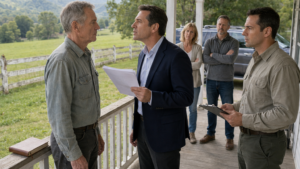
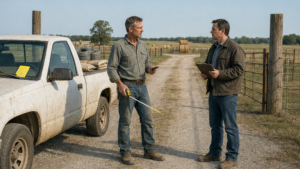
At seven fifteen, Gary’s truck rolled out of his driveway. Eric stepped into the road and raised one hand.
Gary slowed but did not shut off the engine. He wore a faded work shirt, and his right arm rested stiffly against his side.
“What?” he called through the open window.
“Your cattle came through again.”
Gary looked toward the field. “You see them?”
“I found fresh tracks from the rows to your gate.”
“Tracks go both ways.”
“They start in my lettuce.”
Gary pulled out his phone. “Take pictures, then.”
“I did.”
“Good. Send them to whoever you want.”
Eric felt the heat rise along his neck. “Come look at the damage.”
“I’ve got a job.”
“It’ll take two minutes.”
Gary’s expression hardened. “I told you before, Eric. You want me paying for your crop, you prove those are my cattle. Not cattle. Mine.”
“They crossed through your gate.”
“That gate sits on the line.”
“The latch is bent.”
“Then fix your side.”
Gary put the truck in gear.
Eric stepped back as gravel snapped under the tires. For one second, he imagined grabbing the door handle and forcing the argument to continue.
Instead, he watched the truck disappear toward the highway.
The bent latch gleamed across the road.
By noon, Eric had replanted the worst gaps and repaired the line. He saved the photographs in a folder named INCIDENT 11, adding the date, time, rainfall from the previous evening, and an estimate of lost heads.
The folder sat above ten others.
The proof looked repetitive rather than decisive: mud, leaves, hoofprints, broken plastic. Any one image could be explained away. Together they showed a pattern, but none carried the animals home.
He opened the bottom drawer of the workbench, searching for a spare compression fitting.
Beneath a stack of seed catalogs lay an old feed-store envelope. A bright label had been stapled to it years ago, back when his father marked calves before turning them into a larger herd.
NON-TOXIC FLUORESCENT LIVESTOCK MARKER.
Eric held the faded label under the shop light.
Below the product name, a small line described residue visible under ultraviolet illumination.
He read it twice.
Then he looked through the open shed door toward the bent gate.
Chapter 2: A Bright Powder Across the Broken Boundary
Rebecca Torres set the product container on her desk as though Eric had brought her something that might leak through the wood.
“You want me to approve this?” she asked.
“I want to know whether it’s safe.”
“That isn’t the same question.”
The agricultural-extension office occupied two rooms behind the county services building. Soil maps covered one wall. A shelf near the window held jars of weed samples and three faded photographs of pasture erosion.
Eric sat across from Rebecca with the fluorescent marker between them.
She read the label slowly. “It’s designed for livestock facilities and trace work. Non-toxic when used according to instructions. Not intended for direct application to food crops.”
“I wouldn’t put it on the crops.”
“You said the cattle enter through your vegetable field.”
“I can mark the soil near the gate.”
Rebecca looked at him over the container. “And then?”
“If an animal crosses it, residue transfers to the hooves.”
“And if a raccoon crosses it?”
“The print won’t look like cattle.”
“And if rain spreads it?”
“I photograph the placement before dark.”
“And if Mr. Brown claims you placed feed beyond the line to pull his cattle through?”
Eric paused.
Rebecca leaned back. “That is why I’m asking what happens after.”
He disliked the way she kept making the plan smaller.
For two days, the label had seemed like the first useful answer he had found. Under her questions, it became one more uncertain object.
“I’m not baiting anything,” he said.
“I didn’t say you were.”
“You implied it.”
“I’m telling you what someone disputing your evidence will say.”
She turned the container and read the instructions again.
“One trail might establish movement,” she said. “It will not establish repeated negligence. It won’t calculate crop loss. It won’t tell us whether the failure occurred on your hardware or his.”
“The gate opens into his pasture.”
“The boundary hardware is shared unless your deed or fence agreement says otherwise.”
Eric folded his arms. “So nothing counts unless I already have enough evidence not to need help.”
Rebecca’s expression changed slightly.
“That isn’t what I said. I’m saying evidence has to survive the person who doesn’t want it believed.”
The sentence landed harder than Eric expected.
She pulled a legal pad toward her. “Show me the gate.”
He opened photographs on his phone.
Rebecca enlarged the image of the bent latch. “Do not apply material here.”
“Why?”
“Too easy to argue you contaminated the hardware yourself. Put it on your soil, several feet inside your line, away from produce beds. Use a narrow strip. Photograph the strip with a measuring reference. Record wind and rain. Wear gloves. Keep the packaging.”
Eric pointed to the gravel lane. “If they cross the road, the gravel will scrape it off.”
“Maybe.”
“Then I won’t get a full trail.”
“You may get enough.”
He looked at her. “You don’t think this will work.”
“I think it may show what crossed. I don’t think one dramatic photograph will finish a three-year neighbor dispute.”
“It hasn’t been three years.”
“Then how long?”
Eric put his phone away. “Long enough.”
At the feed store, the clerk found a newer container of the same marker in a locked cabinet behind animal-health supplies. The powder was bright yellow in daylight and green under the demonstration lamp.
“Temporary,” the clerk said. “Moisture helps it hold. Heavy rain washes it.”
“Safe around cattle?”
“Used right, yes. Don’t put it in water or feed.”
Eric bought the smallest container, an ultraviolet flashlight, disposable gloves, and a measuring ruler with large black markings.
When he returned to the farm, Kathleen’s pickup was parked by the office.
She sat at the desk with three printed invoices spread in front of her.
Eric stopped in the doorway.
“What are those?”
“The invoices you didn’t enter.”
“I was going to.”
“They’re six weeks old.”
“I’ve been busy.”
Kathleen tapped one page. “Replacement drip line. Extra seedlings. Refund to the market vendor after the squash shortage.”
“I covered it.”
“With what?”
He took off his cap and set it on a hook. “Operating account.”
“I can see that.”
Her voice remained low, which made it worse.
“We have the weekly order coming,” Eric said. “That makes up the difference.”
“If we can fill it.”
“We can.”
Kathleen looked through the window toward the replanted beds. “How much crop have we actually lost?”
“Not enough to miss payroll.”
“That wasn’t my question.”
He began rinsing dust from his hands at the utility sink.
“Eric.”
“I’m handling the fence.”
“Is that what the powder is for?”
He turned. She had seen the container in the paper bag.
“It’s a marker.”
“For what?”
“To trace movement.”
“You mean Gary’s cattle.”
“I mean whatever crosses.”
Kathleen stood. “You bought fluorescent powder before telling me what this has cost?”
“It’s safe.”
“I’m not worried about the powder.”
“I have photographs. I have dates.”
“You have folders. That isn’t the same as money in the account.”
Eric dried his hands. “The losses are manageable.”
The lie came easily because it was close to what he wanted to be true.
Kathleen studied him, then gathered the invoices into a single stack.
“Send me every receipt by tonight.”
“I will.”
“And call the county before you do anything that Gary can turn around on us.”
“I already spoke to Rebecca Torres.”
That surprised her.
It also ended the argument, though not the distrust.
At dusk, Eric walked the boundary with a bucket, ruler, camera, and ultraviolet lamp. He chose a strip of bare damp soil eight feet inside his field, where the cattle would step after passing the gate but before reaching the first lettuce bed.
He cleared loose stones. He photographed the untouched ground. Then he shook a thin band of powder across it, no wider than his hand.
In daylight it looked almost ordinary, a pale dusting against dark soil.
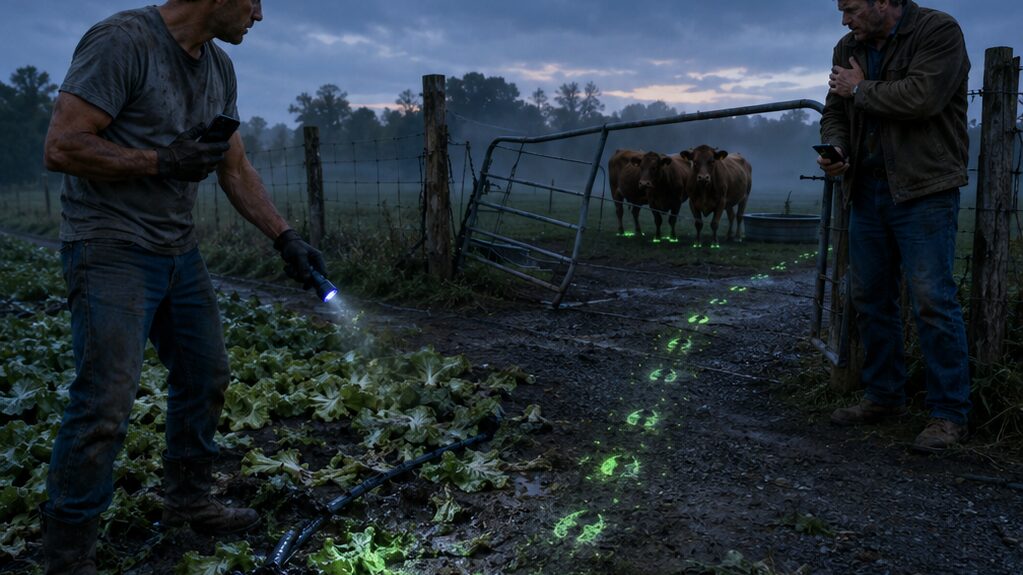
Under the ultraviolet lamp, it burned green.
Eric took photographs from both directions, including the gate, the road, and the distance from the crops. He marked the time in a notebook: 8:14 p.m. No rain forecast. Light south wind. Soil damp from irrigation.
He checked the gate latch without touching it.
The catch plate was still bent. The chain had been looped through twice, but the links hung with enough slack for the gate to shift under pressure.
Across the road, cattle moved through the lower pasture. Their bodies passed behind fence posts, slow and heavy.
Eric returned to the packing shed and set an alarm for four thirty.
At ten, he checked the field.
Nothing.
At midnight, he checked again.
The powder remained unbroken.
He sat on an overturned crate inside the dark shed, listening to the pump cycle. His father had once spent whole nights watching a sick calf breathe, refusing to wake anyone because he believed worry became less real if only one person carried it.
Eric had inherited more than land.
At 2:17 a.m., his phone vibrated.
A message from Kathleen appeared.
Send the invoices.
He turned the screen facedown.
Then a metallic crack traveled across the field.
Not loud. One sharp bang, followed by the long scrape of steel under weight.
Eric stood so quickly the crate tipped behind him.
Beyond the shed, something moved in the dark near the shared gate.
Chapter 3: The Glowing Hoofprints Led Through His Gate
The first print glowed beside a split head of lettuce.
Eric held the ultraviolet lamp low, and the darkness opened around a bright green crescent sunk into the soil. A second crescent completed the hoof. Specks of fluorescent dust clung to the crushed leaves around it.
The print was still wet.
He did not move for several seconds.
Then he switched on his camera.
The flash would flatten the glow, so he used the lamp at an angle, placing the measuring ruler beside the impression. He photographed the full hoof, then the next one, recording direction and spacing.
Another print lay two feet ahead.
Then another.
The trail crossed the first bed in a slow diagonal. Two animals had entered. One had stepped directly onto the irrigation tubing, rupturing it near a connector. The second had veered into the lettuce and circled, leaving overlapping green marks where it turned.
Eric felt something close to satisfaction.
Not joy. Not yet.
The evidence was clearer than anything in his eleven folders. The cattle had crossed the prepared strip, carried the powder into the crop, and pressed their route into wet soil.
He followed without stepping beside the prints.
At the field edge, the trail turned toward the gate.
The green residue had faded on the dry grass, but enough remained to mark each heavy step. One hoof had brushed the wooden corner post, leaving a bright smear at knee height.
Eric photographed it.
At the gate, the trail narrowed. The animals had pushed through one at a time. Fresh scrape marks shone on the latch plate.
He looked across the road.
If the gravel removed the residue, the proof would end there. Gary could say the cattle had come from anywhere, wandered through Eric’s field, then happened to approach his pasture.
Eric moved to the road shoulder.
Under the ultraviolet lamp, the first patch of gravel looked blank.
He took another step.
A small green fragment appeared on the face of a pale stone.
Then another.
Ten feet farther, a half-print glowed where damp mud had collected in a tire rut. Beyond it, a full hoofprint burned beside a clump of grass.
The trail crossed the road.
Eric’s breathing changed.
He filmed continuously now, sweeping the lamp from one print to the next so the route could be seen without cuts. The marks climbed Gary’s gravel lane, faded across a dry patch, then brightened again near the pasture entrance.
At the gate, they did not stop.
They continued through.
One luminous print lay inside Gary’s pasture. Another pressed into the mud beside the water trough. The cattle themselves stood farther up the slope, their lower legs faintly speckled green.
Eric lowered the camera.
For weeks, Gary had protected himself with one sentence.
Show me mine.
Now his cattle stood at the end of the trail.
A brown cow lifted its head and stared at Eric. The animal chewed slowly, indifferent to fences, contracts, and men who argued about responsibility.
Eric raised the camera again.
He photographed the cattle from the public roadside, zooming on the fluorescent residue around their hooves. He did not cross into Gary’s pasture.
Then he turned back to the gate.
Something about the latch was wrong.
The night before, the catch plate had been bent outward, leaving the gate able to shift toward Eric’s field. Now the plate sat higher. Two fresh bolt scratches cut through the rust. The whole assembly had been moved upward by nearly an inch.
It was still defective, but differently defective.
Eric compared it to the photograph on his phone.
The lower bolt had been loosened and tightened again. Mud marked the nut. The latch now appeared to meet the plate from a distance, though under pressure it could still slip beneath it.
Someone had adjusted it.
Not repaired it.
Adjusted it enough to look repaired.
Eric took close photographs of the new position, the scratches, the mud, and the old rust line showing where the plate had sat before.
The glow on the ground suddenly felt less like victory.
If Gary had moved the latch, he knew there was a problem.
But knowing the gate was weak was not the same as knowing cattle had crossed. Eric heard Rebecca’s voice: evidence had to survive the person who did not want it believed.
He returned to his field before sunrise and photographed the entire route again under growing gray light. The fluorescence weakened as daylight spread, but the prints remained visible under the lamp.
In the packing shed, he created a new folder.
INCIDENT 12.
He entered the time of the gate noise, placement photographs, weather, soil condition, hoof measurements, crop damage, broken irrigation, the continuous video, and comparison images of the latch.
He stopped before attaching a loss estimate.
Twelve incidents.
Only one fluorescent trail.
He opened a blank document and typed:
Observed movement from Campbell field through shared gate toward Brown pasture.
He deleted toward.
Typed into.
Deleted that too.
He finally wrote:
Continuous marked hoof impressions documented from interior Campbell boundary strip, through damaged crop rows, across public road, and inside Brown pasture entrance.
It sounded bloodless.
That was useful.
At 6:05, a truck engine started across the road.
Eric carried the ultraviolet lamp and his phone back to the gate.
Gary’s truck came down the lane, then stopped abruptly when its headlights caught Eric standing beside the fluorescent strip.
Gary climbed out.
“What did you put down?”
Eric turned on the ultraviolet lamp.
The green hoofprints appeared between them.
Gary’s face tightened.
“It’s a non-toxic trace marker,” Eric said. “Applied on my side, away from the crops.”
“You put chemicals where my cattle walk?”
“Your cattle weren’t supposed to be there.”
Gary looked toward the pasture gate, then at the trail crossing the road. His eyes followed it farther than Eric expected.
For one brief moment, he said nothing.
Eric held up his phone. “I have the full route. From my field into your pasture.”
Gary took two steps toward him. His right arm stayed stiff at his side.
“You lured them.”
“No.”
“You put feed out.”
“I didn’t.”
“Then why would they go straight through your field?”
“They’ve been doing it for weeks.”
Gary pointed at the glowing ground. “You staged this.”
Eric’s grip tightened around the lamp. “Come look at the crushed rows.”
“I’m not walking into something you set up.”
“It’s dirt and hoofprints.”
“It’s your powder.”
“On my property.”
“You knew they’d come.”
“That’s the point.”
Gary pulled out his phone and began taking pictures, not of the trail leading home, but of the marked strip near Eric’s gate.
“You’re trying to build a case,” he said.
“I’m documenting damage.”
“You want me paying for your bad crop.”
Eric stepped closer. “I want you to keep your cattle behind your fence.”
“Our fence.”
“Your gate.”
Gary’s gaze shifted to the latch.
It lasted less than a second, but Eric saw it.
Then Gary raised his phone and photographed the bent catch plate.
“That hardware sits on your post,” he said.
“You moved it.”
Gary looked back at him. “Prove that too.”
The words were quiet.
More controlled than before.
Eric felt the argument waiting for him—the months of damage, the denials, the broken line, the buyer’s warning, Kathleen’s invoices. He could have unloaded all of it in the road before sunrise.
Instead, he lowered the lamp and saved the recording.
“I will,” he said.
Gary’s expression changed, not to fear exactly, but to calculation.
He climbed into his truck without another word.
As he pulled away, Eric looked down at the trail that seemed, minutes earlier, capable of ending the dispute by itself.
Now Gary had given it another meaning.
Proof could show where the cattle had walked.
It could not yet prove why the gate had failed, who had known, or whether Eric had created the very crossing he claimed to document.
Behind him, the fluorescent hoofprints glowed brilliantly across the dark soil.
By full daylight, most of them would be almost invisible.
Chapter 4: One Perfect Trail Was Still Not Enough
“Did you place feed anywhere near the marked ground?”
The county livestock officer asked the question before Eric had finished opening the photograph folder.
“No.”
“Mineral block?”
“No.”
“Salt?”
“No.”
“Vegetable waste?”
Eric glanced at Rebecca Torres. She sat beside the officer with the fluorescent marker container sealed in a clear evidence bag. Her expression gave him nothing.
“No,” Eric said. “Nothing that would draw cattle.”
The officer turned Eric’s printed photograph toward the window. Against the dark field, the hoofprints shone almost impossibly green.
It was the clearest image Eric had ever taken.
It was also, he was beginning to understand, the easiest one to attack.
They sat in a small meeting room at the county extension office. Eric had brought his phone, the product packaging, the unused powder, weather records, photographs of the application strip, and a flash drive containing the continuous video from his field to Gary’s pasture.
He had expected questions about Gary’s cattle.
Instead, most of the questions were about him.
“How long between applying the marker and observing the prints?” the officer asked.
“About six hours.”
“Who had access to the site?”
“Anyone could have reached the road. The marked strip itself was inside my property.”
“Any cameras?”
“One facing the packing shed, not the gate.”
The officer made a note.
Eric leaned forward. “The video shows the trail crossing the road and entering Gary’s pasture.”
“It shows marked hoof impressions along that route.”
“What else would that mean?”
“It could mean exactly what you say. But Mr. Brown disputes the conditions under which the cattle crossed.”
“He says I baited them.”
“He says the fence failed from your side.”
Eric sat back.
The officer opened a second folder.
Inside were photographs Eric had not taken.
They showed the shared gate from Gary’s pasture, the wooden post leaning slightly toward Eric’s field. One image focused on the bottom hinge. Another showed a section of woven wire bowed outward where weeds had grown through it.
Gary had photographed every weakness that could be made to look like Eric’s neglect.
“He sent those this morning,” the officer said.
“The latch is on his gate.”
“The post appears to stand on your side of the surveyed line.”
“It has stood there for twenty years.”
“That does not answer who maintains it.”
Eric looked at Rebecca. “You saw the photographs from before he moved the latch.”
“I did.”
“And?”
“They show a change in position. They do not show who changed it.”
“So he can touch the gate, deny the cattle, accuse me of baiting them, and none of it matters?”
Rebecca folded her hands. “It matters. It is not yet enough.”
The phrase tightened something behind Eric’s ribs.
He slid the marker packaging toward the officer. “This says non-toxic. I followed the instructions. I placed it eight feet inside my line, away from produce.”
Rebecca spoke before the officer could answer.
“I inspected the site yesterday. The amount and placement were consistent with what Eric reported. There was no visible feed, mineral residue, or other attractant.”
It was the first unqualified support she had given him.
The officer wrote again. “That helps establish method.”
Eric looked at the twelve empty folders he had arranged beside the single fluorescent photograph. Eleven contained ordinary images: crushed leaves, wet prints, severed tubing, bent wire. The twelfth looked like proof from another world.
“Then what do you need?” he asked.
“Animal identification if possible. Dates and times. Weather. Damage estimates supported by sales records. A pattern showing the same access point. Documentation of fence condition before and after each event.”
“I have twelve incidents.”
“You have one confirmed trace event and eleven reported damage events.”
“They’re all the same.”
“To you.”
The officer closed the folder. “I can issue a notice that a containment complaint has been made. I cannot impose a corrective order or citation based on this alone.”
Eric stared at him. “What would be enough?”
“Repetition under documented conditions. Or agreement between both owners about the defective boundary.”
Gary would never agree.
Eric gathered his photographs slowly.
The officer added, “You should also consider temporary reinforcement on your side.”
“So I pay to contain his cattle.”
“You protect your crop while the dispute is reviewed.”
It was practical advice. Eric hated it for being practical.
Outside, Rebecca walked with him to his truck.
“You expected the photograph to end this,” she said.
“It should.”
“It answered one question.”
“Whose cattle crossed?”
“It strongly supports that.”
“Strongly.”
She stopped beside the truck door. “Now you need to answer the questions he created.”
Eric placed the folders on the passenger seat. “He created them because nobody makes him answer mine.”
Rebecca looked toward the county building. “Document the next event before repairing anything. After that, protect the field. You have a business deadline, not just a dispute.”
Eric shut the door harder than he meant to.
At the packing shed, Kathleen stood beside the office printer holding the produce agreement.
“You said the paperwork was coming,” she said.
“It came?”
“It came with minimum weekly volume.”
Eric took the pages.
The order was larger than the buyer had suggested. Under ordinary conditions, it would have stabilized the farm through the end of the season.
Under present conditions, it left no room for another damaged harvest.
Kathleen pointed to the cancellation clause. “Two short deliveries and they can terminate without paying the remaining weeks.”
“We won’t be short.”
“You said that before I found the invoices.”
Eric placed the county folders on the desk.
Kathleen opened the top one. The glowing trail filled the first page.
“That’s clear.”
“Not clear enough.”
“What did they say?”
“They want a pattern.”
Her eyes moved to the eleven folders beneath it. “You have one.”
“They call those reported incidents.”
“What do they call the missing money?”
He looked away.
Kathleen opened the bookkeeping program on the office computer. A column of expenses appeared—replacement plants, tubing, refunded orders, extra labor. She had entered the invoices he had left out.
At the bottom, a red number showed the operating deficit.
Eric had known each expense separately. Together, they looked like a different kind of trail.
“You told me this was manageable,” she said.
“It is if we fill the new order.”
“And if the cattle come through again?”
“I’ll reinforce the gate.”
“With what money?”
“I have material.”
“You have old posts and half a roll of wire.”
“I’ll make it work.”
Kathleen closed the laptop. “You keep treating this like the only failure is across the road.”
He looked at her.
“You didn’t tell me,” she said. “You didn’t call the county until you had a glowing path. You didn’t ask me whether we could absorb the losses. You decided we could because you didn’t want anyone seeing you couldn’t stop it.”
“That isn’t what happened.”
“It is exactly what happened.”
Eric picked up the folders.
A folded sheet slipped from between two invoices and landed faceup on the floor.
The paper carried the letterhead of a local fence contractor. Kathleen bent first and picked it up.
“This isn’t ours,” she said.
Eric took it from her.
The estimate was four months old. It described replacement of a sagging pasture gate, reinforcement of two posts, and repair of forty feet of boundary fence.
The service address was Gary Brown’s.
At the bottom, beneath the total, someone had written in pen:
Customer declined work. Requested temporary latch adjustment only.
Kathleen read over Eric’s shoulder.
“He knew,” she said.
Eric stared at the date.
The estimate had been made before Incident One.
Chapter 5: Twelve Mornings, One Gate, and Two Lies
The second fluorescent trail appeared three nights after Gary told the county the gate had been repaired.
It was thinner than the first.
Rain had started before dawn, turning the marker into pale green streaks along the edges of two hoofprints. One trail ended in the pepper bed. The other crossed the road and faded beside Gary’s newly tightened chain.
Eric photographed everything.
Incident Thirteen, he thought automatically.
Then he stopped.
The county file began at the first documented crop loss, not the first time Gary’s cattle had entered. The glowing event that Gary disputed was Incident Twelve. This new crossing would be the next entry, but the number mattered less than the pattern.
He renamed the folder:
VERIFIED TRACE 2.
The repair Gary claimed to have completed consisted of a fresh chain looped through old steel. The bent catch plate remained in place. Under pressure, the gate could shift far enough for the latch to slide beneath it.
Eric placed a measuring tape across the gap and photographed six inches of movement.
By breakfast, Gary had sent the county an email stating that the chain had been cut.
It had not.
Eric photographed the unbroken links from three angles and added the images to the file.
The dispute changed after that.
Gary began feeding his cattle earlier on some nights and much later on others. He moved the mineral block uphill. He parked a stock trailer in front of the lower pasture entrance for two days, then removed it without warning. Each change made the crossings less predictable.
Eric changed with him.
He logged evening feeding sounds from his own property. He recorded rainfall. He marked the approach only after checking for feed residue and photographing the untouched ground. He used less powder each time, enough to transfer but not enough to create the dramatic brightness of the first trail.
Rebecca inspected twice without advance notice.
On the fifth morning, there was no crossing.
On the seventh, a single animal entered far enough to crush a row of young cabbage, then returned through the same gate.
On the ninth, the cattle stayed contained, but Eric found the latch plate raised again.
The fluorescent traces began to resemble time itself. Fresh prints burned under ultraviolet light. Older ones faded to weak smears, visible only when Eric held the lamp close to the soil.
Kathleen helped him build the record after he finally gave her access to every folder.
She did not forgive him by announcing it. She simply created a spreadsheet with columns for damaged crop, expected yield, sale price, replacement labor, irrigation repair, weather, and supporting image.
“You counted retail value,” she said one evening.
“That’s what the produce sells for.”
“That isn’t what we recover after harvest and packing costs.”
“It’s still what we lost.”
“It’s what we might have earned.”
Eric looked at the screen. “Whose side are you on?”
“The side that survives somebody checking our numbers.”
He wanted to argue, but Rebecca had said nearly the same thing about evidence.
Kathleen revised the loss estimate downward.
The smaller figure felt less satisfying.
It was also harder to attack.
Near the end of the second week, Eric saw Gary’s teenage son at the gate.
The boy had a wrench in one hand and was trying to lower the catch plate. Each turn of the bolt made him wince with effort.
Eric approached from his field without calling out.
The boy noticed him when they were twenty feet apart. He froze.
“What are you doing?” Eric asked.
“Fixing it.”
“By moving the plate again?”
The boy looked toward Gary’s house.
“Dad said it has to line up.”
“It did line up before someone raised it.”
The wrench lowered.
Eric kept his voice even. “Did he tell you to move it?”
The boy said nothing.
“You don’t have to answer.”
“He said not to talk to you.”
Eric felt the old anger rise, then saw the boy’s grip tighten around the wrench.
“Why?”
“He said you’d twist it.”
“Twist what?”
The boy looked again toward the house. “He hurt his shoulder. He can’t lift the gate right. If you push up on it, the latch catches.”
“And when the cattle push down?”
The boy’s face changed. He had not considered that, or did not want to show he had.
“Did your father know they were getting through?”
“He said they might’ve pushed it once.”
“Once.”
“He said you were making it bigger.”
Eric looked at the gate. “Did he tell you about the repair estimate?”
The boy stepped back.
That was answer enough.
Eric could have recorded the conversation. His phone was in his pocket. One movement would have begun an audio file.
He left it there.
“Don’t touch the plate,” he said. “The county needs to see it where it is.”
The boy’s face hardened with borrowed defensiveness. “It’s our gate.”
“It’s shared hardware. That’s what your father keeps saying.”
Eric walked away before the boy had to choose between loyalty and truth again.
That afternoon, Gary posted a message in a local farm-supply group. He did not name Eric, but he did not need to.
Some people, the post said, moved into specialty crops and then tried to force traditional livestock owners off neighboring land through complaints, inflated damage claims, and staged evidence.
Eric had lived on his acreage since childhood. Gary knew that.
Two neighboring landowners called before sunset.
The first asked whether Eric was planning a lawsuit.
The second warned that county attention could lead to fence inspections throughout the area.
“What did you tell them?” Kathleen asked.
“The truth.”
“Which part?”
“That his cattle crossed.”
“Did you tell them about the estimate?”
“No.”
“Why not?”
“Because the county hasn’t verified it.”
Kathleen studied him. “That’s restraint.”
“It’s procedure.”
“It can be both.”
The remark should have eased him. Instead, it made him realize how close he had come to posting every photograph publicly.
By the third week, his evidence file contained twelve documented events accepted for county review: the original eleven damage incidents, strengthened by timestamps and invoices, plus the verified trace crossings and gate-condition records. Some incidents overlapped in the county’s counting system, but together they established repeated access through the same point.
Rebecca scheduled mediation.
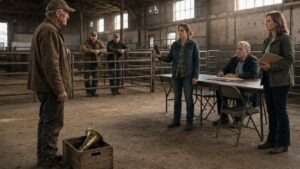
Gary arrived late in a clean work shirt, carrying a binder. The livestock officer sat at one end of the county meeting table. Rebecca sat at the other. Kathleen placed the farm records in front of Eric.
Gary looked at the stack and gave a short laugh.
“This what you do instead of farming now?”
Eric almost answered.
Kathleen touched the corner of the spreadsheet.
He let the remark pass.
Rebecca began with the verified facts: repeated crop damage, cattle-sized hoof impressions, two fluorescent trace events, an unstable shared gate, disputed maintenance responsibility, and documented financial losses.
Gary opened his binder.
Inside were photographs of Eric’s leaning post, printed comments from the local farm group, and a statement claiming Eric had threatened to “make the county take the herd.”
“I never said that,” Eric said.
“You said you’d prove it.”
“That isn’t the same thing.”
Gary leaned back. “He wants maximum penalties. Ask him.”
The livestock officer looked at Eric. “What outcome are you requesting?”
Eric opened his mouth.
Kathleen spoke first.
“Before he answers, the county needs the actual financial position.”
Eric turned toward her.
She slid a corrected loss statement across the table, followed by the produce agreement and the red operating summary.
“The damage is not cosmetic,” she said. “We are at risk of defaulting on a weekly supply contract.”
Gary’s expression shifted.
Eric felt exposed in a way the glowing photographs had never exposed him.
Kathleen continued. “But the delay is not entirely Mr. Brown’s doing. Eric concealed several losses from the business records and waited too long to request formal help.”
“Kathleen.”
She did not look at him.
“The dispute harmed us,” she said. “So did pretending we could absorb it indefinitely.”
The room went silent.
Across the table, Gary watched Eric with something almost like satisfaction.
Then Rebecca placed the fence contractor’s estimate beside the fluorescent trail photograph.
The satisfaction disappeared.
Chapter 6: The Repair Estimate Gary Never Intended to Use
Gary admitted requesting the estimate before anyone asked him a second time.
“I asked what a proper repair would cost,” he said. “That doesn’t mean I knew cattle were crossing.”
The fence contractor’s paper lay in the center of the table. Beside it, the first fluorescent photograph showed green hoofprints running through Eric’s damaged lettuce.
Four months separated the documents.
The connection between them felt smaller on paper than it had in Eric’s mind. Gary had known the gate was failing. That still did not prove he had watched cattle walk through it.
Rebecca pointed to the handwritten note.
“Temporary latch adjustment only,” she read. “Was that completed?”
Gary’s jaw tightened. “I moved the plate.”
“Why?”
“The gate sags. My shoulder was bad. Raising the catch let it close without lifting.”
“And under pressure from the pasture side?”
“It could slip.”
The livestock officer asked, “Did you understand that at the time?”
Gary looked toward the window. “I understood it wasn’t perfect.”
“Did you tell Mr. Campbell?”
“No.”
“Why not?”
Gary gave a dry laugh. “Because every conversation with him turns into a property inspection.”
Eric leaned forward. “Every conversation started after your cattle damaged something.”
Gary looked at him. “You don’t know how many were mine.”
“The trail ended in your pasture.”
“After you put powder down.”
Rebecca raised one hand.
The argument stopped, but not the force behind it.
She opened a second packet. “Mr. Brown, you provided feeding records in response to the county request.”
Gary nodded cautiously.
Rebecca placed his handwritten log beside Eric’s incident chart.
The times aligned more cleanly than Eric had noticed.
On evenings when Gary fed before sunset, no documented crossings followed. On five nights when feeding was delayed beyond ten, damage appeared between two and five in the morning. Both fluorescent traces occurred after late feeding. So did three of the worst crop losses.
Rebecca slid the pages toward Gary.
“Hungry cattle gathered at the lower gate,” she said. “The unstable latch failed under pressure. Whether every animal entered Mr. Campbell’s field cannot be established. But the pattern is consistent.”
Gary stared at his own handwriting.
Eric watched the resistance leave his face in stages. Not surrender. Calculation first, then fatigue.
“My contracting jobs ran late,” Gary said. “I fed when I got home.”
“You have a son,” the officer said.
“He has school. I wasn’t putting the herd on him.”
“So you knew feeding was delayed.”
“I knew they were waiting.”
“And you knew the gate could slip.”
Gary pressed his left hand over his right shoulder. “I knew it needed work.”
“Yet you told the county it had been repaired.”
“I chained it.”
“You also claimed the chain was cut.”
“I thought it was.”
Eric said, “You photographed it.”
Gary turned on him. “You think I’ve got money sitting around for a new gate and forty feet of fence?”
The question struck the room differently from his earlier denials.
It was not proof.
It was the first honest sentence he had offered.
Gary looked down at the estimate. “That contractor wanted more than I cleared in two months. My insurer already asked about the south fence after a wind claim. One livestock notice and they inspect everything. Then the lender sees it.”
No one spoke.
Gary continued, quieter now. “I moved the latch because I could do that myself. I thought it would hold.”
“You saw the damage after the first complaint,” Eric said.
“I saw broken vegetables.”
“You saw hoofprints.”
“I saw prints. I didn’t see my cattle.”
“You made sure not to.”
Gary’s face hardened again. “And you made sure every crushed plant became top-dollar loss.”
Kathleen pushed the corrected statement forward. “No. I reduced the claim to expected net value.”
Gary looked at the total.
The anger in his face changed to fear so quickly Eric almost missed it.
“That amount would take half the herd.”
“It is the verified loss,” Kathleen said.
“If I sell half, I can’t cover the pasture note.”
Eric had imagined this moment many times: Gary confronted with the full cost, unable to shrug or demand more proof.
He had not imagined Gary’s hand resting protectively on the binder as though the papers inside could hold his farm together.
The livestock officer outlined the options.
Formal enforcement could include a containment order, follow-up inspections, administrative penalties for repeated violations, and referral of the damage claim to civil court. The county could not guarantee full reimbursement. A civil judgment might take months and cost both men more than the disputed losses.
The alternative was a binding compliance agreement: immediate temporary reinforcement, permanent gate and fence repair, a feeding and inspection schedule, partial reimbursement based on verified damage, and automatic enforcement if another crossing occurred.
Gary shook his head. “I can’t pay that total.”
Eric said, “I couldn’t afford to lose it.”
“I didn’t ask you to hide it from your own partner.”
The remark landed cleanly because it was true.
Eric turned toward Kathleen. She did not rescue him from it.
Rebecca placed the first fluorescent photograph in front of him.
The green trail had once looked like a line dividing truth from denial. Now it connected two sets of concealed facts: Gary’s failing gate and Eric’s failing accounts.
“You both had earlier options,” she said. “Neither of you used them.”
Gary leaned back. “So we’re equally responsible now?”
“No,” Rebecca said. “The cattle were yours. The containment failure was yours. Moving the latch and denying the known defect were your choices.”
Then she looked at Eric.
“Waiting for perfect proof was yours.”
Eric ran his thumb along the edge of the photograph.
He thought of his father sitting alone beside a sick calf, carrying worry as if sharing it would spread the illness. For years, Eric had called that strength.
Kathleen had called it something else.
The officer produced two draft forms.
The first was a request for formal enforcement. It listed the possible corrective actions and penalties.
The second was a compliance agreement with blank spaces for reimbursement, repair deadlines, inspection dates, and consequences for breach.
Gary looked at the enforcement form and went pale.
“If that goes through,” he said, “the insurer gets notified.”
“That is possible,” the officer replied.
“And the lender?”
“County records may be requested during their review.”
Gary rubbed his shoulder.
Eric wanted the fear to satisfy him.
It did, for a moment.
Then he pictured the cattle sold in a rushed auction, Gary’s son watching the trailers leave, the gate still standing between two farms that had to remain beside each other after the county closed its file.
None of that repaired the lettuce.
None of it repaid Kathleen.
None of it made Eric’s silence wiser.
“What can you pay before the next delivery cycle?” Kathleen asked Gary.
Eric looked at her sharply.
Gary named a number less than half the verified loss.
Kathleen did not accept it. She began asking about contracting income, feed bills, and the timing of cattle sales. Her questions were hard and unsentimental. They were also aimed at keeping both businesses alive.
Gary answered reluctantly.
A workable figure began to emerge: an initial payment large enough to cover seed, tubing, and the next payroll, followed by scheduled installments. Gary would purchase repair material immediately. Labor could reduce part of the remaining obligation if independently valued.
Eric listened as the claim he had built became smaller, slower, and more practical.
The officer turned to him.
“Mr. Campbell, the county can proceed with enforcement based on the documented pattern and admitted gate defect. Or we can finalize a binding repair agreement with enforcement triggered by noncompliance.”
Gary stared at the table.
Kathleen waited.
Rebecca said nothing.
For months, Eric had believed proof would remove the need to choose. Once everyone saw the trail, the correct outcome would follow by itself.
Instead, proof had brought him to two documents.
One could punish the denial.
The other might stop the cattle, preserve the neighboring farm, and return only part of what he had lost.
The officer placed a pen between them.
“Which action are you asking us to take?”
Chapter 7: The Boundary Could Be Repaired, but Not Erased
Eric returned to the shared gate one week later carrying two documents in a clear plastic folder.
The first was the completed enforcement request.
The second was a compliance agreement bearing handwritten figures, repair deadlines, and spaces for both men’s signatures.
Gary stood beside a stack of new fence posts with his right arm held close to his ribs. A roll of woven wire lay in the grass, still bound with metal straps. Behind him, the cattle watched from the upper pasture.
“You brought both,” Gary said.
“Yes.”
“I thought you had to choose.”
“I did.”
Eric removed the papers from the folder and laid them on the hood of his truck. The enforcement request sat beneath the agreement, fully signed by Eric but not yet submitted.
Gary looked at the top page. “What’s that supposed to mean?”
“It means the agreement has consequences.”
The county had accepted Eric’s proposal that morning. Gary would make an initial payment before the next produce delivery, then monthly installments until the approved portion of the crop loss was repaid. He would replace the gate, reinforce the adjoining fence, keep written feeding and boundary-inspection records, and report any escape within twelve hours.
If he missed a payment, failed an inspection, or allowed another undocumented crossing, the enforcement request could be filed without reopening the entire dispute.
Eric had torn up neither option.
Gary read the first page slowly. “You added the inspection log.”
“Rebecca recommended it.”
“I know when I feed my own cattle.”
“You knew before.”
Gary’s jaw tightened, but he continued reading.
Kathleen arrived from the packing shed carrying a receipt book and the revised payment schedule. She set them beside the agreement.
“The first payment clears,” she said, “we can buy enough seedlings and tubing to meet the next delivery cycle.”
Gary looked at the amount.
“I told you what I can pay.”
“This is the number you agreed to at mediation,” Kathleen said.
“I said I might manage it.”
“You signed the draft.”
“That wasn’t final.”
Eric reached for the enforcement form.
Gary watched his hand.
The movement was enough.
Gary took out a folded check and placed it on the hood.
Kathleen examined the amount, then wrote a receipt. She did not thank him.
Neither did Eric.
The agreement required a permanent repair within seven days. The fence contractor had offered to install it, but Gary could not afford both labor and materials after the initial reimbursement payment. He had proposed doing the work himself.
Now, standing beside the sagging gate, it became clear that his shoulder would not let him.
Gary tried to lift the old gate from its lower hinge. The steel frame rose two inches before his right arm failed. He caught it with his left hand and staggered sideways.
Eric grabbed the upper rail before the gate fell.
For a moment, both men held it.
“I’ve got it,” Gary said.
“You don’t.”
“I said I’ve got it.”
Eric looked at the strained angle of Gary’s shoulder. “And when you drop it on the new post, do we start the seven days again?”
Gary’s face reddened.
Kathleen broke the silence.
“Labor can be credited against the remaining balance if it’s documented,” she said. “That was in the agreement.”
Gary stared at Eric. “You planning to charge me for helping fix the fence your field uses too?”
“No.”
“Then why mention it?”
“So neither of you can rewrite what happened later,” Kathleen said.
Eric looked at the old latch.
A faint stain remained in the soil beneath it. In direct sunlight, the fluorescent marker was nearly invisible. Under the ultraviolet lamp, it would still show in protected creases—the last residue from the trail that had once seemed able to decide everything.
He set the enforcement form back on the truck.
“I’ll help with the gate,” he said. “The reimbursement stays the same.”
Gary looked as if he suspected a trap.
“Why?”
“Because the cattle need to stay inside before tonight.”
“That’s not what I asked.”
Eric pulled on his gloves. “It’s the answer you’re getting.”
They cut the old wire first.
The work moved badly at the beginning. Gary wanted the new post aligned to the old fence. Eric insisted on correcting the lean. Gary measured from the pasture side; Eric measured from the crop rows. Each accused the other’s line of drifting.
Kathleen stood between them with the contractor’s diagram.
“The post goes here,” she said, marking the soil with the heel of her boot. “Argue with the survey, not each other.”
They dug until they struck hard clay.
Gary worked one-handed with a post-hole bar. Eric took the heavier turns without comment. Sweat darkened both their shirts. Neither spoke unless the work required it.
By noon, the new corner post stood plumb in concrete.
They replaced the sagging gate with a heavier frame and an adjustable hinge. When Eric bolted the new latch plate into place, fluorescent dust rose from a protected pocket beneath the old hardware.
A weak green shimmer appeared on his glove.
Gary saw it.
Neither man said anything.
The stain no longer looked like an accusation. It looked like residue from something that had already cost too much.
They stretched fresh wire along forty feet of boundary. Gary’s son arrived after school and helped pull tension while Kathleen checked the agreement against the completed work. The boy avoided Eric’s eyes at first.
When the final staple went in, he tested the latch twice.
“It holds downward pressure now,” he said.
Eric nodded. “Good.”
Gary examined the gate, pushing his weight against it from the pasture side. The latch stayed seated.
Kathleen placed the completed inspection sheet on the truck hood.
“Sign here,” she told Gary.
He signed.
Then she turned it toward Eric.
“You too.”
Eric hesitated. “I’m not responsible for containment.”
“You’re acknowledging the repair.”
He signed beneath Gary’s name.
The county livestock officer inspected the boundary the next morning. He checked the posts, chain, latch, and lower wire clearance. Rebecca examined the crop-side approach and confirmed that no feed or produce waste lay near the gate.
The officer approved the temporary compliance status.
Before leaving, he handed both men copies.
“If the agreement is followed,” he said, “the enforcement request stays inactive.”
Gary folded his copy and placed it in his shirt pocket.
Eric put his in the farm office, not in the incident folder.
That evening, Gary fed before sunset.
Eric heard the tractor move uphill and the low calling of cattle gathering around the trough. He stood at the end of the lettuce rows, watching the repaired boundary.
The plants damaged weeks earlier had been replaced. New leaves spread across the gaps, smaller than the surrounding heads but alive.
Kathleen joined him carrying the bank receipt from Gary’s first payment.
“The produce buyer confirmed next week,” she said.
“We’ll have the volume.”
“Yes.”
She waited.
Eric knew what she wanted.
“I should have told you after the first loss,” he said.
“Probably.”
“I thought I could solve it before it became your problem.”
“It was already my problem.”
“I know.”
Kathleen folded the receipt and put it in his shirt pocket.
“You know now.”
Across the road, Gary approached the new gate. He checked the latch, wrote something in the inspection log, then walked away without looking toward Eric.
There was no apology.
Eric had stopped expecting one.
Before dawn the next morning, he returned with the ultraviolet lamp.
The ground showed faint smears from old incidents, trapped beneath grass and along the edge of the road. The residue no longer formed a continuous trail.
He switched off the lamp.
Hooves sounded from the upper pasture.
Three cattle moved downhill toward the gate, drawn by the vegetable scent and the familiar route. The lead cow pressed its nose against the new steel frame. Another leaned its chest against the wire.
The post did not shift.
The latch did not slip.
After several seconds, the lead cow turned.
The others followed it back toward the feeding area, leaving the repaired boundary untouched.
Eric watched until the last animal disappeared over the rise.
Chapter 8: What Remained After the Hoofprints Faded
Six weeks later, Eric still checked the old crossing point before he checked the harvest.
That morning, the soil beside the gate held no broken leaves, no split irrigation line, and no deep hoof impressions. The repaired post stood straight. Young lettuce filled the former gaps in clean green rows.
Gary had made every scheduled payment.
His feeding log appeared each Friday in the county file. No cattle had crossed.
Eric walked the boundary once, then turned toward the packing shed.
A new roll of drip tape rested against the door.
There was no note.
The brand matched the tubing destroyed during the second fluorescent crossing. Eric looked across the road, but Gary’s truck was gone.
He carried the roll inside and set it beside the irrigation fittings.
Kathleen saw it from the office.
“Payment?”
“No.”
“Then what is it?”
Eric glanced toward the pasture. “A roll of drip tape.”
She waited for more, but he gave her nothing.
By seven, the harvest crew had filled the buyer’s order. The once-damaged beds produced smaller heads than the original crop, but enough to complete the delivery.
After the van left, Eric returned to the boundary to flush the irrigation line.
Farther south, one wooden fence post leaned under the weight of old wire.
It was not broken yet.
A season earlier, Eric would have brought tools, reset it alone, photographed the work, and saved the receipt in case the question of ownership arose later.
He stood with one hand on the weak post.
Then he took out his phone.
Gary answered after the fourth ring.
“What?”
“There’s another post starting to lean south of the gate.”
A pause followed.
“Your side or mine?”
“The boundary.”
Another pause.
“I can come by after lunch,” Gary said.
“I’ll be here.”
Eric ended the call and left the post untouched.
Behind him, water moved through the new drip tape in an even line. Ahead, the repaired gate remained closed, holding not because either man trusted the other completely, but because both now knew what happened when a small failure was left for someone else to carry.
The story has ended.