The Blue Bag In The Cedar Tumbler And The Stamped Envelope
CHAPTER 1: THE CEDAR TUMBLER IN THE SIDE GARDEN
The warm October afternoon breeze blowing across the rolling, manicured hills of Willow Creek Crossing carried the rich, earthy scent of fallen sweetgum leaves and damp cedar mulch. At sixty-five years old, Dr. Arthur Vance was a man who understood the intricate chemistry of living soil down to its most delicate microscopic interactions. Standing on the crushed river-stone pathway of his side garden, wearing a faded canvas gardening apron over heavy flannel, Arthur turned the balanced cast-iron handle of his dual-chamber cedar compost tumbler with slow, rhythmic satisfaction. The heavy tumbler barrel rotated smoothly on its sealed stainless-steel bearings, tumbling twenty cubic feet of curing vegetable peels, shredded autumn leaves, and dark, aerobic compost into an odorless, crumbly organic gold.
Arthur was a retired professor of soil microbiology and agricultural biochemistry from the University of Pennsylvania. For thirty-four years, he had advised the United States Department of Agriculture on soil remediation, organic nitrogen fixation, and community waste-reduction strategies. He lived alone in the stone-and-timber craftsman home he had designed to be a certified zero-waste homestead, surrounded by heirloom raised vegetable beds, rainwater cisterns, and native pollinator borders. Arthur was quiet, methodical, and deeply respected by the township agricultural board. What he could not abide was the performative hypocrisy of people who weaponized health codes to harass their neighbors while harboring rot behind their own walls.
‘Shut that repulsive, stinking contraption down this instant, Arthur! Look at this street! You are maintaining a biohazard incubator that smells like open sewage, and I am not leaving this lawn until Inspector Morales writes the maximum five-hundred-dollar sanitation citation and orders this barrel crushed by public works!’
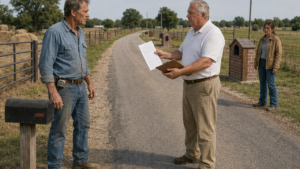
The piercing, nasal voice sliced through the tranquil garden like a pair of hedge shears. Marching up the crushed stone walkway was Karen Sterling-Cross. At fifty-one, Karen was the chairwoman of the Willow Creek Crossing Environmental and Architectural Standards Committee. She was married to an executive at a regional commercial waste brokerage, and she governed the seventy-four homes of the planned eco-subdivision with the ruthless, theatrical vanity of a Roman magistrate. She wore an expensive designer cashmere cardigan, oversized tortoise-shell sunglasses, and dramatically pinched her nose shut with a manicured hand while swatting at the air with an aluminum clip-folder.
Following two paces behind her was Inspector David Morales. David was forty-three, dressed in the dark navy uniform polo shirt, cargo field trousers, and steel-toed boots of the Delaware County Board of Health and Environmental Sanitation Division. Under his arm, he carried an official municipal code binder and a digital VOC air-quality sampling wand. David was a veteran municipal inspector who had spent fifteen years mediating neighborhood health disputes, and his calm, weary eyes reflected the quiet skepticism of an official who had smelled genuine biohazards and knew that fresh vegetable compost did not smell like a sewer.
‘Afternoon, Inspector Morales,’ Arthur said pleasantly, stepping away from the tumbler handle and wiping fine compost dust from his palms onto his apron. ‘Pleasant autumn weather. Ambient humidity is sitting at forty-eight percent. Ideal for aerobic nitrogen decomposition.’
‘Don’t you patronize county officials with your pseudo-science, Arthur!’ Karen shrieked, her voice muffled as she kept her nose pinched shut with two fingers. ‘It smells like dead animals! It’s attracting flies, rats, and raccoons! The odor is drifting through my open bedroom windows three hundred feet away! Section Six of our environmental charter explicitly prohibits any rotting biological matter from creating an off-site odor nuisance! David, smell the air! Write the violation!’
Inspector Morales raised his calibrated digital air-quality wand, checking the digital readout. The sensor registered 0.02 parts per million of volatile organic compounds—indistinguishable from the ambient garden background. He flipped open his Delaware County sanitation handbook, pointing to Section 18-B.
‘Mrs. Sterling-Cross, under county health regulations and according to your own community green-initiative covenants, sealed dual-chamber tumbler systems are fully permitted for residential kitchen and garden waste,’ Inspector Morales explained in a calm, neutral tone. ‘When properly managed with a thirty-to-one carbon-to-nitrogen ratio, aerobic compost generates zero noxious sewer odors. The ambient air around Dr. Vance’s garden is completely within safe regulatory limits.’
‘I don’t care what your wand says!’ Karen yelled, taking an aggressive step forward onto the gravel apron. ‘I can smell it with my own nose! It’s rotting! Open the hatch right now! Prove to this inspector that you aren’t burying illegal carcass waste in this neighborhood!’
Arthur reached into his apron pocket, pulling out a calibrated digital soil thermometer and a pH pen. ‘In a healthy aerobic composting tumbler, thermophilic bacteria like Actinomyces and Bacillus raise the internal core temperature between one hundred and thirty-five and one hundred and sixty degrees Fahrenheit,’ Arthur explained to Morales, showing him the digital readout of one hundred and forty-two degrees. ‘That heat pasteurizes weed seeds and breaks down cellulose through natural microbial respiration. The process produces water vapor and carbon dioxide, completely free of anaerobic hydrogen sulfide or ammonia. But when someone introduces fresh carnivore feces wrapped in non-breathable polyethylene, they create an anaerobic dead zone that generates toxic putrescine and cadaverine within hours. This wasn’t natural breakdown; it was a deliberate biological sabotage of a delicate biochemical balance.’
Inspector Morales leaned closer to the open hatch, his expression tightening as he observed the biological stratification. ‘The county health department receives hundreds of nuisance odor calls every year, Dr. Vance,’ Morales remarked, shaking his head. ‘Nine times out of ten, it’s a neighbor who simply doesn’t understand organic decomposition. But this deliberate contamination goes far beyond a neighborly misunderstanding. Introducing biohazardous pathogens into an agricultural soil preparation system is a direct violation of municipal sanitary codes that will be prosecuted to the fullest extent of the law.’
Arthur looked at Karen with a calm, penetrating gaze that held no anger, only the quiet, unshakable patience of an experienced scientist who had already observed the anomaly.
‘I’m more than happy to open the hatch, Inspector Morales,’ Arthur said, stepping up to the black plastic access door. ‘In fact, I’m glad you’re here to witness this. Because when I walked out to my garden at seven o’clock this morning to add coffee grounds, I noticed an unmistakable smell coming from the upper chamber. And as a professor of soil microbiology, I can assure you that rotting lettuce and carrot peelings do not produce the distinctive, putrid odor of carnivore feces.’
Arthur reached down, unlatched the heavy dual safety pins, and slid the top inspection door open.
Immediately, a sharp, nauseating stench of concentrated canine excrement and rotting synthetic plastic billowed from the interior of the chamber.
Inspector Morales stepped forward, pulling a pair of sterile latex gloves from his tactical pocket. He leaned over the rim, shining his inspection light into the dark drum.
Lying squarely on top of a clean bed of shredded brown oak leaves and fresh orange carrot shavings was an unnatural object: a heavy, bulging blue plastic grocery shopping bag from a regional supermarket chain. The bag was swollen tight, tied with a tight, deliberate knot, and smeared with dark brown, liquid animal feces that was leaking through a tear in the plastic seam.
‘What on earth is that?’ Inspector Morales asked, holding his breath as the foul odor hit his nostrils.
‘That is three pounds of fresh canine feces,’ Arthur said quietly. ‘Tossed into an aerobic vegetable composter. Carnivore waste contains lethal E. coli, Salmonella, and parasitic roundworm eggs. It destroys the aerobic bacterial biome of an agricultural compost pile, rendering the entire twenty-cubic-foot batch of organic fertilizer toxic and unusable for food cultivation.’
Karen scoffed, waving her hand with theatrical dismissal. ‘So a neighborhood stray dog walked by! What does that have to do with anything? It’s all organic fertilizer! It all breaks down in the dirt!’
‘A stray dog doesn’t tie its waste into a double-knotted grocery bag, Mrs. Sterling-Cross,’ Inspector Morales said, his voice dropping into cold, clinical authority.
Inspector Morales reached down into his kit, pulled out a long, clean wooden garden stake, and carefully slipped the pointed tip beneath the tied plastic handle of the blue bag. He lifted the heavy, dripping bundle out of the compost tumbler, holding it suspended in the bright afternoon sunlight.
As the bag swung gently in the air, the lower corner of the plastic unfolded.
Tightly plastered against the wet, knotted handle, held fast by moisture and dried canine waste, was a damp white paper envelope.
Inspector Morales adjusted his glasses, leaning in close with his flashlight. Printed across the face of the envelope in crisp, high-contrast black ink from a national banking institution was a bold windowed postal label:
PRE-APPROVED PLATINUM CREDIT CARD OFFER – EXCLUSIVELY FOR KAREN MILLER-CROSS – 742 EVERGREEN TERRACE, WILLOW CREEK CROSSING.
Inspector Morales stared at the label, his eyes slowly shifting from the dripping envelope directly to Karen Sterling-Cross’s face.
Karen froze. The color drained from her cheeks in an instant, leaving her skin the shade of curdled milk. Her fingers slowly dropped from her nose, her mouth hanging open in paralyzed, humiliated terror.
‘Well, look at that,’ Inspector Morales said, his voice dropping into hard, icy finality. ‘Your organic fertilizer came with your official credit card pre-approval letter attached to it.’
Inspector Morales pulled out his citation clipboard, clicking his pen with a sharp, resonant crack. ‘Under Delaware County Health Code Section 24, unlawful dumping of biological animal waste onto a neighboring property carries a mandatory, non-waivable three-hundred-dollar citation. And while I write this ticket, Dr. Vance and I are going to take a sterile sample of this waste, because judging by the chemical smell, this didn’t come from a single family pet.’