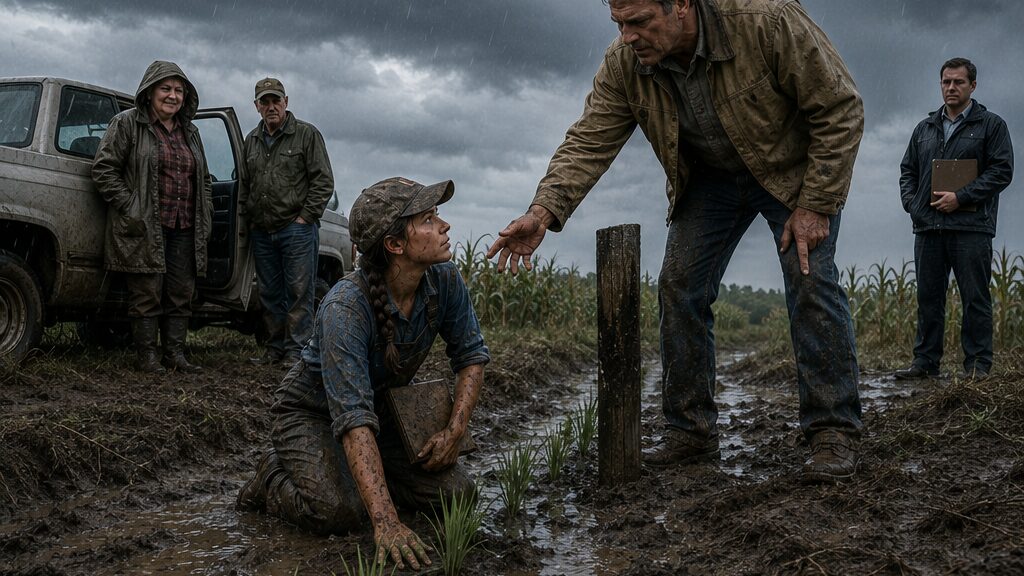
They Laughed While Emily Planted the Flood Ditch, Until the Water Chose Her Side
Chapter 1: The Green Line Across the Mud
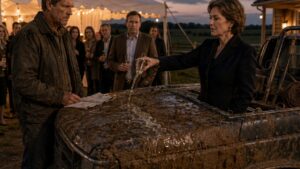
The pickup stopped so close behind Emily that its tires pressed water from the ruts and sent a brown fan across the back of her jeans.
She did not turn around.
The switchgrass plug in her hands had already begun to sag. Its pale roots hung through her fingers, packed with damp soil, and the wind was flattening the narrow green blades toward the drainage swale. She lowered it into the hole she had opened with a broken trowel and pushed mud around the roots with both thumbs.
The truck door opened.
“What are you doing?”
Michael Hall did not raise his voice. He rarely needed to. The flatness in it carried farther than shouting.
Emily pressed harder around the plant.
The line of plugs crossed the lowest part of the field in a shallow curve, starting near the old fence post and bending toward the county-road ditch. Twenty-six were in the ground. Nine remained in the white feed bucket beside her.
Michael’s boots stopped at the edge of the swale.
“Emily.”
She reached for another plug.
A second door creaked open. Barbara Young leaned out of the passenger side, one hand braced against the window frame. Her gray hair had come loose beneath a plastic rain scarf.
“Well,” she said, looking over the crooked green line, “I suppose corn got too ordinary.”
The laugh that followed was brief and uncertain, but it was still a laugh.
Ronald climbed down from the rear door more slowly. He looked at the plants, then at the sky, then at Emily’s notebook lying facedown on a flat stone. He said nothing.
Michael stepped into the mud.
“You dug across the drainage run.”
“It isn’t the drainage run anymore.”
“It is on the field map.”
“The water doesn’t read the field map.”
Barbara’s smile disappeared. Ronald looked down.
Michael’s jaw tightened. “Get up.”
Emily wiped one hand on her shirt and picked up the notebook before he could. Mud streaked its brown cover. A rubber band held several swollen pages together.
Michael glanced at it.
“It’s not a school assignment,” she said.
“I didn’t say it was.”
“You were going to.”
“I was going to say you put plants across ground I need cleared.”
“For what?”
“For planting.”
“This part washes out every spring.”
“It’s still acreage.”
“It’s a trench.”
“It becomes a trench because you keep cutting it bare.”
Michael looked toward the lower cornfield. The rows had been planted late and stood only a few inches high, thin green stitches across dark ground. Beyond them, the sky had turned the dull yellow-gray that came before a hard Midwestern storm.
“You took these from the conservation bed?” he asked.
“They were going to be thrown out.”
“That doesn’t make them yours.”
Carolyn Rivera at the county office had shown Emily the discarded trays three weeks earlier. The plugs had been left from a roadside restoration project, too root-bound for the contractor’s equipment but still alive. Emily had asked whether they could hold a bank. Carolyn had said they could, if placed correctly, if given time, if the flow was understood.
Emily had heard only the part that meant yes.
Michael crouched and touched one of the plugs. He tugged lightly. The roots shifted in the wet soil.
“These haven’t set.”
“They will.”
“Not by tomorrow.”
“They don’t have to be fully set. The roots and stems slow the surface flow.”
Michael looked at the line again. His gaze stopped near the fence post, where Emily had placed three plugs close together and angled the rest southeast.
For half a second, something changed in his face.
He knew the curve.
Emily saw it before he looked away.
“What?” she asked.
“Nothing.”
“You recognized it.”
“I recognized a mess.”
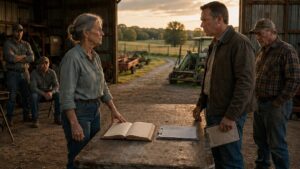
She opened the notebook.
The latest pages were covered with pencil arrows, dates, rainfall totals, and rough measurements written in cramped columns. Some entries had blurred where her wet fingers had touched them. A contour line crossed one page, darkened three times. Beside it she had written: FLOW SHIFT AFTER NORTH TILE SETTLES.
Michael reached for the notebook. Emily pulled it against her chest.
“Give me that.”
“No.”
His eyes lifted to hers.
Ronald moved one boot in the gravel but still said nothing.
Michael extended his hand. “Now.”
Emily opened to another page instead. “March twenty-first. Water came six inches above the south mark. April ninth, it crossed the wheel track. Last week it cut three feet farther east.”
“Measurements from a fourteen-year-old with a ruler are not a drainage plan.”
“I used the fence post.”
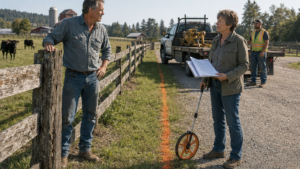
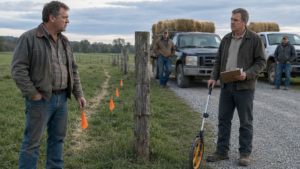
She stood and pushed past him, carrying the notebook to the weathered post at the edge of the swale. Its lower half was stained brown-black where floodwater had dried against the wood. Emily pointed beneath the wire staple.
“That line wasn’t there last year.”
Michael glanced once and dismissed it. “Old mud.”
“No. The old line is lower.”
She scraped the wood with her thumbnail. A second stain appeared beneath the first, faded and cracked.
Ronald stepped closer. “She’s right about that.”
Michael turned toward him.
Ronald’s expression closed immediately. “Looks higher, is all.”
Emily held the notebook beside the post. Her measurements matched the newer stain.
Barbara came around the front of the truck, hugging her cardigan shut beneath the rain scarf. “Couldn’t we leave it until after the storm?”
Michael looked at her sharply. “Eric Sanchez is coming at eight.”
The name changed the air more quickly than thunder.
Emily lowered the notebook.
Eric worked for the bank that carried the farm’s operating loan. He had been out twice since planting, both times with clean boots and a tablet held against his chest. Michael always scrubbed the kitchen table before he came, even if they met outside.
“What does he care about this ditch?” Emily asked.
“He cares about collateral acreage. He cares about the field plan. He cares that we’re already short on projected yield.”
“It’s less than half an acre.”
“It’s half an acre we reported as planted.”
“But it isn’t planted.”
“It was supposed to be.”
The first cold drops struck the notebook cover.
Michael looked at the remaining plugs in the bucket. “Pull them.”
Emily thought she had misheard him.
“The ones in the ground too,” he said. “Fill the holes. I want this clear before morning.”
“You know the water moved.”
“I know we have a lender inspection.”
“You recognized the curve.”
His face hardened so quickly that she knew she had struck something real.
Barbara glanced between them. Ronald studied the mud.
Michael stepped close enough that Emily could smell diesel and rain on his jacket. “You went into the conservation bed without permission. You dug across the field without permission. You made a plan you showed no one, then expected everyone to trust it because you wrote numbers in a notebook.”
“You wouldn’t have looked.”
“You didn’t give me the chance.”
That was true, and she hated him for saying it.
She had started measuring in March. She had recorded every heavy rain, every new channel, every place topsoil gathered against the fence. She had not shown Michael because he had dismissed the first two marks she mentioned at breakfast. She had not shown Barbara because Barbara turned arguments into jokes. She had not shown Ronald because Ronald agreed in private and disappeared in public.
She had waited until the plugs were available, then acted alone.
Now the line of green plants looked smaller than it had an hour earlier.
A low roll of thunder crossed the fields.
Michael picked up the bucket and set it beside her boots.
“Before sunrise,” he said. “Every one of them gone.”
He turned back toward the pickup.
Emily stared at the nine unplanted plugs, their roots drying in open air. Then she looked at the narrow green curve she had already pressed into the mud.
Michael opened the driver’s door but paused before climbing in.
“If they’re still here when I come down,” he said, “I’ll take them out myself.”
Chapter 2: They Watched Her Plant Through the Rain
Barbara found Emily at dawn with both knees sunk in the swale and the last switchgrass plug cupped between her hands.
Rain rattled against the pickup roof. It ran from the brim of Emily’s cap, down her nose, and onto the soil she was packing around the roots. The other plants trembled in the wind, each one standing along the curve Michael had ordered erased.
Barbara lowered the driver’s window.
“You stayed out here all night?”
Emily pushed mud against the plug with the heel of her palm.
“I asked you something.”
“No.”
It was not exactly a lie. She had gone to the machine shed for two hours, wrapped in a horse blanket beside the tool cabinet, then returned before the yard light shut off.
Barbara looked toward the farmhouse. “Your father thinks you’re in bed.”
“He didn’t check.”
“That doesn’t make this wise.”
Emily sat back on her heels. “Did you come to stop me?”
Barbara’s mouth tightened. “I came because the rain is getting harder.”
“You laughed yesterday.”
“I laughed because your line looked like a snake had planted it.”
“It follows the contour.”
“I know what it follows.”
Emily looked up sharply.
Barbara turned her face toward the windshield. “Come inside before Michael sees you.”
“What do you know about the curve?”
The engine ticked beneath the hood. Rainwater streamed down the glass between them.
Barbara did not answer.
A second vehicle appeared at the top of the access lane, headlights pale in the gray morning. It was a silver utility truck with the county conservation district seal on the door. Behind it came Eric Sanchez’s dark SUV.
Barbara closed her eyes briefly.
“You called the county?”
“I emailed Carolyn the measurements.”
“You did what?”
The utility truck rolled to a stop beside the pickup. Carolyn Rivera stepped out wearing a yellow rain shell and tall rubber boots. Eric emerged from his SUV without a coat, holding a folder over his head as he hurried toward the shed overhang.
Michael came from the farmhouse at the same time.
He saw Emily in the swale.
For a moment no one moved except the rain.
Then Michael crossed the yard.
“I told you to pull them.”
Emily rose, mud running from her knees. “Carolyn needs to see the flow line.”
“You brought a county employee here without asking me?”
“I sent her the numbers.”
Michael stopped at the edge of the plants. His gaze moved over the completed curve, then to Carolyn.
Carolyn raised one hand. “I was already in the area checking roadside washouts. She sent enough detail that I thought it was worth a look.”
Eric joined them, his folder damp at the corners. “Is this the acreage variance?”
Michael looked at Emily as though the question belonged to her.
Eric stepped closer to the swale. “This section was listed for corn.”
“It floods,” Emily said.
“It’s still included in the operating plan.”
“It hasn’t held corn for three seasons.”
Michael said, “Emily.”
She opened her notebook to the most recent pages. Not the older ones. Not the pages with the repeated curve and the faint pencil marks she did not fully understand. Only the dates, rainfall totals, and depth measurements she had made herself.
Carolyn crouched under the edge of the pickup’s raised tailgate while Emily held the notebook open.
“Here,” Emily said. “The runoff used to stay west of the fence post. After the north tile settled, it started crossing the wheel track. The last two storms cut toward the lower rows.”
Carolyn studied the page, then looked across the field.
“You measured the elevations?”
“With a clear hose and stakes.”
“Who helped you?”
“No one.”
Michael folded his arms.
Carolyn walked the line of plugs. At three points she knelt and pressed two fingers into the soil. Then she followed the shallow depression toward the road.
Eric remained beside Michael. “How much ground is out of production?”
“Point four acres,” Emily said.
Eric looked at her. “That isn’t nothing.”
“Neither is losing the lower field.”
“We don’t base loan terms on what might happen.”
Michael’s mouth twitched at that, though not quite in agreement.
Carolyn returned from the road ditch. “The runoff path has shifted.”
Emily felt the words settle through her more warmly than praise.
Michael did not move.
Carolyn pointed toward the fence. “The stain on the post is recent. There’s also fresh sediment on the east side of the track. She’s right about the direction.”
Eric flipped open his folder. “Does that make this planting approved?”
“No,” Carolyn said.
The warmth vanished.
“These plugs are too new to function like an established strip,” Carolyn continued. “They may slow shallow sheet flow, but I can’t tell you what happens under a heavy surge. And I haven’t checked the culvert capacity.”
Emily frowned. “The culvert is above the line.”
“Which means anything you slow here may back up there.”
“It hasn’t before.”
“You don’t know that it won’t now.”
Michael gave a short, humorless breath. “There it is.”
Emily turned toward him. “She said the water moved.”
“She also said you don’t know what this barrier will do.”
“It isn’t a barrier.”
“What do you call a row of roots across drainage?”
“A filter strip.”
“You copied a failed plan and changed the name.”
The rain seemed to sharpen around them.
Barbara looked at Michael.
Ronald, who had come from the machine shed carrying a canvas coat, stopped halfway across the yard.
Emily tightened her grip on the notebook. “What failed plan?”
Michael’s face had gone pale beneath the brim of his cap.
Eric looked between them, sensing something outside the inspection but not understanding it. “Michael, I need a clear answer about whether this acreage will be restored.”
Michael did not take his eyes from Emily. “Yes.”
Carolyn stood. “I’d wait until we inspect the upstream culvert.”
“The storm is coming tonight,” Michael said.
“That is why I’d inspect it.”
“And if the bank washes because these plants redirect flow?”
“Then removing them without understanding the system could make it worse.”
Eric closed his folder. “The bank cannot count unapproved conservation acreage toward the current plan. If it stays out of production, we revise the projected yield and review the loan conditions.”
Michael looked across the lower field. The young corn bent under the rain.
Emily saw the calculation in him. Seed, fertilizer, diesel, the late payment notice tucked beside the kitchen phone. Half an acre was not the farm. But Eric was not talking about half an acre. He was talking about whether Michael still controlled what happened on his own ground.
Emily knelt again.
Her hands shook, so she pressed them into the mud until they steadied. She cupped soil around the final plug, firming it on all sides.
Michael said, “Get up.”
She finished the plant.
“Emily.”
She stood and held out the notebook. “Check the fence-post mark. Check the wheel track. Then check this page.”
He did not take it.
“You knew the curve yesterday,” she said. “You knew it before Carolyn said anything.”
Barbara stepped forward. “Michael—”
“No.”
The single word silenced her.
Michael took the notebook from Emily, not gently. He looked at the open page. His eyes moved over her arrows and numbers, then stopped at the faint contour line showing through from the sheet beneath.
His thumb covered it.
“You have no idea what you’re copying,” he said.
“I drew those measurements.”
“Not the first line.”
Emily stared at him. “Who did?”
Michael closed the notebook.
Behind them, Ronald’s coat slipped from one hand and landed in the mud.
Eric cleared his throat. “I’ll return this afternoon. I need the acreage condition settled by then.”
He walked back to his SUV.
Carolyn hesitated. “Michael, let me check the culvert first.”
“I know this ground.”
“So does she.”
His expression made Carolyn stop.
Michael carried Emily’s notebook toward the machine shed. She followed.
“Give it back.”
“No.”
“It’s mine.”
“It’s part of whatever you’ve been doing without permission.”
He entered the shed office and locked the notebook inside the metal desk.
Emily stood beyond the small window, rain dripping from her sleeves. Michael took the tractor key from the pegboard.
The old utility tractor started on the second turn. Its engine filled the shed with a heavy mechanical pulse.
Michael backed into the rain and lowered the narrow grading blade.
Barbara called his name from the yard.
He drove past her.
The tractor rolled toward the swale, tires sinking into the softened lane. Emily ran alongside until mud pulled at her boots.
Michael did not look down.
The blade hovered inches above the green line.
Chapter 3: The Notebook Page Michael Recognized
Michael locked the office door even though Emily stood three feet away and had watched him place the notebook in the top drawer.
“You don’t lock that door,” she said.
“I do now.”
Rain drummed on the machine-shed roof. The tractor waited in the open bay behind him, idling hard enough to rattle a row of wrenches against the wall.
Emily’s face was streaked with mud. She looked younger when she was exhausted, but the way she held herself made Michael think of someone older—someone standing at the same threshold years ago with folded maps under one arm and anger held tightly behind her teeth.
He turned away before the memory formed completely.
“Go to the house.”
“Give me the notebook.”
“No.”
“You don’t get to keep it because you don’t like what it says.”
“I get to stop you from making decisions on land you don’t own.”
The words landed harder than he intended.
Emily’s expression changed, but she did not step back.
“This is my home.”
“It is not your operating loan.”
“No. It’s just my mud when something needs doing.”
Michael reached for the tractor rail.
Emily caught his sleeve. “Who drew the first line?”
He pulled free.
“Who?”
“Your measurements are not enough.”
“That wasn’t my question.”
He climbed onto the tractor.
Barbara stood in the shed entrance. Ronald was behind her, holding the canvas coat he had dropped earlier. Neither moved aside.
Michael shut off the engine.
The sudden quiet was worse.
Barbara said, “You should tell her.”
“No.”
“She found it on her own.”
“She found half of it.”
“Then tell her the other half.”
Michael looked toward the locked office. Through the small window he could see the metal desk, the rain-dark notebook hidden inside it.
Emily followed his gaze.
Barbara stepped into the shed. “I kept the pages.”
Michael’s head turned.
“What pages?” Emily asked.
Barbara pressed her lips together, already regretting the sentence.
Michael climbed down from the tractor. “You said they were gone.”
“I said I didn’t know where they were.”
“You knew.”
“I knew where some were.”
Ronald shut the large shed door against the rain, reducing the outside world to a gray strip beneath it.
Barbara looked at Emily. “Years ago, your mother made a drainage plan for the lower field.”
Emily’s hand fell from Michael’s sleeve.
“She worked with the county,” Barbara continued. “Not Carolyn. Someone before her. They marked contour lines and wanted to take part of the field out of row crops.”
Michael said, “Enough.”
“No, it isn’t.”
Barbara’s voice shook, but she kept going. “Your father helped her measure.”
Emily looked at him.
Michael felt the old room return around him: the kitchen table covered in topographic maps, two mugs gone cold, a baby monitor hissing beside the salt shaker. He had drawn the first heavy line himself. Emily’s mother had corrected its angle and laughed when he argued over two degrees.
They had planted a trial strip.
Then came the storm.
Not this kind of forecast, not three inches over twelve hours, but a stalled system that dropped nearly nine. The upper ditch choked. Water crossed the road, cut through the field, and left three acres under silt. The lender called it preventable. Neighbors said the new planting had dammed the flow. Michael had repeated that explanation until it sounded like fact.
Emily’s mother had said the culvert had not been maintained.
Michael had said she cared more about proving a plan than saving the farm.
She left six months later.
He had not told Emily that part.
“Where are the pages?” Emily asked.
Barbara looked at Michael before answering. “In the house.”
“You kept them all this time?”
“Not all. A few maps. Notes.”
Michael stepped between them. “Those pages describe a plan that failed.”
Barbara’s eyes flashed. “They describe a plan we never finished.”
“It flooded.”
“The culvert was packed with soil.”
“You don’t know that caused it.”
“You don’t know the grass caused it.”
“I saw the water.”
“So did she.”
Emily said nothing. The silence frightened Michael more than an accusation would have.
He unlocked the office and took out her notebook.
The cover left mud on his fingers. He opened to the page he had seen near the swale. Emily’s fresh contour line ran across it in dark pencil. Beneath it, impressed faintly through the paper, was an older shape copied from something that had once rested under the sheet.
He turned the page.
There it was: a partial line in blue ink, faded at the edges. The handwriting beside it was not Emily’s.
SOUTH FLOW AFTER TILE SETTLEMENT.
Michael had written those words fourteen years earlier.
Emily moved close enough to see.
“You drew that.”
He shut the notebook.
She took it from him before he could stop her and opened it again.
“My measurements match yours.”
“Partly.”
“I didn’t copy this. I didn’t even know it was there.”
“I know.”
The admission escaped before he could pull it back.
Emily looked up.
Michael saw the moment she understood. He had believed her before Carolyn arrived. He had recognized the contour at the first glance. Everything after that—the order, the lender, the tractor—had not come from ignorance.
It had come from fear.
“You knew,” she said.
“I knew the shape.”
“And you still called it a school project.”
“Because knowing where water went once doesn’t tell you what it will do now.”
“That isn’t why.”
Michael took the tractor key from his pocket. “Eric will be back this afternoon.”
Emily gave a short laugh with no humor in it. “So that’s the reason you’re choosing.”
“I’m choosing whether this farm gets another season.”
“You’re choosing what you can explain to him.”
“Yes,” Michael said. “Because explanations matter when someone else holds the note.”
Barbara left for the farmhouse and returned with a narrow recipe tin tucked beneath her cardigan. She set it on the workbench.
Inside were four folded sheets, yellowed along their creases.
Michael stared at them.
Emily unfolded the first page. A county conservation heading crossed the top. Below it were hand-drawn lines, measurements, and maintenance notes. Her mother’s writing slanted uphill across the margins. Michael’s block letters appeared beside it.
The new lines in Emily’s notebook did not sit exactly atop the old plan. They crossed it, corrected it, and extended farther east.
“I wasn’t copying,” Emily said.
Michael could not answer.
She had inherited the question, not the solution.
Outside, a gust struck the shed door. Water hissed beneath the gap and spread over the concrete in a thin sheet.
Eric’s deadline sat in Michael’s mind beside the overdue equipment payment and the seed invoice. If the field plan changed, the bank could lower the projected yield. If the yield fell, the operating line could tighten. There would be no money for replanting, no room for another bad season.
He looked at the old pages and saw not evidence but the beginning of everything that had come apart.
Emily gathered them.
Michael put out his hand. “Leave those.”
“They’re about the field.”
“They’re about more than that.”
“Then maybe you should have told me.”
He had no answer that did not sound like cowardice.
Ronald spoke from near the door. “You could wait until Carolyn checks the culvert.”
Michael turned. “And tell Eric I let half an acre go because a fourteen-year-old planted it overnight?”
“You could tell him the field changed.”
“He’ll tell me the loan didn’t.”
Michael started the tractor again.
Emily stepped in front of the bay.
He lowered the throttle but did not shut it off.
“Move.”
“No.”
Barbara reached for her. Emily pulled away.
Michael gripped the steering wheel. “Do not make me choose between keeping you safe and keeping this farm.”
“You already chose.”
The words were quiet.
Michael looked past her to the lower field. Rainwater had begun collecting in the wheel ruts, moving in narrow silver threads toward the swale.
He knew the safest choice was to wait.
He knew the responsible choice was to inspect the culvert.
He also knew Eric would return and see unauthorized acreage, an incomplete plan, and a farmer who no longer controlled his own operation.
Michael eased the tractor forward.
Ronald guided Emily aside before the tire reached her.
At the swale, Michael lowered the grading blade only enough to cut a narrow opening through the middle of the green line. He told himself he was not destroying it. He was restoring a release path. He was reducing uncertainty.
The blade entered the mud.
Several plugs folded beneath it. Dark roots rolled up with the soil.
Emily stood ten yards away holding the old pages against her chest. She did not shout. That made it worse.
Michael made one pass, no wider than the tractor blade, opening a channel toward the lower rows. Then he raised the blade and backed away.
For several seconds nothing happened.
Rain struck the exposed soil.
A thin stream entered the cut.
It gathered speed, carrying loose earth with it. By the time Michael shut off the tractor, brown water was already moving through the opening he had made, carving the channel deeper before the storm had fully arrived.
Chapter 4: The First Water Proved Too Little
The first hard surge reached the green line before anyone had finished arguing about the tractor cut.
Water came across the upper wheel track in a brown sheet, carrying corn leaves, loose stalks, and clods of soil large enough to knock against Emily’s boots. She stood beside the fence post with her notebook under her jacket while Michael watched from the tractor seat.
The stream struck the switchgrass.
For one breath, the plants flattened.
Then the water divided.
Part of it slipped through the stems in thin, broken ribbons. The heavier flow bent along the curve Emily had planted, spreading sideways instead of dropping straight into the lower rows. Mud boiled around the exposed roots where Michael’s blade had cut the opening, but the rest of the line held.
Ronald stepped closer to the swale. “Look at that.”
Barbara covered her mouth with one hand.
Michael climbed down from the tractor without shutting it off. His boots sank ankle-deep as he crossed toward the plants.
The lower corn rows shivered beneath the rain, but they remained upright. Sediment collected against the thickest switchgrass clumps instead of rolling through the field.
Emily felt something inside her release.
Not triumph. Not yet.
Proof.
She pulled the notebook free and turned to the page marked with the last storm’s flow arrows.
“It’s doing what I said.”
Michael stared at the channel.
“The opening is cutting,” he said.
“You made the opening.”
“I made a release.”
“You made the fastest path through the whole strip.”
A section of loose bank collapsed into the cut and disappeared in the current.
Michael looked toward the county road. “The flow has to go somewhere.”
“It was already going somewhere. I was slowing it.”
The rain thickened, drumming against the notebook cover. Emily wiped the page with her sleeve and smeared one pencil arrow into gray.
Carolyn’s utility truck came down the access lane with its amber light flashing. She parked above the swale and climbed out carrying a survey rod.
“I saw water crossing the north field,” she called. “How long has this been running?”
“Five minutes,” Ronald said.
Carolyn stopped when she saw the switchgrass line. Her gaze followed the divided flow, then fixed on Michael’s fresh cut.
“Who opened that?”
No one answered immediately.
Michael said, “I did.”
Carolyn waded to the edge and planted the survey rod beside the channel. Water climbed another inch while she watched.
“The strip is holding surface flow,” she said.
Emily looked at Michael.
Carolyn continued before the satisfaction could settle. “But the road ditch is filling too quickly.”
She pointed upstream.
Beyond the pasture fence, water had begun gathering along the county-road shoulder. It should have passed through the culvert beneath the road and emptied into the wider drainage run. Instead, the ditch was swelling backward toward them.
Michael squinted through the rain. “It’s always slow during a hard storm.”
“Not like that.”
Carolyn walked toward the road, stepping over the wire fence where it sagged. Emily followed, with Michael behind her.
The ditch water had risen to the bottom of the roadside grass. A discarded feed sack spun in place near the culvert entrance, caught by a current that seemed to pull and release without moving forward.
Carolyn lowered the survey rod.
“We’ve got less than six inches before it reaches the shoulder.”
Emily opened her notebook and found the page for the north drainage run. Rain struck the paper. The figures blurred at the edges.
“That doesn’t match,” she said.
Michael looked over her shoulder. “What doesn’t?”
“The rise. The swale should take more before this backs up.”
Carolyn studied the page. “Your downstream measurements may be right. But you didn’t measure culvert capacity.”
“I couldn’t get through the fence.”
“You still assumed it was open.”
Emily looked at the dark mouth beneath the road. Water swirled against it, almost black.
The correction stung because it was true.
She had measured where the water traveled across their land. She had not measured what happened after it left. The line in her notebook ended at the road ditch as if the world ended there too.
Michael said, “So the grass caused this.”
“No,” Carolyn replied. “The grass may be exposing a problem that was already there.”
“Water wasn’t backed up yesterday.”
“It wasn’t raining like this yesterday.”
Michael stepped into the ditch and pushed the feed sack away with his boot. It shot sideways, then spun back toward the same place.
“There’s suction,” Emily said.
Carolyn nodded. “Some flow is getting through.”
“Then it’s not blocked.”
“Partly blocked is worse in some ways. Pressure keeps building while people assume it’s draining.”
A pickup slowed on the county road, tires sending spray across the shoulder. The driver leaned toward the window, watching the water.
Carolyn pulled out her phone. “I’m calling the road crew.”
Michael’s head snapped toward her. “Don’t.”
“The shoulder is taking water.”
“If the county comes out, they’ll document the field changes.”
“They’ll document a culvert problem.”
“And the unapproved strip.”
Carolyn looked at him. “That is not the main risk anymore.”
“It will be when Eric reviews the report.”
Emily shut the notebook. “The road could wash.”
Michael’s eyes shifted toward the lower field, then back to the road. His face had the strained look of someone trying to hold two collapsing things apart with his hands.
The switchgrass had worked.
Emily could see that clearly now. Soil gathered behind the roots. The water spreading into the lower rows had lost some of its speed. If Michael had not cut through the center, the strip might have held more.
But Carolyn was right. The success had changed the pressure elsewhere.
A horn sounded from the road.
The same pickup had stopped. Another vehicle approached behind it, braking when it saw water crossing the edge of the pavement.
Carolyn spoke into her phone.
Emily turned upstream and followed the roadside ditch with her eyes. The water surface rose in uneven humps near a patch of flattened weeds. Something beneath it tugged at the current.
She climbed through the fence.
“Where are you going?” Michael called.
“To see the entrance.”
“You can’t see anything in that water.”
“I can see where it isn’t moving.”
She walked along the ditch, bent against the rain. The notebook stayed under her jacket, pressing against her ribs. Every few yards she drove a stick into the water and watched the current turn around it.
Behind her, Carolyn shouted measurements into the phone. Ronald moved the pickup away from the lowest part of the lane. Barbara stood beneath the open tailgate, no longer laughing.
At the culvert mouth, Emily crouched.
The opening was almost invisible beneath weeds and muddy foam. She reached with the stick and felt resistance two feet in. Not stone. Something springy.
She pushed harder.
A length of rusted fence wire rose from the water, tangled around dead grass and packed soil. The current grabbed it and snapped it back down.
“Carolyn!”
Carolyn hurried over. Michael followed.
Emily pointed with the stick. “There’s wire in it.”
Carolyn knelt beside her and probed the opening. Her face tightened.
“Old woven fencing,” she said. “And the inlet is narrowed with compacted sediment.”
Michael looked at the culvert as though it had betrayed him.
Ronald joined them, breathing hard. “That fence came down from the north boundary years ago.”
“How did it get in there?” Barbara asked.
Ronald did not answer.
The road crew dispatcher called Carolyn back. She turned away to speak.
Emily studied the flow around the blocked mouth. Water pressed against the wire, found no clear passage, and spread backward toward the farm. The switchgrass was not sending the flood toward the road. The culvert had been choking the drainage long before she planted anything.
The first answer had only revealed the larger problem.
She stood. “We need to clear it.”
Michael said, “The road crew will handle it.”
“They said they’re twenty minutes out,” Carolyn replied, lowering her phone. “Maybe longer. They have two washouts west of here.”
The shoulder gave a soft, wet crack.
A section of gravel slumped into the ditch.
Everyone turned.
Water rushed into the gap, widening it immediately.
Carolyn stepped back. “No one goes near the road edge.”
Emily looked beyond the culvert toward the equipment lane. The small excavator sat beside the machine shed, its boom lowered.
Michael followed her gaze.
“No,” he said.
“We can reach the inlet from our side.”
“The bank is saturated.”
“You can stay off the shoulder.”
“I said no.”
“If the road gives, it takes the fence and the pasture corner with it.”
“And if I put the excavator there and the bank collapses, it takes the machine.”
Emily opened the notebook again, shielding it with her body. The pencil marks were fading under the dampness. She found the rough profile she had drawn of the roadside slope.
“There’s a firm shelf behind the old gate,” she said. “You could work from there.”
Michael shook his head. “You measured water. You did not measure load-bearing soil.”
Carolyn looked at the page. “She’s right about the shelf existing. I can’t guarantee it will hold.”
Another crack came from the road shoulder.
This time the sound was louder.
Emily moved toward the old gate, where weeds and brush hid the descending bank. She pushed through until she could see the culvert mouth from the side.
The blockage filled most of it: rusted wire, compacted mud, branches, and something pale that might have been a broken fence post. No one could pull it free by hand against that pressure.
Michael stood ten yards away.
Emily pointed toward the shelf.
“You don’t have to trust the plants anymore,” she said. “The water already did that for you. Trust the ground long enough to get the machine here.”
He did not move.
Below them, the current dragged another strip of gravel from the road.
Emily looked at the excavator, then at the blocked culvert. She had found the reason her calculations failed.
She could not reach it alone.
Chapter 5: The Plan They Buried Years Ago
Michael refused to move the excavator even after water began cutting a narrow channel across the road shoulder.
“It stays where it is,” he said.
The rain had turned the farmyard lights into pale blurs. Carolyn stood near the old gate with the survey rod planted in the ground, tracking the water as it climbed. Ronald waited beside the pickup, his coat soaked through. Barbara had gone to the farmhouse for dry towels and returned carrying the narrow recipe tin beneath one arm.
Emily stood between Michael and the machine shed.
“The shelf is holding,” she said.
“For now.”
“The road isn’t.”
“The county crew is coming.”
Carolyn checked her phone. “They’re still at least fifteen minutes out.”
Michael looked toward the road. A volunteer firefighter had parked a truck across one lane and was waving vehicles around the flooded edge. The water had not crossed the centerline yet, but it was close.
Emily held her notebook open beneath the porch light. Its pages had swollen. Pencil numbers bled into one another.
“The culvert inlet is below the old gate. You can reach it from the equipment lane without putting the excavator on the shoulder.”
Michael’s eyes stayed on the machine.
“No.”
Barbara climbed the porch steps. “Michael.”
He turned.
She set the recipe tin on the railing and removed the old conservation pages. Rain spotted them immediately.
“You need to see the maintenance notes.”
“I have seen them.”
“You saw what you wanted.”
His face closed.
Emily took the pages before the rain could ruin them. One sheet showed the original contour strip. Another showed the culvert and the north boundary fence. Along the margin, in her mother’s handwriting, were three dated entries.
INLET PARTLY SILTED.
FENCE DEBRIS NOT REMOVED.
CLEAR BEFORE HEAVY RAIN.
Emily read them twice.
Michael said, “Those notes were preliminary.”
“The dates are months apart,” Emily replied.
“They don’t prove what happened during the flood.”
“They prove someone knew the culvert needed work.”
Barbara gripped the porch railing. “We all knew.”
Ronald looked up.
Michael stared at his mother. “What are you saying?”
Barbara’s voice went thin. “The north fence came down that spring. Ronald stacked part of it by the ditch. You were waiting for the ground to dry before hauling it.”
Ronald’s mouth tightened. “I should have moved it sooner.”
“You told me it was gone,” Michael said.
“I thought it was.”
“You thought?”
Ronald looked toward the water. “Some of it must have washed down.”
Michael stepped off the porch, then turned back as if he had nowhere to go.
Barbara continued. “The culvert was already choking before that big storm. Your wife kept saying the grass wasn’t the whole problem.”
“She said a lot of things after the field was gone.”
“She said them before.”
Michael’s hand struck the porch post—not hard, but hard enough to shake water from the roof edge.
“You think I don’t remember?”
Emily held the pages tighter.
“I remember the bank cutting,” he said. “I remember three acres under mud. I remember the lender sitting at our kitchen table. I remember neighbors saying we had dammed the drainage with a conservation experiment.”
Barbara’s face crumpled briefly, then steadied. “And you let them say it.”
“What was I supposed to tell them? That I had ignored the culvert? That I had helped draw a plan and failed to maintain the one thing that could make it safe?”
The words hung between them.
Emily had expected denial. Anger. Another order.
Not this.
Michael looked at the old page in her hands. “I blamed the strip because it was visible. Everyone could see it. The culvert was under the road. The neglect was mine.”
Rain struck the porch roof in a hard, steady roar.
Emily’s mother had not left because a plan failed. She had left after being blamed for a failure Michael understood was not hers alone.
“Did you tell her that?” Emily asked.
Michael did not answer.
That was answer enough.
Barbara pressed a hand to her mouth.
Emily felt the first sharp satisfaction of being right, but it died before it fully formed. Michael’s shame did not repair the field. It did not return her mother. It did not clear the culvert.
And it did not excuse what he had done that morning.
“You knew what the first flood taught you,” Emily said. “Then you cut my strip anyway.”
Michael looked at the dark line of water crossing the lane. “I thought if I left it, I was making the same mistake twice.”
“You made the same choice twice.”
He flinched.
Emily closed the notebook. She wanted him to feel the full weight of it. She wanted him to stand there while the road failed and understand that refusing to listen had a cost.
Then the shoulder dropped another six inches.
The volunteer firefighter shouted for everyone to move back.
Water rushed through the new break, taking gravel and roadside grass with it. The fence post nearest the culvert leaned sharply toward the ditch.
Carolyn ran from the gate. “We’re losing the edge.”
Ronald stepped toward Michael. “Move the excavator.”
Michael shook his head once, as though refusing the words could restore the ground.
Ronald grabbed the front of his jacket.
It was the first time Emily had ever seen him put his hands on Michael.
“Listen to her,” Ronald said.
Michael stared at him.
“You stood quiet when I should’ve spoken,” Ronald continued. “I stood quiet when she should’ve been defended. I’m not doing it again while the road falls in.”
Barbara wiped rain from her face. “Neither am I.”
The volunteer firefighter called that the county crew was delayed by another washout.
Emily opened the old pages beside her notebook. The original plan showed an emergency bypass gate farther down the swale. Her mother’s line had been drawn toward it. Emily’s new measurements showed the active flow had shifted east, but the higher shelf near the old gate remained outside the strongest current.
She pointed to the map.
“The excavator can come down the equipment lane and stop here. Not closer. Use the boom from the west side. Pull the wire first, then shave the packed soil from the top. Don’t dig under the culvert lip.”
Carolyn crouched beside the page. “That keeps the machine off the saturated edge.”
Michael said, “If the blockage releases all at once, the surge goes straight toward the cut I made.”
Emily looked toward the switchgrass line.
He was right.
The opening through the center had weakened the only structure slowing the flow into the lower field.
“We can close the emergency gate,” Ronald said.
“It hasn’t moved in years,” Michael replied.
“I can get it moving.”
Emily studied the route. “Close it halfway. Not all the way. It needs to take the first surge and send part of it through the west channel.”
Michael looked at her. “You’re guessing.”
“Yes.”
The admission surprised them both.
Emily swallowed. “I know where the water has been. I know where it is now. I don’t know exactly what it will do when that culvert opens.”
The rain ran down the pages and through her fingers.
“But leaving it blocked isn’t safe,” she said. “And waiting isn’t neutral.”
Michael looked toward the road, where the firefighter was moving the barricade farther back.
Emily stepped closer.
“You don’t have to pretend I know everything. I don’t. But you know I’m not making this up.”
His eyes moved to the notebook, the old pages, and the green line barely visible beyond the rain.
Another section of shoulder slumped.
Michael exhaled through his nose.
Then he reached into his jacket and pulled out the equipment radio.
He held it toward Emily.
She did not take it at first.
“You tell me where to set the tracks,” he said.
The radio was heavy and warm from his pocket. Emily wrapped both hands around it.
Michael turned toward the machine shed.
“Where do I dig?”
Chapter 6: Emily Called the Cuts in Darkness
The excavator lights revealed water running across the county road in a silver-brown sheet.
Emily stood on the equipment lane with the radio against her mouth, the old conservation pages tucked inside her jacket and her notebook open on the hood of the pickup. Wind lifted the swollen paper each time she released it.
Michael’s excavator crawled toward the culvert shelf.
“Two feet left,” Emily said into the radio.
The machine stopped.
Carolyn stood near the tracks with a flashlight aimed at the ground. “Shelf is firm here. Softer toward the road.”
Emily keyed the radio. “Keep the right track inside Carolyn’s marker.”
Michael raised one hand through the cab window.
Ronald and the volunteer firefighters worked farther down the swale at the old emergency gate. They had wrapped a chain around its rusted wheel and were using the pickup to pull it free a few inches at a time. Barbara held the floodlight while shouting whenever the gate shifted.
The county road crew had finally arrived, but their larger excavator could not approach until the shoulder was stabilized. For now, the work depended on the farm machine and a narrow shelf of ground no one fully trusted.
Michael extended the boom.
The bucket entered the water beside the culvert mouth and came up with weeds, mud, and a loop of rusted fencing. The pressure beneath it changed immediately. Water punched through a fist-sized opening and sprayed against the bucket.
“Stop,” Emily said.
Michael paused.
Carolyn moved the flashlight. “Good. Pull from the top, not the center.”
Emily repeated it over the radio.
The next scoop brought up a broken fence post wound in wire. Ronald saw it from the gate and lowered his head.
Water began feeding through the culvert in a stronger stream.
“It’s moving,” Barbara called.
“Not enough,” Carolyn replied.
Emily checked the notebook. Her pencil arrows had nearly vanished, but the water-depth columns remained legible. She matched them to the fence-post marks and the time written in the margin.
The current should have dropped at the swale by now.
It had not.
“There’s more packed behind it,” she said.
Michael lowered the bucket again.
Too far.
The excavator boom angled toward the bottom lip of the culvert.
Emily saw the bank tremble.
“Stop!”
The bucket continued down.
She pressed the radio harder. “Michael, stop now.”
The machine froze.
For a second only rain and rushing water filled the darkness.
Michael’s voice came through the speaker. “I can get under the blockage.”
“You’ll undercut the inlet.”
“It’s packed below the wire.”
“The bank is moving.”
Carolyn swept her light across the soil. A thin crack had opened beside the excavator’s left track.
“She’s right,” Carolyn said. “Back the boom out.”
Michael hesitated.
Emily watched the crack widen by the width of a finger.
“Back it out,” she repeated.
The boom rose.
The crack stopped spreading.
Michael repositioned the bucket without argument.
Something inside Emily shifted. Not because he obeyed, but because she had said stop without needing to prove she was fearless first.
The next pull lifted a solid mat of wire, roots, and compacted soil from the culvert mouth.
Water struck the opening.
The culvert roared.
“Gate!” Emily shouted.
Downstream, Ronald and the firefighters hauled the chain. The old emergency gate moved another foot, then jammed.
The first surge reached the swale.
The switchgrass bent almost flat. Water divided along the green curve, just as it had earlier, but the opening Michael cut through the center took the strongest current. Soil peeled away around the damaged roots.
Emily ran toward it.
Carolyn caught her arm. “Stay off the bank.”
“If that cut widens, the whole surge goes into the lower field.”
“What can you do by hand?”
Emily looked at the notebook.
The page showing the present flow line was already tearing at the binding. She ripped it free.
Michael’s voice came through the radio. “What happened?”
“The center opening is failing.”
“Can we close it?”
“Not from here.”
The excavator sat upstream, blocked from turning quickly by the narrow lane. Ronald’s gate remained only partly closed. The surge was building.
Emily flattened the torn page against the pickup hood and used the grease pencil from Carolyn’s pocket to mark three points along the west bank.
“If we cut here, here, and here,” she said, “we can take pressure off the center.”
Carolyn studied the marks. “That sacrifices the west end of the strip.”
“It sends the surge into the old channel.”
“And into the field corner.”
“The field corner is already bare.”
Carolyn looked toward the young corn beyond it. “You’ll lose several rows.”
Emily looked at the switchgrass she had planted through the night. The green line had been the first thing on the farm that felt wholly hers. Every root marked a measurement no one had trusted.
Saving all of it was no longer possible.
She keyed the radio.
“Michael, bring the bucket south of the fence post.”
“That puts me beside the strip.”
“I know.”
“What are you asking me to cut?”
Emily pressed her palm over the page to keep it from blowing away.
“My west section.”
Silence came through the radio.
“You planted that section deepest,” Michael said.
“That’s why it will hold long enough to guide the cut.”
Another clump tore free at the center opening.
“Do it,” Emily said.
Michael repositioned the excavator. This time he followed her marks exactly.
The first shallow cut opened into the old west channel. Water hesitated, then began sliding toward it.
“Second mark,” Emily said.
The bucket lowered.
A strip of switchgrass disappeared beneath the mud. Emily felt the loss physically, as though the blade had passed across her own hands.
The redirected flow strengthened.
At the emergency gate, Ronald shouted that the wheel was moving. The firefighters pulled again. The gate closed halfway, forcing more water toward the west channel and less through Michael’s central opening.
“Third cut,” Carolyn said.
Emily looked at the page. The third mark would take another cluster of plugs, but without it the first two channels might merge and scour the bank.
She keyed the radio.
“Third mark. Same depth.”
Michael lowered the bucket.
The surge spread across the sacrificial corner of the field. Several young corn rows vanished beneath muddy water, but the current lost speed before reaching the lower acreage. Behind it, the remaining switchgrass rose slowly from the flow, stems trembling but rooted.
The road crew began shoring the shoulder with rock from the opposite side. Carolyn relayed measurements between them and Emily. Barbara carried flashlights and dry gloves. Ronald remained at the gate, one hand on the chain even after it stopped moving.
For the next two hours, Emily called adjustments from the notebook.
Open the west channel six inches more.
Hold the gate.
Move the excavator back from the crack.
Pull another length of wire.
Do not deepen the central cut.
Each instruction became a choice she had to make in front of everyone. She could not hide behind secret pages now. When Carolyn questioned a measurement, Emily checked it. When Michael asked whether she was certain, she said when she was and admitted when she was not.
Near dawn, the rain weakened.
The road stopped shedding gravel. Water continued through the culvert in a steady, unobstructed rush. The lower field stood under patches of shallow water, but most of the young corn remained upright.
Emily walked the swale with the notebook under one arm.
The center of the green line was gone. Michael’s first cut had become a raw channel, and the three emergency cuts had carved a deep scar through the west section. Broken switchgrass blades lay tangled in silt.
Michael climbed down from the excavator. Mud covered the machine tracks and the front of his jacket.
“The road held,” he said.
Emily looked toward it. Road-crew trucks sat across one lane, but the pavement remained intact.
“So did most of the field,” Ronald added from behind them.
Emily crouched beside one of the surviving plants. Water had stripped soil from one side, exposing a dense web of pale roots beneath the crown.
They had held more than anyone could see from above.
Michael stood beside her.
“I’m sorry about the strip,” he said.
Emily touched the exposed roots. “I told you to cut it.”
“I mean before.”
She did not answer.
The sky beyond the road had begun to lighten, revealing the damage without mercy: lost corn rows, collapsed shoulder, torn fencing, and the black channel through the plants she had fought to save.
Nothing looked victorious.
But the water was moving where it could be carried, and the land had not been taken from them.
Michael looked at the notebook under her arm. “You should get those pages dry.”
Emily rose.
The mud-stained cover had split near the spine. One page was missing, torn out and pinned beneath a rock near the equipment lane, its grease-pencil marks still directing the cuts.
She left it there until the road crew finished.
By full daylight, the flood had receded enough to reveal a continuous scar through the green line—wide, uneven, and permanent enough that no one could pretend the night had ended without cost.
Chapter 7: What the Roots Held Afterward
Eric Sanchez placed the flood-damage figures beside Emily’s acreage proposal and aligned both stacks with the edge of the kitchen table.
No one reached for either one.
Two weeks had passed since the storm, but the room still smelled faintly of wet paper. Emily’s notebook lay open near her elbow, its broken spine repaired with black cloth tape. Mud stained the oldest pages. Beside them sat a clean county map marked with new drainage boundaries in blue.
Eric tapped the damage report.
“You lost six rows in the southwest corner, part of the access lane, and roughly a tenth of an acre along the central cut.”
Michael stood at the sink with his arms folded. “The lower field held.”
“Most of it did.”
“And the road held.”
“Because the culvert was cleared before the shoulder failed.”
Carolyn Rivera sat across from Emily with a folder bearing the county conservation district seal. She had spent the morning walking the swale, checking surviving roots and measuring the new channels. Her boots left dried flakes of mud beneath the chair.
Eric turned to Emily’s proposal.
“You’re asking to remove one-point-two acres from annual crop production.”
“From row crops,” Emily said. “Not from use.”
He glanced at her. “The bank treats productive acreage as planted acreage.”
“The swale protected more planted acreage than it replaced.”
Eric did not argue, but he did not agree either. He turned a page.
The proposal included a widened switchgrass strip, a protected maintenance lane to the culvert, marked inspection points, and a written schedule for clearing debris. Carolyn had required Emily to add overflow routes and an annual review. Michael had insisted on exact acreage figures. Ronald had measured the gate opening twice. Barbara had copied the old maintenance notes onto fresh paper after admitting she could no longer read some of the faded pencil.
It was the first farm plan Emily had worked on that everyone had seen before work began.
That made it harder, not easier.
Every line had been questioned.
Every assumption had needed an answer.
Eric said, “If we accept this, projected corn yield drops.”
“So does erosion risk,” Carolyn replied.
“The bank cannot lend against avoided damage.”
Carolyn slid the storm photographs across the table. One showed the intact lower rows behind the battered grass. Another showed the road shoulder collapsed above the blocked culvert. A third showed the deep channel Michael’s blade had opened through the strip.
“You can lend against reduced exposure,” she said.
Eric studied the photographs.
Michael left the sink and sat beside Emily. He had spoken little since the meeting began. The silence felt different from Ronald’s old silence. Michael was not hiding from the conversation. He was waiting for the part he knew was coming.
Eric pointed to the photograph of the central cut.
“Who authorized this opening?”
Michael looked at the image.
“I did.”
Emily turned toward him.
Eric asked, “Before or during the emergency?”
“Before.”
“Based on whose recommendation?”
“No one’s.”
Carolyn stopped writing.
Michael placed both hands flat on the table. “Emily had measurements showing the runoff had shifted. Carolyn advised us to inspect the culvert before removing the planting. I opened the strip anyway.”
Eric’s expression remained controlled, but his pen paused.
“Why?”
Michael looked at the figures, not at Emily. “Because I was trying to preserve reported acreage. And because I recognized the plan and didn’t want to admit why I distrusted it.”
No one spoke.
Barbara sat near the stove with the old recipe tin in her lap. Ronald stood behind her chair, one hand resting on its back.
Michael continued. “The opening increased the scouring. Emily’s later cuts were necessary because of mine.”
Eric wrote something in the margin.
The admission did not feel like victory. It made Emily remember the sound of roots rolling under the tractor blade and the look on Michael’s face when he finally asked where to dig.
She had imagined him saying the truth would repair something immediately.
It did not.
But it stopped the lie from shaping the next decision.
Eric closed the damage report.
“The operating line can be extended under revised conditions.”
Michael’s shoulders lowered slightly.
Eric raised one finger. “Conditions. The protected drainage acreage comes out of annual crop projections. The culvert receives documented inspections. Any change to the conservation strip requires district review. Your available margin will be smaller.”
“How much smaller?” Michael asked.
Eric gave him the number.
Barbara inhaled softly. Ronald looked toward the window.
It was enough to keep the farm operating, but not enough to plant every acre the way Michael had planned. Equipment repairs would be delayed. The south field might need a cheaper seed variety. There would be no room for another careless decision.
Michael nodded once. “We can work with it.”
Emily looked at him. “Can we?”
“We’ll have to.”
Carolyn opened her folder and placed the conservation agreement on the table.
The words protected drainage acreage appeared near the top.
Emily read them twice.
The swale was no longer listed as wasted ground, idle ground, or an acreage variance. On the new map it had a function. It belonged in the farm plan because it carried water, held soil, and required maintenance.
Eric pushed the signature page toward Michael.
Michael signed first.
Carolyn signed beneath him.
Then she turned the folder toward Emily. “This line acknowledges the monitoring plan. It isn’t a property signature.”
Emily picked up the pen.
Her name looked small beside the adults’ signatures, but it was there.
After the meeting, they walked to the swale.
The surviving switchgrass had begun to straighten. New blades rose through the silt around several damaged crowns. The center remained deeply scarred, and the west corner lay bare where Emily had redirected the final surge.
Barbara gave Emily the recipe tin.
Inside were the original conservation pages, now enclosed in clear sleeves.
“They should stay with your notebook,” Barbara said.
Emily held the tin but did not thank her immediately.
“You laughed at me.”
Barbara looked toward the green line. “I did.”
“You knew enough not to.”
“I knew enough to be afraid of the argument.”
“That didn’t make it harmless.”
“No.”
Barbara’s answer was quiet and complete. Emily accepted the tin.
Ronald had already begun clearing weeds from the emergency gate. He worked without being asked, placing each length of rusted wire into the pickup bed instead of leaving it beside the ditch.
Michael stood near the old fence post with a clean field map rolled beneath his arm.
“We’ll have to mark next year’s seed rows soon,” he said.
Emily expected him to hand her the map.
He did not.
He opened it across the pickup hood and placed a pencil between them.
“Before I mark the rows,” he said, “show me where the water needs to go.”
Emily looked at the blank contour space.
For months, she had wanted him to admit she had been right. The request he made now was smaller than an apology and larger than praise. It meant her measurements would affect what they planted, what they surrendered, and how they worked.
It also meant she could no longer keep the important pages hidden until everyone else was forced to notice.
She opened the repaired notebook beside the clean map.
The mud-stained records showed where the water had been. The new page waited for what they would decide together.
Emily placed the pencil at the old fence post.
“First,” she said, “we mark the culvert inspection path.”
Michael nodded.
“And then?”
She drew the first line toward the surviving roots.
“Then we mark the water before we mark the seed.”
The story has ended.