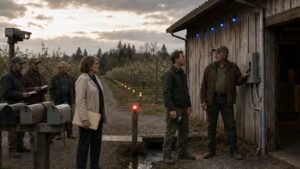
Her Neighbor Dug a Drainage Trench Across the Farm—Then She Measured Where the Water Was Really Going
Chapter 1: The Water Was Not There Yesterday
Michelle Carter stopped the utility cart so abruptly that the feed bucket tipped against the passenger-side floorboard.
Water was moving across the lower hay field.
Not rainwater settling in a low place. Not the thin silver ribbon that sometimes remained after a hard spring storm. This was a steady brown flow, wide enough to flatten the new grass and carry pieces of straw toward the equipment shed.
The field had been dry the evening before.
Michelle stepped down into the cold mud and followed the water uphill.
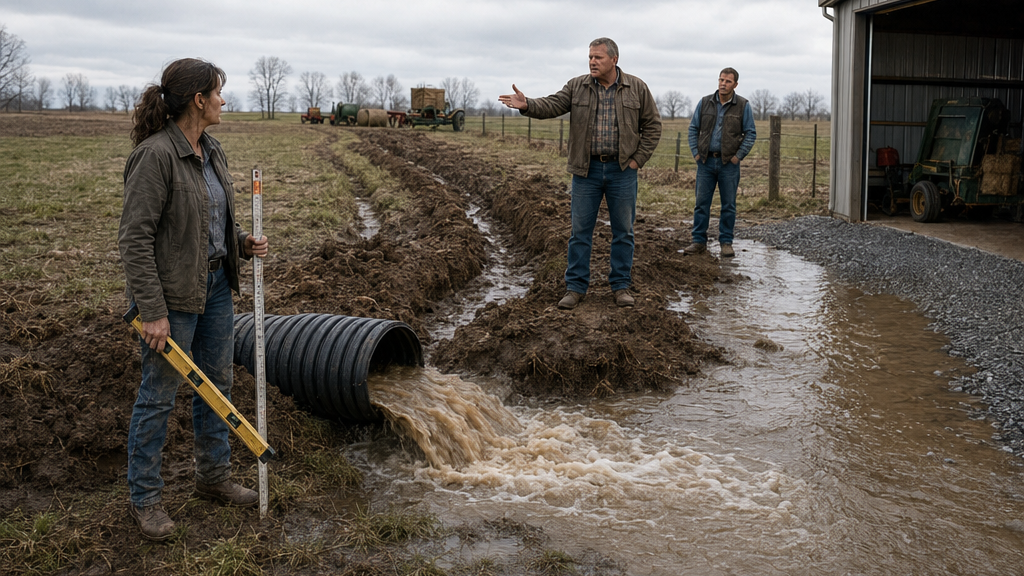
Thirty yards from the shed, she found the trench.
Fresh clay lay in ridges on either side, dark and raw against the established pasture. Someone had cut a line through the grass from the fence row above, straight enough to have been made by an excavator. At its lower end, a black corrugated pipe pushed muddy water onto her land.
Michelle stood still.
The pipe outlet was nearly waist-high against the slope, large enough that she could have put both arms inside it. Water pulsed from it in surges and spread downhill in a widening fan.
She looked toward the old swale.
It lay twenty feet to the east, shallow and grassed, where runoff from the upper farms had traveled for years.
The new outlet did not point toward it.
It pointed toward her equipment shed.
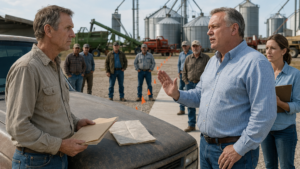
A pickup came down the gravel lane above the fence and stopped. Jason Adams climbed out.
He wore work boots, jeans, and a faded canvas jacket. He looked first at the water, then at Michelle, as if neither sight surprised him.
“You saw it,” he said.
Michelle glanced at the fresh trench. “When was this dug?”
“Yesterday afternoon.”
“On whose authorization?”
Jason hooked his thumbs in his jacket pockets. “Drainage association.”
Michelle looked at him.
“You approved excavation across my boundary?”
“It doesn’t cross your deed line up top.”
“The discharge does.”
“It enters the lower drainage area.”
Michelle turned toward the stream of brown water. “That is my hay field.”
Jason gave a small exhale. “Michelle, that water has always come downhill.”
“Not through a pipe that size.”
“The upper lane has washed twice in two years.”
“That doesn’t answer my question.”
Jason’s jaw tightened. “The board approved a drain improvement last month.”
“I wasn’t notified.”
“You weren’t required for work on the association side.”
Michelle walked toward the pipe.
The ground beneath her boots had already softened. Water curled around clumps of fescue and disappeared beneath the shed-side gravel apron. She crouched and touched the flow. It was cold and gritty with suspended clay.
“How long has it been running?”
“Since early morning.”
“From where?”
“Upper collection ditch.”
“All of it?”
Jason hesitated just long enough for her to notice.
“Most of it.”
Michelle straightened.
Behind Jason, another truck approached. Joshua Harris parked along the lane and came down through the gate. His eyes went first to the trench.
“Well,” he said quietly. “That moved more than I expected.”
Jason glanced at him. “Ground’s saturated.”
Michelle pointed toward the old swale. “Why wasn’t it tied into that?”
Joshua shifted his weight.
Jason answered. “Because that swale backs up.”
“It spreads.”
“That’s the problem.”
“No. Spreading over grass is sometimes the design.”
Jason gave her a tired look. “Water has to go somewhere.”
Michelle almost laughed, but nothing about the field felt funny.
She walked to the shed footing. Water had reached the outer gravel edge. The concrete remained dry, but only by several feet.
“You knew where this outlet was aimed.”
Jason followed her halfway down the slope. “It’s aimed downhill.”
“It’s aimed at developed ground.”
“It’s physics, Michelle.”
That did make her look at him.
Jason seemed to realize how the sentence sounded, but he did not take it back.
Michelle had spent most of her adult life calculating what water did when people underestimated it. She had designed culverts under county roads, detention systems beside warehouses, farm crossings, subdivision stormwater networks, and erosion controls nobody noticed when they worked correctly.
She did not tell Jason any of that.
He already knew what she did.
That made his tone worse.
Joshua looked from the pipe to the shed.
“How close is that building?”
“Closer than the old drainage route,” Michelle said.
Jason rubbed a hand over the back of his neck. “We can walk the whole line. I’ll show you what we were dealing with above.”
“No.”
Both men looked at her.
Michelle kept her eyes on the trench.
“I don’t need a tour before I know what was installed.”
Jason’s expression hardened. “So you’ve already decided.”
“I’ve decided I want the approved plan.”
“You know how this association works.”
“Yes.”
That was precisely the problem.
For years, decisions had been made at tailgates, in equipment sheds, beside tractors idling in fields. Somebody needed gravel, somebody else needed a culvert cleaned, everyone agreed, and paperwork arrived later if it arrived at all.
Most of the time, it worked because the consequences were shared.
This one was not shared.
The water crossed one fence and entered one farm.
Hers.
Jason stepped back toward his truck.
“I’ll get you the minutes.”
“I want the drainage sketch.”
He nodded once. “Fine.”
“And the permit number.”
Jason looked at her again.
“It’s county-approved.”
“Then the number won’t be difficult.”
Joshua lowered his eyes.
Jason said, “I’ll send it.”
He left without another word.
Michelle stayed.
The water kept coming.
She walked the edge of the trench, not yet measuring, only observing. The cut was deeper than it had appeared from below. Fresh tire impressions showed where an excavator had worked along the fence. At one point the trench disappeared behind a rise, then continued toward the upper property.
She followed it farther than she meant to.
The farther she walked, the wider the excavation became.
Near the crest, she found a junction where two smaller drainage lines entered the new trench from opposite directions.
Michelle stopped.
Jason had described an improvement to an upper collection ditch.
What she was looking at was not one ditch.
It was a collection system.
She turned and looked downhill.
From this elevation, the black pipe outlet was hidden, but the path of the trench was unmistakable. It gathered water from multiple acres, concentrated it, and sent it through one line toward the lowest developed part of her farm.
Michelle pulled out her phone.
She took one photograph.
Then another.
When she lowered the phone, she noticed a fresh excavator track continuing beyond the junction toward a second rise.
The system extended farther uphill than Jason had said.
Chapter 2: The Grade Told a Different Story
Michelle returned forty minutes later carrying a battered yellow survey level in one hand and a fiberglass measuring rod in the other.
Jason was back.
So was Joshua.
Neither man said anything as she crossed the wet grass.
The water had slowed, but not enough to stop moving sediment. A brown stain spread downhill from the outlet.
Jason nodded at the equipment. “You planning to survey the whole farm?”
“Just what changed.”
She set the level on its tripod.
Jason watched her extend the legs.
“Michelle, I told you I’d show you the upper washout.”
“And I told you I want to know what was installed.”
Joshua stood beside the fence with his arms folded, quieter than before.
Michelle sighted the rod at the pipe outlet, recorded the elevation, then moved uphill. She measured again at the fence, again near the bend, then beside the first collection junction.
Jason followed at a distance.
After the fourth reading, he said, “You’re making this bigger than it is.”
Michelle wrote another number in her field notebook.
“Twenty-four-inch pipe.”
“That’s standard.”
“For what?”
“Farm drainage.”
She looked up. “That isn’t an answer.”
Jason’s face tightened.
Michelle returned to the outlet and stretched a tape from the end of the pipe toward the equipment shed. She measured the distance to the gravel apron, then to the nearest footing corner.
Joshua finally asked, “What are you seeing?”
She did not answer immediately.
She checked the level again.
The fall from the upper junction was steeper than she had expected. Not extreme, but enough to carry concentrated flow quickly. The old swale had forced water to spread, slow, and soak into a broad grassed area.
The new pipe removed that delay.
Michelle tapped the measuring rod against the ground.
“This line is collecting from more than one drainage area.”
Jason said, “Those areas already drained this direction.”
“Not at the same velocity.”
“Velocity changes every storm.”
“With this diameter and this grade, the pipe changes it before the storm does.”
Joshua stepped closer.
Michelle pointed toward the outlet.
“That end is twenty-eight feet from the shed gravel. The grade continues toward the building. There is no energy dissipation. No apron. No spreader. No connection to the old swale.”
Jason said, “The contractor wasn’t finished.”
Michelle turned.
“Was he planning to move my shed?”
Joshua looked down quickly, hiding something that might have been a smile.
Jason did not.
“You know what I mean.”
“I know exactly what you mean. You’re saying the system is incomplete. I’m saying an incomplete system is already discharging onto my property.”
Jason stepped toward the pipe.
“This is temporary.”
“Then show me the temporary-control detail.”
He stared at her.
Michelle placed the survey level directly beside the run and looked through the scope again.
Jason said, “You don’t have to turn every neighbor problem into an engineering hearing.”
The words landed harder than she expected.
Not because they were true.
Because she had heard versions of them before.
Too exact. Too formal. Too unwilling to let practical people solve practical problems.
Her father had once told her that being right could become a hiding place if she was not careful.
She pushed the memory aside.
“What drawing did the board approve?” she asked.
Jason spread his hands. “A drainage improvement.”
“What diameter?”
“I don’t remember.”
“What outlet location?”
“It followed the lower drainage area.”
“Which lower drainage area?”
“The one we’re standing in.”
Michelle looked at Joshua. “Do you remember the sketch?”
He hesitated.
“I remember a line from the upper ditch.”
“What size?”
“I thought twelve.”
Jason turned toward him. “That was preliminary.”
Joshua frowned. “Was it?”
The change was small, but Michelle felt it immediately.
For the first time, Jason was no longer explaining the project to two people who accepted his version.
Joshua walked to the pipe and crouched beside it.
“That’s definitely twenty-four,” he said.
Jason’s voice sharpened. “Nobody is hiding the pipe, Joshua.”
“I didn’t say anybody was.”
Michelle closed her notebook.
“Jason, one more time. Which approved drawing matches this installation?”
His expression settled into something flat.
“The county has the permit.”
“Good.”
He waited.
Michelle did not fill the silence.
Finally he said, “We can walk the upper lane. You’ll understand why it had to be done.”
“No.”
Joshua looked at her.
Jason gave a bitter little laugh. “There it is.”
“What?”
“You’d rather prove something than look at the problem.”
Michelle felt heat rise in her face.
“I am looking at the problem.”
“You’re looking at numbers.”
“Numbers are part of the problem.”
“So is a road washing out every spring.”
“I didn’t say it wasn’t.”
“Then come look.”
For one second she almost agreed.
Then she looked at the black pipe, the muddy fan spreading across her field, and the fresh trench cut without a call.
“No. Send me the plan.”
Jason nodded slowly.
“You know, this is why people stop asking you things.”
Joshua said, “Jason.”
But Michelle had already turned away.
She carried the level back toward the farmhouse.
By noon she had loaded the county permit portal on the old desktop in the workroom. The internet connection stalled twice before the files opened.
The application was brief.
Agricultural drainage improvement.
Upper access lane.
Existing runoff route.
Michelle scrolled to the sketch.
A thin line followed the upper ditch toward the lower swale.
She leaned closer.
The pipe notation was visible beside it.
Twelve inches.
She checked again.
Twelve.
The outlet ended at the edge of the old grassed drainage area.
Not at her shed.
Michelle sat back.
The room was silent except for the ceiling fan.
She opened the field notebook and placed her measurements beside the printed permit sketch.
Twenty-four-inch installed line.
Multiple collection branches.
Steeper fall.
Different outlet.
For the first time that morning, her anger gave way to something colder.
This was no longer a disagreement over whether Jason had chosen the best way to move water.
The county file described a different system.
Chapter 3: The Permit Named Her Field
Michelle found her parcel number halfway down the second page.
She read it once.
Then again.
Receiving area: lower agricultural swale, Carter parcel.
Her hand stayed on the mouse.
The wording was casual enough to be dangerous.
It did not say easement.
It did not say ownership.
It did not even say discharge authorization.
It simply named her property as though the fact had already been settled somewhere else.
Two days had passed since she measured the trench. The field had begun to dry, but a strip of flattened grass still marked the route water had taken toward the shed.
Michelle printed the application and drove to the county records office.
The clerk behind the counter located the paper file and brought it out in a cardboard folder thick with older drainage documents.
Michelle worked through it slowly.
Application.
Preliminary sketch.
Contractor estimate.
Association letter.
No signed consent from her.
She checked the back of every page.
Nothing.
A county engineering reviewer had initialed the sketch beside a handwritten note about maintaining existing discharge patterns. Another page referenced the receiving area “per association documentation.”
Michelle copied the phrase into her notebook.
“What association documentation?” she asked.
The clerk searched the file.
“This is what was submitted.”
“So there’s no landowner authorization attached?”
“Not in this folder.”
Michelle looked again at the parcel number.
“Can I get certified copies?”
The clerk nodded.
By the time Michelle returned home, Patricia Davis’s pickup was parked beside the gate.
Patricia stood near the porch holding a narrow binder against her chest.
“I figured you’d call me eventually,” she said.
Michelle unlocked the kitchen door. “I was going to.”
“I know.”
They sat at the kitchen table.
Michelle placed the certified copies between them.
Patricia adjusted her glasses.
“I’ve already looked through the association files.”
“And?”
“I can’t find your signature.”
Michelle watched her.
“Was there ever one?”
Patricia hesitated.
“I don’t remember one.”
“That isn’t the same thing.”
“No.”
Patricia opened the binder.
“There’s a vote in February approving repair of the upper drainage problem. There’s a motion to get contractor pricing. There’s a note saying existing lower drainage would be used.”
Michelle touched the county application.
“My parcel is listed as the receiving area.”
“I saw that.”
“Who supplied the parcel number?”
“I don’t know.”
“You keep the records.”
“I keep the records I’m given.”
The answer irritated Michelle more than it should have.
“So nobody knows how my land became part of the design?”
Patricia’s mouth tightened.
“That lower swale has taken runoff for thirty years.”
“Runoff.”
“Yes.”
“Not concentrated pipe discharge.”
“I understand that.”
“Do you?”
Patricia sat back.
“Michelle, I’m not saying what they did was right.”
“It sounds like you’re saying it was normal.”
“I’m saying people around here have always treated that swale like shared drainage.”
“It isn’t shared land.”
“I know.”
“Then why was I never asked?”
Patricia looked down at the binder.
“Because I think everybody assumed you’d say no.”
The sentence went through Michelle with surprising force.
“Everybody?”
“I shouldn’t have said that.”
“Who is everybody?”
Patricia closed the binder halfway.
“Jason said the problem had to be fixed before cutting season. Joshua agreed the upper lane couldn’t take another washout. Nobody voted to cross your property. Nobody said, ‘Let’s use Michelle’s land without permission.’ It wasn’t talked about that way.”
“How was it talked about?”
“As restoring drainage.”
Michelle pushed the permit toward her.
“This is not restoration.”
Patricia rubbed her thumb along the binder edge.
“No.”
The admission took some of the fight out of the room.
Michelle stood and brought the field notebook from the counter. She showed Patricia the pipe diameter, slope readings, and outlet distance.
Patricia studied the numbers without pretending to understand all of them.
“That’s twice the size on the sketch?”
“Twice the diameter. Much more than twice the capacity.”
Patricia looked up. “How much more?”
“It depends on slope and conditions. Enough that this should never have been treated as a minor field drain.”
Patricia exhaled.
“I thought it was twelve.”
“So did Joshua.”
“I never saw the installed pipe.”
Michelle sat again.
“Who changed it?”
Patricia shook her head.
“The board authorized Jason to coordinate with the contractor.”
That was not proof of anything.
Michelle knew it.
She also knew how quickly anger could turn incomplete facts into certainty.
Her father had hated that habit in other people and feared it in her.
She closed the notebook.
“I need the contractor invoice.”
Patricia looked uncomfortable.
“Why?”
“Because somebody paid for a twenty-four-inch line.”
“The association did.”
“Then the invoice is an association record.”
Patricia did not argue.
She returned an hour later with photocopies.
Michelle spread them across the table.
Excavation hours.
Machine transport.
Stone bedding.
Pipe fittings.
Then the material line.
She traced it with her finger.
Twenty-four-inch corrugated HDPE.
One hundred eighty feet.
Two junction fittings.
Michelle looked up.
Patricia had gone pale.
“That isn’t the permit sketch,” she said.
“No.”
“Could the contractor have changed it?”
“He could have recommended it.”
“But somebody had to approve the cost.”
Michelle moved to the final page.
At the bottom was an authorization line.
The signature was not difficult to recognize.
Jason Adams.
Below it was a handwritten notation authorizing the larger pipe “to prevent recurring lane failure.”
Michelle stared at it.
The permit showed twelve inches.
The invoice showed twenty-four.
And Jason had personally approved the change.
She looked through the kitchen window toward the lower field.
From here, the trench was only a faint brown line through the grass.
Two days earlier it had looked like damage.
Now it looked like a record.
A line connecting the county sketch, her parcel number, the missing consent, and the larger pipe.
Patricia spoke quietly.
“What are you going to do?”
Michelle folded the invoice copy once and placed it beside the certified permit.
“I’m going to find out who decided the permit stopped mattering.”
Chapter 4: Twelve Pages Changed the Argument
Two days after the rain stopped, water still stood beside the equipment shed.
Michelle pushed the toe of her boot into the saturated gravel and watched a thin film rise around the leather. The field beyond had begun to firm, but the ground nearest the shed remained dark and soft. A shallow depression along the footing held water where she had never seen it collect before.
She crouched and pressed two fingers into the soil.
Cold. Wet. Dense.
Not proof of damage.
Not yet.
That distinction mattered.
She carried a folding table out from the shed and set her field notebook, county drawings, permit copies, contractor invoice, and survey notes across it. Then she walked the trench again, this time not as an angry landowner but as the engineer she had spent most of the last week resisting becoming.
Pipe diameter.
Invert elevation.
Slope.
Distance to developed structures.
Drainage area.
Soil condition.
Existing flow path.
Every measurement had to survive someone who wanted it to be wrong.
By noon, she had enough to begin modeling the flow.
The farmhouse office had once been her father’s bookkeeping room. His old metal filing cabinet still stood in the corner, dented at the bottom from the year he had kicked it after learning how much a failed culvert had cost them.
Michelle remembered that year too well.
Deferred repairs. Borrowed money. One drainage problem leading quietly to another until something cheap became something they could barely afford.
Her father had made her promise never to let water become invisible just because fixing it was inconvenient.
She opened her laptop.
The numbers were worse than she expected.
Not catastrophic. She refused to use that word.
But sustained concentrated discharge at the measured grade could keep the lower soil saturated after major storms. If the outlet remained where it was, the most likely progression was not a sudden collapse. It was slower: softened subgrade, settlement near the shed apron, erosion along the foundation drainage path, repeated wetting closer to the farmhouse during larger events.
She built conservative assumptions.
Then more conservative ones.
She removed every number she could not defend.
The estimate that remained still made her sit back.
Over five years, repairs could plausibly exceed eighteen thousand dollars if the drainage pattern persisted and affected both the shed approach and the house-side drainage.
She printed the calculation.
For several seconds she looked at the page without touching it.
Eighteen thousand dollars was not a threat.
It was a range based on risk.
If she treated it like a weapon, Jason would call it exaggeration, and he might not be entirely wrong.
So she wrote the report the way she would have written it for a client she did not know.
Existing conditions.
Observed modifications.
Measured geometry.
Potential impacts.
Limitations.
Recommended immediate stabilization.
Recommended permanent review.
No accusations.
No speculation about intent.
Twelve pages by the time she finished.
She signed it and pressed her engineering seal onto the final sheet.
The sound of the stamp against paper was small.
It changed the argument anyway.
At the county engineering desk the next morning, the reviewer read the first pages in silence.
Michelle waited.
He turned to the permit sketch.
Then to the photographs.
Then back to her measured pipe dimensions.
“This is what’s installed?”
“Yes.”
“And this is what was filed?”
“Yes.”
He studied the contractor invoice.
“Who authorized the change?”
“The association chair signed the invoice.”
“That doesn’t necessarily mean he approved a design change.”
“I know.”
The reviewer glanced at her.
Michelle was grateful she had said it before he did.
“You’re asking for enforcement?”
“I’m asking for a field inspection and a determination.”
“Not the same thing.”
“No.”
He nodded once and continued reading.
When he reached the damage projection, he stopped.
“Eighteen-four?”
“Upper estimate over five years.”
“You’re comfortable defending it?”
“I’m comfortable defending the assumptions written underneath it.”
He looked at her for another second, then closed the report.
“We’ll inspect.”
That afternoon a county drainage inspector walked the trench with Michelle, Jason, and Joshua.
Jason barely looked at her.
The inspector measured the pipe independently and photographed the outlet. He asked where the approved discharge point was supposed to be.
Jason pointed toward the old swale.
“Ultimately there.”
“Why isn’t it there now?”
“Contractor hadn’t finished.”
The inspector looked at the open end discharging toward the shed.
“Was temporary stabilization installed?”
Jason said nothing.
Joshua answered softly.
“No.”
The inspector walked uphill.
At the junction, he stopped and looked back down the trench.
“This is receiving from two collection lines.”
Jason folded his arms.
“That’s the only way to keep the road from washing.”
“Was that configuration submitted?”
“It was part of the improvement.”
The inspector did not argue.
He wrote something on his clipboard.
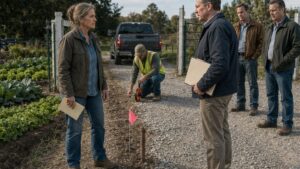
By late afternoon, a printed notice had been fixed to a stake beside the trench.
Work suspended pending review.
No additional excavation.
No further connection of upstream drainage.
Michelle stood alone after the others left.
She should have felt relief.
Instead she looked at the blocked upper end of the project and pictured the next heavy rain collecting where the new work now stopped.
The county had given her exactly what she had asked for: a pause.
She had thought a pause meant safety.
At dusk, Jason’s truck pulled into the lane.
He did not get out immediately.
When he finally did, he walked only as far as the fence.
“You happy now?” he asked.
Michelle looked at him. “That isn’t why I filed the report.”
“They shut it down.”
“Until they review it.”
“And the rain doesn’t care what they’re reviewing.”
She said nothing.
Jason pointed uphill.
“You ever see my road after three inches in six hours?”
“No.”
“I tried to show you.”
Michelle felt the words before she answered.
“You tried to show me after cutting a trench onto my property.”
“Yes.”
“That matters.”
“So does losing the only lane I can haul loaded wagons down.”
“You have another entrance.”
“For pickups.”
“Not loaded hay.”
Jason shook his head.
“You know what that stop order does if the next storm hits before they clear anything?”
Michelle glanced toward the upper ridge.
“The drainage remains where it was before construction.”
“No. It doesn’t.”
She looked back at him.
Jason pointed toward the excavation.
“They opened the upper ditch. They cut the collection branches. Then the county froze the job halfway through. Water will reach the unfinished section faster than it used to, and now it has nowhere controlled to go.”
Michelle’s stomach tightened.
“Why wasn’t that stated during inspection?”
“I tried.”
“You argued about the permit.”
“Because everyone was looking at the pipe.”
Jason stepped closer to the fence.
“If that road goes, I don’t have a route for loaded hay until it’s rebuilt.”
“That doesn’t justify using my field.”
“I didn’t say it did.”
For the first time since the trench appeared, there was no challenge in his voice.
Only exhaustion.
“You wanted it stopped,” he said. “It’s stopped.”
He turned toward his truck.
Then he paused.
“The next storm might show you what stopped really means.”
Chapter 5: The Man Behind the Bad Decision
The erosion cut beside Jason’s upper access lane was deep enough to swallow Michelle’s boot to the ankle.
She stood at the edge and stared down into exposed clay, stone, and tangled roots.
Jason had not exaggerated that part.
A section of road shoulder nearly thirty feet long had been eaten away. Old repair stone lay scattered downslope. One more serious washout could narrow the lane beyond what a loaded hay wagon could safely use.
Jason stood several yards away.
“This was last August.”
Michelle looked toward the ridge.
“Where did the runoff come from?”
“Three fields above. Same place it always comes from.”
“Why wasn’t the old ditch enlarged?”
“Because it crosses the lane twice.”
“And?”
“And every fix we priced cost more than the association had.”
They walked farther.
At the second bend, Michelle saw where fresh stone covered an older repair. Tire tracks had pressed deep into the shoulder.
“How much have you spent on this?”
Jason looked away.
“Personally?”
“Yes.”
“More than I should have.”
“That isn’t a number.”
He gave her a tired half smile.
“There you go.”
Michelle waited.
“Eleven thousand over two years,” he said. “Not all at once.”
She looked at him.
“Why?”
“Because waiting for everybody to agree didn’t keep the road open.”
“You’re association chair.”
“That doesn’t make money appear.”
They continued toward the equipment shed used for association meetings. A stack of culvert sections rested beside one wall, faded from sun.
Jason leaned against a post.
“Last year I had hay sold before that washout. Couldn’t get loaded wagons down for four days. Had to pay for smaller trucks and transfer loads.”
Michelle understood enough agricultural margins to know what that meant.
“You never brought that to the board?”
“I did.”
“Patricia’s minutes don’t show it.”
“Because I didn’t ask for reimbursement.”
“Why not?”
Jason looked toward the road.
“Because if everybody saw what I’d already spent, they’d know how tight things were.”
There it was.
Not corruption.
Not a secret scheme.
Pride.
The same kind she knew too well.
Michelle folded her arms.
“So you decided the solution yourself.”
“We approved a drain improvement.”
“Twelve inches.”
“That was the first sketch.”
“And you authorized twenty-four.”
“Yes.”
The answer came so easily that she almost missed its importance.
“You knew?”
“I knew the contractor wanted bigger pipe.”
“That isn’t what I asked.”
Jason rubbed a hand across his jaw.
Michelle stepped closer.
“You signed the material change.”
“Yes.”
“And you knew my property was the receiving area.”
He looked at her.
“Yes.”
“Did you know I never signed consent?”
Silence.
The equipment shed creaked softly in the wind.
Michelle’s voice lowered.
“Jason.”
“Yes.”
The word landed between them without defense.
She stared at him.
“So you knew.”
“I knew there wasn’t a signature in front of me.”
“And you went ahead.”
“I thought the lower swale was already accepted drainage.”
“My land is not an assumption.”
“I know that now.”
“You knew it then.”
“No.” He shook his head. “I knew you hadn’t signed. I did not think that meant the whole drainage path was unauthorized.”
Michelle laughed once, without humor.
“That is a distinction you made because it was convenient.”
“Yes.”
The bluntness stopped her.
Jason looked toward the lane.
“I also thought if I asked you formally, you’d say no.”
Michelle felt her anger sharpen again.
“You didn’t give me the chance.”
“I’m aware.”
“Why would I say no?”
He finally looked directly at her.
“Because you say no when the details aren’t right.”
“That’s called doing it correctly.”
“Sometimes.”
She stiffened.
Jason continued before she could interrupt.
“You think I don’t know what you do? Everybody knows. You can look at a ditch and see ten failures before the rest of us see water. That’s useful. It also means nothing is simple once you’re involved.”
“That does not give you permission to bypass me.”
“No.”
“Then stop trying to make this my personality problem.”
“I’m not.”
“You just did.”
Jason looked down.
After a moment he said, “I made a bad decision because I was scared of losing the road again.”
The words were quiet.
No excuse attached.
Michelle’s anger did not disappear.
But it changed shape.
Jason kicked loose gravel from the lane edge.
“I had payments due on equipment. Hay contracts I couldn’t miss. Association reserve had enough for part of the repair, not all of it. Contractor said bigger pipe would solve the washout once instead of patching it every year.”
“And you believed him.”
“I wanted to.”
That, more than anything else, sounded true.
A phone buzzed in Michelle’s jacket pocket.
She pulled it out.
County weather alert.
A slow-moving storm system was expected within three days. Forecast totals had increased.
Jason saw her expression.
“How much?”
“Possibly four inches.”
He looked toward the unfinished drainage line.
Neither of them spoke.
Four inches would test everything.
The stop order prevented additional construction. The upper ditches had already been disturbed. The large pipe could not legally be connected or completed. The old system was no longer fully intact.
Michelle walked to the edge of the washout and studied the grade.
From this side, the trench did not look like an intrusion.
It looked like a desperate attempt to give water somewhere to go.
A bad attempt.
An unauthorized one.
But not an imaginary problem.
Jason said, “County won’t approve a redesign in three days.”
“No.”
“And I’m not touching anything under a stop order.”
“Good.”
He gave her a look.
Michelle ignored it.
Her mind was already moving through elevations.
Upper collection point.
Road crossing.
Existing swale.
Her field.
Equipment shed.
If the line remained closed, runoff would concentrate near the unfinished excavation. If someone simply reopened it, her farm would take the full discharge again.
There might be another path.
Not permanent.
Not elegant.
But controlled.
Jason watched her face.
“You’re calculating.”
Michelle looked at him.
He almost smiled.
She did not.
On the drive back to her farm, the forecast updated again.
Thunderstorms.
Heavy rainfall.
Localized flooding possible.
Michelle parked beside the lower field and walked to the stop-work stake.
The black pipe lay silent now.
Beyond it, the trench climbed toward Jason’s acreage like a question drawn through the ground.
She had wanted the county to stop the system.
They had.
Now the water was coming anyway.
Chapter 6: Before the Storm Reached the Ridge
The storm warning arrived before sunrise.
Michelle read it at the kitchen table while coffee went cold beside her.
The county had upgraded the rainfall estimate again.
Three to five inches, with higher localized totals.
She opened the drainage drawings.
By six-thirty, her survey level was in the truck.
By seven, she was standing beside the trench.
The fresh excavation no longer looked like evidence.
It looked like geometry.
Michelle set the level and began shooting elevations.
She worked from the upper collection junction downhill, then crossed the old swale and measured toward a broad grassed depression west of the equipment shed.
The depression had carried overflow years earlier before sediment and field grading changed its shape. If reopened shallowly—not as a deep trench, not as a concentrated pipe—it could spread runoff across several hundred feet of grass before water reached developed ground.
She measured twice.
Then a third time.
A truck stopped at the gate.
Jason got out but remained on the other side of the fence.
“Am I allowed to ask what you’re doing?”
Michelle kept her eye to the level.
“Temporary diversion.”
He waited.
She took another reading.
“Not through your pipe,” she added.
Jason came closer.
“Where?”
Michelle pointed with the rod.
“Disconnect the upper collection from the unfinished line. Shallow cut west. Check berm here. Rock at the transition. Spread discharge before it reaches my property.”
“That sends some flow back toward my lane.”
“Some.”
“How much?”
“Enough to keep the lower outlet from carrying everything.”
“And the road?”
“May get wet.”
“That’s what we were trying to stop.”
Michelle folded the tripod legs.
“You asked for a way to keep it from washing out, not a guarantee that it stays dry.”
Jason stared at the ground she had indicated.
“County will never approve this by tonight.”
“They might approve temporary stabilization.”
“Might.”
“Yes.”
He looked at her.
“You’d sign it?”
Michelle did not answer.
That was the part she had been avoiding.
Putting her engineering seal on the emergency plan meant accepting professional responsibility for a system involving the same neighbor who had bypassed her consent.
It also meant stepping away from the cleanest position available to her.
The clean position was simple: his problem, his violation, his consequences.
Water did not care about clean positions.
At the county engineering office, the reviewer studied her sketch.
“You designed this this morning?”
“Yes.”
“Temporary only?”
“Yes.”
“No connection to the disputed twenty-four?”
“Correct.”
“Controlled spill through the old swale?”
“With stone stabilization and a shallow spreader.”
He traced the line with one finger.
“This crosses your acreage.”
“At the lower end.”
“And you consent?”
“For this temporary configuration only.”
The reviewer leaned back.
“You realize the stop order can remain in place while we authorize emergency stabilization.”
“I’m counting on it.”
He looked at her seal.
“You’re accepting design responsibility?”
Michelle looked through the office window toward a sky already thickening over the ridge.
“Yes.”
The word cost more than she expected.
By noon, the county issued a narrow written authorization.
Temporary emergency stabilization.
No permanent rights created.
No alteration beyond specified limits.
Jason read every line before signing.
Michelle watched him.
“You don’t start until the inspector arrives.”
“I know.”
“No widening.”
“I know.”
“No connecting that pipe.”
“I know.”
She held out the final page.
“And you acknowledge this does not establish drainage rights across my farm.”
Jason took the pen.
“I know.”
He signed.
For the first time since the dispute began, his name beneath a drainage decision did not feel like something done behind her back.
The excavation contractor arrived under county supervision.
Work moved quickly but carefully.
A shallow diversion took shape west of the unfinished trench. Stone was placed where flow would turn. The old swale was reopened only enough to distribute water across grass rather than send it down one concentrated chute.
Michelle checked elevations as the machine worked.
Jason hauled stone.
Joshua arrived with a tractor and helped shape the spreader berm.
Nobody talked about who had been right.
There was too much to do.
Late in the afternoon, Joshua stood beside Michelle as she checked the final grade.
“You could’ve made Jason deal with this himself.”
Michelle kept her eyes on the rod.
“He couldn’t legally touch it.”
“You know what I mean.”
She did.
Joshua looked toward the unfinished black pipe.
“I thought you were trying to prove he crossed your line.”
“He did.”
“But this doesn’t look like proving anything.”
Michelle lowered the level.
“No.”
“What changed?”
She looked uphill at Jason shoveling stone from the truck bed.
“The water still has to go somewhere.”
Joshua gave a short laugh.
Michelle almost did too.
By six, the county inspector approved the temporary configuration.
The twenty-four-inch pipe remained disconnected.
The stop-work notice remained in place.
The disputed trench remained open, an ugly brown cut through the farm, but now it was no longer the only path available.
Jason walked over as Michelle packed the survey level into its case.
“I owe you.”
“No.”
He frowned.
“You owe restoration costs if the county determines them. You owe the association an honest explanation. You owe me a permanent design that doesn’t treat my field like empty space.”
Jason nodded.
“That too.”
Michelle closed the case.
“And this doesn’t make the permit issue disappear.”
“I know.”
He looked down at the worn yellow level.
“My father had one like that.”
“This was mine before I could afford a good one.”
“Why keep it?”
Michelle ran her thumb over a scratch along the housing.
“Still reads true.”
Jason nodded as if that answer made sense.
A low roll of thunder crossed the ridge.
Everyone looked west.
The sky had gone almost black above the upper fields.
The inspector climbed into his truck.
“Whatever you’re moving,” he called, “move it now.”
Joshua headed for his tractor.
Jason ran toward the stone pile to secure the last tarp.
Michelle carried the survey level to her truck, then stopped.
The first drops struck the hood.
Large, widely spaced.
One landed on the yellow case and burst into a dark circle.
Within minutes, rain covered the field.
Water began gathering in the upper collection ditch.
Michelle stood beneath the equipment-shed overhang and watched it reach the new temporary turn.
For a moment the flow hesitated against the stone.
Then it divided.
Part moved toward the old swale.
Part spread west through the shallow grassed channel.
Nothing entered the black pipe.
Nothing shot toward the shed.
Jason stood uphill in the rain, watching the same thing.
The storm had arrived.
And for the first time since the trench was dug, neither of them knew whether what they had built together would hold.
Chapter 7: Where the Water Was Finally Allowed to Go
The black pipe came out of the ground six weeks later.
Michelle stood beside the lower hay field as the excavator lifted the first twenty-foot section from the trench. Mud dropped from its ribs in heavy clumps. For a moment the pipe hung above the field exactly as it had existed in her mind since April: oversized, blunt-ended, and aimed toward a place it never should have been allowed to reach.
Then the operator swung it onto a flatbed.
Jason watched from the opposite side of the work area.
Neither of them said anything.
The storm had tested the temporary diversion harder than Michelle expected. Four inches of rain had fallen in less than eight hours. Jason’s upper road had taken water, but it had stayed passable. The temporary spreader had pushed runoff into the old swale without sending concentrated flow toward Michelle’s shed.
The morning after the storm, she had walked the entire system with her survey level.
Nothing had failed.
That success had complicated everything.
It proved Jason had been right about one thing: the upper farm genuinely needed a better drainage solution.
It also proved he had been wrong about the other: protecting his road had never required turning Michelle’s field into the outlet.
The permanent design took four meetings.
The first two were unpleasant.
Jason wanted more capacity than Michelle believed necessary. Michelle wanted more detention than he believed the association could afford. Joshua argued for a simpler stone-lined ditch. Patricia kept returning everyone to the numbers in the reserve account.
Nobody got everything.
That was probably why the final plan worked.
The twenty-four-inch pipe would be removed completely.
A shallow engineered swale would begin above Jason’s damaged road, slowing runoff before it reached the crossing. A smaller controlled outlet would carry only the portion the swale could not safely spread. Riprap would protect the turns. The final discharge would enter the broad grassed depression west of Michelle’s shed, far enough from the buildings that water could disperse before reaching developed ground.
Most importantly, every part crossing or discharging onto private property would require written landowner consent.
No assumptions.
No handshake in an equipment shed.
No sentence in a permit pretending consent existed because everyone had always done it that way.
Michelle walked beside the excavation as the second pipe section was removed.
Jason came over.
“They’re starting final grading after lunch,” he said.
“I know.”
“The contractor wants to finish your restoration today.”
“If the soil’s workable.”
“He thinks it is.”
Michelle looked at the damp ground.
“He thought twenty-four inches was a good idea too.”
Jason gave her a brief look.
“That’s fair.”
The old exchange might have become an argument.
This one did not.
Jason shoved his hands into his jacket pockets.
“Meeting’s at four.”
“I’ll be there.”
He nodded and started to leave.
“Jason.”
He stopped.
Michelle looked toward the flatbed carrying the black pipe.
“You don’t have to make a speech.”
“I wasn’t planning to.”
“Good.”
His mouth tightened slightly.
“I am planning to say what happened.”
“That’s different.”
At four, the association gathered inside the equipment shed.
There were no cameras, no county officials, no crowd waiting for someone to be embarrassed.
Just folding chairs, a scarred table, coffee in paper cups, and farmers who had work waiting outside.
Patricia opened the revised procedures.
Every drainage project crossing property boundaries would require written consent before excavation.
Any material change in pipe diameter, capacity, discharge point, or collected drainage area would require renewed review.
Projects affecting more than one ownership would receive independent technical review rather than approval by the chair alone.
Emergency work would have to be documented within forty-eight hours.
Joshua read the last page twice.
“That’s going to slow things down.”
“Yes,” Patricia said.
“That isn’t always good.”
“No.”
He looked at Michelle.
“But neither was this.”
Michelle said nothing.
Jason sat at the end of the table with his elbows on his knees.
When Patricia asked for comments before the vote, he stood.
Michelle almost told him again not to turn it into something larger than it needed to be.
He did not.
“I approved the larger pipe,” he said. “I signed the contractor change before we had complete permission for the receiving area.”
Nobody moved.
Jason continued.
“I thought the existing drainage pattern gave us more authority than it did. I also knew Michelle had not signed anything, and I convinced myself that was paperwork we could fix afterward.”
His eyes remained on the table.
“That was my decision.”
Joshua shifted in his chair.
Jason looked toward Michelle briefly.
“The upper road problem was real. That part hasn’t changed. But I tried to solve it by putting more risk on somebody else’s ground than she had agreed to carry.”
That was all.
No excuse.
No apology designed for an audience.
He sat down.
Michelle found she preferred it that way.
The board voted unanimously for the new procedures.
The financial settlement was less dramatic.
Jason agreed to cover the restoration costs associated with the unauthorized discharge area and the disturbed section nearest Michelle’s field. The association paid for the permanent shared drainage improvements because the upper runoff problem had always been an association responsibility.
Nobody was ruined.
Nobody escaped responsibility either.
When the meeting ended, Joshua caught Michelle outside.
“You satisfied?”
She considered the word.
“No.”
He smiled faintly. “I figured.”
“But it’s correct.”
“That sounds more like you.”
Michelle looked back through the open shed doors.
Jason was helping Patricia stack chairs.
“Maybe that’s not always a compliment.”
Joshua laughed once.
“Maybe not.”
By sunset, the lower field looked different.
The deep trench was gone.
In its place was a wide, shallow swale following the natural fall of the ground. Fresh seed and straw covered the disturbed soil. Stone lined the transition points. The new controlled outlet sat well west of the equipment shed, angled into grass rather than toward concrete.
The black pipe sections were gone from the field.
Only a darker strip of soil showed where they had been.
Michelle carried her old yellow survey level down after the crews left.
She set the tripod near the fence and checked the new grade.
The numbers matched the approved plan.
She moved downhill and checked again.
Still right.
Jason appeared on the lane above.
“You checking their work?”
“Yes.”
“You already checked it this afternoon.”
“Yes.”
He leaned against the fence.
Michelle looked through the scope.
“You have a problem with that?”
“Not anymore.”
She lowered the level.
They stood there without speaking.
They were not friends.
Michelle did not expect them to become friends simply because both had finally behaved better than they had at the beginning.
Trust did not return because a board voted for a procedure.
But something more useful had begun replacing the old assumptions.
Jason asked before crossing the fence.
Michelle answered directly instead of making him guess.
And when either of them said no, the other now understood that no was information, not an insult.
Three days later, the first rain came over the ridge.
Not a storm.
Just a steady spring rain strong enough to show whether the new grades worked.
Michelle put on her boots and walked to the lower field.
Water appeared first along the upper swale.
Instead of accelerating into a pipe, it spread.
Some moved through the controlled outlet. Some slowed against the grass. The flow widened, thinned, and followed the shallow depression west.
Michelle walked beside it.
At the place where the old trench had once pointed toward the equipment shed, the water turned away.
She stopped.
The shed gravel remained dry.
The farmhouse stood farther beyond it, untouched.
Up on the lane, Jason’s truck slowed.
He looked toward the swale.
Michelle looked up.
Jason lifted one hand from the steering wheel.
She returned the gesture.
Then he drove on.
Michelle stayed in the rain a little longer.
At her feet, water followed the new channel without rushing, without cutting, without forcing one farm to absorb the whole cost of protecting another.
The old trench had begun as a scar drawn across her land without permission.
For weeks, she had treated that line as proof of where somebody else’s rights ended.
Now grass seed waited beneath the straw where the deepest excavation had been filled.
Beside it, the new swale curved deliberately through the field.
A boundary had not disappeared.
It had simply stopped being confused with a wall.
Michelle watched the water travel safely past the shed and disappear into the grass beyond.
This time, it was finally going where everyone had agreed it could go.
The story has ended.