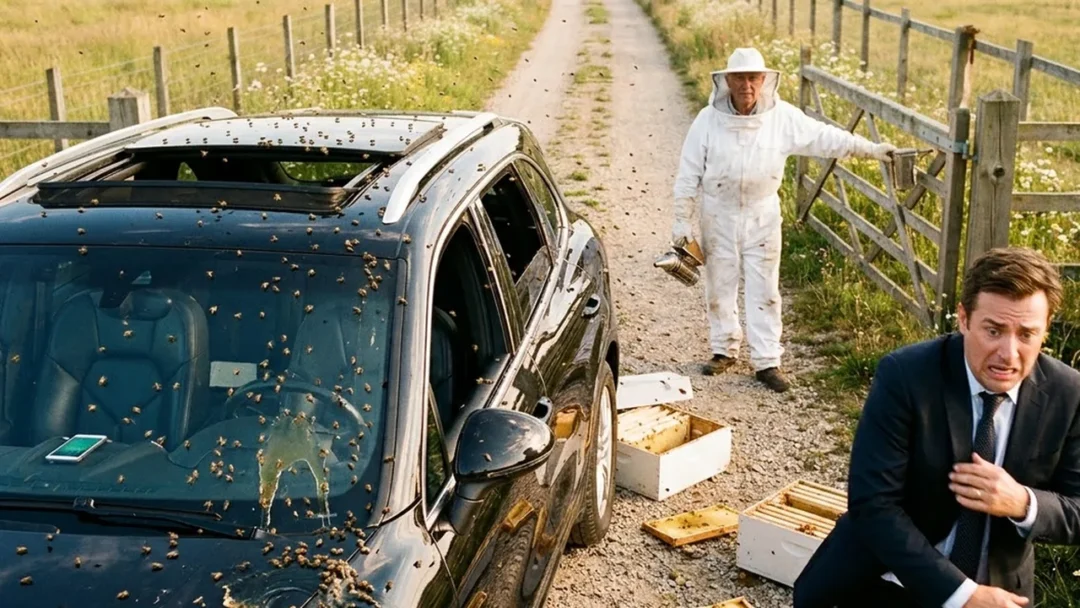
The Shattered Beehives On The Farm Lane And The Engulfed SUV
CHAPTER 1: THE WOODEN BARRIER AT CLOVER HILL
The golden autumn sun bathed the limestone pastures of the Shenandoah Valley in warm, honeyed light, illuminating the rolling wildflower meadows of Augusta County, Virginia. Here, between the blue ridgeline of the Appalachian Mountains and the winding silver loops of the Middle River, fourth-generation family homesteads were connected by narrow, gravel farm lanes. These single-lane passages were not county highways; they were historic private agricultural easements established under eighteenth-century land grants, where cattle crossings, combine harvesters, and seasonal harvest rituals took absolute legal precedence over modern transit.
Amos Yoder moved with the patient, rhythmic economy of a man who had worked this valley floor for nearly seven decades. At sixty-eight, Amos was the master apiarist and owner of Clover Hill Apiaries, managing over two hundred thriving colonies of Italian honeybees that provided essential pollination services to regional apple orchards and clover meadows. He was dressed from head to foot in heavy white canvas bee overalls, thick goatskin gloves that extended past his elbows, and a round wire-mesh protective veil that shielded his weathered face and steady gray eyes. In his left hand, he held an antique copper bee smoker, its bellows gently puffing sweet, cool smoke fueled by burning burlap and dried sumac bobs.
Across the narrow gravel lane, Amos had set up a heavy two-wheel steel handcart, upon which were stacked four pristine white Langstroth hive supers. The boxes were humming with intense, vital energy. Inside, thousands of worker bees were actively sealing comb cells filled with fragrant wildflower nectar and capping brood frames. To protect the colonies and any approaching travelers during the delicate transfer process, Amos had swung the heavy cedar farm gate closed and deployed a sturdy wooden sawhorse barrier across the center of the lane. Nailed to the sawhorse was a large, reflective yellow aluminum sign: “PRIVATE AGRICULTURAL ACCESS — LIVE APIARY TRANSFER IN PROGRESS — DO NOT ENTER.”
The peaceful drone of the bees and the rustle of dry orchard leaves were shattered by the aggressive, high-speed roar of a large V8 engine accelerating recklessly down the gravel switchback.
A massive, midnight-black Cadillac Escalade SUV crested the rise, throwing plumes of white limestone dust and loose gravel thirty feet into the hedgerows. The vehicle was brand-new, riding on customized twenty-two-inch chrome wheels with low-profile tires, its dark privacy glass reflecting the afternoon sun like obsidian mirrors. In the front grille, hidden strobe flashers pulsed with unauthorized blue and white light, imitating an executive convoy. The luxury SUV was traveling at over forty miles per hour down a lane posted for ten, its tires groaning as the driver braked violently, stopping barely eighteen inches from the wooden sawhorse.
The driver’s door flew open with a sharp, impatient click. Trent Sterling stepped down onto the crushed stone, his polished leather loafers kicking up dust against the clean white fence posts. Trent was forty-one, tall, athletic, and dressed in a bespoke Italian navy blazer, open-collar linen shirt, and polarized designer sunglasses. He was a senior partner at Blue Ridge Commercial Land Holdings, a predatory investment group that had spent eighteen months attempting to assemble five hundred contiguous acres in the valley to build a gated resort and luxury golf compound. Trent was on his way to an aggressive closing session at the county seat in Staunton, where he intended to execute an unpermitted option on an adjacent parcel before the owners could consult their family attorney.
Trent slammed the heavy driver’s door, leaving the Escalade idling with its V8 rumbling deeply, its panoramic glass sunroof wide open to catch the autumn breeze, and all four power windows rolled completely down to air out the cabin’s rich leather interior.
He marched directly toward the wooden barrier, scowling with deep, personal offense.
“Hey! Old man!” Trent bellowed, his voice echoing over the humming meadow. “Move these damn wooden crates off the road! I have a three-million-dollar land acquisition closing in Staunton in twenty minutes, and your farm gate isn’t on my navigation app! Get this handcart out of my lane!”
Amos Yoder did not flinch, nor did he raise his voice. He squeezed the bellows of his copper smoker once, sending a gentle puff of cool white smoke across the handcart to keep the colonies calm.
“Good afternoon, sir,” Amos replied calmly, his voice steady through the wire mesh of his veil. “This is not a public thoroughfare. This is Clover Hill Farm’s private deeded easement under Virginia Century Farm protection. As the warning sign states, we are in the middle of transferring active breeding hives across the lane. The road is closed for your safety and the safety of the colonies. You will need to turn your vehicle around and take the state route around the valley.”
Trent took two aggressive strides forward, stopping inches from the sawhorse. His face was flushed with anger, his jaw clenching tight. “I don’t turn around for beekeepers, old man. My firm owns an option on the parcel two miles west of here, which gives me implied access across every gravel strip in this district. Move this cart right now, or I will personally drag it into the ditch.”
Amos looked at the young executive with quiet, unyielding dignity. “That gate was closed for your protection, young man. Leave those hives alone. There are sixty thousand defensive bees on that cart, and they do not understand corporate deadlines.”
Trent’s mouth curled into a sneer of pure, arrogant malice. “Watch how fast I solve this problem.”
Trent lunged forward, kicked the heavy wooden sawhorse with his designer boot, and reached with both hands for the top Langstroth boxes on the steel handcart.
The agricultural history of Clover Hill Farm stretched back to a colonial patent signed by the royal governor of Virginia in 1752. For over two and a half centuries, the Yoder family had tended the rich limestone soil of Augusta County, rotating heirloom wheat, alfalfa, and apple orchards while maintaining a reverence for the natural rhythms of the Shenandoah watershed. Under the Virginia Century Farm Program, properties that had remained in continuous agricultural production within the same family for more than a century were granted sovereign legal status, protecting their historic boundary lanes from unauthorized public ingress and shielding active farm operations from nuisance litigation by encroaching suburban developments.
The Langstroth hive itself was an American marvel of nineteen-century apicultural engineering. Invented by Lorenzo Langstroth in 1851, the modular design relied on the precise discovery of “bee space”—a gap between three-eighths and one-quarter of an inch that bees will neither bridge with comb nor seal with propolis. Each of the four white pine supers resting on Amos Yoder’s handcart contained ten precision-milled wooden frames hung with beeswax foundation sheets. The bees had drawn out these frames into hexagonal marvels of engineering, filling them with hundreds of thousands of individual cells dedicated to honey storage, pollen reserves, and delicate brood rearing. To a seasoned apiarist like Amos, each box was not mere merchandise; it was an integrated biological city representing thousands of hours of collective labor.
The valley breeze carried the sharp tang of ripening Jonagold apples from the orchards flanking the lane. Amos Yoder took a slow, deep breath, his gloved hands resting gently on the wooden frame of his smoker. In this valley, generations of farmers had learned that patience was not merely a virtue; it was the fundamental law of survival. The limestone soil yielded abundance only to those who respected its limits, and the honeybees produced their golden harvest only when handled with quiet, unhurried gentleness.
Across the gravel, Trent Sterling glanced down at his gold wristwatch, his heart thumping with aggressive impatience. The closing was scheduled for precisely three o’clock at the Old Dominion Title Company in downtown Staunton. If he arrived late, the escrow agent was legally required to return the earnest money deposit to the syndicate partners, scuttling eighteen months of clandestine land acquisitions. Trent had bullied county planning commissioners, bribed environmental surveyors, and forced out dozens of small family businesses across northern Virginia. To him, an elderly man in a white canvas suit was nothing more than an irritant to be kicked out of the path of progress.