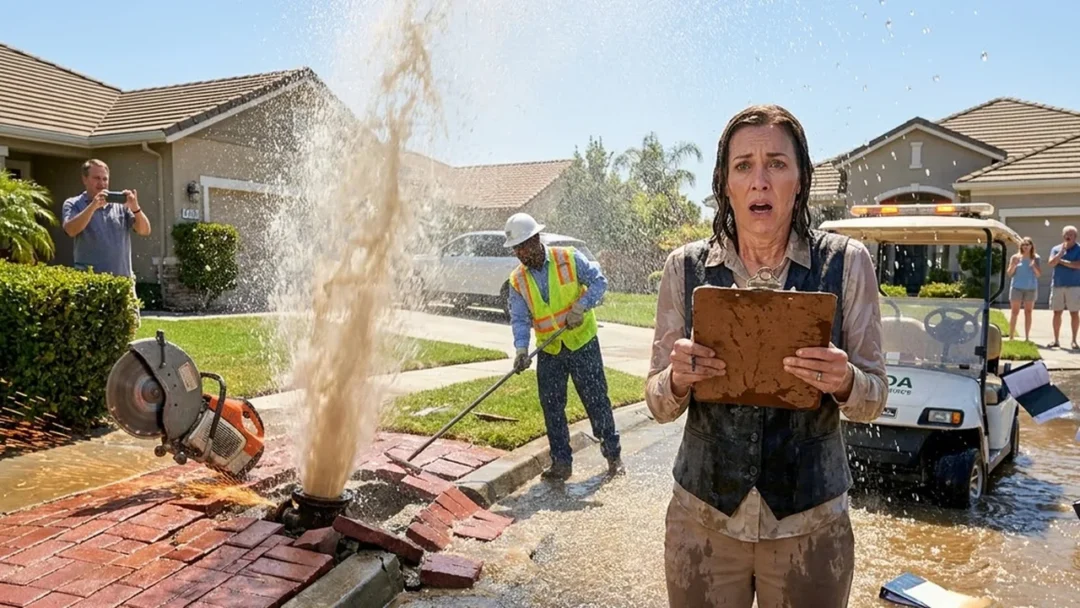
The Severed Municipal Fire Main And The Flooded HOA Golf Cart
CHAPTER 1: THE RED CURB ON MAGNOLIA TRACE
The gentle morning sun filtered through the spreading canopy of mature white dogwoods and southern live oaks, casting dappled shadows across the manicured lawns of Magnolia Trace Country Club. Tucked into the rolling red clay hills of Cobb County, Georgia, the gated community was a master-planned sanctuary of antebellum-inspired brick mansions, pristine Bermuda fairways, and immaculate architectural harmony. Every exterior fixture, from the hue of the carriage lanterns to the beveling of the driveway curbing, was subject to the exhaustive, unyielding oversight of the neighborhood Architectural Review Committee. The community took immense pride in its pristine appearance, but that obsession with uniformity often masked a simmering undercurrent of bureaucratic hostility.
At the corner of Magnolia Trace and Sweetwater Court, beside the driveway entrance of 402 Magnolia Trace, Caleb Foster knelt on a rubber work mat. At thirty-nine, Caleb was the senior field utility specialist for the Cobb County Water System. He had spent fifteen years maintaining high-pressure municipal distribution infrastructure, water purification mains, and dedicated fire suppression loops across metropolitan Atlanta. In his gloved hands, he held a heavy rubber mallet, tapping the final interlocking red brick paver into a low, elegant six-inch protective barrier that encircled a subterranean utility access valve.
The barrier had been constructed with precision. Poured on a four-inch gravel footing with hydraulic bonding mortar, the red pavers matched the estate’s brickwork while serving an indispensable municipal purpose. Embedded flush into the asphalt directly beneath the paver ring was a heavy cast-iron blue utility cover, permanently cast with bold raised lettering: “COBB COUNTY WATER SYSTEM — FIRE MAIN SHUTOFF — DO NOT OBSTRUCT.” To the right of the curb, parked legally along the public street with its amber rooftop strobe flashing quietly, sat Caleb’s white Ford F-350 utility truck, its cargo bed stocked with hydraulic valve keys, pipe sleeves, and digital pressure transceivers.
Beside Caleb stood Gregory Hayes, forty-eight, a senior captain for an international commercial airline and the homeowner at 402 Magnolia Trace. Gregory stood with his arms folded, holding his phone in his hands, watching the careful placement of the brickwork with obvious relief. Three months earlier, a distracted delivery van had backed over the unprotected valve riser in the grass, nearly shearing the casting. Gregory had spent ten weeks coordinating with the county to have this protective masonry collar installed under official municipal right-of-way easement protocols.
The morning quiet was interrupted by the high-pitched electric whine of a customized golf cart speeding aggressively down the asphalt grade.
The vehicle was a top-of-the-line, lifted Club Car Onward, finished in sparkling pearl-white automotive lacquer with custom chrome brush guards, aluminum alloy wheels, and premium marine-grade leather seats. Mounted across the dashboard was a high-output Bluetooth audio console and a heavy plastic organizer stuffed with citation clipboards and architectural violation notices. The cart bounced violently as it crested the crest of Sweetwater Court, its aggressive off-road tires squealing as the driver slammed on the brakes.
The golf cart came to a halt directly downhill in the street gutter, barely five feet from the red paver curb.
The driver’s side doorless opening framed Regina Vance. At fifty-four, Regina was the president of the Magnolia Trace Homeowners Association and a retired commercial real estate developer. She was dressed in tailored tennis whites, oversized designer sunglasses, and diamond stud earrings, her silver hair pulled back into a severe, windswept ponytail. Regina treated the five hundred homes of Magnolia Trace like a personal feudal estate, enforcing covenants with the vindictive enthusiasm of an authoritarian monarch who viewed any independent municipal action as a direct challenge to her reign.
Regina stepped out of the cart, letting the vehicle idle in neutral with its parking brake engaged, and marched directly toward the red brick curb.
“Foster!” Regina barked, pointing a manicured, French-tipped finger at the masonry. “I don’t know who gave you permission to unload wet mortar on this street, but this unauthorized pile of brick is an immediate violation of Section Seven of the Magnolia Trace Aesthetic Charter! You have exactly fifteen minutes to scrape this concrete off my curb before I have county code enforcement tow your utility truck!”
Caleb Foster slowly stood up, brushing red clay dust from his canvas work trousers. His expression remained calm, professional, and entirely unruffled.
“Good morning, Mrs. Vance,” Caleb replied, his voice measured and polite. “I am Caleb Foster with the Cobb County Water System. This masonry barrier was installed under County Infrastructure Emergency Order 418. It protects an active eight-inch municipal fire main shutoff valve that supplies the primary hydrant circuit for fifty homes along this ridge.”
Regina scoffed, her face twisting into a sneer of pure, condescending arrogance. “I don’t care about your county work orders! This street is a private gated community. The HOA owns the aesthetic airspace and the curb profile. I approved no curb. If the board didn’t vote on it, it doesn’t exist.”
Regina turned, stepped back to the rear cargo bed of her lifted golf cart, and reached beneath a canvas tarp. With a metallic rattle, she lifted out a heavy, orange Husqvarna gas-powered concrete cut-off saw equipped with a twelve-inch diamond-grit abrasive blade.
The history of Magnolia Trace had always been defined by an obsession with curated perfection. When the subdivision was plotted in the late nineteen-nineties, the original developers had incorporated strict deed restrictions designed to evoke the stately grandeur of historic Savannah squares. Utility meters were required to be hidden behind evergreen shrubbery; exterior paint schemes had to be chosen from an approved palette of historic southern pastels; and even the mailboxes were cast from a proprietary aluminum mold costing eight hundred dollars each. But beneath this veneer of antebellum gentility lay the harsh physical realities of modern municipal civil engineering.
Cobb County’s water infrastructure had undergone massive capital upgrades following regional droughts and suburban expansion. The Chattahoochee water transmission corridor pushed millions of gallons daily through reinforced ductile iron mains buried beneath the rolling hills. To ensure fire suppression crews could draft sufficient volume during structural emergencies, high-pressure isolation valves were strategically placed at every major intersection. Because Magnolia Trace had been built with curved streets and tight turnaround radii, these valve risers were frequently positioned near residential curb aprons. For months, Caleb Foster had submitted engineering reports requesting protective masonry collars to prevent accidental vehicle strikes from delivery trucks and lawncare trailers. The work order was the culmination of meticulous bureaucratic planning, not an impromptu landscaping whim.