The Severed Municipal Fire Main And The Flooded HOA Golf Cart
CHAPTER 3: SPARKS ON THE CAST-IRON STEM
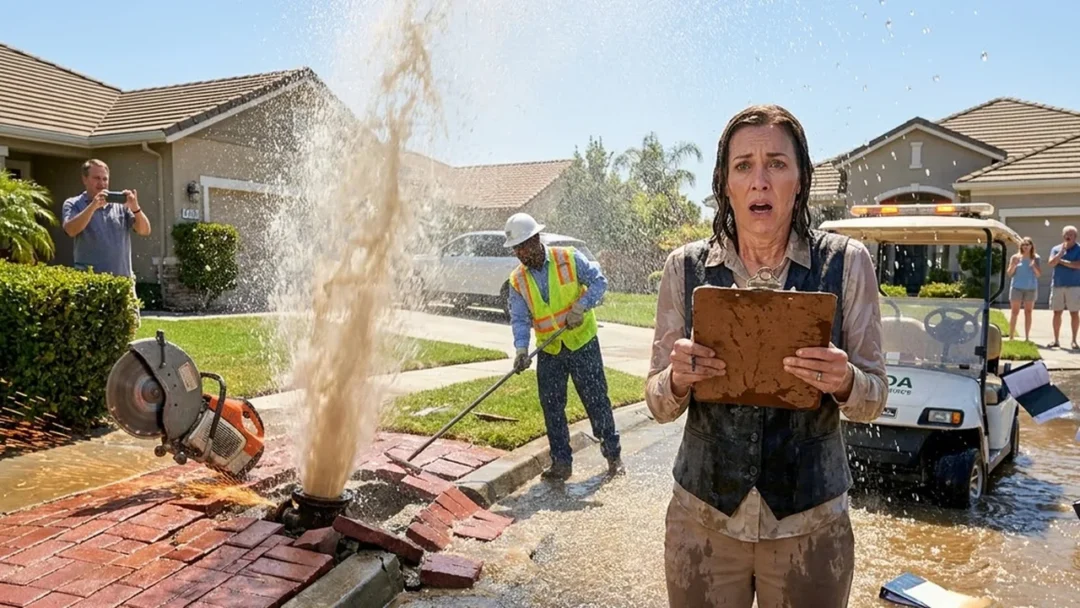
The diamond-grit teeth bit into the freshly set red clay pavers with an agonizing, high-pitched shriek of mechanical violence. A dense cloud of powdery terracotta dust exploded into the air, coating Regina’s white designer tennis outfit, her sunglasses, and the polished chrome trim of her golf cart in fine crimson silt. Pulverized mortar chips flew in all directions, pinging off the asphalt and clattering against the aluminum body of her Club Car.
Gregory Hayes kept his phone perfectly level, capturing every millimeter of the saw’s descent. The video clearly framed the stamped blue county utility disc, the discarded gold-sealed work order resting between Regina’s shoes, and the violent, determined pressure she applied to the tool’s handlebars.
Inside the red brick enclosure, the layout of the municipal infrastructure was complex. The pavers had been built in an interlocking octagonal ring around a heavy-wall cast-iron valve box extension stem—a four-inch-diameter vertical sleeve that extended five feet underground, connecting the street-level operating nut directly to the eight-inch ductile iron gate valve on the pressurized municipal main. The assembly was engineered to absorb vertical traffic loads, but it was vulnerable to lateral mechanical shear.
The diamond wheel chewed through the two-inch brick paver cap in less than five seconds.
Beneath the paver lay the gray cast-iron collar.
As the industrial diamond abrasive struck the high-tensile cast iron, the tone of the saw changed from a dull, grinding roar to a piercing, metallic shriek. A blinding geyser of bright orange sparks erupted from the kerf, throwing glowing metal slivers across Regina’s forearms. Cast iron is brittle under localized thermal stress; as the diamond teeth cut into the four-hundred-pound tensile sleeve, the extreme rotational friction created intense thermal expansion along the shear plane.
“Mrs. Vance, release the throttle!” Caleb shouted, his voice booming over the engine’s scream. “You are cutting into the structural valve housing! That line is under eighty pounds of direct hydrostatic pressure from the Chattahoochee reservoir pumps!”
Regina leaned her full body weight into the saw, her face contorted with hysterical, stubborn malice. “I’m finishing the job! No one tells me what to do on my own street!”
The diamond blade penetrated three-quarters of an inch into the cast-iron stem.
Deep beneath the pavement, inside the pressurized eight-inch water main, eighty pounds per square inch of water pressure was bearing against the internal bronze gate. The sudden localized vibration from the high-speed saw, combined with the structural weakening of the upper collar, transferred severe rotational torque down the vertical operating rod.
A sharp, explosive metallic crack, like the sound of an iron railway rail snapping in winter cold, vibrated through the roadbed.
The cast-iron valve stem fractured completely at the bonnet junction.
Immediately, the rhythm of the Husqvarna saw faltered. A violent, rhythmic shudder tore through the handles, nearly wrenching the heavy tool from Regina’s grasp. From the narrow kerf in the brickwork, a high-velocity jet of pressurized, vaporized water hissed outward, atomizing against the hot diamond blade into a searing storm of scalding red mud and fine iron filings.
Regina blinked in sudden shock, her sunglasses instantly obscured by red silt. “What… what is that?”
Caleb Foster didn’t waste a breath. He grabbed Gregory Hayes by the shoulder and propelled him backward toward the elevated front lawn.
“Move!” Caleb yelled. “The casting is blown!”
In materials engineering, the behavior of gray cast iron under mechanical shock and thermal friction is well documented. Unlike modern ductile iron or forged carbon steel, which possess sufficient ductility to deform plastically under localized stress, cast iron has high compressive strength but relatively low tensile and shear tolerance. When the segmented diamond blade chewed through the protective brick paver and struck the four-inch valve stem, the localized rotational heat reached nearly six hundred degrees within seconds, while the internal water maintained a cool subterranean temperature of sixty degrees.
This severe thermal differential, combined with the severe harmonic vibration generated by the nine-thousand-RPM two-stroke engine, induced instantaneous micro-fracturing along the crystalline graphite boundaries of the metal. Deep inside the valve bonnet, the bronze stem that held the heavy gate disc in place was subjected to extreme lateral bending moments. The mechanical leverage of the saw’s arbor acted like a chisel driven directly into an over-torqued bolt. When the casting finally yielded, it did not tear; it shattered like brittle porcelain under a sledgehammer.