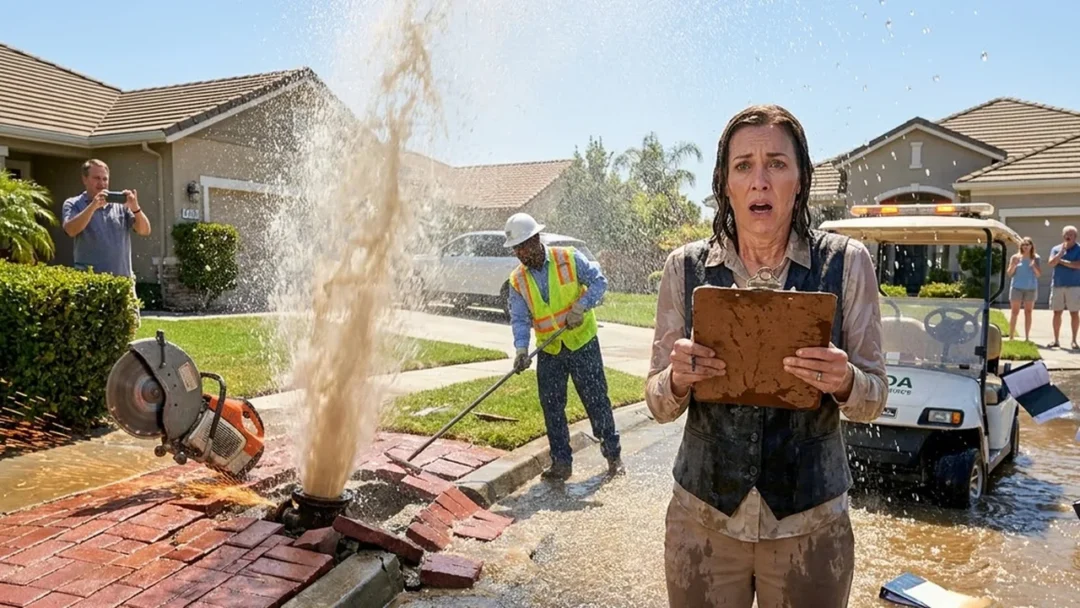
The Severed Municipal Fire Main And The Flooded HOA Golf Cart
CHAPTER 5: THE VALVE KEY AND THE STROBE
Caleb Foster did not freeze. His training as a municipal utility specialist kicked in with the precision of a military drill team.
He sprinted past the screaming golf cart to the back of his utility truck. From the storage rack, he unlatched a heavy, six-foot solid-steel T-handled gate valve key and a brass hydrant pressure gauge. He grabbed an orange traffic cone and sprinted fifty yards uphill to the intersection of Magnolia Trace and Sweetwater Court, where the master isolation valve for the eight-inch street distribution loop was located beneath a marked street box.
Caleb slammed the square socket of the heavy steel key into the access hole, feeling the key seat firmly over the bronze operating nut five feet underground.
Bracing his boots against the asphalt, Caleb threw his full upper body weight against the crossbar of the key. He began rotating the heavy valve clockwise, counting the revolutions with methodical precision: one… two… three… four…
It took twenty-four complete turns against the roaring hydrostatic backpressure to slowly force the heavy gate down onto its brass seat.
With each turn, the towering geyser fifty yards downhill began to lose its height. The forty-foot plume dropped to thirty feet, then twenty, then five, until the violent roaring jet collapsed into a bubbling, muddy spring that spilled harmlessly across the shattered red pavers.
As the water subsided, the wailing siren of a fire battalion cruiser broke through the morning air.
A red-and-white command SUV from Cobb County Fire and Emergency Services pulled to a halt at the curb, its blue and red LED light bars washing across the flooded roadway. Battalion Chief Thomas Sterling stepped out of the vehicle, his gold badge gleaming on his turnout coat. At fifty-two, Sterling had spent twenty-five years commanding emergency responses across the county, and his primary responsibility on this morning was ensuring residential fire suppression capability.
Chief Sterling walked down the street, his waterproof boots splashing through four inches of standing water. He took in the scene in five seconds: the shattered paver curb, the fractured iron collar, the muddy torrent filling the street, the soaked woman shivering on the curb, and the pearl-white golf cart still blaring its continuous, ear-splitting horn:
HOOOOOOOOOOOOOOOOOOOOOOOOOOOOOOOOOOOOOOONK!
Chief Sterling walked over to the submerged golf cart, reached beneath the driver’s seat with a pair of insulated wire cutters, and cleanly severed the auxiliary horn wire with a single, sharp snap.
The deafening blare cut out instantly.
The sudden silence that settled over Magnolia Trace was profound, broken only by the sound of muddy water gurgling down the storm drain and the dripping of soaked dogwood leaves.
Chief Sterling turned toward Regina Vance, who was sitting on the curb with her head in her hands, her white clothes soaked in red mud, shivering uncontrollably despite the eighty-degree morning heat.
“Identify yourself,” Chief Sterling commanded, his voice carrying the cold, hard authority of a fire marshal on an active emergency scene.
Regina looked up through her wet, mud-streaked hair, her voice trembling with fragile, desperate defensiveness. “Chief… thank goodness you’re here. This county contractor—he laid a booby-trap on our street! He built an illegal curb that ruptured our water pipe! Look at my golf cart! It’s completely ruined! I want him arrested immediately!”
Chief Sterling didn’t blink. He looked at Caleb Foster, who was walking down the street carrying his valve key.
“Caleb, what happened here?” Sterling asked.
Caleb stopped beside the ruined masonry, pointing with his steel key toward the pavement. “Chief, we were completing the emergency protective encasement on the fire main isolation valve under County Work Order 418. Mrs. Vance arrived with an unpermitted concrete saw, slapped the certified county work order into the gutter, and deliberately sawed through the paver cap into the cast-iron valve collar.”
Caleb pointed to the grass. “The saw kicked, severed the collar, and triggered an eighty-PSI hydraulic blowout.”
Chief Sterling looked down at the street between Regina’s feet. There, plastered to the wet asphalt by red silt, was the official Cobb County work order, stamped with the gold seal of the water system.
The tactical management of a municipal water main blowout requires immediate, decisive coordination between public works and emergency services. In Cobb County, every primary distribution loop is mapped on real-time SCADA computer networks that monitor flow rates and pressure drops across hundreds of miles of pipe. The moment the valve collar shattered, pressure sensors at the regional booster station registered a sudden, abnormal sixty-percent pressure drop, triggering automated alarm klaxons at county dispatch.
Caleb Foster’s rapid response in deploying the six-foot valve key was what prevented an even greater catastrophe. Had the eighty-PSI geyser continued to vent unthrottled for another fifteen minutes, the high-velocity discharge would have scoured out the roadbed beneath Sweetwater Court, collapsing the asphalt and undermining the foundation footers of the adjacent brick carriage gates. By executing a controlled shutdown, Caleb preserved the structural integrity of the surrounding street while isolating the compromised sector before the regional storage tanks could be drained.