They Filled His Empty Farm Shed With Their Equipment—Then He Counted Every Single Item
Chapter 1: The Shed Was Full by Sunrise
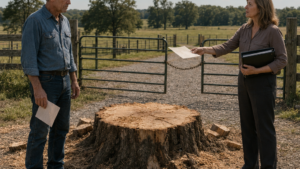
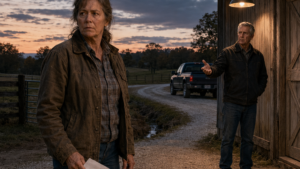
Edward Walker knew something was wrong before he reached the padlock.
A red fertilizer spreader sat sideways across the doorway of his machinery shed, one wheel sunk into the gravel and its drawbar angled toward the lane. Edward stopped ten feet away with his coffee cooling in his hand.
The spreader was not his.
Neither were the two plastic feed totes stacked beside it.
He set the mug on the hood of his pickup and walked closer.
The shed stood at the edge of his hay ground, a long weathered structure with corrugated metal patched over older wood siding. Edward kept his mower, hand tools, fencing supplies, and whatever machinery he wanted out of the weather inside it. Since he had sold his larger tractor the year before, one whole bay had been mostly empty.
Mostly.
He pulled the brass-bodied padlock into his palm.
No pry marks.
No bent hasp.
No broken screws.
The lock opened with his key as cleanly as it always had.
Edward slid the door sideways.
Then he stopped.
His empty bay was gone.
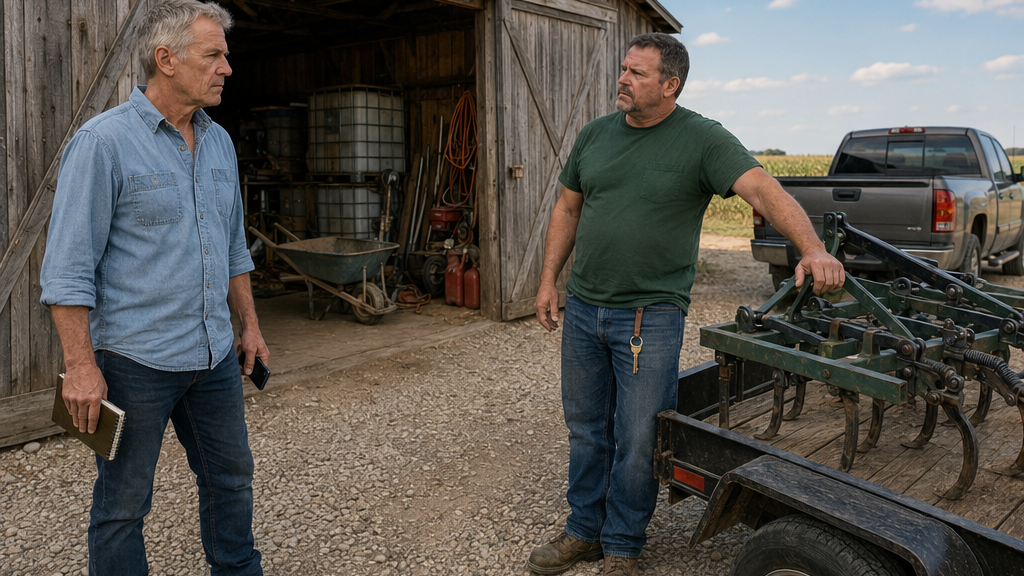
A wheelbarrow leaned against the back wall. Two orange extension cords hung from a nail that belonged to Edward. A black power-drill case sat on his workbench beneath three bags of mineral supplement. Beside them were a portable generator, two fence chargers, a narrow seed spreader, four plastic fuel cans, and a stack of folded livestock panels.
Someone had even moved Edward’s welding cart six feet to make room.
He stood there for a while without touching anything.
Months earlier he had noticed a shovel that wasn’t his.
Then a pair of bolt cutters.
Then two buckets.
He had assumed Kevin Miller had left them temporarily after helping repair the boundary fence. Edward had thought about saying something.
He hadn’t.
Out here, a man could make himself ridiculous over small things if he wasn’t careful. Edward had watched neighbors stop speaking over borrowed trailers, gate chains, and who had mowed which side of a ditch.
So he’d let the shovel stay.
Then the buckets.
Now he couldn’t walk a straight line through his own shed.
Edward took out his phone and began photographing.
Not because he had a plan.
Because he needed to know he wasn’t exaggerating the scene in his own mind.
He counted twenty-three objects or groups of objects he didn’t recognize.
The twenty-fourth was the fertilizer spreader blocking the entrance.
He stepped back outside and looked toward the adjoining property.
Kevin’s place lay beyond a strip of pasture and a gravel lane. From here Edward could see the upper half of the Millers’ machine barn.
A section of its roof was still covered with dark tarps from the summer storm.
Edward stared at it, then at his crowded shed.
“All right,” he said quietly.
He walked back to the farmhouse.
Two years earlier, after fuel had disappeared from an outdoor tank, Edward had mounted a small security camera beneath the shed eave. He hadn’t looked at the recordings in months.
The screen in his office took several tries to wake.
He pulled up the previous week.
At first there was nothing but cats, windblown grass, and Edward himself moving a hay rake.
Then, Tuesday afternoon, Kevin’s pickup entered the frame.
Edward leaned forward.
Kevin backed a utility trailer to the shed. Jessica Miller climbed from the passenger side.
They opened the door.
Not forced it.
Opened it.
Kevin carried in two feed totes. Jessica rolled the wheelbarrow behind him.
Edward dragged the playback bar forward.
Thursday.
Kevin again.
This time with the generator.
Friday evening.
Jessica alone, placing two fuel cans inside.
Edward watched all three clips twice.
His irritation changed shape.
It was no longer the hot, simple anger he’d felt standing inside the shed. This was worse.
They weren’t confused about whose building it was.
They were using it routinely.
He reached for a notebook from the desk drawer and wrote down the dates and times.
Tuesday, 3:41 p.m.
Thursday, 5:18 p.m.
Friday, 7:06 p.m.
Then he went back farther.
Two weeks.
Three.
The shovel had appeared nearly six weeks earlier.
Edward sat back.
So that was how it happened.
Not all at once.
A shovel was easy to ignore.
Two buckets weren’t worth an argument.
A cord could be temporary.
Then one morning the whole building belonged to somebody else in practice, even if it still belonged to you on paper.
He returned to the Tuesday recording and enlarged the image.
Kevin walked toward the door.
His right hand disappeared near the lock.
A moment later the door opened.
Edward paused the frame.
The picture wasn’t sharp enough.
He advanced it one second.
Then another.
Kevin turned slightly toward Jessica.
Something caught the morning light near his hand.
Edward enlarged the frame again until the pixels broke apart.
A key.
Not a modern silver duplicate.
An old brass key, darkened around its edges.
Edward stopped moving.
His own shed key was brass.
He had never given Kevin one.
For several seconds Edward simply stared at the frozen image of the man he’d known for almost twenty years standing in front of his shed with a key that appeared to fit the lock.
He printed the frame.
The printer pushed the page out slowly.
Edward took it while it was still warm and looked again at the small brass shape between Kevin’s fingers.
This was no longer only a question of why Kevin was storing things in his shed.
Now Edward needed to know something much simpler.
Where had Kevin gotten the key?
Chapter 2: You Were Not Using It Anyway
The answer did not come to Edward.
Kevin did.
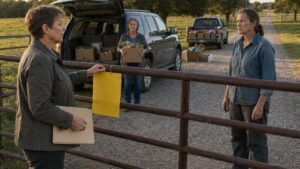
Just after two that afternoon, Edward heard the rattle of a trailer crossing the gravel lane and stepped out of the shed.
Kevin’s pickup was backing toward him.
On the trailer sat a compact three-point cultivator.
Edward walked into the middle of the lane and raised one hand.
Kevin stopped.
For a moment neither man moved.
Then Kevin lowered his window.
“Need through?”
“No.”
Kevin glanced toward the shed. “Then what’s up?”
Edward pointed at the cultivator.
“That going in my building?”
Kevin’s expression changed only slightly.
“Just for a few days.”
Edward looked toward the open doorway behind him, where Kevin’s generator, feed totes, cords, fuel cans, and other equipment were already visible.
“No.”
Kevin turned off the truck.
“What do you mean, no?”
“I mean you’re not putting anything else in there.”
Kevin got out.
He was heavier than Edward and nearly ten years younger, broad through the shoulders from a lifetime of lifting things the wrong way because it was faster.
“We talked about needing dry space.”
“No,” Edward said. “You talked. I don’t remember agreeing.”
Kevin looked genuinely puzzled.
“It’s an empty shed.”
“It was.”
“You’ve got half the building sitting there doing nothing.”
Edward felt heat rise behind his ears.
“That’s still my half of my building.”
Kevin opened both hands.
“I’m not hurting anything.”
Edward almost laughed.
Instead he looked down.
There, hanging from a short leather loop on Kevin’s belt, was the old brass key.
Edward’s anger became very steady.
“Where’d you get that?”
Kevin followed his gaze.
“The key?”
“Yes.”
Kevin touched it as if he’d forgotten it was there.
“I’ve had this thing forever.”
“Who gave it to you?”
Kevin gave him a strange look.
“Your brother.”
Edward said nothing.
Kevin seemed to take the silence as an advantage.
“Andrew gave it to me years ago.”
Edward’s late brother’s name landed harder than he expected.
Andrew had owned the property with Edward before his death. He had been the kind of man who would loan a hay wagon, leave a gate unlocked for a neighbor, or tell someone to put machinery under cover before a storm and sort it out later.
Edward had admired that about him.
He had also spent years cleaning up after it.
“When?” Edward asked.
“Must’ve been twelve, thirteen years ago.”
“For what?”
“Storm coming through. Remember? Tore the roof off that old lean-to we had.”
“That doesn’t answer what you’re doing now.”
Kevin sighed.
“Edward, come on.”
“No. Answer it.”
Kevin pointed toward the shed.
“You weren’t using it anyway.”
The sentence was so casual that Edward felt something in him give way.
Not his temper.
His reluctance.
Kevin continued, “You wouldn’t even notice half this stuff if you weren’t looking for a reason to be sore.”
Edward looked past him at the cultivator on the trailer.
Then at the brass key.
Then at the shed.
He could have shouted.
Part of him wanted to.
Instead he reached into his shirt pocket and pulled out the small spiral notebook he’d started that morning.
Kevin frowned.
Edward opened to a clean page.
“What are you doing?”
Edward took his phone from his pocket and photographed the cultivator.
Then he wrote:
Three-point cultivator. Delivered Saturday, 2:17 p.m. Owner unknown.
He looked up.
“Whose is it?”
Kevin stared at him.
“What?”
“The cultivator. Yours?”
Kevin’s face tightened.
“Why does that matter?”
“Whose is it?”
A pause.
“Mine for the week.”
“That’s not what I asked.”
Kevin crossed his arms.
Edward wrote another note beside the item.
Ownership not confirmed.
Then he walked inside the shed.
He photographed the wheelbarrow.
The drill case.
The generator.
Both extension cords.
The fuel cans.
The fence chargers.
One by one.
Kevin followed him to the doorway.
“This is ridiculous.”
Edward numbered the feed totes.
“You have forty-eight hours.”
“To do what?”
“Remove everything in here that belongs to you.”
Kevin gave a short laugh.
“And whatever doesn’t?”
Edward turned.
“Tell me who owns it.”
Something flickered across Kevin’s face.
Small.
But Edward saw it.
“Why would there be anything in there that isn’t mine?”
Edward held his gaze.
“You tell me.”
Kevin stepped closer.
“You’re making a big deal out of nothing.”
Edward closed the notebook.
“No. I spent six weeks making nothing out of something.”
That silenced them both.
Edward heard insects buzzing in the weeds beside the shed and the ticking exhaust of Kevin’s truck cooling in the lane.
“I should’ve said something when the shovel showed up,” Edward continued. “I didn’t. That’s on me.”
Kevin’s expression softened slightly, as though he thought Edward was retreating.
Then Edward said, “But I’m saying it now.”
He held up two fingers.
“Forty-eight hours.”
Kevin’s jaw tightened.
“You going to lock me out?”
“I haven’t decided.”
“You can’t just change an arrangement because you woke up irritated.”
Edward looked at the brass key again.
“What arrangement?”
“The one we’ve always had.”
“I never had one with you.”
“Your brother did.”
“My brother’s been gone five years.”
Kevin flinched, but his voice hardened.
“Doesn’t mean everything he did disappeared.”
Edward felt the words hit somewhere he didn’t want touched.
For years he had kept Andrew’s habits alive without calling them that. He’d continued letting neighbors cross the south lane. Continued sharing the water tank during dry summers. Continued saying yes when somebody needed the post driver.
Maybe he had believed keeping those habits meant keeping something of his brother.
But this was different.
Wasn’t it?
Kevin climbed back into his pickup.
Edward stepped aside but didn’t move from the lane.
“What about the cultivator?” he asked.
Kevin started the engine.
“It’s staying on the trailer.”
“Good.”
Kevin put the truck in gear, then looked through the open window.
“You want to make me sound like some thief, go ahead.”
“I didn’t call you that.”
“You don’t need to.”
Edward said nothing.
Kevin shook his head.
“Ask anybody around here.”
Then he added the sentence Edward would carry back to the farmhouse with him.
“Your brother always let me use it.”
The pickup rolled away.
Edward stood beside the shed with his notebook in one hand.
Forty-eight hours had begun.
But for the first time that day, he wasn’t certain the story started with Kevin taking something that had never been offered.
Chapter 3: The Favor Edward Never Revoked
Edward found Kevin’s name in his brother’s handwriting at 6:12 the next morning.
He had been searching the old desk for less than twenty minutes.
The drawer stuck halfway, as it always had. Edward pulled harder, and a stack of folded receipts slid forward with a small metal tag beneath them.
He almost missed it.
A rectangular brass tag, blackened around one punched hole.
SHED – K.M.
Edward sat down.
Under the tag lay one of Andrew’s pocket notebooks.
His brother had kept dozens of them—weather dates, cattle treatments, fuel purchases, things people owed him that he rarely collected.
Edward turned the pages.
Three quarters of the way through, he found it.
Kevin – duplicate shed key. Storm storage. Equipment until roof fixed. No charge.
Edward read the four lines twice.
Then a third time.
The date was thirteen years earlier.
Kevin had told the truth.
Edward leaned back in the chair.
For most of Saturday he’d pictured the brass key as proof of the worst version of events: Kevin copying it without permission, finding some forgotten spare, or taking advantage of Andrew’s death.
Instead Andrew had placed the key in his hand.
Probably without ceremony.
Probably with a sentence like, Put your stuff in there until you get dried in.
Exactly the sort of thing he would have done.
Edward rubbed his thumb along the edge of the tag.
He remembered the storm now.
A line of wind had come through after dark and peeled sheet metal from barns for miles. The Millers had lost part of a lean-to. Andrew had spent the next morning helping Kevin drag wet tools out of the mud.
Edward had been working cattle two counties away.
He had never asked what arrangements Andrew made.
The anger he had felt Saturday did not disappear.
But its shape changed again.
Kevin had not stolen access.
At least not at the beginning.
Edward carried the notebook to the kitchen and set it beside his coffee.
He thought about the past five years.
Had Kevin ever asked whether the arrangement continued?
No.
Had Edward ever told him it didn’t?
Also no.
Worse, Edward knew there had been smaller signs.
The shovel.
The buckets.
A roll of wire last spring.
Each time he had noticed, decided it wasn’t worth making trouble, and moved on.
He had believed silence meant he was being patient.
Kevin may have heard permission.
By midmorning Edward drove to the county offices.
He wasn’t looking for a legal weapon. Not yet.
He wanted to confirm dates connected to the property transfer after Andrew’s death and make sure there wasn’t some written storage agreement buried somewhere he had forgotten.
The county clerk found nothing beyond the ownership records.
“No lease on the shed,” she said.
“There wouldn’t have been.”
“Then what are you trying to find?”
Edward hesitated.
“Proof I didn’t agree to something.”
The clerk gave him the kind of look people gave when they had spent enough years around land disputes.
“That can be harder to prove than something you did agree to.”
Edward almost smiled.
“That’s what I’m finding out.”
Back home, he returned to the camera recordings.
If Andrew had given Kevin the key for temporary storm storage thirteen years ago, Edward wanted to know when temporary had started becoming permanent.
He worked backward through the previous two months.
Kevin appeared often.
Jessica appeared less often.
Then Edward saw a pickup he didn’t recognize.
The driver backed toward the shed on a Wednesday afternoon.
Kevin was already waiting.
Together they unloaded a narrow piece of equipment with a yellow hopper.
Edward paused the image.
He had seen it before.
Not recently.
At a farm two roads east.
He advanced the recording.
Kevin unlocked the shed.
Both men rolled the machine inside.
Edward sat forward.
He checked another date.
A different pickup.
This time a man unloaded fencing supplies.
Kevin opened the building again.
Edward took out his notebook.
The ledger had started as a list of objects.
Now he added a second column.
Owner.
Beside most items, he still wrote unknown.
He went back to the shed and stood in the open doorway.
The place looked different now.
Yesterday he had seen Kevin’s clutter.
Today he saw a network he did not understand.
He checked the power drill case for a name.
Nothing.
The generator had faded marker on its fuel tank, but he couldn’t read it.
One fence charger had initials scratched into the bottom.
Not K.M.
Edward’s stomach tightened.
The old permission was beginning to look less important than what Kevin had done with it.
He walked around the yellow-hopper machine shown in the video.
It was tucked behind two mineral totes where he hadn’t noticed it the first morning.
A mower attachment sat beyond it.
Edward wiped dust from the gearbox housing.
A dealership sticker was still visible.
He knew that mower.
He had seen it attached to a tractor at a place two roads away during first cutting.
Edward returned to the house and pulled up the footage again.
There it was.
Same dent along the guard.
Same faded red paint at the hitch.
The mower did not belong to Kevin.
Edward took the printed frame of Kevin holding the brass key and placed it beside Andrew’s notebook.
Yesterday, one had looked like proof against Kevin and the other did not exist.
Now the two pieces told a different story together.
Andrew had trusted Kevin with access.
Kevin had kept the key.
Edward had failed to draw a new line.
And somewhere along the way, Kevin had apparently begun opening Edward’s building for people Edward had never spoken to at all.
Edward wrote one new question beneath the inventory.
How many owners?
His phone buzzed on the desk.
For a second he thought it might be Kevin.
It wasn’t.
Edward looked again at the frozen camera image of the mower being rolled through his shed door.
He recognized the man beside it now, too—not by name, but by the farm he belonged to.
Two roads over.
Edward closed the notebook.
The problem was no longer whether Kevin had once been invited into the shed.
The problem was that Kevin seemed to have started inviting others.
Chapter 4: Every Item Had Another Owner
The stranger arrived Monday morning while Edward was standing inside the shed with his notebook open.
He heard tires slow on the gravel, then a pickup door slam.
A man Edward recognized only by sight walked toward the doorway and pointed past him.
“I’m here for my spreader.”
Edward looked behind him.
“The yellow one?”
“That’s it.”
Edward did not move.
“How did it get in here?”
The man frowned as if the question made no sense.
“Kevin put it here.”
Edward felt the answer settle into the room.
“Did Kevin tell you this was his building?”
The man hesitated.
“He said he had storage.”
“That wasn’t my question.”
The man took out his phone.
For a moment Edward thought he might call Kevin. Instead he opened a text thread and held the screen out.
Got room in the dry shed. Bring it by Tuesday. Twenty bucks for the week.
Edward read the message twice.
Kevin’s number was at the top.
He copied the date into his notebook.
The man shifted his weight.
“I didn’t know.”
Edward looked at the spreader.
“I believe you.”
“So can I take it?”
Edward nearly said yes.
Then he stopped.
The shed had become more complicated than ownership alone. He had no idea which objects belonged to whom, whether anything had been damaged, or whether Kevin had promised access to people who might arrive whenever they pleased.
“You can take yours,” Edward said. “But I want a picture before it leaves.”
The man looked irritated.
“Why?”
“Because when this is over, I want to know exactly what came out.”
After a moment, the man nodded.
They rolled the spreader outside together.
Edward photographed it in the doorway, then crossed item fourteen from his list.
Under Owner, he wrote the name of the farm instead of the man’s name.
The list no longer looked like an inventory of clutter.
It looked like a map.
By noon Edward had identified six objects that were not Kevin’s.
The mower from two roads east.
The yellow spreader.
One fence charger.
A post driver.
Two livestock panels marked with blue paint.
And a portable generator belonging to a family that rented pasture farther north.
He drove to two nearby farms, showing photographs rather than making accusations.
The answers were variations of the same thing.
Kevin had offered dry space.
Kevin had said he had room.
Kevin had never said the shed belonged to Edward.
One landowner told Edward he had traded Kevin a half-day with a skid steer instead of paying cash.
Another said he had paid forty dollars to keep two pieces of equipment under cover until harvest.
Edward drove home more slowly than he had left.
The money bothered him less than the assumption underneath it.
Kevin had not merely continued using an old favor.
He had converted it into something he could offer other people.
At the shed, Edward opened his notebook and drew a vertical line through the middle of the page.
On the left he wrote Item.
On the right he wrote Owner.
Below that, he added another heading.
Arranged By.
Every line said the same thing.
Kevin.
Edward stood with the notebook in his hand while the shed door moved slightly in the breeze.
The forty-eight-hour deadline had passed.
Nothing belonging to Kevin had been removed.
Edward could have changed the lock right then.
He had a new padlock in the pickup.
He even took it from the toolbox and carried it to the door.
Then he looked at the objects still inside.
If he locked everything in, he would not only be blocking Kevin.
He would be trapping property belonging to people who had apparently been misled.
Edward put the new lock back in the truck.
His anger wanted something simple.
The facts would not give it to him.
Late that afternoon, he called the sheriff’s non-emergency line and explained only enough to create a record.
“I’m not reporting stolen equipment,” he told the dispatcher. “I own the building. Other people’s property is being stored inside without my permission.”
“Are you asking for an officer?”
“Not yet.”
“Then what do you need?”
“A record that I called before this gets more complicated.”
The dispatcher took the address.
Edward wrote the time in the notebook.
Then he walked back outside.
Jessica Miller was waiting near the lane.
She had come on foot.
That alone made him cautious.
Jessica usually drove the quarter mile between their farms, even if she was only returning a wrench.
“Kevin know you’re here?” Edward asked.
Her expression tightened.
“I’m not sneaking around.”
“I didn’t say you were.”
She looked toward the shed.
“You’ve been calling people.”
“I’ve been finding out who owns what’s in my building.”
“You don’t need to call everybody.”
Edward stared at her.
“I absolutely do.”
Jessica lowered her voice.
“You’re making this bigger than it has to be.”
“No. Kevin did that when he started offering my space to other people.”
She looked away.
Edward waited.
There was something else in her face.
Not anger.
Fear.
“You knew he was charging them?”
Jessica folded her arms.
“I knew about some of it.”
“How many?”
She did not answer.
“Jessica.”
“We needed somewhere dry.”
“That explains your equipment. It doesn’t explain theirs.”
Her eyes went toward the Miller property.
For the first time, Edward noticed how tired she looked.
There were dust marks on her jeans and a faint grease line across one wrist.
“Please,” she said. “Don’t call anyone else yet.”
Edward’s grip tightened around the notebook.
“Why?”
She looked at him for several seconds.
Then she said, “Because you don’t know what’s happening over there.”
Before Edward could ask what she meant, Jessica turned and walked back down the lane.
Edward watched her go.
Inside the shed, his ledger lay open on the workbench.
Twenty-nine lines.
Nine owners confirmed.
And for the first time since this began, Edward suspected the crowded building was only the visible part of the problem.
Chapter 5: The Barn Kevin Could Not Afford to Fix
The tarp on Kevin Miller’s barn was not covering a hole.
It was covering nearly a third of the roof.
Edward stood beside Jessica the next morning and looked up at rafters exposed beneath torn sheet metal. One section of the north wall leaned inward, braced by temporary lumber. Rain had stained the concrete floor in long brown tracks.
“You said storm damage,” Edward said.
Jessica nodded.
“I didn’t know it was this bad.”
“Most people don’t.”
She led him inside.
The smell was wet plywood, diesel, and old feed.
A tractor sat under plastic. Two implements had been pushed beneath the remaining good section of roof. Everything else was packed tightly along the walls.
Kevin stood at a workbench near the back.
The brass shed key lay beside his gloves.
Not offered.
Just visible.
He looked up when Edward entered.
“So she brought you over.”
Jessica said, “He needed to see it.”
Kevin’s jaw moved.
“He didn’t need to see anything.”
Edward looked around.
A repair estimate was pinned beneath a magnet on the metal cabinet.
He could not read the amount from where he stood, but the bottom line was large enough to notice.
“What happened with insurance?” Edward asked.
Kevin gave a short laugh.
“What do you think happened?”
Jessica answered instead.
“They covered the roof damage. Not everything underneath. Then they said part of the wall problem was older.”
Kevin picked up a wrench and set it down again.
“We were already carrying the operating note. Then the combine needed work.”
Edward looked at him.
“So you rented out my shed.”
Kevin’s face hardened.
“I used space nobody was using.”
“You charged people.”
“I charged enough to cover moving things around and keeping them dry.”
“It wasn’t your space to charge for.”
Kevin’s shoulders tightened.
“I had a key.”
“From thirteen years ago.”
“From your brother.”
“For storm storage.”
Kevin stepped away from the bench.
“You want to know what Andrew would’ve done if he saw this?”
Edward felt the old pressure immediately.
Kevin pointed toward the roof.
“He would’ve told me to use the shed until I got dried in.”
“Maybe.”
“No maybe about it.”
Edward looked at the brass key.
“That doesn’t mean he would’ve told you to sell the space.”
Kevin said nothing.
Jessica moved between them only enough to break the line of sight.
“He wasn’t trying to run a business out of it.”
Edward turned to her.
“People paid him.”
“Sometimes.”
“Or traded work.”
“Yes.”
“That’s a business.”
Kevin slapped one hand against the workbench.
“It was forty bucks here, a skid-steer job there. I wasn’t opening a storage company.”
Edward did not answer.
The silence made Kevin angrier.
“You think I liked doing it?”
“I don’t know what you liked.”
“I liked not watching equipment rot while I tried to find thirty thousand dollars I don’t have.”
The figure landed harder than Edward expected.
Kevin looked toward the damaged roof.
“The bank won’t extend me again until after harvest. Insurance paid less than half what we expected. Every piece that stays dry is one less thing I might have to replace.”
Edward’s anger did not disappear.
But it became harder to hold cleanly.
He remembered seeing the tarp from his own property for weeks.
He had noticed.
He had never asked how bad the damage was.
Then he remembered the shovel in his shed.
The buckets.
The wire.
All the chances he had to say, Kevin, don’t leave things here without asking.
He had chosen silence because silence had been easier.
Kevin had turned that silence into permission because permission had been easier.
Neither fact erased the other.
“Why didn’t you ask me?” Edward said.
Kevin looked genuinely confused.
“I thought I had.”
“When?”
“For years.”
“That is not asking.”
Kevin pointed toward him.
“You never said no.”
Edward took that without answering.
Because it was true.
Not enough to excuse what Kevin had done.
But true.
Jessica leaned against the workbench.
“Every time something showed up over there and you didn’t say anything, Kevin figured you were fine with it.”
Edward looked at her.
“You figured that too?”
She nodded reluctantly.
“I thought if it really bothered you, you’d say so.”
Edward almost smiled at the ugliness of it.
Three people had built an agreement out of words nobody had spoken.
He looked at Kevin.
“What about after Saturday?”
Kevin’s expression changed.
That was the dividing line.
Before Saturday, Kevin could claim history, habit, assumption.
After Saturday, Edward had said no.
Clearly.
“That’s different,” Edward said.
Kevin looked away.
Edward nodded toward the key.
“You knew after Saturday.”
Kevin ran one thumb along the workbench edge.
“I thought you’d cool off.”
The honesty was so plain Edward almost missed how damning it was.
“You thought my no wasn’t real.”
“I thought you were mad.”
“I was.”
“You’ve been mad before.”
“And?”
Kevin shrugged.
“You don’t stay mad.”
Edward stared at him.
There it was.
Not a legal argument.
Not history.
Not Andrew.
Kevin had learned Edward.
He had learned that Edward disliked conflict, that Edward let things sit, that Edward would rather swallow irritation than risk making the lane uncomfortable for the next ten years.
Kevin had counted on it.
Edward looked down at the brass key.
For the first time, he understood his own part in the problem without feeling obligated to accept Kevin’s.
“I should’ve stopped this sooner,” Edward said.
Kevin glanced up.
“I should’ve told you the first time I saw your shovel. I should’ve asked for the key when Andrew died.”
Kevin’s face loosened slightly.
Then Edward continued.
“But I told you Saturday.”
The looseness vanished.
“You did.”
“And you left everything there.”
“I can’t move it all in two days.”
“Then you should’ve said that.”
Kevin folded his arms.
“What do you want, Edward?”
“A real answer.”
“To what?”
“When.”
Kevin looked toward Jessica.
She said nothing.
Edward pulled a folded sheet from his pocket.
It was not a legal notice. Not yet.
Just an inventory and a proposed removal schedule.
“I’ve identified nine owners,” Edward said. “I want your equipment out first. Then theirs, by appointment, so nobody claims something disappeared.”
Kevin did not take the paper.
“You’re turning this into a courthouse.”
“No. I’m trying to keep it from becoming one.”
Kevin laughed without humor.
“Same thing with you. Paper for everything.”
Edward held the page out another few seconds.
Kevin finally took it.
He read the first lines.
His face hardened again.
“No.”
Jessica looked at him.
“Kevin.”
“No. I’m not agreeing to this.”
“You don’t have to agree that I own the shed.”
“I’m not moving everything on his schedule just because he decided he’s done being neighborly.”
Edward felt the old impulse to retreat, to say they could talk tomorrow.
He forced himself not to.
“Then I’ll send it formally.”
Kevin threw the page back onto the workbench.
“Do what you have to do.”
The brass key jumped from the impact and spun once on the wood.
Edward watched it settle.
Kevin did not pick it up.
But neither did he hand it over.
Edward left the barn knowing more than he had wanted to know.
Kevin was not using his shed because he believed it was his.
He was using it because he was desperate, because Andrew had once made it easy, and because Edward had spent years making no sound when lines moved.
None of that changed what had happened after Saturday.
By the time Edward reached the lane, he knew exactly what the next step had to be.
This time, his boundary would not depend on anyone guessing what he meant.
Chapter 6: The Notice Was About Responsibility
Edward crossed out the words STORAGE PENALTY so hard the pen tore the paper.
He sat at his kitchen table on the seventh morning with three drafts spread around him.
The first had been written while he was angry.
Twenty dollars per item, per day.
The second was worse.
Administrative fees. Access fees. Unauthorized-use charges.
By the third page, Edward had created a punishment large enough to satisfy him and probably foolish enough to create another problem.
He stared at the torn line.
Then he called Patricia Lee.
They had worked together years earlier when Edward served on a county agricultural advisory committee and Patricia handled extension programs. She had spent enough time around farm leases, shared wells, access lanes, and handshake arrangements to distrust any sentence beginning with, Everybody knows.
She listened without interrupting.
When Edward finished, she said, “Are you trying to get your shed back or make Kevin hurt?”
Edward leaned back.
“Both, if I’m being truthful.”
“Pick one.”
He looked at the pages.
“What if I charge him for storage?”
“You can write whatever number you want on paper. That doesn’t make it collectible.”
“So I do nothing?”
“I didn’t say that.”
Patricia’s voice stayed calm.
“You document what is there. You tell him permission is revoked. You give owners a reasonable way to retrieve property. You document actual expenses you incur—hauling, repairs, replacement locks if necessary. And if you’re worried about liability, call your insurer.”
Edward looked at the torn draft again.
“What about the money he collected?”
“That may matter between you and Kevin. But don’t invent your own punishment because you’re angry.”
Edward was quiet.
Patricia added, “The cleaner you behave, the harder it is for anyone to pretend they don’t understand the issue.”
After the call, Edward gathered the first two drafts and put them in the trash.
He kept the third.
Then he rewrote it.
No penalties.
No dramatic language.
The first sentence simply stated that all permission to use the machinery shed was revoked effective immediately.
The next pages listed every identified object, its apparent owner, the date photographed, and whether retrieval had been arranged.
He created three collection windows over four days.
He added one paragraph stating that Kevin would be responsible for documented costs directly caused by unauthorized storage or removal, subject to proof.
Then he copied the camera dates.
At the bottom he wrote:
No additional property may be placed in the building.
Edward read it twice.
It did not feel satisfying in the way his first draft had.
That was probably a good sign.
At the post office he sent Kevin and Jessica a copy by certified mail.
Then he emailed the same document.
Then he drove home and placed the receipt in his ledger.
The notebook that had begun with Wheelbarrow and Extension cords now held dates, owners, retrieval times, photographs, and expenses.
It no longer felt like a tally.
It felt like a plan.
The first third-party owner came Tuesday afternoon.
Edward met him at the shed and unlocked the door himself.
The man retrieved a fence charger and two livestock panels.
“Kevin told me this was his cousin’s shed,” he said while loading them.
Edward looked at him.
“His cousin?”
“Or brother-in-law. Something like that.”
“Did he tell you I owned it?”
“No.”
The second owner came the next morning for the mower.
His answer was simpler.
“I thought Kevin rented it.”
“From me?”
“He never said from who.”
Edward wrote both statements in the notebook after they left.
Not sworn statements.
Not ammunition.
Just facts.
By day ten, seven objects were gone.
The shed floor had begun to reappear.
For the first time, Edward could reach his welding cart without moving someone else’s equipment.
That should have felt like victory.
Instead Kevin arrived just before noon.
He did not come for equipment.
He came angry.
“You’ve been telling everybody I’m stealing from you.”
Edward stood beside the workbench.
“No.”
“That’s what’s getting around.”
“I told owners their equipment was in my shed without my permission.”
Kevin pointed toward the ledger.
“You’re making a record of every conversation like I’m some criminal.”
“I’m making a record because nobody agrees on what happened.”
“You called the sheriff.”
“Non-emergency. To document the dispute.”
Kevin’s mouth tightened.
“You called insurance too?”
Edward had, that morning.
“Yes.”
Kevin looked away.
“You could’ve handled this between us.”
“I tried.”
“No, you made a deadline you knew I couldn’t meet.”
Edward felt the accusation land because part of it was fair.
Forty-eight hours had been emotionally satisfying.
Practically, it had been nearly impossible.
“You’re right about the deadline,” Edward said.
Kevin stopped.
Edward continued.
“Forty-eight hours wasn’t realistic for everything. That’s why I changed the retrieval schedule.”
Kevin seemed almost annoyed not to be given an argument.
“But after I told you no,” Edward said, “you still treated it like I’d change my mind.”
Kevin looked toward the doorway.
“You always do.”
Edward nodded once.
“I know.”
The words quieted the room.
“That part’s over.”
Kevin’s expression hardened again.
“So this is what you want now? Everybody watching me haul stuff out of your place?”
“No.”
“Could’ve fooled me.”
“I don’t want anybody watching.”
Edward closed the ledger.
“I want the shed empty.”
Kevin stared at him, then left without another word.
By day twelve, most third-party equipment was gone.
Kevin’s generator, feed totes, fuel cans, and several tools remained.
Edward had also paid for a farm-supply driver to help move one heavy implement after its owner could not retrieve it himself. He recorded the invoice.
He had replaced one bent latch and documented that too.
Nothing else.
No invented fees.
No daily penalty.
Only costs he could put a receipt beside.
That afternoon his phone rang while he was inside the shed.
The caller identified herself as an insurance representative.
“I’m calling regarding property currently stored at your location,” she said.
Edward stepped outside.
“What property?”
“Equipment associated with the Miller farm and potentially two other insured parties.”
Edward looked toward Kevin’s damaged barn in the distance.
The representative continued.
“We need to understand who authorized storage, who currently controls access, and whether any items may have been damaged while on your premises.”
Edward glanced down at the notebook in his hand.
For twelve days he had been trying to get other people’s property out of his shed.
Now the question had changed.
Someone wanted to know who might be responsible for what had happened while it was there.
Chapter 7: The Key Came Back Before the Money
Kevin placed the brass key in Edward’s palm at 7:18 the next morning.
No apology.
No explanation.
Just the key.
Edward had been standing beside the shed with a clipboard when Kevin walked across the gravel yard, stopped two feet away, and held out his hand.
The old key looked smaller than Edward remembered.
For two weeks it had seemed large enough to represent the entire dispute.
Edward closed his fingers around it.
“Thank you.”
Kevin glanced toward the open shed.
“I need my stuff.”
“You’ll get it.”
“Today.”
Edward looked at the retrieval schedule clipped to the board.
“Some of it today.”
Kevin’s mouth tightened.
“The insurance company called me.”
“They called me too.”
“That generator has to be inspected.”
“Then we’ll bring it out.”
Kevin stared at the clipboard.
“I don’t need an appointment to take my own equipment.”
“You need an appointment to enter my building.”
The distinction hung between them.
Kevin looked toward the county road.
“You planning to stand here while everybody comes by?”
“Yes.”
“So they can all see this.”
Edward lowered the clipboard.
“No one is being invited to watch you.”
“They already know.”
“That isn’t the same thing.”
Kevin gave a hard laugh.
“You called half the neighborhood.”
“I called the people whose property was here.”
“Same difference.”
“No.”
Edward waited until Kevin looked at him.
“I’m not putting a sign at the road. I’m not telling people what you owe. I’m not asking anyone to pick sides.”
Kevin’s expression shifted slightly.
“But you’re not getting the key back either,” Edward said.
That ended the small opening.
Kevin nodded once.
“Fine.”
The first retrieval began fifteen minutes later.
Jessica arrived carrying a folder thick with receipts, text-message printouts, and a handwritten list.
Edward looked at it.
“What’s that?”
“Everything I could identify.”
Kevin looked away.
Jessica handed the folder to Edward.
There were names, item descriptions, dates, and notes about what had been paid or traded.
Edward flipped through the pages.
“You kept all this?”
“I do the books.”
Kevin said, “You didn’t have to bring that.”
Jessica did not answer him.
She pointed toward Edward’s ledger.
“Your mower entry is wrong. That one belongs to the north pasture owner, not the farm you wrote down.”
Edward corrected it.
Then he looked at her.
“How many did Kevin arrange?”
“All of them.”
Kevin turned toward her.
“Jessica.”
“What?” she said. “He already knows.”
The words were not angry.
They sounded tired.
Over the next three hours, the shed emptied in pieces.
A pickup arrived for two fence chargers.
Another owner came for the post driver.
Edward unlocked the building each time, checked the item against his list, photographed it in the doorway, and crossed off the line once it was loaded.
Kevin helped without speaking much.
By noon, only his own equipment and three unclaimed items remained.
The open floor looked strange.
Edward could see oil stains he had forgotten were there.
He could see the bottom shelf of his workbench again.
Then they reached the generator.
Kevin rolled it forward and stopped.
One corner of the steel frame was bent.
“That wasn’t like that,” he said.
Edward looked closely.
A scraped line ran along the tube.
“When was the last time you saw it?”
Kevin’s face hardened.
“When I put it in here.”
Jessica crouched beside the frame.
“This could’ve happened moving it.”
Kevin looked at Edward.
“Or something fell on it.”
Edward felt the old anger rise.
Two weeks earlier he might have answered immediately.
Instead he opened his ledger.
“Let’s look.”
Kevin threw up one hand.
“Of course. More paper.”
“Yes.”
Edward turned back through the photographs.
He found the first image of the generator from the morning he discovered the shed.
The frame was partially obscured by a feed tote.
He enlarged the photo.
The bend was there.
Smaller than it looked now, but visible.
Kevin leaned closer.
Jessica did too.
“It was already bent,” Edward said.
Kevin studied the screen.
For several seconds, nobody spoke.
Then Kevin stepped back.
“Fine.”
That one word carried less resistance than anything he had said in two weeks.
Edward wrote beside the item:
Preexisting frame bend visible in initial photograph.
The insurance question did not disappear, but it stopped being a weapon.
By late afternoon, they had reduced the remaining dispute to numbers.
Edward spread receipts across the workbench.
Farm-supply driver: hauling charge.
Replacement latch.
Certified mail.
A small amount for lumber used to brace one item during removal.
Nothing for Edward’s time.
Nothing for daily storage.
Nothing for inconvenience.
Kevin ran his finger down the page.
“You’re not charging me rent?”
“No.”
“I thought that was the whole point.”
“It was when I was angry.”
Kevin looked at him.
Edward did not look away.
“I wanted to charge you for every object in here.”
“How much?”
“Enough to make you mad.”
Kevin almost smiled.
Almost.
“What changed?”
“Patricia asked me whether I wanted my shed back or wanted you to hurt.”
“And?”
“I wanted the shed more.”
Kevin looked around the nearly empty building.
“You got it.”
“Almost.”
Kevin tapped the hauling receipt.
“I don’t agree with this one.”
“The owner couldn’t move the implement. It had to leave.”
“You chose the driver.”
“Yes.”
“You could’ve waited.”
“And leave it here after the deadline?”
Kevin sighed.
Jessica took the receipt.
“It’s reasonable.”
He looked at her.
“You’ve been saying that a lot.”
“Because we need this finished.”
The tiredness in her voice ended the argument more effectively than Edward could have.
Kevin walked to the doorway.
Outside, the last third-party owner was fastening a chain over an implement.
For the first time, the conflict looked less like a fight and more like cleanup.
Kevin turned back.
“I’ll pay the documented costs.”
Edward said nothing.
“Not some storage penalty later.”
“There isn’t one.”
“And that closes it?”
“The money part.”
Kevin nodded slowly.
Edward picked up the brass key from the workbench.
It had sat beside him all afternoon.
He held it between thumb and forefinger.
“You really thought I’d let this go?”
Kevin looked at the key.
“I thought you’d complain.”
“That wasn’t the question.”
Kevin took a long time to answer.
“I thought you’d decide it wasn’t worth ruining things between us.”
Edward considered that.
Maybe Kevin had not been entirely wrong.
For years, Edward had treated any firm boundary as if it threatened the whole relationship.
That had been his mistake.
“The relationship wasn’t supposed to depend on me never saying no,” Edward said.
Kevin looked down.
“No.”
It was the closest thing to agreement they had reached.
Jessica closed her folder.
“I’ll bring the check tomorrow.”
Edward shook his head.
“No rush tonight.”
Kevin looked surprised.
“Thought you wanted everything settled.”
“I do.”
Edward closed his fingers around the key.
“But I know the difference between settled and punished now.”
Kevin gave a small nod.
Then he followed Jessica toward their truck.
Edward stayed in the doorway.
The shed was almost empty.
The key had come back.
The money would follow.
But as he watched Kevin cross the gravel yard without looking back, Edward understood that paperwork could settle every object on his list and still leave one question untouched.
What did two neighbors do after the argument was over?
Chapter 8: An Empty Shed Is Still Someone’s
For the first time in weeks, Edward could see the entire concrete floor.
He stood in the doorway on a Saturday morning with one hand against the frame.
No spreader blocked the entrance.
No generator crowded the workbench.
No feed totes stood beneath his shelves.
Only Edward’s mower, welding cart, fencing supplies, and tools remained.
The building looked larger than he remembered.
Jessica had delivered the check the previous week.
Kevin had reimbursed the hauling charge, the latch, the certified mailing costs, and the small repair expenses without another argument.
The insurance question had closed after the remaining equipment owners inspected their property.
On paper, everything was finished.
Edward still found himself looking toward the Miller place whenever a truck entered the lane.
That morning he carried the brass key into the shed office.
He had considered throwing it away.
Instead he hung it on a hook inside the locked metal cabinet above his desk.
Beneath it he taped a small handwritten card.
Emergency storage only.
Owner approval required.
Dates agreed in advance.
Key returned when use ends.
It looked absurdly formal for a building where his brother had once waved people inside without writing anything down.
Edward stared at the card.
Then he folded a second copy into his ledger.
The old notebook had changed too.
The pages that began with numbered objects now ended with retrieval dates and check marks.
He turned to a clean sheet.
At the top he wrote:
Temporary emergency use.
He left the rest blank.
Edward was closing the cabinet when he heard an engine on the lane.
Kevin’s tractor appeared between the trees.
A damaged hay rake trailed behind it, one wheel angled slightly inward.
Edward felt his shoulders tighten before he could stop them.
Kevin pulled up outside the shed and shut off the engine.
For several seconds he remained in the seat.
Then he climbed down.
“I need a hand.”
Edward looked at the rake.
“With what?”
“Getting that wheel assembly off. I can do it at my place, but the ground’s soft under the tarp and I don’t want the jack sinking.”
Edward said nothing.
Kevin rubbed one hand over his jaw.
“I was wondering if I could use the concrete apron here.”
There it was.
Not assumption.
Not a key in his hand.
A question.
Edward looked at the rake again.
“How long?”
“Couple hours.”
“Inside?”
“No. Just the apron.”
“You bringing anything else?”
Kevin shook his head.
“Just that.”
Edward let the silence sit for another second.
Not to punish him.
To make sure his answer came from choice rather than habit.
“All right.”
Kevin nodded.
“Thanks.”
Edward walked to the tractor.
They worked without much conversation.
Kevin positioned the rake on the concrete. Edward brought out a floor jack and two stands.
The damaged wheel fought them.
One bolt had rusted nearly solid, and Kevin leaned too hard on the breaker bar until Edward told him to stop before he rounded the head.
Kevin released it.
“You always hated how I use tools.”
“I hate how you use my tools.”
Kevin glanced at him.
For a moment Edward thought the line had gone too far.
Then Kevin gave a quiet laugh.
“Fair.”
Edward found penetrating oil.
They waited.
The awkwardness between them did not vanish.
It simply stopped demanding attention every second.
After a while Kevin said, “I shouldn’t have offered the shed to those people.”
Edward wiped his hands on a rag.
“No.”
“I thought I was solving three problems at once.”
“You were using my building to do it.”
“I know.”
Edward looked at him.
Kevin was staring at the damaged wheel.
“I wasn’t trying to make a fool of you,” Kevin said.
“I know that too.”
Kevin seemed surprised.
Edward sat on the edge of the concrete.
“That doesn’t mean it was all right.”
“I didn’t say it did.”
They worked the bolt loose.
Metal gave with a sharp crack.
Kevin steadied the wheel while Edward pulled the assembly free.
When it was down, they rolled it beside the tractor.
“That’ll do,” Kevin said.
Edward began putting away his tools.
Kevin hesitated.
“Your brother would’ve just left the shed open.”
Edward stopped.
For a moment the old argument was back between them.
But Kevin’s voice held no challenge.
Only memory.
“Probably,” Edward said.
Kevin nodded.
“He helped me a lot.”
“He helped everybody.”
“Sometimes too much.”
Edward looked at him.
Kevin gave a faint smile.
“You can say it. He did.”
Edward smiled too.
It surprised him how little betrayal he felt saying it aloud.
Andrew’s generosity had been real.
So had the problems it sometimes created.
Preserving one did not require inheriting the other.
“I thought saying no made me different from him,” Edward said.
Kevin leaned against the tractor tire.
“Maybe it does.”
Edward waited.
“Doesn’t mean worse.”
The words were plain.
That made them easier to believe.
Kevin loaded the wheel assembly and secured it.
Before climbing onto the tractor, he looked toward the open shed.
“You ever going to let anybody store anything in there again?”
Edward glanced at the doorway.
“If there’s a tornado warning and someone’s got equipment sitting outside, probably.”
Kevin nodded.
“But they’ll ask first.”
“That part too.”
“And the key?”
“I have it.”
Kevin looked at him.
“Good.”
No request followed.
That mattered more than Edward expected.
Kevin started the tractor.
He raised one hand as he pulled away.
Edward returned the gesture.
Then he went back inside the shed.
On the workbench sat the ledger.
Edward opened it to the clean page.
Under Temporary emergency use, he wrote the date.
Kevin Miller — concrete apron only — hay rake repair — permission requested and granted — two hours.
He stared at the entry and shook his head at himself.
Then he closed the book.
Maybe he would eventually stop recording every small favor.
Maybe he wouldn’t.
The lesson was not that every act of neighborliness needed paperwork.
It was that kindness worked best when both people understood what had actually been offered.
Edward put the ledger in the cabinet.
The brass key hung above it.
He did not destroy it.
It belonged to a history he no longer needed to deny: Andrew giving shelter to a neighbor after a storm, Kevin holding onto that permission too long, Edward remaining silent until resentment replaced clarity.
The key had once meant trust.
Then assumption.
Then intrusion.
Now it meant something simpler.
Access belonged to the person who had the right to grant it.
Edward shut the cabinet and turned the small lock.
Outside, Kevin’s tractor was disappearing beyond the pasture fence.
The concrete apron was empty again.
Edward slid the machinery-shed door closed.
He threaded the chain through the hasp and locked it.
Then he put the key in his own pocket.
The building was empty where he wanted it empty, available when he chose to make it available, and still capable of sheltering a neighbor when circumstances called for it.
Nothing about that felt unfriendly.
For the first time, Edward understood that a boundary was not the opposite of generosity.
Sometimes it was the thing that allowed generosity to remain a gift.
The story has ended.