He Cut Open My Farm Fence for a Pond View—Then the County Approved What I Built There
Chapter 1: The Hole That Framed the Pond
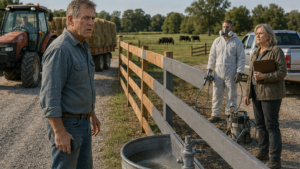
The power saw stopped just as Thomas Walker reached the pasture gate.
For half a second, the sudden quiet confused him more than the noise had.
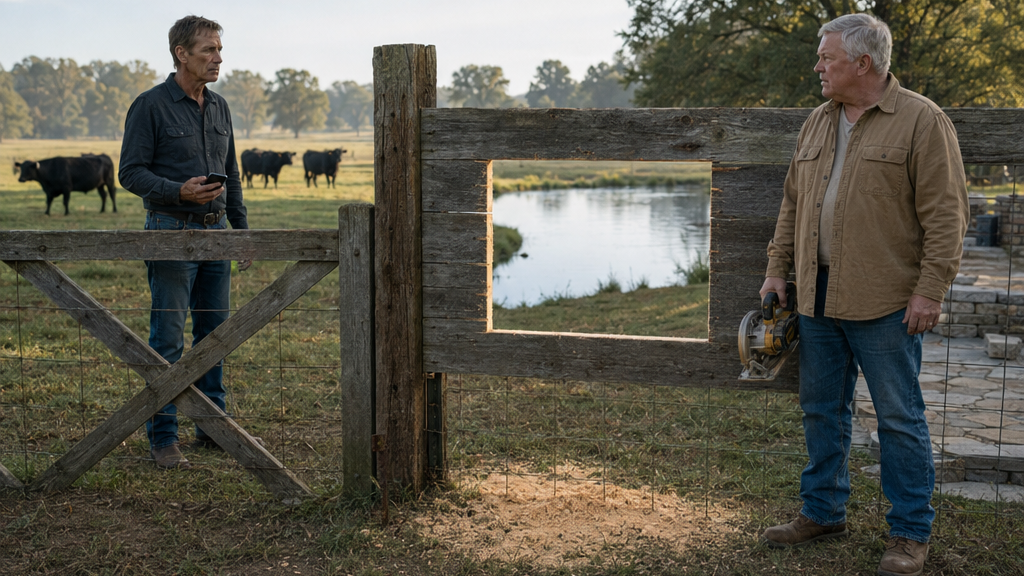
Then he saw David Carter standing on the far side of the boundary fence with both hands wrapped around a circular saw.
A rectangle had been cut through the weathered cedar boards.
Not a cracked board. Not storm damage. Not a place where cattle had pushed against weak lumber.
A clean opening.
About four feet wide.
Through it, the pond lay blue and still beneath the low September sun.
Fresh sawdust covered the grass.
Thomas did not open the gate.
David lowered the saw.
“Morning.”
Thomas looked from him to the hole.
“What are you doing?”
David glanced at the opening as though Thomas had asked why he was mowing his own lawn.
“Fixing this.”
Thomas took his phone from his shirt pocket.
David’s expression tightened. “You don’t need to make a whole thing out of it.”
Thomas photographed the fence.
One picture of the entire section.
One of the clean upper cut.
One of the lower corner where a cedar board had been removed above the livestock wire.
Then one of the rust-dark survey pin visible beside the post.
David watched him.
“You know that view was open before.”
Thomas took another picture.
“I asked what you’re doing.”
“I’m restoring the sightline.”
That made Thomas look at him.
David pointed through the rectangle.
From where he stood, the opening framed the pond almost perfectly. Beyond the water, the pasture sloped toward a line of sycamores. The old hay field rose behind them.
It was the kind of view real-estate listings called peaceful.
Thomas called it the west pasture.
“Restoring,” Thomas repeated.
“Yes.”
“You cut my fence.”
“It’s on the boundary.”
“That doesn’t make half of it yours.”
David sighed.
He was already dressed for work around his place—clean jeans, boots that had seen little mud, canvas overshirt. Behind him, beyond the boundary, Thomas could see part of the stone patio David had been building behind the renovated farmhouse.
“You’ve known since I bought this place that the pond view was part of the property.”
“The pond isn’t.”
“I didn’t say the pond was.”
Thomas stepped closer to the fence but remained on his side.
“Turn the saw off.”
“It is off.”
“Unplug the battery.”
David stared at him.
Thomas waited.
After a moment, David pulled the battery loose.
Thomas photographed that too—not because he needed a picture of a battery, but because his hands needed something precise to do.
He could feel the anger working its way upward.
His father had always distrusted anger near tools, cattle, and property lines.
Nothing good, the old man used to say, happens after somebody says, “I’ll show him.”
Thomas had spent most of his adult life proving he understood that.
Sometimes too well.
David leaned the saw against a fence post.
“This used to be open.”
“There was a fence here when you bought your place.”
“Not like this.”
“Exactly like this.”
“No.”
David walked several yards toward his house, then turned.
“When I bought the property, I was shown photographs. The view was open from the back patio.”
Thomas almost told him that photographs did not change ownership.
Instead he looked at the cut edges.
They were straight.
Measured.
One board had even been sanded where the saw had splintered it.
This was not something David had done in frustration five minutes earlier.
He had planned the opening.
“How long have you been working on this?”
David gave him a tired look.
“Thomas, nobody’s trying to take your land.”
“You removed part of a fence on my land.”
“Boundary fence.”
“My fence.”
“The sightline was always there.”
A cow called from the lower pasture.
Thomas glanced toward the herd.
The livestock wire remained intact beneath the opening, but the cedar boards above it had helped keep the cattle from crowding that side whenever there was activity on David’s property.
The opening did not create an immediate escape route.
It created something worse: another condition Thomas would have to watch.
“I want you to stop,” Thomas said.
David folded his arms.
“You can repair around the opening.”
“No.”
“You don’t even use that section for anything.”
Thomas looked at him.
David seemed to hear himself a second too late.
He softened his tone.
“I mean, the boards don’t serve a purpose there. The wire keeps the cattle in.”
Thomas photographed the entire opening again.
Then he walked along the fence line and photographed the next post, the corner brace, and the survey pin.
David followed him from the other side.
“You really going to call somebody over this?”
“I haven’t decided what I’m going to do.”
“Well, before you decide, you should check what was agreed to.”
Thomas stopped.
“What agreement?”
David hesitated.
That hesitation cooled Thomas faster than any apology could have.
“What agreement?”
“The previous owner of my place told us the view was shared.”
“Shared how?”
“He said it had always been kept open between the properties.”
Thomas knew the previous owner. Not well, but well enough to remember a man who called every borrowed gate “our gate” and every gravel lane “the road,” regardless of whose deed held it.
“That isn’t an agreement.”
“It mattered when we bought.”
“To you.”
“To the sale.”
Thomas stared through the rectangular opening.
From David’s new patio, it must have worked like a picture frame. Pond in the middle. Trees at the edges. No visible cattle chute. No equipment shed. No feed bunks.
Just water.
For the first time that morning, Thomas understood that David had not cut the fence merely because he disliked it.
He believed he was correcting something.
That did not make the cut less deliberate.
It made the problem larger.
Thomas put his phone away.
“Don’t touch another board.”
David shook his head.
“You’re making this harder than it needs to be.”
“No. I’m making it clear.”
He turned toward the pasture gate.
“Thomas.”
Thomas looked back.
David had taken out his own phone.
“I wasn’t making up what I was told.”
He tapped the screen, found something, then walked to the fence and held the phone through the opening.
On the display was an old real-estate photograph of David’s farmhouse.
The picture had been taken from the unfinished back patio years earlier.
The pond sat bright in the distance.
And where Thomas’s cedar fence now stood, the sightline appeared almost completely open.
Thomas took the phone without speaking.
He enlarged the photograph.
The date was older than David’s ownership.
The image was real.
And for the first time since hearing the saw, Thomas found himself wondering not what David had done—
but what someone had promised him before he did it.
Chapter 2: What Thomas Never Corrected
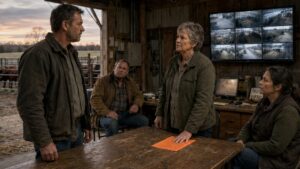
Anna Walker laid three old photographs across Thomas’s desk and said, “You aren’t going to like these.”
He knew that before he looked down.
The farmhouse office was barely large enough for two file cabinets, a battered desk, and the printer Anna threatened to replace every tax season. Thomas had spent Sunday morning searching old farm records for anything that showed when the cedar section had been installed.
Instead, Anna had found evidence of something else.
In the first photograph, Thomas was repairing the water line beside the boundary while David stood inside the Walker pasture holding a coil of hose.
In the second, David was cutting back branches from a hedge that belonged to Thomas.
In the third, taken during the previous winter, the two men were standing near the fence with the pond clearly visible behind them through a temporary section Thomas had removed for repairs.
Anna tapped the pictures.
“You see the problem.”
“I see pictures.”
“You see him on our side.”
“He was helping.”
“I know.”
Thomas sat down.
Anna remained standing.
“That isn’t the point.”
“He asked before he came across.”
“The first time.”
Thomas said nothing.
Anna pulled another picture from the folder.
In that one, David was walking along the pasture edge with a contractor.
Thomas remembered the day.
David had been planning drainage improvements around his barn. The shortest route between two survey points crossed the Walker corner by perhaps forty yards.
David had waved.
Thomas had waved back.
Neither man had said anything.
Anna pushed the photo toward him.
“You never corrected this.”
“It was forty yards.”
“That time.”
“He wasn’t hurting anything.”
“No. And when he trimmed those branches?”
“They were shading his side.”
“They were our trees.”
“I know whose trees they were.”
Anna sat across from him.
Her anger was different from his.
Thomas’s anger tended to settle into silence.
Anna’s became organization.
By breakfast she had printed the photographs from his phone, written down the time he had found David at the fence, called the fence contractor for an estimate, and placed a yellow legal pad beside the coffee maker with a list of things Thomas needed to remember.
She pointed at the pictures again.
“You keep thinking this started yesterday.”
“It did.”
“The cutting did.”
Thomas leaned back.
The old chair creaked.
Anna lowered her voice.
“You spend ten years teaching somebody that you don’t mind little things, then you’re surprised when he decides one more thing is little.”
“He used a saw.”
“I know.”
“He didn’t ask.”
“I know that too.”
“He cut a four-foot hole in the fence.”
“And I’m telling you why he thought you’d complain for five minutes and live with it.”
Thomas stared at the photo of David standing inside the pasture.
That bothered him more than the others.
Not because David was there.
Because Thomas remembered seeing him there and deciding not to say anything.
His father’s voice had been part of that decision.
Don’t start a feud over something you can settle at a gate.
Thomas had treated the advice like a commandment.
He had forgotten the second half.
Settle it at the gate.
He had skipped that part.
A diesel engine rumbled outside.
Anna looked toward the window.
“Feed truck.”
Thomas stood.
The delivery should have been routine.
It wasn’t.
By the time he reached the cattle yard, the first group of cows had drifted toward the western fence.
The truck’s air brakes hissed near the lane.
Cattle lifted their heads.
Thomas saw three animals walking toward the rectangular opening.
The livestock wire still held them, but David was working on the far side of the boundary. A portable table sat near his patio. Lumber was stacked beside it.
Every sound and movement drew the cattle.
One cow pushed her nose through the wire.
Another crowded beside her.
Thomas swore under his breath and moved them off.
The feed-truck driver leaned from the cab.
“You want me to wait?”
“No. Go ahead.”
Thomas opened the interior gate and used the truck’s movement to turn the cattle toward the bunk.
For the next ten minutes, what should have been an ordinary delivery became a careful exercise in keeping animals from pressing toward the damaged section.
The danger was not dramatic.
That was what bothered him.
Farm problems rarely announced themselves with drama.
A loose wire.
A bad latch.
A piece of machinery parked three feet wrong.
Then a frightened animal and a person standing where neither should be.
When the truck left, Thomas went back to the fence.
David was gone.
Thomas stood in front of the rectangular opening.
The pond was bright beyond it.
He could see why David wanted it.
That irritated him almost as much as David’s cutting.
Anna arrived carrying a temporary cedar panel.
“You going to help me or stare through it?”
Together they fastened the panel across the opening from Thomas’s side without disturbing the evidence around the cut edges.
When they finished, the pond disappeared.
Anna stepped back.
“There.”
Thomas looked at the temporary repair.
“You think I’m responsible for this?”
“No.”
“That sounded like yes.”
“I think David is responsible for cutting it.”
She brushed sawdust from the bottom rail.
“And I think you are responsible for letting everything before it stay vague.”
Thomas looked toward David’s farmhouse.
“For what it’s worth,” Anna said, “I would’ve told him no the first time he trimmed those branches.”
“I know.”
“And probably made him mad.”
“I know that too.”
“But he’d have known where the line was.”
That one stayed with him.
They spent the afternoon sorting records.
Tax maps.
Old contractor receipts.
A copy of the fence installation invoice.
A drainage plan.
Nothing mentioned a view.
Nothing mentioned shared access.
Near the bottom of an old metal file box, Thomas found a brown survey folder with his father’s handwriting across the front.
WEST LINE.
Inside was a plat, a set of measurements, and several surveyor notes from the year Thomas had rebuilt that pasture.
The cedar fence was marked.
So was the pond.
Thomas read every notation twice.
Anna stood behind his shoulder.
“Well?”
“I don’t see anything.”
“Anything about the view?”
“No.”
“Easement?”
“No.”
“Access?”
Thomas traced the boundary with one finger.
“Nothing.”
Anna let out a breath.
Thomas should have felt vindicated.
Instead, he thought about David’s old photograph.
A promise could be worthless on paper and still cost a man money if he believed it.
He closed the folder.
Anna said, “County office tomorrow?”
Thomas nodded.
Then he opened the folder again.
For years he had assumed that avoiding conflict kept things simple.
Now the paperwork in front of him suggested the opposite.
There might never have been a legal right to the pond view.
But because Thomas had never clearly said what David could and could not do, he still did not know how much of the mess belonged only to the man with the saw.
Chapter 3: The Record Said Less Than Either Man Wanted
Michelle Brown did not begin by asking who had cut the fence.
She began by asking whether Thomas knew exactly where the fence stood.
“On the line,” Thomas said.
Michelle looked over the top of her glasses.
“On the surveyed line?”
“Yes.”
“Or where everybody has called the line for thirty years?”
Thomas paused.
Michelle turned the survey folder toward herself.
“Those are different answers often enough that I have to ask.”
They were sitting at a laminate counter in the county land-use office Monday morning. Thomas had brought the survey, the fence invoice, photographs of the damaged section, the contractor estimate, and a printed copy of the old real-estate photograph David had shown him.
Michelle studied the plat.
“Survey’s old.”
“Pins are still there.”
“That helps. Doesn’t make me a surveyor.”
“I understand.”
“Good.”
She examined the photograph of the cut opening.
“Your neighbor did this?”
“I watched him finish it.”
“Did he say why?”
“The pond.”
Michelle glanced up.
“Your pond?”
“Yes.”
“On your parcel?”
“Yes.”
“He claiming access?”
“View.”
That earned a small pause.
Michelle set the photograph down.
“A view isn’t the same thing as an easement.”
“I know.”
“I’m saying it because people mix them up.”
She opened the computer record.
Thomas watched her type.
“What I want to know,” he said, “is whether there’s anything attached to his parcel that gives him a right to keep that sightline open.”
“If it’s recorded through this office, we’ll find it.”
“And if it isn’t?”
“Then I can’t tell you it doesn’t exist somewhere else. Private agreements happen. Old deeds can contain language that never gets summarized where you’d expect. That’s why I’m not going to tell you something absolute just because it would be convenient.”
Thomas appreciated that less than he expected.
He had come wanting a sentence.
No, he has no right.
Or yes, you must leave it open.
Something he could carry home and use.
Instead Michelle kept giving him boundaries around the answer.
She pulled up David’s parcel.
“No view easement indexed here.”
Thomas felt his shoulders loosen.
Michelle noticed.
“Don’t celebrate yet.”
“I wasn’t.”
“You were a little.”
She searched again.
“No recorded access easement across your west pasture related to his parcel. No scenic-preservation covenant that I see. No shared-water rights connected to the pond.”
“So he can’t cut the fence.”
“That is a different question.”
“How?”
“The county doesn’t determine ownership of fence boards in a neighbor dispute. If the fence is yours and he damaged it, that’s between you, him, and possibly law enforcement or civil court.”
Thomas slid the contractor estimate toward her.
“I don’t want court.”
“Good. Most people don’t after they learn what it costs.”
“What I want is to rebuild it so this doesn’t happen again.”
Michelle looked at the photographs.
“Same fence?”
“Maybe.”
That word changed her attention.
“What are you thinking?”
Thomas had not planned to say it aloud.
“Solid agricultural screen.”
Michelle leaned back.
“For cattle?”
“Partly.”
“Partly isn’t a land-use category.”
Thomas almost smiled.
“There’s activity on that side now. Patio construction. Guests eventually, from what I understand. The cattle crowd the boundary when people are over there. We also use the lower section during calving.”
“That is more relevant.”
She reached for the survey folder again.
“When was the original fence permitted?”
Thomas gave her the year.
Michelle searched the archive.
The old scanned file took several seconds to load.
Then she frowned.
“What?”
“Nothing bad.”
She enlarged a page.
“You had a screening provision approved with this.”
Thomas moved closer.
“I don’t remember that.”
“Doesn’t mean it wasn’t there.”
The old application had been filed when Thomas rebuilt the west pasture after taking over full management from his father. Most of it concerned the cedar fence and livestock containment.
But one paragraph dealt with the farm-service area downhill from the house.
Michelle read it silently.
“Interesting.”
Thomas disliked that word in government offices.
“What does it say?”
“You were approved for agricultural visual screening along this section, subject to height and setback conditions.”
“I never built one.”
“Apparently not.”
“Does the approval still matter?”
“Maybe.”
She held up a hand before he could ask more.
“The ordinance changed since then. We need to determine whether the approval was vested, expired, or can be renewed under current rules.”
Thomas sat back.
For the first time since Saturday, something sharp and satisfying moved through him.
David had cut a hole for a view.
The old permit might allow Thomas to put up something far more effective than the cedar boards David had removed.
Michelle seemed to read his face.
“Don’t decide what you’re building before we know what you’re allowed to build.”
“I didn’t say anything.”
“You didn’t have to.”
She printed several pages.
They went through setbacks.
Drainage.
Sight triangles near farm entrances.
Structure height.
Whether the screen could interfere with runoff from David’s property.
Whether the old cedar fence itself sat entirely within Thomas’s parcel.
By the end of forty minutes, Thomas had fewer certainties than he had expected and more options than he had possessed when he walked in.
One certainty remained.
Nothing in the county record gave David the right to remove part of the fence merely because he wanted to see the pond.
Michelle wrote the name of the county zoning inspector on a sticky note.
“Have the line verified if there’s any doubt. Let the inspector look at drainage. Then we can tell you what survives from the old approval.”
Thomas gathered his papers.
At the counter, he stopped.
“If it survives—what are we talking about?”
Michelle looked back at the old permit.
“You mean maximum height?”
“Yes.”
She checked the ordinance cross-reference, then the old conditions.
Thomas watched her expression.
“How tall?”
Michelle turned the page so he could see the number himself.
The approved agricultural screening height was substantially taller than the cedar fence David had cut.
Tall enough that nobody standing on David’s patio would see the pond through it.
Thomas stared at the figure.
Two days earlier, he had wanted only his fence put back the way it had been.
Now the county had placed a different possibility in front of him.
And for the first time, he understood how easy it would be to tell himself that whatever the rules allowed was automatically the right thing to do.
Chapter 4: The View Was Worth More Than David Admitted
The real-estate photographer was standing inside David Carter’s unfinished patio when Thomas came down the fence line Wednesday morning.
A tripod had been set near the stone edge. The camera faced directly through the temporary cedar panel Thomas and Anna had fastened over the opening.
David was beside him, pointing toward the pond.
Thomas stopped.
The photographer lowered the camera.
David saw Thomas and gave the kind of nod people used when they hoped acknowledgment might prevent conversation.
It did not.
“You selling?” Thomas asked.
David looked toward the camera equipment.
“Not exactly.”
The photographer busied himself adjusting a lens.
Thomas glanced at the patio.
It had changed quickly over the summer. What had once been a cracked concrete pad behind an aging farmhouse now had new stonework, black railing, recessed lights beneath the roofline, and a wide set of steps aimed toward the pasture.
Toward the pond.
“What’s he photographing?”
David’s jaw tightened.
“The property.”
Thomas waited.
David exhaled.
“We’re finishing the marketing materials.”
“For what?”
“The guest place.”
That was the first time David had said it plainly.
Thomas knew there had been renovations. Everyone who drove the county road knew. Contractor trucks had been coming and going for months.
He had assumed David was improving the house for himself.
“What guest place?”
“Short stays. Weekends. Small groups. Nothing big.”
Thomas looked toward the farmhouse.
“You running a business?”
“I’m setting something up.”
“And the pond is part of the pictures?”
David’s eyes moved toward the photographer.
“It’s part of the setting.”
“My pond.”
“I didn’t say people were using it.”
“You’re putting it in advertisements.”
“We aren’t advertising access.”
“That isn’t what I asked.”
David rubbed a hand across the back of his neck.
The photographer stepped away from the tripod.
“I can come back.”
David shook his head.
“No. Give us a minute.”
The man walked toward the house.
Thomas remained on his side of the fence.
Between them, the temporary panel covered the rectangular cut, but its different color made the opening more obvious than before.
David pointed toward it.
“That’s exactly the problem.”
“The repair?”
“The fact that you covered it.”
Thomas almost laughed.
“You cut the hole.”
“I know.”
“Then you don’t get to complain because I closed it.”
“I am not saying I handled it right.”
It was the closest thing to an admission Thomas had heard.
David continued before Thomas could answer.
“But when I bought this place, the view mattered.”
“You keep saying that.”
“Because you keep acting like I invented it last week.”
Thomas leaned one arm against the fence post.
“What exactly were you told?”
David hesitated.
“That the pond view had always been shared.”
“By who?”
“The seller.”
“Those exact words?”
“Pretty close.”
“And you never asked whether there was anything recorded?”
David’s face changed just enough.
There it was.
“No,” he said.
Thomas looked past him toward the unfinished patio.
David followed his gaze.
“We bought fast,” he said. “There were other offers.”
“That isn’t my problem.”
“I know.”
But his tone suggested that knowing and accepting were different things.
Thomas started walking toward the lower corner of the fence.
David kept pace on his side.
“The house needed more work than we expected,” David said.
Thomas stopped.
David had never offered him personal information without being asked.
“We had foundation work. Electrical. The septic had to be upgraded. Then the contractor got behind.”
Thomas said nothing.
David continued.
“We’re deeper into it than planned.”
“How deep?”
“Enough.”
The answer came too fast.
Thomas looked at him.
David looked away.
The patio, Thomas realized, was not merely where David wanted to drink coffee while looking at the water.
It was part of a calculation.
New stone.
New railing.
New doors opening toward the west.
The camera tripod.
Thomas could suddenly see the project the way David did.
Not as a neighbor looking at someone else’s pond.
As an investment.
“So this view is worth money to you.”
David gave a humorless smile.
“Everything is worth money when the bank is involved.”
That changed the shape of Thomas’s anger.
It did not lessen it.
It made it harder to enjoy.
David stepped closer to the fence.
“I can pay for the repair.”
“You already offered.”
“No. I mean more than that.”
Thomas waited.
“We can make the opening permanent.”
“No.”
“Listen first.”
“No.”
“A framed section. Properly built. Above the livestock wire. Your contractor can do it.”
Thomas stared at him.
“I’ll pay for the whole thing.”
“You still think this is about the price of lumber.”
“I’m trying to solve the problem.”
“For you.”
“For both of us.”
“How does a hole in my fence solve anything for me?”
“You keep the wire. I keep the view. Nobody has to spend months fighting with the county.”
Thomas felt something harden again.
Not because David wanted the opening.
Because he still spoke as though money could convert Thomas’s boundary into a negotiable feature.
“You went through my fence with a saw.”
David looked down.
“I should’ve waited.”
“You should’ve asked.”
“I thought I knew what the answer was.”
“That is not the same thing.”
“I know that now.”
Thomas let the silence sit between them.
From the lower pasture came the clank of a cow bumping a mineral feeder.
David looked toward the sound.
“I didn’t move out here to fight with you.”
“Neither did I.”
“I thought I was buying something different.”
There was no accusation in the sentence.
That made it land harder.
Thomas could picture David at the closing table, looking at the photograph with the pond framed behind the farmhouse. He could picture an agent or seller saying, casually, that the view had always been open.
A sentence spoken in ten seconds.
A belief carried into a mortgage.
A saw blade months later.
Thomas said, “That still doesn’t give you the right to change my fence.”
David nodded.
“No.”
It was the first time he had said it without qualification.
Thomas felt the smallest part of the conflict settle.
Then David looked at the temporary panel.
“If you put up that agricultural screen, what happens?”
“I don’t know yet.”
“You know the height.”
Thomas did not answer.
David’s expression tightened.
“So you do.”
“I know what the old approval allowed.”
“If you build to that height, the view is gone.”
Thomas looked through a gap between the boards where a strip of water flashed in the distance.
“Yes.”
David swallowed.
He stepped away from the fence.
“You should know something before you decide.”
Thomas waited.
David looked toward the house, as though the renovated walls might overhear him.
“I didn’t pay cash for all this.”
“I figured.”
“The renovation loan was based on the finished project.”
Thomas said nothing.
“The appraiser used the retreat plan. The patio. The landscape. The view.”
There was that word again.
David’s voice lowered.
“If I can’t market what we planned, I’m not just losing scenery.”
Thomas studied him.
“How much of the loan depends on it?”
David shook his head.
“Enough that I can’t pretend it doesn’t matter.”
The anger Thomas had carried since Saturday no longer felt clean.
That was inconvenient.
Clean anger made decisions easy.
David had damaged his fence. That remained true.
David had no recorded right to the pond. That remained true.
But now Thomas knew that closing the sightline would not merely disappoint a man who wanted prettier mornings.
It might damage something David had borrowed heavily to build.
David put one hand on the temporary repair.
“I made a bad decision with the saw.”
Thomas looked at his hand until David removed it.
“But if you build the full screen,” David said, “you’re making a decision too.”
Thomas walked back toward the pasture gate.
Behind him, David called, “Thomas.”
He turned.
David stood beside the photographer’s tripod, with the farmhouse behind him and the blocked pond beyond the fence.
“If that view disappears completely, this project may not survive it.”
Thomas left without answering.
For three days he had wanted proof that David had no right to the sightline.
Now he had it.
What he did not have was any certainty about what kind of man he would become if he used that proof as far as the county would let him.
Chapter 5: Permission Was Not the Same as Judgment
The approved height was higher than Anna expected.
She stood in the farm shop holding the county paperwork with both hands and read the number twice.
“That’s ridiculous.”
Thomas looked up from the workbench.
“You wanted approval.”
“I wanted approval. I didn’t think they’d let us build something that tall.”
The county had finished the site review that morning.
The surveyor confirmed the fence sat inside the Walker parcel. The zoning inspector found no drainage conflict with the proposed line. The old agricultural-screening provision could be renewed under current conditions.
Thomas could build a continuous solid screen along the service and calving section.
And the maximum height was enough to erase David’s pond sightline completely.
Anna lowered the papers.
“Well.”
Thomas knew that tone.
“No.”
“I didn’t say anything.”
“You were about to.”
Anna placed the approval on the workbench.
“He cut the fence.”
“I remember.”
“He had no right.”
“I remember that too.”
“And now we know exactly what we can build.”
Thomas folded a shop rag.
“Knowing what we can build isn’t the same as deciding what we should.”
Anna stared at him.
“Do not start feeling sorry for him because he borrowed too much money.”
“I didn’t say I felt sorry for him.”
“You came home yesterday looking like somebody had made you apologize for having a property line.”
Thomas tossed the rag aside.
“He made a bad assumption.”
“He used a saw.”
“Yes.”
“He didn’t accidentally misunderstand four feet of cedar.”
“I know.”
Anna looked toward the open shop door.
Outside, temporary survey stakes ran along the western boundary.
A contractor had set one every few yards, each topped with bright flagging.
Some carried pencil marks showing the maximum approved height.
Even from the shop they looked excessive.
Thomas understood why David had gone quiet when the survey crew arrived.
The fence contractor pulled up shortly after lunch.
He walked the line with Thomas, stopping near the former rectangular opening.
The temporary cedar panel was still in place.
The contractor tapped one stake.
“You really want this whole run at approved height?”
Thomas looked at the pencil mark.
“You asking because you can’t build it?”
“I can build it.”
“Then why ask?”
The contractor shrugged.
“Because I build what people tell me. Sometimes they tell me things while they’re mad.”
Anna, standing several yards away, crossed her arms.
Thomas looked at the contractor.
“What would you do for livestock?”
“That depends.”
“Calving lot on this side. People on the other. Lights at night once they start using that patio.”
The contractor looked along the terrain.
“For calming cattle? You don’t need full height.”
“How much?”
He indicated a lower point on the stake.
“This would block most movement at eye level. Solid panels here through the service area. You could taper near the upper pasture.”
“And the pond?”
The contractor looked toward David’s property.
“From his patio?”
“Yes.”
“Mostly gone through this section.”
“Mostly?”
“He’d probably catch water from farther uphill.”
Anna said, “Full height fixes that.”
The contractor glanced between them and wisely said nothing.
Thomas walked toward the calving lot.
A cow stood near the fence, watching activity on David’s side.
There were no guests now.
No patio lights.
No unfamiliar cars.
But if David’s project opened, that would change.
Thomas pictured people stepping outside after dark. Doors opening. Music. Children approaching the fence because cattle were interesting until cattle became frightened.
For the first time, the screen stopped being theoretical.
It could actually solve something.
Not David.
A farm problem.
That distinction mattered.
The contractor followed.
“If you run solid panels from the service gate to the lower corner, animals won’t see as much activity.”
“Wind?”
“Leave clearance below. Engineer the posts correctly. Should be fine.”
Thomas looked back at the stakes.
The maximum height marks seemed almost accusatory now.
Permission had felt satisfying when Michelle first showed him the number.
Standing here, it looked different.
Like anger translated into lumber and steel.
Anna came over.
“He deserves consequences.”
Thomas nodded.
“He’s getting them.”
“Are you sure?”
“He’s losing the opening.”
“He cut our fence because he thought we’d roll over.”
Thomas turned toward her.
“That part is on me.”
Anna frowned.
“No.”
“Yes.”
“He chose the saw.”
“I chose not to say anything the ten times before it.”
“That does not make you responsible for what he did.”
“I didn’t say it did.”
Thomas picked up one of the contractor’s pencils.
“What it means is I’m not going to fix my mistake by making another one.”
Anna looked toward David’s farmhouse.
“You’re worried about his loan.”
“Some.”
“He wasn’t worried about our cattle.”
“No.”
“You’re worried about being fair to somebody who wasn’t fair to you.”
Thomas considered that.
“Yes.”
Anna looked at him sharply.
He continued before she could respond.
“Because if I only believe in being fair when the other person earns it, then I’m not actually being fair. I’m trading.”
The contractor became very interested in his clipboard.
Anna’s expression softened, but only slightly.
“What happens next time he decides your boundary is negotiable?”
“There won’t be a next time.”
“You don’t know that.”
Thomas looked at the cut fence.
“No. But he’ll know what the line is.”
That afternoon, Thomas walked the entire proposed screen with the contractor.
They marked the section where cattle gathered.
The service yard.
The calving area.
The stretch affected by David’s new patio.
Then Thomas stopped the line before it reached the upper pasture where a screen would serve no agricultural purpose.
The contractor drew the design.
Solid continuous panels.
Dark green to blend with the tree line.
Lower than the maximum approval, but high enough to block direct activity and most of the pond sightline from David’s patio.
When he finished, he handed Thomas the order.
At the top was the approved maximum specification copied from the permit.
Thomas read it.
He could leave it exactly as written.
No one at the county would object.
David would lose every inch of water visible from that part of the property.
Thomas thought of the sawdust.
Then David standing beside the camera tripod.
Then his father’s old advice.
Settle it at the gate.
Thomas drew a line through the maximum height.
The contractor watched.
Thomas wrote the lower specification beside it.
Anna stood at his shoulder.
For a moment she said nothing.
Then she asked, “That’s enough for the cattle?”
“Yes.”
“Enough to secure the boundary?”
“Yes.”
“Enough that he can’t cut another window?”
Thomas looked toward the flagged line.
“Yes.”
Anna nodded.
“Then sign it.”
Thomas did.
The contractor took the order and tucked it into his clipboard.
As he walked toward his truck, Anna remained beside Thomas.
“You know he’s still going to hate it.”
“I know.”
“You know he’s going to say you’re doing it to block his view.”
“I know.”
“And part of you is.”
Thomas looked at her.
Anna held his gaze.
He did not lie.
“Yes.”
That was the uncomfortable part.
The screen had a legitimate farm purpose.
It would improve livestock control.
It would protect the service area.
It would eliminate the damaged opening.
And Thomas would be lying to himself if he claimed he felt nothing at the thought of David staring at a solid green barrier where he had once cut a frame for the pond.
The difference was that Thomas no longer wanted that satisfaction to make the decision for him.
The contractor’s truck rolled down the lane.
Thomas looked at the marked-up copy still lying on the workbench.
The maximum number remained visible beneath the line he had drawn through it.
He had spent days asking what the county would allow him to build.
Now the order was signed.
And David still had no idea that what Thomas had chosen was not the largest wall he could legally put in front of him.
Chapter 6: The Wall David Had Made Necessary
The first steel post went into the ground exactly where the pond had once appeared through David’s four-foot opening.
Thomas watched the crew set it plumb.
Behind the post, David stood on his patio with both hands in his jacket pockets.
He had been there since the equipment arrived.
The contractor’s crew worked without speaking to him.
A hydraulic auger drilled the next footing. Dark soil curled upward. Gravel went in. Concrete followed.
By noon, five posts traced the boundary.
From David’s side they looked taller than the old fence.
From Thomas’s side they looked like the beginning of a livestock screen.
David finally walked over.
“You’re really doing it.”
Thomas was checking the line near the calving gate.
“Yes.”
“How far?”
Thomas pointed toward the flag at the lower corner.
“Through the service area.”
“And uphill?”
“Stops before the upper pasture.”
David looked surprised.
“You’re not running the whole boundary?”
“No.”
“Why not?”
“Don’t need it there.”
David stared at the posts.
The answer seemed to unsettle him more than if Thomas had said because I can.
The next morning, the first dark-green panel went up.
It covered the section where David had made the rectangular cut.
Thomas stood several yards back.
For weeks, that opening had framed the pond.
Now the frame was gone.
The panel was smooth, solid, and deliberately plain.
No decorative top.
No unnecessary extension.
Just a working barrier.
David appeared on the other side almost immediately.
“You couldn’t leave that one section open?”
Thomas looked through the remaining gap between two posts.
“No.”
“The wire is still there.”
“This isn’t only about wire anymore.”
David stepped closer.
“What if we built a fixed viewing slot higher up?”
Thomas shook his head.
“I’d pay.”
“No.”
“You won’t even consider it?”
“I already did.”
David looked toward the crew.
A worker lifted another panel into position.
The pond narrowed between the posts.
“You know what this does to my place.”
“Yes.”
“Then how is this different from what I did?”
Thomas felt the question more than he wanted to.
He looked at the clean panel covering the old opening.
“I stayed on my property.”
David’s mouth tightened.
Thomas continued.
“I went through the county. I verified the line. I checked drainage. I used the permit process.”
“That makes it legal.”
“Yes.”
“Doesn’t make it neighborly.”
Thomas looked at him.
“No.”
David seemed surprised by the answer.
Thomas walked toward the cattle lot.
Behind him, another panel locked into place.
By afternoon, the change in the cattle was noticeable.
Normally, when workers moved around David’s patio or contractors unloaded material, several cows would collect near the western boundary.
Now their sightline was interrupted.
They grazed farther inside the pasture.
One cow approached the screen, sniffed near the lower clearance, then moved away.
Anna stood beside Thomas.
“Well.”
He looked at her.
“You were right about one thing.”
“Only one?”
“It works.”
The satisfaction he felt then was different.
Less sharp.
More useful.
The structure was not merely blocking David.
It was doing a job.
Two days later, the screen was nearly finished.
The dark-green panels ran continuously from the service gate across the calving section and stopped before the land rose toward open pasture.
From Thomas’s yard, the top followed the terrain.
From David’s patio, it formed a broad green barrier.
The pond was gone from that view.
Not entirely from David’s property. Farther uphill, a person could still catch water between trees.
But the carefully framed vista from the renovated patio no longer existed.
David came down while the contractor was checking the final posts.
He stood beside one of the panels and looked up.
For the first time, Thomas understood how the original source of the conflict had reversed itself.
David had cut four feet of cedar because he thought the fence was too much barrier.
Now he looked small against something far more permanent.
His eyes traveled to the top edge.
Then to the paperwork tube under Thomas’s arm.
“How high could you have gone?”
Thomas did not answer immediately.
David looked at him.
“I checked.”
Thomas waited.
“The county website has the ordinance.”
“Then you know.”
David nodded.
“You could’ve gone higher.”
“Yes.”
“A lot higher.”
“Yes.”
David looked toward the finished section.
“Why didn’t you?”
Thomas glanced at the crew.
“Because the cattle don’t need it.”
David gave a short, bitter laugh.
“That’s the answer?”
“For now.”
David walked toward the end of the screen where the panels stopped.
He looked uphill.
A narrow piece of the pond was visible from there.
Then he came back.
“What about leaving one panel shorter?”
“No.”
“One.”
“No.”
David’s frustration returned.
“You’re giving me a strip of water uphill and acting like that’s generosity.”
“I am not giving you anything.”
The words came out harder than Thomas intended.
David went still.
Thomas lowered his voice.
“That is the part you still don’t understand.”
David’s face tightened.
Thomas pointed toward the pond beyond his pasture.
“You can see whatever you can see from your land. I don’t control that. But I am not obligated to arrange my farm so your view works.”
David looked away.
The crew began packing tools.
Thomas could feel the argument reaching the same edge it had reached before—the place where one more sentence might make everything worse.
So he stopped.
That, at least, was different from silence.
He had said the boundary.
Clearly.
No hint.
No shrug.
No assumption that David would understand without hearing it.
The contractor came over with the completion sheet.
Thomas signed.
David watched.
When the last truck left, the two men remained on opposite sides of the new screen.
Thomas should have felt victorious.
Instead he felt the strange sadness of looking at a solution that would never have been necessary if both men had been clearer sooner.
David ran one hand along the green surface.
“No window.”
“No.”
“No opening.”
“No.”
David nodded slowly.
Then he looked at Thomas.
“The old fence was six feet.”
“About.”
“This approval allowed more than what you built.”
“Yes.”
David took his hand off the panel.
His voice, when he spoke again, had lost its anger.
“Why didn’t you build the full height?”
Thomas looked at him across the boundary.
For the first time since the morning of the saw, David was not asking about the pond.
He was asking about Thomas.
And Thomas realized that answering him would require admitting something he had not yet said aloud to anyone except himself.
Chapter 7: A Boundary Spoken Before It Breaks
David came back three weeks later carrying the piece of fence Thomas thought had already gone to the burn pile.
It was one of the cedar boards cut from the rectangular opening.
Thomas recognized it before David reached the farm gate. The pale saw line still ran across one end, unnaturally straight against years of gray weathering.
David stopped outside the gate.
“I found this behind my shed.”
Thomas rested one hand on the latch.
“You keeping souvenirs now?”
David gave a brief smile that disappeared almost immediately.
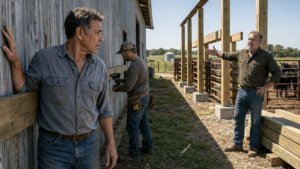
“No.”
He held out the board.
“I figured it belonged to you.”
Thomas took it.
The cedar was lighter than he remembered.
For weeks the cut section had seemed like the largest object on the farm. Now it was only a piece of lumber he could hold under one arm.
Beyond them, the new green agricultural screen ran along the lower boundary. The cattle barely noticed activity on David’s side anymore.
The screen worked.
That was the simplest fact left in the entire argument.
David looked past Thomas toward the pond.
“You ever going to answer me?”
Thomas knew what he meant.
“About why I didn’t build it higher.”
“Yes.”
Thomas opened the gate but did not invite him through.
Instead he stepped outside and closed it behind himself.
That was deliberate.
He noticed David notice.
“I didn’t need it higher,” Thomas said.
“You told me that already.”
“Then that’s part of the answer.”
David waited.
Thomas turned the cedar board over in his hands.
“The county would’ve let me build higher because of the agricultural approval. But the cattle didn’t need it. The service area didn’t need it. The farm didn’t need it.”
“And you didn’t want to punish me.”
Thomas looked toward the screen.
“I wanted to.”
David’s expression changed.
That was apparently not the answer he expected.
Thomas continued.
“For a while, I wanted every permitted foot of it.”
David looked down.
“I probably would’ve, in your place.”
“Maybe.”
“I was wrong to cut the fence.”
“Yes.”
David nodded once.
No explanation followed.
Thomas appreciated that.
A month earlier, every admission from David had arrived carrying a second sentence that weakened the first.
I shouldn’t have cut it, but the view was promised.
I should’ve asked, but I knew what you’d say.
This time there was only the admission.
Thomas rested the board against the gatepost.
“I was wrong about something too.”
David looked up.
Thomas could almost hear Anna telling him not to turn an apology into permission.
So he chose the words carefully.
“You were on my pasture before. Trimmed branches. Crossed the corner with contractors. Talked about the pond like the view was part of your place.”
David said nothing.
“I saw all of it.”
“I thought you were okay with it.”
“I know.”
Thomas looked at the ground between their boots, where the gate met the gravel lane.
“I kept thinking if I didn’t make a problem out of little things, we’d never have a big problem.”
David glanced at the cut board.
“That worked out.”
“No.”
Thomas almost smiled.
“No, it didn’t.”
The two men stood there for several seconds.
A cow moved along the inside fence and then turned away from the green screen without stopping.
Thomas watched her go.
“My father hated property feuds,” he said.
David leaned against the outside post.
“He have a lot of them?”
“Enough.”
Thomas remembered old arguments conducted from pickup windows. Survey stakes pulled and reset. Men refusing to wave at each other for twenty years over strips of grass neither one actually used.
“He told me not to start fights over things you could settle at a gate.”
David looked at the gate between them.
Thomas did too.
“I remembered the first half,” Thomas said. “Forgot the second.”
“What was the second?”
“Settle it.”
David rubbed one thumb along the edge of the cedar board.
“So if you’d told me earlier?”
“I don’t know.”
Thomas looked at him.
“Maybe you’d have gotten mad earlier.”
“Probably.”
“Maybe we’d still have ended up here.”
“Maybe.”
“But you’d have known.”
That answer stayed between them.
David looked toward his house.
The patio was finished now.
The new doors had been installed.
From the chairs nearest the house, the green screen occupied most of the western view.
Farther uphill, between two sycamores, a person could still see a narrow stretch of pond.
It was beautiful.
It was also clearly somewhere else.
“The seller did tell me it was shared,” David said.
“I believe you.”
“He said the previous owners had always kept that line open.”
“I believe that too.”
“I should’ve checked what that meant.”
“Yes.”
David breathed out through his nose.
“I heard what I wanted to hear.”
Thomas did not answer.
David continued.
“We had already stretched on the purchase. Then the renovation kept growing. Every time something went wrong, I kept looking at that view and thinking at least we had that.”
His eyes went toward the screen.
“When you repaired the opening, it felt like somebody had changed the deal after I signed it.”
“Nobody had a deal with me.”
“I know that now.”
The words contained no challenge.
Thomas picked up the cedar board again.
David reached into his jacket pocket and brought out an envelope.
Thomas stared at it.
“What is that?”
“Repair cost.”
“You already offered.”
“This isn’t an offer.”
David held it toward him.
Thomas did not take it immediately.
“I got the estimate amount from the copy you gave the deputy.”
Thomas looked at him.
“You talked to the deputy?”
“He called after you documented everything.”
Thomas had almost forgotten about that part. The sheriff’s deputy had taken information, photographed the damage, and told both men the matter could go farther if Thomas chose.
Thomas had decided not to pursue charges once the fence and land-use issues moved toward resolution.
David held the envelope out again.
“I damaged it. I pay for it.”
Thomas took the envelope.
He did not count what was inside.
“And I’m not asking you to change the screen,” David added.
Thomas looked at him.
“That doesn’t mean I like it.”
“I didn’t expect you to.”
“I still think it hurts the project.”
“It probably does.”
David nodded.
There was the remaining cost.
No miracle had appeared.
The guest property had not regained the patio view. Thomas had not decided to remove a panel because David finally became reasonable.
Some consequences stayed.
David looked through the bars of the gate toward the pasture.
“You know what bothers me?”
Thomas waited.
“I could’ve asked you before I bought.”
“That would’ve helped.”
“And you might’ve told me the fence could change.”
“Yes.”
David gave a small laugh.
“I probably wouldn’t have liked hearing it then either.”
“No.”
“But I would’ve known.”
Thomas felt something shift at that.
Not forgiveness exactly.
Recognition.
That was enough.
David straightened.
“Well.”
He glanced at the old board.
“You going to keep that?”
Thomas studied the rectangular cut.
“Yes.”
“For evidence?”
“No.”
David waited, but Thomas offered nothing more.
Eventually David nodded and walked back toward his property.
They did not shake hands.
Thomas did not invite him in.
David did not apologize again.
The distance between the two farms remained what it had always physically been.
Only now neither man pretended the line between them was invisible.
Before the next grazing season, Thomas replaced the temporary marker at the pasture gate.
He drove a simple steel post beside the surveyed line and attached a small reflective marker where equipment operators could see it from the lane.
Nothing decorative.
Nothing threatening.
Just clear.
Anna came down while he tightened the final bolt.
She looked at the marker.
“That for David?”
“For everybody.”
She looked toward the green screen.
“You keeping the old board?”
Thomas had leaned it inside the equipment shed.
“Yes.”
Anna smiled slightly.
“To remind you what he did?”
Thomas tested the marker with one hand.
“No.”
He looked across the pasture.
The pond lay beyond the cattle, catching afternoon light. From where Thomas stood, nothing blocked it.
The view had never changed from this side.
He thought about how many arguments began because people treated silence as agreement, patience as permission, or beauty as ownership.
Then he looked at the clean steel marker beside the gate.
“To remind me not to wait that long again.”
Anna nodded.
They started back toward the barn.
Behind them, the boundary was unmistakable now: fence, gate, marker, and the dark-green screen where the livestock area required it.
No opening framed the pond for the neighboring patio anymore.
No one had won everything.
David kept his renovated property but not the view he had counted on.
Thomas kept his boundary but had to admit that his own silence had helped blur it.
The pond remained where it had always been, inside the Walker pasture, reflecting a strip of open sky.
This time, nobody needed to cut a hole to understand where one property ended and the other began.
The story has ended.