The Severed Municipal Fire Main And The Flooded HOA Golf Cart
CHAPTER 6: THE ANATOMY OF A PUBLIC HAZARD
A Cobb County Sheriff’s patrol cruiser swung around the corner of Sweetwater Court, followed by a second utility truck from the water system carrying emergency excavation shoring.
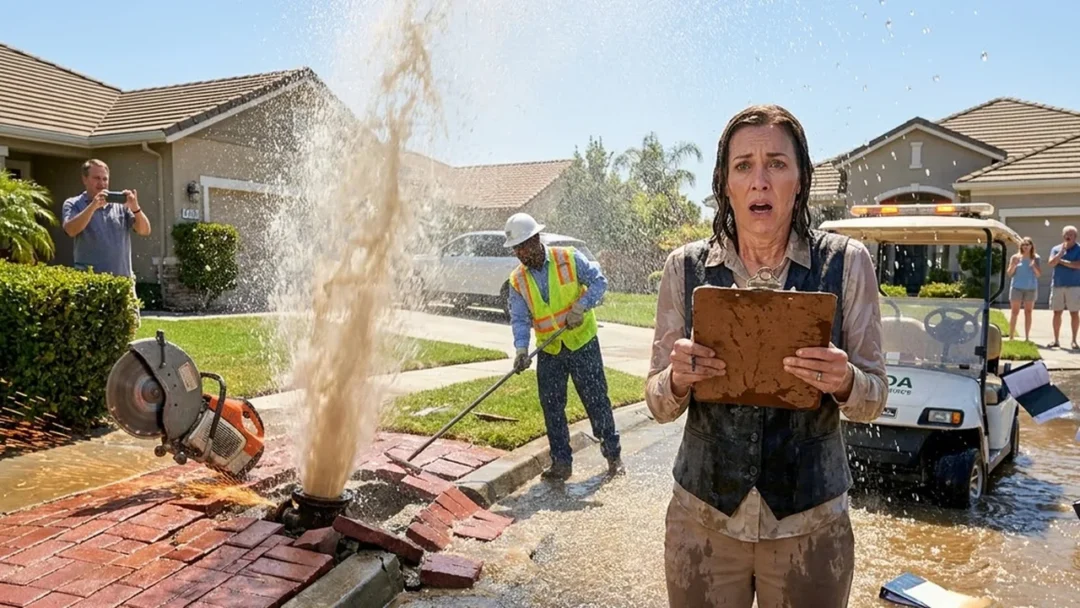
Deputy Amanda Cross stepped out of the cruiser, adjusting her tactical duty belt. At thirty-three, Deputy Cross was a sharp, observant road patrol deputy with specialized training in environmental property crimes and municipal code enforcement. She walked over to Chief Sterling, surveying the flooded street, the damaged golf cart, and the shattered brickwork.
“Chief, what do we have?” Deputy Cross asked.
Chief Sterling turned, his expression grim and uncompromising. “Deputy, we have a Class B emergency infrastructure failure caused by deliberate, unpermitted mechanical vandalism. By severing this primary valve stem, the suspect has forced the water department to isolate the primary eight-inch loop. As of five minutes ago, fifty-two residential homes on this ridge are completely without municipal water service, and three primary fire hydrants on Magnolia Trace have zero gallons per minute of available flow.”
Sterling looked directly at Regina Vance, his voice dropping into the grave register of formal public endangerment. “If a kitchen fire breaks out on this street in the next four hours, my pumpers will have zero hydrant pressure. We would have to establish a five-thousand-foot tanker relay up this hill. That constitutes an imminent, active threat to public safety.”
Deputy Cross knelt on the asphalt beside Regina, using the tip of her tactical pen to lift the soaked work order from the pavement. She read the embossed seal, the emergency order number, and the clear statutory warning printed at the bottom: “UNLAWFUL INTERFERENCE WITH MUNICIPAL FIRE SUPPRESSION INFRASTRUCTURE IS A FELONY UNDER GEORGIA CODE 16-7-22.”
She stood up and looked down at Regina. “Mrs. Vance, did you see this work order before you started that concrete saw?”
Regina swallowed hard, her mouth dry, her hands trembling violently in her mud-soaked lap. “I… I thought it was a fake. I thought the homeowner was lying to protect his landscaping. The HOA has rules about paver styles…”
“Step over here, Deputy,” Gregory Hayes called out calmly from his front walkway.
Gregory held up his smartphone, displaying the 4K video recording. “I have the entire encounter recorded in ultra-high-definition from the second she arrived in her golf cart. Audio and video are crystal clear.”
Deputy Cross walked over and watched the playback on Gregory’s phone.
The video showed Regina pulling up in her golf cart, screaming her demands, and reaching for the Husqvarna saw. It clearly captured Caleb Foster holding up the stamped county order, warning her that the line was a live municipal fire main. It captured Regina’s sneering slap that knocked the document to the ground, followed by her pulling the starter cord and deliberately driving the diamond blade into the paver cap until sparks erupted and the valve blew apart.
Deputy Cross watched the video twice, nodding slowly as the legal elements of the crime locked into place.
“Thank you, Mr. Hayes,” Deputy Cross said. “Please email that original file directly to the Cobb County Sheriff’s Evidence Intake portal. That recording is prima facie evidence of intentional, malicious destruction.”
Deputy Cross walked back to Regina, unhooking a heavy carbon-steel citation book and a pair of handcuffs from her belt.
“Regina Vance, stand up and step onto the sidewalk,” Deputy Cross commanded.
Regina struggled to her feet, her mud-caked tennis shoes slipping on the wet asphalt. “Wait! You can’t cite me! I’m the president of this association! I have an umbrella liability policy with State Farm! They’ll pay for the broken pipe!”
“State Farm will not pay for this, Mrs. Vance,” Deputy Cross said coldly. “And neither will your homeowners association.”
The statutory authority of a responding law enforcement officer at the scene of infrastructure destruction is comprehensive. Under Georgia Code Section sixteen-seven-twenty-two, criminal damage to public property involving utility infrastructure does not require proof of premeditated malice toward the government; it requires only the intentional commission of an unlawful act that damages public property. The presence of Gregory Hayes’s high-definition 4K video recording stripped away any possibility of legal ambiguity or creative defense posturing.
Deputy Amanda Cross had handled dozens of code enforcement disputes in Cobb County’s affluent subdivisions, but rarely had she encountered an individual who had documented their own criminal liability with such breathtaking clarity. The video showed every legal element: the formal presentation of the emergency work order, the suspect’s aggressive physical rejection of the mandate, the unpermitted deployment of industrial machinery, and the deliberate application of the cutting wheel against the marked utility sleeve. There was no defense of mistake, no plausible claim of accident, and no corporate shield that could protect Regina from personal criminal indictment.