The Farm Board Fined Everyone for Leaving Equipment Out—Until One Farmer Checked Their Own Yard
Chapter 1: The Fine Beside Betty’s Hay Barn
Gregory Hall took the photograph while Betty Green was still backing her tractor toward the trailer.
Andrew Carter saw the flash of Gregory’s phone from the adjoining hayfield road. Betty had one hand twisted around in the seat, looking over her shoulder as she eased the drawbar toward the tongue of a weathered sixteen-foot utility trailer. Two rolls of woven wire, a rusted gate, and several fence posts lay inside it.
Gregory stood twenty feet away in clean work boots and a brown canvas jacket, holding his phone upright.
“Hold on,” Betty called over the tractor engine. “I’m moving it now.”
Gregory lowered the phone, but not because she had asked.
“I can see that.”
Andrew slowed his pickup.
Betty shut off the tractor. The sudden quiet carried across the cut hayfield.
“What are you doing, then?”
“Documenting the violation.”
Andrew almost kept driving.
That was his usual instinct when two neighbors had found a reason to argue before breakfast. He had cattle waiting at the lower pasture and a broken latch on the north mineral feeder. Neither problem would improve because he stood beside the road listening to board business.
Betty spotted his truck.
“Andrew.”
That one word stopped him.
He rolled down the window.
Gregory glanced toward him. “Morning.”
Andrew nodded. “Morning.”
Betty climbed carefully from the tractor. At seventy-two she still did most of her own work, though she had learned to use the fender as a step and took an extra second before putting her weight on her left knee.
She pointed at the trailer.
“He says this is storage.”
Gregory answered before Andrew could.
“It was observed from the access road after six yesterday evening and again this morning.”
“I was using it.”
“The rule doesn’t say you have to abandon something for it to qualify.”
Betty gave Andrew a look that asked him to hear how ridiculous that sounded.
Andrew rubbed his thumb against the steering wheel.
The agricultural access board had sent revised notices in August. He had skimmed his copy between feed invoices and a machinery-parts catalog. Something about roadside appearance, obstructions, storage, and maintaining clear sightlines along the private roads that served the cluster of farms.
Most of it had sounded reasonable enough.
People had started leaving more equipment near the lanes over the last few years. Old combines with flat tires. Bale wagons half in the grass. A stock trailer that stayed beside a curve long enough for weeds to reach its axles.
Andrew disliked those things too.
Gregory walked to his pickup and returned with an envelope.
Betty stared at it.
“How much?”
“One hundred seventy-five.”
Andrew looked at Gregory.
“For that trailer?”
Gregory’s mouth tightened slightly. “For noncompliant exterior storage after prior notice of the revised enforcement schedule.”
Betty laughed once, without humor.
“One hundred seventy-five dollars for leaving a trailer beside my barn overnight?”
“It isn’t beside the barn.”
Gregory pointed toward the gravel lane.
“It’s inside the roadside management strip.”
Betty turned to Andrew. “Tell him where that strip ends.”
Andrew knew almost exactly where it ended. His father had helped lay out the access road decades earlier, before the current board existed. But knowing where an old line had been understood to run and knowing what the recorded paperwork now said were two different things.
Gregory seemed to read the hesitation.
“This isn’t about picking on Betty,” he said. “We’ve had complaints. Sightlines. Equipment left too close to the lane. Delivery trucks getting pinched. Insurance questions. If we don’t enforce the standard, then it isn’t a standard.”
That slowed Andrew’s irritation.
Three months earlier, a fertilizer truck had nearly clipped a parked hay rack at the western bend. Andrew had complained about it himself.
Gregory continued.
“I don’t enjoy writing citations. But if I make an exception because something is being used eventually, everyone has an exception.”
Betty folded the envelope in half.
“I was moving fence yesterday.”
“And you can appeal.”
“To the same board you chair?”
“To the board, yes.”
Betty looked at Andrew again.
“Come to the appeal meeting.”
Andrew immediately knew what she wanted. Not a lawyer. Not somebody to speak for her. Just another landowner willing to say the trailer had been in ordinary use.
He also knew what would happen if he agreed.
Gregory would produce the new policy. Betty would argue about the old understanding. Emma Baker would probably hear about it and arrive with three other complaints. A forty-minute meeting would become two hours. Somebody would bring up drainage. Somebody always brought up drainage.
Andrew had hay equipment to winterize.
“You should appeal it,” he said.
Betty waited.
He added, “I wasn’t here yesterday. I can’t say when you parked it.”
Her expression changed only a little.
“I didn’t ask you to.”
Andrew felt heat rise under his collar.
Gregory tucked his phone into his jacket.
“If you want, Betty, I’ll make sure your appeal is on next Monday’s agenda.”
“How generous.”
Gregory let that pass.
Andrew shifted his truck into gear.
“I’ve got cattle waiting.”
Betty stepped back from the lane.
“Of course you do.”
He drove away before the sentence could become anything else.
For the rest of the morning, Andrew told himself Gregory had at least made one good point. A rule applied badly was still not the same thing as a rule without purpose. Betty should have moved the trailer farther from the road. Gregory could have warned her first. Both things could be true.
That was the sort of conclusion Andrew preferred: balanced enough that nobody could reasonably ask him to do anything.
Near noon, his hired hand asked why Betty had been standing by the lane holding a piece of paper.
“Board nonsense,” Andrew said.
He heard his father’s voice in the phrase that followed in his own head.
Keep the farm working, not political.
His father had said that whenever meetings got ugly. Road district. Drainage disputes. Township assessments. He had believed that work had a way of clarifying what arguments made complicated.
Andrew had built much of his adult life around the same idea.
By evening, Betty’s trailer was gone.
The gravel strip looked wider without it.
Andrew noticed that and disliked himself for noticing.
The following morning, he drove toward the lower pasture just after six. Something white fluttered against his front gate.
He stopped.
A clear plastic sleeve had been clipped beneath the chain.
Inside was a board envelope.
Andrew opened it where he stood.
The first page carried a timestamped photograph of his own hay trailer.
Chapter 2: The Trailer Gregory Photographed Twice
The photograph had been taken at 7:43 the previous evening.
Andrew knew because the time was printed beneath the image.
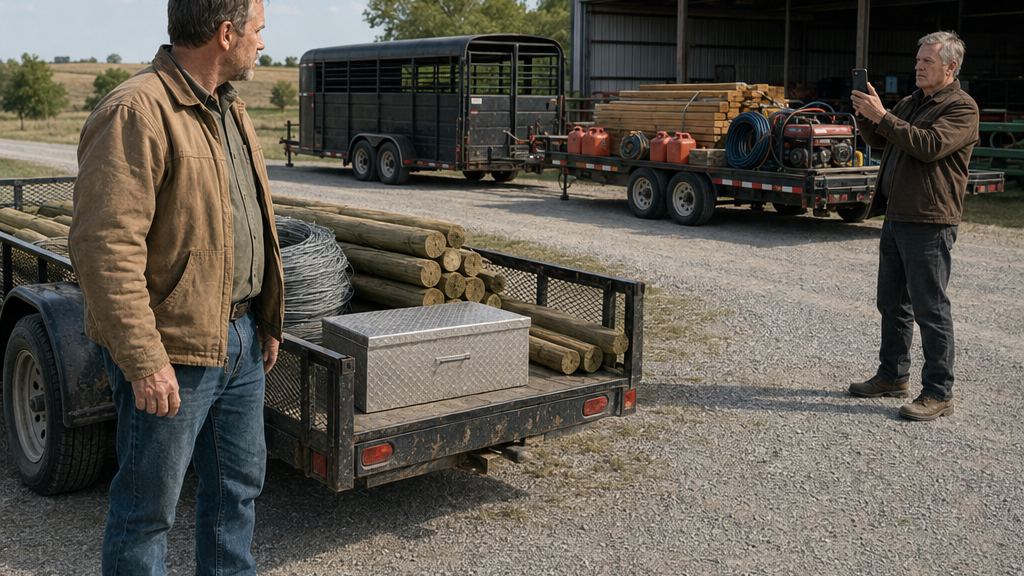
His utility trailer sat exactly where he had left it: on the lower equipment lane, loaded with two coils of barbed wire, cedar posts, a steel toolbox, and the yellow fencing jack he intended to use after breakfast.
The citation was for two hundred twenty-five dollars.
He read it twice.
Then he looked over the gate toward the trailer, as if it might somehow appear guiltier now that somebody had assigned a dollar value to it.
Gregory’s second photograph had been taken at 5:58 that morning.
The trailer had not moved.
That, apparently, was the problem.
Andrew folded the notice and drove straight to the lower lane instead of the pasture.
Gregory was there.
He stood beside his pickup with his phone out again.
“You beat me to it,” Andrew said.
Gregory lowered the phone.
“I figured you’d see the notice.”
“I’m using that trailer today.”
“I don’t doubt it.”
“Then how is it storage?”
“The rule doesn’t distinguish by intention.”
Andrew stared at him.
“That sentence sounded stupid yesterday too.”
Gregory’s face hardened, but his voice stayed level.
“The equipment has to be returned behind the designated setback after use.”
“It was dark when we quit.”
“Then it should’ve been moved this morning before the inspection window.”
Andrew looked at the time on his phone.
“Before six?”
Gregory shrugged slightly. “The rules went out to everybody.”
Andrew wanted to say what Betty had said. He almost did.
Instead he held up the citation.
“I’ll appeal it.”
“That’s your right.”
“And I’m not paying it before the appeal.”
“The notice explains the process.”
Andrew turned away.
He had reached his truck when another pickup rattled down the lane and stopped half on the gravel. Emma Baker leaned out her window.
“I heard you joined the club.”
Andrew looked at her.
“What club?”
She held up a yellow envelope.
“The people Gregory thinks own too many objects.”
Gregory exhaled sharply.
“Emma.”
She got out.
“My hose cart was visible beside the machine shed.”
Gregory said, “It was left inside the frontage zone.”
“For nine hours.”
“It had been warned before.”
“And the wrapped fence rolls?”
Andrew glanced at her.
“Fence rolls?”
Emma pulled another folded notice from her jacket pocket.
“Last month. Two rolls of high-tensile wire near the drive.”
“That was you?”
“One hundred fifty dollars.”
Gregory crossed his arms.
“We are not going to retry every citation on a gravel road.”
Emma pointed toward Andrew’s trailer.
“Fine. Let’s just do today’s.”
Andrew followed her gesture.
Then his eyes carried beyond his own trailer, across the shared lane toward the board-controlled maintenance yard.
He had passed the yard hundreds of times.
That morning he actually looked at it.
A white enclosed trailer stood beside the metal equipment shed. Next to it sat a longer flatbed loaded with lumber, orange road cones, coiled hose, a portable generator, fuel cans, hand tools, and a stack of treated planks secured beneath a faded tarp.
Both were plainly visible from where Gregory stood.
Andrew looked back at his own trailer.
Then at Gregory.
“What about those?”
Gregory did not need to ask what he meant.
“Board equipment.”
Andrew waited.
Gregory added, “Operational use.”
Emma gave a short laugh.
“Operational use.”
“Yes.”
Andrew walked into the center of the gravel lane.
From there he could see all three trailers at once.
His was smaller than either of the board’s. His fencing supplies sat below the rails. The board’s flatbed was stacked nearly shoulder high.
“So mine isn’t operational?”
“Yours is privately stored equipment in the frontage management area.”
“And those?”
“Association equipment supporting road and common-property maintenance.”
“Show me where the rule says that.”
Gregory’s jaw shifted.
“It’s been the board’s interpretation since the policy was adopted.”
Andrew reached into his pocket.
Gregory watched him pull out his phone.
Andrew stood where Gregory had been standing when he photographed the citation.
He framed his own trailer first.
Then, without moving his feet, he turned slightly and photographed the two board trailers across the lane.
No one spoke.
Emma looked from the screen to Gregory.
“That’s about as clean a comparison as you’re going to get.”
Gregory stepped toward Andrew.
“If you think this is some kind of trick—”
“It isn’t.”
Andrew put his phone away.
“I’m asking for the rule.”
“You’ll get it.”
“Good.”
Gregory’s voice cooled.
“And if the rule confirms what I told you?”
“Then I’ll move my trailer farther back and pay whatever I owe.”
Emma looked sharply at him.
Andrew ignored her.
Gregory seemed almost surprised.
“That simple?”
“It should be.”
For the first time that morning, Gregory’s expression eased.
“That’s all I’ve been trying to get people to understand. This isn’t personal.”
Andrew glanced at the board trailers.
“That depends on what the paper says.”
By noon he had moved his own trailer behind the marked gravel setback. Not because Gregory had won the argument, but because fencing still needed to be done and Andrew did not intend to turn an equipment lane into a battlefield.
Emma met him near the north fence after lunch.
“You really going to pay him if there’s some exemption?”
“If there’s actually an exemption.”
“You know there won’t be.”
“I know what I’ve seen. That isn’t the same thing.”
She tossed a fence staple into the bucket harder than necessary.
“That’s why he gets away with it.”
Andrew stopped setting a post.
“What’s that supposed to mean?”
“You always need one more piece of proof.”
“That’s usually better than being wrong.”
“And sometimes it’s just a polite way to stay out of things.”
The remark landed closer than Andrew liked.
He drove the post another inch into the soil.
“Did you appeal your fines?”
“The first one.”
“What happened?”
“They reduced it fifty dollars and told me the rule had to be consistent.”
Andrew looked toward the distant maintenance shed.
“Consistent.”
“That was the word.”
At four thirty, an email from the board arrived on Andrew’s phone.
Attached was a scanned copy of the agricultural access covenant and the later enforcement policy.
He printed both after supper.
The pages spread across his kitchen table beneath the yellow light, weighted at one corner by a salt shaker and at another by his fencing pliers.
Andrew found the storage provision.
He read it once.
Then again more slowly.
Trailers, implements, materials, and mobile equipment were to be kept beyond the designated frontage setback when not in active use.
He searched for “board.”
Nothing.
“Association.”
Nothing useful.
“Operational.”
The word appeared twice, neither time as an exemption.
Andrew went back through every page.
At 10:16, he drew a circle around the paragraph Gregory had cited.
There was no exception for board equipment anywhere on the page.
Chapter 3: The Rule That Wasn’t on the Page
By eleven that night, Andrew had circled the same empty space three times.
Not a blank line. Not a missing paragraph.
An absence.
The covenant defined frontage setbacks. It defined temporary obstructions. It defined farm access, emergency clearance, seasonal machinery, drainage easements, and even the minimum turning width required at the shared maintenance road.
It never said board property was exempt.
Andrew laid Gregory’s citation beside the printed photograph of his trailer.
Then he placed his own phone beside it, screen showing the board trailers photographed from the same spot.
For once, the problem did not look complicated.
That made him suspicious.
The next morning he called the county zoning office.
The clerk listened to his explanation without interrupting.
“This is a private covenant?” she asked.
“Partly. But the road ties into county frontage, and the board keeps talking about safety requirements.”
“Those are two different things.”
“I figured.”
“If you want to know what county code applies, bring the parcel numbers.”
Andrew looked at the clock.
“I can be there in forty minutes.”
The county office occupied a low brick building beside the highway department garage. Andrew arrived in work clothes with dust still on his boots and a folder tucked under one arm.
The clerk pulled up a parcel map.
“This your property?”
Andrew pointed.
“And that’s the maintenance yard.”
She clicked the adjoining parcel.
The highlighted boundary extended around the metal shed and both trailer spaces.
“Same agricultural access district,” she said.
“Same covenant boundary too?”
“I can’t interpret a private covenant for you. But the recorded plat shows the parcel inside the same development boundary.”
Andrew leaned closer.
“So there’s no separate public-maintenance parcel?”
“Not according to this.”
She printed the map.
He tapped the road.
“What about storage?”
“For county purposes, visibility by itself isn’t generally the issue out there.”
That made him straighten.
“What is?”
“Clearance. Sight distance. Drainage. Whether equipment blocks a required access area. Hazardous material has its own rules.”
“So a trailer can be ugly?”
The clerk almost smiled.
“County code does not regulate ugliness in the way you seem to mean.”
Andrew thought of Gregory photographing Betty’s trailer while she backed toward it.
The clerk continued.
“Private covenants can be stricter than county code. Just because the county allows something doesn’t mean your recorded agreement does.”
There it was—the complication he had expected.
Andrew nodded.
“And if the board has its own equipment inside the same boundary?”
“Then whether the covenant applies to them depends on the covenant.”
“Not on what they’ve always done.”
“That would be a question for whoever interprets or enforces the agreement.”
Andrew left with less certainty than he had hoped for and more than he had arrived with.
That afternoon he drove the access roads slowly.
At Betty’s entrance, he stopped where Gregory had photographed her trailer.
The gravel shoulder narrowed near the ditch. If the trailer had sat where Andrew remembered, one wheel might indeed have been inside the management strip.
He pictured a feed truck meeting a tractor there.
Gregory had not invented the danger.
That bothered Andrew because it ruined the clean version of the story Emma preferred.
He drove on.
At the western bend, faded tire tracks showed where heavy trucks swung wide. A stack of abandoned pallets sat well beyond the setback, ugly but harmless. Near another farm, an old bale wagon rested too close to the ditch and forced a delivery truck toward the center of the lane.
Rules had reasons.
The question was whether Gregory had turned one reason into permission to control everything visible from the road.
Back home, Andrew called the agricultural-extension office and described the covenant language without giving names.
The officer there said what the county clerk had said in a different way.
“Working farms need room to look like working farms.”
Andrew wrote that down.
“But shared access still has to function,” the officer added. “A good rule measures the problem. Distance. Clearance. Duration. Sightline. Something people can actually comply with.”
“What about ‘appearance’?”
“That’s harder to administer fairly unless the language is very specific.”
By Thursday evening, Andrew had built two columns on a legal pad.
Safety.
Appearance.
Under safety he wrote: road clearance, sightline, drainage, emergency access.
Under appearance: visible trailer, hose cart, fence rolls, materials.
Betty’s case sat between the columns.
His own did not.
Neither, as far as he could tell, did Emma’s hose cart.
Friday morning he returned to the county office with the recorded covenant rather than the board’s scanned copy.
The clerk compared the recording number.
“Same document.”
“And this parcel?”
She tapped the maintenance yard again.
“Inside the boundary.”
Andrew placed the two trailer photographs beside the map.
The clerk looked at them but did not offer an opinion.
He did not ask her to.
He had what he needed for the next step, not the last one.
Back at his kitchen table, he highlighted the covenant provision in yellow and the county access requirements in blue.
The two systems overlapped, but they did not say the same thing.
The board could enforce a stricter private standard if the covenant authorized it.
What it could not do, Andrew increasingly believed, was invent an exemption for itself that nobody else could find.
He sent a written request that afternoon.
Not an accusation.
A request.
He asked for the board’s interpretation establishing the operational-use exemption, the parcel basis for treating board equipment differently, and the enforcement records for storage-related citations issued under the revised policy.
Samuel Thompson called twenty minutes later.
Andrew had known Samuel most of his life. Samuel handled the board’s accounts because he was patient with numbers and disliked public speaking enough that nobody had ever considered him a threat.
“I got your request,” Samuel said.
“Good.”
“I can send you the policy history and meeting minutes.”
“And the enforcement records?”
A pause.
“Not the full ledger.”
“Why?”
“It contains payment information.”
“Redact the private parts.”
Another pause.
“That’s not something I can authorize by myself.”
“You’re the treasurer.”
“I’m aware of what I am.”
Andrew sat back.
“Samuel, I’m not asking who paid late. I’m asking how many citations were issued under this interpretation and what they were for.”
“I understand.”
“Then why can’t I see it?”
Samuel lowered his voice, though Andrew had no idea who might be near him.
“Because once you start pulling individual entries out of that ledger, this stops being about one trailer.”
Andrew looked at the photographs spread across his table.
“I think it stopped being about one trailer before I ever got fined.”
Samuel said nothing.
Andrew waited.
Finally Samuel answered.
“Put it formally on the agenda.”
“I already made a formal records request.”
“I mean the board agenda.”
“And then?”
“Then we deal with it in the room.”
Andrew frowned.
“What are you protecting?”
Samuel’s answer came slowly.
“I’m trying to keep from telling you something I don’t have the authority to tell you.”
The line clicked dead a few seconds later.
Andrew remained at the table, staring at the yellow-highlighted covenant.
For the first time, the missing exemption was no longer the thing bothering him most.
The board had a ledger.
And Samuel Thompson did not want Andrew to see it.
Chapter 4: The Ledger Nobody Wanted Opened
Gregory Hall was waiting beside Andrew’s pickup when Andrew came out of the feed shed.
He had no clipboard, no phone, no envelope. That bothered Andrew more than if he had brought all three.
“Got a minute?”
Andrew set a mineral block on the tailgate.
“One.”
Gregory glanced toward the hired hand working near the pens.
“Privately.”
Andrew left the tailgate down and walked with him toward the equipment shed.
Gregory stopped where the windbreak blocked most of the yard from view.
“I can void your citation.”
Andrew said nothing.
“The trailer fine. Two twenty-five. I’ll mark it as a first-week enforcement error.”
“You told me yesterday the rule was clear.”
“It is.”
“Then why was the citation an error?”
Gregory’s patience tightened.
“Because you moved the trailer immediately, and because this has become more trouble than the violation is worth.”
Andrew looked at him.
“And my records request?”
“That’s what I wanted to discuss.”
There it was.
Gregory shoved his hands into his jacket pockets.
“The board’s dealing with road resurfacing, ditch work, and two insurance renewals. If you start demanding years of citation records over one trailer, you’re going to turn an administrative issue into a community fight.”
Andrew thought of Betty beside her tractor.
“It was already a community issue.”
“It wasn’t until people started comparing things that aren’t comparable.”
“Board trailers and private trailers?”
“Exactly.”
Andrew almost smiled.
Gregory noticed.
“You think that’s clever?”
“No. I think it’s a sentence worth hearing twice.”
Gregory’s voice dropped.
“The maintenance yard exists to keep these roads usable. The equipment there serves everyone.”
“And mine serves my farm.”
“That’s not the same thing.”
“Show me where the covenant says it isn’t.”
Gregory looked toward the lane.
“I’m offering you a way to end this.”
Andrew understood then that Gregory genuinely believed he was being reasonable.
That was worse than anger. Anger could be waited out.
“You’re offering to fix mine.”
“Yes.”
“What about Betty’s?”
Gregory shook his head. “Different facts.”
“Emma’s?”
“Also different.”
“And the others in the ledger?”
Gregory’s eyes came back to him.
“You don’t know what’s in that ledger.”
“No. Samuel made sure of that.”
The muscles at the side of Gregory’s jaw moved.
Andrew picked up the mineral block again.
“Keep the fine.”
Gregory frowned.
“I’m appealing it.”
“That’s not what I mean.”
“I know.”
Andrew carried the block toward his truck.
“I want the records.”
By afternoon, half the road seemed to know about the conversation.
Emma arrived while Andrew was repairing a gate chain.
“He offered to cancel yours?”
“Who told you?”
“Does it matter?”
“Yes.”
She folded her arms.
“Betty.”
That stopped him.
Andrew set the pliers down.
“Betty wasn’t there.”
“Gregory told somebody. Somebody told somebody else. Welcome to living within six miles of everyone you’ve ever argued with.”
Andrew looked past her toward Betty’s property.
“What did she say?”
“That you should’ve taken the deal.”
He blinked.
Emma smiled faintly.
“Surprised?”
“A little.”
“She said at least then somebody would get their money back.”
“That wasn’t money back. That was Gregory making one problem disappear.”
“I know.”
Emma nudged the gatepost with her boot.
“She also told me you wouldn’t come to her appeal.”
Andrew’s hand stopped on the chain.
“I told her to appeal.”
“That isn’t what I said.”
He looked at Emma.
“You want to have this argument too?”
“No. I want you to understand why people aren’t automatically going to see you as the man saving everybody from Gregory.”
“I never said I was.”
“Good.”
She walked away before he could answer.
The remark stayed with him.
That evening, Andrew attended the board’s regular work session for the first time in nearly two years.
Gregory sat at the end of a folding table inside the maintenance office. Samuel had a calculator beside a stack of invoices. Two other board members sorted papers relating to gravel and drainage.
Nobody looked pleased to see Andrew.
Gregory opened the meeting with road expenses.
Andrew listened.
A culvert replacement had cost nearly twice the estimate. Gravel prices were up. One insurer had warned the board that recurring obstructions along access roads could complicate coverage if emergency vehicles could not maintain clearance.
Gregory slid a photograph across the table.
It showed a hay wagon parked near the western bend, forcing a delivery truck across the road center.
“This,” Gregory said, “is why the policy exists.”
Andrew studied it.
He had seen that wagon.
Gregory looked around the table.
“If we wait until somebody gets hit, everyone will ask why the board didn’t enforce the rules we already had.”
For several seconds, Andrew had no answer.
The photograph did not excuse the board trailers. It did not explain Emma’s hose cart.
But it made Gregory’s fear real.
Andrew pushed the picture back.
“That one’s a road-clearance problem.”
“It’s a storage problem.”
“No. That’s the point.”
Gregory stared at him.
“If you call everything storage, you don’t have to prove it’s dangerous.”
The two unnamed board members stopped sorting papers.
Samuel kept his eyes on his calculator.
Andrew placed copies of the covenant and county map on the table.
“The recorded rule talks about active use, obstruction, and the frontage setback. It doesn’t say the board gets an operational exemption.”
Gregory replied immediately.
“That interpretation predates me.”
“Then there should be minutes.”
“There are.”
“Good. Give them to me.”
Samuel finally spoke.
“We discussed inconsistent enforcement in March.”
The room went still.
Gregory turned his head.
“Samuel.”
Samuel’s fingers rested on the calculator.
“He asked for history.”
“That isn’t what we discussed.”
“We discussed whether the same standard was being used on all parcels.”
Andrew leaned forward.
“What happened?”
Samuel looked uncomfortable.
“We didn’t change anything.”
“Why?”
One of the board members said, “Because we were in the middle of the road-maintenance renewal.”
Samuel nodded.
“There was concern that changing enforcement language at the same time would make it look like we were weakening the access standard.”
Gregory cut in.
“We agreed the maintenance-yard equipment was categorically different.”
“You agreed,” Samuel said.
Gregory’s chair scraped slightly against the floor.
Andrew watched them.
This was not a hidden conspiracy.
It was something more ordinary.
They had noticed the problem.
They had postponed it.
Then enforcement had continued.
Samuel looked at Andrew.
“This started before your trailer.”
The words settled heavier than Andrew expected.
He thought of Betty asking him to attend her appeal.
He had postponed that too.
Gregory leaned back.
“You want to blame me because the board chose continuity?”
“No.”
Andrew’s answer surprised everyone, including him.
“I’m trying to figure out which fines the actual rule supports.”
Gregory gave a dry laugh.
“That’s what I’ve been doing for years.”
“Then the records should help.”
Samuel closed his calculator.
“I can put the ledger before the board at the public meeting.”
Gregory looked sharply at him.
“All of it?”
“Redacted payment details. Citation type, parcel, amount, outcome.”
One of the board members shifted uneasily.
“That could get ugly.”
Andrew looked at the table.
“It already is.”
A voice came from the open doorway.
“Some of us figured that out sooner.”
Betty stood there.
Andrew felt the blood drain from his face.
She had come for her scheduled appeal.
The yellow fine notice was folded in her hand.
Gregory invited her inside.
Betty did not look at him.
She looked at Andrew.
“You find anything useful in all those papers?”
“Some.”
“Good.”
She placed her citation on the table.
“Would’ve been useful last week.”
Andrew had no defense that did not sound like one.
“I should’ve come.”
Betty’s expression softened just enough to make the admission hurt more.
“Yes.”
The meeting continued, but something in Andrew had shifted.
He had arrived believing the records would divide the room neatly between people who had enforced the rule and people who had suffered under it.
Instead he had found Gregory with a legitimate safety problem, Samuel with a silence of his own, and Betty holding up a mirror Andrew had not expected.
When the meeting ended, Samuel caught him beside the door.
“Public meeting is Thursday next week.”
Andrew nodded.
Samuel looked back toward Gregory, then at Andrew again.
“I’ll bring the ledger.”
Chapter 5: Seventy-Two Hours at the Equipment Yard
The county inspector stretched a measuring tape from the edge of the gravel road to the left wheel of the board’s flatbed trailer.
Gregory stood three feet away with his arms crossed.
Andrew stayed beside his pickup.
He had made the complaint. He had no intention of hovering over the inspector as if enthusiasm could improve the measurement.
“Eleven feet, six inches,” the inspector said.
Gregory answered immediately.
“That’s not an active travel lane.”
“No.”
The inspector reeled in the tape.
“It’s part of the required clear zone at this approach.”
Gregory pointed toward Andrew.
“His trailer was closer than that last week.”
Andrew said, “And I moved it.”
The inspector looked between them.
“I’m not here to compare personalities.”
Emma, standing farther down the lane, covered a smile with one hand.
Gregory did not.
The inspector walked to the enclosed white trailer next. He checked the parcel map, measured from the road, then looked toward the ditch.
“Drainage access is also tight here.”
“That trailer has been there three years,” Gregory said.
“That doesn’t make it farther from the road.”
“It supports maintenance operations.”
“I understand.”
“So it’s exempt.”
The inspector looked at the paperwork.
“Show me the exemption.”
For the first time since Andrew had begun asking the same question, Gregory had nothing ready.
He walked to the office and returned with a binder.
Pages turned.
The inspector waited.
Gregory found the board policy, then the covenant.
He pointed at language concerning maintenance authority.
“This gives the board the right to maintain common facilities.”
“It does.”
“And store equipment necessary for that purpose.”
The inspector read the paragraph.
“It says you can maintain facilities. I don’t see storage-setback relief.”
Gregory’s voice sharpened.
“That has always been the interpretation.”
“For your private agreement, that’s a board matter.”
The inspector tapped the map.
“For county-required access and drainage clearance, it isn’t.”
Andrew felt a quick pulse of satisfaction.
Then he looked at Gregory.
The older man did not look caught.
He looked worried.
That mattered.
“What happens now?” Andrew asked.
The inspector wrote on a form.
“Correct the clearance issues or demonstrate an applicable exemption.”
“How long?”
“Seventy-two hours.”
Emma let out a quiet breath.
Gregory stared at the two trailers.
“Both?”
“Both.”
The inspector tore off a copy.
Gregory took it without speaking.
Andrew could have said something then.
He could have reminded Gregory of Betty’s deadline. Or his own. Or the photograph taken before six in the morning.
Instead he said, “If the board needs somewhere temporary to put the equipment, I’ve got space behind my machine shed.”
Gregory looked at him as if he had misheard.
Emma did too.
Andrew shrugged.
“It clears the road.”
“We don’t need your charity.”
“It isn’t charity.”
Gregory folded the notice.
“We’ll handle it.”
By the following afternoon, nothing had moved.
A few neighbors slowed as they passed the maintenance yard.
Andrew hated that part.
He had wanted the rules examined, not the place turned into a roadside spectacle.
Emma called him that evening.
“You should take a picture.”
“I already have pictures.”
“I mean now. With the notice.”
“No.”
“Why?”
“Because the inspector documented it.”
“You’re getting soft.”
“I’m getting tired.”
She was quiet for a moment.
Then she said, “Fair.”
At dawn on the second day, Andrew heard a diesel engine on the shared road.
He drove down after feeding cattle.
An equipment driver was backing a truck toward the flatbed. Gregory stood nearby guiding him with one arm.
The white enclosed trailer had already been moved.
Only two pale rectangles remained in the gravel where its tires had rested.
Andrew stopped at the entrance.
Gregory looked over.
Neither man spoke until the driver had hitched the flatbed.
Then Gregory walked toward him.
“You happy?”
“No.”
Gregory gave him a skeptical look.
“You filed the complaint.”
“Yes.”
“You got exactly what you wanted.”
“I wanted the same rule used on the same land.”
“And now the board spends money moving equipment that’s been serving these roads for years.”
Andrew glanced at the empty space.
“Then the replacement rule should give you a legal place to put it.”
Gregory shook his head.
“You still think this proves those citations were wrong.”
“It proves your exemption wasn’t real.”
“For county clearance.”
“And the covenant?”
“That question hasn’t been decided.”
Andrew could not argue with that.
Gregory saw it.
“Your photograph makes a good point,” he said. “It does not make every person we fined innocent.”
“I didn’t say it did.”
“Emma does.”
“I’m not Emma.”
“No.”
Gregory looked toward Betty’s farm.
“And Betty?”
Andrew did not answer.
Gregory continued.
“She had a trailer inside a narrow approach. You know that.”
“I do.”
“You think I should refund her?”
“I think the board should decide what part of her fine was for safety and what part was for looking at a trailer from the road.”
Gregory studied him.
“You’ve changed your argument.”
“I learned something.”
“That’s convenient.”
“So is calling everything storage.”
For a second, Gregory almost smiled.
Almost.
The driver pulled the flatbed onto the road.
Its load of lumber, hose, cones, and tools rattled as it passed the place where Andrew’s trailer had been photographed the week before.
Andrew watched it go.
He had imagined this moment more than once.
In those versions, the empty gravel spaces had felt like proof.
Instead they looked like empty gravel spaces.
Betty still had a fine.
Emma still had two.
Andrew’s own appeal was unresolved.
And somewhere inside Samuel’s office sat years of numbers that would decide whether the problem was a handful of bad calls or something larger.
Gregory seemed to read part of that in his face.
“Removal doesn’t rewrite history.”
“No.”
Andrew put his hands into his coat pockets.
“But it makes Thursday harder for you.”
Gregory’s expression closed.
“For all of us.”
That afternoon the board posted notice of the public meeting.
Andrew spent the next two days sorting his material into three piles.
County requirements.
Recorded covenant.
Board interpretation.
He deliberately removed photographs that proved nothing except that a trailer looked messy.
By Thursday, he had six photographs he could defend, three maps, and a single highlighted copy of the covenant.
Emma wanted him to bring every citation she had received.
“Bring them yourself,” Andrew told her.
“You’re presenting the pattern.”
“I’m presenting what I know.”
She stared at him across the hood of his truck.
“You really can’t just pick a side, can you?”
“I picked one.”
“Which?”
“The rule should mean what it says.”
“That isn’t a side.”
“It is if enough people prefer what they wish it said.”
She shook her head, but she gathered her own papers.
The public meeting was still hours away when Andrew parked beside the maintenance office.
He sat in the cab checking the covenant one last time.
A knock sounded against the passenger window.
Samuel stood outside holding a thick black ledger.
Andrew unlocked the door.
Samuel climbed in and placed the book between them.
Its corners were worn white.
Andrew looked at him.
“I thought you were bringing it to the meeting.”
“I am.”
Samuel kept his hand on the cover.
“But you should know what you’re asking before you open it in front of everybody.”
Andrew waited.
Samuel removed his hand.
The ledger lay between them.
“Go ahead.”
Chapter 6: Four Thousand Eight Hundred Dollars
The first number Andrew noticed was not a fine.
It was the total at the bottom of a column.
$4,800.
He stared at it long enough that Samuel finally said, “That’s the storage-category total since the revised enforcement schedule started.”
Andrew turned the ledger slightly toward the window.
There were entries for trailers, implements, bins, fencing materials, portable tanks, hose equipment, and miscellaneous exterior storage. Some had been reduced on appeal. Some had been canceled. Most had been paid.
“Four thousand eight hundred dollars.”
“Yes.”
“How many people?”
Samuel pointed to the redacted parcel column.
“More than I’m comfortable summarizing without counting.”
Andrew flipped back several pages.
Betty’s citation was there.
Emma’s too.
His had already been entered as pending.
Andrew looked up.
“Why didn’t you want me to see this?”
Samuel rested both hands on his knees.
“Because once this number gets said out loud, people will stop listening to what the entries actually mean.”
“What do they mean?”
“That some were wrong.”
Andrew waited.
“And some weren’t.”
Samuel pulled one sheet from the ledger pocket.
“Look.”
One citation involved a stock trailer left near a blind curve for eleven days. Another involved stacked irrigation pipe extending into the maintained shoulder. A third described machinery blocking access to a drainage inlet.
Andrew read them slowly.
“These are safety problems.”
“Yes.”
“They’re listed under storage.”
“Yes.”
Andrew leaned back.
“So the board used one category for two different problems.”
“That’s part of it.”
“And the other part?”
Samuel looked toward the meeting hall.
“Gregory was warned in March that appearance-only enforcement was getting mixed with access enforcement.”
“You said that last week.”
“I didn’t tell you the rest.”
Andrew closed the ledger.
Samuel’s voice became quieter.
“I agreed to leave it alone.”
There it was.
Not a dramatic confession.
Just a man admitting where he had chosen convenience.
“Why?”
“Road contract was falling apart. Insurance renewal was coming. Gregory said if we reopened enforcement at the same time, half the district would treat every clearance notice as optional.”
“And you believed him.”
“I believed it could happen.”
Samuel looked at the ledger.
“I also believed we’d fix the language afterward.”
“You didn’t.”
“No.”
Andrew thought of the sentence he had used on Betty.
Her paperwork.
Samuel had said essentially the same thing to himself, only with larger consequences.
People began arriving.
By seven, the meeting room was full enough that chairs had been brought from the office.
Betty sat in the second row. Emma sat beside her with a folder on her lap.
Gregory opened the meeting.
No speeches.
No attempt to soften the reason everyone had come.
“The storage-enforcement policy is under review,” he said. “We’ll take comments after the records presentation.”
Samuel placed the ledger on the table.
Andrew had not planned to speak first, but Gregory looked at him.
“You requested the review.”
Andrew stood.
He placed two photographs on an easel.
His trailer on one side.
The board flatbed on the other.
A low murmur moved through the room.
Andrew pointed to the images.
“These were taken from the same place.”
He did not say hypocrisy.
He did not need to.
“The board cited mine. The board treated theirs as operational equipment. We checked the recorded covenant and county parcel boundaries. I couldn’t find a written exemption for board equipment.”
Gregory said, “The county notice dealt with road and drainage clearance.”
Andrew nodded.
“That’s right.”
The room quieted slightly.
Emma turned toward him, surprised.
Andrew continued.
“That matters because not every storage citation is the same.”
He opened the ledger.
“Some things in here were real access problems.”
He described the stock trailer near the blind curve.
The irrigation pipe.
The blocked drainage inlet.
A farmer in the back of the room muttered that nobody should have left equipment there.
Andrew heard agreement.
Gregory’s posture eased slightly.
Then Andrew said, “But other entries are for things that were visible, not dangerous.”
He held up Emma’s hose-cart citation.
“Nothing here says it blocked the road.”
He lifted another.
“Wrapped fence wire behind a driveway.”
Then Betty’s.
“Trailer near the frontage strip. This one is harder.”
Betty stood.
Andrew stopped.
She faced the room.
“My trailer was too close to the lane.”
Emma looked at her.
Betty continued.
“Not every time Gregory photographed it. But that morning, yes. I was moving it because I knew it was.”
Gregory said nothing.
Betty looked toward Andrew.
“I still think one hundred seventy-five dollars was too much for something I was already hitching.”
A few people murmured agreement.
“But if you’re going to fix this,” she said, “fix what’s wrong. Don’t pretend none of us ever left anything where it shouldn’t have been.”
She sat down.
The clean argument Andrew could have made vanished.
In its place was a better one.
He looked at the room.
“Betty asked me to come to her appeal.”
She met his eyes.
“I didn’t.”
No one moved.
“I told myself it was her citation, her paperwork, her problem. Then I got fined and suddenly I had time to read every page.”
Emma lowered her eyes.
Andrew touched the ledger.
“So I’m not asking this board to declare everybody innocent. I’m asking it to separate actual safety enforcement from appearance enforcement, apply the same rule to board property, and review money collected under language that wasn’t being applied consistently.”
Samuel turned the ledger toward the board.
“The total collected in the category is four thousand eight hundred dollars.”
The number moved through the room differently than Andrew had expected.
Not outrage.
Calculation.
People thinking about their own checks.
Gregory looked at Samuel.
“How much is clearly access-related?”
“I don’t know yet.”
“How much is appearance-only?”
“I don’t know that either.”
Emma spoke from her chair.
“Then audit it.”
One of the board members nodded slowly.
Another asked how long it would take.
Samuel said several weeks.
Gregory stared at the photographs.
Finally he stood.
“I will agree to suspend collection on disputed storage citations pending an audit.”
The room stirred.
He raised a hand.
“That does not mean the policy was pointless.”
Andrew said, “Nobody said it was.”
Gregory looked at him.
“The road still has to stay clear.”
“Yes.”
“Equipment still has to be moved when it creates a hazard.”
“Yes.”
“And if we replace this policy with something nobody will enforce, we’ll be back here after somebody gets clipped by a feed truck.”
Andrew understood the challenge hidden inside the warning.
Gregory continued.
“We need measurable setbacks. Temporary-use definitions. Seasonal exceptions. Drainage access.”
Emma said, “And no special rule for board trailers.”
Gregory looked at her.
“No special rule.”
Then he turned back to Andrew.
“You wanted the words to mean what they say.”
Andrew nodded.
Gregory pushed the policy binder across the table.
“Help write them.”
For several seconds Andrew did not touch it.
He could feel Betty watching him.
He could hear his father’s old instruction as clearly as if it had been spoken beside him.
Keep the farm working, not political.
Andrew had spent years believing those were opposites.
Now the open binder sat directly in front of him.
And for the first time, walking away would be a decision too.
Chapter 7: The Rule They Had to Share
Betty Green received two envelopes on the same morning.
She carried both across the gravel to Andrew’s truck before he had finished loading feed sacks.
“One gives me money,” she said. “The other tells me where I’m allowed to put my own trailer.”
Andrew set down a sack.
“Which one made you madder?”
Betty considered that.
“The second one.”
Then she handed him both.
The first contained the audit decision. Part of her original citation had been unsupported because the board had treated visibility as a violation without documenting an obstruction. That portion would be refunded.
The second contained the new temporary storage guidelines.
Andrew read them carefully.
Twenty feet of clear access at designated approaches. No obstruction of drainage inlets. Equipment used during active seasonal work could remain inside the broader frontage area for forty-eight hours provided the marked safety clearance remained open.
No mention of whether something could be seen from the road.
Betty pointed to the diagram.
“They’ve drawn a line through the place I’ve parked that trailer since your father still had black hair.”
“That doesn’t mean it was a good place.”
“I know.”
Andrew glanced at her.
Betty frowned.
“That doesn’t mean I have to enjoy you saying it.”
Six weeks had passed since the public meeting.
The audit had been slower than anyone wanted.
Samuel reviewed every storage-category citation with one of the other board members, separating documented safety issues from violations based only on visibility or the unwritten operational distinction.
Not everyone got money back.
That caused a second round of anger.
Emma had expected both of her fines to disappear. The hose-cart citation was canceled. The fencing-roll citation was reduced but not erased because the photographs showed one roll partly inside a required turning area.
She had argued for twenty minutes.
Then she had gone to the property herself with a measuring tape.
At the next policy meeting, she arrived carrying the same tape.
“Fine,” she had said. “The turn needs room. Then write down how much room instead of telling people something ‘looks too close.’”
That sentence had survived nearly unchanged into the new draft.
Andrew had been attending every meeting.
He still disliked them.
The dislike, he discovered, was not a useful argument for avoiding them.
The final policy session took place in the maintenance office where the ledger had first been discussed. The board trailers were no longer parked beside the access road. Both now sat on a widened gravel pad behind the shed, outside the required clear zone.
Gregory arrived last.
He placed a binder on the table and looked directly at Andrew.
“You moved your trailer?”
“Yesterday.”
“Behind the new line?”
“Yes.”
Gregory nodded once.
It was the closest thing either of them had offered to peace.
Samuel distributed the audit summary.
Of the roughly forty-eight hundred dollars collected under the broad storage category, some had been supported by documented access, drainage, or sightline violations. Some had been partly justified. The rest would be refunded or credited.
The total correction was smaller than several neighbors had demanded.
Larger than Gregory had expected.
Nobody cheered.
That seemed right to Andrew.
A refund could correct a bill. It could not make six months of irritation vanish or restore confidence by itself.
The meeting turned to the last unresolved issue: who would decide when a questionable object crossed from ordinary farm use into a violation.
Gregory wanted the chairman to retain emergency authority.
Emma objected immediately.
“That’s how we got here.”
“If a fuel trailer is blocking emergency access at nine at night,” Gregory said, “I’m not scheduling a committee meeting.”
“Nobody said you should.”
“Then somebody needs authority.”
Andrew looked at the draft.
“What if emergency correction and fines are separate?”
Gregory looked toward him.
Andrew continued.
“If something blocks access, whoever’s on duty can require it moved immediately. But a monetary citation needs a photograph, a measurement, and a second review.”
Samuel tapped his pen against the table.
“That would slow fines down.”
“Good,” Emma said.
Gregory ignored her.
“It could also slow enforcement.”
“Moving the hazard doesn’t wait,” Andrew said. “Only the punishment does.”
One of the board members leaned over the draft.
“That might work.”
Gregory stared at Andrew.
“You know there will be people who test every inch.”
“Yes.”
“And people who claim everything is seasonal.”
“Yes.”
“And when somebody leaves a wagon exactly one inch outside the line, they’ll ask whether we’re really going to fine them.”
Andrew thought about Betty’s trailer.
“I hope whoever looks at it asks what problem that inch is causing.”
Gregory leaned back.
“That’s how subjective enforcement starts.”
“No.”
Andrew tapped the measuring diagram.
“This is what keeps it from becoming subjective. We measure first. Then we use judgment about the remedy.”
Gregory’s mouth tightened.
For weeks, Andrew had expected the final argument to be about winning.
Instead it was about how much discretion any reasonable rule could survive.
Too little, and every farm became a measuring exercise.
Too much, and they returned to Gregory deciding whose trailer counted as necessary.
Samuel broke the silence.
“We could require two-person review for fines unless there’s an immediate safety hazard.”
Emma nodded.
Gregory looked around the table.
He knew the vote before anyone took it.
“All right,” he said.
No drama.
No apology.
Just two words.
The final draft removed sole citation discretion from the chairman.
Gregory signed it with the others.
Afterward, while people gathered coats and papers, Andrew found him outside beside the equipment pad.
The white board trailer stood behind the fresh gravel setback.
Gregory looked at it.
“You know I still think the old policy solved problems.”
Andrew stood beside him.
“It did.”
Gregory turned.
Andrew added, “It also created some.”
“That’s not the same as saying I was wrong.”
“I didn’t ask you to say that.”
Gregory gave him a tired look.
“You came pretty close.”
Andrew put his hands into his jacket pockets.
For a moment, neither spoke.
Then Gregory said, “Your father hated these meetings.”
Andrew laughed softly.
“He hated any meeting that lasted longer than feeding cattle.”
“He told me once that committees were where useful afternoons went to die.”
“That sounds like him.”
Gregory looked toward the road.
“He still showed up when the drainage district tried to move that ditch.”
Andrew had forgotten that.
Or perhaps he had remembered only the part of his father’s advice that suited him.
Keep the farm working, not political.
Maybe his father had never meant stay silent.
Maybe he had meant never let the argument become more important than the work it was supposed to protect.
Gregory picked up his binder.
“You taking the temporary oversight seat?”
Andrew sighed.
“That depends how temporary ‘temporary’ is.”
Gregory almost smiled.
“Six months.”
“That’s not temporary.”
“It is to a board.”
Andrew shook his head.
“I’ll do it.”
Gregory nodded.
Then he walked back toward the office.
The first hard freeze was forecast for that night.
Andrew returned home before dusk and drove down to his equipment lane.
His hay trailer stood behind the newly marked gravel line.
Twenty-three feet from the required approach.
He had measured it twice.
The same trailer had looked different six weeks earlier.
Not because anything about the steel frame had changed.
It had been evidence against him.
Then evidence against Gregory.
Now it was simply a trailer again.
He hitched it to his pickup and moved it farther behind the shed anyway. Winter repairs would be easier there.
On his way back, he saw Betty beside her barn.
Her tractor was idling.
The weathered utility trailer sat at an awkward angle, its tongue several inches left of the drawbar.
Betty backed once.
Missed.
Pulled forward.
Tried again.
Andrew stopped his truck.
She saw him climb out.
“I can do it.”
“I know.”
“Then why are you coming over?”
“Because it’ll freeze before you get lined up.”
Betty gave him a look.
“You’ve gotten bossier since joining government.”
“I haven’t joined government.”
“You attend meetings voluntarily.”
“Temporary condition.”
He walked behind the trailer and pushed the tongue sideways while she eased the tractor backward.
The hitch dropped over the ball.
Betty climbed down and fastened the latch.
Together they hooked the safety chains.
She looked toward the new marked setback, where two short posts identified the minimum clear zone beside her lane.
“They refunded ninety dollars.”
Andrew nodded.
“They should’ve refunded more.”
“Maybe.”
She tightened the jack.
“But I was too close that morning.”
“Yes.”
Betty gave him a sideways look.
“You really enjoy being difficult.”
“I learned from the board.”
That got a laugh.
She climbed back onto the tractor.
Andrew stepped away.
“Where are you putting it?”
“Behind the hay barn.”
“Inside the line?”
Betty narrowed her eyes.
Then she pointed toward his truck.
“Go home, Andrew.”
He raised both hands and backed away.
She drove forward.
The trailer rolled behind her, its tires crunching over the gravel and then onto the packed ground beside the barn.
It passed the new setback marker with room to spare.
Andrew watched until she cleared the lane.
Nothing about the place looked cleaner than it had before.
There were still tractors under lean-tos, fence posts stacked beside sheds, wagons waiting for repair, hoses coiled on walls, and trailers parked where trailers had practical reasons to be.
It still looked like farms.
The difference was smaller than appearance.
A line now marked the space everyone had agreed to leave open.
The board’s equipment had to respect it.
Andrew’s did too.
So did Betty’s.
He turned toward his pickup as the first grains of frozen rain tapped against the hood.
Behind him, Betty shut off the tractor and called across the yard.
“Andrew.”
He looked back.
“Thanks for helping.”
He nodded.
This time, when a neighbor asked him to stand beside her problem, he had no place else he needed to pretend to be.
The story has ended.